Archive for the ‘Space News’ Category
 Author:
  November 8th, 2024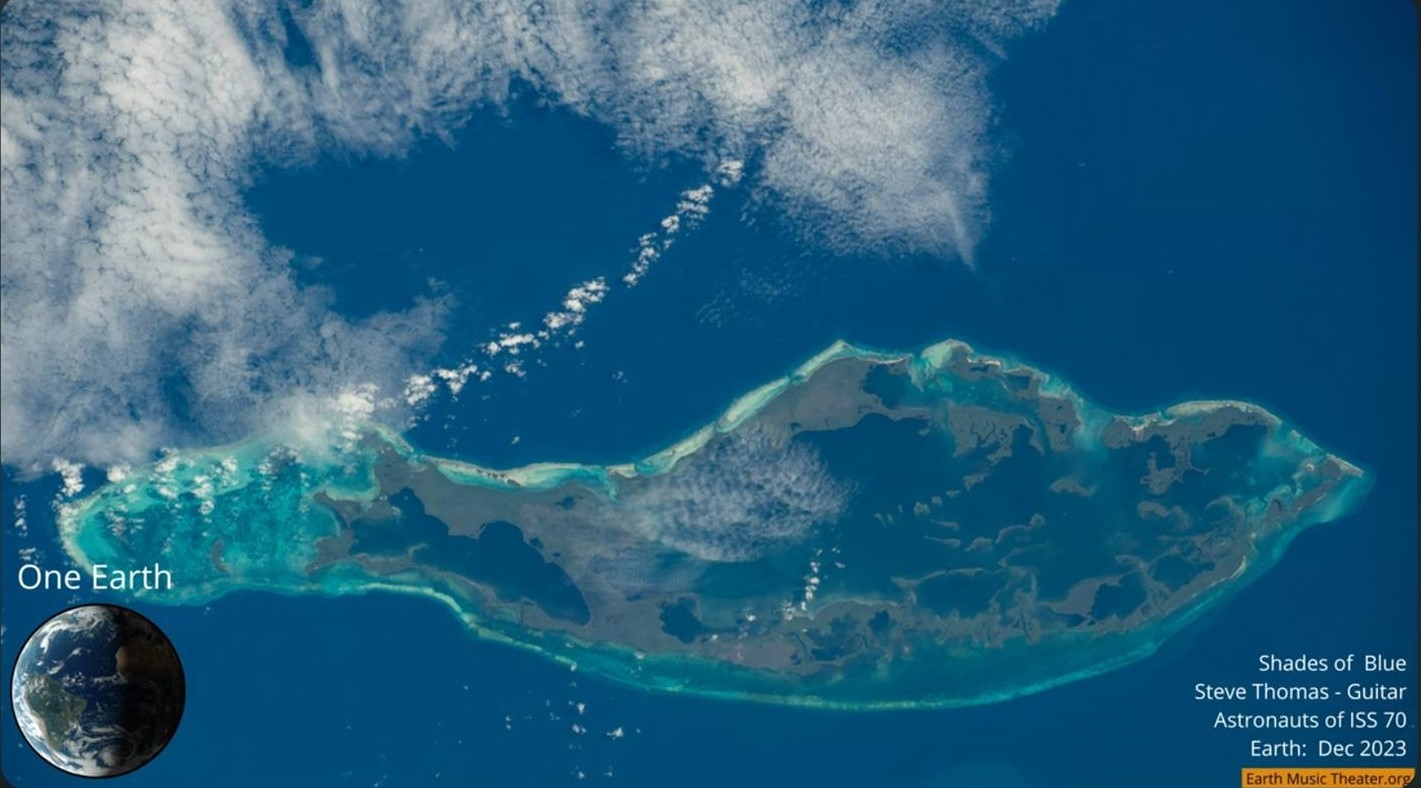
Image credit: ASE/NASA ISS
Enjoy this mesmerizing montage of photos and music celebrating One Earth.
“Astronauts aboard the International Space Station Expedition 70 took these artistic photos in wonderfully diverse shades of blue in December, 2023,” explains Dan Barstow, Director of Earth Music Theater.
“Steve Thomas crafted this musical ‘guitarscape’ to resonate with the lovely blues of our planet,” Barstow explains.
Go to this “Shades of Blue” video at:
https://youtu.be/k2ENTuPuQoo?si=UY_OPy6d9qbMnOk8
Out the window
For Shades of Blue, photos were taken by astronauts in December 2023 on the International Space Station Expedition 70
USA – Jasmin Moghbeli, Jeanette Epps, Loral O’Hara, Matthew Dominick, Michael Barratt, Tracy Caldwell-Dyson
Denmark – Andreas Mogensen
Japan – Satoshi Furukawa
Russia – Alexander Grebenkin, Konstantin Borisov, Nikolai Chub, Oleg Kononenko
Earth, music and education
Earth Music Theater is produced by the Association of Space Explorers (ASE); site operated by ASE. ASE has copyrights for Earth Music movies. Musicians hold copyrights to the music, and license ASE.
Both ASE & musicians can freely use the movies for Earth, music and education.
University of California Television (UCTV) posts a series of movies to their YouTube/@EarthSeranade
Source images taken by ISS astronauts are in public domain thanks to NASA Crew Earth Observation.
Go to Earth Music Theater at:
 Posted in

Image credit: NASA
Now that the election is over, here are some of the major issues facing the nation and next Congress in regards to space programs, according to the U.S. Government Accountability Office (GAO).
“Competition in space is growing as more countries launch their own space programs. We’ve reviewed NASA’s major projects—including sending Americans back to the moon by the end of September 2026 and then (eventually) on to Mars,” reports the GAO.

Image credit: NASA
“Our work has reported several challenges these efforts face that have caused delays and increased costs,” the GAO notes.
Space issue page
A GAO “space issue” page outlines the government watchdog’s most recent work on NASA’s efforts.
Spotlighted are the following reports and open recommendations:
- NASA Artemis Missions: Exploration Ground Systems Program Could Strengthen Schedule Decisions
- Artemis Programs: NASA Should Document and Communicate Plans to Address Gateway’s Mass Risk
- NASA Lunar Programs: Improved Mission Guidance Needed as Artemis Complexity Grows
To read these GAO space reports, go to:

Image credit: CCTV
Space specialists in China have begun to assess experiment samples brought back by the Shenzhou-18 crew that touched down November 4 in north China’s Inner Mongolia Autonomous Region.
Ye Guangfu, Li Cong and Li Guangsu parachuted back to Earth after their six-month stay in the country’s Tiangong space station. The Shenzhou-18 crew conducted some 90 experiments and tests in the fields of material science, life science, medicine, space technology and the basic physics in microgravity.

Image credit: China Global Television Network (CGTN)/Inside Outer Space screengrab
Sample categories
According to China Central Television (CCTV), the space trio brought back 55 categories of scientific experiment samples, involving 28 subjects in space life sciences, space materials sciences, microgravity combustion science and other fields.
The samples weigh over 75 pounds (34.6 kilograms) in total.
On Monday morning, the life science experiment samples of 24 categories were transported to the Space Application Center of the Chinese Academy of Sciences in Beijing.
Space exposure
Zhang Gaosen, associate researcher at the Northwest Institute of Eco-Environment and Resources, Chinese Academy of Sciences told CCTV:
“Our extreme-environment microbial samples were mainly exposed outside the cabin in the space, just to get closer to the real space environment. The samples were exposed outside the cabin for six months.”
Zhang said researchers want to compare the results with the last batch of samples which survived a three-month extravehicular exposure to determine how long their survival limit is in the space environment.

Image credit: China Global Television Network (CGTN)/Inside Outer Space screengrab
Blades, lasers, catalysts
The returned-from-space material and combustion samples are being transported to Beijing along with the return capsule of Shenzhou-18.
There are 30 categories of material samples including composite lubricating materials, optical fibers and optical films.
“The research results of these samples will provide important technical support for the preparation and application of materials in the fields of next-generation aero-engine turbine blades, fiber lasers for space, miniaturized high-sensitivity catalysts, and precision medical repair,” said Ma Ping, deputy chief designer of the Space Application Engineering and Technology Center of the Chinese Academy of Sciences.
Zebrafish and hornwort
Tao Yi, senior engineer at the Shanghai Institute of Technical Physics, Chinese Academy of Sciences, added that what was conducted in orbit mainly were to collect fish egg boxes and water samples in the early stage.
“We sampled water three times in total, respectively on the 10th, 20th and 30th day (from the beginning of the experiment), and replace the fish food boxes in the middle stage,” Tao said. “Next, we will study the physical and chemical properties of the collected water samples to explore the law for stable operation of the binary system composed of zebrafish and hornwort.”

Handover of station duties between Shenzhou-18 and Shenzhou-19 crew members.
Image credit: CCTV/CNSA
There are 24 categories of life science samples, including zebrafish culture medium, amino acids, and radiation-resistant microorganisms.
The zebrafish culture medium focuses on the study of the substance circulation mechanism of aquatic ecosystems in space environment, so as to provide theoretical support for the construction of complex ecosystems in long-term stable operation in space, reports CCTV.
New station crew
Meanwhile, the newly arrived Shenzhou-19 crew onboard the Tiangong orbiting outpost — Cai Xuzhe, Song Lingdong and Wang Haoze — marks the fourth piloted flight in the application and development phase of China’s space station, and is the 33rd flight of China’s human spaceflight program.
The Shenzhou-19 crew successfully joined the Shenzhou-18 crew within the space station on October 30.
Crew members Song and Wang are on their first spaceflight mission. Cai was on board the Tiangong space station as part of the Shenzhou-14 mission in 2022. With this mission underway, Cai set a new record for the shortest interval between two spaceflights for Chinese astronauts.
Wang is a female space flight engineer and the third Chinese woman to take part in a crewed spaceflight mission.

Pre-launch photo shows Shenzhou-19 crew.
Image credit: CCTV/Inside Outer Space screengrab

Image credit: Boeing Space/Inside Outer Space screengrab
The Boeing Space-built X37-B robotic space plane is currently performing advanced aerobraking maneuvers, taking it from a highly elliptical orbit and lowering its altitude using minimal fuel.

Image credit: Boeing Space/Inside Outer Space screengrab
“This first-of-its-kind demonstration expands our knowledge of dynamic operations between orbits,” explains Boeing Space.
Boeing Space is partnered with the United States Space Force to showcase the space plane’s unique attributes.
The space plane’s use of aerobraking enables an orbit change and the safe disposal of its service module components in accordance with recognized standards for space debris mitigation, notes the aerospace firm.

Image credit: Boeing Space/Inside Outer Space screengrab
A just-issued Boeing Space video spotlights the program and can be viewed at:
https://x.com/BoeingSpace/status/1852470814383214848

Image credit: Boeing Space/Inside Outer Space screengrab
Image credit: CCTV/CNSA
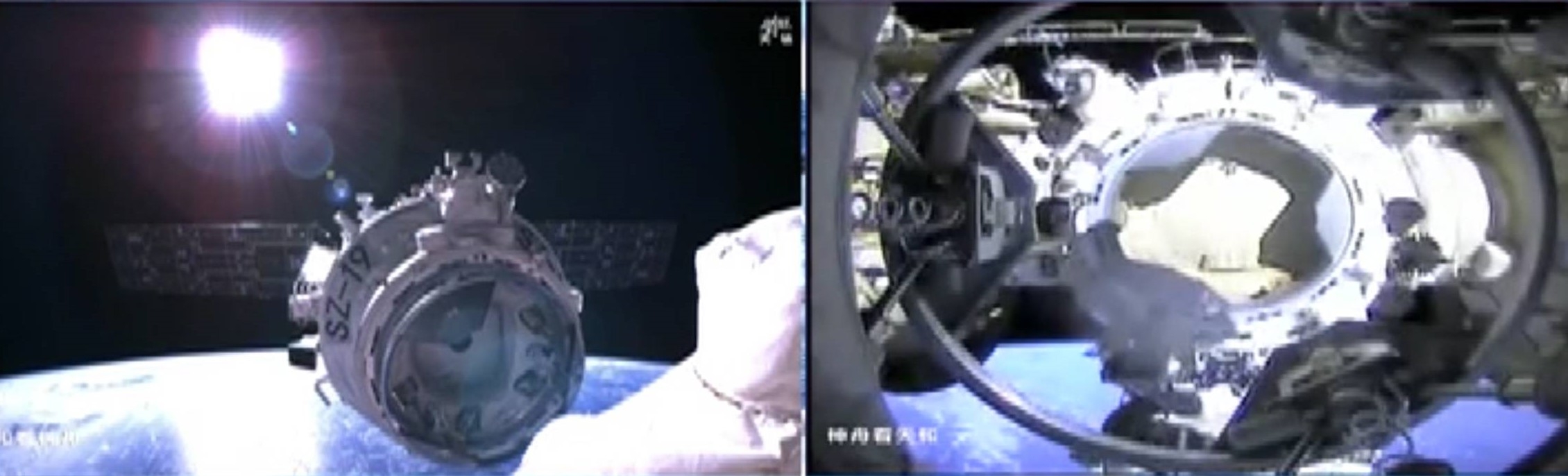
There has been an in-space handover of space station operations between the country’s Shenzhou-18 and Shenzhou-19 crews.
“Today, we pass the space station key to you as a relay baton. We trust that you will make our space home even better,” said Ye Guangfu, mission commander of the Shenzhou-18 taikonaut trio.
The transfer of control of the Tiangong space station took place on Friday.
Cai Xuzhe, Song Lingdong, and Wang Haoze joined their Shenzhou-18 colleagues on Wednesday after their Shenzhou-19 craft completed a rapid automated rendezvous and docking with the space station’s core module, Tianhe.
CCTV/CNSA/Inside Outer Space screengrab
Night landing
Meanwhile, recovery teams are in practice-mode at the Dongfeng landing site in north China’s Inner Mongolia Autonomous Region for return to Earth of Guangfu, and Shenzhou-18 crewmates, Li Cong, and Li Guangsu.
Lu Shengwang, a member of the Shenzhou-18 landing site survey team told China Central Television (CCTV) that Shenzhou-18 will return at night.
“We have prioritized the use of infrared thermal imagers for capturing images. To ensure the highest image quality possible, we have conducted technical research on infrared image processing, yielding good results,” Lu said. “In addition, we have employed in-depth learning technology to enhance our target recognition methods, significantly boosting the stability and reliability of target tracking.”
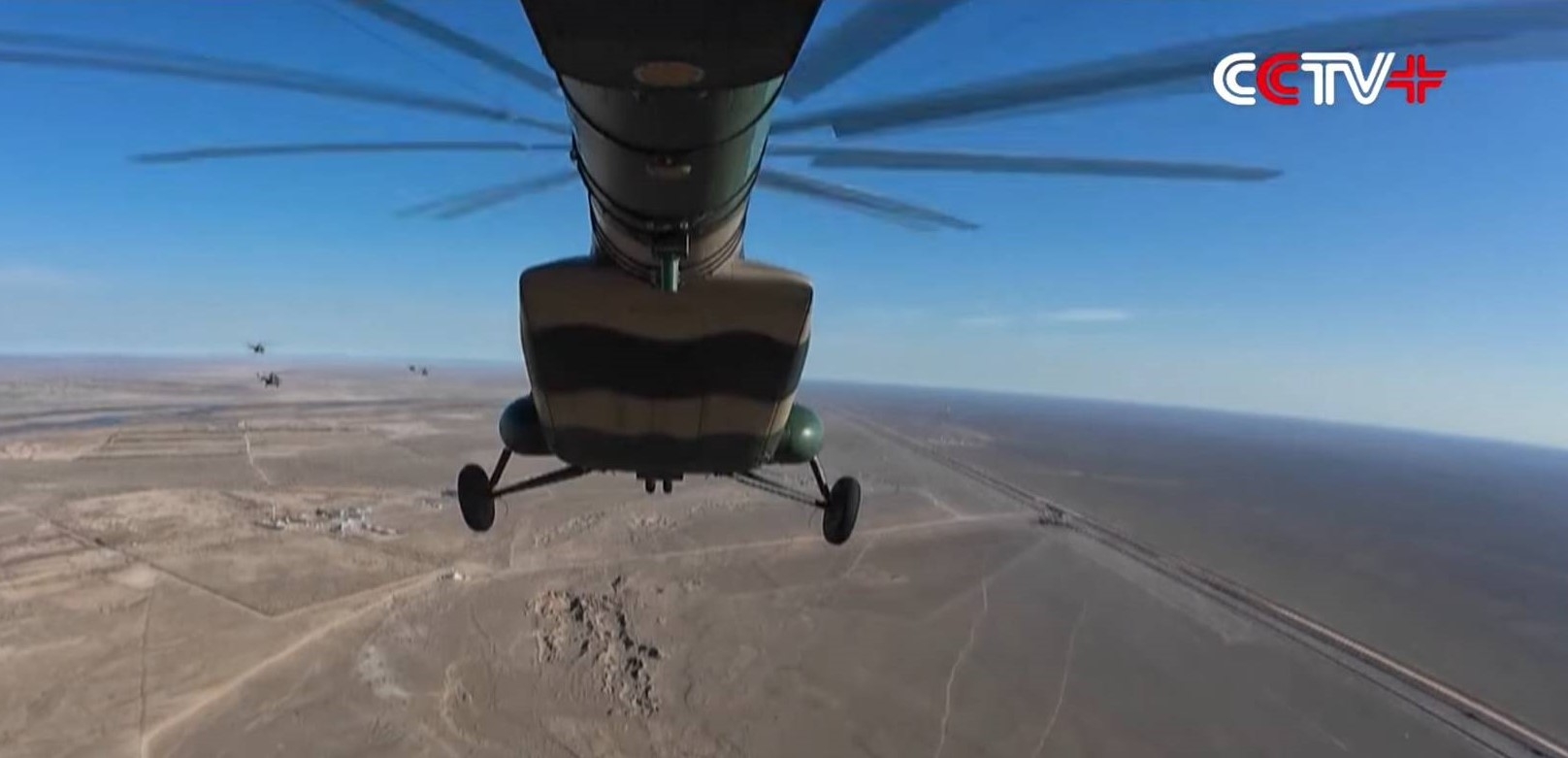
Image credit: CCTV/Inside Outer Space screengrab
Monday departure
The Shenzhou-18 crew is set to depart for Earth aboard the Shenzhou-18 spaceship on Monday. The return capsule of the Shenzhou-18 manned spaceship, carrying three astronauts, is slated to touch down on Earth in the early morning on November 4.
Wang Guoliang, a communications operator, space search and rescue team at the Jiuquan Satellite Launch Center added: “Our integrated communication vehicle has undergone upgrades to its satellite antenna system and the command and dispatch vehicle has been thoroughly optimized to ensure that image transmission is now more stable and efficient.”
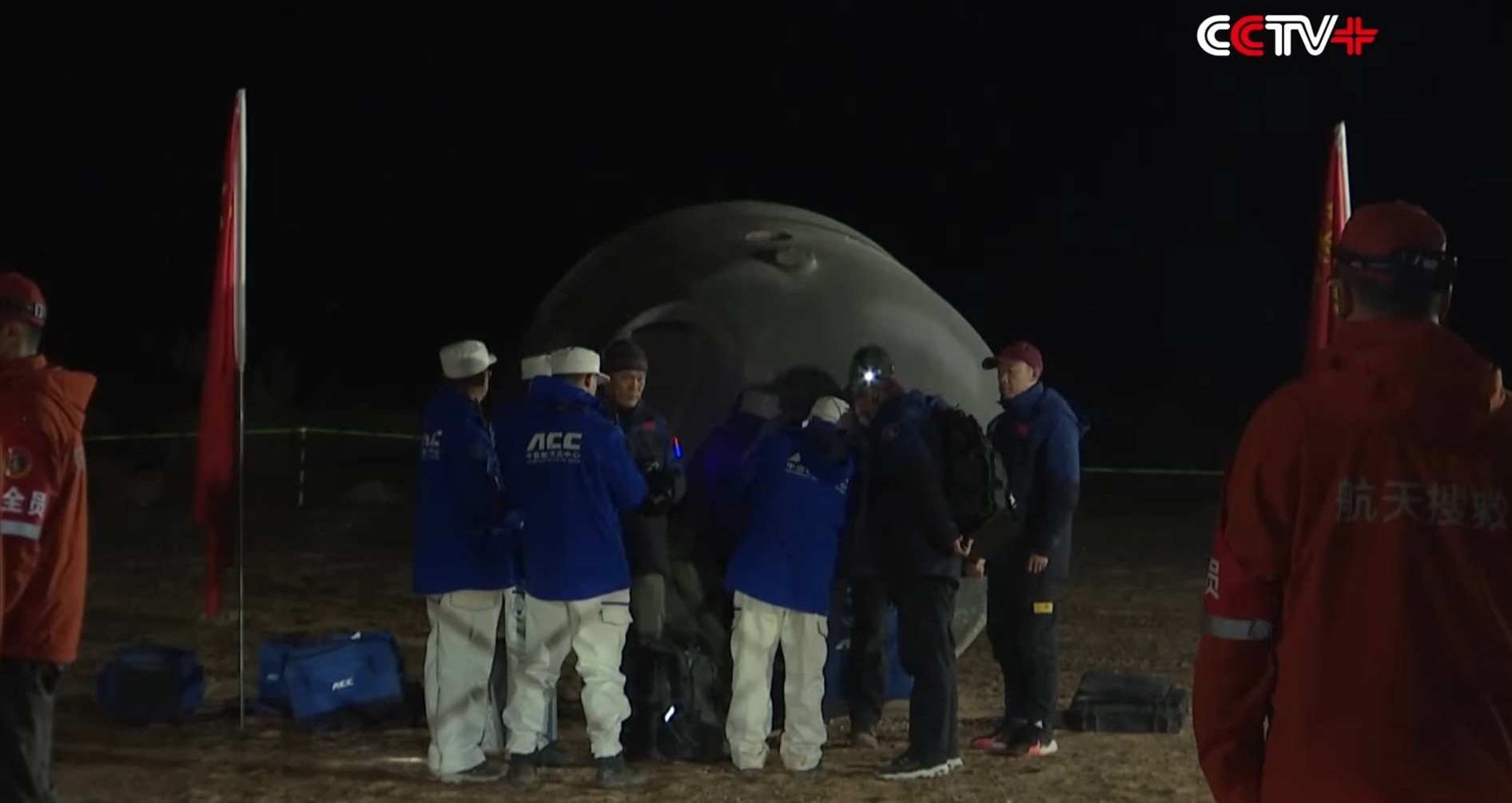
Image credit: CCTV/Inside Outer Space screengrab
Desert lighting
As reported by CCTV, “the Gobi Desert’s uneven terrain, dust and debris stirred up by vehicles, as well as fallen tree branches and barbed wire that can cause tire blowouts, constitute significant challenges to the ground teams’ search efforts.”
The ground team’s vehicles have received upgrades to their lighting systems, including warning lights to maintain safe distances between ground search vehicles.
“This is the lighting equipment we set up at the landing site,” said Sun Liwen, leader of the search and rescue team of the Jiuquan Satellite Launch Center.
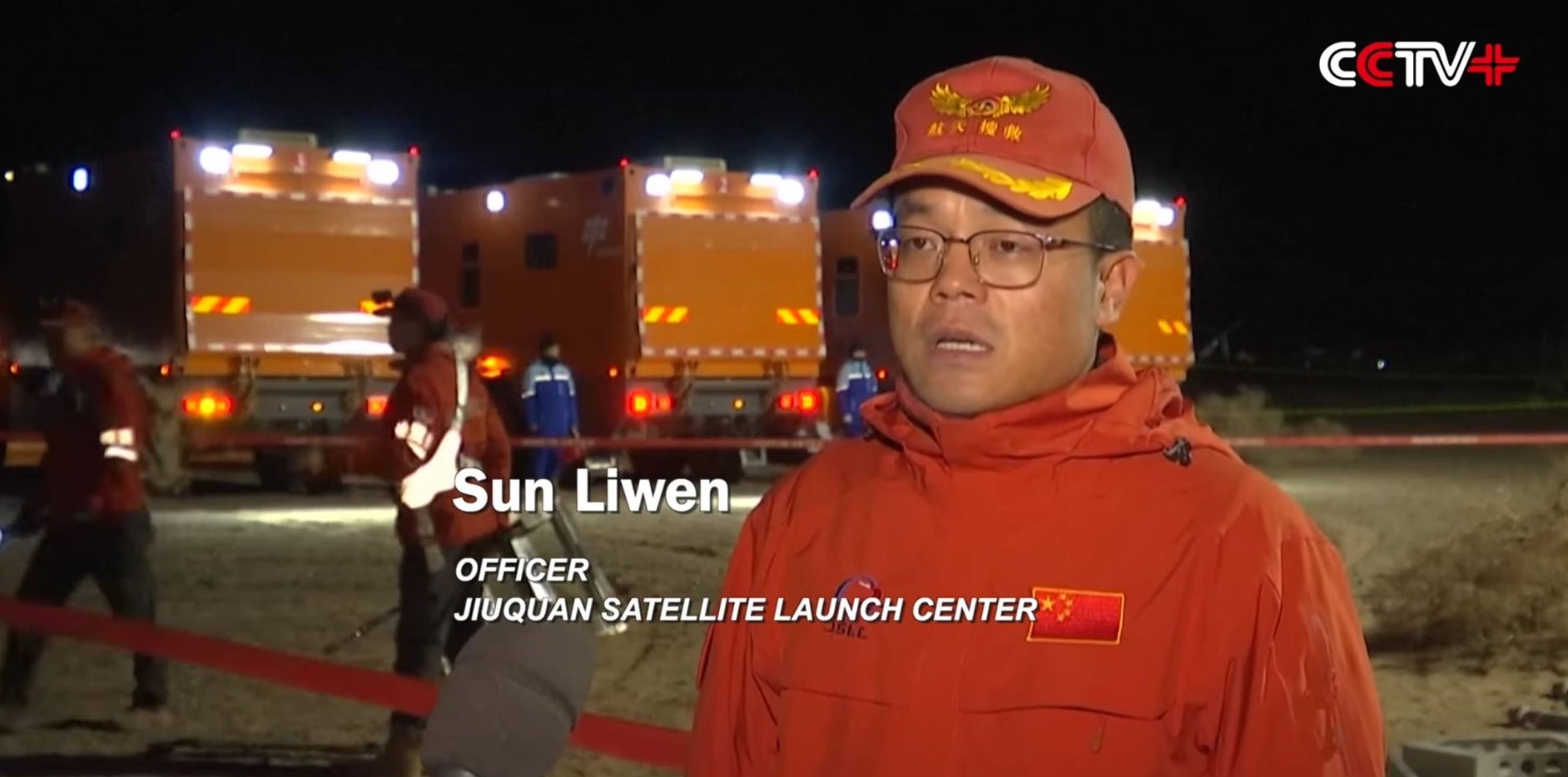
Image credit: CCTV/Inside Outer Space screengrab
“We have installed four 400-kilowatt square lights on it. The pole can be elevated to 10 meters, ensuring that the area is illuminated as brightly as during the day,” Sun said.
The Dongfeng landing site has successfully carried out six search and rescue missions for Shenzhou spacecraft.
To handle the incoming Shenzhou-18 mission, the landing site has upgraded its communication equipment, refined contingency plans, and conducted multiple rounds of specialized night training and coordinated drills.
For CCTV video on recovery trial-runs go to:

Image credit: CCTV/CNAS/Inside Outer Space screengrab
China’s Mars Sample Return – Ripple Effects at the Red Planet
It appears that China has moved up their agenda for rocketing collectibles from Mars, and ahead of any still-to-be scripted time period for the U.S. to achieve this same goal.
NASA’s Mars sample return plan, as originally orchestrated by the space agency and the European Space Agency, continues to be scrutinized.

China blueprint for Mars sample return mission.
Image credit: Kanyan Xu/COSPAR
The hoped for bottom line at NASA is a blueprint for the Red Planet, one that offers the highest chance of Mars samples on Earth before 2040 and doing so for under an $11 billion price tag.
Meanwhile, China is on an earlier flight path to achieve what scientists call the “holy grail” of Mars exploration.
Take a look at my new Space.com story that takes the pulse of several leading Mars researchers about their thoughts, concerns, and aspirations for hauling back the goods from the Red Planet.
Go to — Will China return Mars samples to Earth before the US does? – “If, as has been reported, China successfully executes even a ‘grab sample’ at Mars and returns it safely to Earth before the U.S., that would constitute a ‘Sputnik Moment'” – at:
https://www.space.com/the-universe/mars/will-china-return-mars-samples-to-earth-before-the-us-does

Image credit: CCTV/Inside Outer space screengrab
China’s Tiangong space station is now occupied by six astronauts following the rendezvous and docking of the Shenzhou-19 crew, commander Cai Xuzhe and colleagues Song Lingdong and Wang Haoze.
Following launch atop a Long March-2F carrier rocket, the Shenzhou-19 craft made a fast automated rendezvous and docking with the space station’s Tianhe core module. The liftoff to docking process took about 6.5 hours.

The newcomers and the Shenzhou-18 crew of Ye Guangfu, Li Cong and Li Guangsu will live and work together for about five days to complete planned tasks and handover work, according to the China Manned Space Agency (CMSA).
Handover and departure
Starting their mission in April, the Shenzhou-18 crew are now slated for a November 4 return to the Dongfeng landing site in north China’s Inner Mongolia Autonomous Region after completing an in-orbit handover with the newly arrived Shenzhou-19 crew.

High-definition images of China’s space station were taken by the departing Shenzhou-16 crew October 30, 2023.
Image credit: CMS
Due to the impact of typhoon Yagi on the Wenchang Space Launch Center in Hainan province, China’s next cargo mission to the Tiangong space station, the Tianzho- 8 supply ship has been rescheduled to launch in mid-November, according to Lin Xiqiang, deputy director of the CMSA.
For video replay of the arrival of the space station newcomers, go to:
Image credit: CCTV/Inside Outer Space screengrab
All systems for the crewed Shenzhou-19 are ready with weather conditions suitable for the liftoff of Cai Xuzhe, Song Lingdong and Wang Haoze.
The new trio of space flyers will launch at 04:27 Beijing Time on Wednesday (2027 GMT on Tuesday/4:27 p.m. Eastern Time) from the Jiuquan Satellite Launch Center in the country’s northwest, the China Manned Space Agency (CMSA) announced Tuesday.
33rd flight mission
For the Shenzhou-19 crew, two of the space travelers, except Cai Xuzhe (mission commander) were born in the 1990s and are from the third batch of Chinese astronauts, reports China Central Television (CCTV).

Image credit: CCTV/Inside Outer Space screengrab
The Shenzhou-19 is the 33rd flight mission of China’s human spaceflight program and the fourth crewed mission during the application and development stage of China’s Tiangong space station.
According to the CMSA, the Shenzhou-19 crew will carry out 86 scientific experiments in space after they enter the orbital outpost.

Image credit: CCTV/Inside Outer Space screengrab
Space flight engineer
As reported by CCTV, Wang Haoze is billed as China’s first and only female space flight engineer who will embark on the Shenzhou-19 crewed spaceflight mission and “is set to make history as the country’s first rocket designer to ride one of her works into space.”
Wang holds a degree of engineering thermophysics and previously served as a senior engineer at the Academy of Aerospace Propulsion Technology under the China Aerospace Science and Technology Corporation.

Image credit: CCTV/Inside Outer Space screengrab
Enhanced Shenzhou craft
China’s Shenzhou-19 crewed spaceship features increased in-cabin loading space and enlarged carrying capacity, according to its developer, China Aerospace Science and Technology Corporation (CASC).
CASC said that the enhanced Shenzhou’s loading capacity was done by optimizing the spatial layout of the Shenzhou-19 orbital module.
“By optimizing the installations on and the layout of the orbital module, we have further enhanced the carrying capacity of the Shenzhou-19 crewed spaceship. This allows it to carry more spaceflight supplies for the astronauts and provide them with a more comfortable environment, therefore better supporting their mission throughout the entire spaceflight,” said Liu Qingbo, an aerospace engineer at the CASC.
Shenzhou-19’s loading space has also been expanded by 20 percent from earlier models, enabling the astronauts to carry more time-sensitive supplies and temporary necessities.
In-orbit handover
Now onboard China’s space station is the Shenzhou-18 crew Ye Guangfu, Li Cong and Li Guangsu. They began their mission in April and are now slated for a November 4 return to the Dongfeng landing site in north China’s Inner Mongolia Autonomous Region after completing in-orbit handover with the incoming Shenzhou-19 crew.

Shenzhou-18 crew: astronauts Li Guangsu, Ye Guangfu, Li Cong.
Due to the impact of typhoon Yagi on the Wenchang Space Launch Center in Hainan province, China’s next cargo mission to the Tiangong space station, the Tianzho- 8 supply ship has been rescheduled to launch in mid-November, according to Lin Xiqiang, deputy director of the China Manned Space Agency.
For live launch coverage, go to CCTV at:
https://www.facebook.com/events/1094035451998414/?ref=newsfeed
For pre-launch video of the new Chinese crew, go to:

High-speed return from lunar distance, the thermal protection system of Orion’s crew module must endure blistering temperatures to keep crew members safe. Measuring 16.5 feet in diameter, Orion’s heat shield is the largest of its kind developed for missions carrying astronauts.
Image credit: NASA
NASA remains in an ongoing test mode to determine what’s behind the ablative thermal protective material that chipped away unexpectedly from the Artemis 1 Orion heat shield during its reentry into Earth’s atmosphere back on December 11, 2022.
The Orion spacecraft for the Artemis I mission splashed down in the Pacific Ocean after a 25.5-day mission.
During the high-speed, 25,000 miles per hour return from lunar distance, the thermal protection system of Orion’s crew module must endure blistering temperatures to keep crew members safe. Measuring 16.5 feet in diameter, Orion’s heat shield is the largest of its kind developed for missions carrying astronauts.

Orion heat shield features ablative material, called Avcoat.
Image credit: Lockheed Martin
Root cause
But in a post-flight analysis of the Artemis 1 heat shield, NASA identified more than 100 locations where ablative thermal protective material was liberated during its speedy reentry.
Work to determine the root cause did conclude last summer, said NASA’s Lori Glaze Deputy Associate Administrator (Acting) Exploration Systems Development Mission Directorate.
Speaking October 29 at the Annual Meeting of the Lunar Exploration Analysis Group being held in Houston, Texas, Glaze did not say what root cause was uncovered.
However, Glaze said that additional testing is ongoing before any final determination is made. That testing will conclude by the end of November, then provided to NASA chief, Bill Nelson, for a final decision.

Arc Jet Complex at NASA’s Ames Research Center in California’s Silicon Valley has been used to study unexpected heat shield issues found after Orion capsule’s Artemis I flight in 2022.
Image credit: NASA Ames Research Center
Artemis II
Meanwhile, NASA is moving forward on readying the Artemis II hardware to support hurling a four-person crew to sojourn out beyond the Moon, then return to Earth.
The Artemis II crew is to depart Earth no earlier than September 2025 on a 10-day trek.

Wait-a-Minute!
Image credit: Barbara David
In classic “wait a minute” style, a NASA Office of Inspector General (OIG) report was issued in May of this year – “NASA’s Readiness for the Artemis II Crewed Mission to Lunar Orbit” – calling attention to this issue and others before sending off the first human crew toward the Moon since 1972 – the Apollo 17 mission.

Image credit: NASA OIG
To ensure the safety of the crewed Artemis II mission, the OIG report recommended the Associate Administrator for Exploration Systems Development Mission Directorate to ensure the root cause of Orion heat shield char liberation is well understood prior to launch of the Artemis II mission.
The OIG report called for analysis of Orion separation bolts using updated models that account for char loss, design modifications, and operational changes to Orion prior to the Artemis II launch.
The report by the NASA OIG also notes that “human space flight by its very nature is inherently risky, and the Artemis campaign is no exception. We urge NASA leadership to continue balancing the achievement of its mission objectives and schedule with prioritizing the safety of its astronauts and to take the time needed to avoid any undue risk.”

Engineers and technicians conduct inspections of the heat shield on the Artemis 1 Orion spacecraft after splashing down in the Pacific Ocean on Dec. 11, 2022.
Image credit: NASA/Skip Williams
Avcoat changes
The heat shield features the same ablative material called Avcoat used in Apollo lunar outings and return-to-Earth missions. However, the building process has changed, according to Lockheed Martin that fashioned Orion’s thermal protection system.
“Instead of having workers fill 300,000 honeycomb cells one by one with ablative material, then heat-cure the material and machine it to the proper shape, the team now manufactures Avcoat blocks – just fewer than 200 – that are pre-machined to fit into their positions and bonded in place on the heat shield’s carbon fiber skin,” the aerospace firm’s website explains. That process is a timesaver in putting on the Avcoat – about a quarter of the time.
So here’s the lingering and nagging question: Is it possible that changes in the Avcoat may be needed? If so, that decision would seemingly necessitate de-coupling the heat shield from the Artemis II Orion capsule.

Credit: Lockheed Martin
Heat shield hiccups
When the heat shield issue first came to light, Inside Outer Space contacted the Orion program office at NASA Johnson Space Center for comment regarding the heat shield hiccups.
“During Artemis I post-flight inspection, engineers observed variations of Avcoat material across the appearance of Orion’s heat shield. Some areas of expected charred material ablated away differently than computer modeling and ground testing predicted, and there was slightly more liberation of the charred material during re-entry than anticipated,” the program office stated.
“We expect the material to ablate with the 5,000 degrees Fahrenheit the spacecraft encounters on a re-entry through Earth’s atmosphere, and to see charring of the material through a chemical reaction, but we didn’t expect the small pieces that came off, versus being ablated,” the NASA statements adds.
Healthy margin
“We don’t know yet exactly how much was liberated, which is why we’re analyzing the data, but there was a healthy margin remaining of virgin Avcoat, and temperature data inside the cabin remained at expected levels, so if crew were on board they would not have been in danger,” explains the program office statement.

Image credit: NASA OIG
“It’s still too early in our testing and analysis to arrive at any potential recommendations or solutions that address additional char liberation,” NASA responded. “It’s possible the phenomenon may just [be] part of what the heat shield is, and what we would expect as we return from the Moon, but we’ll let the data inform us.”
Lastly, the NASA Orion program office stated: “We’ll continue to protect for variations that could happen during re-entry as we want to ensure we have significant margin against the various types of uncertainties that might occur as the spacecraft re-enters the atmosphere. Our teams want the confidence that we have the best heat shield possible to fly humans going forward.”
In double-checking with the NASA Orion program office today, Inside Outer Space was advised “we have not made any decisions yet, but NASA will provide an update on our plans after the completion of the investigation, and we have determined a forward path.”
Earlier reporting
In earlier reporting, here’s my take on the situation, as posted on Space.com:
“NASA still investigating Orion heat shield issues from Artemis 1 moon mission” at:
https://www.space.com/nasa-investigate-orion-heat-shield-artemis-1-mission
For a full read of the NASA OIG report, go to:
https://oig.nasa.gov/wp-content/uploads/2024/05/ig-24-011.pdf
For an informative Lockheed Martin video on Orion’s re-entry, go to:

Nine candidate landing regions for NASA’s Artemis III mission The background image of the lunar South Pole terrain within the nine regions is a mosaic of LRO (Lunar Reconnaissance Orbiter) WAC (Wide Angle Camera) images.
Image credit: NASA
NASA has released an updated set of nine potential landing regions near the lunar South Pole for its Artemis III mission.
The refined candidate Artemis III lunar landing regions are, in no priority order:
— Peak near Cabeus B
— Haworth
— Malapert Massif
— Mons Mouton Plateau
— Mons Mouton
— Nobile Rim 1
— Nobile Rim 2
— de Gerlache Rim 2
— Slater Plain
Criteria used
According to NASA, these regions contain diverse geological characteristics and offer flexibility for mission availability.

Rendering of Artemis astronauts exploring a lunar south pole crater. A water ice-rich resource ready for processing?
Image credit: NASA
Criteria used to pick these regions: Science potential, launch window availability, terrain suitability, communication capabilities with Earth, and lighting conditions.
Additionally, the multidisciplinary team assessed the combined trajectory capabilities of NASA’s Space Launch System rocket, the Orion spacecraft, and the SpaceX Starship Human Landing System to ensure safe and accessible landing sites.
The lunar South Pole has never been explored by a crewed mission and contains permanently shadowed areas that can preserve resources, including water, NASA explains.

Image credit: NASA

