Archive for the ‘Space News’ Category
 Author:
  November 25th, 2024
Ready for shipping! Blue Ghost lunar lander.
Image credit: Firefly Aerospace
A Moon-bound lunar lander is being shipped to Cape Canaveral, Florida next month under NASA’s Commercial Lunar Payload Services (CLPS) initiative.
Firefly Aerospace of Cedar Park, Texas announced it has wrapped up the Blue Ghost’s rigid environmental testing for a projected launch in January of next year.
“While we know there will be more challenges ahead, I’m confident this team has what it takes to softly touch down on the lunar surface and nail this mission,” said Jason Kim, chief executive officer at Firefly Aerospace.

Artwork credit: Firefly Aerospace/Inside Outer Space screengrab
Full lunar day
Blue Ghost’s ride into space comes via a SpaceX Falcon 9 rocket, a liftoff within a six-day window that opens no earlier than mid-January 2025.
Once lofted, Blue Ghost will begin its approximately 45-day transit to the Moon. Its destination is a touchdown in Mare Crisium and then operating a suite of payloads for a full lunar day (14 Earth days).
The roughly 60-day mission will be operated from Firefly’s Mission Operations Center in Cedar Park, Texas.
Payload tasks
As part of NASA’s CLPS initiative, the lander’s 10 payloads will perform science and technology demonstrations, including lunar subsurface drilling, sample collection, and mitigation of the pesky lunar dust.
According to a company statement, additional demonstrations by the Blue Ghost include X-ray imaging of Earth’s magnetic field, expected to provide insight into how space weather impacts our planet.

Blue Ghost will capture imagery of the lunar sunset and provide critical data on how lunar regolith reacts to solar influences during lunar dusk conditions. The lander will then operate for several hours into the lunar night.
Artwork credit: Firefly Aerospace/Inside Outer Space screengrab
“Once payload operations are complete, Blue Ghost will capture the lunar sunset and provide critical data on how lunar regolith reacts to solar influences during lunar dusk conditions. Blue Ghost will then operate for several hours into the lunar night,” adds the company statement.
Blue Ghost Mission 1 is the first of three Firefly task orders supporting the NASA CLPS undertaking as part of NASA’s Artemis campaign to “reboot” the Moon with human crews, the space agency’s program to further a lasting lunar presence and stimulate a potential commercial lunar economy.
Go to this informative video – “Blue Ghost’s Journey to the Moon” – at:
 Posted in

Image credit: NASA
Put yourself in forget me not and space time travel retro-mode: it is now four decades ago that astronaut Owen Garriott, callsign W5LFL, pioneered amateur radio communication from space. He was a crewmember on the space shuttle program’s STS-9 mission.
During that shuttle flight in 1983, Garriott conducted the first-ever person from space to communicate with amateur radio operators on the ground. He was also the first to be heard directly from space by the public using simple receivers and scanners.

Image credit: Amateur Radio on the International Space Station (ARISS)
What’s coming?
That event transformed astronaut communications from space forever, allowing amateur radio operators and the public to communicate with people in space.
But tune in to hear what’s coming…there’s strong signal strength!
Go to my new Space.com story – “How amateur radio is connecting astronauts in space with kids on Earth” at:

Image credit: Boeing/Inside Outer Space screengrab
Boeing has issued a video detailing the company’s secretive spaceplane, the X-37B.
“Boeing-built X-37B Innovates and Breaks New Records” is the name of the video.

Image credit: Boeing/Inside Outer Space screengrab
“The Boeing-built X37B will perform ground-breaking aerobraking maneuvers to take the dynamic spaceplane from one Earth orbit to another while conserving fuel. Partnered with the United States Space Force, this novel demonstration is the first of its kind,” Boeing explains.

Image credit: Boeing/Inside Outer Space screengrab

Image credit: Boeing/Inside Outer Space screengrab
Go to the video at:
https://www.youtube.com/watch?v=WduDiC8VFyY&t=1s
Special thanks to Michael Rose for calling my attention to this video.

The NS-28 Crew (left to right): Sharon Hagle, Marc Hagle, Emily Calandrelli, J.D. Russell, Hank Wolfond, and Austin Litteral.
Image credit: Blue Origin
Blue Origin has completed its 28th New Shepard suborbital mission and its ninth human spaceflight.
The November 22 NS-28 flight means that the company has now flown 47 people to space (three people have flown twice).
The NS-28 Crew (left to right): Sharon Hagle, Marc Hagle, Emily Calandrelli, J.D. Russell, Hank Wolfond, and Austin Litteral.
Go to this video replay at:
https://x.com/i/broadcasts/1yNGagXkwnrxj

Image credit: Blue Origin/Inside Outer Space screengrab

Image credit: Blue Origin/Inside Outer Space screengrab

Image credit: Blue Origin/Inside Outer Space screengrab

Image credit: Blue Origin/Inside Outer Space screengrab

Image credit: CCTV/CMSA/Inside Outer Space screengrab
China has rolled out new details of how the country will attempt a future human Moon mission, targeted for 2030.
The China Manned Space Agency (CMSA) showcased a new video at a Human Space Symposium.
Highlighted by China Central Television (CCTV), the video underscores:
- production of the Long March-10 carrier rocket,
- a piloted spacecraft Mengzhou
- development of the lunar lander Lanyue
- fabrication of a lunar spacesuit
- testing a lunar rover for mobility of two taikonauts
Prototyping hardware
CMSA indicates that prototyping of hardware is progressing as planned, along with related ground tests.

Image credit: CCTV/CMSA/Inside Outer Space screengrab
A series of ground facilities and equipment designed to support these production and testing activities have been completed and put into operation.
Meanwhile, the construction of the Wenchang Spacecraft Launch Site in south China has been prioritized and is advancing smoothly in readiness for handling human sojourns to the Moon.

Prototype work on China’s lunar lander – Lanyue.
Image credit: CCTV/CMSA/Inside Outer Space screengrab
Self-reliant capability
According to the video, as reported by the Xinhua news agency, China’s crewed lunar landing mission will focus on mastering critical technologies and techniques for human Earth-Moon round trips, short-term stays on the lunar surface, and human-robot collaborative exploration.
CCTV notes that the project seeks to establish a “self-reliant capability” for human lunar exploration.

Image credit: CCTV/CMSA/Inside Outer Space screengrab
Both robotic and human Moon mission will conduct large-scale space science experiments, with scientists outlining preliminary goals across three key areas: lunar science, lunar base science, and resource exploration and utilization, covering nine major research directions, CCTV reports.
Large scale tests
“Our new rockets, spacecraft, landers, and lunar rovers have already been developed, and prototype products are complete. We are currently conducting large-scale tests, including mechanical, thermal, and electrical tests,” said Zhou Jianping, chief designer of China’s human space program, during the sixth Human Space Symposium a two-day gathering of experts in Shenzhen, south China’s Guangdong Province.

China lunar rover testing.
Image credit: CCTV/CMSA/Inside Outer Space screengrab
“By leveraging the development of the manned lunar exploration program,” Zhou told CCTV, “the near-Earth manned rockets and spacecraft are being developed simultaneously. For example, the near-Earth orbit rocket uses the first stage of the lunar landing rocket, and the second stage is quite similar, though it has fewer engines due to its smaller scale. This is currently the best reusable configuration among China’s launch vehicles. It will lead our rocket technology to a new level,” said Zhou.

Image credit: CCTV/Inside Outer Space screengrab
To view the newly released animation, go to:

Image credit: Sierra Space
Expandable space structure development has entered a new milestone at Sierra Space, a commercial firm working on their Large Integrated Flexible Environment (LIFE) habitat.
The LIFE 10 article underwent burst testing on October 29th at NASA’s Marshall Space Flight Center in Huntsville, Alabama. The structure ruptured at the highest pressure yet, 255 psi, and was the highest loading to date of any test article in the three-year restraint layer certification test campaign, Sierra Space announced today.

Moment of burst.
Image credit: Sierra Space
This sixth successful stress test was also the fourth Ultimate Burst Pressure test showcasing its Factor of Safety recommendations ahead of certifying the structure for human habitation.
Dream weaving
A key aspect of the work is evaluating and testing the use of “softgoods” to fashion expandable structures using Vectran, a weave of high-performance liquid crystal polymer fiber that’s stronger than steel when inflated.
Chief “dream weaver,” Shawn Buckley, vice president of Space Destinations and In-Space Infrastructure at Sierra Space, said that the inflatable habitat design is part of a roadmap to fabricate larger and larger expandable structures.
For more information on the LIFE expandable structure activities, go to my recent SpaceNews story – “Dream Chaser Space Plane and Inflatable Space Structures – Sierra Space Advances Agenda” – at:

Image credit: SpaceX/Inside Outer Space screengrab
Flight test six of the SpaceX Starship departed from Starbase, near Brownsville, Texas on November 19, “seeking to expand the envelope on ship and booster capabilities and get closer to bringing reuse of the entire system online,” noted the company, founded by chief rocketeer, Elon Musk.
The Super Heavy booster successfully lifted off at the start of the launch window, with all 33 Raptor first stage engines powering it off the pad.

Image credit: SpaceX/Inside Outer Space screengrab
Boostback burn
Following a nominal ascent and stage separation, the mega-booster successfully transitioned to its boostback burn to begin the return to launch site.
However, a SpaceX posting notes that, during this phase, “automated health checks of critical hardware on the launch and catch tower triggered an abort of the catch attempt.”
Aborting that on-the-pad catch, the booster then executed “a pre-planned divert maneuver,” but made a landing burn and soft, water splashdown in the Gulf of Mexico.

Image credit: SpaceX/Inside Outer Space screengrab
Indian Ocean: soft splashdown
Continuing onward, Starship completed a successful ascent, placing it on the expected trajectory.
“The ship successfully reignited a single Raptor engine while in space,” SpaceX adds. In doing so, that demonstrated the capabilities required to conduct a ship deorbit burn before starting fully orbital missions.

Image credit: SpaceX/Inside Outer Space screengrab
Relayed by SpaceX Starlink, live views and telemetry from the ship showed the craft plowing its way through reentry, executing a flip, making a landing burn, followed by a soft splashdown in the Indian Ocean.
Closing in on full and rapid reusability
“Data gathered from the multiple thermal protection experiments, as well as the successful flight through subsonic speeds at a more aggressive angle of attack,” explains SpaceX, “provides invaluable feedback on flight hardware performing in a flight environment as we aim for eventual ship return and catch.”

Image credit: SpaceX/Inside Outer Space screengrab
Starship’s sixth flight test delivered, yielding data and flight knowledge as the mission’s primary payload. “Lessons learned will directly make the entire Starship system more reliable as we close in on full and rapid reusability,” SpaceX concludes.
“We will do one more ocean landing of the ship. If that goes well, then SpaceX will attempt to catch the ship with the tower,” Musk posted post-test flight.
Moon, Mars plans
SpaceX’s Starship spacecraft and Super Heavy rocket – collectively referred to as Starship – represent a fully reusable transportation system designed to carry both crew and cargo to Earth orbit, the Moon, Mars and beyond.

Image credit: SpaceX
Starship is the fully reusable spacecraft and second stage of the Starship system. The vehicle offers an integrated payload section and is capable of carrying passengers and cargo to Earth orbit, planetary destinations, and between destinations on Earth.

Image credit: SpaceX
Starship leverages tanker vehicles (essentially the Starship spacecraft minus the windows) to refill the Starship spacecraft in low-Earth orbit prior to departing for Mars. Refilling on-orbit enables the transport of up to 100 tons all the way to Mars. And if the tanker ship has high reuse capability, the primary cost is just that of the oxygen and methane, which is extremely low.

Image credit: SpaceX
Starship will be used to land astronauts on the lunar surface on NASA’s Artemis III mission, which will put the first humans on the Moon since 1972.
For a replay of the test flight six, go to:
https://www.spacex.com/launches/mission/?missionId=starship-flight-6
For flight profile, go to:
https://x.com/i/status/1858988675423772928

Image credit: SpaceX/Inside Outer Space screengrab

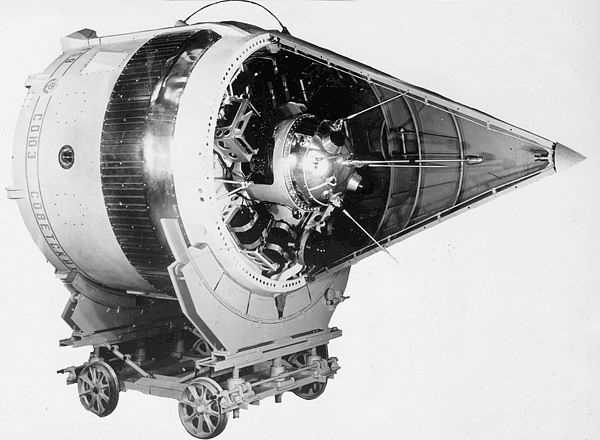
the Soviet Union’s National Exhibition came to New York City in June 1959 and ran until late July. The focal point of the exhibition was Sputnik, including full-scale models of the first three Soviet sputniks – and proudly on floor display was the “Lunik” mounted to its upper stage..
Image credit: Walter Sanders/The LIFE Picture Collection/Shutterstock
Now in the works is a retro-fire look back in time at a bizarre Cold War caper by the Central Intelligence Agency thanks to a forthcoming, star-studded comedy/drama movie called “Lunik Heist.”
Lunik Heist is described as a “a wild, roller-coaster ride, filled with subterfuge and unlikely heroes.”
A model of Lunik 1 on display in Moscow.
Image credit: Don Mitchell/Mental Landscape
The film is based on a for real incident that saw CIA operatives plot to disassemble and inspect overnight a Soviet Union spacecraft on exhibit during a 1959 expo in Mexico City.
For more information, go to my new Space.com story – “’Lunik Heist:’ A real-life CIA rocket kidnapping goes to Hollywood” – at:

Image credit: CCTV/CNSA/Inside Outer Space screengrab
China’s now-orbiting Shenzhou-19 astronauts are moving supplies and equipment into the Tiangong space station, brought to the orbiting facility by the newly docked Tianzhou-8 cargo craft.
Weighing about six tons, China’s Tianzhou-8 cargo craft includes supplies for the astronauts, propellant, application experiments and test equipment, with over 880 pounds (400 kilograms) of scientific gear.
Roughly three hours after the launch, the Tianzhou-8 cargo craft autonomously docked at the rear docking port of the space station’s core module Tianhe.

Handover of station between Shezhou-18 and Shenzhou-19 crew.
Image credit: CCTV/CMSA/Inside Outer Space screengrab
Larger cargo capacity
China launched the Shenzhou-19 crewed spaceship on October 30, sending a fresh crew of three astronauts — Cai Xuzhe, Song Lingdong and Wang Haoze — to its space station for another six-month mission.

Image credit: CCTV/CNSA/Inside Outer Space screengrab
The newly arrived cargo craft, compared to its predecessors — Tianzhou-6 and Tianzhou-7 — boasts a larger cargo capacity — an increase of more than 200 liters of space and more than 100 kilograms of cargo load.
Friday’s launch is the third cargo delivery mission since China’s crewed space program entered the space station’s application and development stage.

Lunar brick specialist, Zhou Cheng.
Image credit: CCTV/Inside Outer Space screengrab
Lunar bricks
According to China Central Television (CCTV), for the first time, a brick made of synthetic lunar soil will be brought aboard the space station and subject to an exposure experiment to test whether it could be used to construct buildings on the Moon.
It is expected that the lunar soil brick will be returned to Earth by the end of next year, following the experiment.

Image credit: CCTV/Inside Outer Space screengrab
“What we are most concerned with are: first, its mechanical properties, as they are most closely related to building structures; second, its thermal properties, particularly how well it performs in terms of insulation and heat resistance; third, the impact of radiation on it,” said Zhou Cheng, professor, National Center of Technology Innovation for Digital Construction, Huazhong University of Science and Technology. “We want to know if these lunar bricks can withstand the exposure to cosmic radiation,” Zhou told CCTV.
Go to video detailing the supply ship docking at:

FLIR
Credit: DOD/U.S. Navy/Inside Outer Space screengrab
A release today of the Department of Defense annual report on Unidentified Anomalous Phenomena (UAP) comes one day after a witness-based Congressional hearing on the topic.
The All-domain Anomaly Resolution Office’s Annual Report on Unidentified Anomalous Phenomena is required by the National Defense Authorization Act (NDAA) for Fiscal Year 2022, as amended by the NDAA for Fiscal Year 2023.
“Analyzing and understanding the potential threats posed by UAP is an ongoing collaborative effort involving many departments and agencies,” said a DoD statement.
“The safety of our service personnel, our bases and installations, and the protection of U.S. operations security on land, in the skies, seas, and space are paramount. We take reports of incursions into our designated space, land, sea, or airspaces seriously and examine each one,” adds the DoD.

Credit: DOD/U.S. Navy/Inside Outer Space screengrab
Rigorous scientific framework
The All-Domain Anomaly Resolution Office is leading DOD’s efforts with others to document, analyze, and when possible, resolve UAP reports using a rigorous scientific framework and a data-driven approach.
This year’s UAP report covers UAP reports from May 1, 2023, to June 1, 2024, as well as any UAP report from previous time periods that were not included in an earlier report.
This brought the total cases that AARO has been reviewing to over 1,600 as of June 1, 2024.
According to the AARO report itself, to date, AARO has no indication or confirmation that these activities are attributable to foreign adversaries.”

Image credit: AARO
Wanted: timely, actionable sensor data
AARO is continuing to coordinate with the Intelligence Community (IC) to identify whether these activities may be the result of foreign adversarial activities.
However, AARO’s ability to resolve cases “remains constrained by a lack of timely and actionable sensor data.”
To that end, AARO has begun collections using a prototype sensor system, GREMLIN, for detecting, tracking, and characterizing UAP.
The just-issued report explains that GREMLIN demonstrated functionality and successfully collected data during a test event in March of 2024.
“The next step for GREMLIN is a 90-day pattern of life collection at a site of national security,” the AARO report states.

Image credit: Statista
Partnerships
The AARO report notes that the group continues to address this challenge by working with military and technical partners to optimize sensor requirements, information-sharing processes, and the content of UAP reporting.
“AARO is also expanding engagement with foreign partners to share information and collaborate on best practices for resolving UAP cases,” the report concludes. “AARO will continue to develop partnerships across the USG [US Government], academia, and commercial communities. Through these partnerships, AARO will expand its sensor technology capabilities, analytic tool suites, and the UAP-related sciences spanning the space, air, and maritime domains.”
To dive into the full report — The All-domain Anomaly Resolution Office’s Annual Report on Unidentified Anomalous Phenomena – go to:

