Archive for the ‘Space News’ Category
 Author:
  January 7th, 2025
Image Credit: Sierra Space
This year, the Sierra Space Dream Chaser spaceplane is to make its way to the International Space Station.
A multiple-hour simulation on December 5 matched up both Sierra Space and NASA Johnson Space Center controllers to ring out procedures, even simulating a number of flight controller problems.
In addition to thousands of hours of cumulative classroom and self-study training across the team, simulations provide “a unique laboratory” for bringing everything together to demonstrate the Sierra Space team’s knowledge, as well as test flight controller skills.

All hands and eyes on deck! Simulation of Dream Chaser approaching the International Space Station on Dec. 5, 2024. Image credit: Barbara David
Go to my new Space.com story — How NASA and Sierra Space are preparing for Dream Chaser space plane’s 1st flight to ISS – “This is the world’s greatest video game except, in the end, it is very real.”
 Posted in
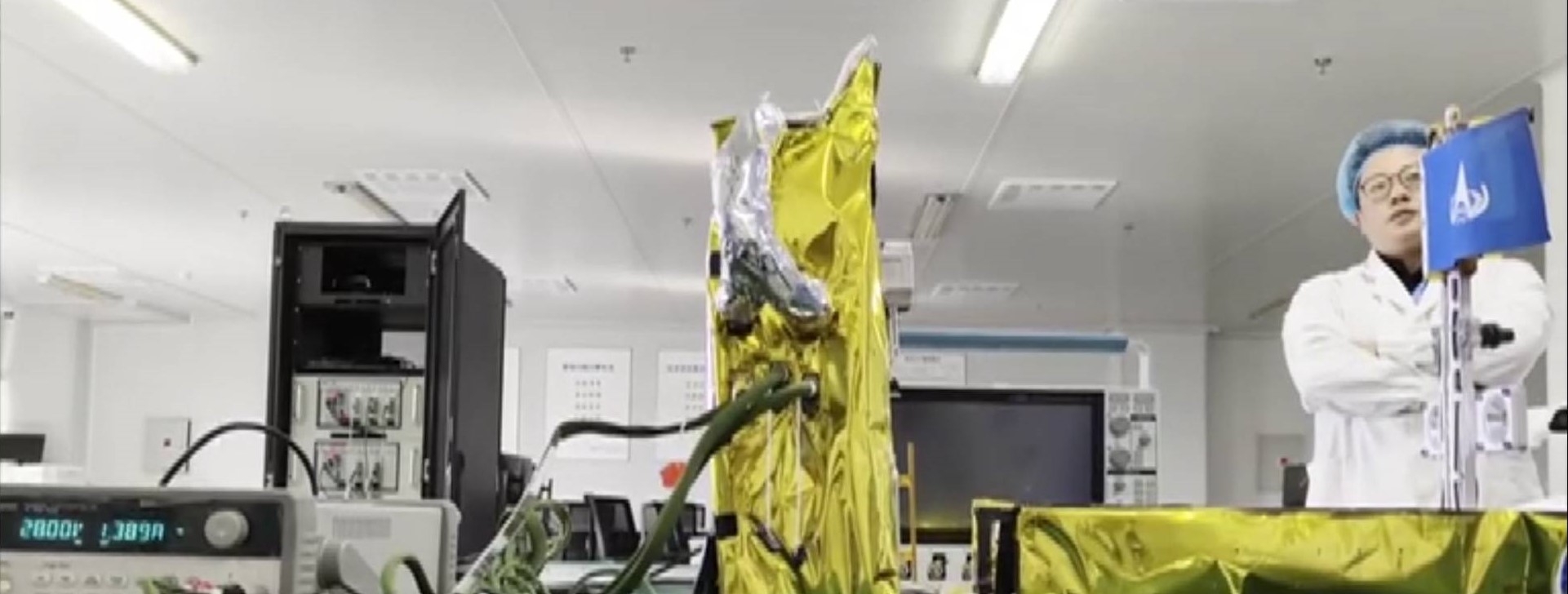
Image credit: CCTV/Inside Outer Space screengrab
Research work on building China’s Chang’e-7 lunar exploration mission includes sending a flag that can flutter in the Moon’s thin and tenuous atmosphere.
“We know that the Moon is vacuum with no air, so it is difficult to make a flag flutter by wind like on Earth,” said Zhang Tianzhu, deputy head of the institute of future technology at the Deep Space Exploration Laboratory.
That lab was co-established by the China National Space Administration and the University of Science and Technology of China and began operations in June 2022. It is headquartered in Hefei, the capital city of Anhui, and has a branch in Beijing.

Zhang Tianzhu.
Image credit: CCTV/Inside Outer Space screengrab
Fluttering solution
Zhang said the flag fluttering solution is based on arranging closed loop wires on the surface of the flag with access to two-way positive and negative currents, “and make the flag flutter through the interaction of electromagnetic fields.”
China plans to launch its Chang’e-7 lunar lander to find traces of water and ice at the Moon’s south pole around 2026. If successful, the deployed flag will be the first to flutter on the lunar surface.
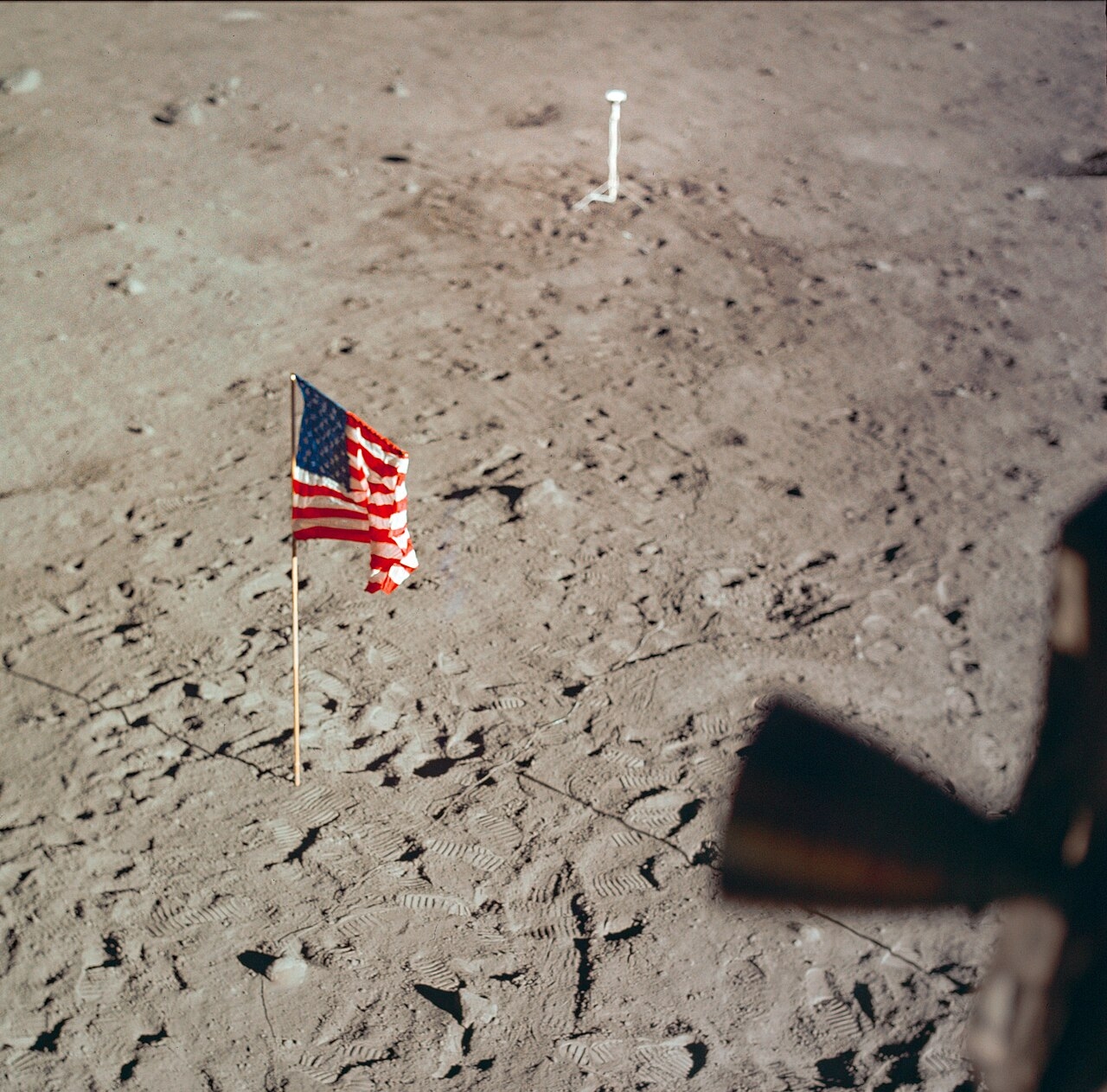
Image credit: NASA

Image credit: CCTV/CNSA/Inside Outer Space screengrab
Sustainable and scalable
“Now, in order to complete the development of our popular science test payload in February, we are motivated and divided into different groups to advance this task,” Zhang told China Central Television (CCTV).
Work is also proceeding on the following Chang’e-8 lunar lander mission and the International Lunar Research Station (ILRS).
“Our goal is to establish a sustainable and scalable comprehensive scientific experimental facility on the lunar surface and in lunar orbit, capable of long-term autonomous operation and short-term human participation, and to basically build an International Lunar Research Station by around 2035,” said Zhang.
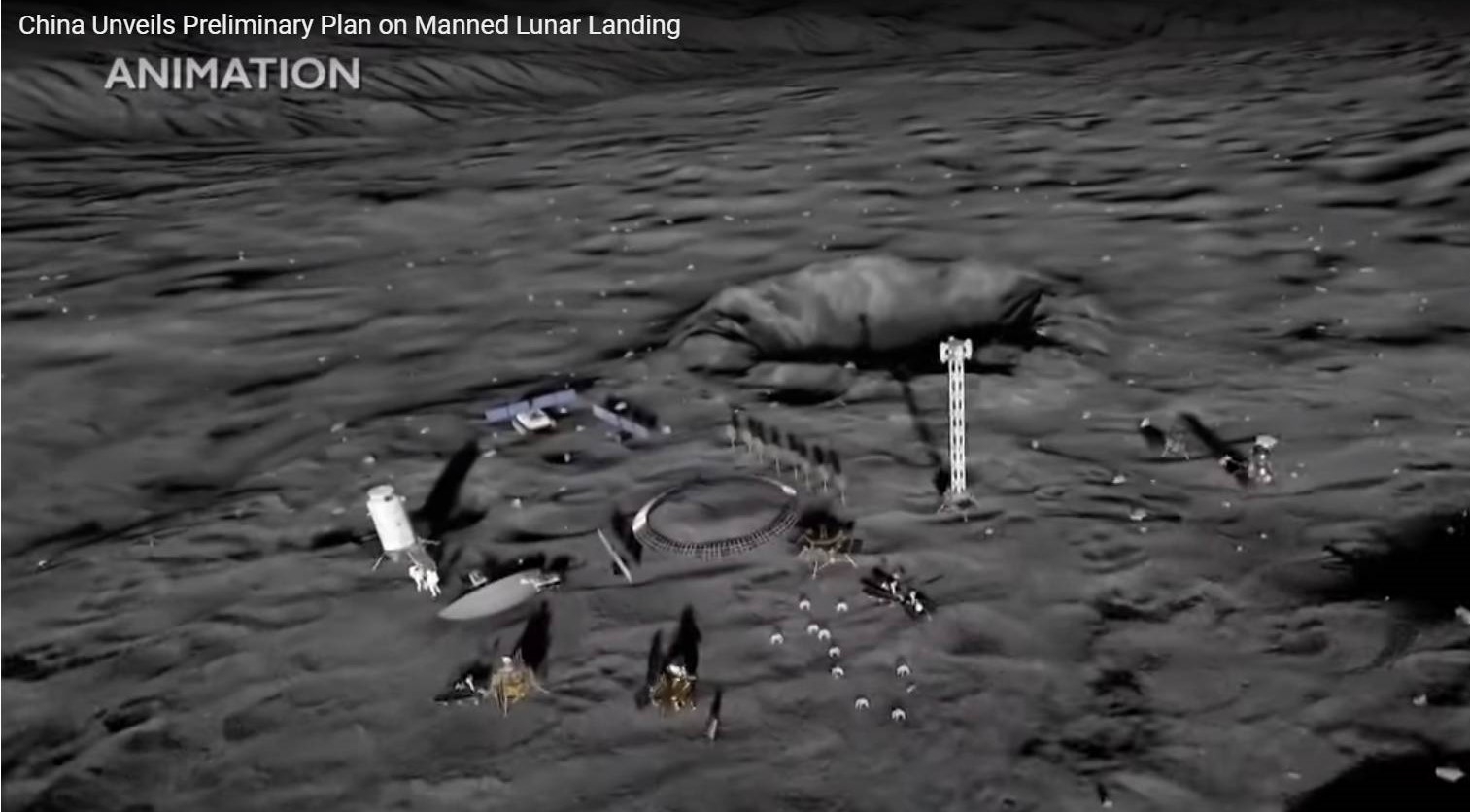
Artist’s view of International Lunar Research Station . Credit: CNSA
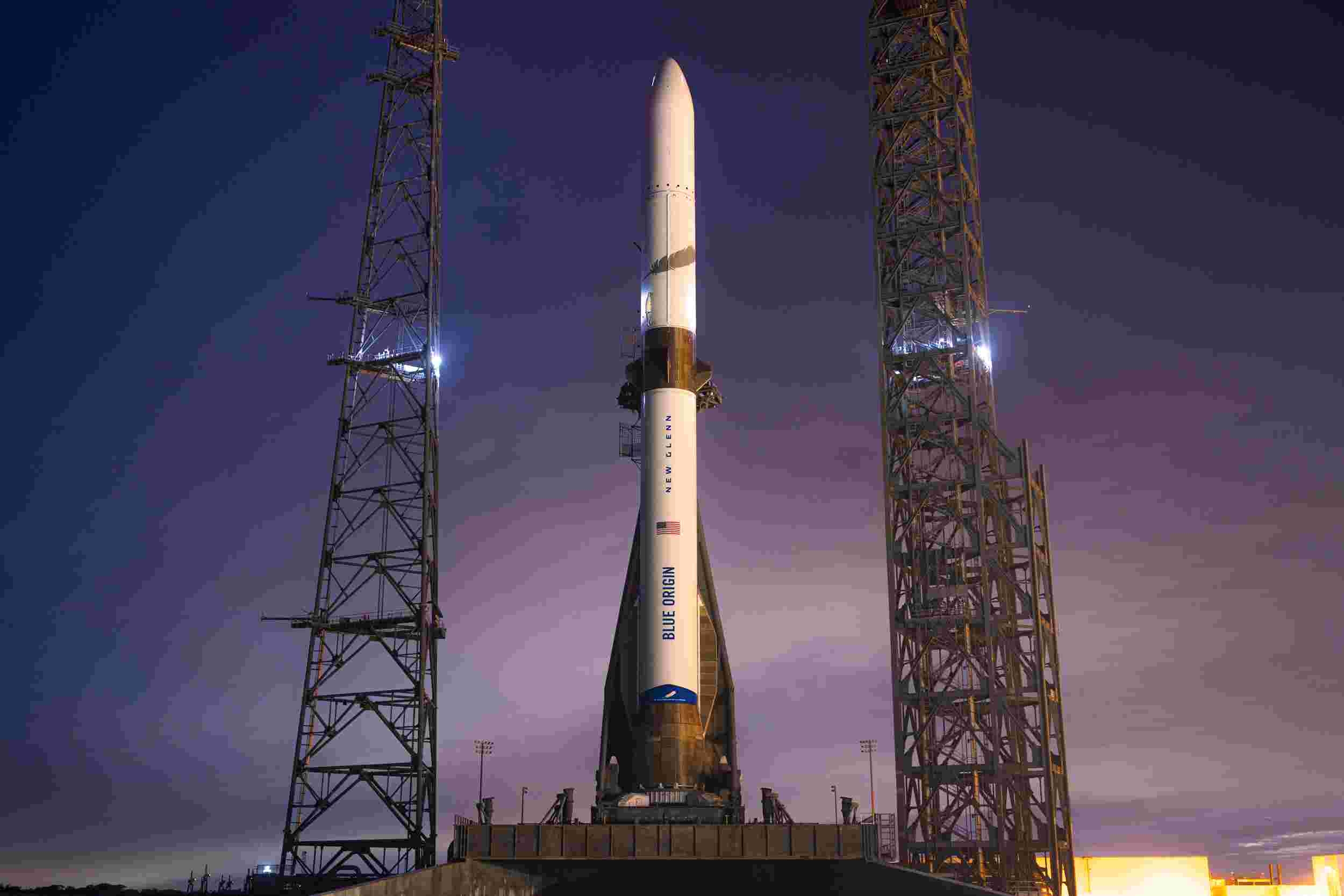
Image credit: Blue Origin
“It’s time to fly,” said Jarrett Jones, SVP, for the Blue Origin New Glenn rocket program.
New Glenn’s first liftoff is now targeted for no earlier than January 10.
The booster’s inaugural mission (NG-1) will lift off from Launch Complex 36 at Cape Canaveral Space Force Station, Florida. The three-hour launch window opens at 1 a.m. Eastern Time, and is the vehicle’s first National Security Space Launch certification flight.

Image credit: Blue Origin
The payload is the Blue Ring Pathfinder that will evaluate Blue Ring’s core flight, ground systems, and operational capabilities as part of the Defense Innovation Unit’s (DIU) Orbital Logistics prototype effort.
“Our key objective is to reach orbit safely,” Blue Origin notes in a company statement. “We know landing the booster on our first try offshore in the Atlantic is ambitious—but we’re going for it.”
“This is our first flight and we’ve prepared rigorously for it,” said Jones. No amount of ground testing or mission simulations can replace flying this rocket, he said.
Jones added: “No matter what happens, we’ll learn, refine, and apply that knowledge to our next launch.”

Pre-;liftoff engine test.
Image credit: Blue Origin

Image credit: Boeing/Inside Outer Space screengrab
That U.S. Space Force X-37B Orbital Test Vehicle (OTV-7) has silently slipped past one-year of flight time.
The craft is engaged in performing aerobrake maneuvers, a technique to alter its orbit around Earth, as well as safely dispose of its attached service module.
Lofted in December of 2023, the military spaceplane was placed in an orbit higher than any of the earlier space plane missions – into a highly elliptical high Earth orbit.

Artist rendering of the X-37B performing an aerobraking maneuver using the drag of Earth’s atmosphere.
Image credit: Boeing Space
From that orbit, the United States Space Force, supported by the Air Force Rapid Capabilities Office, conducted radiation effect experiments and tested Space Domain Awareness technologies.
X-37B/OTV-7 is also referred to as United States Space Force-52 (USSF-52). This spaceplane was lofted on December 28, 2023.
The OTV-7 flight marks the first time the U.S. Space Force and the X-37B have attempted to carry out a dynamic aerobraking maneuver.
Expending minimal fuel
In a statement released last year by Boeing, builder of the X37B “will perform ground-breaking aerobraking maneuvers to take the dynamic spaceplane from one Earth orbit to another while conserving fuel. Partnered with the United States Space Force, this novel demonstration is the first of its kind.”

X-37B reentry tiles as seen from earlier mission.
Image credit: Boeing
The use of the aerobraking maneuver requires the heat-tiled spacecraft to conduct a series of passes using the drag of Earth’s atmosphere. That technique enables the spacecraft to change orbits while expending minimal fuel.
There are no details as yet on whether the X-37B’s aerobrake maneuvering is complete.
If so, the uncrewed vehicle was slated to resume its test and experimentation objectives until they are accomplished.
At that point, the vehicle is to de-orbit and execute a safe return to Earth, likely at the Kennedy Space Center Shuttle Landing Facility Runway.

OTV-6 was the first mission to introduce a service module that expanded the capabilities of the spacecraft.
Image credit: Staff Sgt. Adam Shanks
Flight log
Here’s a listing of previous flights of the spaceplane:
OTV-1: launched on April 22, 2010 and landed on December 3, 2010, spending over 224 days on orbit.
OTV-2: launched on March 5, 2011 and landed on June 16, 2012, spending over 468 days on orbit.
OTV-3: launched on December 11, 2012 and landed on October 17, 2014, spending over 674 days on-orbit.
OTV-4: launched on May 20, 2015 and landed on May 7, 2015, spending nearly 718 days on-orbit.
OTV-5: launched on September 7, 2017 and landed on October 27, 2019, spending nearly 780 days on-orbit.
OTV-6: launched on May 17, 2020 and landed on November 12, 2022, spending 908 days on-orbit.
OTV-7: launched on December 28, 2023 and remains in-flight.
Go to this informative video at:
https://www.youtube.com/watch?v=WduDiC8VFyY

Image credit: Boeing Space/Inside Outer Space screengrab

Image credit: Citizen TV
There is a possible candidate for that large metallic ring that fell from the sky on December 30 in Africa, reportedly crashing “red-hot” into Mukuku village, in Makueni county – in the country’s south.
Investigators with the Kenya Space Agency (KSA) officials in Nairobia reported that the object, which is roughly 8 feet (2.5 meters) in diameter and weighing some 1,100 pounds (500 kilograms), is a piece of rocket debris. But the question remains from where?

Image credit: KSA
KSA officials said the leftovers came crashing down, reportedly within the village at roughly 3 p.m. local time.
Preliminary assessment
The KSA “secured the area and retrieved the debris, which is now under the Agency’s custody for further investigation.”
“Preliminary assessments indicate that the fallen object is a separation ring from a launch vehicle (rocket),” the KSA stated in a January 1st official statement.
There is discussion regarding possible rocket launch hardware associated with the Indian Space Research Organization’s (ISRO) Space Docking Experiment (SpaDeX) launch on December 30.

Image credit: ISRO/Inside Outer Space screengrab
Polar satellite launch vehicle
The SpaDeX payload flew atop ISRO’s Polar Satellite Launch Vehicle (PSLV-C60), lifting off at 10:00:15 PM local time from the Satish Dhawan Space Centre, Sriharikota.
The SpaDeX mission deployed two spacecraft—SDX01 (Chaser) and SDX02 (Target) — to carry out a series of complex maneuvers, leading to their docking in Earth orbit.
India’s mastering of autonomous docking technology, reports ISRO, is vital for future human spaceflights, lunar missions, and the construction of India’s proposed space station, Bharatiya Antariksh Station.
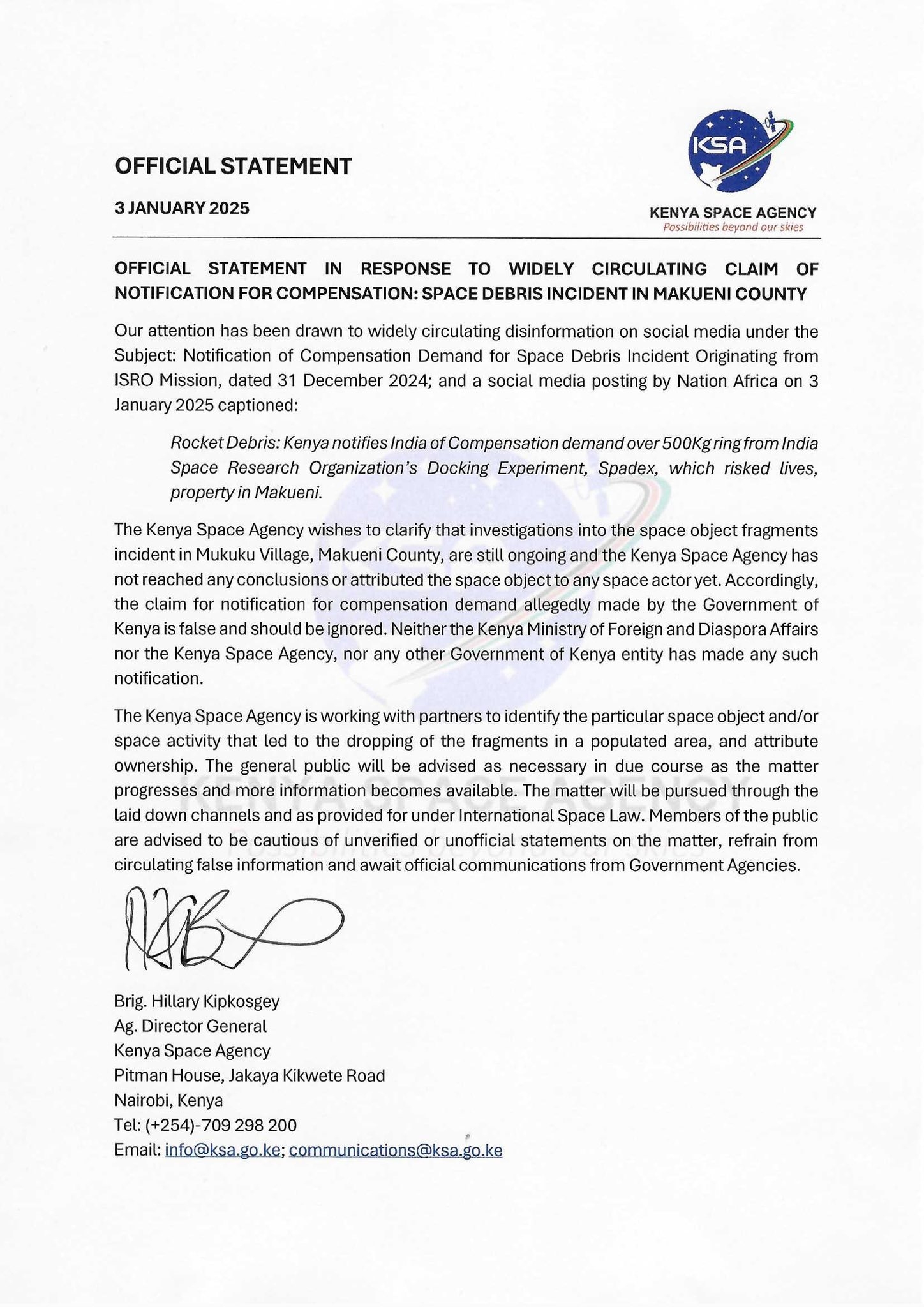
Image credit: KSA
Report dismissed
Meanwhile, the Kenya Space Agency has dismissed a media report by Nation Africa that the country had demanded compensation for the debris dumping from India.
In a post on X on Friday, the KSA stressed that “investigations into the object’s origin are still ongoing, and no official statement has been issued linking the debris to the Indian Space Research Organization or any specific space mission.”
KSA advised the public to “await official findings.”

Image credit: SpaceX
The seventh flight test of the SpaceX Starship atop its Super Heavy booster is being readied for launch.
According to SpaceX, the upcoming flight test, reportedly targeted for January 10, will launch a new generation ship “with significant upgrades.”
In addition, there will be an attempt for Starship’s first payload deployment test, fly multiple reentry experiments geared towards ship catch and reuse, and launch and return the Super Heavy booster.

Image credit: SpaceX
Major improvements
A block of planned upgrades to the Starship upper stage will debut on this flight test, bringing major improvements to reliability and performance.
The upcoming test flight will debut:
- The vehicle’s forward flaps have been reduced in size and shifted towards the vehicle tip and away from the heat shield
- Redesigns to the propulsion system, including a 25 percent increase in propellant volume,
- The vacuum jacketing of feedlines
- A new fuel feedline system for the vehicle’s Raptor vacuum engines
- An improved propulsion avionics module controlling vehicle valves and reading sensors.
These upgrades add additional vehicle performance and the ability to fly longer missions, explains SpaceX. Additionally, the ship’s heat shield will also use the latest generation tiles and includes a backup layer to protect from missing or damaged tiles.

Image credit: SpaceX/Inside Outer Space screengrab
Increasingly complex missions
According to the SpaceX website, the vehicle’s avionics underwent a complete redesign, adding additional capability and redundancy “for increasingly complex missions like propellant transfer and ship return to launch site.”
Those avionics upgrades include a more powerful flight computer, integrated antennas which combine Starlink, Global Navigation Satellite System (GNSS), and backup Radio Frequency communication functions into each unit.
Also, the ship is outfitted with a redesigned inertial navigation and star tracking sensors, integrated smart batteries and power units that distribute data and power across the ship to 24 high-voltage actuators.
There will be an increase to more than 30 vehicle cameras to provide engineers insight into hardware performance across the vehicle during flight.

Actual photo of stage separation via SpaceX tracking camera. Image credit: SpaceX
Synchronize with Starlink
By using the SpaceX Starlink system, the vehicle is capable of streaming more than 120 megabits per second (Mbps) of real-time high-definition video and telemetry in every phase of flight. That capability yields engineering data to rapidly iterate across all systems.
While in space, Starship will deploy 10 “Starlink simulators.” These are similar in size and weight to next-generation Starlink satellites. This will be the first exercise of a satellite deploy mission. The Starlink simulators will be on the same suborbital trajectory as Starship, with splashdown targeted in the Indian Ocean.
A relight of a single Raptor engine while in space is also planned.
Stress-test
Regarding return to launch site and catch, the upcoming flight test will include several experiments to further that capability.
“On Starship’s upper stage, a significant number of tiles will be removed to stress-test vulnerable areas across the vehicle. Multiple metallic tile options, including one with active cooling, will test alternative materials for protecting Starship during reentry,” SpaceX reports.

Catch via chopsticks. Image credit: SpaceX/Inside Outer Space screengrab
“On the sides of the vehicle, non-structural versions of ship catch fittings are installed to test the fittings’ thermal performance, along with a smoothed and tapered edge of the tile line to address hot spots observed during reentry on Starship’s sixth flight test,” the company posting adds.
The ship’s reentry profile on this flight will intentionally stress the structural limits of the flaps while at the point of maximum entry dynamic pressure.
Tower chopsticks
Several radar sensors will be tested on the tower chopsticks. The goal is to increase the accuracy when measuring distances between the chopsticks and a returning vehicle during catch.
The Super Heavy booster will utilize flight proven hardware for the first time, reusing a Raptor engine from the booster launched and returned on Starship’s fifth flight test.
The new SpaceX posting explains why there was no tower chopstick catch on the sixth test flight.

Image credit: SpaceX
For this soon-to-fly test, there are protections to the sensors on the tower chopsticks “that were damaged at launch and resulted in the booster offshore divert on Starship’s previous flight test.”
Accept no compromises
“Distinct vehicle and pad criteria must be met prior to a return and catch of the Super Heavy booster, requiring healthy systems on the booster and tower and a final manual command from the mission’s Flight Director,” SpaceX explains. “If this command is not sent prior to the completion of the boostback burn, or if automated health checks show unacceptable conditions with Super Heavy or the tower, the booster will default to a trajectory that takes it to a landing burn and soft splashdown in the Gulf of Mexico.”
To ensure the safety of the public and the SpaceX launch team, “we accept no compromises,” the website notes, “and the return will only take place if conditions are right.”
“This new year will be transformational for Starship,” SpaceX concludes, “with the goal of bringing reuse of the entire system online and flying increasingly ambitious missions as we iterate towards being able to send humans and cargo to Earth orbit, the Moon, and Mars.”

Image credit: SpaceX
Image credit: KSA
About that possible space debris landing in Africa.
Comment from “Ed”: “Check out the Ariane 5 Space Debris (33155) that reentered around the same time. It was equatorial and more likely to be a candidate at the time of reentry.”

Image credit: CORDS/The Aerospace Corporation
However, the reentry messages from space track, Ed adds, would have both the U.S. Atlas and European Space Agency (ESA) Ariane debris in completely different parts of the world.
Meanwhile, my posting on this incident via Space.com is at:

Image credit: NASA
NASA wants to bring Mars samples to Earth, but budget problems and technical woes have the mission caught between a rock and the Red Planet.
Meanwhile, there appears to be an unofficial robotic space race underway involving the Red Planet.
Both the U.S. and China are scripting a strategy for bringing back to Earth goodies from Mars via their respective Mars Sample Return (MSR) endeavors.

China’s Red Planet plans. Image credit: CCTV/CNAS/Inside Outer Space screengrab
Real-time hand-ringing
For America, things are now happening in real-time on Mars.
The NASA Perseverance rover is busily wheeling about within the ins and outs of Jezero Crater, biting into and snatching primo chunks of Mars for eventual pick-up by a future MSR mission.
But slapped around by independent assessments, the space agency wound up hearing a cash register ka-ching sound for MSR that rang up to upwards of $11 billion.
Also, a time period of 2040 would be needed to inspect any FedEx-like delivery of select Mars dirt, rock, and atmosphere on Earth.

The Mars Ascent Vehicle (MAV) is a major and costly component of NASA’s robotic Holy Grail mission, a Mars sample return effort to bring back to Earth Martian collectibles.
Credit: NASA/JPL-Caltech
For details, go to my new Space.com story – “Can NASA’s troubled Mars Sample Return mission be saved?” – at:
https://www.space.com/the-universe/mars/can-nasas-troubled-mars-sample-return-mission-be-saved

Image credit: KSA
Talk about ring in the New Year!
Kenya Space Agency (KSA) officials in Nairobia, Kenya, East Africa, are reporting that on December 30 a large metallic ring roughly 8 feet (2.5 meters) in diameter and weighing some 1,100 pounds (500 kilograms) fell from the sky, reportedly “red-hot” and crashed into Mukuku village, in Makueni county – in the country’s south.
Investigators think the object is space debris, believed to be rocket leftovers that came crashing down, reportedly within the village at roughly 3 p.m. local time.
The KSA “secured the area and retrieved the debris, which is now under the Agency’s custody for further investigation.”

Early assessments indicate that “the fallen object is a separation ring from a launch vehicle,” reported the KSA.

Image credit: KSA
However, sky watching veteran and reentry tracker, Jonathan McDowell who works at the Harvard–Smithsonian Center for Astrophysics, told Inside Outer Space that there is “no obvious space candidate. I am not convinced it’s not from an airplane. Don’t see obvious evidence of reentry heating.”
On the other hand, Darren McKnight, a space debris expert at LeoLabs, points out that sometimes incoming space debris stays covered by some “sacrificial mass” that burns up and leaves the raw hardware to reenter.
So what is “the object”?
Official statement
Following the discovery of a metallic fragment of a space object in Mukuku Village, Makueni County, the Kenya Space Agency has issued the following statement, as posted on X (formerly Twitter):

Image credit: KSA
The agency thanked the residents of Mukuku Village, local leadership, and media outlets for their swift actions in reporting and disseminating the incident.

Image credit: KSA
Possible link?
An early review by Inside Outer Space of the Aerospace Corporation’s Center for Orbital and Reentry Debris Studies (CORDS) Reentry Database suggested a possible link to an incoming rocket body associated with an Atlas Centaur launch back in 2004.
That rocket body leftover, tagged as object 28385, was predicted to reenter on December 30 at 21:33 UTC ± 2 hours, with a flight path taking it over Africa.
The Atlas Centaur rocketed out of Cape Canaveral Space Force Station on August 31, 2004 carrying a classified USA-179 satellite.
According to the NASA Space Science Data Coordination Archive, USA-179 is an American military satellite for the National Reconnaissance Office (NRO), launched by an Atlas 2AS rocket from Cape Canaveral. It was the last flight of the Atlas 2 models.
However, reentry tracker McDowell said U.S. Space Force data showed the 28385 rocket stage reentered over Lake Baikal in Russia.
So yes, further official, KSA assessment of this speculative space debris prospect is likely forthcoming.

Image credit: CORDS
In an independent review by Inside Outer Space to better identify the nature of the skyfall, there’s an interesting, but still speculative photo comparison – that could point to some design features of manufactured booster-related hardware and techniques used.
Image credit: KSA

Image credit: Roscosmos
As example, Roscosmos enterprise images of upgraded Angara-A5M rocket hardware seem telling, perhaps, or suggest a type of fabrication process commonly used in the booster-making business by various firms.
Specialists from the Khrunichev Center manufacture parts and components for the first two Angara-A5M launch vehicles, as well as test benches for testing and fine-tuning modern rocket manufacturing technologies.
Use of new technologies in the manufacture of key structural elements with improved weight characteristics relative to the standard Angara-A5 design.
Any follow-up suggestions are welcomed.

High-definition images of China’s space station were taken by the departing Shenzhou-16 crew October 30, 2023.
Image credit: CMS
The China Manned Space Agency on Monday released a first-ever progress report on the output from the country’s space station.
This CMSA report provides an overview of the work accomplished over the past two years.
Over those years, China carried out four crewed flights, three cargo resupply missions, and four spacecraft return missions.
Five “taikonaut” crews carried out 15 long-term stays in orbit, with 10 taikonauts performing extravehicular activities.

Image credit: CMSA/CCTV/Inside Outer Space screengrab
According to the report, multiple spacewalk maintenance missions were completed, setting a new world record for the duration of a single spacewalk.
Additionally, the selection of the fourth batch of reserve taikonauts was completed, including two payload specialists from Hong Kong and Macao, according to the report.
Samples returned
As of December 1, 2024, reports China Central Television (CCTV), a total of 181 scientific and application projects have been carried out in orbit, with nearly 2 tons of scientific materials delivered and nearly 100 types of experimental samples returned, producing over 300 terabytes of scientific data.

Image credit: CCTV
Spotlighted in the report are experiments in space life and human research, microgravity physical science research, and new space technology and application research.
As a national space laboratory, China’s orbital outpost is projected to conduct over a thousand research projects during its 10-15 years of operation.

Gu Yidong, chief expert of space science, manned space program.
Image credit: CCTV/Inside Outer Space screengrab
Exceeding expectations
“In my judgment, the results have exceeded my expectations,” said Gu Yidong, chief expert of space science, manned space program.
“Overall, I am encouraged by the progress we’ve made,” Gu told CCTV. “Despite facing time constraints in the early stages, the progress of the first batch of scientific experiments aboard the space station shows that our scientists are capable of achieving even greater results in the future with continued, sustained effort, to truly make a special contribution of the space station application to building China’s strengths in science and technology.”
Go to these newly issued videos that detail China’s space station research activities at:
https://www.facebook.com/share/v/18ahhyZbDf/
https://www.facebook.com/share/v/15NowMGdvU/

Image credit: CCTV/Inside Outer Space screengrab

