Archive for the ‘Space News’ Category
 Author:
  February 10th, 2025
Image credit: CNSA/Inside Outer Space screengrab
A candid video details the spacewalking tribulations by China’s Shenzhou-18 crew back in May of last year.
During an 8.5-hour spacewalk, astronauts Ye Guangfu, Li Cong and Li Guangsu successfully installed space debris protection devices, among other tasks.

Image credit: CNSA/Inside Outer Space screengrab
Ye and Li Guangsu made the spacewalks then returned to the station’s Wentian lab module after their outside strolls.
This EVA marked the 15th spacewalk by Chinese astronauts. It was the first spacewalk for Li Guangsu, who operated the station’s robotic arms during the extravehicular activity.

Image credit: CMG/CCTV//Inside Outer Space screengrab
Endless black void
“All I could see below me was an abyss of blackness,” recounted Li Guangsu in an exclusive interview with state-controlled China Media Group (CMG) as shown on China Central Television (CCTV).
“Beneath me was nothing but an endless black void,” said Ye. “In that moment, a wave of nervousness hit me, and I felt my hair stand on end.”

Image credit: CMG/CCTV//Inside Outer Space screengrab
The two spacewalkers offer insights into working outside China’s space station. Their interview can be viewed here at:
https://www.facebook.com/NewsContent.CCTVPLUS/videos/651980734029718
 Posted in
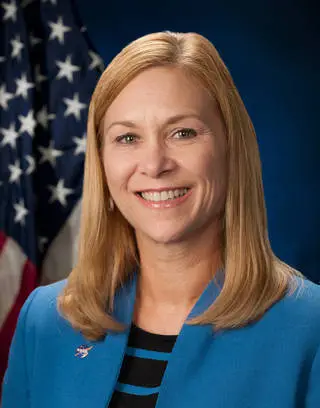
Image credit: NASA
NASA’s Acting Administrator, Janet Petro, has requested space agency employees “to lean into this opportunity” that the Department of Government Efficiency (DOGE) seeks to maximize efficiencies.
“I know the recent executive orders and subsequent guidance are weighing on many of you,” Petro explains in a February 7 NASA update. “Speculation from all areas has contributed to uncertainty and concern, and the volume of updates can feel overwhelming.”
But Petro reminded the NASA workforce that the civilian space agency is no stranger to challenges. “We are an agency built on tackling complex problems, pushing boundaries, and rising above adversity. This moment is no different.”
In her acting administrator role, Petro is responsible for directing the agency, including budget and programs, until a new administrator is confirmed by the U.S. Senate. She is a former director of NASA’s John F. Kennedy Space Center, Florida.
Petro has also extended a NASA welcome to Michael Altenhofen, appointed as senior advisor to the NASA administrator. Altenhofen started his career as a NASA intern and returns to the agency after 15 years with SpaceX.

In 2021, NASA celebrated the agency’s first African American female engineer, Mary W. Jackson, with a ceremony to formally name the agency’s headquarters building in Washington in her honor.
Image credit: NASA/Inside Outer Space screengrab
Deadline for departure
As for NASA employees, the word now is that the Deferred Resignation Program/Volunteer Early Retirement Authority has had its deadline for participation extended until Monday, Feb. 10, at 11:59 p.m. Eastern Standard Time.
“While some employees have openly made their colleagues aware of their choice, we have not yet received updated numbers from the Office of Personnel Management (OPM) on how many NASA employees have decided to accept this option thus far,” Petro explains. “We expect to see that information after the deadline and will share it with officials in charge.”
For those departing, Petro adds that “we honor your service and contributions to this agency. For those continuing, know your commitment is seen and deeply valued, even when it may not always be visible outside the agency.”

Image credit: NASA
Pronoun usage
In the meantime, the “Pronoun Usage in Email Addresses” feature has been disabled by the Office of the Chief Information Officer (OCIO).
Late last month, per NASA Headquarter direction, workers were required to scrub mentions of the following terms from public sites. “This is a drop everything and reprioritize your day request,” the communiqué said, listing the following at the time:
— DEIA
— Diversity (in context of DEIA)
— Equity (“ “)
— Inclusion (“ “)
— Accessibility (“ “)
— MSI
— Minority Serving Institution
— Indigenous People
— EEJ
— EJ
— Environmental Justice
— Underrepresented groups/people
— Anything specifically targeting women (women in leadership, etc.)

Image credit: NASA
“If you previously added pronouns to your display name, they will be automatically removed from the system this week,” Petro said. Additionally, OCIO and the Office of Communications have advised on how to update a NASA employee’s email signature in a way that aligns with the space agency’s graphics standards.
Effective stewards of taxpayer dollars
“Let’s keep refining our processes and find new ways to work smarter,” Petro adds. “More to come on how you can let your voice be heard – we do value your input in ensuring we remain effective stewards of taxpayer dollars while growing and evolving together.”
Lastly, Petro’s message to the NASA workforce said “we are more than an agency. We are a team bound by a shared purpose, a sense of duty, and a belief that what we do matters. I have no doubt that we will emerge stronger, just as we always have.”

Image credit: NASA

Uncertainty exists associated with operating in cislunar space, as well as on and around the Moon – so much so that a “security dilemma” between countries can evolve.
There is need to provide an opportunity for transparency, coordination, cooperation, and collaboration a new report suggests. It calls for inclusive engagement and decision-making concerning cislunar space, including the development of improved rules and best practices.
The Outer Space Institute has published a report on cislunar security: New Moon: A Cislunar Security Workshop Report.
The Outer Space Institute (OSI) is based at the University of British Columbia in Vancouver and is a network of world-leading space experts.

Earth’s Moon and cis-lunar space are new destinations for numbers of nations. To what extent is that presence demand or promote a military presence?
Image credit: Inside Outer Space
Military buildup
Defined in the report is that a security dilemma occurs “when a state, lacking clear information about whether a potential adversary is engaged in a military buildup, faces a choice between building up its own military, or doing nothing and risk being overwhelmed.”
Indeed, voices within U.S. national security circles have voiced support that the U.S. Space Force should have a cislunar military presence, strengthening the ability to guard commercial interests as a “cislunar economy” evolves.
One major issue identified in the report is lunar surface traffic management. It involves ensuring that one actor does not impede another actor – or imperil its personnel, equipment or installations – by approaching too closely or causing dust lofting or radio interference of some kind. “But what is a reasonable distance,” the report adds, “and who gets to decide?”

Carving up near-moon locales: How strategic could this be for military interests? (Image credit: Aerospace Corporation)
China’s lunar program
Given China’s growing progress in Moon exploration, via robots and eventual human treks to emplace an International Lunar Research Station (ILRS), there has been little effort by Western experts to analyze documents on cislunar space from China or, indeed, to engage with Chinese experts.
“Unfortunately, this only increases the risk of one or more security dilemmas,” the report observes.

Image courtesy U.S. Defense Intelligence Agency (DIA) in its “2022 Challenges to Security in Space” report.
To access the full report — New Moon: A Cislunar Security Workshop Report — and its recommendations and conclusions, go to:

A new strategy for the exploration of Venus.
(Image credit: VEXAG Strategic Plan Study Analysis Workgroup)
Albeit a hell hole of a world, the planet Venus is a tantalizing, cloud-enveloped cool place for scientific scrutiny to ferret out its history, evolution and gauge its present state.
At the forefront of tackling what that puzzling place can teach us is the Venus Exploration Analysis Group (VExAG), a community-based forum to help NASA shape and advance a clear strategy to probe that planet.
Extraordinary destination
Late last year, a VExAG gathering included a dedicated and strategic look at opening-up Venus in the next decade and beyond by way of a host of advanced technologies, from balloons to long-lived landers.

Enigmatic Venus holds tight its secrets under thick clouds. Image shows the night side of Venus glowing in thermal infrared, captured by Japan’s Akatsuki spacecraft.
Credit: JAXA/ISAS/DARTS/Damia Bouic
A key part of this strategy is a call to scientists in the US and internationally to demonstrate just how extraordinary a destination Venus is and why we should set our scientific sights on further purging that planet of its secrets.
For more information, go to my new Space.com story – “Exploring Venus may require exotic tech like balloons and ‘aerobots’” – at:

A signal is detected from other star folks. But what happens now?
The International Academy of Astronautics has outlined protocols for what to do if we discover extraterrestrials. The major points of the protocol fall into three areas:
- The detection of alien life should be carefully verified by repeated observations.
- The discovery should be publicized.
- No response should be sent without international consultation.

The late Frank Drake with cosmic equation to gauge the presence of intelligent life in the cosmos. The Drake Equation identifies specific factors believed to play a role in the development of civilizations in our galaxy.
Image credit: SETI Institute
Next-gen SETI
That factoid is one among many in Next-Gen SETI: Pioneering the Search for ET.
If you’re curious about the search for extraterrestrial intelligence, download a free eBook produced by the SETI Institute.
Learn about:
- The Allen Telescope Array and China’s FAST facility used to detect potential extraterrestrial signals.
- Different approaches like radio and optical methods that expand our search.
- Key scientific concepts and theories, including the Drake Equation and the Fermi Paradox.
- Societal implications and protocols for responding to extraterrestrial discoveries.
Download your free eBook at:
https://www.seti.org/sites/default/files/2025-01/SETI%20ebook%20%20final.7.9.24.pdf

An annual safety report to NASA has both praise and also underscores a number of cautionary woes, including the space agency’s undertaking of the Artemis back-to-the-Moon with humans campaign.
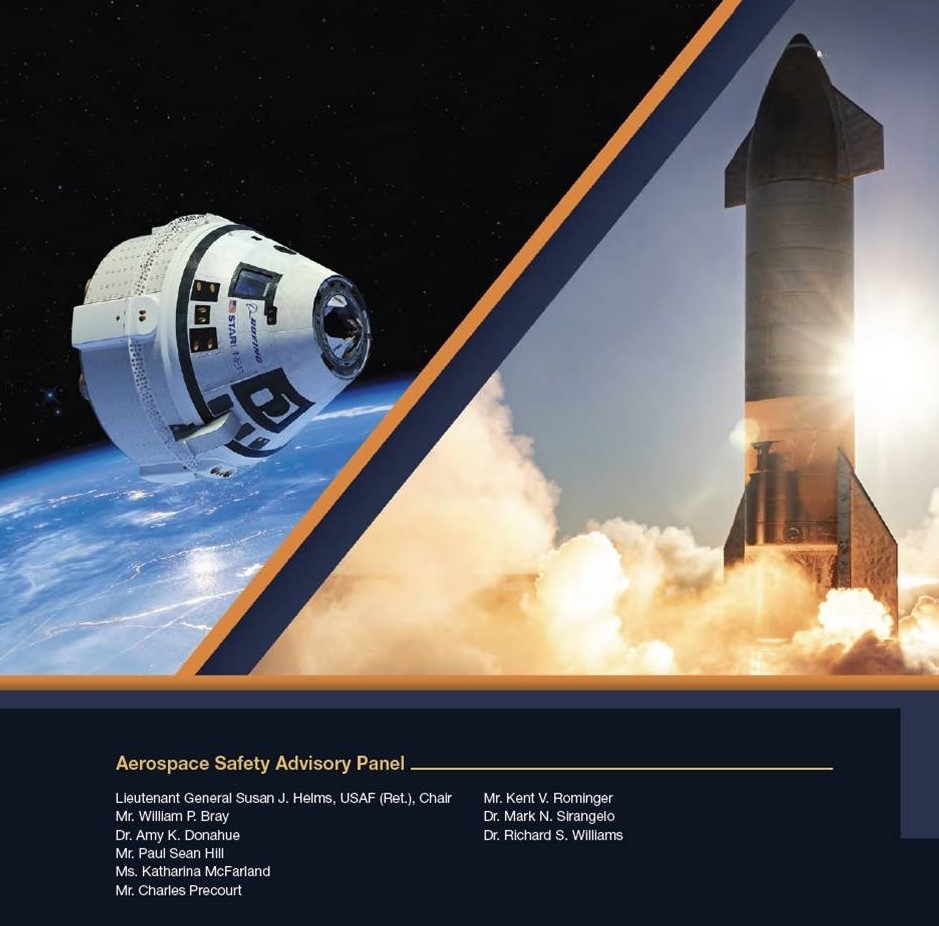
The annual report from the Aerospace Safety Advisory Panel (ASAP) has been released. The report observes that NASA has made impressive progress. Challenges remain, however, and are highlighted in this report.
Of note, this report points to significant safety observations for both the Moon to Mars Program and the current International Space Station operations in low-Earth orbit.
Risk-related issues
The ASAP of experts, led by former NASA astronaut Lieutenant General Susan J. Helms, USAF (Ret.) who chairs the group, notes that there are “considerable risk-related issues” surrounding NASA’s planned transition to Commercial low-Earth orbit destinations, “some of which are not wholly within NASA’s control.”
The just-released ASAP report also touches on relevant areas of human health and medicine in space “and the impact of budget constraints and uncertainty on safety.”
The new report has been sent to Janet Petro, NASA Acting Administrator, as well as JD Vance, Vice President and President of the Senate and Mike Johnson, the Speaker of the U.S. House of Representatives.
Congress established the ASAP or “Panel” in 1968 to provide advice and make recommendations to the NASA Administrator and Congress on safety matters.

Image credit: ASAP
Artemis: fraught with uncertainty
“Of particular concern are the risks surrounding the development, integration, and execution of the Artemis campaign. NASA’s mandate for deep space exploration to Mars and beyond is supremely challenging and fraught with uncertainty,” the ASAP report explains.
“A critical steppingstone in the development of human interplanetary travel capabilities and space hardware—and ultimately safe operations and overall mission success—is the safe return to the Moon. The Moon offers both the opportunity to gain experience operating on a planetary surface and a nearby test bed with an extreme environment akin to Mars,” the report points out.
“Yet, NASA will face a myriad of daunting budgetary, industrial, geopolitical, technical, and health and medical constraints and challenges,” the report continues, “as it both executes the Artemis campaign and maintains the Nation’s presence in low-Earth orbit (LEO) throughout the coming decade.

Orion heat shield features ablative material, called Avcoat.
Image credit: Lockheed Martin
Physics of failure
The ASAP flagged the fact that, during 2024, the Orion Program continued proactively investigating the heat shield spalling and char loss that occurred during the December 11, 2022 Artemis I mission’s Orion capsule entry to Earth.
NASA’s focus on understanding the physics of the failure and identifying corrective actions, the ASAP report points out, led to corrective actions for future heat shield assemblies, and entry trajectory changes that can enable the 2026 Artemis II to fly with the existing heat shield.

Image credit: NASA OIG
“The ASAP has not yet reviewed the engineering details of this work and the related risk assessments with NASA. This will be a Panel focus early in 2025,” the ASAP report says.
Technical readiness level
As for the first human return to the Moon, post-Apollo 17 in 1972, Artemis III is planned as a crewed surface landing and exploration of the lunar south pole region in mid-2027, the Panel “remains very concerned that, on the current schedule and with the current technical readiness level of some segments of the architecture, the Artemis III mission is oversubscribed.”
As it has in the past, the ASAP views the aggregated risk associated with accomplishing “so many ‘first-time’ milestones, including several critical prerequisite demonstrations, may be too high,” the 2024 report reiterates.

Artemis explorers at the Moon.
Image credit: NASA
There remain extraordinary challenges for the Artemis “rebooting” of the Moon, such as the delivery of fuel to orbit, cryogenic refueling, and long-duration storage in space; the human landing system (HLS) and Orion mating; and HLS successful descent to and ascent from the lunar surface “are just a sample of critical test objectives that must be successfully demonstrated,” the report says, “to ensure risks are managed appropriately prior to a crewed mission.”
Safety culture
Also spotlighted in the report is the Boeing Starliner crewed flight test (CFT), labeling it as “A Case of Safety Culture.”

Boeing Starliner attached to International Space Station. Came home empty.
Image credit: NASA
“Ultimately, the resolution of the Starliner CFT anomaly demonstrated that, even in the face of unexpected and complex challenges, NASA’s commitment to safety is unshaken,” the report states. “The lessons learned from the past tragedies of Challenger and Columbia continue to influence the Agency’s safety culture today, ensuring that risk management and crew safety are paramount in every decision.
The ASAP adds that, while the Starliner thruster issues received considerable attention, the Panel had previously noted other Starliner issues “that require resolution prior to certification, such as a battery redesign plan and ongoing work to strengthen the landing airbag backing panel to increase operational flexibility,” the report notes.
And, beyond these technical matters, the report continues, “schedule and budget pose substantial challenges to Starliner certification.”

Image credit: SpaceX
Tempo of SpaceX operations
Tagged as a concern by the ASAP is the tempo of SpaceX operations, given the increased pace of Falcon 9 operations, the addition of U.S. west coast–based Dragon crew hops to space and cargo spacecraft recovery, as well as the contract award of the United States Deorbit Vehicle (USDV) for downing the International Space Station, along with the ongoing large-scale Starship development program.
“The ASAP cautions NASA and SpaceX to maintain their intense focus on safe Crew Dragon operations and be alert both to complacency and schedule pressure. NASA and SpaceX must guard against allowing the fast-paced operating environment to interfere with sound judgment, deliberate analysis, and careful implementation of corrective actions.”
Budget Uncertainty
An even greater challenge is underscored in the ASAP report – the persistent budget uncertainty stemming from Congress’s failure to provide timely and definitive appropriations.
“This ambiguity significantly hampers NASA’s ability to plan for and execute highly technical missions. Budget uncertainty can escalate risks during development and create operational risks later on. It also diverts attention from critical work, introduces inefficiencies, and delays important decisions that directly impact safety and mission success,” the Panel report says.
“Given the likelihood that Congress will not provide timely budget clarity, NASA must be candid about the consequences of operating within this uncertainty. Congress and other stakeholders must also understand the negative impacts this uncertainty has on NASA’s ability to execute missions safely and effectively.”
To access the full ASAP report for this year issued on February 5, and previous years, go to:

The Center for Security and Emerging Technology within Georgetown University’s Walsh School of Foreign Service has issued a new report: Shaping the U.S. Space Launch Market
Key Takeaways from the document are:
The United States finds itself in the position of world leader in launch, with a relatively consolidated
market. The United States conducts 50% more launches than it did at the peak of the space race—
but more than five out of every six U.S. launches come from SpaceX.
While evaluating the American launch market’s ability to meet critical U.S. national security and
foreign policy needs, this paper found the following challenges and opportunities exist in the
market:
Opportunities
• The United States leads the world in space launch by nearly every measure: number of
launches, total mass to orbit, satellite count, and more.
• SpaceX’s emergence has provided regular, reliable, and relatively affordable launches to
commercial and national security customers.
• Alongside SpaceX is a small group of technically viable alternatives. This variety offers the
country a measure of resilience in the face of national security threats.
Challenges
• Today’s market consolidation coupled with the capital requirements necessary to develop
rockets make it difficult for new competitors to break in.
• China has shown the ability and willingness to invest the level of capital needed to create
international competitors to the American leaders.

Image credit: Center for Security and Emerging Technology
Source: Dates via Crunchbase and company websites
Recommendations
1. The U.S. Department of Defense and NASA should:
a. Conduct research and strategic investment toward in-space transportation technologies.
b. Execute small satellite missions and expand purchases of small launch vehicle services to cheaply test technology and encourage a competitive future launch market.
c. Expand launch infrastructure capacity, dispersion, and resilience to improve U.S. launch capacity in peacetime and safeguard it in case of conflict.
2. The federal government should promote competition in the commercial space launch industry by continuing to allocate launches among multiple competitive vendors to ensure resilience and innovation.
Given the national security implications of the launch market, the United States must continue to encourage innovation and progress. Technologies such as reusability have provided a window of time for U.S. advantage. Continued innovation will be necessary to advance and sustain that advantage.
To download full report, go to:
https://cset.georgetown.edu/publication/shaping-the-u-s-space-launch-market/
Science instruments onboard Lunar Trailblazer smallsat probe for lunar water.
Image credit: Jasper Miura, Lockheed Martin
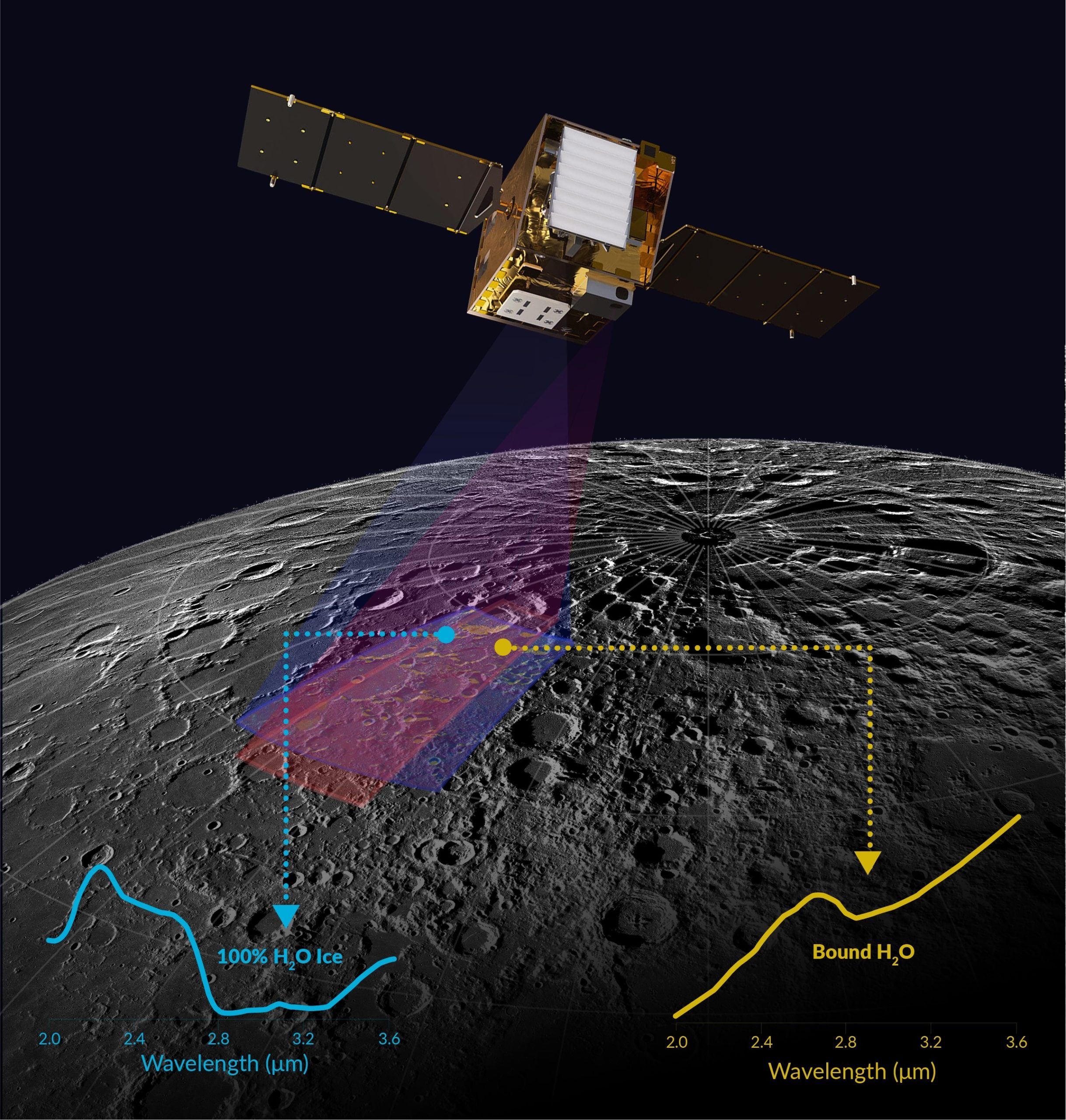
LITTLETON, Colorado – A university-led lunar orbiter is nearing takeoff that will operate in patrol mode to detect signatures of ice in reflected light, pinpointing the locales of ice or water trapped in rock at the Moon’s surface.
The Lunar Trailblazer is now in Florida and slated to be stacked atop a SpaceX Falcon 9 launcher. It will be boosted in “rideshare” mode — likened to Uber/Lyft-pool transportation – along with the commercial Intuitive Machines-2 lunar lander named Athena.
Clean room preparation
Prior to its transport, I spent time here within a Lockheed Martin clean room where the probe was undergoing final grooming for shipping.

Leonard David, a dirty reporter in Lockheed Martin clean room gets up-close view of moonbound Lunar Trailblazer.
Image credit: Barbara David
Lunar Trailblazer utilizes the aerospace company’s new Curio platform – a novel and scalable deep space smallsat spacecraft architecture, designed for deep space exploration and probe scientific questions at less cost.
University/industry duties
Lunar Trailblazer is managed by NASA’s Jet Propulsion Laboratory and led by the California Institute of Technology (Caltech) in Pasadena, California. Bethany Ehlmann, professor of planetary science at Caltech is principal investigator for Lunar Trailblazer.
Lockheed Martin developed and built the roughly 440 pound (200 kilograms) spacecraft, as well as integrated the craft’s science instruments. The probe is outfitted with two deployable solar arrays.
For more information on this spacecraft and its duty to scout for water ice on the Moon, go to my new Space.com story – “SpaceX to launch water-hunting moon probe ‘Lunar Trailblazer’ on Feb. 26” – at:

The view by moonwalking astronauts standing on the edge of the Vallis Schrödinger canyon is captured in this artistic rendering.
Image credit: Lunar and Planetary Institute/Michael Carroll
Earth’s Moon continues to surprise!
In a major discovery, a team of scientists at the Lunar and Planetary Institute (LPI), an institute of the Universities Space Research Association (USRA), have found two Grand Canyon-scale features on the lunar far side.
Similar in width and depth to Earth’s Grand Canyon that took millions of years to form, the epic features were produced in minutes during a period of planetary upheaval when the Earth and Moon were being resurfaced by impacting asteroids and comets.
The research findings were published today in Nature Communications.

Views of the Schrödinger peak-ring impact basin and two radiating canyons carved by impact ejecta.
Image credits: NASA\SVS\Ernest T. Wright; LRO LROC WAC/Arizona State University/NASA GSFC
Formed in minutes
According to lead author of the new research paper, David Kring of the USRA’s LPI: “Nearly four billion years ago, an asteroid or comet flew over the lunar south pole, brushed by the mountain summits of Malapert and Mouton, and hit the lunar surface. The impact ejected high-energy streams of rock that carved two canyons that are the size of Earth’s Grand Canyon. While the Grand Canyon took millions of years to form, the two grand canyons on the Moon were carved in less than 10 minutes.”
The features are called Vallis Schrödinger and Vallis Planck. These deep groves were formed by rocky debris flung from the celestial impact that created the enormous 320-kilometer-diameter Schrödinger impact basin, near the lunar south pole.
Making use of imagery and elevation data churned out by NASA’s Lunar Reconnaissance Orbiter spacecraft, the canyons were found to be 20 to 27 kilometers wide, 2.7 to 3.5 kilometers deep, and 270 to 860 kilometers long.

Width and depth of the Grand Canyon along the Bright Angel hiking trail from the south to the north rim contrasted with width and depth of Vallis Planck.
Image credit: Kring, et al.
Energetic ejecta
Co-author Gareth Collins adds: “The Schrödinger crater is similar in many regards to the dino-killing Chicxulub crater on Earth. By showing how Schrödinger’s km-deep canyons were carved, this work has helped to illuminate how energetic the ejecta from these impacts can be.”
The colliding, canyon-producing culprit, an impacting asteroid or comet, likely struck the lunar surface at about 35,000 miles per hour (55,000 kilometers per hour). The Moon-specific big bang yielded the Schrödinger impact basin.
Most of the excavated rock was ejected away from the lunar south polar region, which Artemis astronauts will soon explore.
Geologic samples
The Schrödinger impact debris did not bury the lunar south polar region. Therefore, astronauts will find it easier to collect geologic samples from an even older epoch in lunar history.

Image credit: NASA
Furthermore, the two canyons provide an opportunity to sample material that is more ancient; this material was once two or three kilometers beneath the lunar surface.
That extraordinary geology will be matched by extraordinary vistas, Kring adds. “The splendor of the canyons is so dramatic that if exposed on Earth, they would be national or international parks.”
For more information on this exciting find, go to – “Grand canyons on the Moon” at:

Image credit: ESO/P. Horálek
It is labeled “noctourism” or nocturnal tourism, the hunger to experience first-hand, along with eyes-on, the nighttime sky in order to soak up the enveloping splendor.
Noctourism is a top travel trend for 2025, one that has been flagged by Booking.com, a leading digital travel firm headquartered in Amsterdam with local support offices around the globe. They underscore that voyage dictum, “It’s not the destination, it is the journey,” with looking up and outward as one trend that’s shaping the future of travel.

Image credit: Booking.com/Svalbard Hotel The Vault
Starbathing experiences
“With space tourism edging ever closer to reality, travelers will be focused on building connections with the universe as they turn to more attainable astro-pursuits in 2025,” observes Booking.com. Their research indicates nearly two thirds (62%) of those polled are considering visiting darker sky destinations with “starbathing” experiences (72%), star guides (59%), viewing once in a lifetime cosmic events (59%), and constellation tracking (57%) high on the stellar adventure to-do list.
“An appreciation for the nocturnal world,” Booking.com adds, “is also deepening travelers’ connections with nature, as the majority of travelers (54%) would book an accommodation without lights to encourage less light pollution and preserve flora and fauna.”

Capturing the constellation Orion and bright star Sirius taken from Mojave National Preserve.
Image credit: NASA/Preston Dyches
Key takeaways
According to the group, their travel predictions 2025 commissioned research surveyed a sample of adults who plan to travel for business or leisure in the next 12-24 months. In total, 27,713 respondents from 33 countries and territories were polled.
Along with trips around nocturnal, nature-based activities, other key takeaways from the research include:
- There will be an increased desire for authentic, off-the-beaten-path experiences
- Sustainability will be an even bigger priority
- A blend of wellness and adventure will drive travel choices
- Family values will hold more importance
- Trips and experiences will need to cater for diversity
Dark-sky zones
Booking.com points out that noctourism will see travelers seeking out dark-sky zones intent on marveling at the solar system and engaging in activities involving stargazing activities.
“And it’s not a handful of us, either – over 60% of the people we asked said they were considering visiting destinations with limited light pollution as a way to inch closer to the cosmos,” the online travel platform explains.
Interestingly, the trend in noctourism is being fueled by concerns around climate change here on Earth.
Over half of those surveyed plan to elevate their nighttime viewing sojourns to avoid rising daytime temperatures, with 42% of travelers preferring to vacation in cooler locations.
“Protection from UV rays is important for 61% of travelers who say they plan to reduce the amount of time they spend in the sun, while more than half (57%) expect to plan activities in the evenings and early mornings when the sun is at its lowest,” Booking.com states.

It’s a big Universe – any other skywatchers out there?
Credit: Space Telescope Science Institute
Night markets
Across both city and rural destinations, the digital travel firm said, noctourism will see existing attractions extending their opening hours to cater for changing visitor preferences, “alongside a host of new experiences springing up to meet demand (organized stargazing tours, night markets, and opportunities to witness once-in-a-lifetime cosmic events).”
Taking a longer look into future years, Booking.com suggests technology to further revolutionize how travelers plan and experience their excursions.
“AI-driven tools and neuro-inclusive innovations will make holidays more adaptable, ensuring all travelers feel catered to. Additionally, the growing focus on wellness suggests that travel will increasingly be seen as a tool for long-term self-care rather than just a brief escape,” they conclude.
For more information on Booking.com and their predictions for travel in 2025, go to:

