Archive for the ‘Space News’ Category
 Author:
  February 20th, 2025
Intuitive Machines IM-2 lunar lander within SpaceX Falcon 9 payload fairing.
Image credit: SpaceX
Intuitive Machines announced its IM-2 mission Nova-C class lunar lander, Athena, has completed all integration milestones.
The lunar lander is safely encapsulated within SpaceX’s payload fairing in preparation for launch. A multi-day launch window opens no earlier than February 26 from Launch Complex 39A at NASA’s Kennedy Space Center in Florida.

Firefly Blue Ghost now in lunar orbit.
Artwork credit: Firefly Aerospace/Inside Outer Space screengrab
Trio of lunar landers
“Humanity has never witnessed three lunar landers en route to the Moon at the same time, and Athena is ready to rise to the occasion,” said Intuitive Machines CEO Steve Altemus.
The two other landers are Firefly’s Blue Ghost now in lunar orbit, targeted for a March 2 landing, and Japan’s ispace lander expected to perform a Moon orbit insertion maneuver around early May.

ispace lunar lander/rover.
Image credit: ispace
Moon orbiter too
The Intuitive Machines IM-2 mission and Firefly’s Blue Ghost are part of NASA’s Commercial Lunar Payload Services (CLPS) initiative, viewed as central to the space agency’s Artemis lunar exploration plans.
Along with the upcoming departure of IM-2, the Caltech-led Lunar Trailblazer, an ice-snooping Moon orbiter, is also being integrated in the SpaceX payload fairing as a ride share.
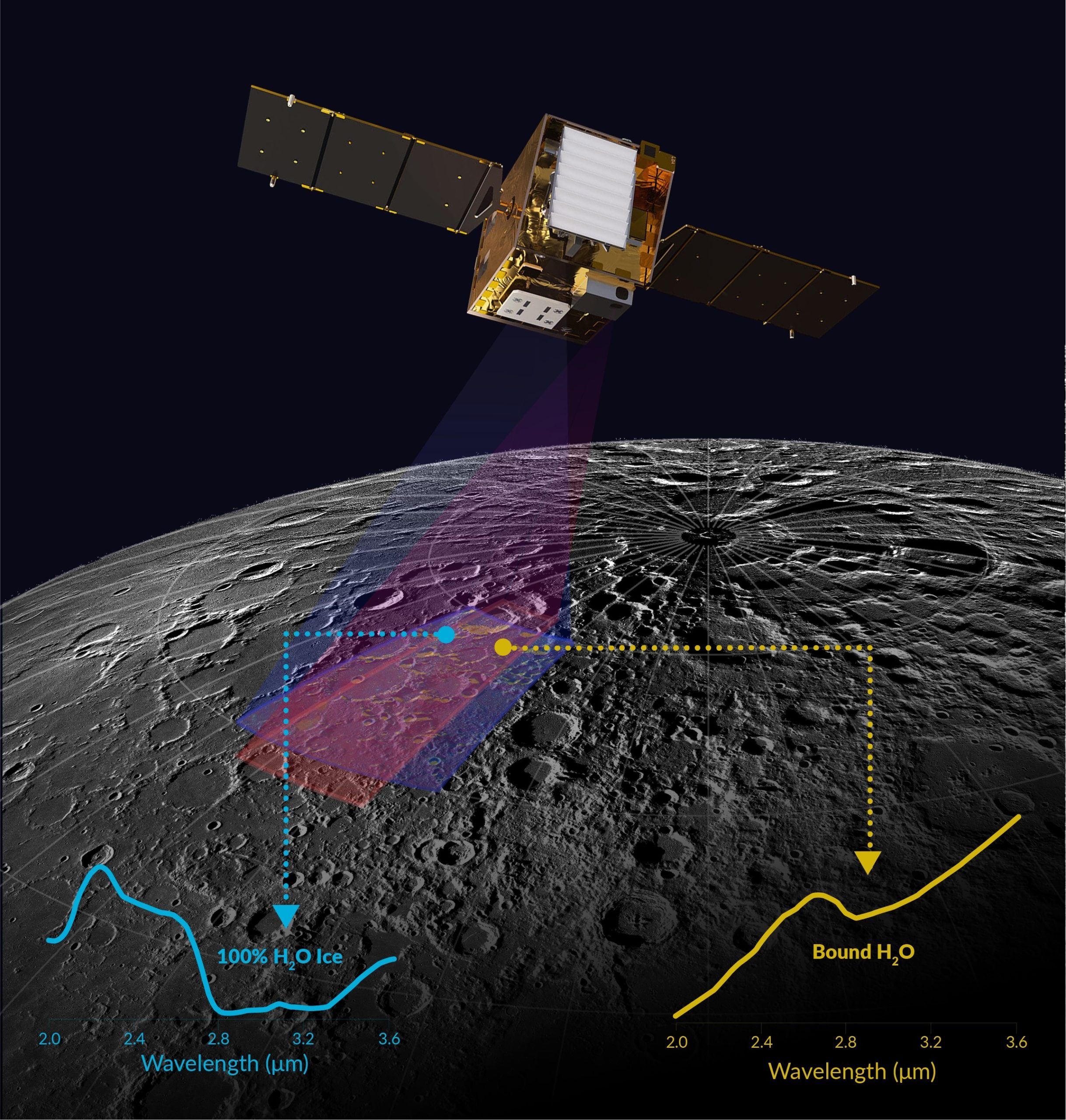
Science instruments onboard Lunar Trailblazer smallsat probe for lunar water.
Image credit: Jasper Miura, Lockheed Martin
 Posted in

New Horizons was built by the Johns Hopkins Applied Physics Laboratotry.
Credit: NASA/Johns Hopkins University Applied Physics Laboratory/Southwest Research Institute/Steve Gribben/Alex Parker
NASA’s New Horizons spacecraft conducted the first and only exploration flyby of the Pluto system, culminating at the closest approach of that distant world in July of 2015.
Sailing onward, the vehicle carried out a January 1, 2019 flyby of Arrokoth, a Kuiper Belt Object, or KBO, located in a region of space beyond Neptune called the Kuiper Belt. There could be scads of other icy worlds residing in the Kuiper Belt, celestial leftovers from the formation of our solar system.

New Horizons Principal Investigator Alan Stern of Southwest Research Institute (SwRI), Boulder, CO., left, with print of a U.S. stamp with suggested update since the New Horizons spacecraft explored Pluto in July 2015.
Credit: NASA/Bill Ingalls
For New Horizons, the gathering of more exploration science is, pun intended, on the horizon.
As for what’s coming next, go to my new Space.com story — Leaving Pluto in the dust: New Horizons probe gearing up for epic crossing of ‘termination shock’ – at

Image credit: Firefly Aerospace
The Firefly Moon landing team reports that a second lunar orbit maneuver has been attained.
Their Blue Ghost commercial lander performed a 3 minute, 18 second burn.
Blue Ghost Mission-1 will deliver 10 science and technology instruments to the lunar surface as part of NASA’s Commercial Lunar Payload Services (CLPS) initiative.
“This maneuver moved the lander from a high elliptical orbit to a much lower elliptical orbit around the Moon,” Firefly central explains.
In this orbit, the team will experience planned rolling communication blackouts as Blue Ghost goes around the far side of the Moon.

Closing in on the Moon! Firefly Blue Ghost new imagery.
Image credit: Firefly Aerospace
Landing date
When on the near side, the team will continue to downlink data and finalize the plan for the craft’s next maneuver that nudges Blue Ghost even closer to the lunar surface.
All is on track for sticking the lunar landing on March 2.
Blue Ghost will attempt to land near a volcanic feature called Mons Latreille within Mare Crisium.
Go to this newly released video of the Moon’s surface taken by Blue Ghost.

NASA’s Small Spacecraft Systems Virtual Institute (S3VI) has released the 2024 State-of-the-Art Small Spacecraft Technology report.
This informative and detailed 2024 edition reflects updates in several areas, including formation flying and rendezvous and proximity operations, additive manufacturing, free space optical communications and hosted orbital services.
Invaluable insights
The document provides invaluable insights in numerous areas, including power, in-space propulsion, guidance, navigation, and control, as well as thermal control, smallsat avionics and deorbit systems.
The S3VI is located at the NASA Ames Research Center in California’s Silicon Valley. The S3VI is sponsored by NASA’s Space Technology Mission Directorate (STMD).

Image credit: S3VI
Improved capabilities
“Technology maturation and miniaturization continues to expand small spacecraft capabilities with the rise in complex SmallSat mission designs. These improved capabilities have broadened the common SmallSat platform resulting in larger CubeSats and smaller SmallSats,” the report notes.
The NASA Small Spacecraft Technology State-of-the-art report is updated annually to capture new information on publicly available small spacecraft systems from NASA and other sources.

Image credit: S3VI
Mass categories
SmallSats are generally grouped according to their mass, and this report adopts the following five small spacecraft mass categories:
- minisatellites are spacecraft with a total mass of 100 – 180 kg;
- microsatellites have a total spacecraft mass of 10-100 kg;
- nanosatellites have a total mass of 1 – 10 kg;
- picosatellites have a mass of 1 – 0.01 kg; and
- femtosatellites have a total spacecraft mass 0.01 – 0.09 kg.
Bridging technology gaps
“While updates in all chapters reflect this growth in the small spacecraft market,” the report points out, “a focused effort was made to update areas with recent technology developments that may ultimately bridge existing technology gaps.”
To access a copy of this report, go to:
https://www.nasa.gov/wp-content/uploads/2025/02/soa-2024.pdf?emrc=0945a0
Also, be sure to check out the resource-rich Small Spacecraft Systems Virtual Institute website at:
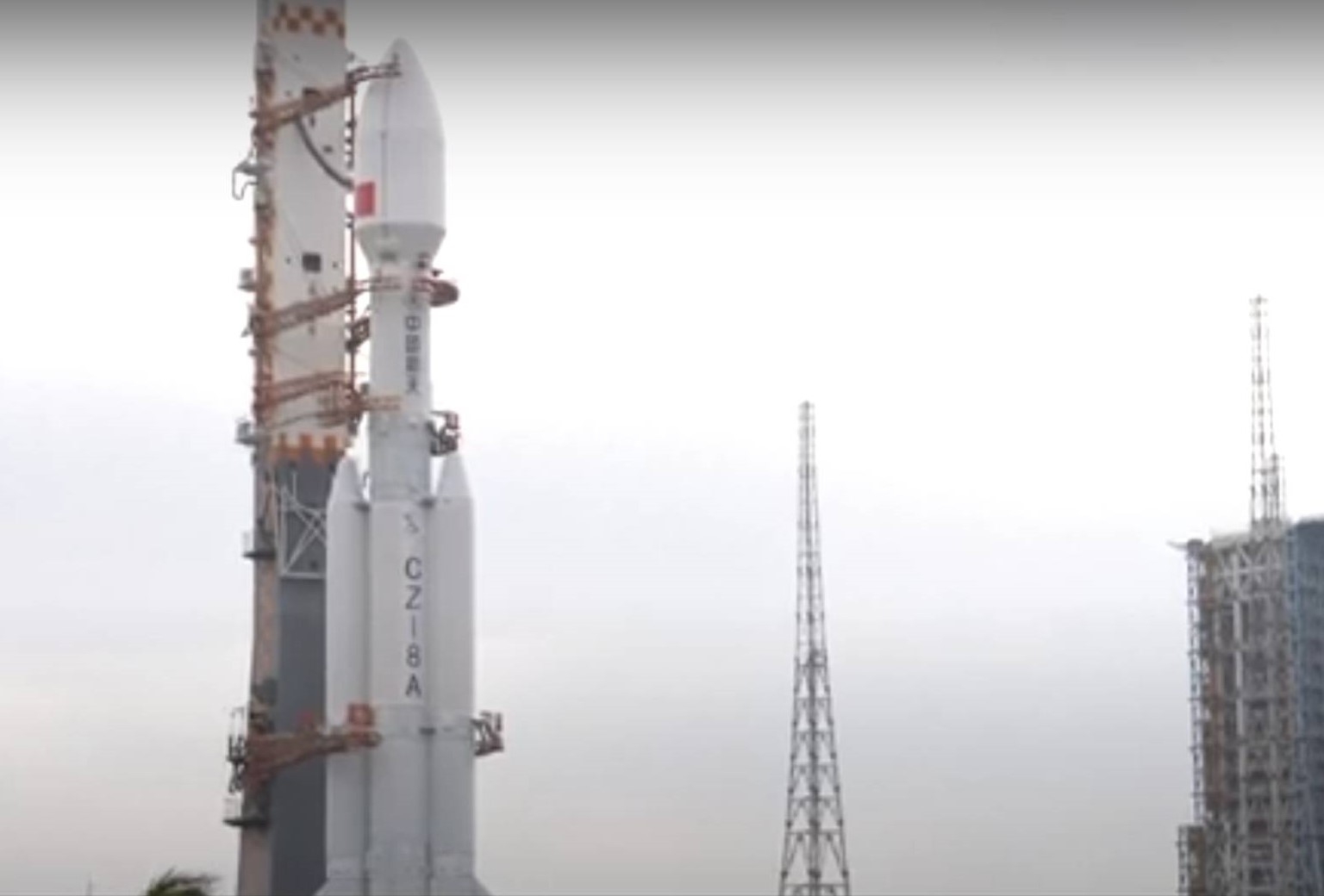
Image credit: China Central Television (CCTV)/China Aerospace Science and Technology Corporation (CASC)
Once again the Philippine Space Agency was on guard for possible rocket debris stemming from China’s recent launch of a Long March 8A rocket from Wenchang Spacecraft Launch Site in Wenchang, Hainan.
The maiden flight of the Long March 8A booster took place on February 11, reportedly hurling into orbit a set of satellites for China’s State-owned internet network.

Drop zones
As posted by the Philippine Space Agency (PhilSA) any expected debris resulting from the rocket launch were projected to fall within identified “drop zones.”
The Philippine Office of Civil Defense (OCD) alerted residents in the provinces of Palawan and Basilan, where parts of China’s Long March 8A rocket were expected to careen into coastal waters:
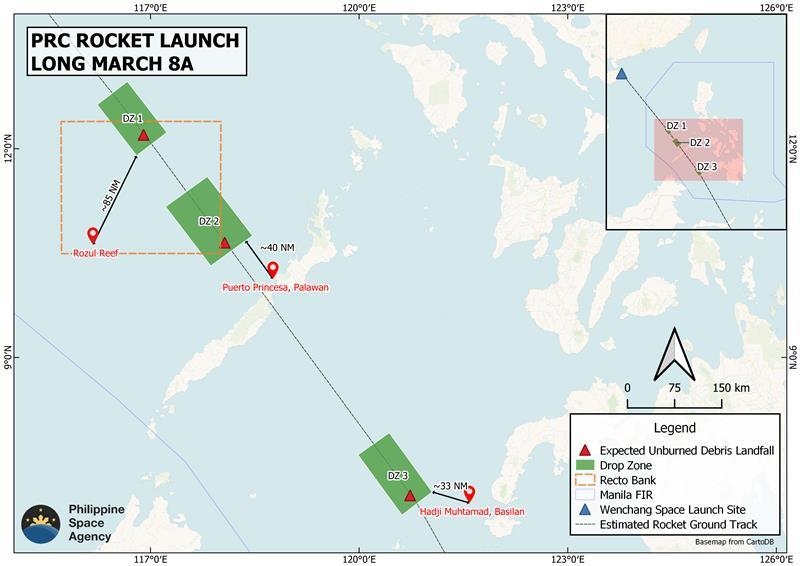
Image credit: PhilSA
Drop Zone 1: Approximate distance: 85 nautical miles from Rozul Reef.
Drop Zone 2: Approximate distance: 40 nautical miles from Puerto Princesa, Palawan.
Drop Zone 3: Approximate distance: 33 nautical miles from Hadji Muhtamad, Basilan.
Danger and potential risk
Meanwhile, the Bureau of Fisheries and Aquatic Resources (BFAR) temporarily barred fishermen from sailing at Rozul Reef in the Drop Zone 1.
In a February 11 PhilSA posted that while not projected to fall on land features or inhabited areas, “falling debris poses danger and potential risk to ships, aircraft, fishing boats, and other vessels that will pass through the drop zone.”

Rocket debris recovered in 2022.
Image credit: Philippine Coast Guard
There is also a possibility, PhilSA added, “for the debris to float around the area and wash toward nearby coasts.”
Toxic fuel
PhilSA reiterated its advice for the public to inform local authorities if suspected debris is sighted. “PhilSA also cautions against retrieving or coming in close contact with these materials that may contain remnants of toxic substances such as rocket fuel,” they stated.
As of Wednesday of this week, the PhilSA has not received reports about Long March 8A debris being found in coastal waters.
“The Long March 8A debris is expected to be from the side boosters and payload fairing of the rocket,” a PhilSA spokesperson told Inside Outer Space, based on the released information of a pre-launch Notices to Air Missions (NOTAMs) advisory.

China Long March-5B Y3 rocket remains from July 24, 2022.
Image credit: Philippine Coast Guard/Mamburao
No active search
It is safe to assume that the booster and payload fairing did land on the water within minutes after the launch, the PhilSA official added.
“As there have been no reports of pieces spotted floating in the water, it is also possible that the debris has sunk instead and therefore will not be found,” stated the PhilSA public relations and information division contact.
“Please note that we are not actively seeking out the debris. Our fishermen are not asked to do search parties for it. PhilSA only requests to be informed in case there are any sightings. Historically, the drop zones have been reliable,” said the official of the Philippine Space Agency.
In the past, on multiple occasions, Chinese rocket leftovers have peppered the area, including debris from a Long March 5B rocket launch in 2022. Filipinos later recovered launch litter thought to be parts of that booster plucked from waters off Mamburao, Occidental Mindoro.
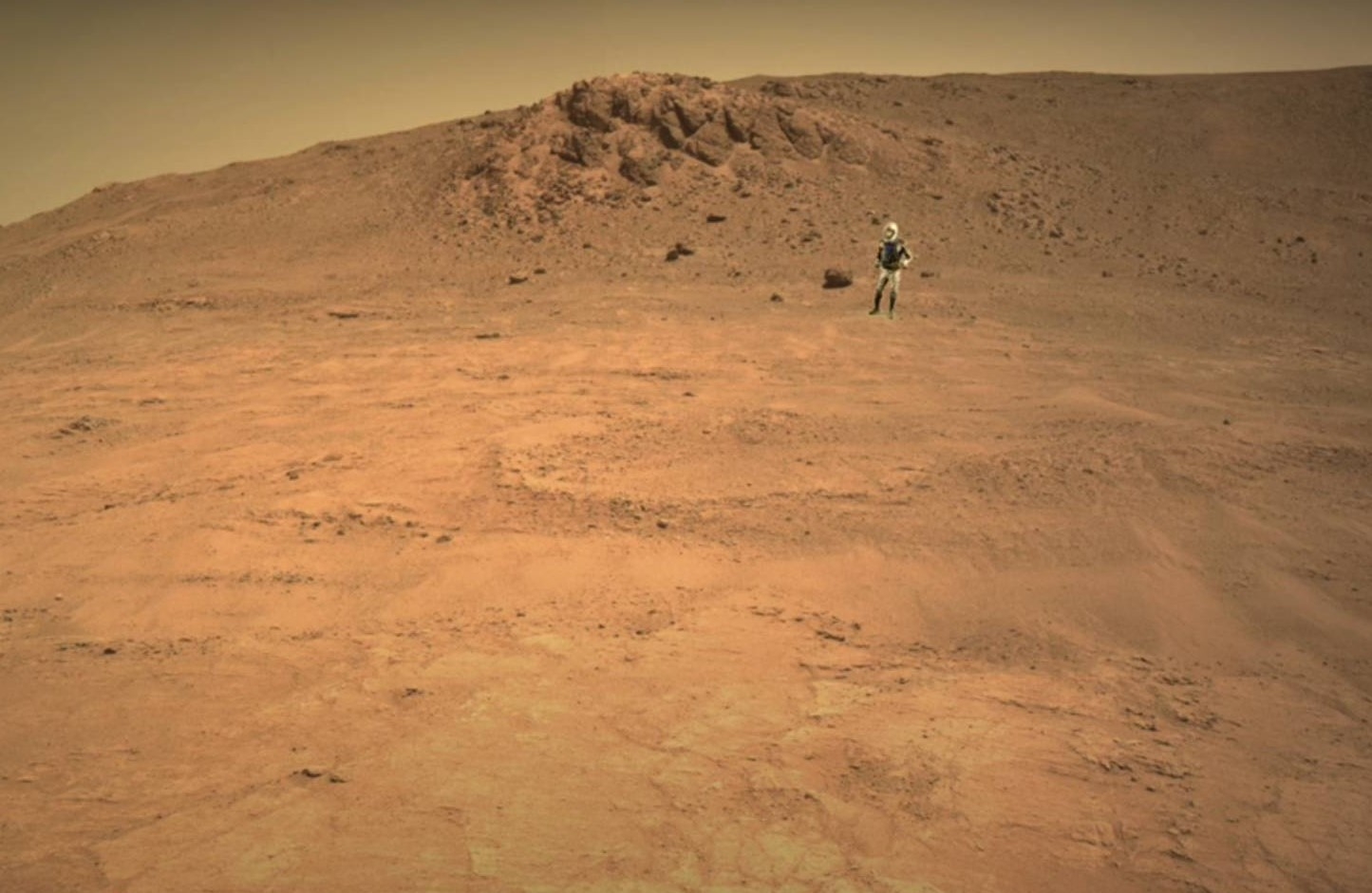
Image credit: Mars GuY
Mars refuses to share! That’s the word from Mars Guy in a new video episode.
NASA’s Perseverance Mars rover at Jezero crater drove back to the location of what could be one of the most significant discoveries of the mission.
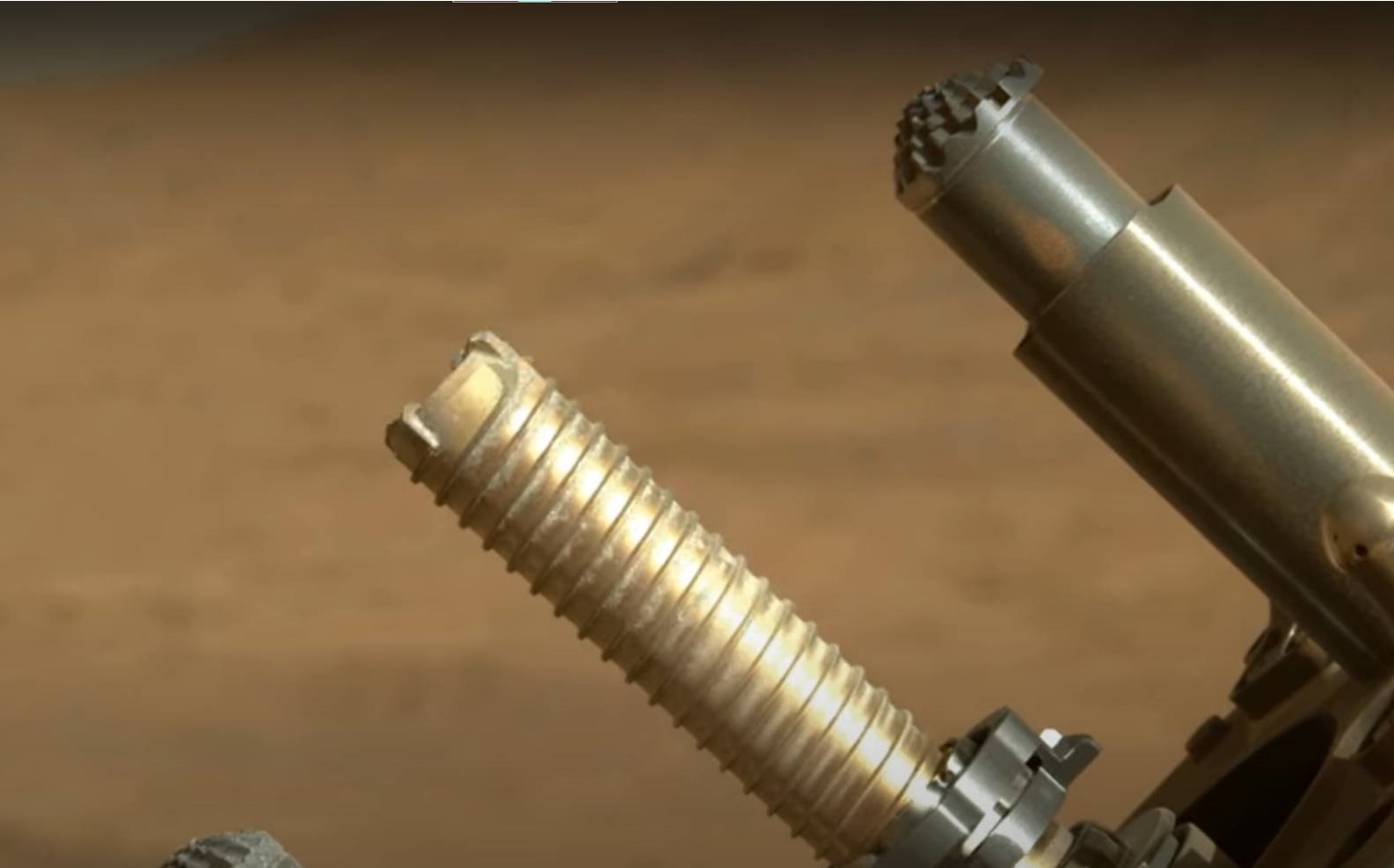
Image credit: NASA/JPL-Caltech/ASU
The plan this time was to collect a sample for return to Earth via a future Mars Return Sample campaign.
But Mars was not ready to participate in that plan.
What happened?
What’s at the “core” of this story?
Go to:
https://youtu.be/SuFE–SUfp8?si=-SUu1Ci1bVKaiEWc

Image credit: NASA/JPL-Caltech

Image of the Moon taken on Feb. 15, 2025 by ispace’s Resiloience lunar lander.
Image credit: ispace
Japan’s Resilience lunar lander completed a flyby of the Moon today, zipping within roughly 5,220miles (8,400 kilometers) of the Moon’s surface.
The commercial lunar lander is a product of ispace, a Moon exploration company.
“Resilience is now on a trajectory out to deep space before completing orbital maneuvers that will bring it back towards the Moon in advance of lunar orbit insertion,” stated ispace. “The date and time of the insertion maneuver have yet to be determined but are expected around early May.”

Image credit: ispace
Image credit: ispace
Packed with payloads
The lunar lander was launched on a SpaceX Falcon 9 rocket on January 15 of this year, along with the now-Moon orbiting Firefly Blue Ghost mission.
Resilience is toting a number of commercial payloads:
- Water electrolyzer equipment
- A food production experiment
- Deep space radiation probe
- A commemorative alloy plate modeled after “Charter of the Universal Century”
- The Tenacious micro rover developed by ispace-Europe
- A “Moonhouse” designed by Swedish artist Mikael Genberg and mounted on the rover
- A memory disk that preserves linguistic and cultural diversity from the United Nations Educational, Scientific and Cultural Organization (UNESCO)
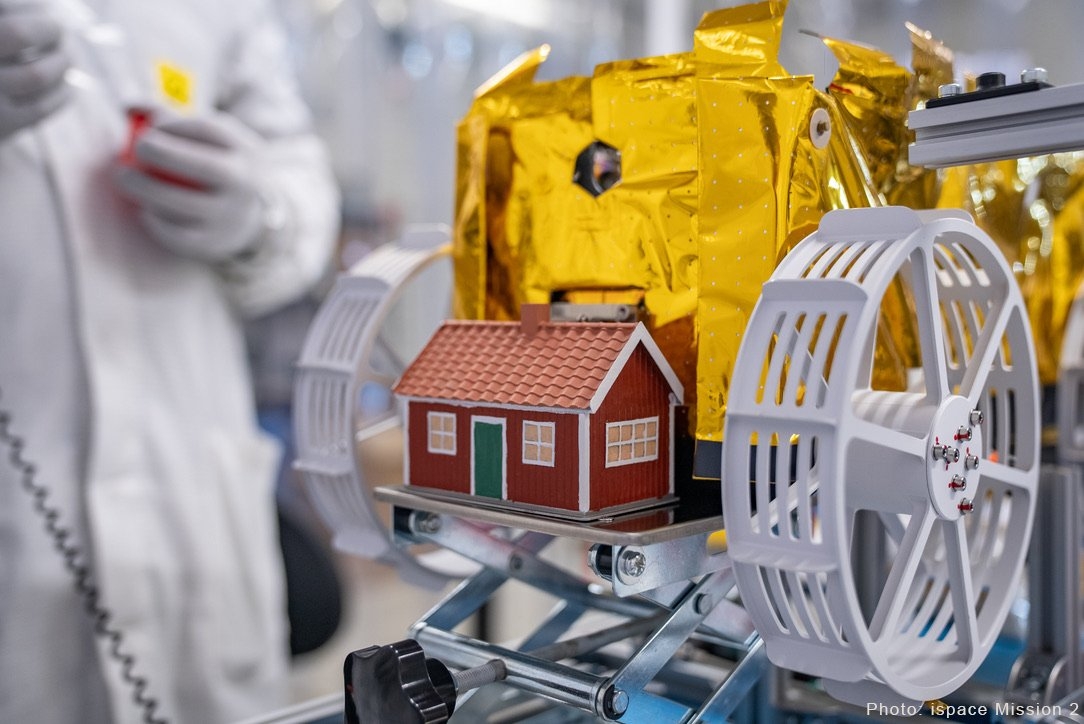
A “Moonhouse” designed by Swedish artist Mikael Genberg and mounted on the Tenacious micro rover.
Image credit: ispace
This is not the first lunar outing by ispace.
The ispace maiden mission of the company’s commercial lunar exploration program, known as HAKUTO-R, failed in April 2023 to land on the Moon, crashing onto the lunar terrain due to a navigation software failure.
Artwork credit: Firefly Aerospace/Inside Outer Space screengrab
Firefly’s Blue Ghost lander is on cruise control as it prepares to enter orbit around the Moon.
A recent engine burn to send the probe off to the Moon was performed with such accuracy, Firefly mission controllers are skipping the next one.
“With Earth in the rearview mirror, we’re on cruise control until we reach the Moon’s orbit and perform a Lunar Orbit Insertion in just a couple days,” a Firefly posting explains.
Since launching on January 15, Blue Ghost has performed dozens of health tests, and all 10 NASA payloads onboard remain healthy and ready for surface operations on the Moon.
The moonbound Firefly mission supports NASA’s Commercial Lunar Payload Services (CLPS) initiative.

Blue Ghost onboard camera captures Earth reflecting off the solar panel with the Moon on the horizon above Earth. Firefly’s X-band antenna and NASA’s LEXI payload are also shown on the top deck of the lander.
Image credit: Firefly Aerospace
What’s ahead?
Within the next two days, Blue Ghost will perform a Lunar Orbit Insertion, a 4-minute burn to enter the Moon’s orbit.
Following that vital step, the spacecraft will then spend 16 days in lunar orbit before descent.
“This gives us plenty of time to calibrate our navigation system and continue payload science operations for NASA,” the Cedar Park, Texas-based group adds.
Touchdown timing
As for lunar descent, Blue Ghost’s final autonomous descent will take approximately an hour, starting with a Descent Orbit Insertion burn that will place Blue Ghost on its descent trajectory on March 2.
The projected lunar landing site is Mare Crisium near Mons Latreille.
Upon touchdown, Blue Ghost will operate 10 NASA instruments for a complete lunar day (about 14 Earth days). On March 14, Blue Ghost will capture high definition imagery of a total eclipse from the Moon where the Earth blocks the Sun.
The Blue Ghost lunar lander will then capture the lunar sunset on March 16 before operating several hours into the lunar night.

Blue Ghost will capture imagery of the lunar sunset and provide critical data on how lunar regolith reacts to solar influences during lunar dusk conditions. The lander will then operate for several hours into the lunar night.
Artwork credit: Firefly Aerospace/Inside Outer Space screengrab

Image credit: CCTV/Inside Outer Space screengrab
China’s Moon exploration plans, including placing humans on the lunar landscape before 2030, continues to progress.
The China Manned Space Agency (CMSA) unveiled today the names of the lunar landing spacesuit and human-carrying lunar rover.
The Moon walking spacesuit is named “Wangyu”, meaning “gazing into the cosmos.”
“Tansuo” is the name selected for the rover, meaning “to explore the unknown.”

Image credit: CCTV/Inside Outer Space screengrab
These two names build upon a public naming campaign for China’s piloted Moon craft that took place in 2023, with the CMSA launching the naming campaigns for the lunar spacesuit and rover in September and October 2024.
Prototype development stage
“During the early stages of development, we have mastered key technologies such as the manufacture of lightweight and smaller-sized moon-landing spacesuits, as well as comprehensive protection against complex environments,” said Zhang Wanxin, director, spacesuit engineering office, China Astronaut Research and Training Center.

Zhang Wanxin, director, spacesuit engineering office, China Astronaut Research and Training Center.
Image credit: CCTV/Inside Outer Space screengrab
“We have now fully entered the prototype development stage, and are currently conducting comprehensive performance and function assessments and verifications of the prototype products,” Zhang told China Central Television (CCTV).
According to CCTV, the development and construction of the lunar landing phase of China’s human lunar exploration program are advancing as scheduled. The program has now entered the initial prototype development phase.

China lunar rover testing.
Image credit: CCTV/CMSA/Inside Outer Space screengrab
Ground trials
China’s humans to the Moon endeavor will complete multiple tasks, including “landing, patrolling, sampling, research, and return,” and establish an independent and autonomous manned lunar exploration capability.
CCTV also reports that the Long March-10 carrier rocket, the Mengzhou crewed spacecraft, the Lanyue lunar lander, along with the just-named lunar spacesuit and rover are in the initial prototype production and testing phase.

Image credit: CCTV/Inside Outer Space screengrab
Related ground trials are progressing as planned, CCTV adds. Ground facilities and equipment supporting these production and testing activities have been completed and are now operational. Similarly, construction at the Wenchang launch site to support China’s Moon landing effort is progressing as planned.

Prototype work on China’s lunar lander – Lanyue.
Image credit: CCTV/CMSA/Inside Outer Space screengrab
Go to this video detailing China’s Moon plans at:

Image credit: CCTV/Inside Outer Space screengtrab
A Chinese research team is developing a lightweight robotic drone with a targeted special mission scenario of Mars exploration.
The air-ground dual-purpose unmanned aerial vehicle (UAV) weighs only 300 grams, equivalent to the weight of an apple. The development team is at the School of Astronautics of Harbin Institute of Technology.
Shifting center of gravity
Seen as showing promising potential in future Red Planet science work, the UAV can take off at any time, traverse obstacles, and boasts superb endurance, reports China Central Television (CCTV).
“On the ground, it mainly rolls by shifting its center of gravity,” said Zhu Yimin, a Ph.D candidate of the School of Astronautics at Harbin Institute of Technology.
“In the air, it relies on a pair of contra-rotating coaxial rotors, controlled by a steering engine to adjust the forward direction, to control torque and force, ultimately achieving stable flight,” Zhu told CCTV.

Image credit: CCTV/Inside Outer Space screengtrab
Multiple models
The UAV work entails multiple models of air-ground dual-mode robots with different configurations, CCTV reports, moving by rolling close to the ground, saving power, reducing energy consumption, and achieving a flight endurance time of more than six times that of drones of the same size.
According to Zhang Lixian, a professor within the School of Astronautics, the hope is the aerial vehicle can show off its long endurance and observational abilities on Mars.
“Our second goal is for such machines to be suitable for construction in many underground spaces and for exploring unknown underground spaces. We also need robotic means for inspection and environmental detection. We have now materialized all these functions,” said Zhang.

Ingenuity on Mars.
Image credit: NASA/JPL-Caltech
NASA’s Ingenuity
The Chinese aerial drone work is taking a different approach that NASA’s Ingenuity Mars Helicopter. That milestone-making autonomous aircraft operated for nearly three years of flight on Mars, making 72 flights within Jezero Crater.
Dispatched by NASA’s Perseverance rover, Ingenuity weighed 4 pounds on Earth (1.81 kilograms on Mars); 1.5 pounds on Mars (.68 kilograms) – 1,814.3 grams.
Ingenuity first lifted off the martian surface on April 19, 2021, making its last flight on January 18, 2024. On flight 72 rotor blades on the craft were damaged during landing, permanently grounding the vehicle.
As the first aircraft on another world, Ingenuity flew more than 14 times farther than planned while logging more than two hours of total flight time.

Image credit: NASA/JPL-Caltech
For a video look at the potential Mars craft developed by China, go to:
https://www.facebook.com/NewsContent.CCTVPLUS/videos/600097986193696

