Archive for the ‘Space News’ Category
 Author:
  March 1st, 2025
Firefly Blue Ghost now in lunar orbit.
Artwork credit: Firefly Aerospace/Inside Outer Space screengrab
The Firefly Aerospace Blue Ghost lunar lander is slated to touch down in Mare Crisium on the Moon’s near side no earlier than 2:45 a.m. Central Standard “Texas” Time (0845 UTC) on Sunday, March 2.
Blue Ghost’s final autonomous descent will take roughly an hour, kick-started by the craft’s 19-second burn that will place Blue Ghost on its final descent trajectory and landing spot within Mare Crisium, near Mons Latreille.

Image credit: Firefly Aerospace
Delivery service
Blue Ghost Mission 1 is slated to deliver 10 science and technology instruments to the lunar surface as part of NASA’s Commercial Lunar Payload Services (CLPS) initiative. Following its landing, Blue Ghost is set to operate payloads for a complete lunar day (about 14 Earth days).
On March 14, Firefly expects to capture high-definition imagery of a total eclipse when the Earth blocks the Sun above the Moon’s horizon.
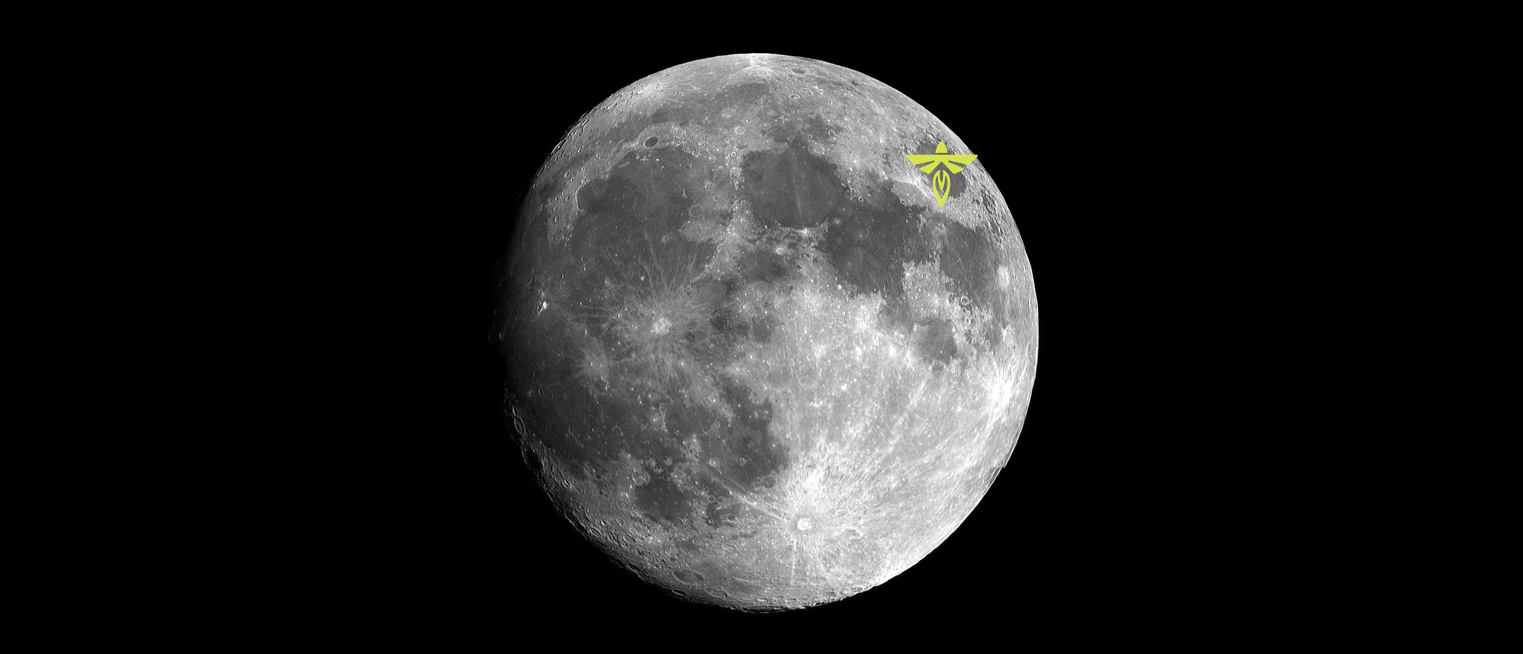
Image credit: Firefly Aerospace
Horizon glow
Blue Ghost will then capture the lunar sunset on March 16, perhaps helping unravel how lunar dust levitates due to solar influences and creates a “lunar horizon glow” as documented by Apollo 17 crewmembers in 1972.

Apollo 17’s Gene Cernan sketches of puzzling glow .
Image credit: NASA/Gene Cernan
Just before sunrise, in lunar orbit, Apollo 17 commander, Gene Cernan spotted and sketched out a puzzling glow circling the horizon of the Moon.

Surveyor 7 images of puzzling Moon glow.
Image credit: NASA
Years earlier, there were camera observations in 1967-1968 by several NASA Surveyor-series Moon landers of the phenomenon, dubbed Lunar Horizon Glow, believed to be electrically charged dust grains that could be levitated at sunset.
Firefly’s Blue Ghost will operate several hours into the lunar night following sunset.

Blue Ghost will capture imagery of the lunar sunset and provide critical data on how lunar regolith reacts to solar influences during lunar dusk conditions. The lander will then operate for several hours into the lunar night.
Artwork credit: Firefly Aerospace/Inside Outer Space screengrab
Soviet lunar landers
For space history buffs, Mare Crisium has already seen spacecraft landings.
The former Soviet Union’s Luna 23 was a robotic sample return mission that landed on November 6, 1974.
However, a spacecraft malfunction prevented the collection and return of a lunar sample. Due to a failure of the spacecraft’s Doppler equipment, the landing occurred with an increased vertical speed, which led to damage to the soil collection device
The entire spacecraft – consisting of a descent stage, ascent stage, and Earth-return capsule – is still at its touchdown spot.
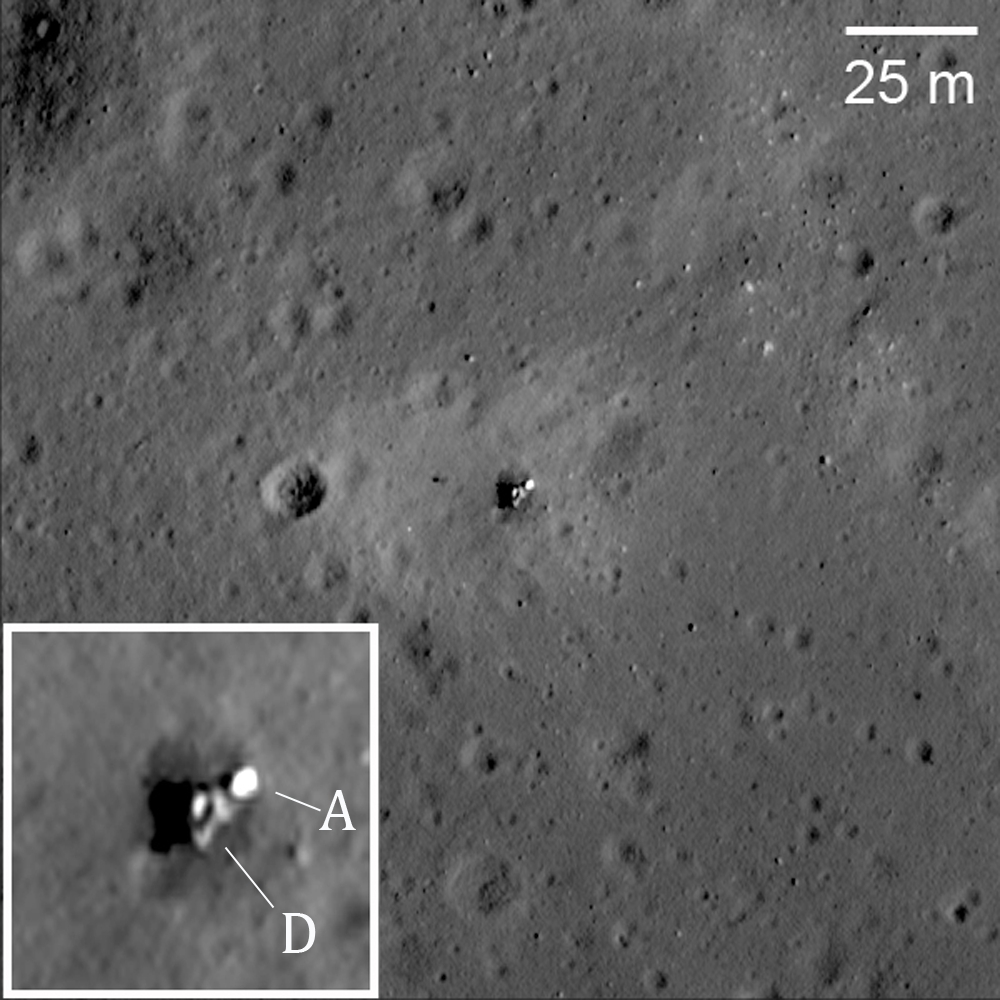
The entire Luna 23 vehicle (descent stage, ascent stage and Earth-return capsule) landed at an unexpected speed and fell on its side. Enlargement of vehicle in lower left inset; D: descent stage, A: ascent stage.
Image credit: NASA/GSFC/Arizona State University
This lander struck the surface at a very high velocity, tipping over as indicated in imagery taken years later by NASA’s Lunar Reconnaissance Orbiter (LRO).
Follow-up success
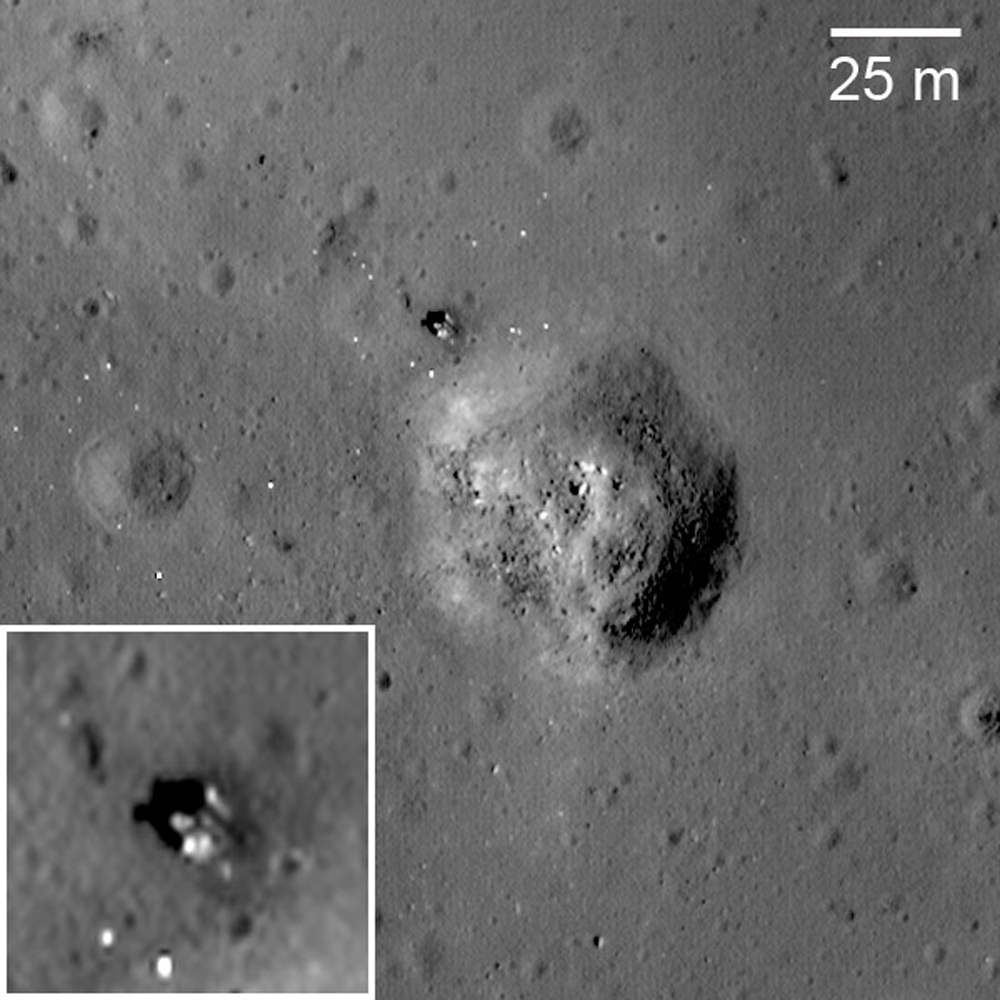
After the failure of Luna 23, the Soviet Union’s Luna 24 also landed in Mare Crisium on August 18, 1976. As noted by postings on the Lunar Reconnaissance Orbiter Camera (LROC) Science Operations Center website at Arizona State University, the landing sites of Luna 23 and 24 are only 1.4 miles (2.3 kilometers) apart.
Successful Soviet Moon lander – Luna 24.
Image credit: NASA/GSFC/Arizona State University
“The region of Mare Crisium where they landed is a typical smooth mare surface with little relief in the immediate vicinity,” the website notes.
The successful Luna 24 rocketed back to Earth its sample collection on August 22, 1976.
Given the incoming trajectory of Firefly’s Blue Ghost to its targeted touchdown, “It’s not within our procedures to capture the shot,” advises Firefly Aerospace, so maybe/maybe not.
Stay tuned!
To follow the lunar landing attempt by the Firefly Aerospace Blue Ghost, go to:
LIVE TRACK! Firefly Blue Ghost Lunar Landing at:
https://www.youtube.com/watch?v=k93YE-otlLo
Live coverage, jointly hosted by Firefly and NASA, is scheduled to begin at 1:30 a.m. CST (0730 UTC). Go to:
https://www.youtube.com/watch?v=ChEuA1AUJAY
For detailed information on the mission and its payloads, go to:
https://fireflyspace.com/missions/blue-ghost-mission-1/

Image credit: Firefly Aerospace
 Posted in

Caltech-led Lunar Trailblazer mission on the prowl to probe the abundance, distribution of water on the Moon, as well as the lunar water cycle.
Image credit: Lockheed Martin
A spacecraft to help sort out the availability and nature of water ice on the Moon is on the fritz.
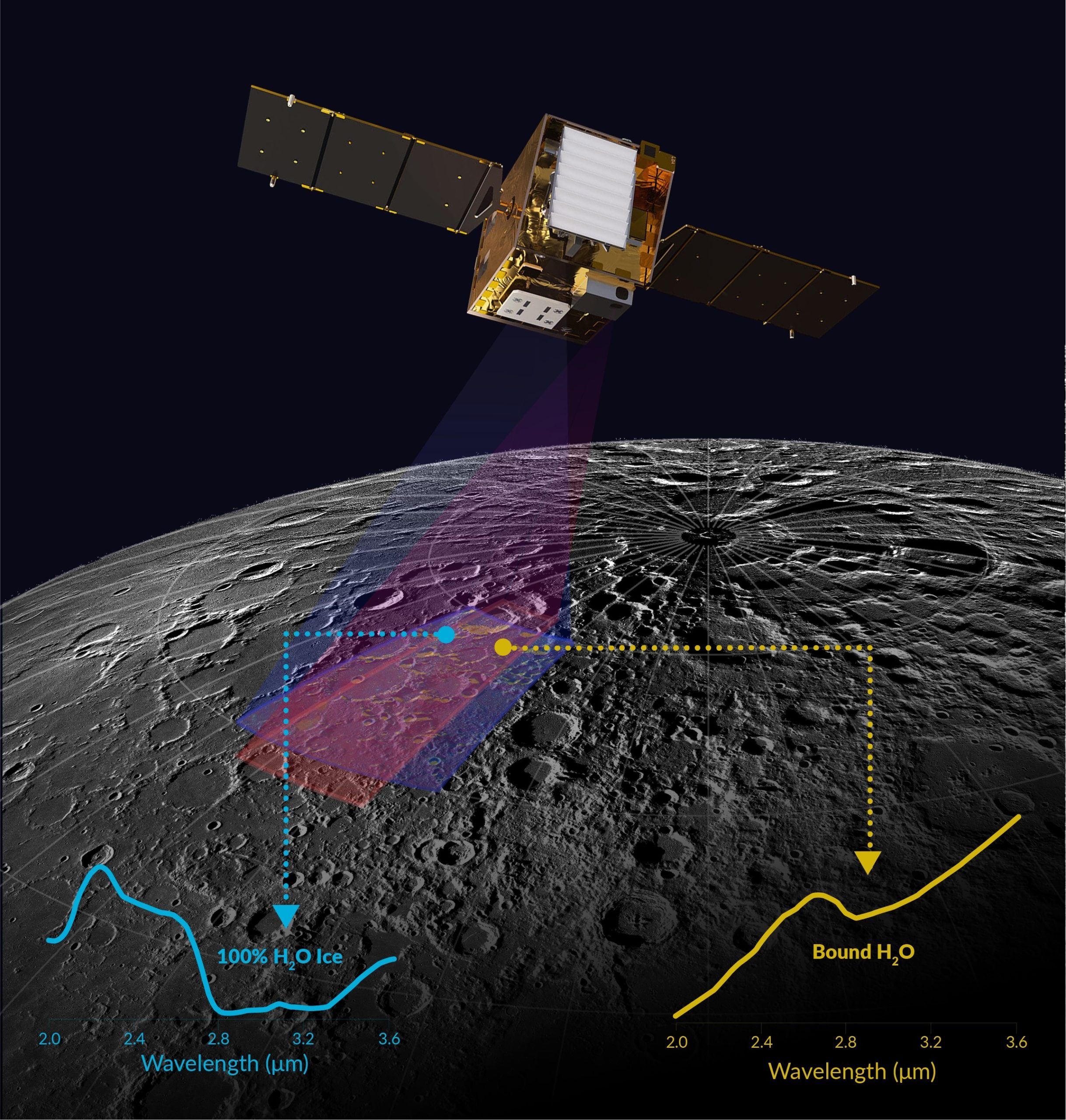
The NASA/Caltech Lunar Trailblazer was successfully deployed on February 26 as a ride share payload from a SpaceX Falcon 9 booster. It is designed to circuit the Moon in patrol mode to detect signatures of ice in reflected light, pinpointing the locales of ice or water trapped in rock at the Moon’s surface.
Mission operators at Caltech in Pasadena, California, established communications with the small satellite as expected following deployment.

Image credit: Lunar Trailblazer
Intermittent power issues
However, the team subsequently received engineering data indicating intermittent power system issues. They lost communication with the spacecraft Thursday morning at about 4:30 a.m. Pacific Standard Time.
Several hours later, the spacecraft turned on its transmitter.
Now the team is working with NASA ground stations to reestablish telemetry with Lunar Trailblazer.
Work is underway to better assess the power system issues and develop potential solutions.

Leonard David, a dirty reporter in Lockheed Martin clean room gets up-close view of moonbound Lunar Trailblazer.
Image credit: Barbara David
Curio platform
Lunar Trailblazer was developed and built by Lockheed Martin, with the aerospace firm also integrating the craft’s science instruments.
“We’ve been working closely with our partners at NASA JPL and Caltech throughout the mission,” said the company in a statement provided to Inside Outer Space. “Our spacecraft team onsite and our mission operations team in Denver are advising the Caltech-led flight operations team with solutions. We’re dedicated to the health and safety of Lunar Trailblazer and its mission.”
Lunar Trailblazer utilized the aerospace company’s new Curio platform. Curio is a scalable smallsat spacecraft architecture, designed to aid deep-space exploration and to probe scientific questions in a cost-efficient way.
In a NASA-provided statement to Inside Outer Space, the space agency approved life cycle cost for the mission is $94.1 million.

Image credits:
Lunar south pole basemap: LROC
PSR detections from Mazarico, et al. (2011)
Crater: Caltech/PCC/Hongyu Cui for Lunar Trailblazer project
Higher risk posture
Lunar Trailblazer was a selection of NASA’s SIMPLEx (Small Innovative Missions for Planetary Exploration) competition.
“To maintain the lower overall cost, SIMPLEx missions have a higher risk posture and less-stringent requirements for oversight and management,” NASA explains. “This higher risk acceptance bolsters NASA’s portfolio of targeted science missions designed to test pioneering technologies.”
For more information on this eagerly-awaited mission, go to my pre-launch reporting at:
Ready for Liftoff: Lunar Trailblazer to Scout for Water Ice on the Moon
https://www.leonarddavid.com/ready-for-liftoff-lunar-trailblazer-to-scout-for-water-ice-on-the-moon/

Image credit: Intuitive Machines
After liftoff on February 26, the Intuitive Machines’ Athena lunar lander established a stable attitude, solar charging, and radio communications contact with our mission operations center in Houston.
According to Intuitive Machines, the lander is in excellent health, sending selfies and preparing for a series of main engine firings to refine the probe’s trajectory ahead of lunar orbit insertion, planned on March 3.
Intuitive Machines is targeting a lunar landing opportunity on March 6.

Image credit: NASA/Inside Outer Space screengrab
Science instruments onboard Lunar Trailblazer smallsat probe for lunar water.
Image credit: Jasper Miura, Lockheed Martin
Trailblazer
Also deployed after the SpaceX Falcon 9 boost, and now en route to the Moon, is the Caltech-led Lunar Trailblazer.
Mission operators at Caltech in Pasadena, California, have received an initial signal from NASA’s Lunar Trailblazer. This indicates that the small spacecraft has powered up.
Weighing only 440 pounds (200 kilograms) and measuring 11.5 feet (3.5 meters) wide when its solar panels are fully deployed, Lunar Trailblazer will orbit the Moon about 60 miles (100 kilometers) above the surface.
The small satellite will generate the highest-ever resolution maps of the Moon’s surface water to determine the water’s location, form, abundance, and how it changes over time.

Image credit: NASA
Step by Step: The Artemis Program and NASA’s Path to Human Exploration of the Moon, Mars, and Beyond – A hearing by Space and Aeronautics Subcommittee held on February 26, 2025.
The purpose of this hearing is to review outside perspectives of NASA progress on the Artemis program, about the importance of maintaining the continuity of purpose for NASA’s human exploration program.
Strategy and goals
This hearing was focused on assessing how the strategy and goals behind NASA’s human exploration program have evolved over time from the Vision for Space Exploration to the current Moon to Mars Architecture.

Image credit: Inside Outer Space screengrab
The Committee is also considering whether NASA can leverage developments in United States space capabilities to achieve Artemis objectives in a faster and more cost-effective manner.
Finally, the hearing is focused on addressing how today’s efforts are directly tied to NASA’s future exploration goals, including a crewed mission to Mars.

Image credit: Inside Outer Space screengrab
Witnesses
Dr. Scott Pace, Director of Space Policy Institute, George Washington University
Mr. Dan Dumbacher, Adjunct Professor, Purdue University
Go to replay of hearing video at:
https://www.youtube.com/live/HpJmCt17KsA?si=rv5aq53_QcWKqrP7

Image credit: SpaceX
The eighth flight test of the SpaceX Starship is preparing to launch no earlier than March 3. The launch window will open at 5:30 p.m. Central (Texas) Time.
Due to the loss of Starship on flight test seven, several hardware and operational changes have been made to increase reliability of the upper stage.
“The upcoming flight will target objectives not reached on the previous test,” the SpaceX posting notes. They include:
- Starship’s first payload deployment involves four Starlink simulators that will be on the same suborbital trajectory as Starship and are expected to demise upon entry.
- Multiple reentry experiments geared towards returning the upper stage to the launch site for catch.

Image credit: SpaceX
Extensive upgrades
Starship’s upper stage that debuted on the previous flight test, focused on adding reliability and performance across all phases of flight.
“Starship’s forward flaps have been upgraded to significantly reduce their exposure to reentry heating while simplifying the underlying mechanisms and protective tiling,” SpaceX explains.
There are also redesigns to the propulsion system, including a 25 percent increase in propellant volume over previous generations. These redesigns add additional vehicle performance and the ability to fly longer duration missions.

Image credit: SpaceX/Inside Outer Space screengrab
Furthermore, the vehicle’s avionics has undergone a complete redesign, adding additional capability and redundancy for increasingly complex missions like propellant transfer and ship return to the launch site.
Vehicle and pad criteria
The upcoming test flight also includes the launch, return, and catch of the Super Heavy booster.
The Super Heavy booster for this flight features upgraded avionics, including a more powerful flight computer, improved power and network distribution, and integrated smart batteries.
“Distinct vehicle and pad criteria must be met prior to the return and catch of the Super Heavy booster, requiring healthy systems on the booster and tower and a final manual command from the mission’s Flight Director,” the SpaceX posting observes.

Refueling in space.
Image credit: SpaceX
If this command is not sent prior to the completion of the boostback burn, SpaceX adds, or if automated health checks show unacceptable conditions with Super Heavy or the tower, “the booster will default to a trajectory for a soft splashdown in the Gulf of America.”
Given a go to catch the Super Heavy booster, several radar sensors will once again be tested on the launch and catch tower’s chopsticks with the goal of increasing the accuracy when measuring distances between the chopsticks and a returning vehicle.

Flight test 7 image.
Image credit: SpaceX

Starship 7 leftovers arc into the Atlantic near the Turks and Caicos Islands.
Image credit: Dean Olson
Unpredictable
Lastly, as pointed out by the SpaceX posting, “developmental testing by definition is unpredictable.”
“But by putting flight hardware in a flight environment as frequently as possible, we’re able to quickly learn and execute design changes as we seek to bring Starship online as a fully and rapidly reusable vehicle,” the SpaceX overview statement concludes.
A live webcast of the flight test will begin about 40 minutes before liftoff, now slated for Friday, February 28, pending regulatory approval. The launch window will open at 5:30 p.m. Central (Texas) Time.
The flight test can be viewed on X @SpaceX. You can also watch the webcast on the X TV app. The live broadcast can also be viewed at:
https://www.spacex.com/launches/mission/?missionId=starship-flight-8
To read an update on the seventh test flight, go to:
https://www.spacex.com/updates/#flight-7-report

Image credit: SpaceX

Image captured by Firefly’s Blue Ghost lunar lander shortly after second lunar orbit maneuver on February 18. Blue Ghost’s solar panel, X-band antenna (left), and LEXI payload (right) on the top deck is also shown.
Image credit: Firefly Aerospace
Firefly Aerospace has completed a third and final lunar orbit maneuver of its Blue Ghost Moon lander.
Taking place early Monday morning, the Moon-circling lander carried out a 16-second burn of reaction control system thrusters, thereby inserting itself into a near-circular low orbit.
Up next…going down
This critical February 24 maneuver sets up the spacecraft to perform a descent to the lunar surface as planned on March 2.
“Up next, we’ll perform a 19-second Descent Orbit Insertion at our 100-kilometer perilune [point of orbit nearest the lunar surface] to begin our descent to Blue Ghost’s final destination, Mare Crisium, on March 2,” Firefly Aerospace states.
Go to newly issued video at:

Wait-a-Minute!
Image credit: Barbara David
Enter the “wait-a-minute” world of space stations.
Early this morning I saw the International Space Station slip across my Colorado mountain skyline.
I waved, but I don’t think they saw me.
But I did ponder the early demise of this huge human outpost in Earth orbit.
Incremental utility?
“It is time to begin preparations for deorbiting the Space Station,” recently explained SpaceX chief rocketeer Elon Musk on an X posting.

Sprawling but aging International Space Station.
Image credit: NASA
“It has served its purpose. There is very little incremental utility. Let’s go to Mars,” Musk said. “The decision is up to the President, but my recommendation is as soon as possible. I recommend two years from now,” Musk advised.
SpaceX has a NASA contract to junk the orbiting outpost into the ocean in coming years.

SpaceX-provided deorbiting of the International Space Station under NASA contract.
Image credit: SpaceX
Inclination “eternal”
But no need to worry. The Russian’s will soon fill the missing in action ISS void.
The first module of the Russian Orbital Station (ROS) is being prepared for hurling into polar orbit in less than three years.

Projected Russian orbiting station.
Image credit: Roscosmos/Inside Outer Space screengrab
That’s the word from RSC Energia’s Ilya Zheleznov, a lead engineer in the ROS design department.
In a recent Pro Kosmos interview, Zheleznov said that ROS will become the base for assembling and sending ships into deep space. The high orbital inclination of ROS will not only allow advancement in the development of radiation protection, but its modular design will extend the service life indefinitely.
“It could be eternal,” Zheleznov advised.

Image credit: Roscosmos/Inside Outer Space screengrab
Nose-dive
To nose-dive into the International Space Station discussion, go to:
NASA Responds to Musk Statements about Deorbiting ISS, Butch and Suni by space policy analyst Marcia Smith at:
Also, go to:
Ocean experts raise concerns over deorbiting the International Space Station at:
https://spacenews.com/ocean-experts-raise-concerns-over-deorbiting-the-international-space-station/
Lastly, check out the informative Pro Kosmos interview (in Russian) with Ilya Zheleznov at:
https://vkvideo.ru/video-219699195_456241129?ref_domain=prokosmos.ru

Wait-a-Minute!
Image credit: Barbara David
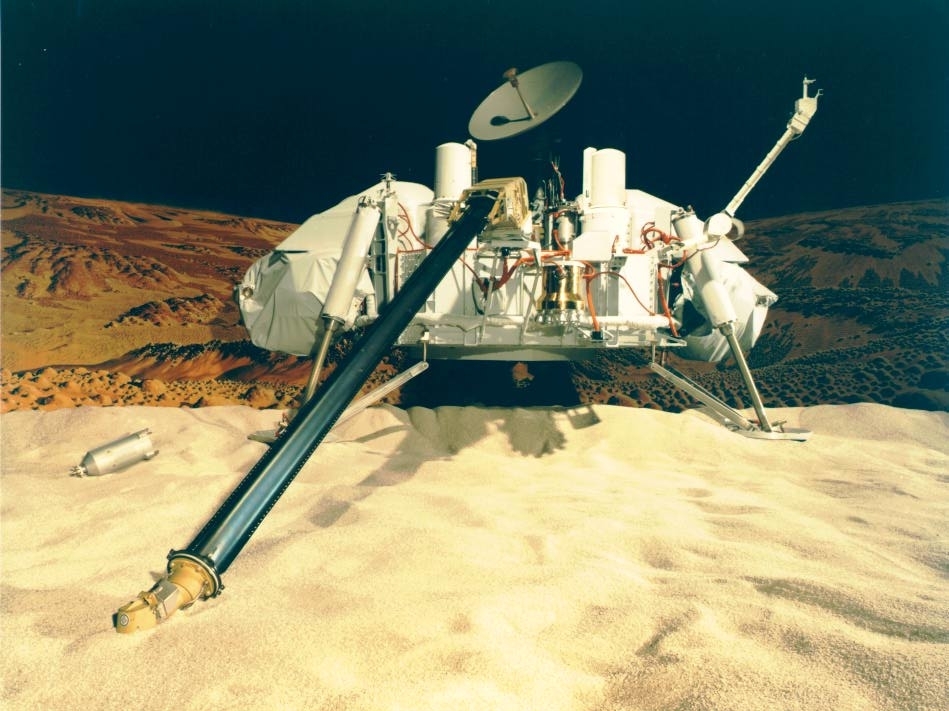
NASA Viking missions to Mars of the 1970s.
Credit: NASA
Back in 1976, the dual NASA Viking landers came to full stop on the Red Planet.
Their life detection experimental findings still reverberate within the scientific community – fueling the on-going discussion on a key question: Is there life on Mars?
Fast forward to today, a new paper tackles and reconsiders the results of the Viking Biology experiments.

NASA 1976 Viking 2 lander image of the Mars Utopian Plain.
Credit: NASA/JPL-CalTech
Perchlorate finding
The most significant change since those 1970’s experiments were conducted was the discovery of high levels of perchlorate on Mars. Perchlorate, plus abiotic oxidants, explains the Viking results and there is no requirement to postulate life on Mars.
“The discovery of perchlorate on Mars by the Phoenix mission has provided a basis for explaining the results of the Viking Landers,” the newly issued paper notes. “Thermal decomposition of perchlorate in the ovens of the [Viking] instrument can explain the lack of organics detected. Accumulation of hypochlorite in the soil from cosmic ray decomposition of perchlorate can explain the reactivity seen when nutrient solutions were added to the soil in the Viking Biology Experiments.”
However, the paper adds, “a non-biological explanation for the Viking results does not preclude life on Mars.”

Credit: NASA/Ben Clark
Revisit the results
The just-released paper — The Viking biology experiments on Mars revisited – has been authored by noted Mars researchers Christopher McKay, Richard Quinn and Carol Stoker. All three authors are from the space science division of NASA’s Ames Research Center at Moffett Field, California, near San Francisco.
“With Mars sample return on the horizon and the prospect of future missions to Mars, perhaps even including life detection instruments, it may be timely to revisit the results of the Viking Biology Experiments,” the research team suggests. “Since Viking landed on Mars, many things have changed, and many things have not. What has not changed in the past 50 years is our understanding of the limits of life in cold and dry environments.”
In a communiqué with Christopher McKay, he told Inside Outer Space: “It is important to note that we are not saying that the Viking results imply ‘no life on Mars.’ Nor are we saying the Viking results imply there is life on Mars.”

The first photo from the surface of Mars shows one of the Viking 1 lander’s footpads.
Credit: NASA/JPL
McKay said that their core point is that the Viking results are saying there is perchlorate and other oxidants on Mars, “and that is what the Viking biology experiments responded to.”
What this means is that the results of the Viking Biology experiments can’t be used to justify an approach to astronaut health and safety or a sample and/or astronaut quarantine policy for return to Earth that assumes no life on Mars.
New data
In their paper for the scientific journal, Icarus, the research trio explains that there have been big changes resulting from missions to Mars. “The most important new data, by far, was the surprising discovery from the Phoenix Mission that the soils of Mars contain about 0.5% perchlorate,” they observe. “This incredibly high concentration of perchlorate is still not adequately explained but the implications for the Viking results are profound.”

NASA Phoenix lander.
Credit: NASA/JPL
The space scientists in their paper explain that the perchlorate model and the resultant conclusion that Viking did not detect life in the surface soils of Mars will factor into any discussion of sample return or astronaut return from Mars.
“The Outer Space Treaty prohibits “adverse changes in the environment of the Earth resulting from the introduction of extraterrestrial matter.” Future experiments are needed to better understand the chemistry of martian soils and the possibility of life persisting there,” McKay and colleagues add.
Good targets
In summing up their research paper, they conclude that the perchlorate model for the Viking results “does not prove that there is no life on Mars, nor does it imply that the continued search for evidence of life on Mars, past or present, is pointless.”
Indeed, as the research team suggests, “we strongly argue for the search for evidence of extant life in future missions. Good targets are salt deposits and polar ground ice.”

The Red Planet as seen by Europe’s Mars Express.
Image credit: ESA/D. O’Donnell – CC BY-SA IGO
For access to the full paper – “The Viking biology experiments on Mars revisited” – go to:
https://www.sciencedirect.com/science/article/pii/S0019103525000132?via%3Dihub

Image credit: CCTV/Inside Outer Space screengrab
China’s Tianwen-2 spacecraft, designed to sample an asteroid, is now at the launch site and slated for launch in the first half of this year.
The China National Space Administration (CNSA) has announced the craft is at the Xichang Satellite Launch Center in southwest China’s Sichuan Province.
Tianwen-2’s targets: Collect samples from near-Earth asteroid 2016 HO3 and explore Comet 311P within the main asteroid belt between Mars and Jupiter.
Research hotspot
“The main-belt comet is another type of asteroid. It should be noted that it is not a true comet, but it may share some characteristics with comets, which is why it is called a main-belt comet or active asteroid,” said Yan Wei, a senior engineer at the National Astronomical Observatories of the Chinese Academy of Sciences.
The comet may emit substances, including gas and particles, when it is close to the sun, which has been observed and is “another research hotspot,” Yan told China Central Television (CCTV).

Image credit: CCTV/Inside Outer Space screengrab
Earth’s quasi-satellite
Asteroid 2016 HO3, which orbits stably near Earth and is known as “Earth’s quasi-satellite,” was first spotted on April 27, 2016, by the Pan-STARRS 1 asteroid survey telescope on Haleakala, Hawaii, operated by the University of Hawaii’s Institute for Astronomy and funded by NASA’s Planetary Defense Coordination Office.
This object contains ancient materials from the early solar system, reports CCTV, making it a “living fossil” useful for studying how the solar system formed and evolved.
With a diameter likely larger than 120 feet (40 meters) and smaller than 300 feet (100 meters), asteroid 2016 HO3 will be observed and analyzed by Tianwen-2, with the probe collecting samples of the object for return to Earth.

Image credit: CCTV/Inside Outer Space screengrab
Following the sample delivery to Earth, the probe is to fly onward to comet 133P, doing so with the assistance of swingbys of Earth and Mars.
The entire mission is expected to last about 10 years.
Material components
“We will also analyze collected spectral data [of the asteroid] to examine some of its material components, to find out what is the similarity between its material composition and that of the Moon and Earth. This is a key focus of our exploration this time,” said Yan Wei, a senior engineer at the National Astronomical Observatories of Chinese Academy of Sciences.

Asteroid 2016 HO3 has an orbit around the sun that keeps it as a constant companion of Earth.
Image credit: NASA/JPL-Caltech
China’s earlier Tianwen-1 mission was an orbiter/lander/rover deploy mission at Mars. Tianwen-3 is to be the country’s Mars sample return mission in the coming years.
For a video showcasing the Tianwen-2 mission, go to:

Image credit: Polish Space Agency (POLSA)
The Polish Space Agency’s (POLSA) Department of Space Security Team has confirmed that on February 19 there was an uncontrolled atmospheric entry of a SpaceX Falcon 9 rocket body that occurred over the territory of Poland.
The rocket stage, weighing approximately four tons, came from the Space X Starlink Group 11-4 mission, launched on February 1 from Vandenberg Air Force Base in California.
There are reports of rocket part leftovers reaching the ground.

Image credit: SpaceX
“Since the information about the discovery of probable rocket debris appeared, POLSA has been cooperating with the police, who are securing the area on site,” the space agency has stated. “A POLSA employee was immediately sent to these places to inspect the objects. POLSA also contacted SpaceX to confirm the origin of the debris and to plan further actions.”

Image credit: Adam Borucki/Facebook
Pressure vessels
Meanwhile, Marco Langbroek of SatTrackCam Leiden, the Netherlands, reports that there were lots of reports and videos of the reentry of the Falcon 9 upper stage that failed to perform its deorbit burn.
Reports have come in from the UK, the Netherlands, Germany, Denmark and Poland of a bright, slow, fragmenting fireball event, Langbroek explains. “Possible debris has been recovered around Poznan in Poland, two or three what appear to be composite wrapped pressure vessels,” he adds.
Indeed, Adam Borucki has posted imagery on the Internet of the object he found near Poznan, Poland – seemingly identified correctly as a pressure vessel.

