Archive for the ‘Space News’ Category
 Author:
  June 22nd, 2025
Image credit: CCTV/CNSA/Inside Outer Space screengrab
Following a recent escape flight test of China’s next-generation crewed spacecraft, Mengzhou, Chinese engineers are focusing on a flight test of the transport craft.

Image credit: CCTV
Mengzhou means “Dream Craft” and has previously completed a number of tests, including verification of the electronic system and testing of the entire ship. “A flight test will be conducted in [the] future to comprehensively verify its overall performance,” explains a China Central Television (CCTV) report.
Airbag cushioning system
The escape flight test was carried out June 17 at the Jiuquan Satellite Launch Center in northwest China. The spacecraft’s escape engine propelled the capsule-tower assembly upward.

Image credit: CCTV

Image credit: CCTV

Escape test.
Image credit: CCTV/Inside Outer Space screengrab
About 20 seconds later, the return capsule separated from the escape tower at the predetermined altitude. Two minutes later, the capsule landed safely in the designated area using an airbag cushioning system.
Focus shift
“The Mengzhou manned spacecraft is in the final stage of prototype sample development,” Yu Kang, a crewed spacecraft designer with China Aerospace Science and Technology Corporation (CASC) told CCTV.

Yu Kang, a crewed spacecraft designer with China Aerospace Science and Technology Corporation (CASC).
Image credit: CCTV/Inside Outer Space screengrab
“After completing this zero-altitude escape test, our entire development team will shift all focus onto the prototype development, targeting the maiden flight of the Mengzhou manned spacecraft,” Yu added.
Two assignments
CASC is the contractor for development of the Mengzhou spacecraft.
According to CASC, the Mengzhou spacecraft is also scheduled to conduct a maximum dynamic pressure escape flight test later this year, as part of the China Manned Space Program.
Mengzhou consists of a return capsule and a service module.
The spacecraft is being designed to support two key efforts: the low-Earth version is capable of carrying up to seven astronauts to and from China’s space station.
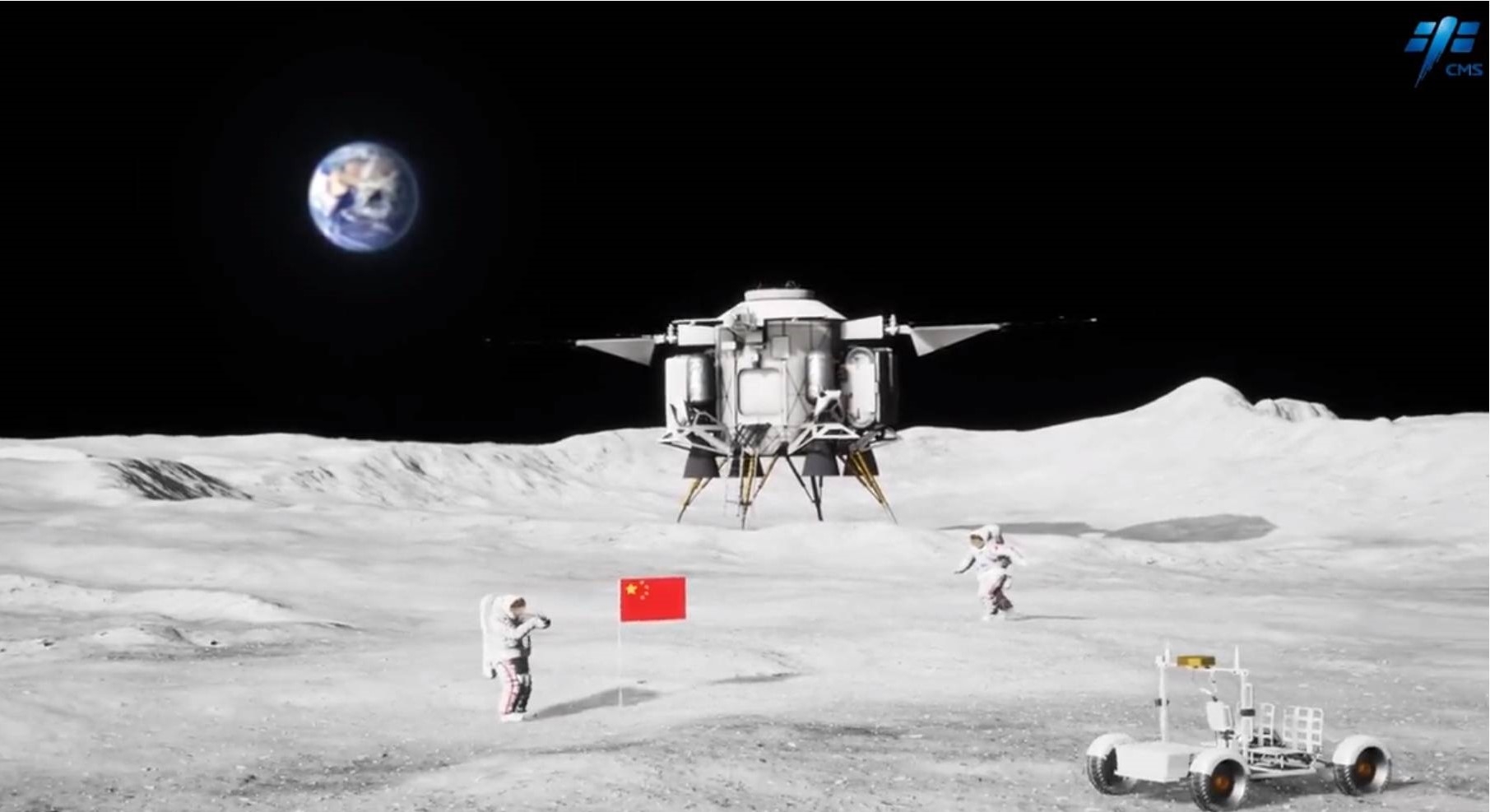
Image credit: China Manned Space Agency
A lunar version would be able to support three astronauts to the Moon.
Go to this video at:
 Posted in

Image credit: Mars Guy/Inside Outer Space screengrab
Sometimes our robotic exploration of another world doesn’t go as planned…
Sometimes a Mars rover drilling operation fails to collect a rock sample…
And sometimes this can lead to a discovery that no one anticipated.
Mars Guy details a drilling failure of the NASA Perseverance rover at Jezero Crater that leads to new discovery.
Go to this new video at:
https://youtu.be/R4qhM72IJXY?si=EqQiR6otAb9VFfhF

Wait-a-Minute!
Image credit: Barbara David
Lagrange points are special locations in space where the gravitational forces from a pair of large celestial bodies interact in out of the ordinary ways.
Lagrange points are named in honor of Italian-French mathematician Josephy-Louis Lagrange.
They offer unique advantages for human-made space objects to loiter indefinitely with minimal expenditure of propulsive energy. These locales are increasingly populated by spacecraft of many nations.
Enter a legal question in wait-a-minute style: should those locations be treated as “the common heritage of mankind?”

Image credit: NASA
Professor David Koplow of the Georgetown University Law Center makes the case in an article just published by the Michigan Journal of International Law. The paper is titled “Pave Outer Space and Put Up A Parking Lot: Lagrange Points Should Be the Common Heritage of Mankind.”
L-point use
But first a few “pointers” about L-points.
For example, the L1 point of the Earth-Sun system affords a continuous view of the Sun and is home to the Solar and Heliospheric Observatory (SOHO) satellite – a project of international cooperation between NASA and the European Space Agency (ESA).
Then there’s the outward looking James Webb Space Telescope nicely parked in Sun-Earth L2, roughly 1 million miles (1.5 million kilometers) from Earth.

Image credit: NASA, STScI, CSA
Also the Deep Space Climate Observatory (DSCOVR) is stationed at the Sun–Earth L1 Lagrange Point
Lastly, in the Earth-Moon system, five Lagrange points are numbered from L1 to L5. The L5 point was popularized by the late Gerard O’Neill and the L5 Society, seen as perfect for establishing a space colony.
Suitable rules
“Lagrange points are scarce and potentially very useful for commercial, civil, and military applications,” Koplow tells Inside Outer Space. “This is a rare opportunity for the international community to develop suitable rules in advance of the rush for the scarce ‘parking places’ in space.”
Lagrange points constitute a limited resource that is just beginning to be occupied, Koplow points out in the paper. “Existing international law is inadequate for optimal governance of their future occupation and use,” he states.
Koplow points out that not all sectors of space are equally valuable for all applications. The most desirable venues can become crowded, “affording a premium for those who gain access first and impeding the development of a fair and efficient all-inclusive international legal regime.”

Image credit: NASA Ames Research Center/Rick Guidice
First come, first served?
In Koplow’s view, space is a venue for multiple forms of competition, and some of that may spread to the Lagrange points. The question, to be resolved sooner or later, he adds, is what will be the rules for allocating access and use – first come, first served, or some more equitable system for sharing the benefits?
“The concept of the ‘common heritage of mankind’ refers to a system that allocates control over a scarce resource to the entire world, instead of to the countries and companies that happen to get there first,” Koplow told Inside Outer Space. “The concept has been applied – always with great controversy – in other shared spaces, and I argue that it should be extended to the Lagrange points,” he concludes.
The Michigan Journal of International Law (MJIL) article — “Pave Outer Space and Put Up a Parking Lot: Lagrange Points Should Be the Common Heritage of Mankind” — is available (for free) on-line at:
https://repository.law.umich.edu/mjil/
MJIL is a student-run law journal published by the University of Michigan Law School in Ann Arbor, Michigan.

Wait-a-Minute!
Image credit: Barbara David

The ispace Resilience lunar lander impact created a dark smudge surrounded by a subtle bright halo.
Image credit: NASA/GSFC/Arizona State University.
Japan’s failed ispace Resilience lunar lander crash site has been imaged by NASA’s Lunar Reconnaissance Orbiter.
The intended June 5 landing zone was within the center of Mare Frigoris (Sea of Cold), a volcanic region interspersed with large-scale faults known as wrinkle ridges.

Image credit: ispace
According to Mark Robinson, a lunar scientist for Intuitive Machines, based in Phoenix, Arizona, Mare Frigoris formed over 3.5 billion years ago as massive basalt eruptions flooded low-lying terrain. Later, the wrinkle ridges formed as the crust buckled under the weight of the heavy basalt deposits.

Glum news. Image credit: ispace/Inside Outer Space screengrab
Lost on landing
Following the ispace HAKUTO-R landing sequence, the Mission Control Center was unable to establish communications with the lander, determining that it was unlikely that communication with the Moon probe would be restored.
Also lost on landing was the Tenacious micro rover. That mini-rover was developed in Luxembourg by ispace EUROPE S.A., the European subsidiary of ispace.
Dark smudge

Image credit: ispaceAccording to Mark Robinson of the Lunar Reconnaissance Orbiter Camera
According to Robinson of the Lunar Reconnaissance Orbiter Camera Science Operations Center in Phoenix, Arizona: “The dark smudge formed as the vehicle excavated and redistributed shallow regolith (soil); the faint bright halo resulted from low-angle regolith particles scouring the delicate surface.”
Robinson told Inside Outer Space, the crash spot is roughly 1.5 miles (2,400 meters) from the one decimal place pre-landing ispace web page of latitude and longitude. Note that one decimal place equals 19 miles (30 kilometers), he said.
The crashed mission was ispace’s second try at soft-landing on the Moon. The private firm’s first attempt in April 2023 also ended in failure.
For details on the ispace moon mishap, go to “Japan crashes into the Moon, but slower than last time” by Scott Manley. Check out his detailed anatomy of a failure at:
https://youtu.be/d1_wAD717u0?si=CEU6C8-J8sWwejub

Click on image for before and after imagery taken by NASA’s Lunar Reconnaissance Orbiter’s LROC camera system.
Image credit: NASA/GSFC/Arizona State University

Image credit: Zengqian Hou, et al.
China’s aim to haul back to Earth bits and pieces of Mars via its Tianwen-3 mission is underscored in a new research paper, an effort to collect and rocket back at least a pound (500 grams) of the extraterrestrial goodies around 2031.
The preliminary proposed payload for the lander has been completed, as have preliminary studies on a strategy for the selection of the landing site.
Also detailed is development of a forward and back-contamination strategy, including the establishment of a dedicated laboratory for the preservation and analysis of the returned Martian samples.

Schematic overview of China’s MSR mission. The lander configuration with
drilling and scooping payloads for biosignature analysis is shown on the left. The uncrewed drone, deployed for rock sampling at remote locations (operational
range is greater than 300 feet (over 100 meters), is shown on the right. All samples ascend to the orbiter.
The layered structure in the lower right highlights potential compositional
stratification within the Martian regolith (schematic representation, not to scale).
Image credit: Zengqian Hou, et al.
Landing sites
China’s landing zone stems from a review of 86 preliminary landing sites. The final, chosen site will favor the emergence and preservation of evidence of traces of life and detection of potential biosignatures in the returned samples.
“The mission aims to provide insights into nine scientific themes centered around the main focus of the search for extant and past life on Mars,” lead author Zengqian Hou of the Institute of Deep Space Sciences, Deep Space Exploration Laboratory, in Hefei, China.
Zengqian and colleagues presented their perspectives on China’s Mars Sample Return (MSR) in Nature Astronomy.
Where to collect, what to collect, how to collect, how to analyze
“Collecting samples from Mars could provide accurate data on the signs of life,” the research team explains.
The scientists detail the issues of where to collect, what to collect, how to collect, and how to analyze.
The plan is to launch two boosters in 2028 in support of MSR, and haul samples back from Mars in 2031. A drill mounted on the lander will penetrate to a depth of 6.5 feet (2 meters) to collect several grams of subsurface samples, while a robotic arm will gather more than 400 grams of surface material from the landing site.
According to artwork in the paper, also to be utilized is an arm-mounted helicopter. This drone is to be deployed for rock sampling at locations greater than 300 feet (over 100 meters) from the lander.

Image credit: Zengqian Hou, et al.
Lander payload
The preliminary proposed payload for the MSR lander includes a Mars Subsurface Penetrating Radar and a Raman and Fluorescence Analyzer for Mars.
The Mars Subsurface Penetrating Radar would gather data on the structure of the shallow subsurface in the study area, as well as help in the selection of drilling sites and monitor drilling operations.
The Raman and Fluorescence analyzer for Mars combines Raman and fluorescence spectroscopy with microscopic multispectral detection, enabling microscopic, on-the-spot measurements of materials on the Martian surface. It can resolve the composition of silicates, oxides, organic compounds and hydrated minerals, and thus help with sample selection.
Planetary protection
China’s MSR mission requires “stringent measures” to prevent potentially living life (presumably microorganisms) from being contaminated by Earth’s biosphere (Forward Planetary Protection) and, “more importantly, to protect Earth from an invasion of Martian life (Backward Planetary Protection),” write Zengqian and colleagues.

Image credit: CCTV/Inside Outer Space
“Although we expect the samples returned from Mars to contain only evidence of the expected life that once existed on Mars billions of years ago, we will still set up a laboratory to quarantine the suspected Martian life and ensure the highest level of biosafety,” the research paper explains.
Dedicated laboratory
It is essential, the research team adds, to set up a dedicated laboratory for the preservation and analysis of the returned Martian samples. This laboratory must maintain high standards of cleanliness with the highest level of biocontainment and analytical capabilities, they explain.
At present, no such laboratory anywhere in the world exists that is specifically designed to handle and analyze samples from Mars, where life is suspected, Zengqian and colleagues observe.
“Once biohazard testing confirms that the returned Mars samples pose no risk to Earth’s biosphere, the Biosafety Protection Zone can be converted to a higher-grade cleanroom laboratory to reduce overall operating costs,” the MSR specialists write.

The Red Planet as seen by Europe’s Mars Express.
Image credit: ESA/D. O’Donnell – CC BY-SA IGO
Win-win cooperation
Zengqian and colleagues conclude in the paper that the exploration of Mars is a collective endeavor for all of humanity.
“The Tianwen-3 mission is committed to win–win cooperation, harmonious coexistence and shared prosperity through international cooperation. It actively seeks international partnerships through various channels and at various levels for joint scientific research, landing site selection and scientific payload development and testing.”
To gain access to the Nature Astronomy paper – “In search of signs of life on Mars with China’s sample return mission Tianwen-3” – go to: https://doi.org/10.1038/s41550-025-02572-0

The current impact corridor for 2024 YR4 (yellow) projected on a map of the Moon’s near side from Lunar
Reconnaissance Orbiter (E. J. Speyerer et al.
Is it likely that in 2032 Earth’s Moon is going to be on the receiving end of an asteroid?
According to an international team of researchers, there’s a 4 percent chance of the space rock hitting the Moon. If so, the rebound of repercussions on the lunar landscape, cis-lunar space, as well as Earth-circling satellites appears worrisome.
The cosmic culprit is the nearly 200 feet (60 meters) in diameter asteroid 2024 YR4.
Odds are?
Earlier this month, NASA updated YR4’s lunar impact odds, noting that the James Webb Space Telescope focused in on the space rock before it escaped from view in its orbit around the Sun.
With the additional data, experts from NASA’s Center for Near-Earth Object Studies at the agency’s Jet Propulsion Laboratory in Southern California further refined the asteroid’s orbit.
“The Webb data improved our knowledge of where the asteroid will be on Dec. 22, 2032, by nearly 20%, the NASA posting explains. “As a result, the asteroid’s probability of impacting the Moon has slightly increased from 3.8% to 4.3%.”

Image credit: NASA
In a spurt of reassurance the NASA post adds that “in the small chance that the asteroid were to impact, it would not alter the Moon’s orbit.”
Consequences for Earth
But the consequences from such an impact have been highlighted in work led by Paul Wiegert of the Department of Physics and Astronomy at the University of Western Ontario, London, Canada.
This study was supported in part by the NASA Meteoroid Environment Office.
“If 2024 YR4 strikes the Moon in 2032, it will (statistically speaking) be the largest impact in approximately 5000 years,” the research team reports.
Such a hit to the Moon would release 6.5 megatons of TNT equivalent energy and produce a roughly one kilometer crater.
Wiegert and colleagues estimate that up to 108 kilograms of lunar material could be “liberated” in such an impact by exceeding lunar escape speed. “Depending on the actual impact location on the Moon as much as 10% of this material may accrete to the Earth on timescales of a few days,” they report.

Captured by astronaut Don Pettit aboard the International Space Station (ISS), this long-exposure photograph showcases Earth’s city lights, the upper atmosphere’s airglow, and streaked stars. The bright flashes at the center are reflections of sunlight from SpaceX’s Starlink satellites in low-Earth orbit.
Image credit: NASA
Eye-catching
The incoming ejecta could cripple satellites in near-Earth space late in 2032.
It becomes possible that “hundreds to thousands of impacts from mm-sized debris ejected by a lunar impact from 2024 YR4 will be experienced across the entire satellite fleet,” the researchers observe. “Such impacts may damage satellites, but are small enough to generally not end active missions or cause breakups,” they add.
The resulting meteor shower at Earth “could be eye-catching,” the research paper suggests.

NASA’s Artemis program wants to establish a sustainable presence on the Moon.
Image credit: NASA
Moreover, the ejection of material from the Moon could be a serious hazard to lunar-circuiting spacecraft, such as the projected Lunar Gateway. The impact would “likely pose even greater dangers to any lunar surface operations given that most ejecta mass will accumulate across a wide swath of the Moon, Wiegert and colleagues note.
Planetary defense
The travel time from the hit on the Moon to Earth is typically several days “but does depend on the precise location of the impact if it even occurs, which probably cannot be determined until the asteroid returns to visibility in 2028.”
Wiegert and colleagues conclude: “Our analysis highlights that issues of planetary defense extend beyond just the effects of impacts on Earth’s surface. Impacts on the Moon may generate particles which can interfere with low Earth orbiting satellites.”
To read the paper – “The Potential Danger to Satellites due to Ejecta from a 2032 Lunar Impact by Asteroid 2024 YR4” – at:

Image credit: Firefly Aerospace
From the folks that brought you the successful Blue Ghost Moon lander, Firefly Aerospace just announced a new lunar imaging service named Ocula.
The intent is to be the first commercial lunar imaging service on the market as early as 2026.
Firefly’s Ocula service will be activated onboard Elytra Dark that is first serving as a transfer vehicle for Blue Ghost Mission 2, set to launch in 2026.
Elytra will then provide a long-haul communications relay and radio frequency calibration services for Blue Ghost and its payloads after the lander touches down on the far side of the Moon.
Following completion of the Blue Ghost mission, Elytra is to remain operational in lunar orbit for more than five years, capturing continuous imagery and autonomously transmitting the data back to Earth.

Image credit: Firefly Aerospace
High-resolution telescopes
The telescope system onboard Elytra is capable of capturing up to 0.2-meter resolution of the lunar surface at an altitude of 50 kilometers, further advancing the capabilities of current U.S. orbiters.
Ocula is enabled by high-resolution telescopes from the Lawrence Livermore National Laboratory (LLNL) that provide ultraviolet and visible spectrum imaging.
According to Firefly Aerospace, they will operate a constellation of Elytra vehicles in lunar orbit to further enhance the Ocula imaging service and enable faster revisit times.
A second Elytra Dark is scheduled to be deployed to lunar orbit in 2028 as part of Blue Ghost Mission 3 and additional Elytra vehicles will be deployed by 2030
For detailed information, go to:
As well as:
https://fireflyspace.com/ocula
Also, go to: LLNL’s high-resolution telescope system to usher in a new era of lunar exploration at:

Book Review: Space to Grow – Unlocking the Final Economic Frontier by Matthew Weinzierl and Brendan Rosseau, Published by Harvard Business Publishing; Pages: 320 pages; Hardcover $32.00.
“We believe that the space renaissance is just getting started,” explain Weinzierl and Rosseau. “Day by day, in ways big and small, the space revolution marches forward.”
As a foundation, this three-part book – “Establish the Market”; “Refine the Market”; and “Temper the Market” – serves up a dozen chapters that are based on the book’s premise: “The space economy is just that–an economy–governed by the same laws of supply and demand that apply here on Earth.”
This valuable read uses case studies spotlighting the real-world complexity, uncertainty, and excitement of the evolving space sector. Those case studies include decision-making at NASA, Blue Origin, SpaceX, Astroscale, and a variety of space-engaged firms and organizations.
As the authors explain, the book is intended to help you appreciate “not only what is changing in the business and economics of space activities but also why it’s changing and why it matters.”
The book delivers on that intent in many ways, encouraging you to develop your own informed, sophisticated perspective on space and how its development can transform your career, your organization, and the collective future of all of us.
But the volume does more than focus in on the “cashing in” on space endeavors. There are segments, such as the tragedy of the orbital commons, planetary resources and property rights in space, as well as national security and what’s termed as “the military-celestial complex.”
As a unique guidebook, this book is a readable, factual, and behind-the-scenes look at space leaders and the tools of economics at work – to showcase the transformation and future possibilities of the business and economics of space.
For more information on this book, go to:
https://store.hbr.org/product/space-to-grow-unlocking-the-final-economic-frontier/10721
Note: By going to that site, you can also call up a “click to preview” – a helpful way to dive into and appreciate the full volume.

China’s momentum in establishing a human Moon landing program was advanced on June 17.
An escape flight test on its new-generation crewed spacecraft Mengzhou has been carried out at zero altitude.
The test was carried out at the Jiuquan Satellite Launch Center in northwest.
Escape tower trial
According to China Central Television (CCTV) the spacecraft’s escape engine ignited, then propelled the capsule-tower assembly upward.

Image credit: CCTV/Inside Outer Space screengrab
About 20 seconds later, the return capsule separated from the escape tower at the predetermined altitude.
Two minutes later, the capsule landed safely in the designated area using an airbag cushioning system.

Image credit: CCTV/Inside Outer Space screengrab
Major milestone
CCTV notes that the flight test marked a major milestone in the development of China’s crewed lunar mission.
“It was the country’s first zero-altitude escape test for a manned spacecraft in 27 years, following a similar test for the Shenzhou spacecraft in 1998.”
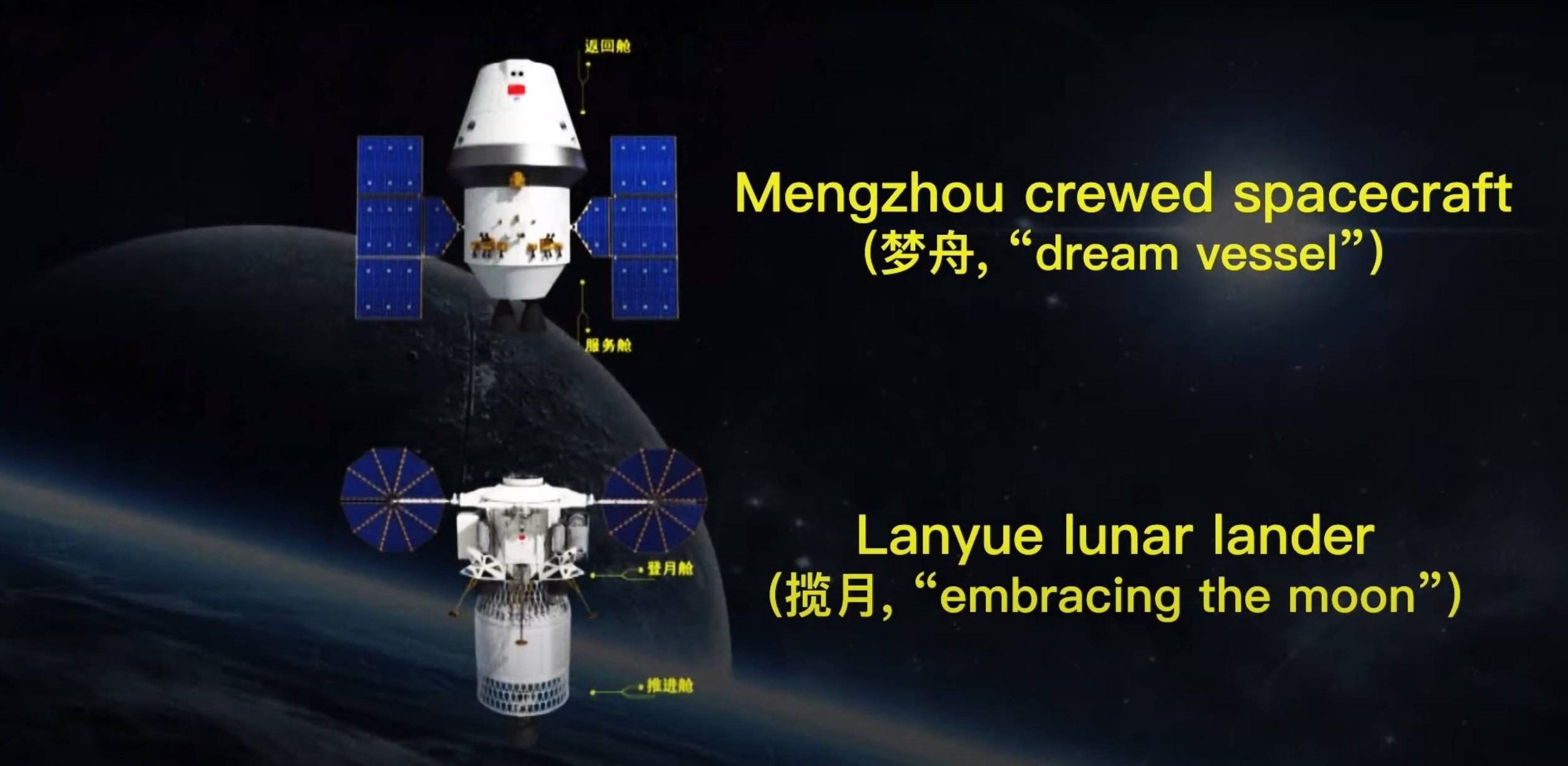
Image credit: China National Space Administration (CNSA)/China Central Television (CCTV)/SciNews.ro/Inside Outer Space screengrab

Image credit: CCTV/Inside Outer Space screengrab
For a video view of the test, go to:
https://www.facebook.com/share/v/1Duw1WLLuo/

Image credit: Etheria Space
There is an uplifting announcement regarding the future of space elevators – a groundbreaking concept that could reshape the future of space exploration.
The dream is to put in place a highway to the stars, a continuous bridge connecting Earth to space, one that offers a more reliable, cost-effective, and eco-friendly alternative to traditional rockets.
A first-ever global space elevator challenge is being kicked off at the National Space Society’s International Space Development Conference in Orlando, Florida June 19-22 at the Rosen Centre Hotel.
Strategic competitions
Designed for university level students and space enthusiasts, a World Space Elevator Competition (WSPEC) will feature multiple strategic competitions designed to advance critical technologies needed to construct an elevator to space – the first ever to take place on a global level.

Image credit: Scientific Workgroup for Rocketry and Spaceflight (WARR) Space Elevator Challenge of Germany.
What’s being staged are live demonstrations of winning robotic climbers from past regional competitions, including the world’s fastest robotic climber that set a record climbing a 1,200 meter ribbon-shaped tether at more than 100 kilometers per hour.
WSPEC is a partnership of Etheria Space, who is driving the initiative, the Japan Space Elevator Association and the Scientific Workgroup for Rocketry and Spaceflight (WARR) Space Elevator Challenge of Germany. The U.S.-based International Space Elevator Consortium (ISEC) is driving the research behind a space elevator.

Image credit: Etheria Space
Critical technologies
WSPEC is an international non-profit organization that aims to advance the critical technologies needed to construct a space elevator through a series of strategic competitions designed to foster innovation and inspire the next generation of scientists and engineers.
At its heart, it’s about building the future, one audacious idea at a time.
The space elevator competition will spotlight innovations in:
- Advanced Materials: Teams will push the limits of material science, developing super-strong, ultra-light materials for the elevator tether.
- Robotics and Automation: showcase advancements in robotics systems designed to construct, maintain, and operate a space elevator.
- Power Beaming: Tame energy transmission needs with technologies that aim to wirelessly power “climbers” over vast distances.
- Artificial Intelligence: Teams will develop AI-powered systems for guidance, navigation, and control of space elevator operations.
Wanted: innovation
By fostering teamwork and innovation, the competition aims to inspire the next generation to make the ambitious dream of space elevators a reality.

Image credit: Etheria Space
The climber competition will be the first challenge of the space elevator games, pitting teams against each other.
Here’s what’s at stake:
Speed: How fast can their climber ascend the tether?
Efficiency: How little energy can they use to get to the top?
Payload Capacity: How much weight can their climber carry?
Innovation: Can they incorporate groundbreaking new technologies or designs?

Image credit: International Space Elevator Consortium
Science fiction turned to fact?
In his 22nd century-set 1970’s novel, The Fountains of Paradise, science fact/fiction writer, Arthur Clarke imagined an elevator connecting Earth with an orbiting satellite, eliminating the need for costly and environmentally destructive rockets.
The concept of the “space elevator” first appeared in 1895 when Russian scientist Konstantin Tsiolkovsky, inspired by the newly constructed Eifel Tower in Paris, thought of a tower that reached all the way into space.
In 1957 Yuri Artsutanov drew up a more feasible plan for building such a space tower. He proposed using a geostationary satellite as a base from which to build it. He suggested lowering a cable toward Earth while a counterweight was extended from Earth, keeping the cable’s center of gravity at the geosynchronous point.
Artsutanov published his ideas in the Sunday supplement Komsomolskaya Pravda (a national newspaper) in 1960.

Image credit: Gollancz/Orion Publishing Group
Clarke prediction
Bringing the concept to a popular readership, Clarke in his novel had engineers construct a space elevator on top of a mountain peak in the mythical island of Taprobane. The builders use advanced materials such as the carbon nanofibers.
“I’m often asked when I think the space elevator will be built,” Clarke once said during an interview. “My answer is about 10 years, when everyone stops laughing.”
For more information, go to:
https://isdc.nss.org/isdc_tracks/space-elevators-25/

