Archive for the ‘Space News’ Category
 Author:
  August 16th, 2014
Early space elevator story in August 1979 issue of Future Life magazine. Art by David Egge.
Courtesy: Robin Snelson
I am pleased to be taking part in the 2014 Space Elevator Conference, to be held August 22-24 at the Museum of Flight in Seattle, Washington.
The theme of the 2014 conference is space elevator Architectures and Roadmaps with a focus on comparing the major space elevator architectures proposed to date.
Space elevators are a radical new way to access space less expensively than possible with chemical rocket technology.
Be advised that registration is open until end of day August 17, 2014.
For more information, go to:
 Posted in

InSight spacecraft on Mars – NASA’s next Red Planet landing probe.
Credit: NASA/JPL
Here’s a new one from me just up on Space.com:
NASA’s Next Mars Lander Will Peer Deep Into Red Planet’s History: Here’s How
By Leonard David, Space.com’s Space Insider Columnist
August 15, 2014 04:01pm ET
http://www.space.com/26820-nasa-mars-insight-mission-planet-history.html
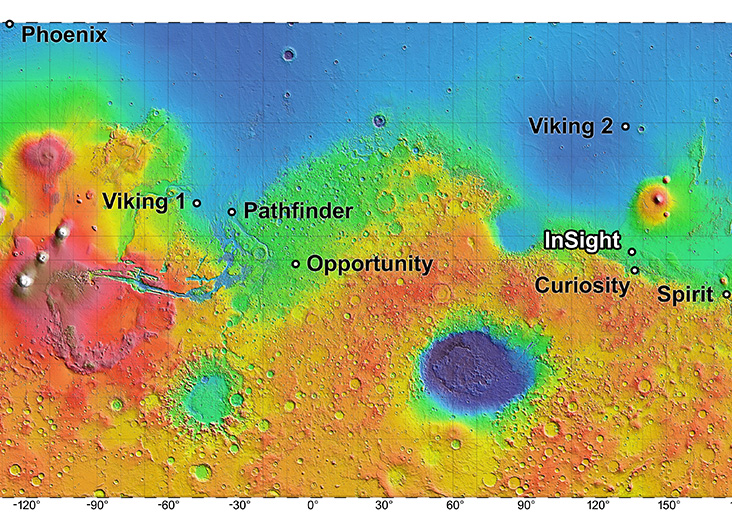
Mars is dotted with landers – InSight is next!
Credit: NASA/JPL

Back pain is experienced by astronauts as their spine elongates up to 2 inches while in the microgravity environment of space.
Credit: NASA
The National Space Biomedical Research Institute (NSBRI) has funded a clinical study to test the Sustained Acoustic Medicine (sam®) device in patients suffering from lower back pain.Thanks to a partnership with the private sector, the idea is to accelerate the development of commercially promising products meeting a medical need in space…as well as on Earth.
Back pain is experienced by astronauts as their spine elongates up to 2 inches while in the microgravity environment of space.
The wearable sam® system enables delivery of one to four hours of therapeutic ultrasound treatment and could be used by astronauts in space.
ZetrOZ, Inc., of Trumbull, CT will receive a Space Medical and Related Technologies Commercialization Program (SMARTCAP) grant. SMARTCAP grants are administered by NSBRI’s Industry Forum.
Ultrasound
Back pain is experienced by astronauts as their spine elongates up to 2 inches while in the microgravity environment of space. sam® was developed for daily use and is prescribed by licensed healthcare practitioners such as orthopedists and physiotherapists for tendonitis and muscle injury recovery.
The wearable sam® system enables delivery of one to four hours of therapeutic ultrasound treatment and could be used by astronauts in space.
“Ultrasound is a great platform for spaceflight, delivering both diagnostic and therapeutic capabilities” said Dr. Dorit Donoviel, NSBRI’s Deputy Chief Scientist and Industry Forum Lead.
Established in 1997 through a NASA competition, NSBRI is headquartered in the Texas Medical Center and is a consortium of leading biomedical institutions.
Sustained acoustic medicine
Donoviel added that ultrasound is portable, wearable and does not deliver harmful radiation. NSBRI has supported the development of diagnostic and therapeutic approaches involving ultrasound for kidney stones, bone, and brain health.
Sustained acoustic medicine holds great promise to accelerate the healing of muscles and tendons as well as possibly bone and cartilage.
“ZetrOZ has developed a disruptive technology and we are excited to fund this important clinical study,” Donoviel stated in an NSBRI press statement.
ZetrOZ, founded in March 2009, is a biomedical ultrasound technology designer and manufacturer.

Nasty NEOs – harmful to Earth – is a topic being wrestled with at the United Nations.
Courtesy: Texas A&M
Here’s a new story from me regarding the UN taking on NEOs:
How Will Earth’s Leaders Respond to a Real Asteroid Threat?
By Leonard David, Space.com’s Space Insider ColumnisT
August 13, 2014 08:01am ET
http://www.space.com/26811-dangerous-asteroid-earth-defense-plan.html
Credit: ULA
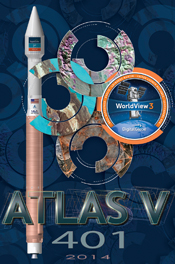
An Atlas V 401 booster is set to launch today DigitalGlobe’s super-powerful Earth observation satellite: WorldView-3.
It’s a melding of mile-high Colorado-based space technology.
The United Launch Alliance Atlas V is provided by Denver’s Lockheed Martin Commercial Launch Services, hurling into space the Boulder-headquartered Ball Aerospace-built WorldView-3 – a spacecraft to be operated by DigitalGlobe, based in Longmont, Colorado.
WorldView-3 will enhance DigitalGlobe’s satellite constellation and will further support customers across a variety of industries, such as agriculture, mining, and oil and gas.
Date/Site/Launch Time: Wednesday, Aug. 13, 2014, from Space Launch Complex-3 at Vandenberg Air Force Base, California.
WorldView-3 will be the 10th of 15 planned missions ULA is slated to launch in 2014, and ULA’s 87th since the company formed in 2006.

DigitalGlobe’s WorldView-3, built by Ball Aerospace, being encapsulated in nose cone shrouds prior to launch atop an Atlas V 401 booster.
Courtesy: Ball Aerospace
The 15-minute launch window opens at 11:30 a.m. Pacific Daylight Time (PDT).To view the launch by webcast: The live webcast will begin at 11:10 a.m. PDT.
NOTE: To view the launch, go to:
http://www.ulalaunch.com/webcast.aspx
For more information about the WorldView-3 satellite, visit:
http://worldview3.digitalglobe.com/
To keep up to speed with updates to the launch countdown, dial the ULA launch hotline at 1-877-852-4321 or join the conversation at:
https://www.facebook.com/ulalaunch
and
twitter.com/ulalaunch; hashtag #WV3

The ISEE-3 Reboot Project logo.
Credit: ISEE-3 Reboot Project
Welcome home NASA’s International Sun/Earth Explorer-3 (ISEE-3)!
Today, Sunday, August 10th, ISEE-3 is on a trajectory that takes it close to the Moon.
Thanks to an effort led by Keith Cowing of NASAWatch and Dennis Wingo of Skycorp, the ISEE-3 Reboot Project was established. And with a dollar-assist from a crowdsourcing campaign, the creative juices were turned on to full-tap resulting in reestablishing a link to the venerable spacecraft – after more than three decades of space travel.
Now the ISEE-3 Reboot Project team – joined by Goggle – is to transform ISEE-3 into a citizen science project. Data from the spacecraft can be accessed and analyzed by all.
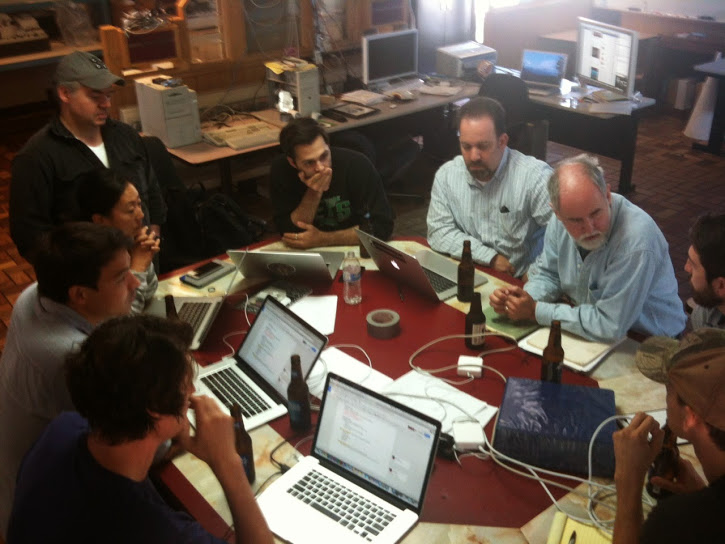
High-speed chats! Google Creative Lab, Pixel Corps, and ISEE-3 Reboot Team planning for today’s live webcast from McMoons – a former McDonald’s fast food eatery in Silicon Valley.
Credit: ISEE-3 Reboot Project
An invite by Cowing to everyone interested in the adventure requests you to join a special Google+ Hangout live event as the ISEE-3 spacecraft makes its long-awaited lunar flyby after 36 years in interplanetary space.
A “Live from ISEE-3 Reboot headquarters” will feature scientists and experts from around the world – all brought together for the historic event.
So tune into the Google Hangout “A Spacecraft for All: The Live ISEE-3 Lunar Flyby.”
The event is slated for Sunday, August 10th, from 10:30 am Pacific Time U.S. to noon PT.
Go to a newly launched website SpacecraftForAll at:
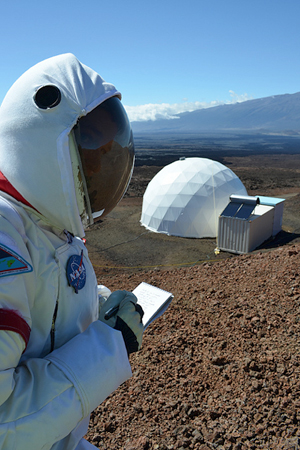
What’s on the menu for Mars? Outside the HI-SEAS (Hawaii Space Exploration Analog and Simulation) mission on the slopes of Hawaii’s Mauna Loa volcano. Cornell and the University of Hawaii at Manoa have been engaged in defining food needs for space travelers, a project funded by NASA’s Human Research Program.
Credit: Sian Proctor
Don’t tell anybody. There may be a secret sauce to cooking in space.
Cornell researchers have taken to the air to better understand the effectiveness of a specially constructed space galley – one designed to be used on the Moon as well as Mars.
Making use of the microgravity-producing “G-Force 1” space simulator plane the team tossed tofu and shredded potatoes into pans of sizzling oil and recorded the resulting oil splatters as the plane climbed and dove in parabolic paths.
Each cycle created a brief period of partial weightlessness, simulating the conditions astronauts would face during extended stays on the Moon’s one-sixth gravity or Mars’ one-third the gravity of Earth.
The work is dedicated to better appreciate cooking 101 on other worlds.
Splatter patterns
A specially constructed space galley was jointly designed by the Cornell team with Susana Carranza of Makel Engineering in Chico, Calif.
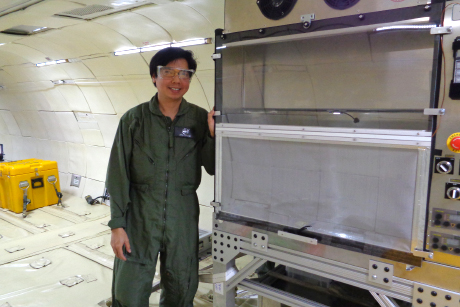
Postdoctoral research associate Apollo Arquiza shows what the galley (kitchen) looks like in the zero gravity G-Force 1 space simulator plane.
Courtesy: Cornell
The experimenters positioned strips of paper inside the galley fume hood and dyed the oil bright red to help them see and collect splatter patterns. Under reduced gravity conditions, the food settled more slowly into the pan, and more oil appeared to fall outside of it. The oil droplets also traveled a greater distance from the pan than under Earth conditions.That data is being analyzed to measure the particles’ size distribution and distance traveled.
Results will be used to create computer models that could be extrapolated to inform the design of future terrestrial and extraterrestrial cooking technology.
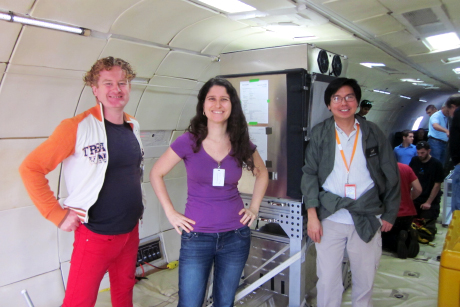
From left, Cornell researcher Bryan Caldwell, Makel Engineering researcher Susana Carranza and Cornell researcher Apollo Arquiza conduct low gravity cooking experiments aboard the G-Force 1 space simulator plane.
Courtesy: Cornell
Menu fatigue
“Understanding oil spatter in reduced gravity is a big step toward designing safe and convenient cooking facilities for future space colonies,” said associate professor Jean Hunter in Cornell’s Department of Biological and Environmental Engineering.
Apollo Arquiza and Bryan Caldwell, postdoctoral research associates in the lab, were also key ingredients in devising the research onboard the G-Force 1.
On the flight itself, they were aided by experts at the NASA Reduced Gravity Research Program, including astronaut Cady Coleman and Sarah Gonzales ’96, program coordinator with the Reduced Gravity Education Flight Program.
Incorporating design elements from submarine galleys and chemical fume hoods used in labs, Arquiza and Carranza created an enclosed unit with activated charcoal filters and a fan that sucks in air from the front and draws particles away from the cook.
The team had just 30 seconds to complete each experiment once a parabola began, Arquiza said in a Cornell story authored by Stacy Shackford, a writer for the College of Agriculture and Life Science.
The project is part of a larger investigation by Hunter’s lab into scientific and social aspects of food in space, including a simulated Mars mission in Hawaii to test resource use, menu fatigue and the benefits of home cooking in an enclosed environment, and a bed rest study to test the effects of simulated weightlessness on smell and taste perception.

Credit: ESA
The European Space Agency’s Rosetta spacecraft has pulled up to comet 67P/Churyumov–Gerasimenko – and what an eye-full!
You might enjoy these comet comments from Chris Lewicki, President and Chief Asteroid Miner at Planetary Resources, Inc.:
What is the difference between a comet and asteroid, after all?
Some comets are believed to be as much as 50% water – dirty snowballs so to speak – and what we’re seeing today at 67P/Churyumov–Gerasimenko is what a comet looks like without all that water vapor in the way.

Credit: ESA
Comets generally have very eccentric orbits, and spend most of their time in the outer Solar System, having the innards baked out as they make their passages around the sun.
Asteroid orbits are less extreme, so we don’t tend to see their behavior change in time, but it is possible that some asteroids could be extinct comets, waiting for their reserves of ancient water to be discovered.
I’m excited to learn what comet 67P/Churyumov–Gerasimenko has to teach, and there will certainly be surprises.
This mission may help us understand more about the makeup and resources on small Solar System bodies.

Credit: ESA

Credit: ESA
The European Space Agency’s Rosetta spacecraft was launched in 2004 and will arrive at comet 67P/Churyumov-Gerasimenko on August 6 – a 10 year long voyage.
It will be the first mission in history to rendezvous with a comet, escort it as it orbits the Sun, and deploy a lander to its surface.
Rosetta is an ESA mission with contributions from its member states and NASA.

Image of comet 67P/Churyumov-Gerasimenko.
Credits: ESA/Rosetta/NAVCAM
After completing a complex series of nine orbital maneuvers since the end of hibernation on January 20, Rosetta is finally in position to rendezvous with the comet.
A timeline of the most crucial steps leading to Rosetta’s arrival at its target comet on Wednesday includes: Orbit entry on August 6, triggered by a small but crucial thruster firing lasting 6 minutes 26 seconds.
That burn will start at 09:00 GMT (11:00 CEST). The commands were uploaded during the night of August 4.
This burn will tip Rosetta into the first leg of a series of three-legged triangular paths about the comet. The legs will be about 100 km long and it will take Rosetta between three and four days to complete each one.

Main Control Room at ESOC, ESA’s operations centre in Darmstadt, Germany.
Credit: ESA-J.Mai
Mission operations and science teams at ESA and scientists from multiple countries will be following progress closely.
Tune in to a Livestream of arrival activities starting August 6 at 08:00UTC.
Go to: http://rosetta.esa.int

Image Credit:
NASA/JPL-Caltech/MSSS
The message from those steering NASA’s Curiosity Mars rover is that sandy Martian valleys are in the rover’s near future!
NASA’s Curiosity Mars rover has just crossed one stretch of rocks hazardous to its wheels and may soon reach rocks different from any it has examined so far.
As it approaches the second anniversary of its landing on Mars –10:32 p.m. PDT, Aug. 5, 2012 — the rover is also approaching its first close look at bedrock that is part of Mount Sharp, the layered mountain in the middle of Mars’ Gale Crater.
Damage to Curiosity’s aluminum wheels from driving across similar terrain last year prompted a change in route planning to skirt such rock-studded terrain wherever feasible.

The main map here shows the assortment of landforms near the location of NASA’s Curiosity Mars rover as the rover’s second anniversary of landing on Mars nears.
Image Credit:
NASA/JPL-Caltech/Univ. of Arizona
Curiosity spent much of July 2014 crossing an upland area called “Zabriskie Plateau,” where embedded, sharp rocks presented hazards for the rover’s wheels.

