Archive for the ‘Space News’ Category
 Author:
  August 29th, 2014
U.S. Air Force X-37B robotic space plane – pre-launch photo.
Credit: Boeing/USAF
Around and around and around it goes – but what’s the mission?
Here’s a new one from me on the X-37B Air Force space plane:
US Air Force’s Secretive X-37B Space Plane Passes 600 Days in Orbit
By Leonard David, Space.com’s Space Insider Columnist
August 29, 2014 01:28pm ET
http://www.space.com/26984-military-x37b-space-plane-mission-600-days.html
 Posted in

NASA’s Wide-field Infrared Survey Explorer (WISE).
Credit: NASA/JPL
If you’re on the hunt for intelligent extraterrestrial life out there in the Cosmos, waste heat may be the signal of detection.
A recent paper in The Astrophysical Journal is led by Jason Wright at Pennsylvania State University.
Titled “The G Infrared Search For Extraterrestrial Civilizations With ˆ Large Energy Supplies. I. Background And Justification,” the extensive paper offers the view that any advanced civilization is likely to churn out large amounts of energy – and the energy should be visible in the infrared.
“We argue that detectably large energy supplies can plausibly be expected to exist because life has potential for exponential growth until checked by resource or other limitations, and intelligence implies the ability to overcome such limitations,” explains Wright and his co-authors.
Moreover, there’s the promise of using new mid-infrared surveys to spot the ETI hot spots, such as that of NASA’s Wide-field Infrared Survey Explorer (WISE).
The informative paper offers the belief that at least one of the following must be true about galaxy-spanning alien civilizations in the search volume:
• They do not exist, or are sufficiently rare that they are not in our search volume
• They exist, but their total energy supplies are universally below the search’s detection threshold
• ETI’s with large energy supplies universally expel waste heat at low temperatures (i.e. wavelengths longer than the capabilities of the search), perhaps because their energy supply is not starlight
• Spacefaring ETI’s inevitably discover and universally employ physics that makes their civilizations effectively invisible in the mid-infrared despite having large energy supplies (for example, expelling their waste heat as neutrinos, efficiently using their energy supply to emit low-entropy radiation, employing energy-to-mass conversion on a massive scale, or by violating conservation of energy).
Consequences of detection
Continuing, the paper serves up a list of consequences if, indeed, there is a positive detection of waste heat from an alien civilization
“Beyond demonstrating that alien life exists, it would also allow us to essentially “peek ahead” at the nature of engineering of a vastly more advanced species, and perhaps allow us to test our current theories of fundamental physics,” the authors of the paper note.
Such a detection would:
• Demonstrate that there are no insurmountable obstacles to energy supplies comparable to the luminosities of stars or galaxies
• Demonstrate that conservation of energy and the laws of thermodynamics, as we understand them, are not circumvented on a large scale by at least some very advanced civilizations, and so may be absolute. This might imply that attempting to overcome them at our level of technology would be fruitless.
• Allow analysis of the extent of the alien supercivilization, and so a measure of characteristic travel speed, potentially revealing the practicalities of travel near the speed of light.
To access the full paper, go to:

Orbital debris is a space environmental problem.
Credit: Lockheed Martin
The U.S. military currently tracks more than 17,000 objects in space on a continuous basis. Some 1,100 of that number are active satellites currently conducting operations.
Air Force Maj. Gen. David D. Thompson, U.S. Strategic Command’s director of plans and policy at Offutt Air Force Base, Nebraska, said the release of new high-quality positional information on space debris of an unknown origin will help owner-operators better protect their satellites from these objects and ultimately create less space debris.
Many public, private, commercial and other governmental organizations conduct space operations.

Chunk of junk zips by the International Space Station.
Credit: NASA
Responsible and safe use of space
There are roughly 16,000 objects — the ones not active and/or of unknown origin in space — that military space trackers are most concerned with.
“Space is not owned by anyone, it is used by all and we strongly support responsible and safe use of space and transparency of operations that go on in space,” Thompson said in a Department of Defense press statement.
One hand-slapping incident, however, is the 2007 test by China of an anti-satellite weapon. That Chinese test almost immediately created 1,500 new objects that pose a risk to satellites in orbit, Thompson said.
What response is needed for dealing with debris is, literally, up for grabs.
Reversing congestion and pollution in space, Thompson said, is a complex task.
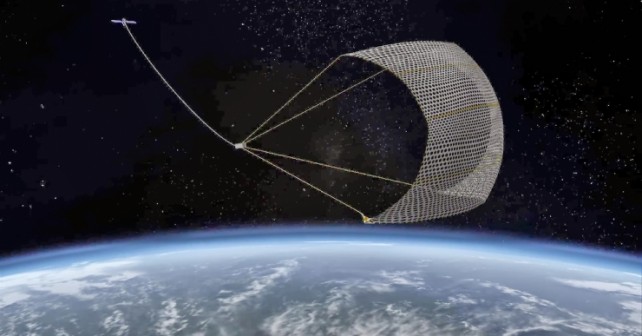
Dealing with debris is a cottage industry of concepts.
Credit: JAXA
“We are talking decades or centuries before the environment will clean itself naturally so we have to share and act responsibly with this precious resource because it’s important to all of us,” Thompson said.

Credit: NASA

Candidate landing sites on comet nucleus.
Credits: ESA/Rosetta/MPS for OSIRIS Team MPS/UPD/LAM/IAA/SSO/INTA/UPM/DASP/IDA
The European Space Agency’s Rosetta spacecraft will deploy onto Comet 67P/Churyumov-Gerasimenko its Philae lander in November.The top five locations on the comet nucleus – about 4 kilometers across — for the touchdown of the 220-pound (100-kilograms) lander have been selected.
Three sites (B, I and J) are located on the smaller of the two lobes of the comet and two sites (A and C) are located on the larger lobe.
Landing date
According to an ESA press statement, the landing is expected to take place in mid-November when the comet is about 450 million kilometers from the Sun.
The ESA Rosetta spacecraft will move closer to the comet, allowing a more detailed look at the proposed landing sites.
By mid-September, the five candidate sites will have been assessed and ranked, leading to the selection of a primary landing site, for which a fully detailed strategy for the landing operations will be developed, along with a backup.

Philae lander.
Copyright: ESA/ATG medialab
“The candidate sites that we want to follow up for further analysis are thought to be technically feasible on the basis of a preliminary analysis of flight dynamics and other key issues – for example they all provide at least six hours of daylight per comet rotation and offer some flat terrain. Of course, every site has the potential for unique scientific discoveries,” Ulamec said.
The Rosetta mission team is eying a nominal landing date of November 11.

A longing look at one space elevator design.
Credit: Obayashi Corporation of Tokyo, Japan.
SEATTLE, Washington – The 2014 Space Elevator Conference is underway, sponsored by International Space Elevator Consortium (ISEC).An international gathering of scientists and engineers have convened here at the Museum of Flight in Seattle, Washington. The meeting is being held August 22 – August 24th.
The theme of this year’s conference is “Space Elevator Architectures and Roadmaps.”
Experts here are taking on a number of challenges, from understanding the dynamics of a space elevator in the Earth’s atmosphere, weather data support for future space elevator operations to needed materials breakthroughs for use in fabricating an Earth to space elevator.
Discussions are also underway on building a lunar space elevator – literally tied to tapping into resources available on the Moon.
Abundant access to space
“The space elevator is one of the most magnificent engineering projects ever conceived. It promises abundant access to space and a multitude of benefits for humanity,” said Peter Swan, president of the ISEC.
“Our vision is a world with inexpensive, safe, routine, and efficient access to space for the benefit of all,” Swan said. “Our mission is to promote the development, construction and operation of space elevator infrastructure as a revolutionary and efficient way to space for all humanity.”
For more information on the meeting and the space elevator concept, go to the International Space Elevator Consortium (ISEC) website at:

Mast Camera (Mastcam) (MSSS-MALIN) images for Sol 726. Evaluation of a pale, flat Martian rock as the potential next drilling target for NASA’s Curiosity Mars rover determined that the rock was not stable enough for safe drilling.
Word from JPL: The rock, called “Bonanza King,” moved slightly during the mini-drill activity on Wednesday, at an early stage of this test, when the percussion drill impacted the rock a few times to make an indentation.
Instead of drilling that or any similar rock nearby, the team has decided that Curiosity will resume driving toward its long-term destination on the slopes of a layered mountain.
It now will take a route skirting the north side of a sandy-floored valley where it turned around two weeks ago.
The rover has driven about 5.5 miles (8.8 kilometers) since landing inside Gale Crater in August 2012, and has about 2 miles (3 kilometers) remaining to reach an entry point to the slopes of Mount Sharp, in the middle of the crater.

Remote Micro-Imager (CHEMCAM_RMI) onboard NASA’s Mars rover Curiosity on Sol 727 (2014-08-23 00:38:42 UTC).
Image Credit: NASA/JPL-Caltech/LANL
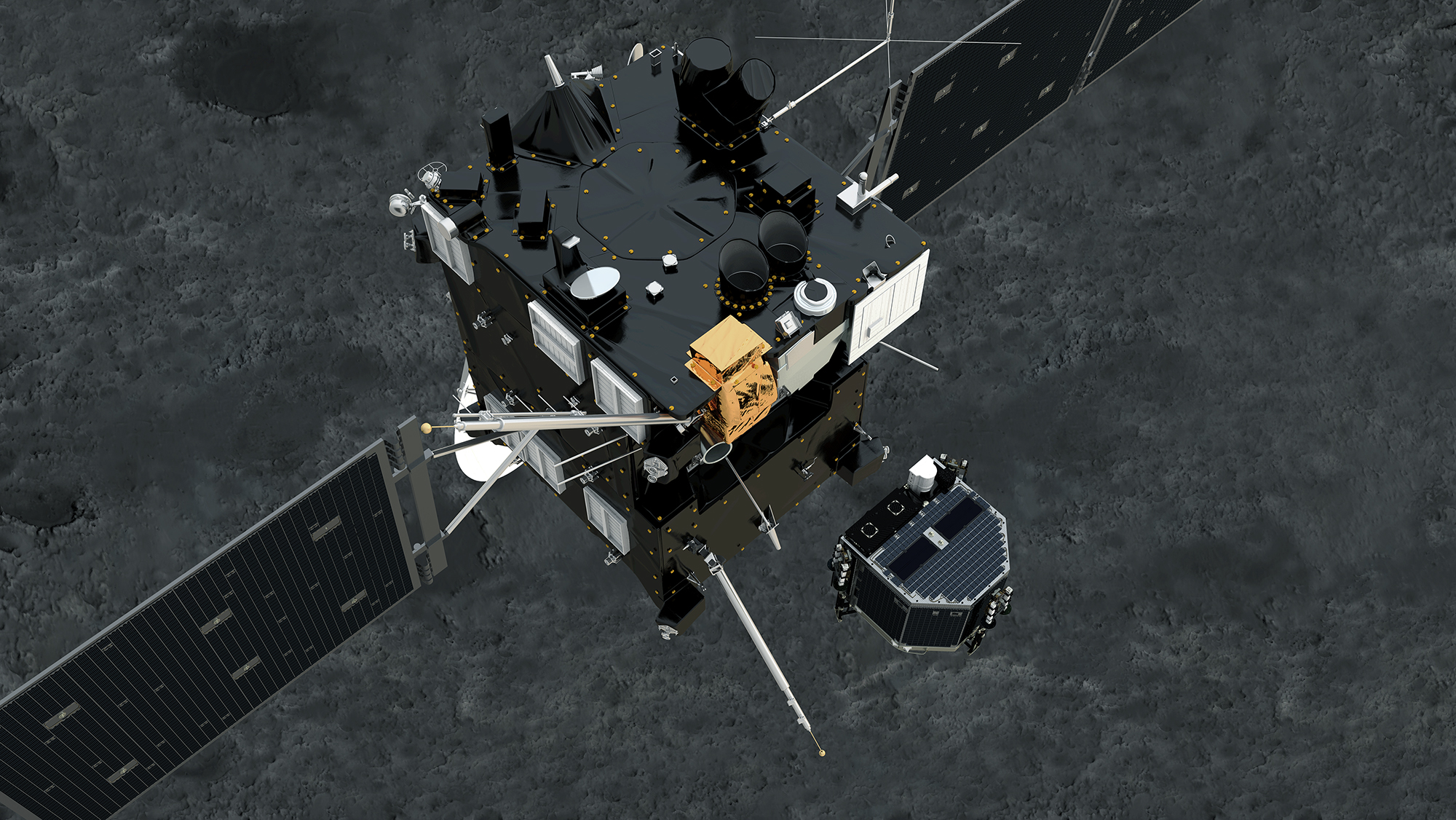
Philae lander separating from Rosetta and descending to the surface of comet 67P/Churyumov-Gerasimenko in November 2014.
Credit: ESA/ATG medialab

Target: Comet 67P/Churyumov-Gerasimenko
Credit: ESA/DLR
Europe’s Rosetta lander will soon dispatch the Philae lander in the hopes of making a spot-on touchdown on Comet 67P/Churyumov-Gerasimenko.
But where to land?
The site needs to be at a level yet scientifically interesting location, with enough sunlight and the right conditions to ensure a long working life.
However, the rugged, unusually shaped comet is not making the choice easy for the lander team, a consortium of experts led by the German Aerospace Center (Deutsches Zentrum für Luft- und Raumfahrt; DLR).
The group has until August 24 to choose up to five potential landing sites. Once that’s done, detailed appraisals of each site can be conducted.
The candidate sites will be announced on August 25.
First ever landing
On November 11, the lander component of the European Rosetta mission, which is controlled and operated by the DLR Lander Control Center (LCC), is scheduled to carry out the first ever landing on a comet.
According to the DLR, the initial selection of no more than five potential landing sites is hard enough.
The comet, which consists of two connected parts, offers only a limited number of level, uniform surfaces on which Philae could land safely.
The “landing ellipses”, within which the actual landing site lies, have a radius of around 500 meters:
“We cannot determine the landing site more precisely,” says DLR scientist Stephan Ulamec, Project Manager for the Philae lander.
As a control signal from Earth takes over 30 minutes to reach the lander, Philae must take care of the landing by itself, automatically, using a procedure pre-programmed by DLR and with no real-time corrective actions from the Control Center.
Therefore, the lander team is anxious to avoid regions with large boulders, rock or fissures, to reduce the risk for the Philae lander as much as possible, Ulamec said in a DLR press statement.
Check out this video of what the lander control team is facing:
http://www.dlr.de/dlr/en/desktopdefault.aspx/tabid-10081/151_read-11379/year-all/#/gallery/16031
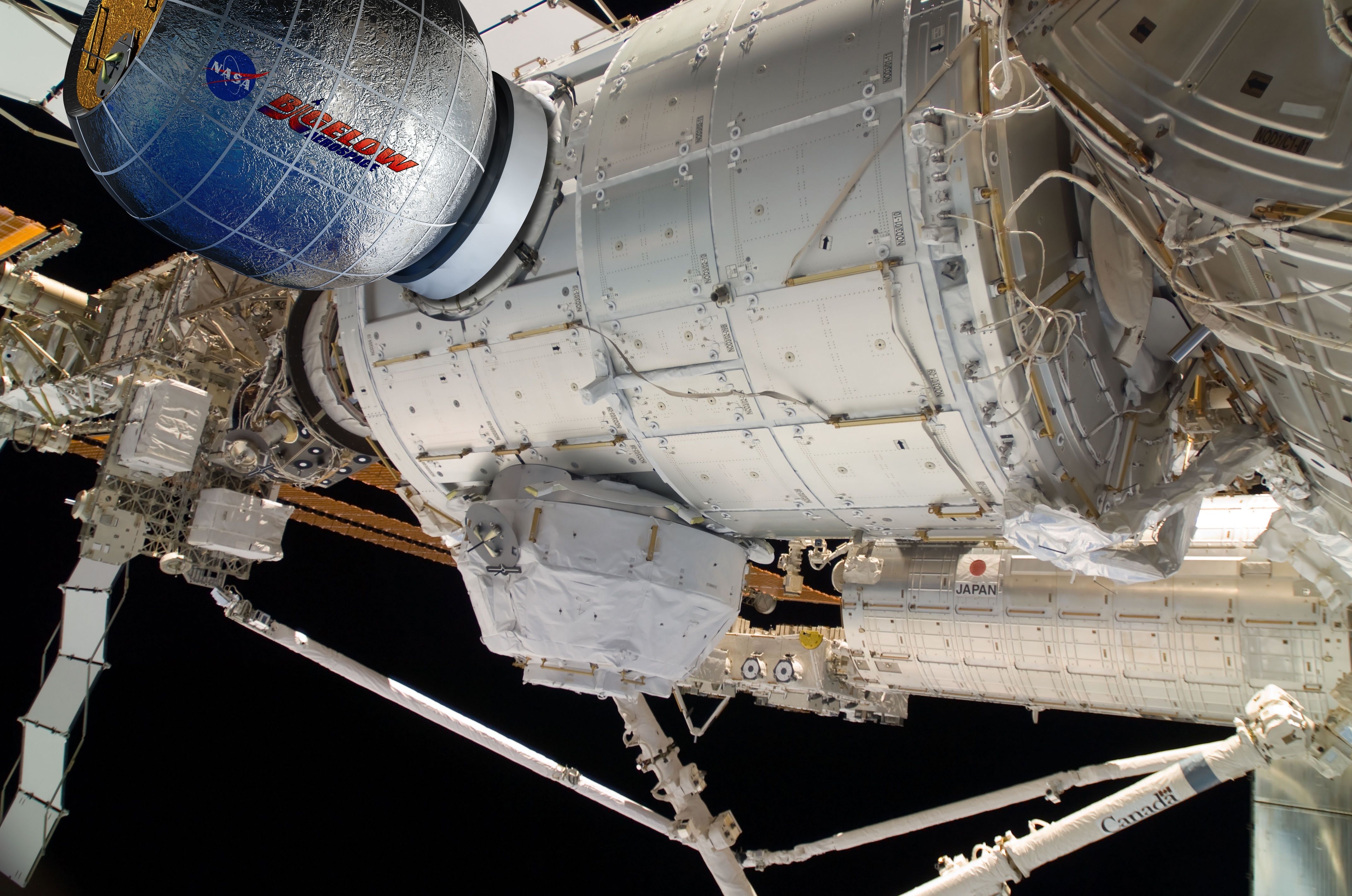 Work is progressing on the Bigelow Expandable Activity Module (BEAM), which is scheduled to arrive at the International Space Station (ISS) mid-year 2015 for a two-year technology demonstration.
The BEAM is scheduled to launch aboard a SpaceX cargo resupply mission to the ISS.
Following the arrival of the SpaceX Dragon spacecraft carrying the BEAM to the station, astronauts will use the station’s robotic arm to install the module on the aft port of the Tranquility node.
Built by private space firm, Bigelow Aerospace, the module is to be berthed to the Tranquility node. At that point, the station crew will activate a pressurization system to expand the structure to its full size using air stored within the packed module.
During the two-year test period, station crew members and ground-based engineers will gather performance data on the module, including its structural integrity and leak rate.
An assortment of instruments embedded within module also will provide important insights on its response to the space environment.
This includes radiation and temperature changes compared with traditional aluminum modules.
Back in January 2013, NASA awarded a $17.8 million contract to Bigelow Aerospace to provide the BEAM.
Check out this new and informative video on BEAM, provided by Bigelow Aerospace.

Russian Angara booster moved to launch pad.
A new story from me up on Space.com:
Russia Reignites Its Rocket Industry with New Angara Booster
By Leonard David, Space.com’s Space Insider Columnist
August 19, 2014 07:00am ET
http://www.space.com/26872-russia-angara-rocket-launch-vehicle-industry.html

Angara booster departs launch pad on suborbital test.
Credit: Khrunichev

