Archive for the ‘Space News’ Category
 Author:
  September 7th, 2014
Accion Systems founder and CEO is Natalya Brikner, a Ph.D. student at MIT.
Credit: MIT Sloan School of Management
The Massachusetts Institute of Technology (MIT) is a constant hotbed of creativity and cultivation central for startup companies.
One such firm that’s attracting attention is Accion Systems, developing liquid ion sources for micro-propulsion systems in satellites.
The target for Accion propulsion is to keep ultra-small satellites – CubeSats — in orbit for far-longer periods of time.
Accion Systems founder and CEO is Natalya Brikner, a Ph.D. student at MIT.
The company’s MAX-1 propulsion module churns out over 100 micro-newtons of thrust.

Tiny and scalable electric propulsion systems.
Credit: Accion Systems
Time for a change
Speaking at the MIT Sloan Women in Management (SWIM) Conference earlier this year, Brikner said:
“The engines that are flying on satellites today were designed before the first handheld calculator was invented,” Brikner said, according to a MITSloan School of Management news statement.
It’s time for a change and the key is scalable electric propulsion systems, Brikner said.
Accion’s systems would cost $1 million, compared to $15 million for current systems, and would significantly increase the life and operability of small satellites, Brikner said.

“Tipping” the scales of propulsion.
Credit: Accion Systems
Molten salt
According to Accion Systems: Need more thrust? Arrange more tiles next to one another. Need thrust in a different direction? Put tiles anywhere on the satellite.
Bolt-on modules simplify and shorten satellite development and integration.
The propellant used is an ionic liquid, a molten salt at room temperature. A high voltage is applied between a sharp tip that has ionic liquid on it and an extractor aperture positioned directly above.
The tip intensifies the electric field, the liquid rises up to a point which further intensifies the field strength, and ions are extracted from the propellant surface. The ions accelerate through the upstream extraction aperture, exiting the spacecraft and providing thrust.
The thrust level scales with the number of tips, so hundreds, thousands, or even millions of tips can be used to achieve the desired thrust level.

The target for Accion propulsion is to keep ultra-small satellites – CubeSats — in orbit for far-longer periods of time.
Credit: Accion Systems
MEMs
Compactness is achieved through the use of Micro-Electro-Mechanical Systems, or MEMS, fabrication techniques – similar to those used in the fabrication of microchip components.
“Our systems are lighter, smaller, and more efficient than existing systems and our product line is infinite…customers can put thrusters anywhere they want on a satellite,” Brikner adds. “Advances in integrated circuits and semiconductors have allowed small satellites the size of softballs to carry advanced communications, but currently there are no propulsion systems available to them.”
“We want to change that,” Brikner concludes.
For a video short course, Brikner describes the concept during the 2014 MIT Sloan Women in Management (SWIM) Conference.
Go to:
http://mitsloan.mit.edu/newsroom/2014-swim-pitch-competition.php
For more information on Accion Systems, go to:
 Posted in

India’s Mars Orbiter Mission (MOM) is that country’s first interplanetary mission to the Red Planet.
Launched November 5, 2013 from Sriharikota, India, the spacecraft is nearing its September 24 rendezvous with Mars. Nudging itself into orbit will require a nearly half-hour burn of a bi-propellant engine.
Space officials at the Indian Space Research Organization (ISRO) have green-lighted a few second firing test of MOM’s 440 Newton liquid engine – last fired on December 1 to put the spacecraft on its trajectory for Mars.
The engine has not been used for over 300 days – so the few seconds of engine firing on September 22 is being done to assure MOM’s engine plumbing is up to snuff for the big burn day – some 48 hours later.
According to Indian press reports, if the large engine malfunctions there is a “Plan B” – using eight smaller thrusters onboard MOM to attain a Mars orbit, although not the intended mission-best orbit.
One of the instruments onboard the MOM is a Methane Sensor for Mars (MSM) designed to measure Methane (CH4) in the Martian atmosphere with parts-per-billion accuracy and chart its sources.

NASA’s MAVEN spacecraft is nearing arrival time at Mars.
Credit: NASA/GSFC
Also beating a path to the Red Planet is NASA’s Mars Atmosphere and Volatile EvolutioN (MAVEN) mission.
MAVEN was launched on November 18, 2013 and the orbiter is on track to arrive at Mars on September 21st.

Poster for Planetary Congress, hosted by China’s Manned Space Agency in cooperation with the Association of Space Explorers (ASE)
Credit: ASE/CMSE
Space travelers from around the world are headed to China this month for an international Planetary Congress, which will explore the possibilities for expanding human spaceflight cooperation among different countries.
A new story from me, up today on Space.com
Astronaut All-Stars Will Visit China to Talk Space Cooperation
By Leonard David, Space.com’s Space Insider Columnist
September 05, 2014 07:01am ET
http://www.space.com/27034-astronauts-visit-china-space-cooperation.html

How best to probe the insides of an asteroid?
Credit: ESA – P.Carril (2)
A nasty asteroid headed toward Earth is on a collision course – how best to protect our home turf?
First of all, knowing its density and structure is important. Is it a rubble pile, solid as rock, Swiss cheese, has a core, or something else?
With that information in hand, dealing with the threatening object should become less than a celestial crap shoot.
And that’s not all. This type of asteroid make-up knowledge can influence future asteroid mining operations.

It’s an inside job. Richard Miller is part of a NASA NIAC-funded research team that could influence future asteroid mining operations and how to deal with an impending asteroid strike.
Credit: Michael Mercier/UAH
CT scan
It’s an inside job, according to Richard S. Miller, a University of Alabama in Huntsville (UAH) physics professor. He is part of a research team borrowing imaging technology concepts developed for medicine and high-energy physics. They are developing a mission concept to probe asteroids using a technique similar to human computerized tomography (CT) scans.
“What we want to do is actually probe the interior of asteroids and determine information about their structure,” Miller said in a UAH press statement.
Backing the research is a newly awarded $500,000 in funding from the NASA Innovative Advanced Concepts (NIAC) Phase II program. The team’s two-year proposal is titled: “Deep Mapping of Small Solar System Bodies with Galactic Cosmic Ray Secondary Particle Showers.”
UAH’s Miller is a co-investigator in a collaborative effort with the Planetary Science Institute (PSI), NASA’s Johnson Space Center, the Universities Space Research Association’s Arecibo Observatory (Arecibo/USRA) and the University of Houston to do the fundamental research and design that could lead to such a mission.

By detecting the number of muons that pass through the object at left, scientists can discover and measure the size of its core, shown reconstructed at right.
Credit: Richard Miller/UAH
Measuring muons
The idea is to position a telescope to orbit an asteroid and measure the number and trajectories of the muons passing through it.
By detecting the number of muons that pass through the object, scientists can discover and measure the size of the object’s core.
Miller said that an asteroid composed of varying densities of material would return a different pattern than one with a single density – just as a CT scan differentiates between densities of structures in the body, he said.
Likewise, if an asteroid has a denser core, it will stop muons from passing through and the telescope will detect the change.
Fundamental challenges
The process is called muon tomography and is well understood. Developed in the 1950s, it was even used in the 1960s by Luis Alvarez to map the Pyramid of Chephren.
Thanks to the NIAC funding, the scientists are tackling a number of fundamental challenges.
For example, the team will be using computer modeling to blueprint how a proposed NASA mission would be conducted, its feasibility and making predictions of the ultimate science return.
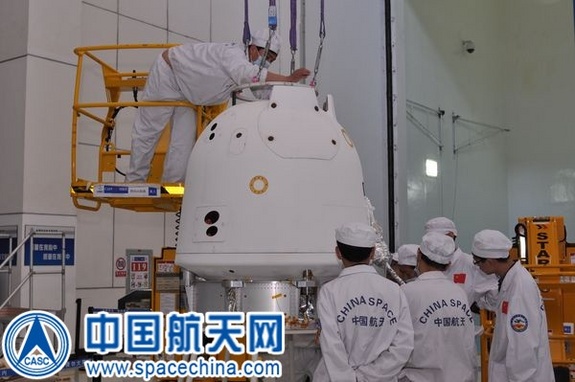
Credit: CASC
China to Launch Recoverable Moon Orbiter Prototype This Year
The country plans to launch a lunar “test orbiter” by year’s end with the intention of laying the foundation for China’s Chang’e 5 lunar sample-return mission in 2017.
http://www.space.com/27011-china-moon-orbiter-recoverable-prototype-launch.html
Credit: NASA/ASU
NASA’s OSIRIS-REx mission is slated to launch toward an asteroid in 2016.
And thanks to an innovative participation project, you can take part in an Asteroid Time Capsule – an initiative to collect ideas from the public about space exploration 10 years from now.
Called the Origins-Spectral Interpretation-Resource Identification-Security-Regolith Explorer (OSIRIS-REx), the spacecraft will rendezvous with the asteroid Bennu in 2019.
Once on target, the spacecraft will collect a sample and return the cache in a capsule to Earth in 2023 for detailed study.
When the sample return capsule returns to Earth in 2023 with a minimum of 2 ounces (60 grams) of asteroid material, the mission team will open the time capsule to view the messages and images, at which time the selected submissions will be posted online.
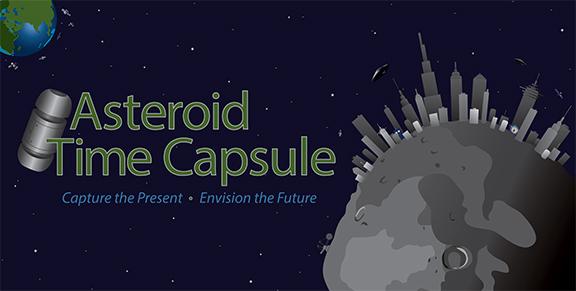
Image Credit: Heather Roper/University of Arizona/OSIRIS-REx
Topics for submissions by the public should be about solar system exploration in 2014 and predictions for space exploration activities in 2023. The mission team will choose 50 tweets and 50 images to be placed in the capsule.
Messages can be submitted Sept. 2 – 30.
Want to take the time to be onboard a time capsule? If so, for more information, go to:

This year’s smashing and spacey poster by Tina Kugler (tinakuglerstudio.com). Copies available from Rahr-West Art Museum.
Credit Tina Kugler
Check out a new article from me in the September issue of Air & Space Magazine:
When Sputnik Crashed in Wisconsin

Stand by for Sputnikfest 2014
Photo: Tina Prigge
Go to:
http://www.airspacemag.com/articles/when-sputnik-crashed-wisconsin-180952388/#ixzz3C5gxTLWP

Hand over hand contact with asteroids – part of our future?
Credit: NASA
Can we protect Earth from potentially hazardous impacts? What do we do if we find an asteroid that threatens Earth?
How about harvesting asteroids for potential economic benefits?
These kind of provocative questions deserve public participation…and now you can take part in the dialogue.
Innovative project
Thanks to an innovative project between NASA and a group led by Arizona State University called ECAST — Expert and Citizen Assessment of Science and Technology — citizens can have their say in decisions about the future of space exploration.
ECAST will hold forums this fall to engage citizens in active dialogue about NASA’s Asteroid Initiative.
Discussion will cover topics from how to detect threatening asteroids and how to defend against them to strategies for human exploration of asteroids and the space beyond the moon.

Numbers of studies have been completed, flagging the issues of hazardous near-Earth objects (NEOs).
Credit: NRC
Citizen forums
The citizen forums will engage diverse publics in respectful, reflective and informed conversations, both face-to-face and online.
The goal is to enable participants to learn about such issues, develop their own questions, and make recommendations based on their own values and interests.
Two forums titled “Informing NASA’s Asteroid Initiative: A Citizen Forum” are on tap:
— Phoenix, Arizona on Saturday, November 8, 2014, from 9 a.m. until 5 p.m.
— Boston, Massachusetts on Saturday, November 15, 2014, from 9 a.m. until 5p.m.
Don’t live in Boston or Phoenix? Anyone age 18 or above can register to participate online.
For more information on the forums, go to:
 In this informative video, Jill Stuart, a visiting research fellow at the London School of Economics and Political Science (LSE) and Editor in Chief of Space Policy Journal, discusses some of the major political issues linked to government and commercially-based space programs.
Among points discussed, Stuart elaborates on
1) why it is important for countries to have a presence in space;
2) who the major players are in the domain;
3) the military “sub-text” that typically underlines space-centered activities; and
4) the future trajectory of these activities.

U.S. Air Force X-37B robotic space plane – pre-launch photo.
Credit: Boeing/USAF
Around and around and around it goes – but what’s the mission?
Here’s a new one from me on the X-37B Air Force space plane:
US Air Force’s Secretive X-37B Space Plane Passes 600 Days in Orbit
By Leonard David, Space.com’s Space Insider Columnist
August 29, 2014 01:28pm ET
http://www.space.com/26984-military-x37b-space-plane-mission-600-days.html

