Archive for the ‘Space News’ Category
 Author:
  October 2nd, 2014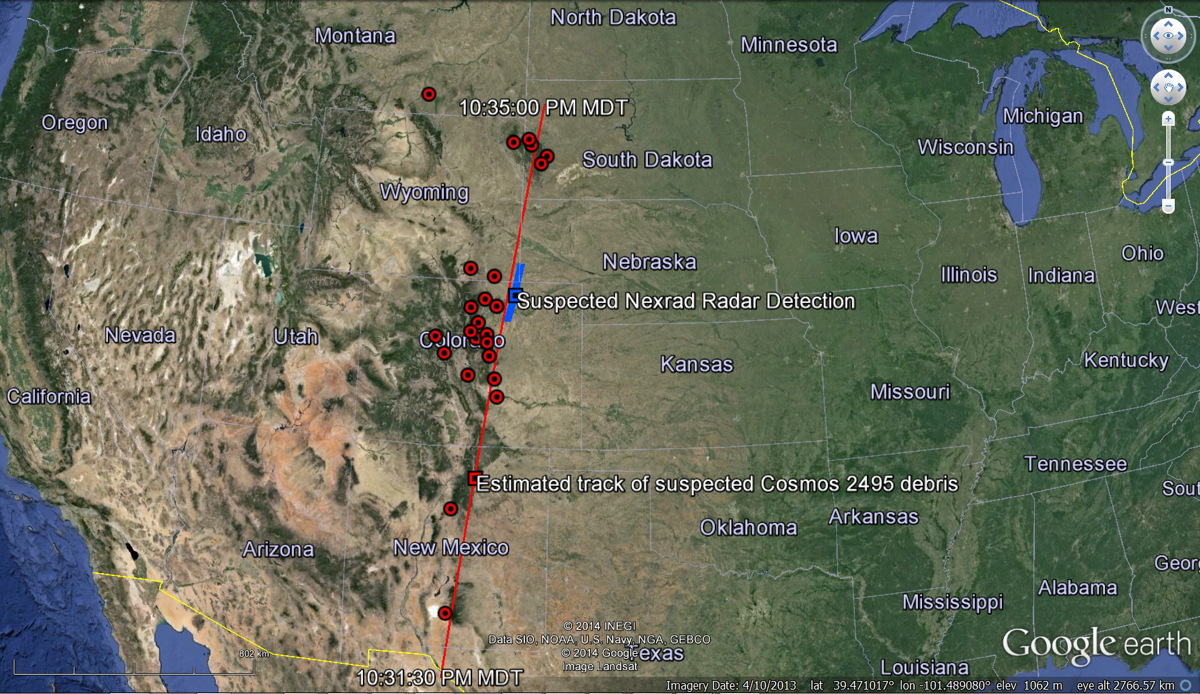
Credit: Ted Molczan
Here’s a new one from me up today on Space.com. Eyes to the skies!
Space Sleuths Piece Together Fiery Fall of Russian Spy Satellite Debris
By Leonard David, Space.com’s Space Insider Columnist
October 02, 2014 07:01am
http://www.space.com/27318-russian-military-spy-satellite-fall.html
 Posted in

Credit: Springer International Publishing
Given that the surrounding Universe may be awash in worlds, the expectations of finding ET out there is growing.
If the rate of discovery keeps up its current pace, one estimate has it that astronomers will have identified more than a million exoplanets by the year 2045.
Vanderbilt Professor of Astronomy David Weintraub has written a thought provoking new book: Religions and Extraterrestrial Life. It will be issued next month by Springer International Publishing.
Weintraub decided to find out what the world’s major religions have to say about the matter of ET, detailed in a recent Vanderbilt press release.
Weintraub’s book describes what religious leaders and theologians have to say about extraterrestrial life in more than two dozen major religions, including Judaism, Roman Catholicism, the Eastern Orthodox churches, the Church of England and the Anglican Communion, several mainline Protestant sects, the Southern Baptist Convention and other evangelical and fundamentalist Christian denominations, the Religious Society of Friends (Quakers), Seventh Day Adventism and Jehovah’s Witnesses, the Church of Jesus Christ of Latter-Day Saints (Mormons), Islam and several major Asian religions including Hinduism, Buddhism and the Bahá’í Faith.
Public opinion
Public opinion polling indicates that about one fifth to one third of the American public believes that extraterrestrials exist, Weintraub reports. However, this varies considerably with religious affiliation.
Belief in extraterrestrials varies by religion:
— 55 percent of Atheists
— 44 percent of Muslims
— 37 percent of Jews
— 36 percent of Hindus
— 32 percent of Christians

Vanderbilt Professor of Astronomy David Weintraub.
Credit: Daniel Dubois/ Vanderbilt
Reincarnated as aliens
According to Weintraub, Asian religions would have the least difficulty in accepting the discovery of extraterrestrial life. Some Hindu thinkers have speculated that humans may be reincarnated as aliens, and vice versa, while Buddhist cosmology includes thousands of inhabited worlds.
Weintraub found very little in Judaic scriptures or rabbinical writings that bear on the question.
The few Talmudic and Kabbalistic commentaries on the subject do assert that space is infinite and contains a potentially infinite number of worlds and that nothing can deny the existence of extraterrestrial life.
At the same time, Jews don’t believe the discovery of extraterrestrial intelligence would have much effect on them.
Are we ready?
Among Christian religions, the Roman Catholics have done the most thinking about the possibility of life on other worlds, the astronomer discovered.
Weintraub also identified two religions – Mormonism and Seventh-day Adventism – whose theology embraces extraterrestrials.
All this and other information in the book leads to the big question: Are we ready?
In answer to that question Weintraub concludes, “While some of us claim to be ready, a great many of us probably are not… very few among us have spent much time thinking hard about what actual knowledge about extraterrestrial life, whether viruses or single-celled creatures or bipeds piloting intergalactic spaceships, might mean for our personal beliefs [and] our relationships with the divine.”
Are the world’s religions ready for E.T.?
Check out this video:

Credit: NASA
Windows on Earth is an educational project that features photographs taken by astronauts on the International Space Station.
Astronauts take hundreds of photos each day, for science research, education and public outreach. The photos are often dramatic, and help us all appreciate home planet Earth.
Windows on Earth also operates software on the International Space Station, as a window-side aide to help astronauts identify priority targets for photography.
Recently, nearly two dozen of these photos were selected for their artistic appeal, and displayed at Gallery Seven in Maynard, Massachusetts.
For a personal tour of the displayed images, go to:
http://www.youtube.com/watch?v=uz-cGB2fzy8&feature=youtu.be
Another web site provides free public access to virtually all of these photos, updated at least weekly.
That site is operated by TERC, an educational non-profit, in collaboration with the Association of Space Explorers (the professional association of flown astronauts and cosmonauts), the Virtual High School, and CASIS (Center for Advancement of Science in Space).
Also engaged is technical support from NASA’s Crew Earth Observation Program.
Take a look at:

Credit: NASA
The developer of the Dream Chaser –Sierra Nevada Corporation (SNC) — has filed a legal challenge to the award of contracts to Boeing and SpaceX under NASA’s Commercial Crew Transportation Capability (CCtCap) program.
SNC’s filing seeks a further detailed review and evaluation of the submitted proposals and capabilities.
Dream Chaser was the only vehicle remaining in the Commercial Crew Program that was not a capsule.
“In its 51 year history SNC has never filed a legal challenge to a government contract award,” the company stated in a press release. “However, in the case of the CCtCap award, NASA’s own Source Selection Statement and debrief indicate that there are serious questions and inconsistencies in the source selection process.”
Because of these factors, SNC “feels that there is no alternative but to institute a legal challenge.”
SNC Space Systems filed a bid protest with the Government Accountability Office (GAO).
According to SNC, the official NASA solicitation for the CCtCap contract prioritized price as the primary evaluation criteria for the proposals, setting it equal to the combined value of the other two primary evaluation criteria: mission suitability and past performance.
“SNC’s Dream Chaser proposal was the second lowest priced proposal in the CCtCap competition. SNC’s proposal also achieved mission suitability scores comparable to the other two proposals.”
SNC believes the result of further evaluation of the proposals submitted “will be that America ends up with a more capable vehicle, at a much lower cost, with a robust and sustainable future.”

This image was taken by Mastcam: Right (MAST_RIGHT) onboard NASA’s Mars rover Curiosity on Sol 759 (2014-09-24 23:58:36 UTC).
Credit: NASA/JPL-Caltech/MSSS
The Curiosity Mars rover has been busy munching into a mountain – an outcrop on Mount Sharp.
The robot’s hammering drill collected a powdered sample of rock. The powder collected by the drilling is temporarily held within the sample-handling mechanism on the rover’s arm.
Curiosity arrived Sept. 19 at an outcrop called “Pahrump Hills,” which is a section of the mountain’s basal geological unit, called the Murray formation.

Curiosity Mars Rover’s route from landing to “Pahrump Hills.”
Credit: NASA/JPL-Caltech/Univ. of Arizona
The next step will be to deliver the rock-powder sample into a scoop on the rover’s arm. In the open scoop, the powder’s texture can be observed for an assessment of whether it is safe for further sieving, portioning and delivery into Curiosity’s internal laboratory instruments without clogging hardware.
Those instruments can perform many types of analysis to identify chemistry and mineralogy of the source rock.
The NASA Mars machinery landed on the Red Planet in August 2012.

Members of the mission team at the Lockheed Martin Mission Support Area in Littleton, Colorado, celebrate after successfully inserting NASA’s Mars Atmosphere and Volatile Evolution (MAVEN) spacecraft into orbit around Mars at 10:24 p.m. EDT Sunday, Sept. 21.
Credit: Lockheed Martin
Two new spacecraft have successfully entered Mars orbit: NASA’s Mars Atmosphere and Volatile Evolution (MAVEN) spacecraft and India’s Mars Orbiter Mission (MOM) – MAVEN on Sept. 21; MOM on Sept. 24.
Both spacecraft are now undergoing extensive checkout.
With the successful insertion of India’s Marscraft into orbit around the Red Planet, the Indian Space Research Organization (ISRO) became the fourth space agency to successfully send a spacecraft to Mars orbit.

Prime Minister of India, Narendra Modi, was present at ISRO’s Telemetry, Tracking and Command Network in Bangalore to witness the country’s MOM spacecraft braking into Mars orbit. ISRO Chairman, K. Radhakrishnan, looks on.
Credit: ISRO
Where will they make new discoveries? Clues to where they should focus investigations can be gleaned from a new geologic map of the planet.
According to Ken Tanaka of the U.S. Geological Survey (USGS) in Flagstaff, Arizona, the new map – seven years in the making — provides a comprehensive digital geologic database of Mars, useful for guiding exploration and research into its geological history, resources, astrobiology potential, and geophysical and climatological information.

Credit: USGS
For access to information on the map, go to this informative American Geophysical Union article at:
http://onlinelibrary.wiley.com/doi/10.1002/2014EO380001/pdf
For full access to the USGS Mars map go to:

A longing look at one space elevator design.
Credit: Obayashi Corporation of Tokyo, Japan.

Scene from CCTV broadcast of China’s moon rover and its panoramic survey of the Moon.
Credit: CCTV
China’s CCTV network has recently released a 360-degree panoramic survey of the Moon – taken by the country’s Yutu lunar rover.
To access this informative video, go to:

New computer graphics have been used to debunk the debunkers regarding historic Apollo 11 lunar landing.
Credit: NASA
Tackling the skeptics out there that the Apollo 11 moon landing in 1969 was a hoax is NVIDIA, a pioneering visual computing and computer graphic enterprise.
By using Maxwell, their new graphics processing unit (GPU) architecture, company experts have debunked the debunkers.
Maxwell is designed to solve some of the most complex lighting and graphics challenges in visual computing. Even on the Moon!
Conspiracy theorists have claimed that the historic mission was performed in a back-lot studio. Part of the crazy claim is that moonwalker Buzz Aldrin must have been lit by something other than the Sun.
Using Maxwell, a demo team rebuilt the scene of the Moon landing in Unreal Engine 4, a game engine developed by Epic Games. They simulated how the Sun’s rays, coming from behind the lander, bounced off the Moon’s surface, and Neil Armstrong’s suit, to cast light on Aldrin as he stepped off the lander.
To recreate the Moon landing, the demo team collected every detail they could.
According to a NVIDIA press statement, their team researched the rivets on the lunar lander, identified the properties of the dust coating the lunar surface, and measured the reflectivity of the material used in the astronauts’ space suits.

Using Voxel-Based Global Illumination, the Apollo 11 landing site was analyzed, determining the way light bounces from one object to another in real time.
Credit: NVIDIA
Big clue
It was during this research when the demo team uncovered a big clue.
A video clip that showed Aldrin descending the ladder had a bright spot of light that seemed to move every time the camera did.
Using Maxwell to simulate the conditions on the Moon’s surface during the lunar landing 45 years ago, it revealed how Aldrin was illuminated by light reflected from the Moon’s surface and Armstrong’s spacesuit.
Stars in the scene
Another detail seized on by skeptics: photos from the landing site don’t show any stars. That’s led some to claim that the U.S. Government faked the landing and left out the stars in the scene, because it would be impossible to portray the position of the stars from the moon.
By using Maxwell the demo team was able to find them.
“The reason the stars aren’t visible is [that] the exposures in the camera are set to capture the scene on the Moon’s surface,” said Mark Daly, a NVIDIA veteran who led the demo team. “But they’re there. And our demo team was able to find them by digitally changing the exposure on the shots to reveal them.”
Bottom line from the company: “No, the Apollo 11 moon landing wasn’t a hoax. And we can prove it.”
Take a look at their work at:
http://blogs.nvidia.com/blog/2014/09/18/debunked/

The MIT BioSuit is a skintight spacesuit that offers improved mobility and reduced mass.
Credit: Photo-illustration: Jose-Luis Olivares/MIT
It’s a tight fit – but if you’re sauntering around on Mars that’s a fashion statement.
Space designers at the Massachusetts Institute of Technology are stitching together plans for shrink-wrapping spacesuits. So much so that spacesuits of the future may resemble a streamlined second skin.
The MIT BioSuit is a skintight spacesuit that offers improved mobility and reduced mass compared to modern gas-pressurized spacesuits.
The skintight, pressurized suit would not only support the astronaut, but would give the space traveler much more freedom to move during planetary exploration.
To take the suit off, the wearer would only have to apply modest force, returning the suit to its looser form.
A flyable first: second skin
Master space suit designer at MIT is Dava Newman, a professor of aeronautics and astronautics and engineering systems researchers.
She and her colleagues are one step closer to engineering an active, “second-skin” spacesuit: active compression garments that incorporate small, spring-like coils that contract in response to heat. The coils are made from a shape-memory alloy – a type of material that “remembers” an engineered shape and, when bent or deformed, can spring back to this shape when heated.
The idea is that an astronaut may don a lightweight, stretchy garment, lined with tiny, muscle-like coils. That person would then plug in to a spacecraft’s power supply, triggering the coils to contract and essentially shrink-wrap the garment around the person’s body.

Close-up view of a 3-D-printed shape memory alloy (SMA) cartridge that packs 24 SMA actuators into a 1-inch-wide structure designed specifically for active compression garments.
Photo: Jose-Luis Olivares/MIT
Mobility for planetary exploration
The coil design was conceived by Bradley Holschuh, a postdoc in Newman’s MIT lab.
“Ultimately, the big advantage is mobility, and a very lightweight suit for planetary exploration,” said Newman in a MIT press statement.
According to Holschuh , while the suit team is concentrating mostly on applications in space, the suit design and active materials may be used for other purposes, such as in athletic wear or military uniforms.
This research was funded by NASA and the MIT Portugal Program.
The MIT Portugal Program is an international collaboration seeking to demonstrate that an investment in science, technology and higher education can have a positive, lasting impact on the economy by addressing key societal issues through quality education and research in the emerging field of engineering systems.

