Archive for the ‘Space News’ Category
 Author:
  November 13th, 2014
First launch of Russia’s heavy-class Angara 5 booster is set for December.
Credit: Khrunichev State Research and Production Space Center
Russian rocketeers are readying the Angara 5 heavy-lift booster for an end of December liftoff.
This will be the first launch of the heavy-class Angara 5 booster.
The creation of the Angara family of launch vehicles signals a growing capability to launch a variety of spacecraft from the territory of Russia.
Developer of the Angara launch system is the Khrunichev State Research and Production Space Center. The Angara-class rocket marks the first space launcher built in Russia from scratch after the fall of the Soviet Union.
Earlier this year, on July 9, the light-lift Angara-1.2ML – meaning “Maiden Launch” – departed from the Plesetsk Cosmodrome in the Archangelsk Region.
That booster made a long-distance, suborbital lob of roughly 21 minutes, tossing hardware into a targeted impact area of the Kura Range on the Kamchatka peninsula – over 3,500 miles (5,700 kilometers) away from the launch site.
The Angara 5 has been rolled out to the launch pad at Plesetsk Cosmodrome.
According to a Khrunichev Press Release, cosmodrome specialists will conduct a comprehensive series of tests, including electrical testing of systems and components, in preparation for first launch of the heavy class Angara 5 next month.
To view a video of Angara 5 preparation for roll out to the pad, go to:
http://tvzvezda.ru/news/forces/content/201411102356-kagv.htm
 Posted in

Virgin Galactic pilot Todd Ericson and NTSB investigators at SpaceShipTwo accident site.
Credit: NTSB
The tragic accident on October 31 involving the private spaceliner, SpaceShipTwo, and the loss of one of its two test pilots, Mike Alsbury, has been addressed in a special message from the CEO of the Mojave Air and Space Port, Stuart Witt:
“The past three weeks have proven exceedingly challenging for the entire Mojave Flight Test Family,” Witt said.
Witt also noted that “it is with great sorrow” that the National Test Pilot School (NTPS) reports that NTPS Instructor Mr. Michael (Mike) Hill and NTPS Student Mr. Ilam Zigante perished in an accident in a T-67 Slingsby Firefly aircraft on October 24. The accident occurred during a scheduled NTPS curriculum sortie approximately 28 miles north of the Mojave Air and Space Port (MASP).
“Losing three valued members of the team in two separate mishaps will have a lasting and profound effect on all. While we chose this profession we are reminded of the price too many have paid so all may enjoy safe mobility around the globe.”
“As the holidays approach, please keep the families of Mike Hill, Ilam Zigante and Mike Alsbury in your thoughts and prayers. God Speed,” Witt said.
Thorough investigation
Additionally, in a MASP newsletter, the SpaceShipTwo accident was detailed:
“On October 31, SpaceShipTwo, piloted by Scaled Composites, under contract to Virgin Galactic, experienced a serious anomaly during a test flight, resulting in the loss of the vehicle. The airport also lost a respected and devoted colleague who was the co-pilot for the test flight,” the newsletter said.
“The National Transportation Safety Board is conducting a thorough investigation with the assistance of Scaled Composites and Virgin Galactic. They have said the full investigation can last up to a year.”
“More information will be released throughout the course of the investigation. At this time we ask that everyone please respect the privacy of the families of those involved.”
“We would like to thank the emergency responders who worked diligently to handle the situation throughout the day. We also appreciate all of those who have showed their continuous support for the airport, Scaled Composites, and Virgin Galactic throughout this difficult time.”
“Our thoughts and prayers go out to the family and friends who have been most affected by this tragedy.”
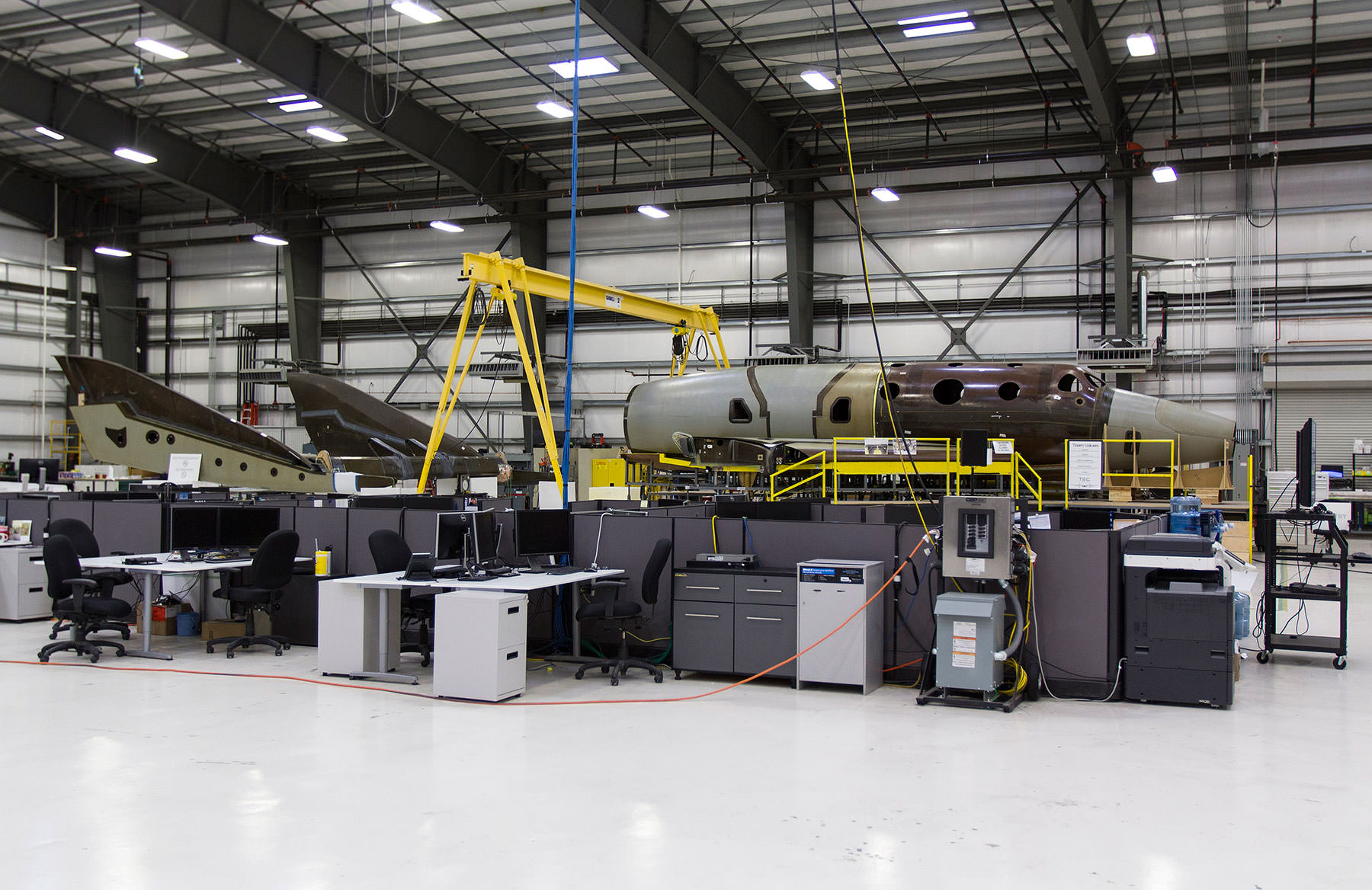
Second SpaceShipTwo under construction.
Credit: Virgin Galactic
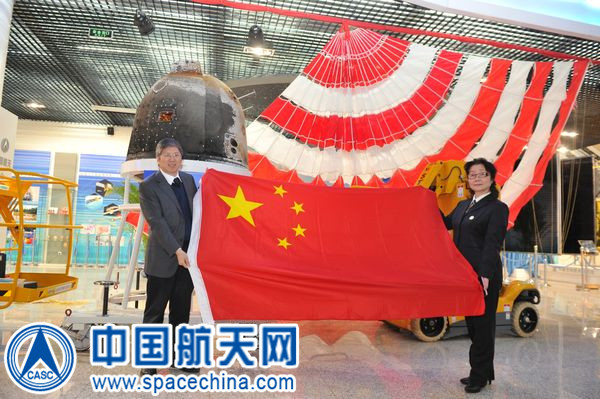
Chinese flag was carried by test capsule that made a circumlunar voyage.
Credit: CASC
A ceremony in China has showcased the re-entry capsule that recently flew a circumlunar trajectory and returned to Earth under parachute.
In a website posting by the China Aerospace Science and Technology Corporation, images are shown of what is now affectionately known as the “little fly” spacecraft.
Shown in photos are items flown in the capsule – such as a large Chinese flag – and other items.
The capsule made use of seven kinds of thermal protection materials, apparently to evaluate the heat-thwarting qualities of various materials. What was learned will be applied to the Chang’e 5 lunar sample return craft that is slated to fly in 2017.

Various items are removed from the test capsule that made a circumlunar voyage.
Credit: CASC
Before its reentry to Earth, the return capsule mounted to its carrier spacecraft was moving at a velocity of 11.2 kilometers per second.
Once released from the carrier craft, the capsule slowed down by employing a reentry method that had the capsule “bounce” off the edge of the Earth’s atmosphere, before reentering again.
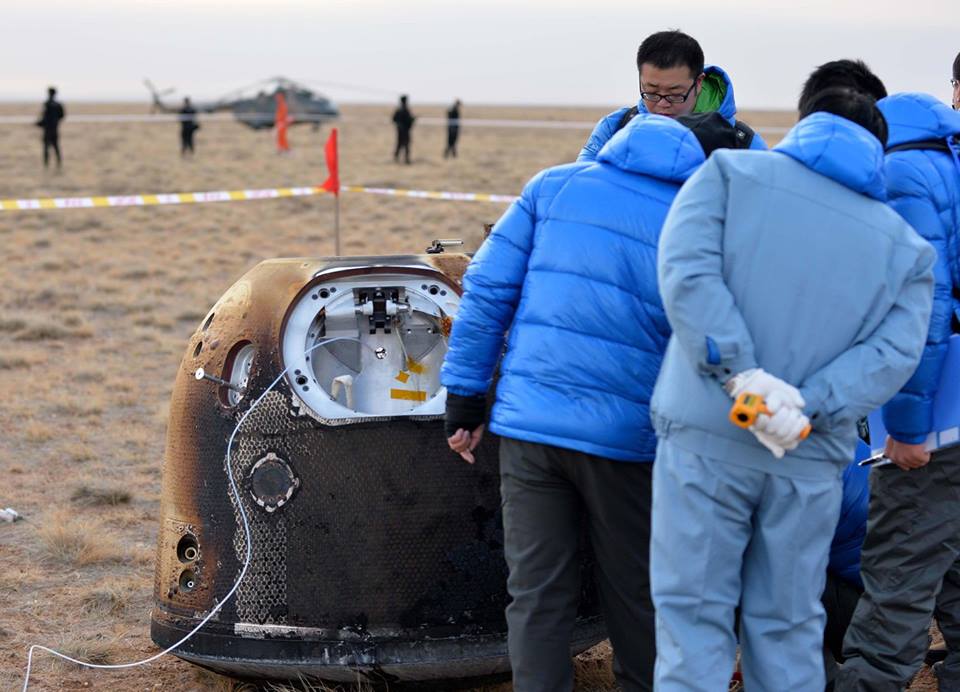
The return capsule landed in safe and sound condition under parachute after some eight days of flight. It parachuted to Earth on November 1 (Beijing time) into Siziwang Banner in north China’s Inner Mongolia and was recovered by ground teams.

Credit: CASC
The test craft was lofted moonward by a Long March-3C rocket on Oct. 24.
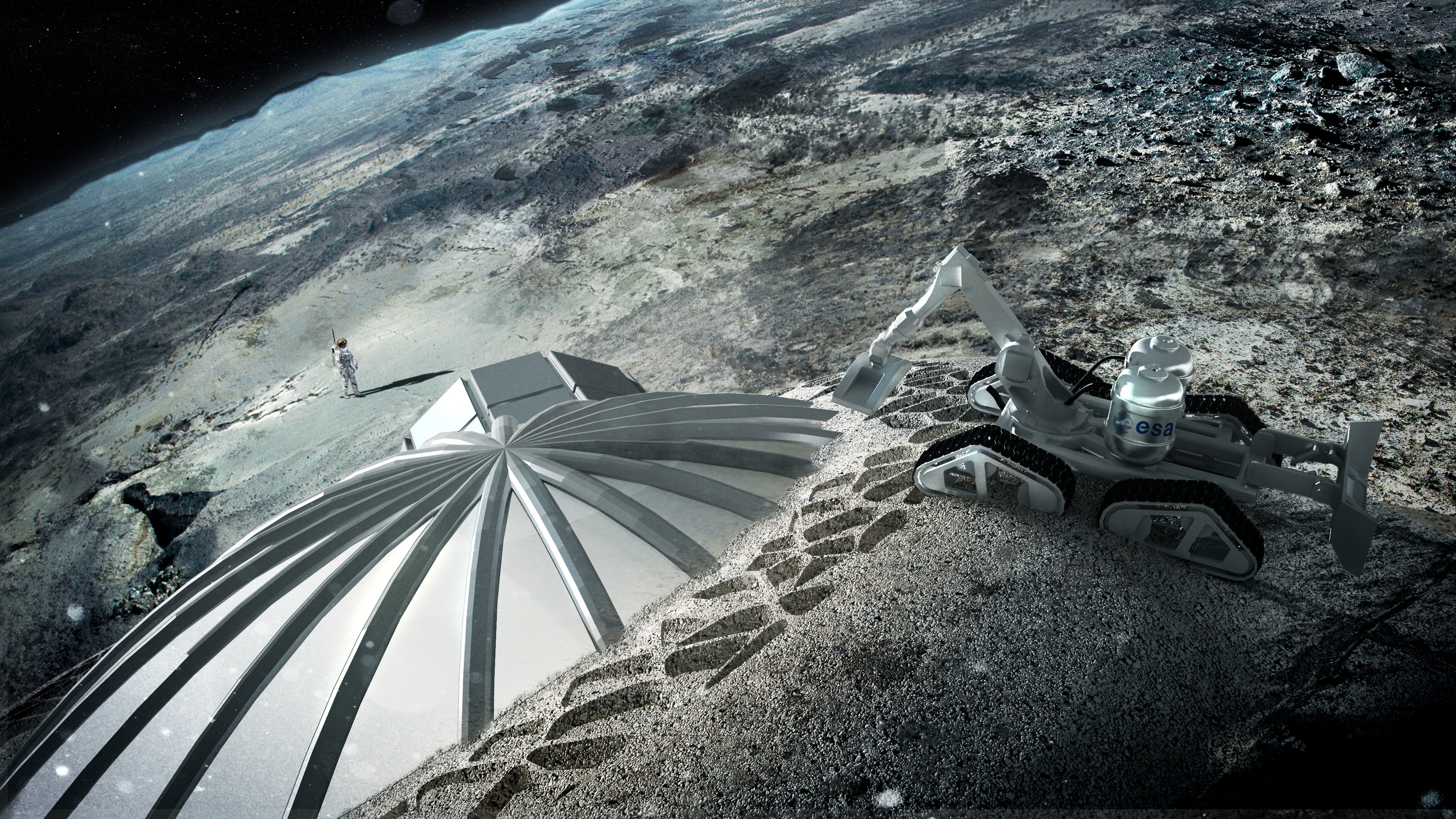
Credit: Foster+Partners
The European Space Agency (ESA) is working with architects at Foster+Partners to evaluate constructing a Moon base via 3D printing using lunar soil.
Started in 2013, the collaboration is eying the rim of Shackleton Crater at the lunar south pole for the base location. A multi-dome lunar base could be built based on the 3D printing concept. Once assembled, the inflated domes would be covered with a layer of 3D-printed lunar regolith by robots to help protect the occupants against space radiation and micrometeoroids.
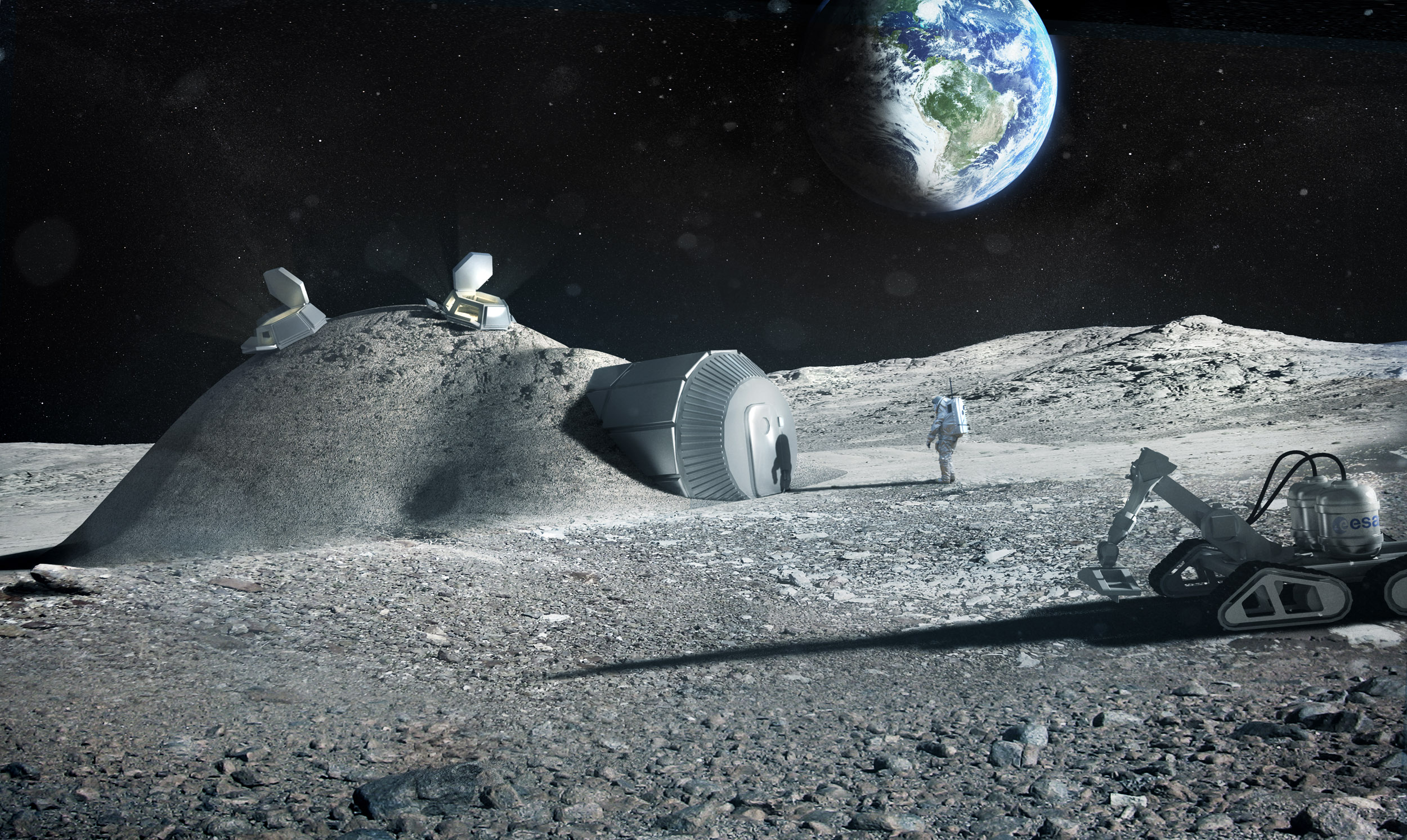
Credit: ESA/Foster+Partners
Why Shackleton Crater?
The Moon’s rotation is such that the Sun only grazes its poles at low angles. The result is a near-constant “peak of eternal light” along the rim of Shackleton Crater, beside regions of permanent shadow.
Building a Moon base in the vicinity of such a site would offer plentiful solar power, and relief from the extremes of heat and cold found across the rest of the Moon.
Inflatable dome
The base is first unfolded from a tubular module that can be easily transported by space rocket. An inflatable dome then extends from one end of this cylinder to provide a support structure for construction.
Layers of regolith are then built up over the dome by a robot-operated 3D printer to create a protective shell.
ESA is due to investigate another lunar 3D printing method: harnessing concentrated sunlight to melt regolith rather than using a binding liquid.

Credit: ESA/Foster+Partners
Additive manufacturing
In reality, according to ESA, any lunar base remains firmly on the drawing board, but adds that each small step forward in research makes future lunar colonization a little more feasible.
Last month, more than 350 experts came together for a two-day Additive Manufacturing for Space Applications workshop at ESA’s ESTEC technical center in Noordwijk, the Netherlands. They discussed the potential of 3D printing – also known as “additive manufacturing” – to transform the way the space industry operates and begin preparing common standards for its use.
Go to a video detailing Europe’s approach to Moon base building at:
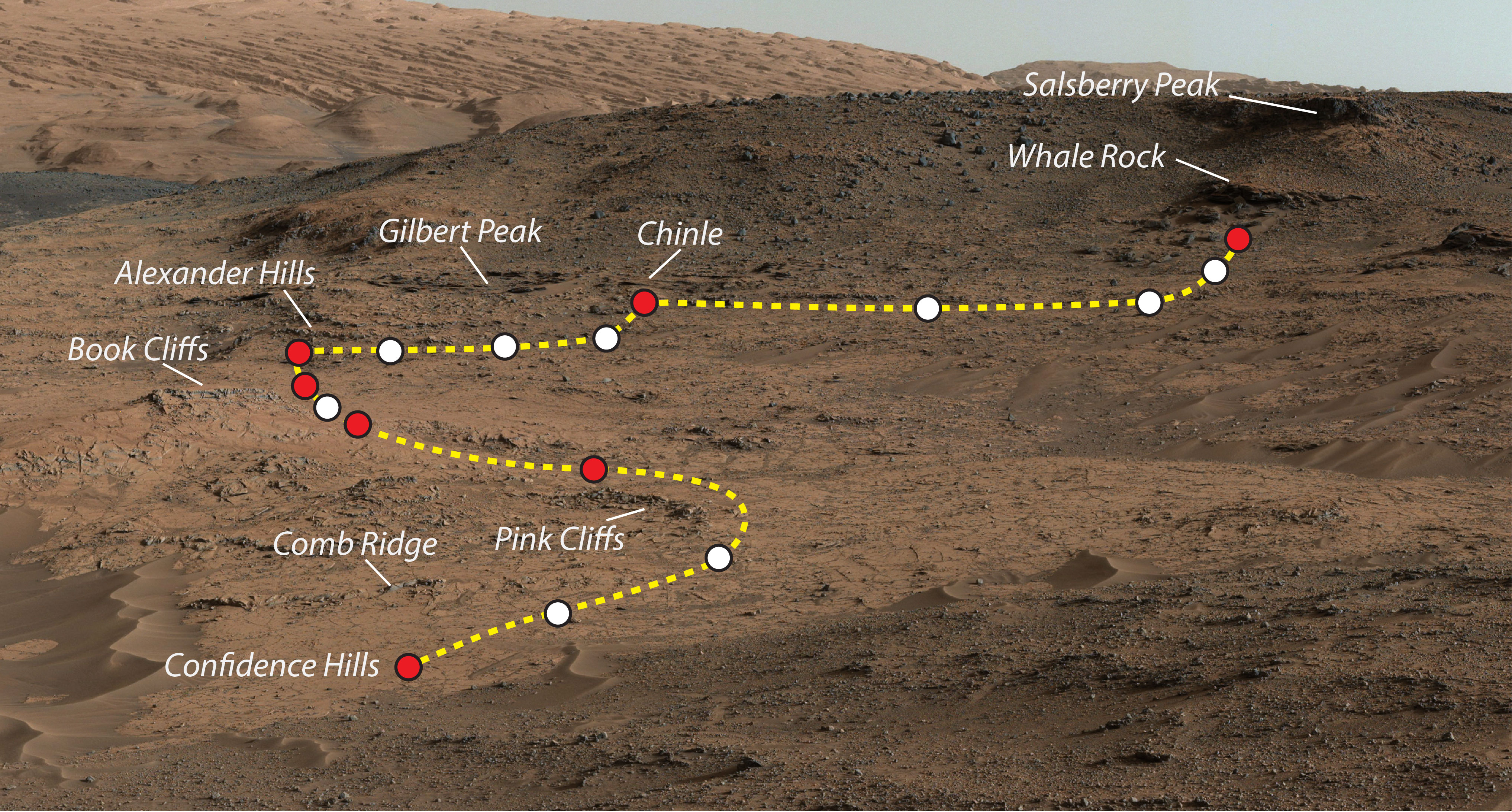
Image Credit: NASA/JPL-Caltech/MSSS
NASA/JPL has issued an image showing the path and some key places in a survey of the “Pahrump Hills” outcrop by NASA’s Curiosity Mars rover in autumn of 2014.
This view of the outcrop and other portions of Mount Sharp beyond is a mosaic of images taken by the rover’s Mast Camera (Mastcam).
The outcrop is at the base of Mount Sharp within Gale Crater. The mission’s in-place investigation of the layered mountain began at the low edge of the Pahrump Hills outcrop, at the target “Confidence Hills.”

This image was taken by Front Hazcam: Left B (FHAZ_LEFT_B) onboard NASA’s Mars rover Curiosity on Sol 802 (2014-11-08 04:06:02 UTC).
Image Credit: NASA/JPL-Caltech
Curiosity collected a drilled sample of rock powder at that target in September 2014 and delivered portions of the powder into analytical instruments inside the rover.
The mission then began a “walkabout” of the outcrop, similar to the way field geologists on Earth walk across an outcrop to choose the best places on it to examine in detail.
The dashed gold line indicates the path the rover drove during the walkabout. Names are shown for a few of the features visited and observed by the rover. Red dots indicate stops at the end of a day’s drive. White dots indicate locations of stops made during the drives to collect observations of the Pahrump Hills outcrop.

Wheel watch 2014. This image was taken by Mastcam: Left (MAST_LEFT) onboard NASA’s Mars rover Curiosity on Sol 797 (2014-11-02 23:46:25 UTC).
Image Credit: NASA/JPL-Caltech/MSSS
The mission completed the walkabout at the site labeled “Whale Rock”, and the team is now examining the observations acquired during the walkabout to decide where to return for more detailed analysis.
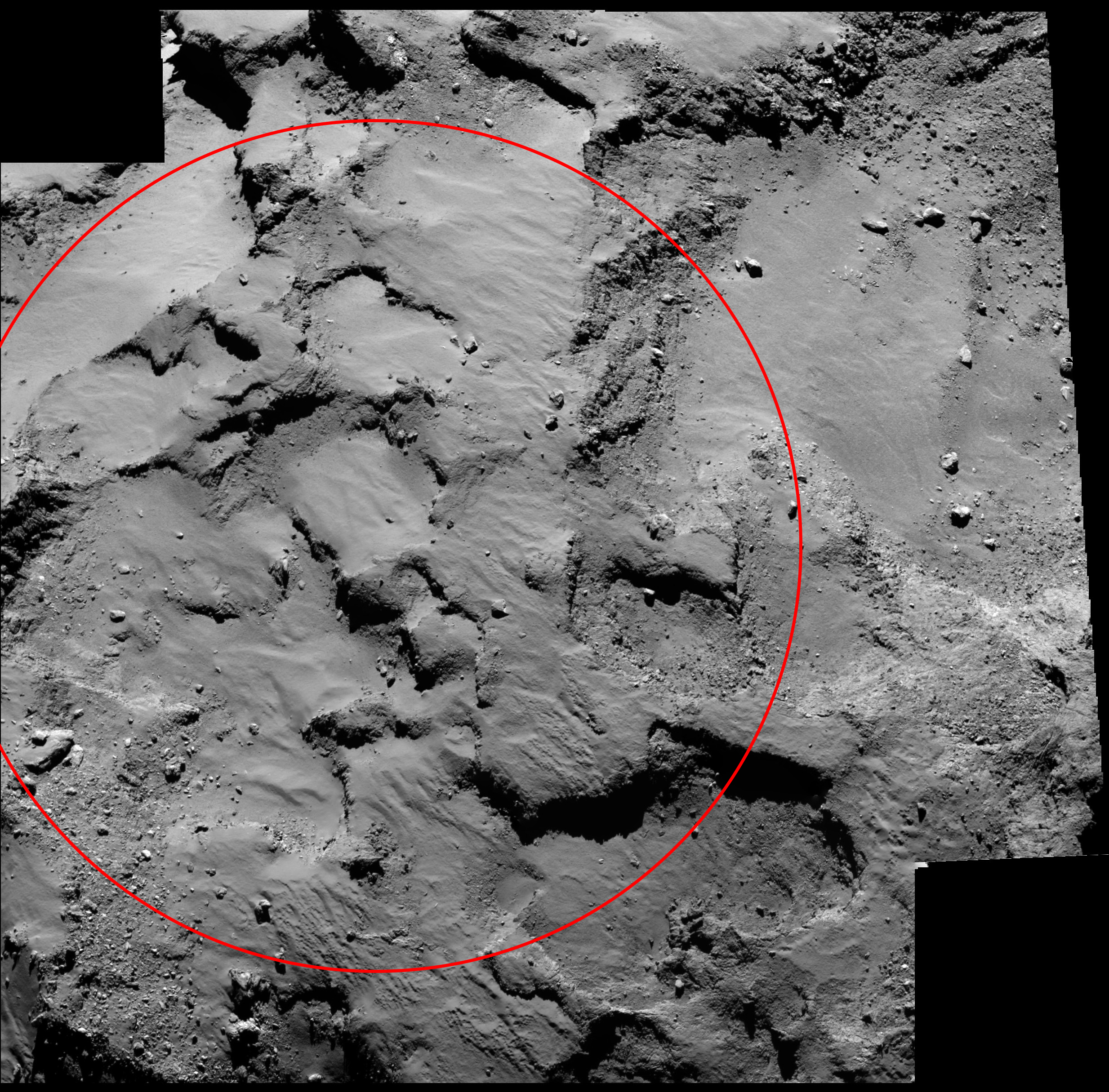
Close-up of the region containing Philae’s primary landing – “Agilkia” — which is located on the “head” of Comet 67P/Churyumov–Gerasimenko.
Credits: ESA/Rosetta/MPS for OSIRIS Team MPS/UPD/LAM/IAA/SSO/INTA/UPM/DASP/IDA
The European Space Agency’s Rosetta spacecraft is set to deploy its Philae lander for a first-time touchdown on a comet.
On November 11-12, Philae is set to separate from Rosetta at 09:03 GMT (10:03 CET) and touch down on Comet 67P/Churyumov-Gerasimenko at about 16:02 GMT (17:02 CET).
A timeline of the most crucial activities related to separation, descent and landing has been scripted by ESA. But be aware that many of these times are subject to change and confirmation, “given the extremely dynamic nature of this delicate and complex operation,” according to an ESA statement.
Landing site
The site where Rosetta’s Philae lander is scheduled to touch down on Comet 67P/Churyumov–Gerasimenko on November 12 now has a name: Agilkia.
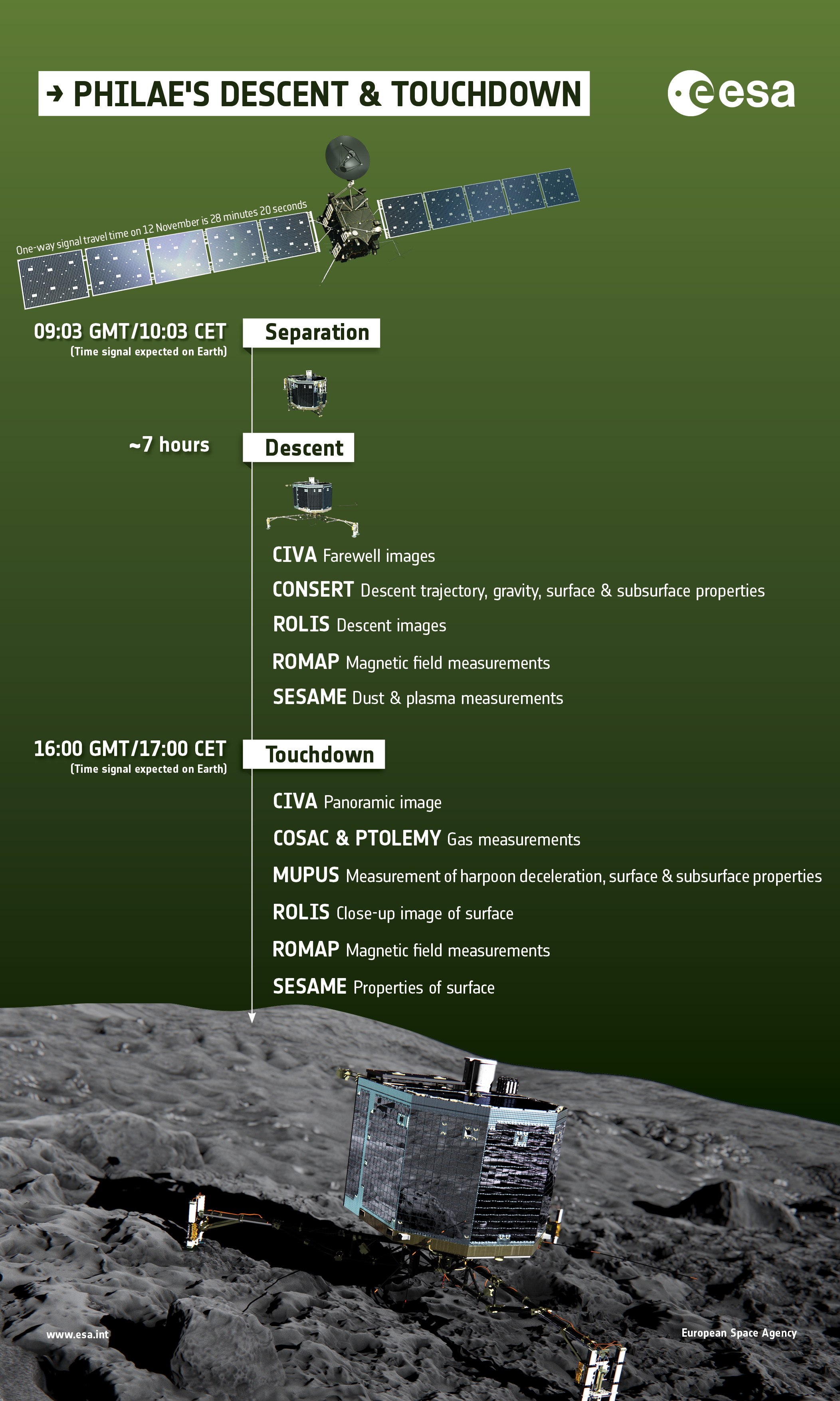
Timeline for touchdown.
Credit: ESA
The landing site, previously known as “Site J”, is named for Agilkia Island, an island on the Nile River in the south of Egypt. A complex of Ancient Egyptian buildings, including the famous Temple of Isis, was moved to Agilkia from the island of Philae when the latter was flooded during the building of the Aswan dams last century.
The name was selected by a jury comprising members of the Philae Lander Steering Committee as part of a public competition run October 16-22 by ESA and the German, French and Italian space agencies.
Rosetta was launched in 2004 and arrived at Comet 67P/Churyumov-Gerasimenko on August 6, 2014. It is the first mission in history to rendezvous with a comet, escort it as it orbits the Sun, and deploy a lander to its surface.
Rosetta is an ESA mission with contributions from its member states and NASA.
To keep updated on the attempted comet landing, go to:
NASA Television and the agency’s website will provide live coverage from 6-8:30 a.m. PST (9-11:30 a.m. EST) on Wednesday, November 12 of the European Space Agency (ESA) Rosetta mission’s scheduled landing of a probe on a comet.
NASA TV streaming video, downlink and updated scheduling information is at:
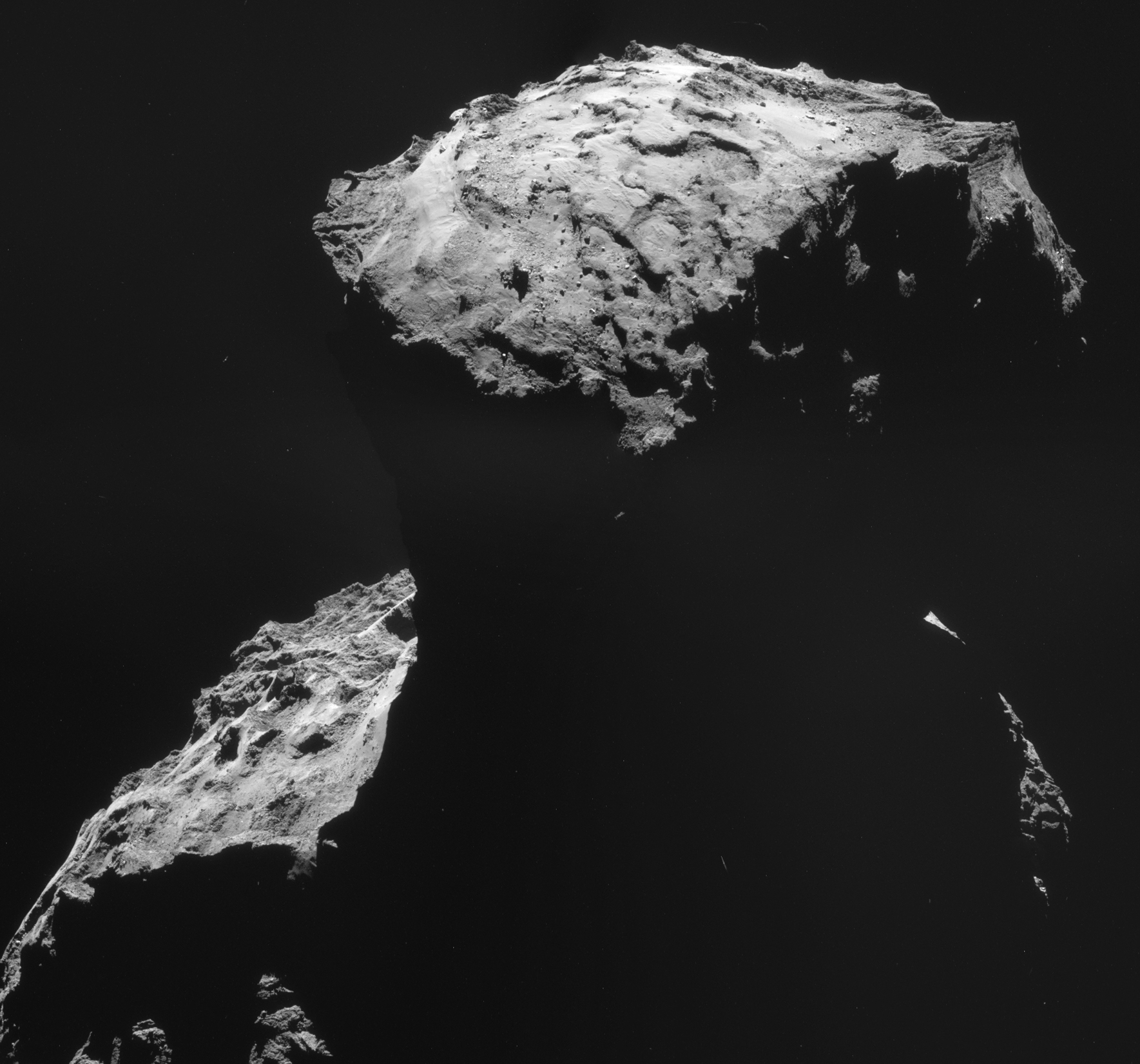
This four-image NAVCAM mosaic shows Philae’s landing site as Rosetta departed its 10 kilometer orbit in order to prepare for the deployment of Philae on November 12.
Credit: ESA/Rosetta/NAVCAM – CC BY-SA IGO 3.0

Space station astronaut Karen Nyberg uses instrument to create still and video imagery of her eye in microgravity.
Credit: NASA
Here’s a unique and novel opportunity for ophthalmology companies.
The National Space Biomedical Research Institute (NSBRI) and the Center for Space Medicine at Baylor College of Medicine have launched the Vision for Mars Challenge.
What’s being tackled here is addressing a key space biomedical issue. That is, after returning from space missions, some astronauts experience eye problems and changes to their vision.
The Challenge is meant to help identify and advance medical technologies for ocular health in space through collaboration and funding support.
New space syndrome
To help NASA better understand this new syndrome, clinical and business leaders within the ophthalmology sector are being asked to help identify cutting-edge, space-appropriate diagnostic approaches and devices.
 “We don’t understand the effects of reduced gravity on the optic nerve,” said Tim Stout, professor and chair of ophthalmology at Baylor. “However, we have some evidence that long term spaceflight can result in visual field defects in astronauts,” he said in an NSBRI press statement.
The next step is bringing the ophthalmologists and scientists needed to answer these questions to the same table.
Disruptive medical technologies
The Vision for Mars Challenge leverages an ongoing successful Industry Forum initiative called Space Medical and Related Technologies Commercialization Assistance Program or (SMARTCAP,) which identifies and funds small U.S.-based companies developing disruptive medical technologies.
At least three SMARTCAP grants in this cycle will be awarded to companies with innovative ophthalmology products.
Key Dates for the Vision for Mars Plan:
- November 6, 2014 – Vision for Mars Challenge conference in Houston, TX.
- December 4, 2014 – Application Deadline for SMARTCAP – Vision for Mars Challenge.
- February, 2015 – Winners of the SMARTCAP Vision for Mars Challenge announced.
Grant recipients must secure a 100-percent match in funding. This leveraging of federal funding actively fosters public-private collaborations and partnerships.
For full submission guidelines and additional information regarding SMARTCAP, go to: www.smartcap.org
China’s recent Moon mission was a round-trip success.
Courtesy: China Space Website
A new story on the recent China succcess, posted today on Space.com:
China’s 1st Round-Trip Moon Shot Sets Stage for Bigger Lunar Feats
by Leonard David, Space.com’s Space Insider Columnist
November 05, 2014 07:00am ET
http://www.space.com/27661-china-moon-mission-sample-return.html
By the way, you might check out this video on the mission:
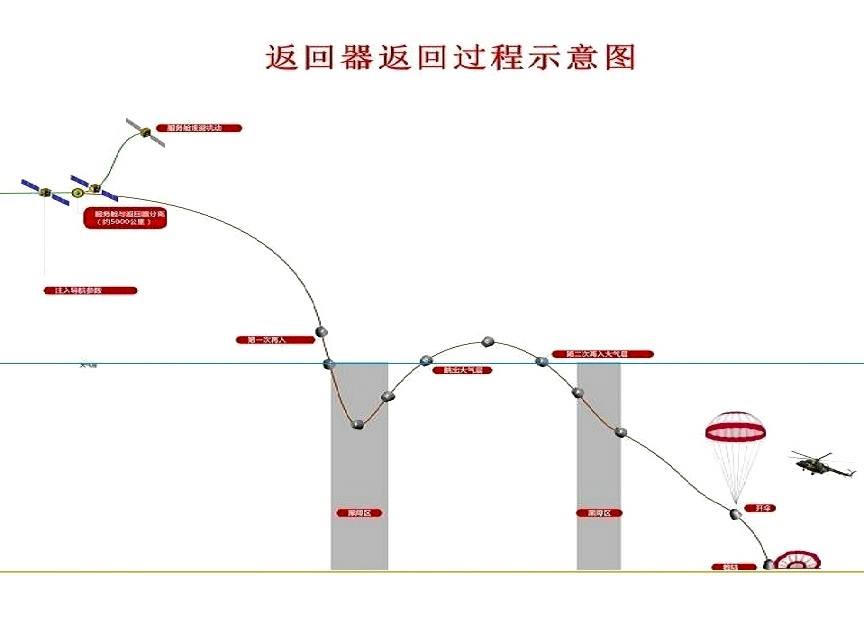
China mooncraft made a skip re-entry into Earth’s atmosphere, then parachuted into pre-selected landing site.
Courtesy: China Space
Website

Credit: Virgin Galactic
November 1st comments from Sir Richard Branson, founder of Virgin Galactic, at the Mojave Air and Space Port, California:
“This is a very tough time for all of us at Virgin Galactic, The Spaceship Company and Scaled Composites, and our thoughts remain with the families of the brave Scaled pilots, and all those affected by this tragedy.
We are determined to find out what went wrong and are working with the authorities to get that information. It is too early for me to add any details of the investigation at this stage.
We have always known that commercial space travel is an incredibly hard project. We have been undertaking a comprehensive testing program for many years and safety has always been our number one priority. This is the biggest test program ever carried out in commercial aviation history, precisely to ensure this never happens to the public.
The bravery of test pilots generally cannot be overstated. Nobody underestimates the risks involved in space travel. Commander Chris Hadfield is amongst those who has sent moving notes of support, in which he highlighted the nature of space projects. He wrote: ‘As a former test pilot, crashes and even deaths were frequent. It is a known part of the business. Little solace, but reality. Pushing the bounds of knowledge and possibility comes with unavoidable risk.’
In testing the boundaries of human capabilities and technologies, we are standing on the shoulders of giants. Yesterday, we fell short. We will now comprehensively assess the results of the crash and are determined to learn from this and move forward together as a company.
We have been touched by the overwhelming support coming from not just the space community but the world at large. If I could hug every single person who has sent messages of love, support and understanding over the past day, I would. The space community sticks together, and there have been touching messages of solidarity from NASA, X PRIZE, our customers, the media, the Virgin family and many, many thousand members of the public inspired by the vision of commercial space travel.
We do understand the risks involved and we are not going to push on blindly – to do so would be an insult to all those affected by this tragedy. We are going to learn from what went wrong, discover how we can improve safety and performance, and then move forwards together.
I truly believe that humanity’s greatest achievements come out of our greatest pain. This team is a group of the bravest, brightest, most determined and most resilient people I have ever had the privilege of knowing. We are determined to honour the bravery of the pilots and teams here by learning from this tragedy. Only then can we move forward, united behind a collective desire to push the boundaries of human endeavour.”

Courtesy: China Space
UPDATE: Chinese space groups and news services are reporting the successful landing of China’s test lunar orbiter, parachuting down in north China’s Inner Mongolia.
Before its reentry to Earth, the spacecraft was moving at a velocity of 11.2 kilometers per second. This speed can generate temperatures of more than 1,500 degrees Celsius.
To help the craft slow down, spacecraft controllers employed a reentry method by letting the craft “bounce” off the edge of the Earth’s atmosphere, before reentering again.
The reentry angle had to be guided so precisely that a 0.2 degrees deviation would render the mission a failure.
China’s circumlunar test vehicle carried out a “trial by fire” reentry – hotfooting itself back to Earth by performing a skip reentry to slow down. The craft appears to have landed in safe and sound condition under parachute after some eight days of flight.
Zhou Jianliang, chief engineer of the Beijing Aerospace Control Center told China’s Xinhua news agency that there were challenges for the spacecraft to make its way home.

Pre-launch photo shows China’s test craft that is now completing a circumlunar flight.
Credit: CASC/China Space
The window for landing was very small and required highly sophisticated telemetry, tracking and command system operations, Zhou said.The test orbiter maneuvered on the edge of the Earth’s atmosphere to slow from a speed of 11.2 kilometers per second before reentry, a process that generated extremely high temperatures.
Launched last Friday (Beijing time), the craft was hurled moonward by a Long March-3C rocket.This moon mission by China is seen as a partial test run for the Chang’e 5 spacecraft flight – part of the country’s multi-step program of lunar exploration.
Chang’e 5’s mission to return collected samples of the Moon’s surface back to Earth is expected in 2017, according to Chinese news sources.

Returned capsule. Courtesy: China Space

