Archive for the ‘Space News’ Category
 Author:
  November 21st, 2014
Credit: NASA/JPL
NASA’s Curiosity Mars rover is cruising for science in studying “Pink Cliffs” within the “Pahrump Hills” outcrop forming part of the basal layer of the Mount Sharp mountain.
Here are some new images from the robot showing the work in progress:

This image was taken by Front Hazcam: Right B (FHAZ_RIGHT_B) onboard NASA’s Mars rover Curiosity on Sol 815 (2014-11-21 10:31:45 UTC). Image Credit: NASA/JPL-Caltech

NASA’s Mars rover Curiosity acquired this image using its Mars Hand Lens Imager (MAHLI), located on the turret at the end of the rover’s robotic arm, on November 20, 2014, Sol 814 of the Mars Science Laboratory Mission, at 11:45:36 UTC. Image Credit: NASA/JPL-Caltech/MSSS
 Posted in

Credit: DLR
What’s it sound like when you land on a comet?
Well, as you would guess, it’s a “thud.”
That’s the report from Martin Knapmeyer, a planetary scientist at the German Aerospace Center (Deutsches Zentrum für Luft- und Raumfahrt; DLR)
A short but significant “thud” was heard by the Cometary Acoustic Surface Sounding Experiment (CASSE) as Europe’s Philae lander made its first touchdown on Comet 67P/Churyumov-Gerasimenko.
The two-second recording from space is the very first of the contact between a human-made object with a comet upon landing.
The CASSE sensors are located in the feet at the base of all three legs of the lander and were active on November 12, 2014 during the descent to the comet.
“The contact with the surface was short, but we can evaluate the scientific data,” said Knapmeyer, scientific leader of the CASSE Team.
Go to:

Credit: Copyright – Don Davis – Used with Permission
New story from me up today on Space.com:
Asteroid Impact Threat: Experts Report on Early-Warning Strategies
by Leonard David, Space.com’s Space Insider Columnist
November 20, 2014 06:40am ET
http://www.space.com/27809-asteroid-impact-early-warning-system.html
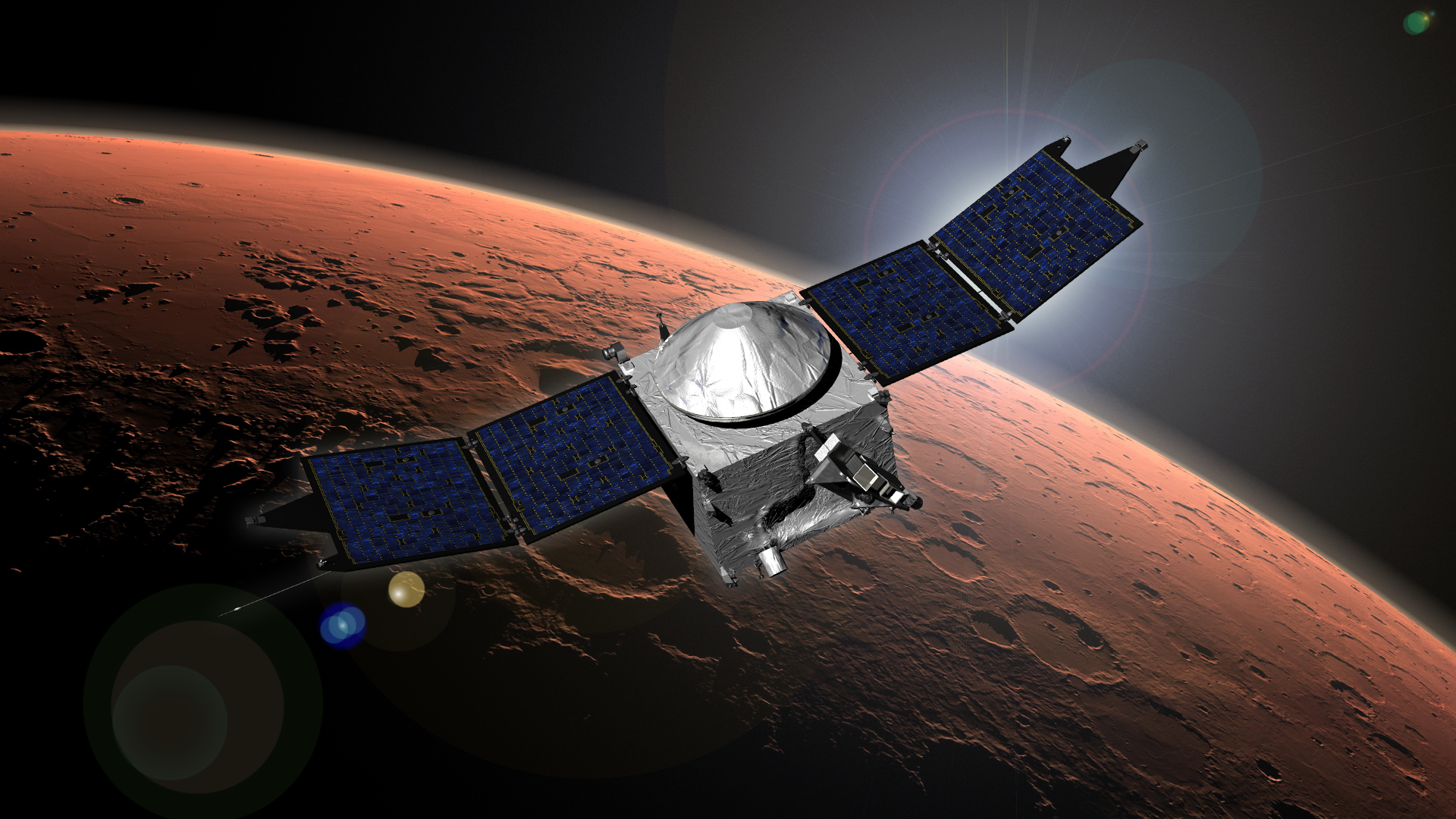
Artist’s image shows NASA’s MAVEN spacecraft in orbit around Mars. (Courtesy NASA/GSFC)
NASA’s Mars Atmosphere and Volatile Evolution Mission (MAVEN) is off and running – starting its one-year primary science mission on November 16.
“With the formal start of our science mission, we’re on track to be able to carry out our full mission as planned, and the science team is looking forward to an incredibly exciting year,” said Bruce Jakosky, MAVEN Principal Investigator at the University of Colorado, Boulder.
The start of science is actually a “soft start”, in that the instruments started making science measurements beginning almost as soon as we were in orbit, and some instrument calibration activities will be continuing throughout the mission.
The commissioning of MAVEN, in what the spacecraft’s team called its “transition phase”, included adjusting the orbit to get into its science orbit, deploying the booms that hold a number of the instruments away from the spacecraft, ejecting the Neutral Gas and Ion Mass Spectrometer instrument cover, turning on and checking out each of the science instruments, and carrying out calibration activities for both the spacecraft and the instruments.
Comet observations
“This period also included the close approach of Comet Siding Spring, which whizzed by Mars at a rough distance of only 135,000 kilometers on October 19, Jakosky said in a NASA statement.
“We also took time off from commissioning to observe the comet and to take before and after observations of the Mars atmosphere to look for changes,” Jakosky said.
“Using several MAVEN instruments, observations both revealed a tremendous quantity of metal ions that came from cometary dust that entered the atmosphere,” Jakosky said. “Their presence was unexpected, in that the nominal models of the paths taken by dust grains, calculated prior to the comet passage, indicated that no dust would make it all the way to Mars. We’re certainly glad that we took precautions to protect us from dust during the encounter!”

Artist concept of NASA’s Space Launch System (SLS) 70-metric-ton configuration launching to space. SLS will be the most powerful rocket ever built for deep space missions, including to an asteroid and ultimately to Mars.
Credit: NASA
The NASA Office of Inspector General (OIG) issued a November 14 report that flags the space agency’s current and top management and performance challenges.
Its key observation is that NASA’s “static” budgets, along with fiscal uncertainties, makes it tough for the space agency to move forward on its agenda.
Looking forward to 2015, the NASA OIG identified the following:
— Managing NASA’s Human Space Exploration Programs: the International Space Station, Commercial Crew Transportation, and the Space Launch System
— Managing NASA’s Science Portfolio
— Ensuring Continued Efficacy of the Space Communications Networks
— Overhauling NASA’s Information Technology Governance Structure
— Ensuring the Security of NASA’s Information Technology Systems
— Managing NASA’s Infrastructure and Facilities
— Ensuring the Integrity of the Contracting and Grants Processes and the Proper Use of Space Act Agreements
“The late October failure of a cargo resupply mission to the International Space Station underscores the difficulty of spaceflight and increases the challenges associated with NASA’s approach to using commercial partners to resupply the Station,” the OIG report notes.
“Similar to last year, we noted that declining budgets and fiscal uncertainties have compounded the difficulty of meeting these and other NASA challenges.”
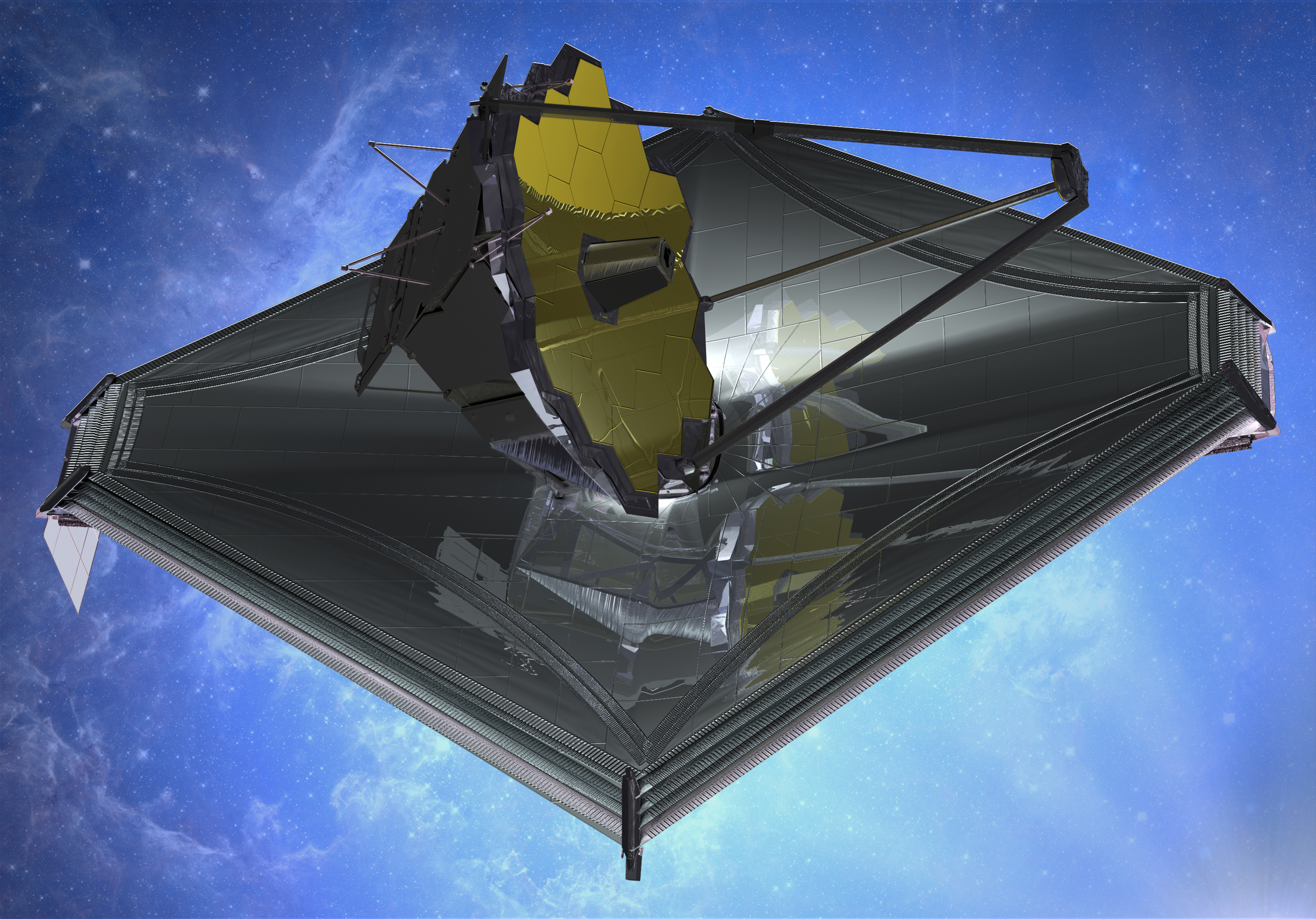
James Webb Space Telescope
Credit: Northrop Grumman
The report takes a hard look at a number of on-going NASA efforts, from extending the life of the International Space Station; developing the Space Launch System; completing the James Webb Space Telescope; as well as scrutinizing the space agency’s Near-Earth Objects (NEO) Observation Program.
The OIG report also carries a response from NASA’s chief, Charles Bolden, noting in part:
“The audits and investigations that your office conduct provide valuable oversight and insight,” Bolden says.
“The one overarching and seven specific management and performance challenges identified in your 2014 assessment provide NASA with additional tools and solutions set for improvement, which the Agency continues to build upon. We continue to aggressively pursue mitigation of the challenges that your office has identified…”
A tip of the space visor goes to SpacePolicyOnline.com News for calling attention to the release of this new NASA OIG report.
Take a look at the full report here:
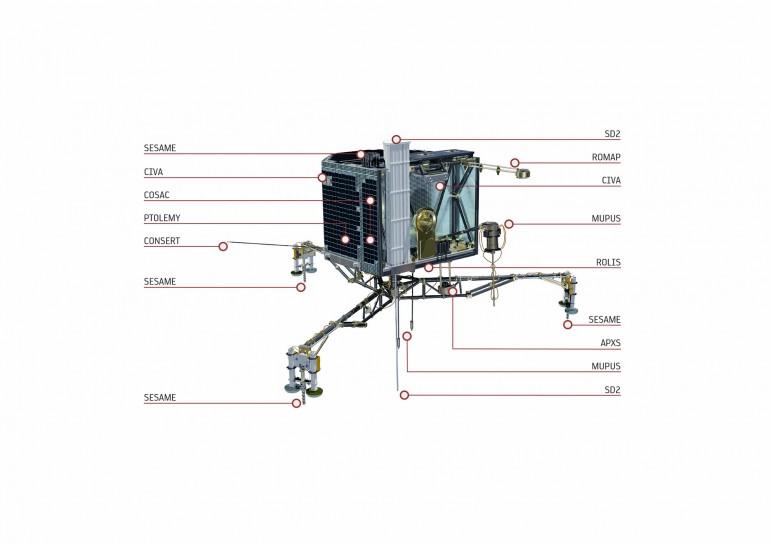
Instrumented Philae comet lander.
Credit: ESA/DLR
Update – the Philae lander has entered sleep mode at 01:36 Central European Time (CET) on November 15, 2014.
The Philae lander performed about 56 hours of continuous scientific measurements on the surface of Comet 67P.
But by 01:15 CET on November 15 the energy state of the lander became so low that the engineers assumed that Philae would go into sleep mode during the night.
“Philae is a complete success,” said Project Manager Stephan Ulamec of the German Aerospace Center (Deutsches Zentrum für Luft- und Raumfahrt; DLR).
According to a DLR press statement, from around 23:30 CET, Philae was in contact with the Lander Control Center (LCC) at DLR Cologne and sent back scientific data from the SD2 drill and the COSAC instrument.
At the beginning of the contact period, engineers in the DLR LCC continued to send commands to Philae.
The lander performed well, although the radio link to Earth failed several times. The mission scientists cheered repeatedly as new data arrived from space.
During the night, the lander also conducted measurements with the PTOLEMY instrument, acquired two images with the ROLIS camera and examined the interior of the comet nucleus using radio signals – together with the CONSERT instrument on board the Rosetta orbiter.
In addition, ground operators were able to rotate the body of the lander with its solar panels by 35 degrees, so that they are better oriented towards the Sun. The team hopes that this will allow the lander batteries to charge faster in its shaded location.
Philae’s hibernation means a break for the Philae team.
“After a very exciting and successful week, Philae is now taking the time to rest – and the team is now able to take a breath,” said DLR engineer Koen Geurts.
In recent days, the lander control team had been working around the clock to command the lander and make optimal use of the time available for the “First Science Sequence.”
Hush-hush spacecraft are providing new data on incoming objects within the Earth’s atmosphere.
Credit: NASA/JPL
Here’s new news via old data!
Data gathered by U.S. government sensors onboard hush-hush spacecraft — and released to NASA for use by the science community — reveal that small impact events are frequent and random.
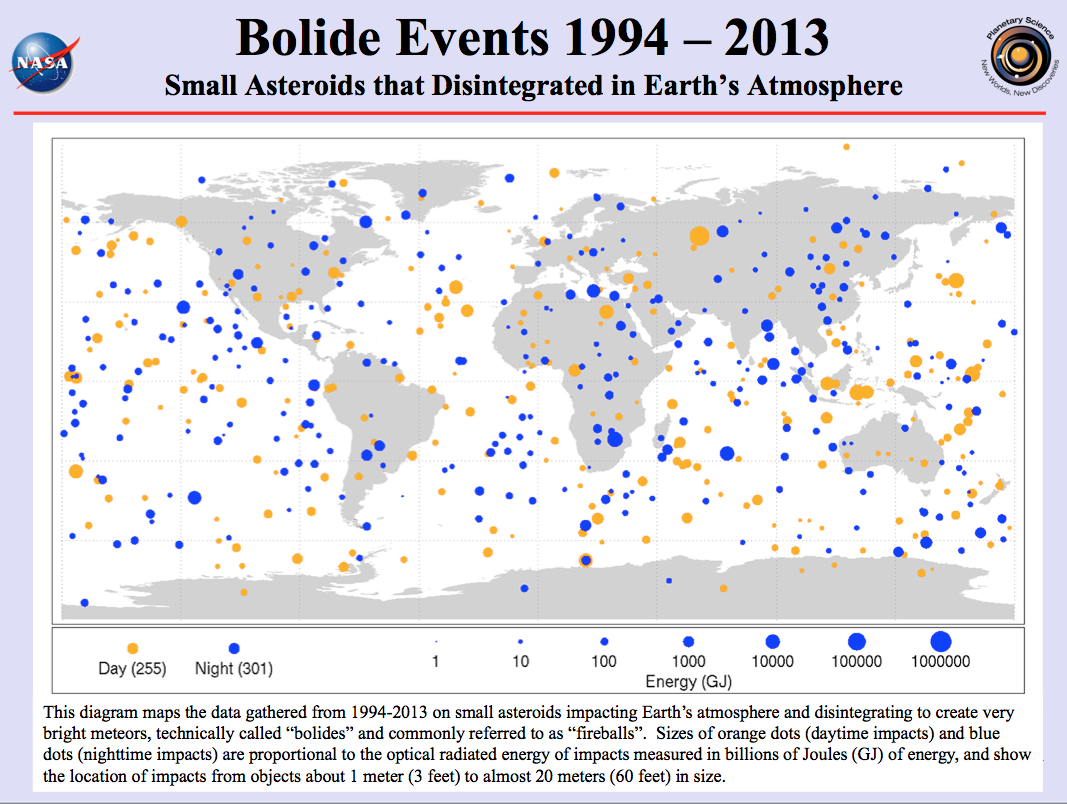
A map of these small impact events – known as fireballs or bolides –has been released by NASA and shows the frequency and approximate energy released by bolide events detected from 1994 through 2013. It dwarfs a data-base of small impacts based on infra-sound detections released last fall, but it does not contain all fireballs – objects less than a meter in size – that impacted the Earth during this period.

Update on bolides! Lindley Johnson, program executive for NASA’s Near-Earth Object (NEO) Observations Program, spotlights bolide impacts on Earth’s atmosphere during a recent Secure World Foundation workshop on NEO communications.
Credit: SWF
Take a look at the graphic.
It shows that, over a 20-year interval, U.S. Government assets recorded at least 556 bolide events of various energies. On a world map illustration, the size of the orange dots (daytime events) and blue dots (nighttime events) are proportional to the optical radiated energy of the impact event measured in billions of Joules (GJ) of energy.
An approximate conversion between the measured optical radiant energy and the total impact energy can be made using an empirical relationship provided by Canadian researcher, Peter Brown, and his colleagues in 2002.
Wanted: more complete picture
For example the smallest dot on the map represents 1 billion Joules (1 GJ) of optical radiant energy, or when expressed in terms of a total impact energy the equivalent of about 5 tons of TNT explosives. Likewise, the dots representing 100, 10,000 and 1,000,000 Giga Joules of optical radiant energies correspond to impact energies of about 300 tons, 18,000 tons and one million tons of TNT explosives respectively.
“These newly released data will help NEO scientists construct a more complete picture of the frequency and scope of asteroid impacts with Earth,” said NASA NEO Observations Program Executive Lindley Johnson.
While the new data emphasize that small asteroid impacts with Earth are not unusual, the risk of future impacts is not to be taken lightly. “The aim is to find potentially hazardous asteroids before they find us,” said Donald Yeomans, manager of NASA’s NEO Program Office at the Jet Propulsion Laboratory.
A new story from me, up today on Space.com:

Desert testing of exoplanet search technique – the starshade.
Credit: Northrop Gruman
Innovative ‘Starshade’ Tech Could Illuminate Rocky Alien Planets
by Leonard David, Space.com’s Space Insider Columnist
November 14, 2014 06:56am ET
http://www.space.com/27765-starshade-tech-alien-planet-search.html
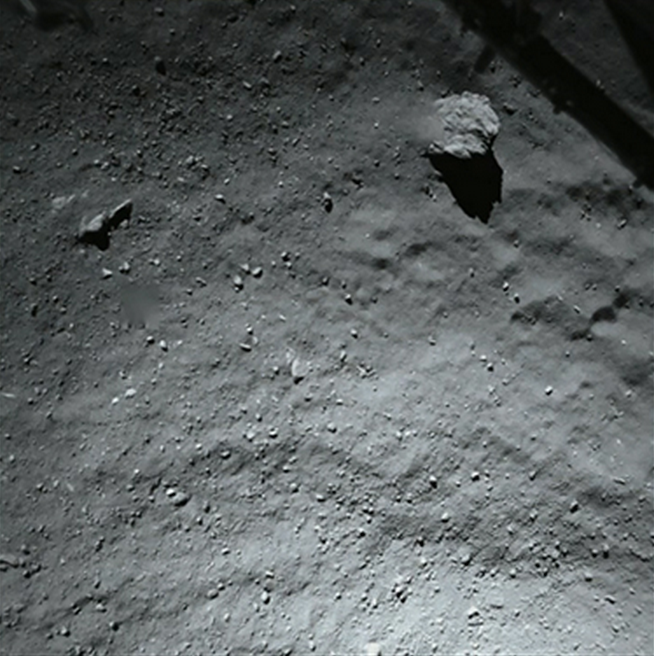
This image was taken by the Philae comet lander looking down using its descent ROLIS imager when it was about 130 feet (40 meters) above the surface of Comet 67P/Churyumov-Gerasimenko.
It shows that the surface of the comet is covered by dust and debris ranging from mm to metre sizes.
The large block in the top right corner is 5 meters in size. In the same corner the structure of the Philae landing gear is visible.
The aim of the ROLIS experiment is to study the texture and microstructure of the comet’s surface. ROLIS (ROsetta Lander Imaging System) has been developed by the DLR Institute of Planetary Research, Berlin.
Credit: ESA/Rosetta/Philae/ROLIS/DLR
The European Rosetta mission deposited the Philae lander onto comet Comet 67P/Churyumov–Gerasimenko on November 12, Central European Time.
European space scientists confirmed that the probe bounced three times prior to coming to a stand-still attitude.
Harpoons on the lander did not fire and Philae appeared to be rotating after the first touchdown, which indicated that it had lifted from the surface again.
The first touchdown was inside the predicted landing ellipse. But then the lander lifted from the surface again – for 1 hour 50 minutes.
During that time, it travelled about 1 km, then made a smaller second hop, followed by a landing in its final resting place seven minutes later.
While the lander remains unanchored to the surface — at an as yet undetermined orientation — the science instruments are running and are delivering images and data, helping the team to learn more about the final landing site.
The descent camera revealed that the surface is covered by dust and debris ranging from millimeter to meter sizes.
Meanwhile, Philae’s CIVA camera returned a panoramic image that on first impressions suggests the lander is close to a rocky wall, and appears to have one of its three feet in open space.
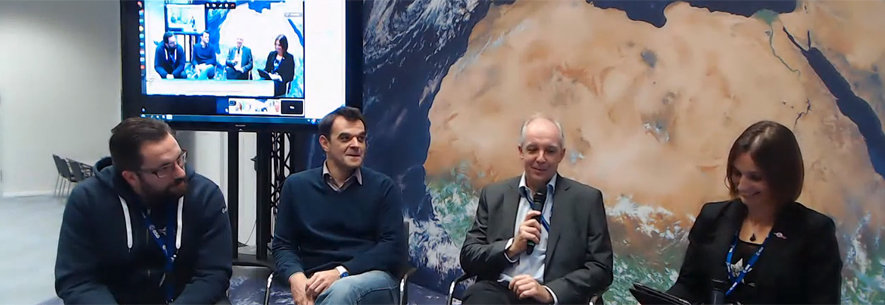
ESA Hangout highlights success of Europe’s Philae lander.
Credit: ESA
Philae’s primary battery may run out very shortly. A secondary battery, charged by solar panels on Philae, is only capable of soaking up 1.5 hours of sunlight available to the lander each day. That being the case, there is an impact on the energy budget to conduct science for a longer period of time.
“It has been an overwhelming experience,” said Matt Taylor, Rosetta project scientist. But there’s more to come, “so stay tuned,” he said during a Goggle Hangout session today from ESA’s Space Operations Centre in Darmstadt, Germany.
Listen to a replay of the session on YouTube by going to:

Two-part image taken by Philae comet lander.
Photo shows Philae safely on the surface – with one of its landing legs visible.
Credit: ESA/Rosetta/Philae/CIVA
Europe’s Rosetta spacecraft deployed the Philae lander – achieving a space first.
They have been riding through space together for more than 10 years.
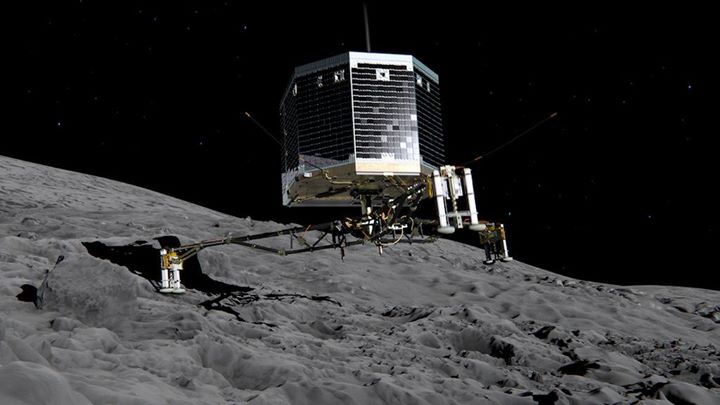
Philae lander makes historic landing.
Credit: ESA
Philae is the first probe to land on a comet, while Rosetta is the first to rendezvous with a comet and follow it around the Sun.
The information collected by Philae at one location on the surface will complement that collected by the Rosetta orbiter for the entire comet.
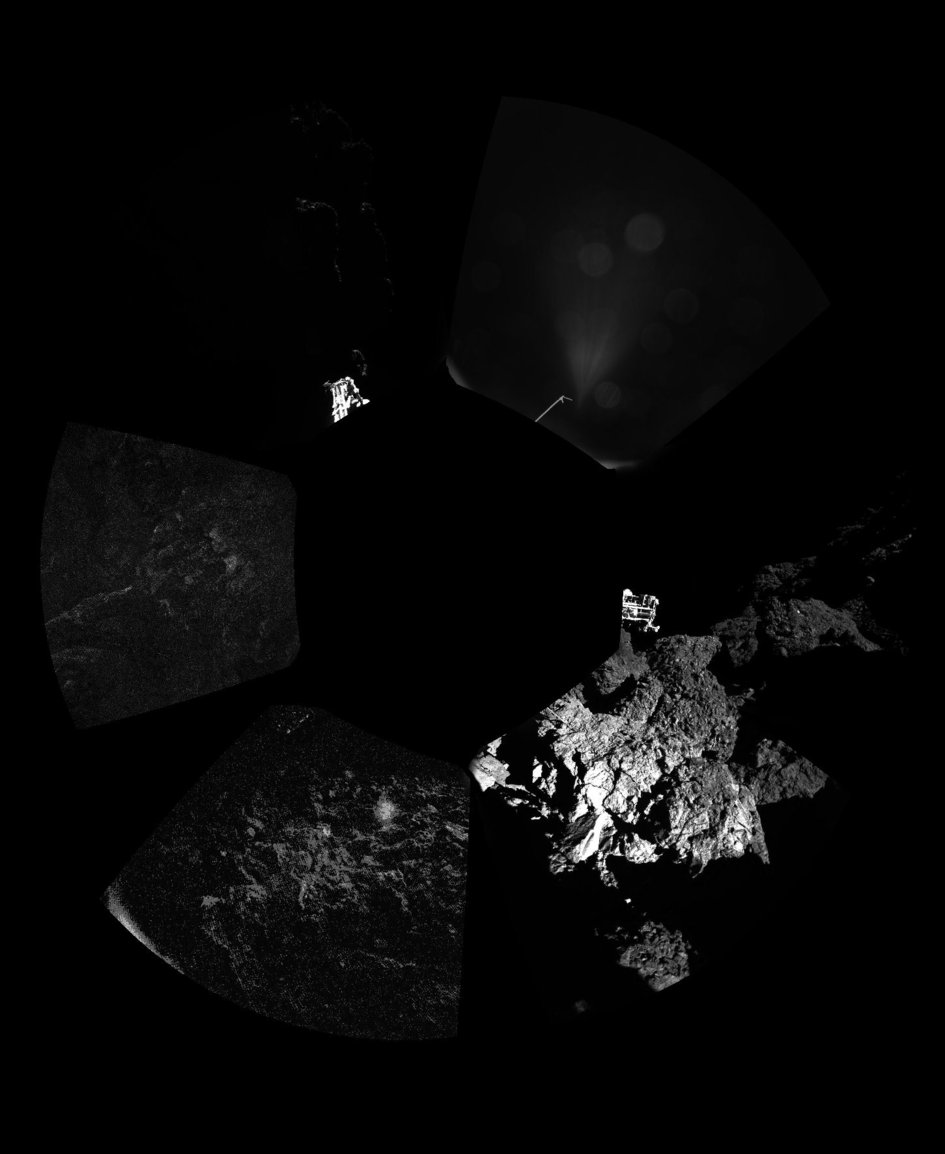
Rosetta’s lander Philae has returned the first panoramic image from the surface of a comet. The view, unprocessed, as it has been captured by the CIVA-P imaging system, shows a 360º view around the point of final touchdown. The three feet of Philae’s landing gear can be seen in some of the frames.
Confirmation of Philae’s touchdown on the surface of Comet 67P/Churyumov–Gerasimenko arrived on Earth at 16:03 GMT/17:03 CET on 12 November.
Credits: ESA/Rosetta/Philae/CIVA

