Archive for the ‘Space News’ Category
 Author:
  December 31st, 2014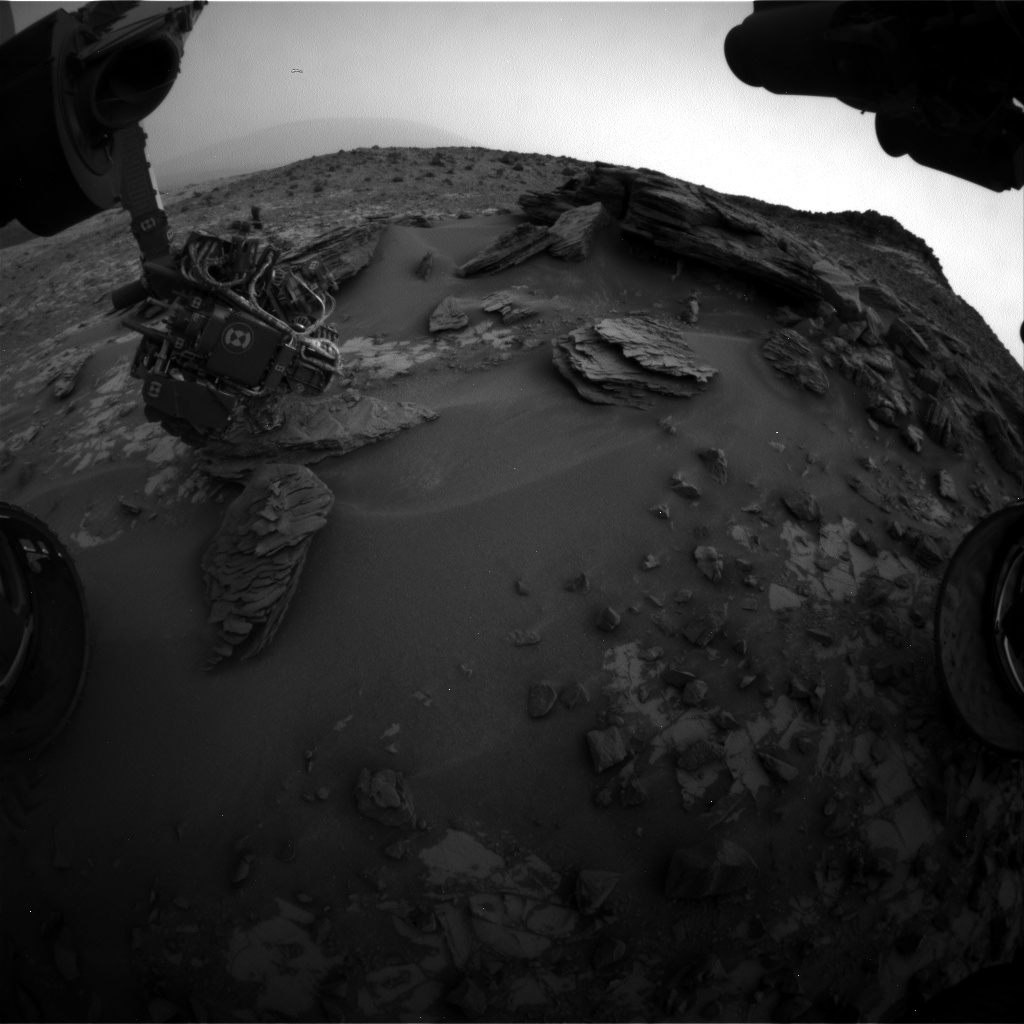
This image was taken by Front Hazcam: Right B (FHAZ_RIGHT_B) onboard NASA’s Mars rover Curiosity on Sol 853 (2014-12-30 18:30:54 UTC).
Image Credit: NASA/JPL-Caltech
NASA’s Curiosity Mars rover continues to gather evidence of lake currents within its current exploration zone.
Observations the robot, as interpreted by scientists, indicate Mars’ Mount Sharp was built by sediments deposited in a large lake bed over tens of millions of years.
This interpretation of Curiosity’s finds in Gale Crater suggests ancient Mars maintained a climate that could have produced long-lasting lakes at many locations on the Red Planet.
A set of new photos shows the robot busy at work, on the prowl since its landing on the Red Planet in early August 2012.
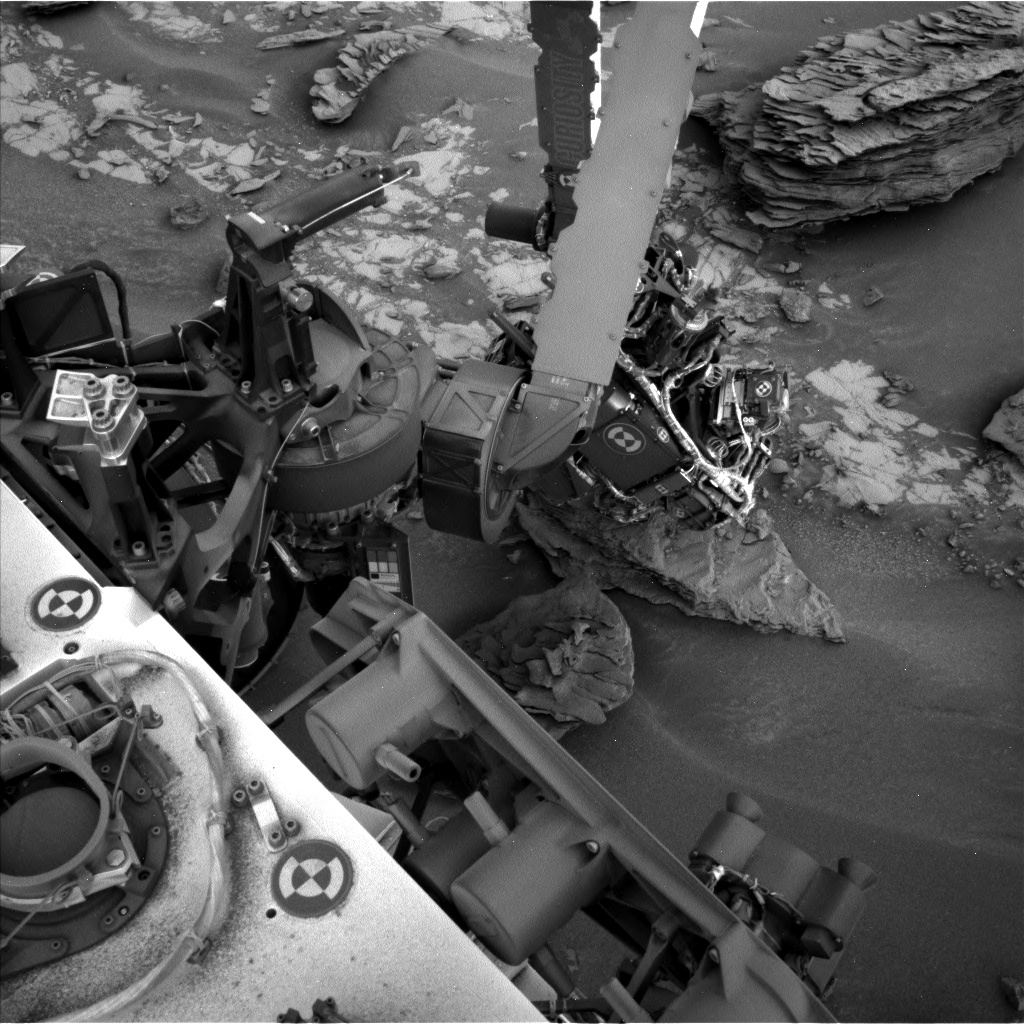
This image was taken by Navcam on Sol 853 (2014-12-30).
Image Credit: NASA/JPL-Caltech

Using an onboard focusing process, the Mars Hand Lens Imager (MAHLI) aboard NASA’s Mars rover Curiosity created this product by merging two to eight images previously taken by the MAHLI, located on the turret at the end of the rover’s robotic arm. Curiosity performed this imagery merge on December 30, 2014, Sol 853 of the Mars Science Laboratory Mission.
Image Credit: NASA/JPL-Caltech/MSSS
 Posted in

Skyfall over Brazil.
Photo: Direto das Ruas via Campo Grande News
In the early morning hours of December 28, large numbers of people in Brazil witnessed what appears to be a spectacular reentry of space hardware, flashing through the sky while producing a roar and several bangs.
Reports from Campo Grande say one of the reentering pieces has been found in a farm field, an object that came to rest not too far from a house.
A selfie image posted on Facebook shows the object that, say locals, came from the sky.

Selfie photo posted on Facebook shows purported piece of space junk associated with objects reentering over Brazil.
Credit: Via Facebook
Worldwide network
Jumping into action as to what caused the event is a worldwide network of amateur satellite watchers. These sky detectives piece together and share video, photographs, local news accounts, as well as satellite tracking reports to help categorize reentering objects, posting their updates on the SeeSat-L website of satellite watchers.
The object that fell in the countryside of Santa Rita do Rio Pardo, about 166 miles (268 kilometers) from Campo Grande is now believed to be a composite overwrap pressure vessel type.
The location of the object was roughly 985 feet (300 meters) from the city’s urban area.

Close-up photo of space debris believed to be associated with skyfall over Brazil.
Credit: Via Facebook
Rocket body?
There is growing but guarded belief that the bit of returned-to-Earth flotsam may well have been associated with the reentry of a SpaceX Falcon 9 rocket body.
Still, according to lead skywatcher, Ted Molczan of Canada, there remains the possibility that some other reentering candidate will emerge that has been overlooked.
“So, there is work remaining to be done,” he said.
Also active in identifying the source of the heavenly hubbub is Cees Bassa and Joseph Remis, each contributing data on the SeeSat-L website. Paul Maley, an experienced satellite observer, is also on the trail of what was behind the recent reentry.

Leftovers from a Falcon 9 second stage is one candidate as the object found in Brazil – or is it? The red tanks on this image of the Falcon 9 second stage appear to match the recovered debris in shape and size.
Photo credit: Chris Thompson, SpaceX via Cees Bassa.
Caught on camera
Flagging early information on the skyfall on the SeeSat-L website was Carlos Bella in Brazil, living in Goiânia city – far north of the trajectory of the reentry fireball.
Bella told Inside Outer Space that he’s quickly alerted of events like the recent incident by friends because he’s founder of the BRAMON (Brazilian Meteor Observation Network), the first video meteor network in the country.
Check out these reentry videos, this one published on Dec 28 by Dourados Agora:
https://www.youtube.com/watch?v=il_uhV23JUk
And a new YouTube vídeo from Navirai city, south of city of Dourados in Brazil, published by Fabiano Barbosa da Silva:

China’s new spaceport on Hainan Island is set to be the departure point for new classes of Long March boosters. Model of the complex depicts layout of the Wenchang Satellite Launch Center.
Credit: China Space website
China’s new Wenchang Satellite Launch Center in Hainan will soon be the test site of the country’s Long March 7 booster.
According to the State-owned China Daily, the booster is near completion for a set of compatibility – fit checks – with the launch complex.
Tao Gang, general manager of the Tianjin Long March Launch Vehicle Manufacturing Co Ltd. is quoted as stating:
“The Long March 2 and Long March 3 families, the backbones of our launches, are scheduled to retire within the next 10 years,” Tao said, “so the Long March 7 and Long March 5 will become the pillars of China’s space program.”
Static testing
Four Long March-7 rockets have been made to date, and three of them are being used for static and thruster tests, said Zhang Beijun, a senior executive at the company.
Ma Zhonghui, a China Academy of Launch Vehicle Technology engineer detailed to the Long March 7’s development said that the rocket has new engines and uses eco-friendly propellants.“It can be widely used in commercial launch service,” she said, adding that a number of orders have already been placed for the rocket from domestic users.
Maiden flight
A Long March 7 is designed to boost a 13.5-ton payload into low Earth orbit and a 5.5-ton payload into a sun-synchronous orbit.
The maiden launch of the Long March 7 and a cargo spacecraft is reportedly slated for around 2016. Once in service it will support China’s Tiangong 2 space laboratory, scheduled to be in orbit by the end of 2015.
Earlier this month, Lei Fanpei, chairman of China Aerospace Science and Technology Corporation, stated that along with the Long March 7, three other new types of rockets – including the Long March 5, a heavy-lift rocket — will take to the air for the first time in the next two years.

Mars meteorite, ALH84001.
Credit: NASA
It’s the Mars rock that keeps on giving!
Snowmobilers plucked from an Antarctic ice field 30 years ago this month the infamous, controversial, and tell-all Alan Hills meteorite – later identified as ALH84001.
Those making the find on December 27, 1984 were part of the ANSMET (Antarctic Search for Meteorites), a program funded by the Office of Polar Programs of the National Science Foundation.

Credit: Case Western Reserve University
Based on chemical analyses, the meteorite is believed to have originated on Mars from a period when liquid water existed on the now bleak planet’s surface.
In 1996, a group of scientists at NASA Johnson Space Center, led by the late David McKay, Everett Gibson and Kathie Thomas-Keprta, published an article in Science announcing the discovery of biogenic evidence in the ALH84001 meteorite.
Jump to today, according to one of those NASA researchers – Everett Gibson – he remains steadfast that, even after 18 years, “there were signatures of possible biogenic activity within selected Martian samples,” he told Inside Outer Space.

An elongated structure resembling a fossil microorganism (centre of image), revealed in a photomicrograph of a sample of the Martian meteorite ALH84001. The finding has been used in support of a controversial suggestion by some scientists that the meteorite contains microscopic and chemical evidence of ancient life indigenous to Mars.
Credit: NASA
Ancient chemistry
The new analysis of the Martian rock reveals a record of the planet’s climate billions of years ago, back when water likely washed across its surface and any life that ever formed there might have emerged.
“Minerals within the meteorite hold a snapshot of the planet’s ancient chemistry, of interactions between water and atmosphere,” said Robina Shaheen, a project scientist at University of California, San Diego and the lead author of a new work reported in the early online edition of the Proceedings of the National Academy of Sciences: “Carbonate Formation Events in ALH 84001 Trace the Evolution of the Martian Atmosphere.”
ALH84001 is the oldest meteorite found on Earth from Mars, a chunk of solidified magma from a volcano that erupted four billion years ago. Since that period something liquid, probably water, seeped through pores in the rock and deposited globules of carbonates and other minerals.
Ozone signal
In the new study, scientists from the UC San Diego, NASA and the Smithsonian Institution report detailed measurements of minerals within the meteorite.
This team measured a pronounced ozone signal in the carbonates within the meteorite, suggesting that although Mars had water back then, vast oceans were unlikely. Instead, the early Martian landscape probably held smaller seas.
As noted in a UC San Diego press statement, carbonates can be deposited by living things that scavenge the minerals to build their skeletons. “But that is not the case for the minerals measured by this team.”
“The carbonate we see is not from living things,” Shaheen said. “It has anomalous oxygen isotopes that tell us this carbonate is abiotic,” she said, that is, factors that are essentially non-living components.
By measuring the isotopes in multiple ways, the chemists found carbonates depleted in carbon-13 and enriched in oxygen-18. That is, the atmosphere of Mars in this era — a period of great bombardment — had much less carbon-13 than it does today.
The change in relative abundances of carbon and oxygen isotopes may have occurred through extensive loss of Martian atmosphere. A thicker atmosphere would likely have been required for liquid water to flow on the planet’s chilly surface.

Mars life: Yes, no, maybe, could be, might have been.
Credit: NASA/USGS
A family of four?
For NASA’s Gibson, basically, the new research “does not change our earlier hypothesis.”
“From the published literature, there are now four unique Martian meteorites with possible signatures of past Martian biogenic activity,” Gibson said. Along with ALH84001, he points to Nakhla, Yamato 000593, and Shergotty meteorites.
In fact, Gibson said, that micro tunnels found in Yamato 000593 – reported by Lauren White at the Jet Propulsion Laboratory — are identical to those produced by microbial bacterials in terrestrial submarine basalts and glasses – and adds evidence for potential biogenic activity on Mars in moderate times.
“Yes, Charlotte, there are reduced carbon phases present on Mars. No surprise that the Curiosity SAM instrument has recently re-discovered ‘reduced carbon compounds’ that terrestrial laboratory studies have shown from the study of Martian meteorites,” Gibson said.
“Perhaps the Curiosity team members should look at the Martian meteorite literature about what has been done,” research that has, he said, laid the foundation for understanding reduced organic materials on Mars.
“I have said for a long time, we can solve a lot of Mars’ problems by studying Martian meteorites,” Gibson concluded.

Courtesy: Mojave Air and Space Port Newsletter
A new story I’ve written, posted today on Space.com:
After SpaceShipTwo Tragedy, How Will Virgin Galactic Return to Flight?
by Leonard David, Space.com’s Space Insider Columnist
December 24, 2014 11:42am ET
http://www.space.com/28088-virgin-galactic-spaceshiptwo-crash-aftermath.html
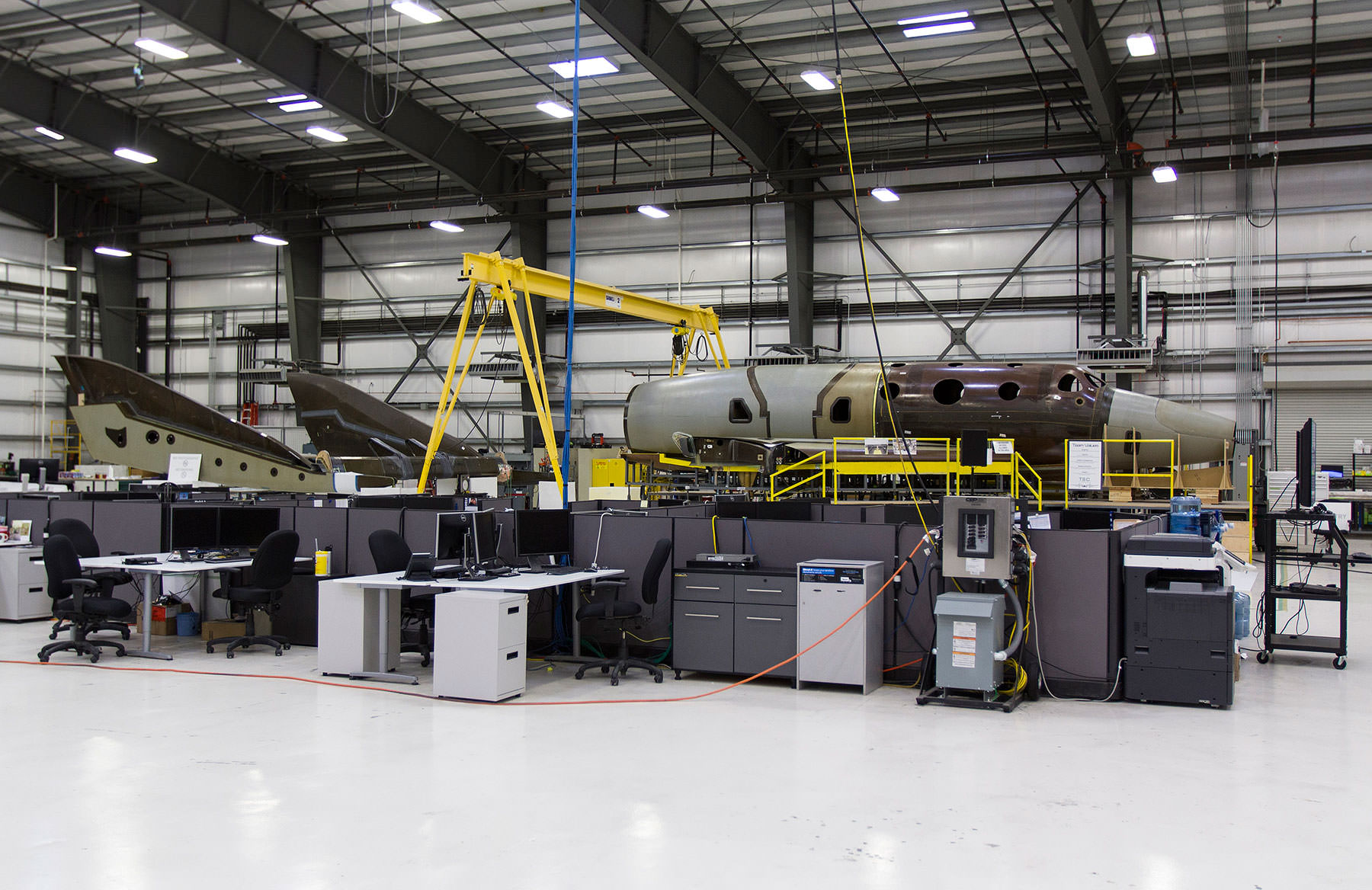
Work is underway on SpaceShipTwo, number two.
Credit: Virgin Galactic

Credit: NASA
The voice of the late Carl Sagan echoes through a new video produced by Space City Films.
This video is sharply focused on the recent NASA test of the Orion capsule.
According to Marc Havican of Space City Films: ‘I wanted to share the kickoff film with you before we release it for Christmas. This first installment is a tribute to Orion and EFT-1, and to the impact that human space exploration has had on humanity.”
The new video is titled Humans Explore: We Are Capable of Greatness.
As noted by the company, Humans Explore will be a series of short films and live experiences that they are producing in-house and will be distributing through a dedicated website and various digital outlets.
The video can be viewed at:
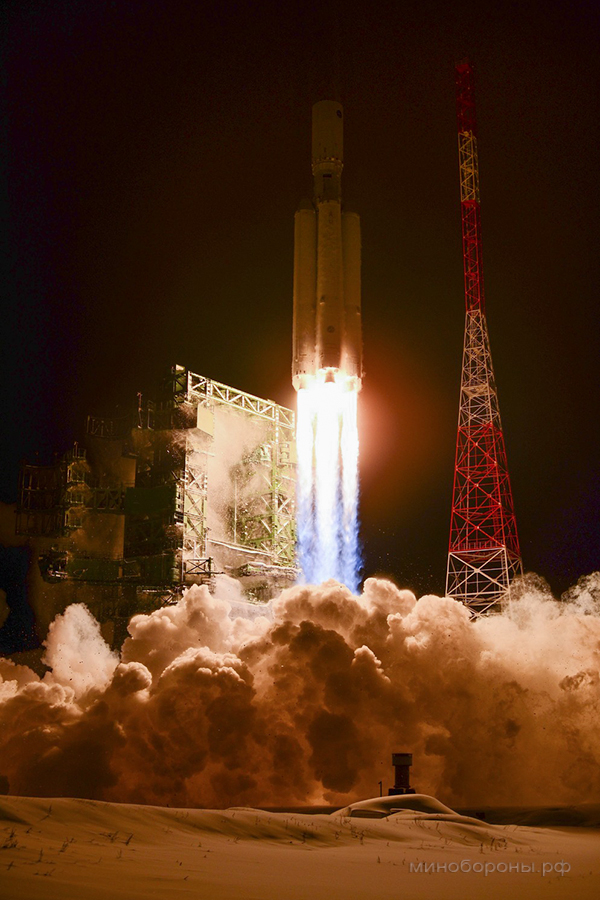
Angara-A5 liftoff.
Credit: Ministry of Defence of the Russian Federation
Russia has launched its new heavy-weight-class launch vehicle – the Angara-A5.
Liftoff took place on December 23 from the Plesetsk cosmodrome in north-west Russia.
The Angara rocket series consists of light, middle, and heavy weight types of boosters.
The Angara-A5 rocket can hurl spacecraft up to 24 tons into a low Earth orbit and up to 4 tons into a geostationary orbit. The Angara-A5 uses non-toxic fuels: oxygen and kerosene.
Initial word is that the booster did lob into orbit a dummy spacecraft. A Briz-M upper stage is to boost the dummy spacecraft into geostationary orbit.
Last July, a lighter version of the Angara was test flown on a suborbital trajectory.
The family of boosters is being produced by the Khrunichev State Research and Production Center.
Video of launch available here:
https://www.youtube.com/watch?v=BsQOpD4TIZM
Note: For a Russian video on the suborbital test of the Angara, go to:
https://www.youtube.com/watch?v=WegrjmrP6MU
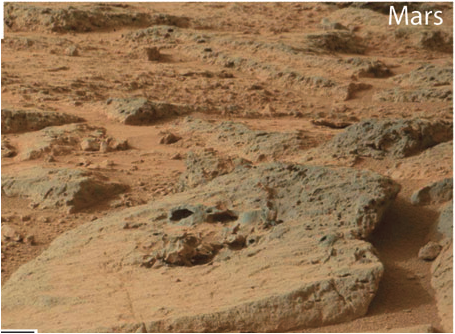
Curiosity rover Mastcam photograph of a plateau in the < 3.7 Ga
Gillespie Lake Member, Mars.
Credit: NASA/JPL-Caltech/MSSS
Photographs from NASA’s Curiosity Mars rover clearly show sediment deposits resembling those found in modern evaporite (salty) settings at Portsmouth Island, N.C., and Bahar Alouane, Tunisia (Africa); in playa lake sediments cropping out of the Mediterranean coast in Tunisia; and in Archean salt deposits of the Pongola Supergroup in South Africa and the Dresser Formation in Australia.
Yes, a picture is worth a thousand words…and in this case it adds up to a 24-page research paper in the Astrobiology journal.
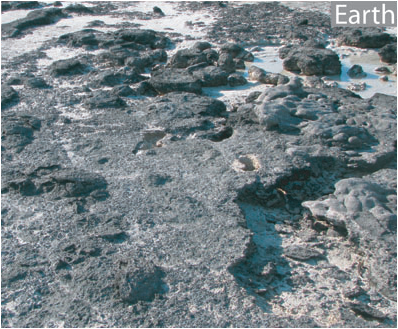
Microbial terrestrial erosional remnant photographed at a modern
site at Carbla Point, Western Australia.
Courtesy: Nora Noffke
Nora Noffke, in the Department of Ocean, Earth and Atmospheric Sciences at Old Dominion University in Norfolk, Virginia reports that: “Sandstone beds of the <3.7 Ga (billion year old) Gillespie Lake Member on Mars have been interpreted as evidence of an ancient playa lake environment. On Earth, such environments have been sites of colonization by microbial mats from the early Archean to the present time.”
Noffke explains that terrestrial microbial mats in playa lake environments form microbialites known as microbially induced sedimentary structures (MISS). On Mars, three lithofacies of the Gillespie Lake Member sandstone display centimeter- to meter-scale structures similar in macroscopic morphology to terrestrial MISS.
Geological evidence
As a geobiologist, Noffke has in the past produced sedimentary evidence that prokaryote biofilms existed on Earth billions of years ago. Now she is focusing efforts on showing that similar colonies of bacterial life may have existed on Mars at about the same time.
Noffke reported last year that the structures found in Australia might also provide scientists with clues about geologic evidence of microbial life that exists, or might have existed, on Mars.
Although Mars today is much colder than Earth and seems only to have water in ice and vapor forms, scientists believe that it must have been a very different place 3.7 billion years ago – warmer, wetter and with a much thicker atmosphere.
Past climate of Mars
Why the climate then was more hospitable to life is puzzling, but perhaps could have been caused by volcanoes or large asteroid impacts.
Still, she acknowledges that any remote analysis of imagery has its drawbacks.
“Without any evidence for life on Mars detected in returned rock samples, reconstructing microbial ecosystems on the Red Planet is pure speculation,” she writes.
One section of the journal article examines possibilities that the structures shown in the NASA photos could be also caused by “abiotic” – non-life – processes such as weathering.
Hypothesis
The Astrobiology article suggests a hypothesis that the structures seen on the Mars images may be ancient MISS; the preliminary evidence presented in her report may be sound enough to warrant more investigation by NASA.
Noffke calls for the Curiosity mission and other astrobiology-focused missions to Mars to dedicate specific photography and data collection assignments to the search for MISS. In her research paper, she proposes a strategy for detecting, identifying, confirming, and differentiating possible MISS.
“The sedimentary structures in the Gillespie Lake Member, Mars, constitute a promising set of potential biosignatures that compel further analyses by Mars rovers, including future sample return missions from Mars,” Noffke concludes.
Check out this impressive “Hypothesis Article” – “Ancient Sedimentary Structures in the <3.7 Ga Gillespie Lake Member, Mars, that Compare in Macroscopic Morphology, Spatial Associations, and Temporal Succession with Terrestrial Microbialities” – by going to:

Credit: CMSA
The European Space Agency (ESA) has agreed to work with the China Manned Space Agency on human spaceflight activities. ESA is also investigating partnering with Russia on two robotic Moon landing missions.
In a December 11 meeting in Beijing, Wang Zhaoyao, Director of the China Manned Space Agency (CMSA) and Jean-Jacques Dordain, Director of ESA, signed an agreement to work together in the human spaceflight arena.
According to the CMSA, Dordain said “he is willing to continue to promote China into participating in the multilateral cooperation on the International Space Station.”
ESA will further deepen the bilateral cooperation and exchanges in the field of manned spaceflight based on the cooperation agreement, according to CMSA.
Cooperation areas
Under the ESA/CMSA agreement, three potential cooperation areas are included:
n implementation of joint scientific experiments and studies in different fields by utilizing in-orbit infrastructures(such as the International Space Station and the Chinese Space Station) and ground facilities, including space life and physical sciences, microgravity research, space biology and medicine, and technology research;
n astronaut selection, training, medical operations and astronaut flights;
n space infrastructure cooperation in human exploration of Low Earth Orbit (LEO) and beyond.
Next steps
Both parties will jointly organize meetings and workshops; identify research programs, exchange information and data, and conduct concrete cooperation on the exchanges of personnel and facilities.
In addition, a Human Spaceflight Consultation Committee will be established to assess the status of the cooperation, examine proposals for conducting specific cooperative activities and make recommendations for implementation.
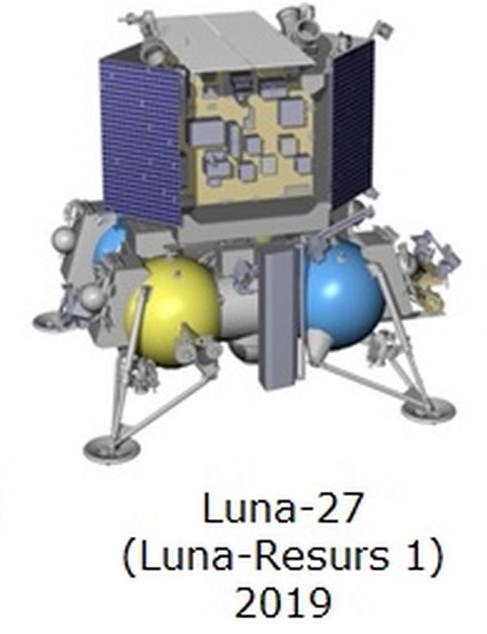
Credit: Roscosmos
Russia’s lunar agenda
On December 2, member states of ESA approved, and provided the needed funds, for ESA to study robotic missions for the exploration of the Moon.
Being eyed is for ESA to engage with the Russian Federal Space Agency – Roscosmos — on the Luna-Resource Lander (Luna 27) and also a Lunar Sample Return, on tap to travel to the Moon in 2019 and early 2020s, respectively.

Credit: Warner Bros. Pictures and Paramount Pictures
You’ve seen the movie, or it’s on your holiday to-do list.
But just how hard is interstellar flight?
Harold White is Advanced Propulsion Theme Lead for the NASA Engineering Directorate at the NASA Johnson Space Center.
In a video, White discusses a couple of advanced propulsion concepts that may one day be useful for crafting an interstellar mission.
White spoke recently at the NASA Ames Research Director’s Colloquium – part of the Center’s 75th anniversary celebration.
Put on your star goggles and take a look at:

