Archive for the ‘Space News’ Category
 Author:
  February 3rd, 2015
This series of 19 images, acquired by the Rosetta orbiter’s Optical, Spectroscopic, and Infrared Remote Imaging System (OSIRIS) on 12 November 2014, shows the Philae lander during its descent towards Comet 67P/Churyumov-Gerasimenko.
Credit: ESA/Rosetta/MPS for OSIRIS Team MPS/UPD/LAM/IAA/SSO/INTA/UPM/DASP/IDA.
Europe’s Philae lander sits somewhere on the surface of Comet 67P/Churyumov-Gerasimenko – its battery depleted as of November 15, 2014.
But there are high hopes that the lander can muster up sufficient energy to “phone home” as the comet continues its journey towards the Sun.
According to Project Manager, Stephan Ulamec from the German Aerospace Center (Deutsches Zentrum für Luft- und Raumfahrt; (DLR): “We will start looking to see whether Philae has been exposed to enough sunlight and been able to acquire sufficient energy as early as the end of March.”
Needle in a haystack
Philae is no bigger than a washing machine making it extremely difficult to spot the lander via the European Space Agency’s Rosetta orbiter that is circling the comet. However, that optical search is viewed as looking for a needle in a haystack.

This image was acquired by the Rosetta orbiter’s Optical, Spectroscopic, and Infrared Remote Imaging System (OSIRIS) at 18:18 CET on 12 November 2014. The Philae lander is visible at the intersection of the red lines – above the crater rim.
Credit: ESA/Rosetta/MPS for OSIRIS Team MPS/UPD/LAM/IAA/SSO/INTA/UPM/DASP/IDA.
Philae touched down on Comet 67P on November 12, 2014. Due to the comet’s low gravity, the tiny spacecraft made a triple landing then carried out more than 56 hours of scientific work.
ESA researchers have determined that the lander is located in a shadowed position close to the rim of a crater on the “head” of the comet, adjacent to its equator.
Philae’s final landing site has now been named after the ancient Egyptian city of Abydos.
Wake up work schedule
If Philae does wake up, it is programmed to listen for the Rosetta orbiter and to transmit a signal at regular intervals.

Philae lander may wake up early next month. This composite image was created using images acquired by the Rosetta orbiter’s Optical, Spectroscopic, and Infrared Remote Imaging System (OSIRIS) on December 13, 2014 from an altitude of 12 miles (20 kilometers) above the final landing site. Philae would be about three pixels across in this image.
Credit: ESA/Rosetta/MPS for OSIRIS Team MPS/UPD/LAM/IAA/SSO/INTA/UPM/DASP/IDA.
According to the DLR, after the initial awakening, it could take several weeks for the lander to generate sufficient power to execute the first commands received from the DLR Lander Control Center and then start charging its battery. Solar cells fitted to the lander are expected to generate needed amounts of power.
By summer, Philae could have stored energy to use its instruments for several hours, notes the DLR.
 Posted in

A team of Belgium researchers is on tap next year to toss into space what they advertise as the first space billboard.
“CubeSats can clearly play a very important role in the future of space research and with SpaceBillboard, we want to give CubeSats and space research an extra boost,” the group says on their website.
The students are from KU Leuven University in Belgium.
Funding for future projects
“We want to start up new and groundbreaking research at KU Leuven, such as formation flying with CubeSats, autonomous docking (two satellites connecting in space), high accuracy pointing platforms to make even more accurate measurements, etc,” the team reports.

Credit: SpaceBillboard.com
SpaceBillboard is now set up to sell advertisement space on a billboard – “the first advertisement platform ever to pass the boundary of space,” they claim, with the revenues of the project used to sponsor space research at the University of Leuven.It should be noted, however, that U.S. entrepreneur, Robert Bigelow, also had an advertising campaign making use of the Bigelow Aerospace Genesis 1 and Genesis 2 modules that flew in 2006 and 2007. Other advertising ideas have also made their way into space in the past.
Squares available for purchase
To be lofted from Brazil’s Alcantara rocket base, the CubeSat billboard will orbit the Earth at an altitude of 310 miles (500 kilometers) and some 80 miles (130 kilometers above the International Space Station.

SpaceBillboard is the initiative of
three PhD researchers in engineering
at the University of Leuven (Belgium).
Credit: SpaceBillboard.com
To get an advertisement on SpaceBillboard, the advertiser can select preferred squares on the billboard or go to a special “Buy squares” page. The billboard itself measures approximately 8×8 centimeters, consisting of 400 squares that are available for purchase.
A special Internet site allows you to upload an image you want to put on the billboard as well as a link to which visitors will be guided if they click your advertisement. SpaceBillboard says they have already attracted several sponsors, including Microsoft.
Personal messages
“Next to brands putting their logo on the billboard, we also want to allow everyone to send their personal message to space and get it around the world,” the site explains.
Individuals can choose a message of a maximum of 140 characters. “And because we want to honor the fact that you supported space research, we also send you a personal certificate afterwards.”
For a personal message, the charge is one Euro per character, or roughly a dollar in U.S. currency. For example, the message “happy birthday Hannah!” counts 22 characters and would cost about $25.00.
Will the billboard be seen from Earth?
No, the CubeSat is moving too fast and at too high of an altitude. “Our goal with the billboard is to give our sponsors and our project visibility here on Earth. By the way, obtrusive space advertising is illegal and a visible billboard in space would just litter our beautiful night sky,” the website adds.
Want more information on the effort?
Go to:
For a video describing the project, go to:
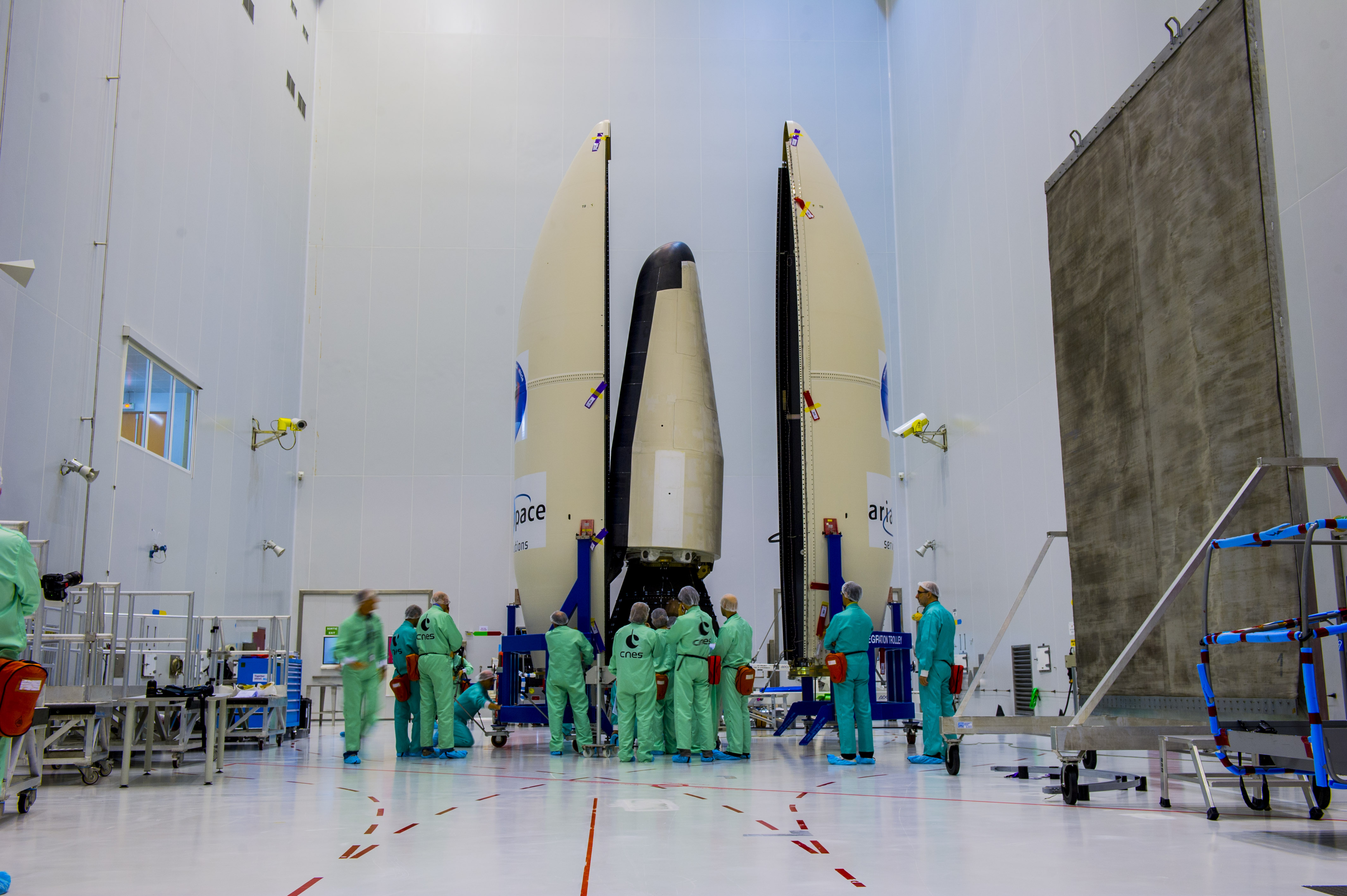
IXV will be launched into space on top of a Vega rocket, VV04, climbing up to 260 miles (420 kilometers) before beginning a long glide back through the atmosphere. In the process, IXV will gather data on reentry conditions to help guide the design of future spaceplanes.
Credit ESA–M. Pedoussaut, 2015
Stand by for flight of the cutting edge Intermediate eXperimental Vehicle, or IXV mission.
The European Space Agency (ESA) has green-lighted the February 11 liftoff of the test vehicle atop a Vega rocket from Europe’s Spaceport in French Guiana.
Here’s what’s cool about this ESA high-speed plunge from space.
This IXV mission will test cutting-edge system and technology aspects to provide Europe with an independent reentry capability. The vehicle is considered a building block for reusable space transportation systems. It will also validate designs for lifting-bodies.
Controllability and maneuverability
According to ESA, the IXV incorporates both the simplicity of capsules and the performance of winged vehicles, with high controllability and maneuverability for precision landing.
Such a capability is a cornerstone for reusable launcher stages, sample return from other planets and crew return from space, as well as future Earth observation, microgravity research, satellite servicing and disposal missions.
Furthermore, the results from the test will be fed into the ESA’s “Program for Reusable In-Orbit Demonstrator for Europe,” long-speak for “Pride” – a reusable spaceplane.
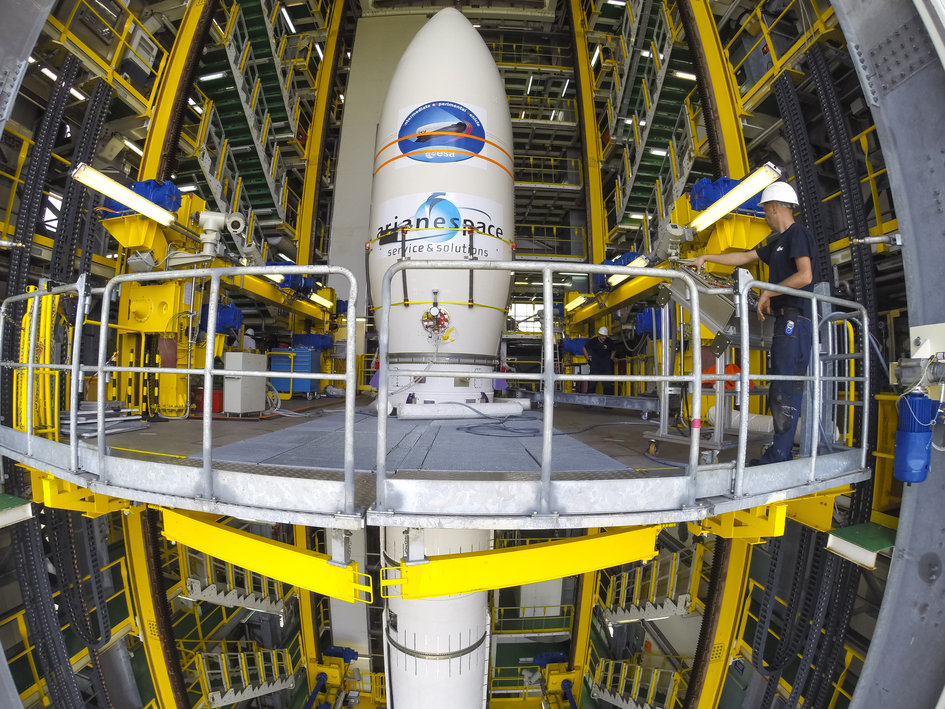
Credit: ESA–M. Pedoussaut
100 minutes
After being boosted skyward, the IXV will maneuver to decelerate from hypersonic to supersonic speeds. Then the IXV will deploy a multistage parachute to slow the descent further. Flotation balloons will keep it afloat after splashdown in the Pacific Ocean, where it will be recovered by a ship for detailed analysis.
The entire flight will last about 100 minutes.
The prime contractor for IXV is Thales Alenia Space Italia, supported by about 40 other European companies. The mission will be controlled from the Advanced Logistics Technology Engineering Centre (ALTEC) in Turin, Italy.
For a video detailing this upcoming mission, go to:
http://www.esa.int/spaceinvideos/Videos/2012/11/ESA_s_IXV_reentry_vehicle_mission

Credit: Explore Mars, Inc./American Astronautical Society
While an international human mission to the surface of Mars in the 2030s deserves a thumbs up, green-light go, that trek to the Red Planet will require sufficient and stable long- term funding, as well as a critical series of risk-reduction activities in the 2020s.
A key example is a long-duration crew habitation system in cis-lunar space that transitions from the International Space Station (ISS) to the systems necessary for human Mars exploration.
That insight is from a set of findings and observations are available in a summary report of the Second Mars Affordability and Sustainability Workshop.
The workshop was held October 14-16 of last year, held at the Keck Institute for Space Studies on the campus of the California Institute of Technology. The gathering was hosted by the NASA Jet Propulsion Laboratory and organized by Explore Mars, Inc. and the American Astronautical Society.

One small step…one giant leap to Mars.
Credit: Explore Mars, Inc./American Astronautical Society
Antarctic analogy
The workshop did not endorse one-way missions to Mars, where the humans on the first mission are settlers.
Rather, the workshop concluded that significant public support and inspiration derives from the national pride of having astronauts from participating countries return to Earth to be celebrated.
Still, initial human missions to the surface of Mars should include elements necessary for eventual establishment of sustainable surface outposts broadly analogous to the initial phases of science-guided Antarctic exploration on Earth.

Workshop participants.
Credit: Explore Mars, Inc./American Astronautical Society
Humans on Mars – precursor activities
Other select statements gleaned from the workshop summary include:
— A robotic sample return mission may be required to learn how to protect against forward and backward contamination before humans land on Mars.
— One potentially advantageous precursor activity is an “all-robotic” sample return to demonstrate high-mass entry, descent, and landing capabilities scalable to human-scale landers.
— Human missions to Mars orbit or the Martian moons – Phobos and Deimos — may be essential for risk reduction as immediate precursors to surface missions, which ultimately are the priority goal for human space flight.
— The scientific goals for lunar exploration are compelling. However, the technical capabilities required for human lunar surface operations are of limited applicability to human Mars exploration.
The full summary report will be posted shortly on the Explore Mars, Inc. web site at:

Credit: MUFON
Here’s a new posting from me on all the UFO traffic…flying saucers that made a wrong turn at Jupiter…!
They Want to Believe: UFO Hunters Plan Database to Track Sightings
by Leonard David, Space.com’s Space Insider Columnist
January 25, 2015 07:30am ET

Credit: MUFON
Go to:
http://www.space.com/28325-ufo-database-mufon-sightings.html

More fallout from the October 31st mid-air destruction of Virgin Galactic’s SpaceShipTwo above the Mojave Air and Space Port – killing one test pilot and injuring another.
The Los Angeles Times reports Jan. 23 that Virgin Galactic will take over testing of the suborbital rocket plane, limiting the role of Scaled Composites that designed and fabricated the vehicle.
According to the LA Times story, citing Kevin Mickey, the president of Scaled Composites, Scaled would be a consultant to Virgin Galactic.
For the full LA Times story, go to:
http://www.latimes.com/business/la-fi-virgin-galactic-update-20150124-story.html#
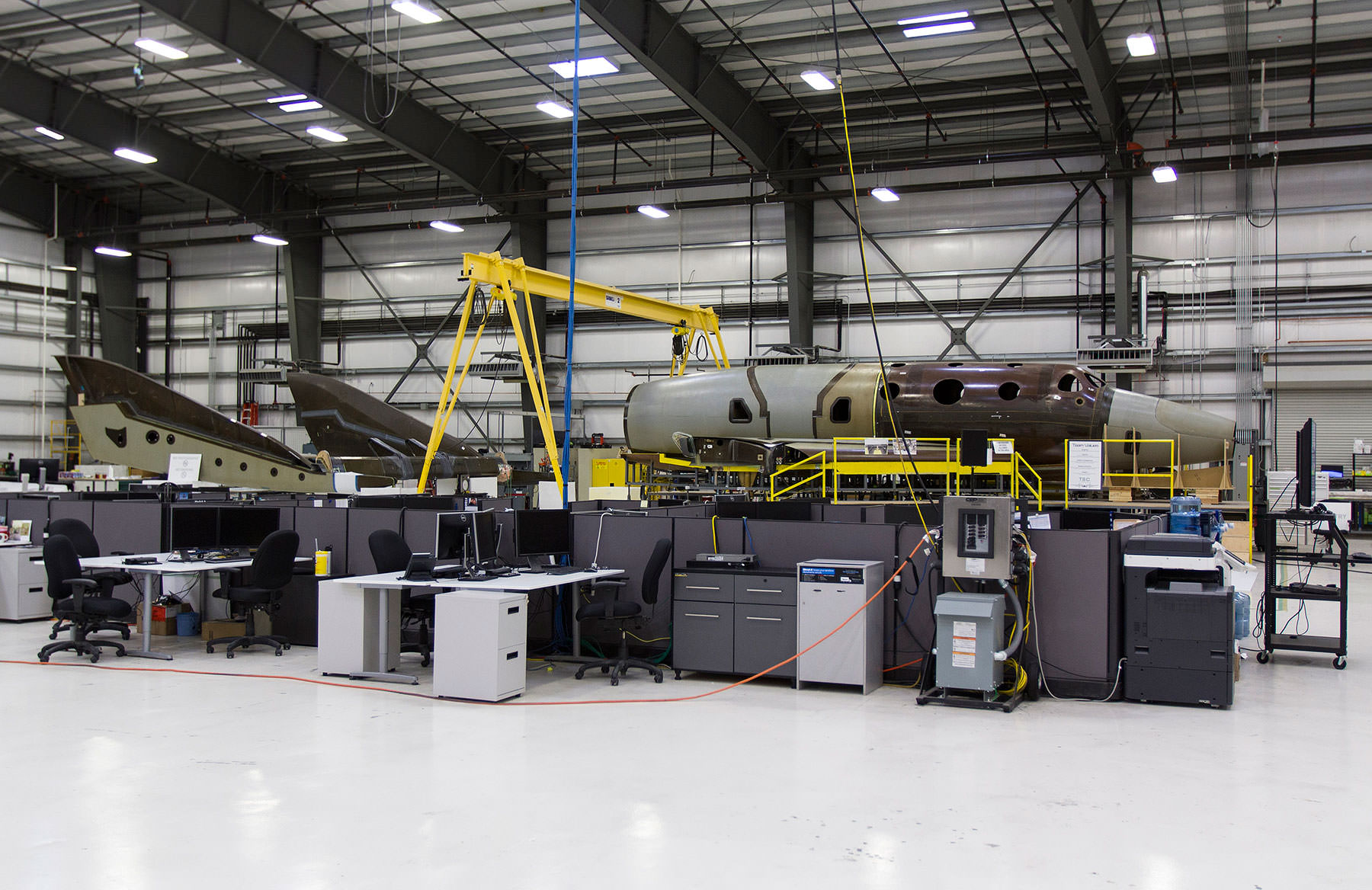
Work is underway on SpaceShipTwo, number two.
Credit: Virgin Galactic
Also take a look at this video from Virgin Galactic “Introducing our Second Spaceship” that was published on Jan 15, 2015.
The Virgin Galactic video features interviews with key team members and behind the scenes shots of the firm’s Spaceship factory.
Go to:
https://www.youtube.com/watch?x-yt-cl=84503534&v=qsL6NCUWtdA&x-yt-ts=1421914688#t=45

Credit: NASA/JPL
Add in another exploration tool for use on the Red Planet – a small helicopter.
The JPL robotics folks have proposed a tiny helicopter scout, one that could act as a science payload on the NASA Mars 2020 mission.
This aerial system could be deployed by the Mars 2020 rover, and would work in partnership with the mobile rover.
The lightweight device measures 3.6 feet (1.1 meters) across from the tip of one blade to the other.

Credit: NASA/JPL
Into thin air
Features of the system include: total mass of roughly 2 pounds (1 kilogram; counter-rotating propellers designed for use the thin Martian air; powered by solar charged batteries; a high resolution downward looking camera for navigation, landing, and science surveying of the terrain; and a communication system to relay data to the rover.
According to a “2014 Robotics Activities at JPL” paper by Richard Volpe, the operations mode for this helicopter would make it an aerial asset for expanding the exploration of the terrain ahead of the rover, for target selection, path selection, and geologic context.
As envisioned, for safety the helicopter would never be directly near the rover. Instead, it would be dropped off on the ground, and only become active after the rover has driven away by a sufficient distance.
Daily flight
Individual daily flights would be limited to a short duration of approximately 3 minutes due to power, but it should attain roughly 330 feet (100 meters) altitude and around a 20,000 foot (600 meter) ground track.
Daily communication of helicopter data will provide overhead image resolution, some ten times greater than orbital images, and greater area coverage than can be seen from the rover.

Credit: NIAC/Anthony Colozza/Ohio Aerospace Institute
Entomopter proposal
A flying device on Mars has been proposed in the past.
Several years ago, the NASA Institute for Advanced Concepts (now the NASA Innovative Advanced Concepts program) funded the idea of using an entomopter for future Mars atmospheric flyer exploration missions.
Anthony Colozza at the Ohio Aerospace Institute blueprinted an entomopter using biomimetics and advanced circulation control techniques to achieve substantially higher lift than possible through conventional design.
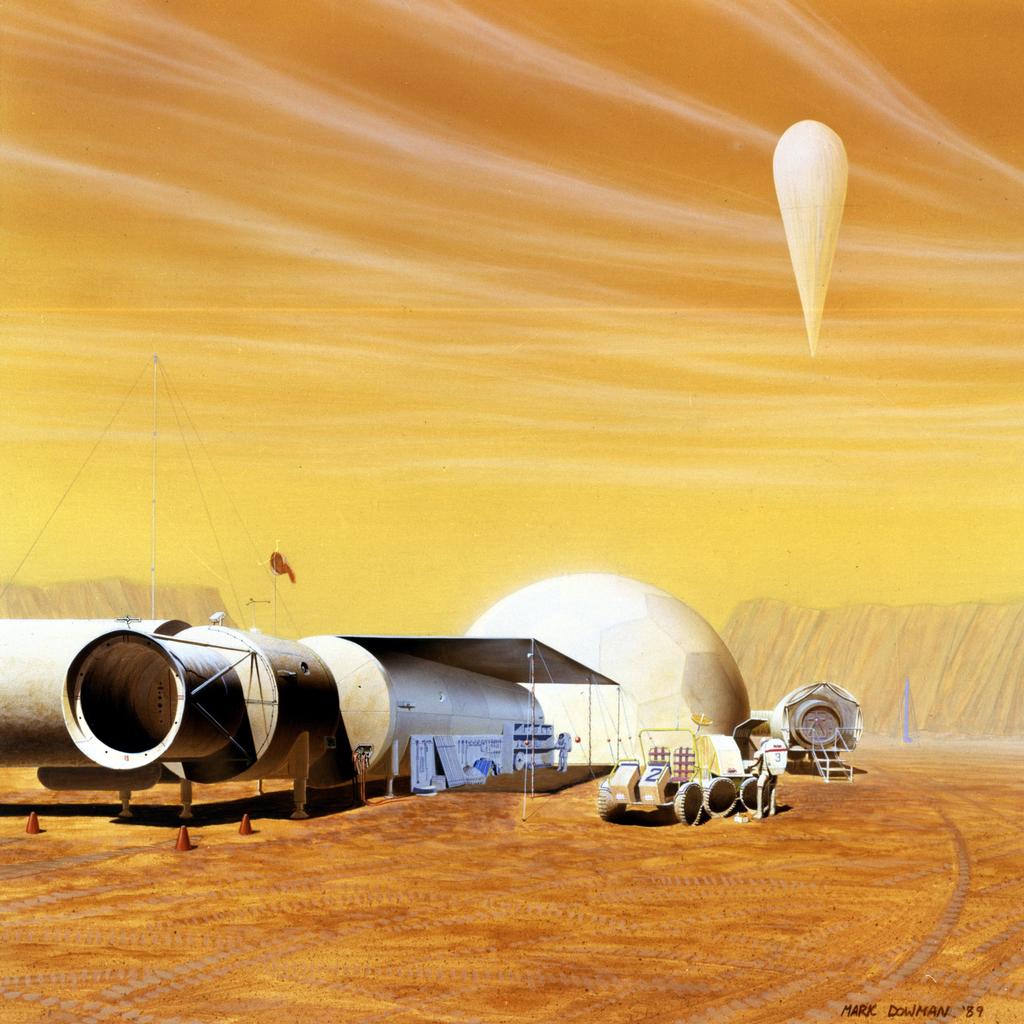
Credit: NASA/JSC by Mark Dowman of John Frassanito & Associates
While the helicopter idea is getting attention — and has been touted as a possible add-on to the Mars 2020 mobile laboratory — Mars hardware that takes flight, including balloons, may well become part of the exploration toolkit of a human expedition to the red planet.
Check out this Mars helicopter video at:

This four-image mosaic comprises Rosetta navigation camera images taken from a distance of 18 miles (28.4 kilometers) from the center of Comet 67P/Churyumov-Gerasimenko on January 16.
Credit: ESA/Rosetta/NAVCAM – CC BY-SA IGO 3.0
The European Space Agency’s Rosetta mission launched in 2004 and arrived at Comet 67P/Churyumov-Gerasimenko on August 6, 2014.
It is the first mission in history to rendezvous with a comet, escort it as it orbits the Sun, and deploy a lander to its surface.
The Rosetta orbiter continues to crank out impressive images of the comet as it enters nearly 270 days at the comet.
On 8/13/2015 the comet will make its closest approach to the Sun.

Credit: ESA/Rosetta/MPS for OSIRIS Team MPS/UPD/LAM/IAA/SSO/INTA/UPM/DASP/IDA

Credit: ESA/Rosetta/MPS for OSIRIS Team MPS/UPD/LAM/IAA/SSO/INTA/UPM/DASP/IDA

Credit: ESA/Rosetta/MPS for OSIRIS Team MPS/UPD/LAM/IAA/SSO/INTA/UPM/DASP/IDA

SpaceShipTwo suborbital craft disintegrated in a test flight last year, killing one pilot and injuring another.
Credit: Virgin Galactic
Is California’s Kern County the next frontier for aerospace innovation?
When you think of Kern County’s economy, two things may jump to mind: oil and agriculture.
But there’s another big player in the county’s economy – aerospace. County economic development officials estimate that around 20,000 people are employed in the sector – and one of the fastest growing areas has been in the field of commercial spaceflight.
The Mojave Air and Space Port in eastern Kern County is home to a number of startups specializing in the field.
But last year that tight knit community was rocked by tragedy when Virgin Galactic’s SpaceShipTwo was destroyed in a test flight, killing co-pilot Mike Alsbury and seriously injuring the other co-pilot.

Virgin Galactic pilot Todd Ericson and NTSB investigators at SpaceShipTwo accident site.
Credit: NTSB
Now three months after that accident, where does the world of commercial spaceflight go from here?Listen to this Valley Public Radio (VPR) — part of the NPR digital network – program on the topic, aired January 20, 2015, hosted by VPR’s Joe Moore and Ezra David Romero.
Guests: Leonard David, space journalist, and Stuart Witt – the CEO of the Mojave Air and Spaceport, the nation’s first inland spaceport and home to Scaled Composites, which has conducted tests of Virgin Galactic’s SpaceShipTwo.
The nearly 18 minute discussion can be heard at:
http://kvpr.org/post/kern-county-next-frontier-aerospace-innovation

Credit: White House
U.S. President Barack Obama delivered the State of the Union before Congress on January 20th.
Within that address, Obama noted the first launch of the Orion spacecraft as part of a “re-energized” American space program that will send American astronauts to the Red Planet. In addition, the U.S. President acknowledged the upcoming year-long mission of astronaut Scott Kelly, who was in the audience at the State of the Union.

NASA astronaut Scott Kelly stands as he is recognized by President Barack Obama, while First lady Michelle Obama, front left, and other guest applaud, during the State of the Union address on Capitol Hill in Washington, Tuesday Jan. 20, 2015. This March, Astronaut Scott Kelly will launch to the International Space Station and become the first American to live and work aboard the orbiting laboratory for a year-long mission. While living on the International Space Station, Kelly and the rest of the crew will carry out hundreds of research experiments and work on cutting-edge technology development that will inspire students here at home in science, technology, engineering and math.
Photo Credit: NASA/Bill Ingalls
Obama also remarked that 2014 was the planet’s warmest year on record, citing the contributions to understand climate change at NASA, NOAA and at universities.
Here are those remarks by President Obama as prepared for delivery:
“I want Americans to win the race for the kinds of discoveries that unleash new jobs — converting sunlight into liquid fuel; creating revolutionary prosthetics, so that a veteran who gave his arms for his country can play catch with his kid; pushing out into the Solar System not just to visit, but to stay. Last month, we launched a new spacecraft as part of a re-energized space program that will send American astronauts to Mars. In two months, to prepare us for those missions, Scott Kelly will begin a year-long stay in space. Good luck, Captain — and make sure to Instagram it.”
“2014 was the planet’s warmest year on record. Now, one year doesn’t make a trend, but this does — 14 of the 15 warmest years on record have all fallen in the first 15 years of this century.”
“I’ve heard some folks try to dodge the evidence by saying they’re not scientists; that we don’t have enough information to act. Well, I’m not a scientist, either. But you know what — I know a lot of really good scientists at NASA, and NOAA, and at our major universities. The best scientists in the world are all telling us that our activities are changing the climate, and if we do not act forcefully, we’ll continue to see rising oceans, longer, hotter heat waves, dangerous droughts and floods, and massive disruptions that can trigger greater migration, conflict, and hunger around the globe. The Pentagon says that climate change poses immediate risks to our national security. We should act like it.”

