Archive for the ‘Space News’ Category
 Author:
  February 13th, 2015
Credit: Copyright – Don Davis – Used with Permission
It has been two years since a sky blast rocked the Chelyabinsk region in Russia on February 15, 2013. The event injured scores of people and damaged property as the over 65-feet (20-meter) across space rock fragmented in the atmosphere.
However, the whereabouts of its parent asteroid remains elusive according to a new paper published in the journal Icarus.
Astronomers had originally predicted that a 2-km near-Earth asteroid (NEA) designated (86039) 1999 NC43 could be the source body from which the Chelyabinsk meteoroid was ejected prior to its encounter with the Earth.
“These two bodies shared similar orbits around the sun and initial studies suggested even similar compositions,” said Planetary Science Institute Research Scientist Vishnu Reddy, lead author of “Link between the Potentially Hazardous Asteroid (86039) 1999 NC43 and the Chelyabinsk meteoroid tenuous” that appears in Icarus.
Unlikely link
However, reanalysis of the orbital parameters and spectral data by an international team of researchers led by Reddy has shown that the link between Chelyabinsk and 1999 NC43 is unlikely.
“The composition of Chelyabinsk meteorite that was recovered after the event is similar to a common type of meteorite called LL chondrites. However, the near-Earth asteroid has a composition that is distinctly different from this,” Reddy said.
The study also showed that linking specific meteorites to an asteroid is extremely difficult due to the chaotic nature of the orbits of these bodies.
To view this research paper, go to:
http://www.psi.edu/news/reddypaper
Deep space mission
“The week of February 15th is a good time to remember the fact that asteroids do hit our planet,” says Ed Lu, a three-time U.S. shuttle astronaut, now co-founder and CEO of the B612 Foundation.

Ed Lu, a three-time U.S. shuttle astronaut, now co-founder and CEO of the B612 Foundation.
Credit: B612 Foundation
The B612 Foundation is building the Sentinel Space Telescope which will provide advance warning of where asteroids are and where they are headed, and it will see them far enough in advance so that we have time to move them out of Earth’s path.
“The B612 Foundation is leading the first privately managed deep space mission with the goal to protect our world from the impact of devastating asteroids. The fact of the matter is that asteroid impacts can be prevented using technology we can employ right now. And unlike other potentially global scale catastrophic events, the solution is nearly purely a technical one, and with a relatively small and known cost,” Lu notes in a B612 Foundation statement.
Protect, deflect
So what do we need to do to protect the Earth from asteroid impacts?
“The surprising answer is that we must find the asteroids that will hit the Earth,” Lu responds.
“In fact, sometime in the next decade, the Sentinel Mission is likely to discover an asteroid on course to hit Earth. And while that asteroid will probably be only about the size of the asteroid that hit Chelyabinsk…that means that we may soon witness the first mission to deflect an asteroid to protect our planet. It is hard to believe that science and technology have advanced to this point. We live in truly amazing times,” Lu concludes.
United Nations: action plan
Meanwhile, the United Nations is making progress on responding to any potential near-Earth object impact threat.

Credit: United Nations
The UN’s Scientific and Technical Subcommittee of the Committee on the Peaceful Uses of Outer Space formally dissolved its Action Team 14.
It dissolved the special Action Team in recognition of the successful completion of its mandate to coordinate international mitigation efforts for near-Earth object (NEO) threats.
“Action Team 14 coordinated the establishment of the Space Mission Planning Advisory Group (SMPAG) and the International Asteroid Warning Network (IAWN) and thus played a vital role in the international community’s response to any potential near-Earth object impact threat,” said Elöd Both of Hungary, Chair of the Subcommittee.
 Posted in

Heads up…but what next?
Credit: NASA
Can we — or should we — try to protect Earth from potentially hazardous impacts?How about harvesting asteroids for potential economic benefits? Could asteroid exploration be used to boost our capabilities and help clear a pathway to Mars? How should we balance costs, risks, and benefits of human exploration in space?
An effort set up between NASA, the US government’s space agency, and a group led by Arizona State University called ECAST—Expert and Citizen Assessment of Science and Technology—is offering ordinary citizens a say in decisions about the future of space exploration.
ECAST is a network of different institutions, launched in 2010 to provide a 21st Century model for technology assessment.
Let’s discuss
Want to give your opinion on what to do about NASA’s Asteroid Initiative?
Last November, several hundred people in Phoenix, Boston, and online came together to learn about NASA’s Asteroid Initiative. They took part to consider and discuss different approaches to dealing with the opportunities and threats posed by asteroids.
Lots of things to consider: Detection; Increase Space-Based Observations; Mitigation; Build-Up Civil Defense; An International Consortium Should Lead Efforts; Use Nuclear Weapons; Use Kinetic Impactor Technology.
Now, the next phase of “informing” NASA’s Asteroid Initiative is an open invite for everyone to participate. So weigh in on the questions considered by the in-person and online forums.
This phase is open now, and anyone can participate.
Go to: https://ecastonline.consider.it/
Also, go to this informative video on this citizen outreach effort:

A U.S./Russian team of experts has found that space travel may severely impair the body’s ability to regulate blood rushing to the brain. If that’s the case, it could contribute to the temporary or permanent vision problems experienced by astronauts.
In a new paper published in the Journal of Applied Physiology, researchers from Florida State University and Russian Academy of Sciences flag the problem.
The international research partnership is delving into the complications that occur when humans travel to space and spend weeks to months in a weightless environment.
The Russian Federal Space Agency, with the help of NASA, assembled an international team of researchers to study mice sent into space for 30 days on a Russian satellite, the Bion-M1.
On April 19, 2013 the automated Bion-M1 mission was launched carrying biological research experiments into low Earth orbit from Baikonur, Kazakhstan. When the mission returned on May 19, 2013 after the animals were in space for 30 days, scientists conducted post-flight analysis of the mice .

Bion-M1 Russian flight hardware for bioscience research is placed aboard the Bion recoverable module by Cosmodrome staff in Baikonur, Kazakhstan.
Cedit: Russian Federal Space Agency (Roscosmos)
Message from mice
According to a press release from Florida State University, when Bion-M1 returned to Earth, the mice were whisked by ambulance to laboratories at the Institute for Biomedical Problems in Moscow. Once there the research team investigated arteries that control blood flow to muscle, skin and the brain of the small creatures.
Their look at the brain revealed some interesting responses to the spaceflight.
“Without gravity pulling body fluids down toward the feet, fluid will rise toward the brain,” reports Florida State Professor Michael Delp. “When spaceflight alters the function of arteries that precisely regulate blood flow to the brain, it could severely affect many things, including vision.”
What next?
Now the issue remains how to solve that problem.
Delp and his Russian colleagues are looking into future experiments that may yield more answers and possible solutions. In May, another group of mice will be sent to the International Space Station for observation.

The international team of researchers worked out of a Moscow laboratory.
Courtesy of Michael Delp
Funding for the research was provided by NASA, the National Institutes of Health, the Russian Federal Space Agency, the Russian Academy of Sciences and M.V. Lomonosov Moscow State University Program of Development.

IXV recovery
Credit: ESA/Tommaso Javidi, 2015
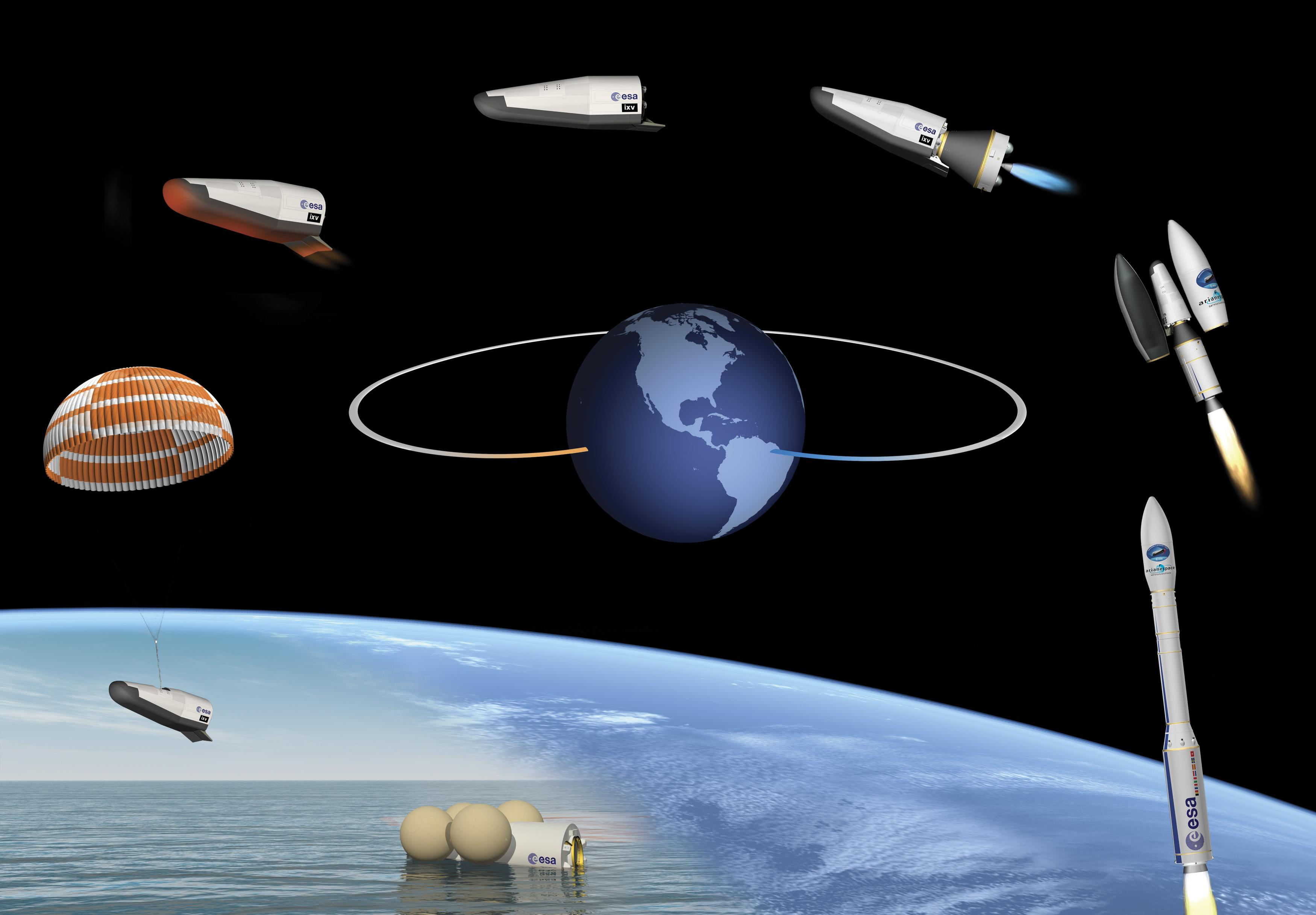
Europe’s Intermediate eXperimental Vehicle (IXV) – an experimental spaceplane – plopped down in the Pacific Ocean just west of the Galapagos islands.
The European Space Agency vehicle was launched Feb. 11 from Europe’s Spaceport in French Guiana atop a Vega rocket.
The craft carried some 300 sensors to record its performance during a high-heat reentry into Earth’s atmosphere.

IXV recovery
Credit: ESA/Tommaso Javidi, 2015
Measuring 16 feet (five meters) long and weighing two-tons, the craft flew a trajectory that enabled it to reach speeds that mimicked the same conditions as those for a vehicle returning from low Earth orbit.
IXV glided through the atmosphere before parachutes deployed to slow the descent further for a safe splashdown in the Pacific Ocean. The entire flight lasted approximately 100 minutes.

Credit: ESA
Pilot mission: PRIDE
This IXV mission tested cutting-edge system and technology aspects to provide Europe with an independent reentry capability. The vehicle is considered a building block for reusable space transportation systems. It will also validate designs for lifting-bodies.
According to ESA, the IXV incorporates both the simplicity of capsules and the performance of winged vehicles, with high controllability and maneuverability for precision landing.
Such a capability is a cornerstone for reusable launcher stages, sample return from other planets and crew return from space, as well as future Earth observation, microgravity research, satellite servicing and disposal missions.
The results from the test are to be fed into the ESA’s “Program for Reusable In-Orbit Demonstrator for Europe,” long-speak for PRIDE – a reusable spaceplane.

Jet streams on Churyumov-Gerasimenko
A prominent jet, together with gas an dust outflows are visible in this four-image mosaic, created from images acquired by Rosetta’s Navigation Camera NAVCAM on January 31, 2015. The comet’s activity will increase as it approaches the Sun.
Credit: ESA/Rosetta/NAVCAM – CC BY-SA IGO 3.0.
Scientists on the European Space Agency’s Rosetta comet mission suggest that Comet 67P/Churyumov-Gerasimenko could lose up to over 65 feet (20 meters) of surface material from its previously unilluminated south side when it heats up, starting in May 2015.
This possible estimate of erosion of 67P comes via data acquired by Rosetta’s Optical, Spectroscopic and Infrared Remote Imaging System (OSIRIS).

Model calculations for the erosion of 67P/Churyumov-Gerasimenko
This image is based on a surface model of comet Churyumov-Gerasimenko and shows the predicted extent of erosion of cometary material.
The left figure shows the comet seen from the north; the center image shows the equatorial plain and the right image shows the southern region. The different colours represent the predicted amount of erosion – the southern part of the comet could lose up to 20 meters of surface material during the orbit.
Credit: ESA/Rosetta/MPS for OSIRIS Team MPS/UPD/LAM/IAA/SSO/INTA/UPM/DASP/IDA/DLR .
“The comet sheds its surface almost constantly, revealing fresh material on its surface, which has not yet been aged by cosmic radiation,” says Ekkehard Kührt, who leads the Rosetta mission science team at the German Aerospace Center (Deutsches Zentrum für Luft- und Raumfahrt; DLR).
The Rosetta orbiter and its lander, Philae, will have an excellent view of the comet as it awakens and ejects gases and dust into space.
Lander wake-up call
The Philae lander now resting on the comet will be able to take advantage of the summer; at its location near the equator, it may receive sufficient sunlight to “wake up” from its current hibernation state. This might occur as early as March, but the probability that the Lander Control Center will resume contact and be able to send commands will be greatest in May, according to a DLR press statement.
The comet’s closest approach to the Sun (perihelion) will occur in August 2015.
The increasing heat as the comet approaches the Sun will trigger this “diet”, during which gases and solid materials will be ejected into space.
Credit: ESA–J. Huart, 2014
Look for a February 11 liftoff of the European Space Agency’s space plane – the Intermediate eXperimental Vehicle, or IXV.
It will be launched on a Vega launcher at 13:00 GMT (14:00 CET) for a suborbital flight to test technologies and critical systems for Europe’s future automated reentry systems.
From liftoff to splashdown in the Pacific Ocean will take 100 minutes.
Credit: ESA
Follow the mission live starting 12:30 GMT (13:30 CET) via Arianespace TV and ESA TV.
Go to:
http://www.esa.int/Our_Activities/Launchers/IXV/Watch_IXV_launch
Meanwhile, take a look at this informative time-lapse video that shows IXV’s preparation, fairing encapsulation, transfer to the Vega mobile gantry and upper composite integration on the Vega launcher, at Europe’s Spaceport in Kourou, French Guiana.
Go to:
http://www.esa.int/spaceinvideos/Videos/2015/02/IXV_ready_for_liftoff

After releasing a test return capsule to Earth, the solar-powered service module first loitered at Earth-Moon L2 and then moved into orbit around the Moon.
Credit: China Space Website
China’s “service module” that is orbiting the Moon has conducted a series of tests – all in prelude to a robotic lunar sample mission eyed for 2017.
According to a statement of the State Administration of Science, Technology and Industry for National Defense (SASTIND), the orbiter modulated its speed, height, and overall orbit around the Moon.
Those tests were completed February 6-7, SASTIND reported.
Space ballet: L2 to lunar orbit
The service module used in the tests was part of China’s experimental Moon probe that was launched on Oct. 24, 2014, a craft that made a circumlunar trek during an eight-day mission. On its flight back to Earth, the service module ejected a return capsule on Nov. 1, with the capsule parachuting to Earth that same day.
After release of the capsule, the service module made its way to the Earth-Moon Lagrangian (L2) position. The craft completed three circuits around that point prior to heading for lunar orbit. It then performed a set of braking maneuvers that nudged itself into lower and lower orbits around the Moon.

China mooncraft jumps from Earth-Moon L2 position into Moon orbit.
Credit: CMSE
Future mission
Experience gained during the service module’s flight is intended to sharpen the skills of ground controllers to undertake a lunar sample mission projected for 2017.

China’s Chang’e 5 mission is slated for 2017 and will land, collect, and return to Earth lunar samples.
Credit: China Space Website
That mission, China’s Chang’e 5, would be a sample return effort, entailing a soft landing on the Moon, scooping up several pounds of rock and soil, then rocket those specimens off the lunar surface for transport back to Earth.

Up, up and away!
Credit: DARPA
This week, at the 18th Annual Federal Aviation Administration Commercial Space Transportation Conference in Washington, D.C., the Defense Advanced Research Projects Agency (DARPA) highlighted its Airborne Launch Assist Space Access program (ALASA).
The current ALASA design envisions launching a low-cost, expendable launch vehicle from conventional aircraft. Serving as a reusable first stage, the plane would fly to high altitude and release the launch vehicle, which would carry the payload to the desired location.
The goal of ALASA is to develop a significantly less expensive approach for routinely launching small satellites, with a goal of at least threefold reduction in costs compared to current military and US commercial launch costs. Currently, small satellite payloads cost more than $30,000 per pound to launch, and must share a launcher with other satellites.
ALASA seeks to launch satellites on the order of 100 pounds for less than $1 million total, including range support costs, to orbits that are selected specifically for each 100 pound payload.
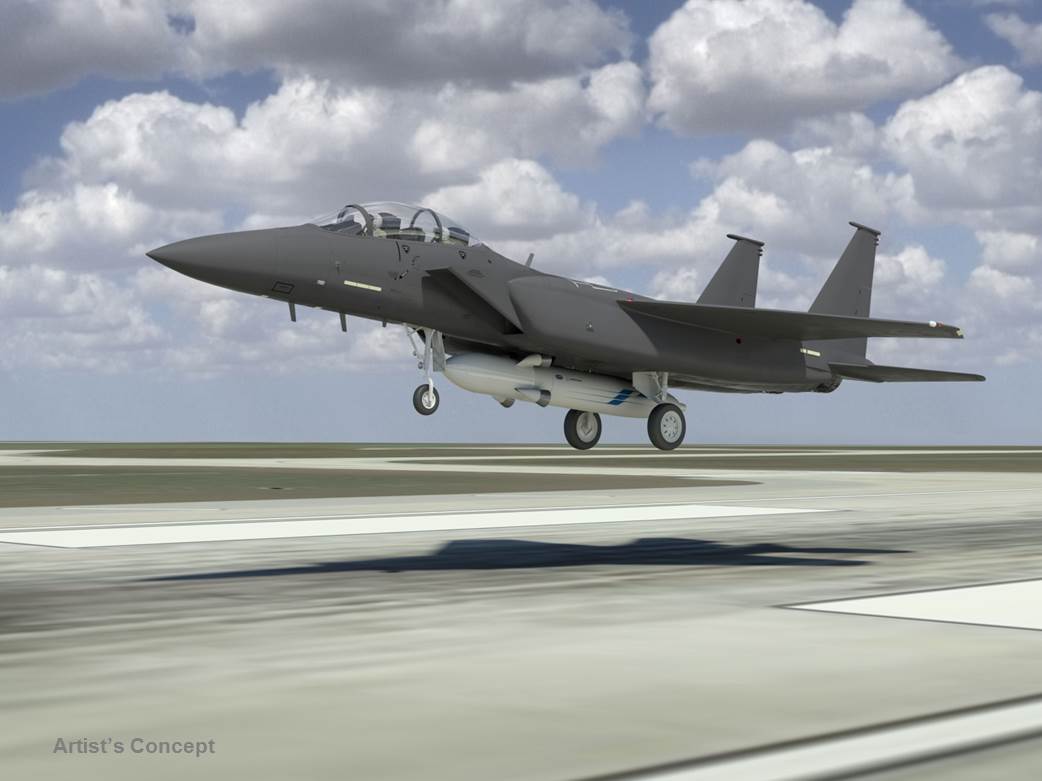
Credit: DARPA
According to DARPA, the ALASA program is moving ahead with rigorous testing of new technologies that one day could enable revolutionary satellite launch systems that provide more affordable, routine and reliable access to space.
Take a look at this DARPA video:
https://www.youtube.com/watch?v=BOaJWoVLhAc

Courtesy: Spaceport America/Leonard David Archives
Spaceport America is seeking approval from the New Mexico Legislature of a special appropriation of $1.783 million to cover the shortfall resulting from the delay due to the Virgin Galactic/SpaceShipTwo mishap last October.
“If the funding is approved, it will only be drawn upon if the spaceport does not make up the difference in additional revenue. It is an insurance policy for the $218.5M state’s investment,” explains Christine Anderson, Executive Director of the New Mexico Spaceport Authority (NMSA).
Anderson said that Spaceport America staff are in discussion with many prospective customers, in varying degrees of development, and hope to have more customers near-term to make use of the sprawling complex.
Spaceport America is located in the Jornada del Muerto desert basin in New Mexico, United States west and north of the White Sands Missile Range. It lies 89 miles north of El Paso, 45 miles north of Las Cruces, and 20 miles southeast of Truth or Consequences. Spaceport America was officially declared open on October 18, 2011.

Credit: NMSA
Sweetheart deal
Want to wing your way into Spaceport America?
The spaceport is hosting a Valentine’s Day Fly-In on February 14th for private pilots. A special spaceport tour, presentation and Valentine’s Day luncheon are included at a price.
For more information on the first-ever fly-in, go to:
“So if you are a pilot, bring your sweetheart and come celebrate the day with us,” Anderson adds.
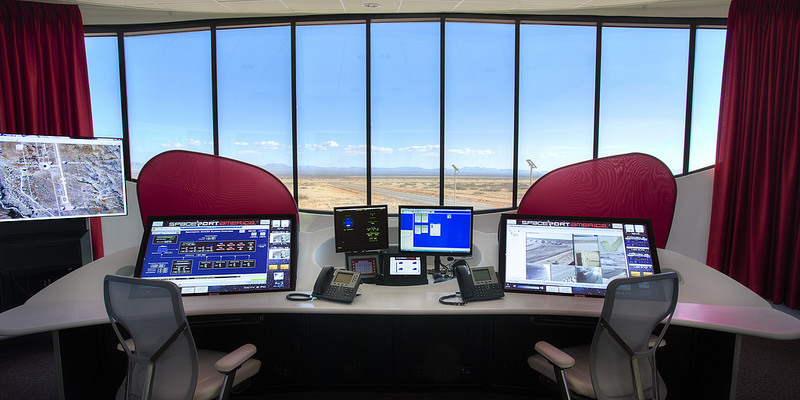
Mission Control equipment at Spaceport America.
Credit: NMSA
Gateway gallery
In other news, the expanded Visitor Experience is almost complete, with the last touches being made on the fit-out of the Gateway Gallery in the Gateway to Space building.
The Gallery will feature a G-Shock Simulator, a number of interactive kiosks and displays focused on the science behind the commercial space industry.
In addition, there are several displays of archaeological artifacts from the region from the residents that lived in the area over 10,000 years ago.
Anderson also notes that the spaceport has current openings in IT, aerospace, marketing and maintenance.
For more information on current openings at Spaceport America, go to:

One small step for making business on the Moon a new economic sphere?
Credit: NASA
The FAA’s Office of the Associate Administrator for Commercial Space Transportation (AST) has given thumbs-up regarding private sector operations on the Moon.
In a December 22 letter to Bigelow Aerospace, the FAA’s AST — in consultation with the Department of State, the Department of Defense, and other federal agencies, including NASA and NOAA – “is prepared to support Bigelow Aerospace’s trailblazing initiative.”
The letter is in response to a Bigelow Aerospace “payload review” tied to commercial development of the Moon.
Protect assets and personnel
The FAA/AST letter, obtained by Inside Outer Space, encourages the private space firm to continue to invest in the development of Bigelow Aerospace’s lunar habitat to support public and private sector activities.
“Moreover, we recognize the private sector’s need to protect its assets and personnel on the Moon or on other celestial bodies,” the FAA AST letter explains. “Supporting non-interference for private sector operations will enhance safety and only add to the long history of preserving ownership interests in hardware and equipment.”
Ill-equipped regulatory framework
Furthermore, the letter explains that the Department of State’s fundamental concern is that the national regulatory framework, in its present form, is “ill-equipped” to enable the U.S. Government to fulfill its obligations under the Outer Space Treaty with respect to private sector activities on the Moon or other celestial bodies.

Space entrepreneur, Robert Bigelow (left) explains company’s plans for commercial operations on the Moon.
Credit: Bigelow Aerospace/Leonard David Archives
“This response represents one small step for Bigelow Aerospace and one giant leap for lunar development,” said Mike Gold, Director of Washington, D.C. Operations & Business Growth for Bigelow Aerospace, LLC.
Economic growth
In 2013, after completing a Space Act Agreement on behalf of NASA to identify potential next steps for commercial space development, Bigelow Aerospace determined that the best destination for future private and public sector activities is the Moon.
Unlike asteroids or Mars, Bigelow Aerospace believes that the Moon has the potential to support near-term opportunities for economic growth.
“As is the case with any new frontier, prospects remain uncertain, but the Moon offers a variety of minerals and resources that could support mining or other forms of commercial operations,” adds Gold. “Bigelow Aerospace sees its role in lunar development as the historic equivalent of the Hudson Bay Company, providing the necessary habitats, equipment, and transportation for entrepreneurs to execute their business plans. Bigelow Aerospace wants to enable individuals, companies, and countries to transform the Moon into a dynamic arena for imagination and innovation.”
Beginning of a process
Does the FAA now have jurisdiction over the Moon? Does this letter fully resolve the legal vacuum that has existed for low Earth orbit (LEO) and beyond LEO commercial operations?
“This is the beginning of a process, not the end,” Gold said. “This response represents a first step by the AST to use what authority it has to create a safe and attractive environment for commercial lunar development. The first step is always the most challenging, and we’re grateful to the FAA AST and their colleagues at the Department of State for this decision.”

