Archive for the ‘Space News’ Category
 Author:
  March 23rd, 2015
A solution to pollution – netting a derelict satellite?
Credit: ESA
Think of it as a new form of “networking” – a method of snagging an uncontrolled, tumbling satellite.
Engineers at the European Space Agency (ESA) are moving beyond powerpoint chatter and carrying out weightless net testing for derelict satellite capture. The use of deployable nets to snag discarded satellites as they tumble in space was explored recently in weightlessness.
To trial-run the technology in a condition of microgravity, a Falcon 20 aircraft was flown for two days earlier this year. The aircraft is flown in such a manner that for 20 seconds at a time it falls through the sky, effectively cancelling out gravity inside the aircraft.
“We shot nets out of a compressed air ejector at a scale-model satellite,” explains ESA engineer Kjetil Wormnes.

The National Research Council of Canada’s Falcon 20 aircraft, flown out of Ottawa Airport, was used for parabolic flight experiments.
Credit: ESA
The behavior of the nets was appraised, with 20 nets fired at various speeds during 21 parabolas over the two days. Packed inside paper cartons, the nets were weighted at each corner, helping them to entangle the model satellite.
Control of debris levels
“Everything was recorded on four high-speed HD cameras,” Kjetil adds. “The aim is to check the simulation tool we have developed, so that we can use it to design the full-size nets for a debris removal mission.”
The work is geared to support ESA’s “e.Deorbit” in 2021, an initiative that will test the feasibility of removing a large item of debris — either a large, derelict spacecraft or rocket upper stage — to help control the debris levels in busy orbits.
It’s an element of ESA’s Clean Space initiative.
“The main advantage of the net option, whether for e.Deorbit or other debris removal missions in future,” Kjetil explains, “is that it can handle a wide range of target shapes and rotation rates.”
Take your own video look at the ESA orbital debris collection idea at:
 Posted in

The city of Philadelphia is shown inside a theoretical lunar lava tube. A Purdue University team of researchers explored whether lava tubes more than one kilometer wide could remain structurally stable on the moon.
Credit: Purdue University/courtesy of David Blair
THE WOODLANDS, Texas – Earth’s Moon is rife with huge lava tubes – tunnels formed from the lava flow of volcanic eruptions.
New theoretical work suggests that lunar lava tubes are large enough to house cities that may be structurally stable on the Moon.
These features could support future long-term human space exploration on the Moon, offering shelter from cosmic radiation, meteorite impacts and wild swings of lunar day and night temperatures.
The assessment made use of lunar gravity data from the NASA Gravity Recovery And Interior Laboratory (GRAIL) spacecraft, suggesting the possibility of lava tubes on the Moon with diameters in excess of one kilometer.
Study details by Purdue University researchers were presented during the Lunar and Planetary Science Conference held here March 16-20.
Really big
According to Jay Melosh, a Purdue University distinguished professor of earth, atmospheric and planetary sciences, the edges of the lava cool as it flows to form a pipe-like crust around the flowing river of lava.
![Southeast view across Vallis Schröteri [Apollo 15 Metric Image AS15-M-2612]. Credit: NASA/JSC/Arizona State University](https://www.leonarddavid.com/wp-content/uploads/2015/03/MOON-AristarchusPlateau.jpg)
Southeast view across Vallis Schröteri [Apollo 15 Metric Image AS15-M-2612].
Credit: NASA/JSC/Arizona State University
The presence of sublunarean voids has recently been confirmed via the observation of “skylights” in several lunar maria.
Structurally sound
David Blair, a graduate student in Purdue’s Department of Earth, Atmospheric and Planetary Sciences, led the study that examined whether empty lava tubes more than one kilometer wide could remain structurally stable on the Moon.

Skylights on the Moon are collapses that occur over subsurface voids. Skylights occur in many terrestrial lava tubes, providing access, although sometimes requiring shimming down a rope. If the skylight roof is too thin, their edges may collapse, making them dangerous places to stand.
Shown here is a skylight in the Moon’s Marius Hills.
Credit: NASA/GSFC/Arizona State University
The Purdue team found that if lunar lava tubes existed with a strong arched shape like those on Earth, they would be stable at sizes up to 5,000 meters, or several miles wide, on the Moon.
“This wouldn’t be possible on Earth, but gravity is much lower on the Moon and lunar rock doesn’t have to withstand the same weathering and erosion,” Blair reported. “In theory, huge lava tubes — big enough to easily house a city — could be structurally sound on the Moon.”
Stability factors
Blair and his team found that a lava tube’s stability depended on the width, roof thickness and the stress state of the cooled lava. They modeled a range of these variables.
The researchers also modeled lava tubes with walls created by lava placed in one thick layer and with lava placed in many thin layers.
Moreover, the study findings about lunar rock and the Moon’s environment were applied to civil engineering technology used to design tunnels on Earth.
Future work, Blair advised, will provide a more accurate picture of the maximum possible size of lunar lava tubes.

Navcam: Left B Sol 930 on 2015 03 19
Image Credit: NASA/JPL-Caltech
NASA’s Curiosity rover has wheeled itself into an area of great interest.
A deserved up-close inspection is now underway of an area of possible vein fracture fills – fractures filled with minerals that precipitated from solution.
More data on this location is in the offing…but stay tuned for a better appreciation of these features.
Meanwhile. the robot is taking a series of close-up images of the site.

Mars Hand Lens Imager (MAHLI),March 19, 2015, Sol 930
Image Credit: NASA/JPL-Caltech/MSSS
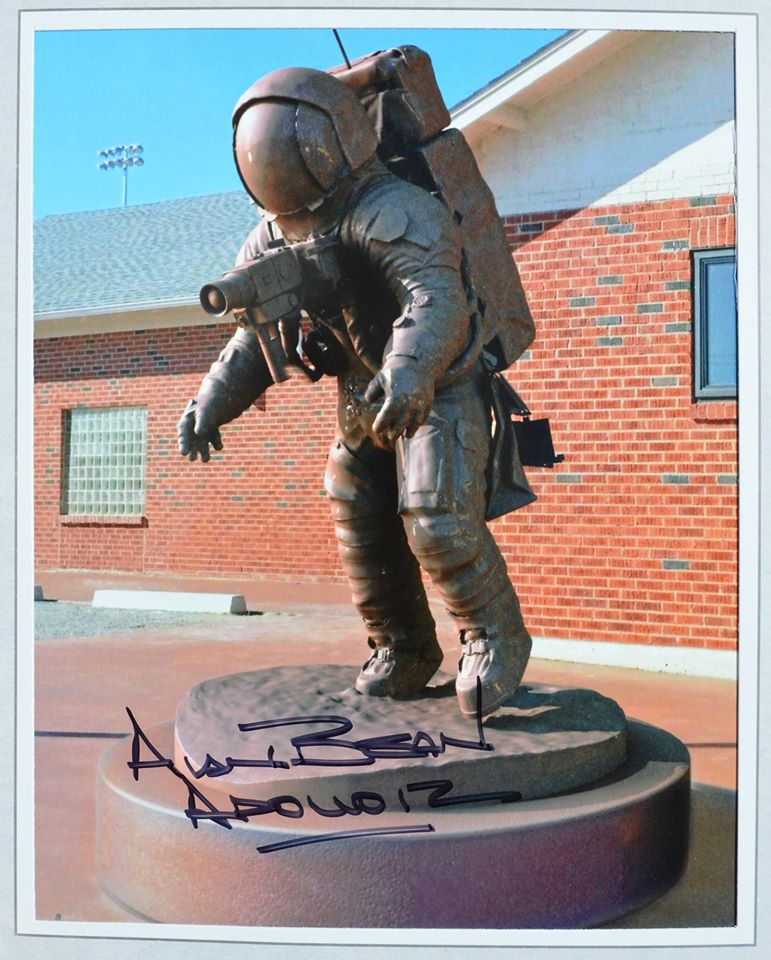
Credit: Erica Burrell Design/Wheeler Historical Museum
The Wheeler Historical Museum in Wheeler, Texas is set to unveil a statue dedicated to Apollo 12 moonwalker, Alan Bean.
Bean became the fourth man to set foot on the Moon in November 1969. He explored the desolate landscape of the Ocean of Storms. His Apollo adventure was followed by being commander of Skylab Mission II in 1973, spending 59 days in Earth orbit.
Alan Bean resigned from NASA in 1981 to devote all of his time and energy to painting, capturing his experiences on the Moon.

Courtesy: Wheeler Historical Museum
As a Wheeler, Texas legendary artist and astronaut, Bean spoke at a St. Patrick’s Day Banquet in Shamrock, Texas on March 13th, then a day later was Marshall of the 69th Annual St. Patrick’s Parade. That same day the Wheeler Historical Museum honored his presence with a reception and dedication of the Alan Bean statue: “Tiptoeing on the Ocean of Storms.”
The American Legion building which is located on U.S. Hwy 83, along the northern edge of the city of Wheeler, Texas, has been preserved and rehabilitated to house the Wheeler Historical Museum.

Credit: Wheeler Historical Museum
“The new statue in Wheeler, the Johnson Space Center, and SpaceX’s announcement that it is building a launch facility in Brownsville bodes well for space tourism in Texas,” observes Stew Magnuson, author of the enlightening book, The Last American Highway: A Journey Through Time Down U.S. Route 83.
“U.S. Highway 83 as it passes through Wheeler is named Alan Bean Boulevard,” Magnuson told Inside Outer Space.
Swift Hill Productions traveled to Houston, Texas to interview Alan L. Bean. In this promo Bean talks about his birth in Wheeler, Texas and the importance of the future.
Go to this video at:
https://www.youtube.com/watch?v=JlSH7BbwSEI

Alan Bean at Wheeler Museum festivities.
Credit: Erica Burrell Design/Wheeler Historical Museum

Credit for Hubble Image: NASA, ESA, K. Kuntz (JHU), F. Bresolin (University of Hawaii), J. Trauger (Jet Propulsion Lab), J. Mould (NOAO), Y.-H. Chu (University of Illinois, Urbana), and STScI
It is called NIROSETI for near-infrared optical SETI.
This new instrument can record levels of light over time so that patterns can be analyzed and assessed for potential signs of other civilizations.
For more than five decades, scientists have been on the lookout for radio signals from other starfolk. But instruments capable of capturing pulses of infrared light have only recently become available.
NIROSETI has been installed at the University of California’s Lick Observatory on Mt. Hamilton east of San Jose and saw “first light” on March 15 – but months of fine-tuning are ahead.
The Nickel 1-meter telescope at Lick Observatory is where NIROSETI has been deployed.
Shelley Wright, an Assistant Professor of Physics at the University of California, ‘San Diego, led the development of NIROSETI while at the University of Toronto’s Dunlap Institute for Astronomy & Astrophysics.
Altruism in the universe
Infrared light penetrates farther through gas and dust than visible light. So this new search will extend to stars thousands rather than merely hundreds of light years away.
NIROSETI could uncover new information about the physical universe as well – as well as help shape an answer to some big questions: Are we alone? Just how crowded is it out there?
The group making the NIROSETI campaign possible also includes SETI pioneer Frank Drake of the SETI Institute and UC Santa Cruz who serves as a senior advisor to both past and future projects and is an active observer at the telescope.
Regarding use of NIROSETI there is one downside, Drake observes. “The extraterrestrials would need to be transmitting their signals in our direction,” Drake said in a Univ. of Calif. San Diego press statement, although he sees a positive side to that limitation.
“If we get a signal from someone who’s aiming for us, it could mean there’s altruism in the universe. I like that idea. If they want to be friendly, that’s who we will find,” Drake adds.
Funding for the project comes from the financial support of Bill and Susan Bloomfield.
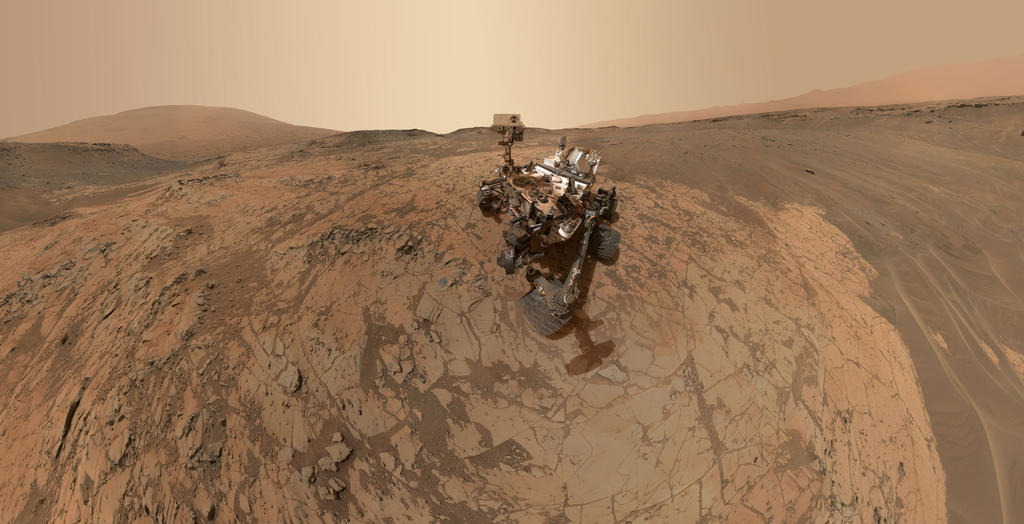
Credit: NASA/JPL
NASA’s Curiosity Mars rover is taking a look at intriguing, eye-catching features on the Red Planet.

This image was taken by Navcam: Right B (NAV_RIGHT_B) onboard NASA’s Mars rover Curiosity on Sol 926 (2015-03-15 15:04:51 UTC).
Image Credit: NASA/JPL-Caltech
Images relayed to date suggest they are vein fracture fills – fractures filled with minerals that precipitated from solution, according to Mars researcher, James Rice.
Curiosity was launched in November 2011, landing on Mars in August 2012.

This image was taken by Mastcam: Left (MAST_LEFT) onboard NASA’s Mars rover Curiosity on Sol 926 (2015-03-15 15:15:19 UTC).
Image Credit: NASA/JPL-Caltech/MSSS
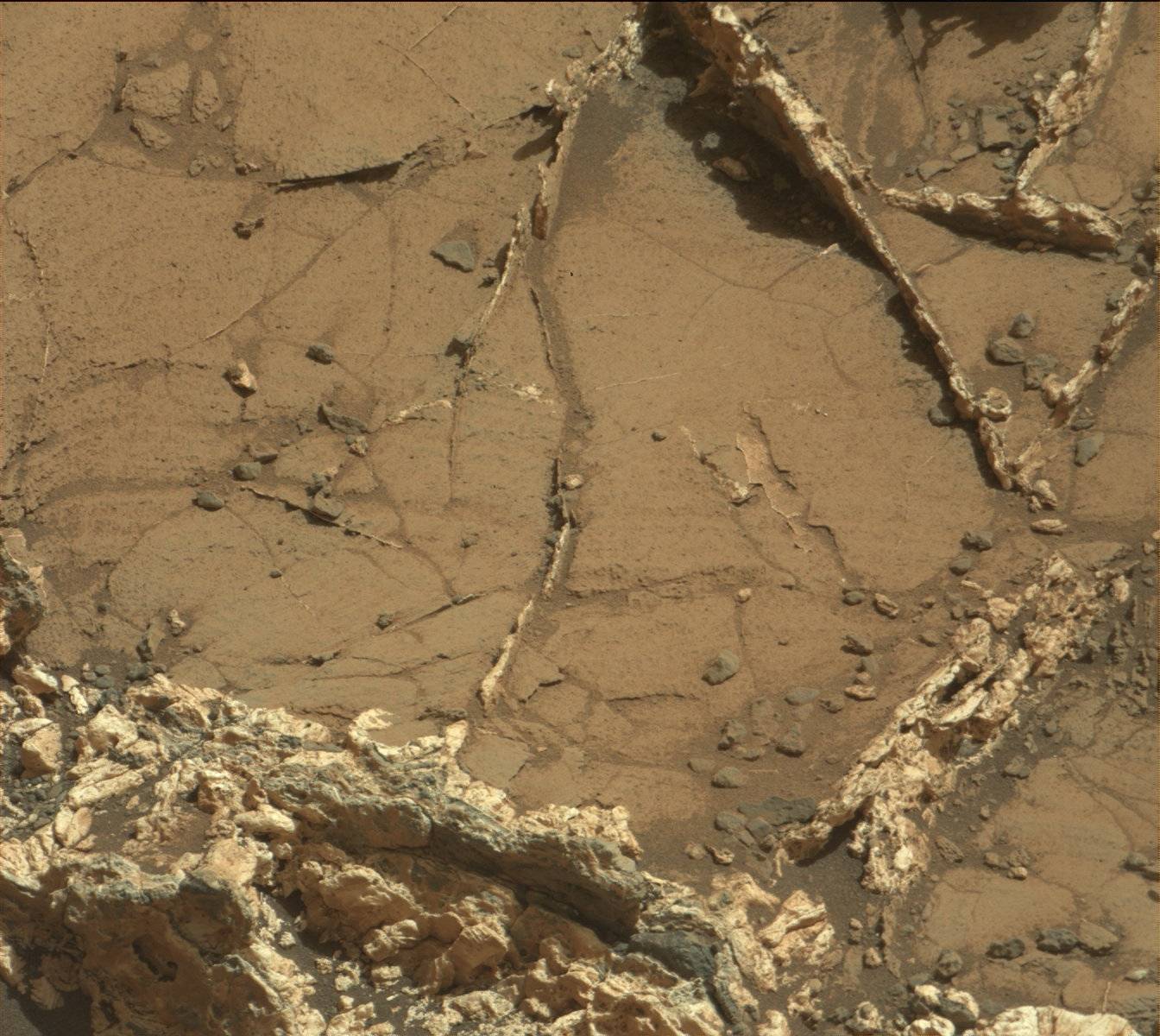
This image was taken by Mastcam: Right (MAST_RIGHT) onboard NASA’s Mars rover Curiosity on Sol 926 (2015-03-15 15:10:56 UTC).
Image Credit: NASA/JPL-Caltech/MSSS

The Earhart crater, a previously unknown lunar crater, is outlined in the magenta dash circle. A team of researchers at Purdue University found the crater through an analysis of data from NASA’s Gravity Recovery and Interior Laboratory mission. The team provisionally named the crater Earhart, after the famous aviator Amelia Earhart. (Purdue University image/courtesy of Rohan Sood)
THE WOODLANDS, Texas – You would think the battered Moon doesn’t need one more crater.
But thanks to data from NASA’s Gravity Recovery and Interior Laboratory (GRAIL) mission, a massive crater has been found, provisionally named the crater Earhart after the famous aviator Amelia Earhart.
A team from Purdue University has been testing a new technique that sharpens the GRAIL data to see smaller-scale features, like ridges and valleys. Diving into the data, they noticed an unusual circular feature, said Rohan Sood, a graduate student in Purdue’s School of Aeronautics and Astronautics who worked on the project.
Note: Go to the aeronautics and astronautics master’s program homepage (the department with which Mr. Sood is affiliated: https://engineering.purdue.edu/ProEd/programs/masters-degrees/aeronautics-astronautics
Sood presented the findings being held here March 16-20, here at the Lunar and Planetary Science Conference.
Zooming in
The crater discovered is 124-miles wide.
“The feature turned out to be the rim of an ancient crater, but it was so big we did not even recognize it as that at first,” Sood said. “We were zoomed in on one little piece of it. We first tried to model it as a small crater, but we had to go bigger and bigger and bigger to match what the data was telling us.”
More discoveries ahead?
The Purdue group plans to extend the search to the entire Moon to reveal other buried craters and small-scale features beneath the surface.
That search could uncover underground tunnels formed by lava flows — called lava tubes – that have been proposed as a possible shelter for human habitats on the Moon.
Crater Earhart is the provisional name as names of planetary features must be submitted and approved by The International Astronomical Union.

Famous aviator Amelia Earhart.
Notable alumni at Purdue include astronauts Neil Armstrong, Gus Grissom, and Eugene Cernan.Earhart was a Purdue career counselor and adviser to the Department of Aeronautics from 1935-1937.
Purdue is also home to the world’s largest compilation of Earhart-related papers, memorabilia and artifacts.
The collection includes documents related to Earhart’s 1932 solo Atlantic flight, her second and fatal attempt at a world flight in 1937, and items related to her time at Purdue.
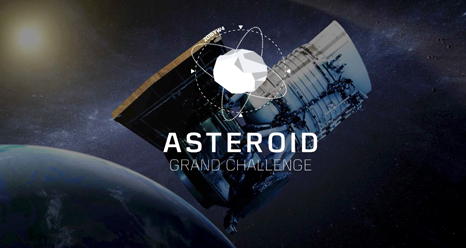
NASA’s Asteroid Data Hunter contest series was part of NASA’s Asteroid Grand Challenge, which is focused on finding all asteroid threats to human populations and knowing what to do about them.
Image Credit: NASA
A software application based on an algorithm created by a NASA challenge has the potential to increase the number of new asteroid discoveries by citizen scientists and amateur astronomers.
If you want to take part in the search to help protect Earth from threatening asteroid impacts an application is now available that enables everyone, everywhere, to help solve this global challenge.
The desktop software application was developed by NASA in partnership with Planetary Resources, Inc., of Redmond, Washington. The application is based on an Asteroid Data Hunter-derived algorithm that analyzes images for potential asteroids.
To download the app and join the hunt for asteroids, go to:
http://www.topcoder.com/asteroids/#

This image was taken by Curiosity’s Mastcam: Left camera on Sol 924, March 13, 2015.
Image Credit: NASA/JPL-Caltech/MSSS
NASA’s Curiosity Rover is trekking on a path toward higher layers of Mount Sharp, a route that takes it first through a valley called “Artist’s Drive,” heading southwestward from Pahrump Hills.
Curiosity’s drill has used a combination of rotary and percussion action to collect samples from six rock targets since the rover landed inside Gale Crater in 2012.

This image was taken by Navcam: Right B onboard the robot on Sol 924, March 13th.
Image Credit: NASA/JPL-Caltech
The first sampled rock, “John Klein,” in the Yellowknife Bay area near the landing site, provided evidence for meeting the mission’s primary science goal.
Analysis of that sample showed that early Mars offered environmental conditions favorable for microbial life, including the key elemental ingredients for life and a chemical energy source such as used by some microbes on Earth.

This area at the base of Mount Sharp on Mars includes a pale outcrop, called “Pahrump Hills,” that NASA’s Curiosity Mars rover investigated from September 2014 to March 2015, and the “Artist’s Drive” route toward higher layers of the mountain. Credit: NASA/JPL-Caltech/Univ. of Arizona
In the layers of lower Mount Sharp, the mission is pursuing evidence about how early Mars environments evolved from wetter to drier conditions.

William Gerstenmaier, NASA’s associate administrator for human exploration and operations, and Jason Crusan, director of the agency’s advanced exploration systems division, view the Bigelow Expandable Activity Module at Bigelow’s facility in Las Vegas on March 12.
Image Credit: Stephanie Schierholz
In a March 12 news briefing, NASA and Bigelow Aerospace detailed future use of the Bigelow Expandable Activity Module, or BEAM.
NASA officials viewed the Bigelow Expandable Activity Module at Bigelow’s facility in Las Vegas prior to its sendoff to Florida for launch later this year aboard a SpaceX Falcon 9 booster.
In its packed configuration tucked aboard SpaceX’s Dragon resupply spacecraft, BEAM will measure approximately 8 feet in diameter.
Once BEAM is attached to the International Space Station’s Tranquility Node, onboard crew members will perform initial systems checks before deploying the habitat.
How will it perform?
During the BEAM’s minimum two-year test period, crews will routinely enter the BEAM. In addition, the module will be assessed as to its performance to help inform designs for future habitat systems.
The expandable habitat will be monitored as to its adaption to the thermal environment of space, reaction to radiation, as well as micrometeroids and orbital debris strikes.
Once BEAM is deployed it will add an additional 565 cubic feet of volume — about the size of a large family camping tent — that is accessible space by astronauts aboard the orbiting laboratory.

