Archive for the ‘Space News’ Category
 Author:
  April 1st, 2015
All eyes on Mars! ISS commander, Terry Virts (center), works with Russian cosmonaut, Anton Shkaplerov (top), and the European Space Agency’s Samantha Cristoforetti (foreground) to look over select imagery taken by the Mars Opportunity rover.
Credit: Terry Virts/NASA
Crew members aboard the International Space Station have assisted in picking spots on Mars for investigation by the Opportunity robot now wheeling about on that distant world.
The Expedition 43 crew “had a great chance to ‘target’ some Martian rocks for sampling by the Opportunity rover,” recently tweeted ISS commander, Terry Virts.
NASA’s Virts, along with Russian cosmonaut, Anton Shkaplerov, and the European Space Agency’s Samantha Cristoforetti used some of their dinner time to look over select imagery taken by Opportunity.
The idea to connect the ISS crew with Mars photos was sparked by astrogeologist, James Rice, Jr., Mars Exploration Rover (MER) Geology Team Leader and Senior Scientist at the Planetary Science Institute.
Targets of Opportunity
A set of navigation camera images taken by the Opportunity rover were uploaded to the ISS crew. Using their laptops, the space travelers picked “targets of Opportunity.”
“It is pretty darn cool seeing those MER images up on the ISS,” Rice said.
“I asked them to pretend they were on Mars, walking there, and what would they take pictures of…what’s scientifically interesting and things that caught their eye,” Rice told Inside Outer Space.

Opportunity Mars rover Panoramic Camera image.
Credit: NASA/JPL
Natural fit
Virts explained: “We heard from my good friend Jim Rice, who interviewed with me to be an astronaut back in 2000, and with whom I’ve done several Mars related events with over the past decade. It seemed like a natural fit for astronauts in space to be involved with robotic geology on another planet,” he noted.
“This very well may be a paradigm we use as we explore the solar system. Jim offered my ISS Expedition 43 crew the chance to choose a rock, or location, to target by the Opportunity rover. Of course we all loved it…and really enjoyed being involved with real time operations on Mars and at JPL,” Virts said. “What a thrill and honor! Now we are anxiously awaiting the results from Mars, but the initial word is that there may be some interesting findings about this particular location,” he said.
Crew-selected scenes
Opportunity has recently driven into an extremely scientifically interesting area on Mars, Rice said.
One puzzler is the Spirit of Saint Louis crater.

Credit: NASA/JPL
“It’s not very big, only 35×27 meters and it’s very shallow. We don’t know what it is yet…an impact crater, or perhaps there is a hydrothermal and or volcanic story here, but with our capable rover and outstanding team we will figure it out,” Rice added.
“That’s the value of a rover. Every time you rove…you’ve got a brand new mission,” Rice said.
Once the crew-selected scenes of Mars territory are back on Earth, they will be then relayed to the ISS, he said.
In many ways, using the ISS as a test bed for select-a-shot imagery of the Mars landscape could be a portent of things to come. That is, future Mars-orbiting crews could run robots on the Red Planet that would scrutinize select areas of Martian terrain.
Target rich site
Landing on Mars in 2004, NASA’S Opportunity rover is now sitting on the apron that surrounds Spirit of Saint Louis crater, roughly an 80 foot (25-meters) wide shallow crater in front of the entrance to Marathon Valley.

Annotated MRO/HiRISE image
Credit: NASA/JPL/Univ. of Arizona
Arvidson said ground controllers will then direct the rover into Spirit of Saint Louis crater to make measurements “to figure out if it is an impact crater or something else,” he told Inside Outer Space.
Afterward, Opportunity will head east into Marathon Valley, Arvidson said, where multiple observations from The Compact Reconnaissance Imaging Spectrometer for Mars (CRISM) aboard the Mars Reconnaissance Orbiter Mars orbit document the widespread presence of smectite clay minerals.
“We’ll probably spend the next winter in this area, since it is very, very target rich,” Arvidson said.
 Posted in
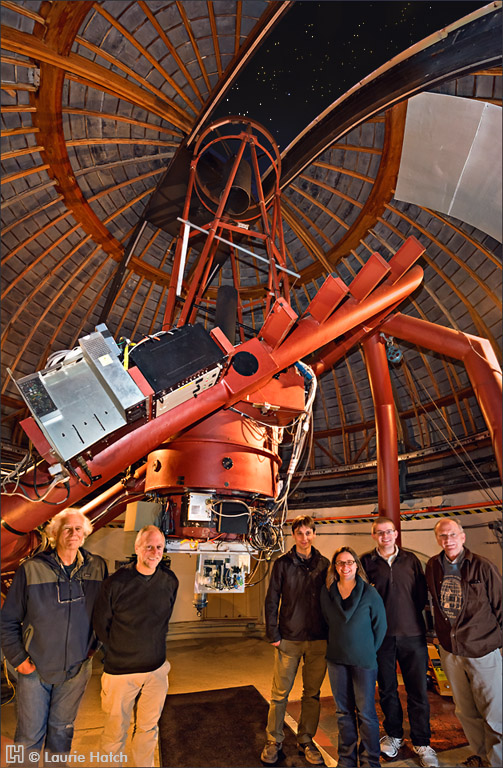
The near-infrared optical SETI (NIROSETI) team with their new infrared detector inside the dome at Lick Observatory. Left to right: Remington Stone, Dan Wertheimer, Jérome Maire, Shelley Wright, Patrick Dorval and Richard Treffers.
Credit: Laurie Hatch Photography, used with permission
The Search for Extraterrestrial Intelligence (SETI) has shifted to the infrared.
Called NIROSETI — short for Near-Infrared Optical Search for Extraterrestrial Intelligence — the instrument saw its “first light” last month at the University of California’s Lick Observatory atop Mt. Hamilton east of San Jose.
NIROSETI technicians are making use of Lick Observatory’s Nickel 1-meter telescope.
The device is built to record levels of light over time so that patterns can be analyzed for potential signals of alien life.
For more information go to:
http://www.space.com/28910-seti-infrared-telescope-tech-nirosetti.html

Credit: University of Mississippi
Here’s a profile I have written for SpaceNews newspaper, an interview with Joanne Irene Gabrynowicz Professor Emerita, University of Mississippi School of Law.
Government legal and regulatory regimes, which operate within the framework of the Outer Space Treaty, have yet to catch up in some areas, says renowned space law expert Joanne Gabrynowicz.
The evolution of space law is painstakingly slow, a reality that makes virtues out of patience and tolerance for ambiguity, Gabrynowicz explains.
Go to: http://spacenews.com/space-law-101-helping-fill-a-legal-vacuum/

Credit: Science China Technological Sciences
New details have become available regarding China’s circumlunar return and reentry spacecraft. That vehicle was launched on October 24, 2014 (Beijing Time).
After nearly 196 hours of flight, the reentry capsule landed safely at Siziwangqi in Inner Mongolia of China on November 1st, recovered and delivered to Beijing on the same day.
That mission mimicked several conditions of China’s future Chang’e 5 moon mission, dedicated to returning samples of the lunar surface back to Earth. China is set to launch the robotic Chang’e 5 from South China’s Hainan province in 2017.

Credit: Science China Technological Sciences
Last year’s circumlunar mission demonstrated hyper-speed semi-ballistic skip reentry technologies, including the circumlunar free return trajectory design, aerodynamic design and verification, thermal protection, guidance, navigation and control as well as a lightweight and minimized recovery system.
Lightweight thermal protection
A technical overview of the circumlunar mission has been published in Science China Technological Sciences. Lead author of the paper is MengFei Yang of the China Academy of Space Technology in Beijing.

Credit: Science China Technological Sciences
The aerodynamic design of China first small skip reentry capsule at hyper speed was verified by the successful reentry and landing, they report.
Seven new kinds of lightweight thermal protection material were developed for the capsule, promoting the development and use of composite material in China.
Free return trajectory
The total weight of the capsule was less than 740 pounds (335 kilograms), which required both limited power consumption and precise assembly.
The free return trajectory used lunar gravity to change the inclination of the capsule’s atmospheric entry, without any large orbit maneuver. This was the first time for China to apply such an orbit design.

Credit: Science China Technological Sciences
“The complete success of this mission indicates that the key technologies of circumlunar return and reentry have been broken through in China,” the space experts write.
Future deep space missions
“The success of reentry and return flight indicates that the key technologies of deep space exploration are verified in China. The key technologies demonstrated in this mission can be directly applied to subsequent lunar sample and return mission, and lays foundation for manned lunar exploration in the future,” the space technology team writes.
“China will take further steps to Mars, Venus and comets in the future. The key technologies such as aerodynamics, GNC [guidance, navigation and control], thermal protection and miniaturization design will provide technical supports for planetary entry and earth reentry missions, and promotes the continuous development of Chinese deep space exploration with greater achievements,” the co-authors of paper conclude.

NASA’s Mars rover Curiosity acquired this image using its Mars Hand Lens Imager (MAHLI), located on the turret at the end of the rover’s robotic arm, on March 29, 2015, Sol 939 of the Mars Science Laboratory Mission.
Image Credit: NASA/JPL-Caltech/MSSS
Landing on Mars in August 2012, NASA’s Curiosity rover continues on its mission to assess whether Mars ever had an environment able to support life.
Indeed, the robot has gathered compelling information regarding the planet’s habitability for life.
New imagery of Curiosity’s wheels show the wear and tear of trekking across the rocky surface of the Red Planet.

Curiosity’s Mars Hand Lens Imager (MAHLI) makes a wheel inspection on March 29, 2015, Sol 939.
Image Credit: NASA/JPL-Caltech/MSSS
Curiosity acquired these images using its Mars Hand Lens Imager (MAHLI), located on the turret at the end of the rover’s robotic arm.

Click on image to view a five-frame sequence of the location where the spacecraft’s heat shield hit the ground.
Image Credit: NASA/JPL-Caltech/Univ. of Arizona
A series of observations from Mars orbit show how dark blast zones that were created during the August 2012 landing of NASA’s Curiosity rover have faded inconsistently.
Images were taken by the High Resolution Imaging Science Experiment (HiRISE) camera on NASA’s Mars Reconnaissance Orbiter. The observations were taken on multiple dates from Curiosity’s landing to last month.
After fading for about two years, the pace of change slowed and some of the scars may have even darkened again.
One purpose for repeated follow-up imaging of Curiosity’s landing area has been to check whether scientists could model the fading and predict how long it would take for the scars to disappear.
Meanwhile, Curiosity is in full-sleuthing mode, inspecting newly found features on the Red Planet.

NASA’s Mars rover Curiosity acquired this image using its Mars Hand Lens Imager (MAHLI), located on the turret at the end of the rover’s robotic arm, on March 27, 2015, Sol 937.
Image Credit: NASA/JPL-Caltech/MSSS

This image was taken by Navcam: Right B onboard NASA’s Mars rover Curiosity on Sol 937 (2015-03-27).
Image Credit: NASA/JPL-Caltech

Lunar Reconnaissance Orbiter (LRO)
Credit: NASA/GSFC
A new story from me, up today on Space.com:
NASA Moon Orbiter, Mars Rover Face Budget Chopping Block
by Leonard David, Space.com’s Space Insider Columnist
March 27, 2015 08:00am ET
Go to:
http://www.space.com/28943-opportunity-rover-lro-nasa-budget.html

This March 13 view from NASA’s Opportunity Mars rover shows part of “Marathon Valley,” a destination on the western rim of Endeavour Crater, as seen from an overlook north of the valley.
Image Credit: NASA/JPL-Caltech/Cornell Univ./Arizona State Univ.

Asteroid Sample Storage This concept image shows an astronaut storing a sample that was collected from the captured asteroid.
Credit: NASA
NASA announced today more details in its plan for an Asteroid Redirect Mission (ARM).
The decision has been made for an uncrewed solar electric-powered ARM spacecraft to rendezvous with a target asteroid, then deploy robotic arms to capture a boulder from the asteroid’s surface.
The ARM craft would then begin a multi-year journey to redirect the boulder into orbit around the Moon. It will take approximately six years for the ARM robotic spacecraft to move the asteroid mass into lunar orbit.
According to NASA Associate Administrator Robert Lightfoot, that 4-meter boulder placed in a stable orbit around the Moon would eventually be explored by astronauts.

Asteroid Redirect Vehicle Landing on asteroid. Once the boulder is secured, the Capture and Restraint System legs will provide a mechanical push off that will separate the boulder from the surface and provide an initial ascent without the use of thrusters to limit the amount of debris created.
Credit: NASA
The agency plans to announce the specific asteroid selected for the mission no earlier than 2019, approximately a year before launching the robotic spacecraft.
NASA has identified three candidates for the mission so far: Itokawa, Bennu and 2008 EV5. The agency expects to identify one or two additional candidates each year leading up to the mission.
Planetary defense test
Before the piece of the asteroid is moved to lunar orbit, NASA will use the opportunity to test planetary defense techniques to help mitigate potential asteroid impact threats in the future. The experience and knowledge acquired through this operation will help NASA develop options to move an asteroid off an Earth-impacting course, if and when that becomes necessary.

Astronaut investigates the boulder captured from an asteroid. Shown is an astronaut, anchored to a foot restraint, preparing to investigate the asteroid boulder.
Credit: NASA
In the mid-2020s, NASA’s Orion spacecraft will launch on the agency’s Space Launch System rocket, carrying astronauts on a mission to rendezvous with and explore the asteroid mass. The current concept for the crewed mission component of ARM is a two-astronaut, 24-25 day mission.
According to NASA, working with the Moon’s gravity, the asteroid would be placed in a stable lunar orbit called a distant retrograde orbit. In terms of honing future in-space skills, this is a suitable staging point for astronauts to rendezvous with a deep space habitat that would carry them to Mars.
Cost of the ARM enterprise: $1.25 billion plus the cost of the launch vehicle.
For more information on NASA’s ARM effort, go to:
http://www.nasa.gov/mission_pages/asteroids/initiative/index.html

NASA’s Space Launch System.
Credit: NASA
The U.S. Government Accountability Office (GAO) released the following report and testimony today, all worth a read:
1)
NASA: Assessments of Selected Large-Scale Projects. GAO-15-320SP, March 24.
In 2015, five of NASA’s largest, most complex projects, several of which are at critical points in their development, are expected to consume 78 percent of the funds for NASA’s major projects.
Therefore, existing and new projects will be competing for remaining funds.

Credit: GAO/2015
For the full report, go to:
http://www.gao.gov/products/GAO-15-320SP
Highlights are available here:
http://www.gao.gov/assets/670/669206.pdf
A special Podcast from GAO is here at:
http://www.gao.gov/multimedia/podcast/669216
2)
Testimony: James Webb Space Telescope: Project Facing Increased Schedule Risk with Significant Work Remaining, by Cristina T. Chaplain, director, acquisition and sourcing management, before the Subcommittee on Space, House Committee on Science, Space, and Technology.

Credit: GAO/2015

This rendering of the James Webb Space Telescope is current to 2015.
Credit: Northrop Grumman
GAO reports that the James Webb Space Telescope (JWST) project is now in the early stages of its extensive integration and testing period. Maintaining as much schedule reserve as possible during this phase is critical to resolve challenges that will likely surface and negatively impact the schedule.
JWST has begun integration and testing for only two of five elements and major subsystems.
While the project has been able to reorganize work when necessary to mitigate schedule slips thus far, the GAO reports that this flexibility “will diminish as work during integration and testing tends to be more serial, as initiating work is often dependent on the successful and timely completion of the prior work.”
GAO-15-483T, March 24 is available at:
http://www.gao.gov/products/GAO-15-483T
Highlights of the document can be read at:
http://www.gao.gov/assets/670/669192.pdf

Work on all sections of the Long March 5 rocket tower is complete at a Tianjin test site. The rocket has entered the full Arrow modal testing phase. Production of the Long March 5 and Long March 6 is underway in a large industrial base in north China’s Tianjin Municipality
Credit: China Aerospace Science and Technology Corporation
China rocket engineers are reporting completion of the second and final ground test of the power system of China’s next-generation carrier rocket – the Long March 5.
This booster is central – among duties – to expanding China’s three-pronged Moon exploration program – orbiting, landing upon, and returning to Earth lunar surface samples.
Long March 5 is slated to have a payload capacity of boosting 25 tons to low Earth orbits, or 14 tons to geostationary transfer orbit. The launcher is also to lift segments of China’s 60-ton space station in the future.
As reported March 23 by the state-run Xinhua news agency, Long March 5 uses non-toxic, non-polluting liquid propellant. The engines of Long March 5 were first test-fired on the ground in February. Maiden flight of the rocket is scheduled for next year.

Shown is the Long March 5 rocket core box headed for a low temperature hydrogen tank station.
Credit: China Aerospace Science and Technology Corporation
Moon sample mission
Meanwhile, China’s Chang’e 5 lunar sample return mission is undergoing intensive development.
According to Xinhua, that Moon mission would be launched with a Long March 5 booster departing China’s new spaceport in south China’s Hainan Province “around 2017,” said Xu Dazhe, head of the State Administration of Science, Technology and Industry for National Defense.
Go to this CCTV video report on the booster at:
http://english.cntv.cn/2015/03/25/VIDE1427226841928266.shtml

