Archive for the ‘Space News’ Category
 Author:
  August 4th, 2025
Caltech-led Lunar Trailblazer mission on the prowl to probe the abundance, distribution of water on the Moon, as well as the lunar water cycle.
Image credit: Lockheed Martin
NASA has officially declared loss of the space agency’s Lunar Trailblazer designed to map lunar water.
“Despite extensive efforts, mission operators were unable to establish two-way communications after losing contact with the spacecraft the day following its Feb. 26 launch,” a NASA statement explains.
“Without two-way communications,” NASA adds, “the team was unable to fully diagnose the spacecraft or perform the thruster operations needed to keep Lunar Trailblazer on its flight path.”

Image credits:
Lunar south pole basemap: LROC
PSR detections from Mazarico, et al. (2011)
Crater: Caltech/PCC/Hongyu Cui for Lunar Trailblazer project
Signatures of ice
The NASA/Caltech Lunar Trailblazer was successfully deployed on February 26 as a ride share payload from a SpaceX Falcon 9 booster. It was designed to circuit the Moon in patrol mode to detect signatures of ice in reflected light, pinpointing the locales of ice or water trapped in rock at the Moon’s surface.
The spacecraft was developed and built by Lockheed Martin, with the aerospace firm also integrating the craft’s science instruments.

Reporter Leonard David in Lockheed Martin clean room gets up-close view of moonbound Lunar Trailblazer.
Image credit: Barbara David
Curio platform
Lunar Trailblazer utilized the aerospace company’s new Curio platform. Curio is a scalable smallsat spacecraft architecture, designed to aid deep-space exploration and to probe scientific questions in a cost-efficient way.
In an earlier NASA-provided statement to Inside Outer Space, the space agency approved life cycle cost for the mission is $94.1 million.
Lunar Trailblazer was a selection of NASA’s SIMPLEx (Small Innovative Missions for Planetary Exploration) competition.
 Posted in

Image credit: Blue Origin
On August 3, Blue Origin successfully completed its 14th human suborbital spaceflight and the 34th flight for the New Shepard program.
Blue Origin’s New Shepard program has now flown 75 people into space, including five who have flown twice.
The passengers on New Shepard-34 (NS-34) mission were Arvi Bahal, Gökhan Erdem, Deborah Martorell, Lionel Pitchford, J.D. Russell, and H.E. Justin Sun.

Image credit: Blue Origin
NS-34 crew
Arvinder “Arvi” Singh Bahal, is a real estate investor
Gökhan Erdem is a Turkish businessman and a board member of Erdem Holding, a diverse group of companies operating in the energy, telecommunications, construction, and manufacturing sectors.

Image credit: Blue Origin/Inside Outer Space screengrab
Deborah Martorell is an award-winning Puerto Rican meteorologist and journalist, reporting on environmental and space topics.
Lionel Pitchford is an Englishman who has spent the last four decades in Spain working as a teacher, translator, and tour guide as a means to travel the world.
James (J.D.) Russell is a serial entrepreneur and founder of Alpha Funds, a technology-focused venture capital company, and Alpha Aerospace, an aerospace consulting and solutions company.

Image credit: Blue Origin/Inside Outer Space screengrab
H.E. Justin Sun, the winning bidder for the first New Shepard seat in 2021, has built a sprawling crypto empire, anchored by the Tron blockchain.
In-cabin/flight replay
A short in-cabin video is available at:
https://x.com/i/status/1952084186807865803
View a full replay of the NS-34 flight at:
https://www.blueorigin.com/news/new-shepard-ns-34-mission

Image credit: Blue Origin/Inside Outer Space screengrab

Credit: NASA
It is THE head-scratching biological question of time and space: the origin of life on Earth.
The spontaneous emergence of a protocell prior to Darwinian evolution remains a fundamental open question in physics and chemistry, notes Robert G. Endres of the Department of Life Sciences at Imperial College in London.
Endres leads the Complex Adaptive and Living Matter (CALM) group at the college, and a noted expert on systems biology.
Coming out party
In a new research paper — “The unreasonable likelihood of being – Origin of life, terraforming, and AI” – Endres explores one provocative idea – the Earth being terraformed by advanced extraterrestrials.
“While the idea of Earth being terraformed by advanced extraterrestrials might violate Occam’s razor from within mainstream science, directed panspermia,” Endres explains, “remains a speculative but logically open alternative.”
Indeed, revealing the physical principles for life’s spontaneous coming out party is an imposing challenge for biological physics.
In his recently released paper, Endres points to panspermia, originally proposed by Francis Crick and Leslie Orgel (two leading researchers delving into early life; Crick with James Watson discovered the structure of the DNA molecule in 1953) “remains a speculative but logically open alternative,” he writes.

Image credit: NASA
Starter kits
Crick and Orgel detailed the directed panspermia view within journal, Icarus, back in 1973, a seminal paper melding cosmology, chemistry and biology.
In their Icarus paper, Crick and Orgel raised the theory that organisms were deliberately transmitted to the Earth by intelligent beings from another planet. “We conclude that it is possible that life reached the Earth in this way,” they wrote, “but that the scientific evidence is inadequate at the present time to say anything about the probability.”
Endres writes in his new paper, in the Crick and Orgel scenario, an advanced extraterrestrial civilization, facing extinction or perhaps scientific curiosity, dispatches microbial “starter kits” to other worlds, like Earth.

Terraforming Mars would require warming the atmosphere to enable engineered microbes to create oxygen through photosynthesis, which would further allow for slow oxygen build-up to support liquid water and more complex life.
Image credit: Los Alamos National Laboratory
Silent governance of physics
Queries Endres: “Which returns us, cautiously but irresistibly, to the question: Was Earth terraformed, or did order coalesce from chaos under the silent governance of physics?”
Even at present, there is serious work concerning the terraforming of Mars or Venus.
“If advanced civilizations exist, it is not implausible they might attempt similar interventions—out of curiosity, necessity, or design,” suggests Endres.
“Still, Occam’s razor weighs in: abiotic evolution, however slow and strange, remains a viable (if mind-bending) explanation. Invoking terraforming adds explanatory complexity without constraint. And while we cannot prove that abiogenesis is inevitable, it remains consistent with thermodynamics,” Endres concludes.
Abiogenesis is the idea that life arose from nonlife more than 3.5 billion years ago on Earth.
To access the paper – “The unreasonable likelihood of being: Origin of life, terraforming, and AI” – go to:
https://arxiv.org/pdf/2507.18545

Silver Spoon Sokpop, CC BY-SA 3.0, via Wikimedia Commons

Image credit: CCTV/Inside Outer Space screengrab
China’s Long March 8A launch from the Hainan Commercial Launch Site in Wenchang, Hainan created another worrisome issue for the Philippine Space Agency.
The Philippine Space Agency (PhilSA) confirmed the launch of the rocket, expecting debris leftovers from the launch that were projected to have fallen within identified drop zones roughly 120 nautical miles (NM) away from Puerto Princesa, Palawan and 42 NM away from Zamboanga City, Zamboanga Del Sur.
This July 30th liftoff of the vehicle and the rocket drop zone were disclosed through a Notice to Airmen (NOTAM) warning of an “aerospace flight activity.”

Image credit: Philippine Space Agency
Falling debris
The Philippine Space Agency disseminated a pre-launch report to relevant government agencies and authorities prior to the launch.
“Unburned debris from rockets, such as the booster and faring, are designed to be discarded as the rocket enters outer space. While not projected to fall on land features or inhabited areas, falling debris poses danger and potential risk to ships, aircraft, fishing boats, and other vessels that will pass through the drop zone,” a PhilSA posting noted.

Image credit: Philippine Space Agency
“There is also a possibility for the debris to float around the area and wash toward nearby coasts. Additionally, the possibility of an uncontrolled re-entry to the atmosphere of the rocket’s upper stages returning from outer space cannot be ruled out at this time,” added the PhilSA posting.
Rocket fuel warning
PhilSA, as it has in the past, reiterates its advice for the public to inform local authorities if suspected debris is sighted. “PhilSA also cautions against retrieving or coming in close contact with these materials that may contain remnants of toxic substances such as rocket fuel.”
According to China Central Television (CCTV), the booster successfully hurled a new group of low Earth orbit satellites, the sixth of its kind that will constitute an internet constellation.
The launch marked the 586th mission of the Long March series carrier rockets.
Go to video of the liftoff at:

Moon to Mars?
Image credit: NASA
A Reason Foundation study calls for shifting the Artemis program to the commercial space industry, canceling unnecessary NASA programs related to the Artemis Space Launch System (SLS), Orion, Exploration Upper Stage, the Mobile Launch Platform-2, and the cis-lunar Gateway project.
In its place, argues the Reason Foundation report, use the public-private partnerships that are transporting cargo and crew to and from the International Space Station to build a much stronger lunar capability.

Space Launch System (SLS) Credit: NASA/MSFC
Private sector
“I believe it would be better for NASA and Congress to transition to the private sector immediately, rather than after two more SLS launches, because it would only add costs, extend delays and problems, and make crewed lunar missions too expensive and infrequent,” the author of the insightful report, Rand Simberg, told Inside Outer Space.
The Reason Foundation published the nearly 50-page study “Why commercial space should lead the U.S. return to the Moon” at:
https://reason.org/policy-study/commercial-space-should-lead-us-return-to-moon/

Image credit: NASA/KSC
Crew-11 scheduled to launch to the International Space Station at 12:09 p.m. EDT on a SpaceX Falcon 9 rocket from Launch Complex 39A at the agency’s Kennedy Space Center in Florida.

SpaceX Crew-11 mission (left to right) are Roscosmos cosmonaut Oleg Platonov, NASA astronauts Mike Fincke, Zena Cardman, and Japan Aerospace Exploration Agency astronaut Kimiya Yui.
Image credit: NASA
Onboard: NASA astronauts Zena Cardman and Mike Fincke, along with JAXA (Japan Aerospace Exploration Agency) astronaut Kimiya Yui and Roscosmos cosmonaut Oleg Platonov.
Russia’s Roscosmos head Dmitry Bakanov and his deputy veteran cosmonaut Sergei Krikalev visited the John F. Kennedy Space Center in Florida. He met with the Crew-11 crew, which includes Russian cosmonaut Oleg Platonov.
Cosmonaut Platonov’s flight will take place under an agreement on cross-flights between Roscosmos and NASA.
The Roscosmos delegation is led by Bakanov, arriving in the United States on July 29 ahead of the launch of Crew Dragon.

Image credit: Roscosmos/Inside Outer Space screengrab
Roscosmos working trip
On the first day of the working trip, the Director General of Roscosmos visited the Lyndon Johnson Space Center’s Mission Control Center, met with employees responsible for managing the Russian segment of the ISS. He also spoke with Russian cosmonauts who are preparing for flights – Sergei Kud-Sverchkov, Sergei Mikayev, Petr Dubrov, and Anna Kikina are currently there.
Bakanov is also expected to meet with Acting NASA Administrator Sean Duffy in the near future. The head of Roscosmos intends to discuss the cross-flight program, cooperation on the ISS, and prospects for cooperation on the Russian Orbital Station (ROS).
In addition, Bakanov plans to visit the production sites of Boeing and SpaceX.

Roscosmos Sergei Krikalev (left) andDmitry Bakanov (right) meet Crew-11 at Kennedy Space Center. Image credit: Roscosmos
Go to live coverage of launch at:
https://plus.nasa.gov/scheduled-video/nasas-spacex-crew-11-launch/

X-37B (OTV-8) military space plane being readied for flight.
Image credit: U.S. Air Force/U.S. Space Force
The Boeing-built X-37B Orbital Test Vehicle (OTV) is preparing to launch its eighth mission (OTV-8) from Florida’s Space Coast, with liftoff scheduled no earlier than August 21.
This upcoming flight comes after the completion of OTV-7 in March of this year.
According to a Boeing statement, OTV-8 will fly with a service module. Doing so expands the capacity for experiments for mission partners, which include the Air Force Research Laboratory and the Defense Innovation Unit.

OTV-6 was the first mission to introduce a service module that expanded the capabilities of the spacecraft.
Image credit: Staff Sgt. Adam Shanks
GPS-denied navigation
“The mission will host demonstrations of high-bandwidth inter-satellite laser communications technologies,” Boeing explains, “as well as the highest performing quantum inertial sensor ever tested in space. The U.S. Space Force will leverage insights from this mission to inform future space architectures.”
“OTV 8’s quantum inertial sensor demonstration is a welcome step forward for the operational resilience of Guardians in space,” said Space Delta 9 Commander Colonel Ramsey Hom.
“Whether navigating beyond Earth-based orbits in cis-lunar space or operating in GPS-denied environments, quantum inertial sensing allows for robust navigation capabilities where GPS navigation is not possible,” Hom adds.

The U.S. Space Force’s X-37B Orbital Test Vehicle Mission Seven successfully landed at Vandenberg Space Force Base, Calif., March 7, 2025. The X-37B landed at Vandenberg SFB to exercise the service’s ability to recover the spaceplane across multiple sites.
Image credit: U.S. Space Force courtesy photo
“Ultimately, this technology contributes significantly to our thrust within the Fifth Space Operations Squadron and across the Space Force guaranteeing movement and maneuverability even in GPS-denied environments,” Hom points out.
Cutting-edge technologies
Boeing and Space Force teams are preparing the spaceplane for launch at Boeing’s facility at Kennedy Space Center, Florida.
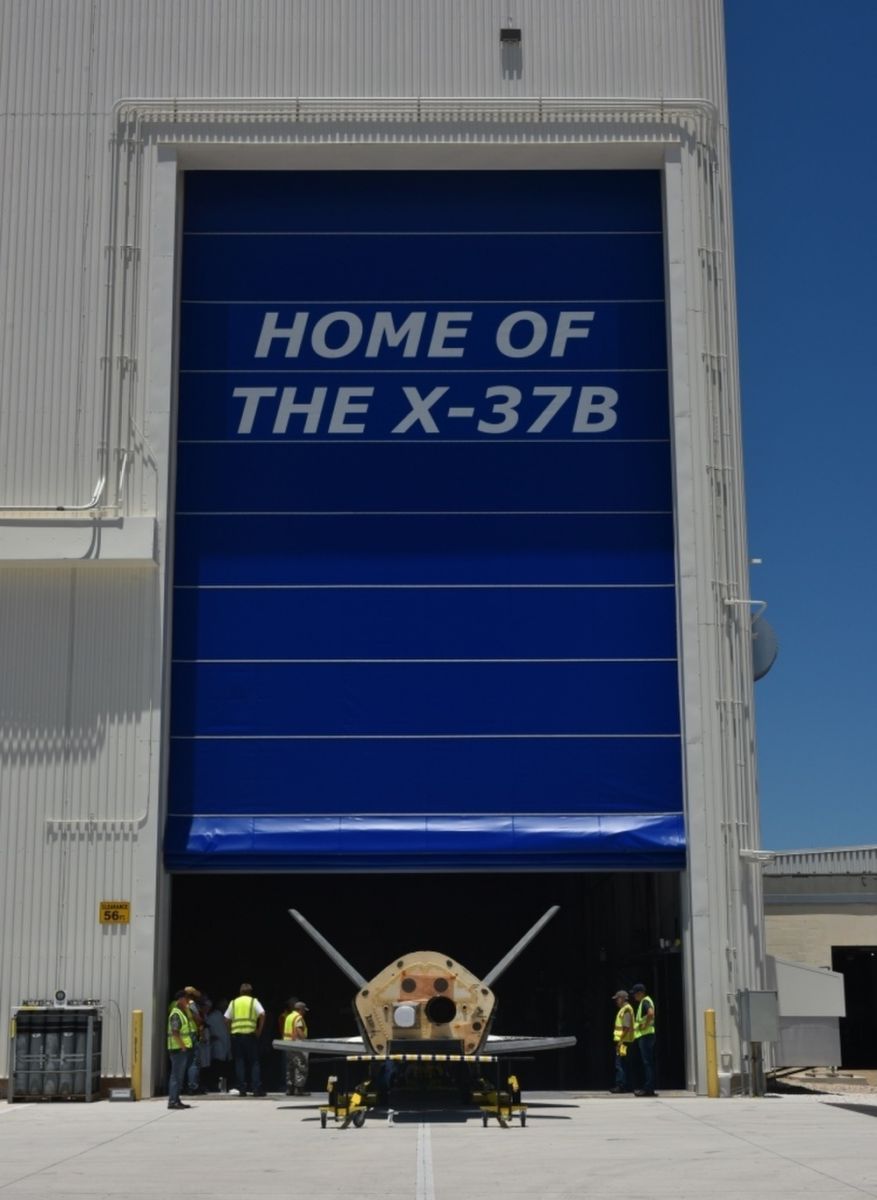
X-37B hangar at Kennedy Space Center.
Credit: Michael Martin/SAF
“With each successive flight, the X-37B has demonstrated adaptability and flexibility by hosting diverse experiments and pioneering new orbital regimes,” said Michelle Parker, vice president of Boeing Space Mission Systems. “This mission continues that legacy by fielding cutting-edge technologies that advance our nation’s space capability and improve the resilience of future architectures.”
Since its inaugural launch in April 2010, the spaceplane program (a fleet of two vehicles) has chalked up more than 4,200 days in space.

Image credit: Gilmour Space Technologies
Ooops!
Gilmour Space Technologies carried out on July 30 the maiden test launch of Australia’s first locally designed and built orbital rocket.
But the 23-meter, 30-tonne Eris rocket — powered by new hybrid propulsion technology — faltered roughly 14 seconds after liftoff from the Bowen Orbital Spaceport in North Queensland, crashing to the ground.
“Space is hard,” said Adam Gilmour, CEO of Gilmour Space Technologies.

Image credit: Gilmour Space Technologies/Inside Outer Space screengrab
Flight data
“Initial data confirms that key systems performed well until the anomaly, including ignition, liftoff, first-stage thrust, range tracking and telemetry,” according to a post-failure statement.
“The team is now reviewing flight data to understand the cause of the anomaly that led to early termination, with lessons already being applied to the next vehicle, which is in production.”
Next launch
The TestFlight 1 mission was a product of years of effort by a team of more than 200 people, over 500 Australian suppliers, and assistance from government and industry.
“The team will now review flight data and apply lessons learned to the next Eris rocket, with plans to launch again within 6-8 months,” the company statement adds.
Go to video of flight at:
https://video.wixstatic.com/video/71c469_f8182dbf5c26468386e7cfd8345fa805/1080p/mp4/file.mp4
SpaceX Update: Starship moved to the launch site at Starbase in Texas for preflight testing:

Image credit: SpaceX

Image credit: SpaceX

Image credit: SpaceX

Image credit: SpaceX

Image credit: Roscosmos
Russia’s Dmitry Bakanov, the Director of Roscosmos, is scheduled to meet with Acting NASA Administrator Sean Duffy to discuss the cross-flight program and the future of the International Space Station.

Acting NASA Administrator Sean Duffy.
Image credit: NASA/Bill Ingalls
This is the first face-to-face meeting between the heads of Russian and US space agencies in eight years, according to a Roscosmos posting.
During his U.S. trek, Bakanov is to visit the NASA Johnson Space Center and tour Boeing’s manufacturing facilities where the CST-100 Starliner is being developed.
Bakanov will be meeting the Crew-11 mission team that includes Roscosmos cosmonaut Oleg Platonov. The launch is no earlier than July 31.
Other members of the SpaceX Crew-11 mission are NASA astronauts Zena Cardman, Mike Fincke, and Japan Aerospace Exploration Agency astronaut Kimiya Yui.
SpaceX Crew-11 mission (left to right) are Roscosmos cosmonaut Oleg Platonov NASA astronauts Mike Fincke, Zena Cardman, and Japan Aerospace Exploration Agency astronaut Kimiya Yui.
Image credit: NASA

