Archive for the ‘Space News’ Category
 Author:
  May 21st, 2015
Up for grabs? Future use of asteroids.
Credit: Texas A&M
The U.S. Congressional Budget Office has taken a look at House Resolution 1508 – the Space Resource Exploration and Utilization Act of 2015.
That bill would establish certain policies and guidelines regarding the development of space resources by nonfederal entities.
Existing international agreements authorize such activities under certain conditions, including requirements for national regulatory regimes to resolve liability, ownership, and operational issues.
The bill would create a domestic framework for assigning property rights for resources from asteroids and for settling any related legal disputes.
CBO estimates that implementing H.R. 1508 would cost about $1 million over the 2016-2020 period.
CBO anticipates that developing a policy framework for this nascent industry would require levels of expertise and effort similar to that of previously done studies by expert policy panels.
Go to:
http://www.cbo.gov/sites/default/files/114th-congress-2015-2016/costestimate/HR_1508.pdf
 Posted in

This image was taken by Curiosity’s Navcam: Left B on May 20, Sol 990.
Credit: NASA/JPL-Caltech
NASA’s Curiosity Mars rover is wheeling about trying to deal with challenging terrain.
The rover team has decided to drive uphill to avoid crossing sandy ripples near Jocko Butte, explains Lauren Edgar, a research geologist at the U.S. Geological Survey’s (USGS) Astrogeology Science Center in Flagstaff, Arizona.

Curiosity’s Navcam: Left B snagged this scene on May 20, Sol 990.
Credit: NASA/JPL-Caltech
As a member of the Mars Science Laboratory’s science team, Edgar explains on Sol 990, Curiosity drove over 170 feet (53 meters) back towards Mt. Shields.
“Hopefully the climb will give Curiosity a good workout,” Edgar adds, “and we’ll get to see some exciting features when we get there!”
After the drive the Mars machinery is set to acquire some standard imaging to help with future targeting.

This image was taken by Mastcam: Left onboard NASA’s Mars rover Curiosity on May 20, Sol 990.
Credit: NASA/JPL-Caltech/MSSS
Curiosity has been wheeling and dealing with Mars since its landing in August 2012.

Curiosity Mars rover snapped this image from its Front Hazcam: Right B on May 19, Sol 989.
Credit: NASA/JPL-Caltech

Credit: ULA
This week the U.S. Air Force’s Rapid Capabilities Office is set to launch the fourth mission of the X-37B Orbital Test Vehicle – the military’s secretive robotic space plane.
The United Launch Alliance (ULA) Launch Readiness Review was completed yesterday and everything is progressing toward the AFSPC-5 launch for the Unites States Air Force – lofting the space plane into Earth orbit.
Weather improving

Previous mission photo shows launch processing of a Boeing-built X-37B Orbital Test Vehicle.
Credit: Boeing
The mission is set to liftoff on a ULA Atlas V rocket on Wednesday, May 20 from Space Launch Complex 41 at Cape Canaveral Air Force Station in Florida.Yesterday’s L-2 forecast has improved and now shows a 60 percent chance of favorable weather conditions for launch. The launch period is 10:45 a.m. – 2:45 p.m. Eastern.
For a look at the political/policy discussion regarding the Air Force space plane, go to:
What Will the X-37B Military Space Plane Do on Its Next Mystery Mission?
by Leonard David, Space.com’s Space Insider Columnist
May 19, 2015 07:00am ET
http://www.space.com/29442-x37b-space-plane-fourth-mission.html
Also, check out the Atlas V AFSPC-5 mission overview video, posted here:

A third mission of the Boeing-built X-37B Orbital Test Vehicle was completed on Oct. 17, 2014, when it landed and was recovered at Vandenberg Air Force Base in California following a successful 674-day space mission. The upcoming space plane flight – on the program’s fourth mission — may land at the Kennedy Space Center in Florida.
Credit: Boeing
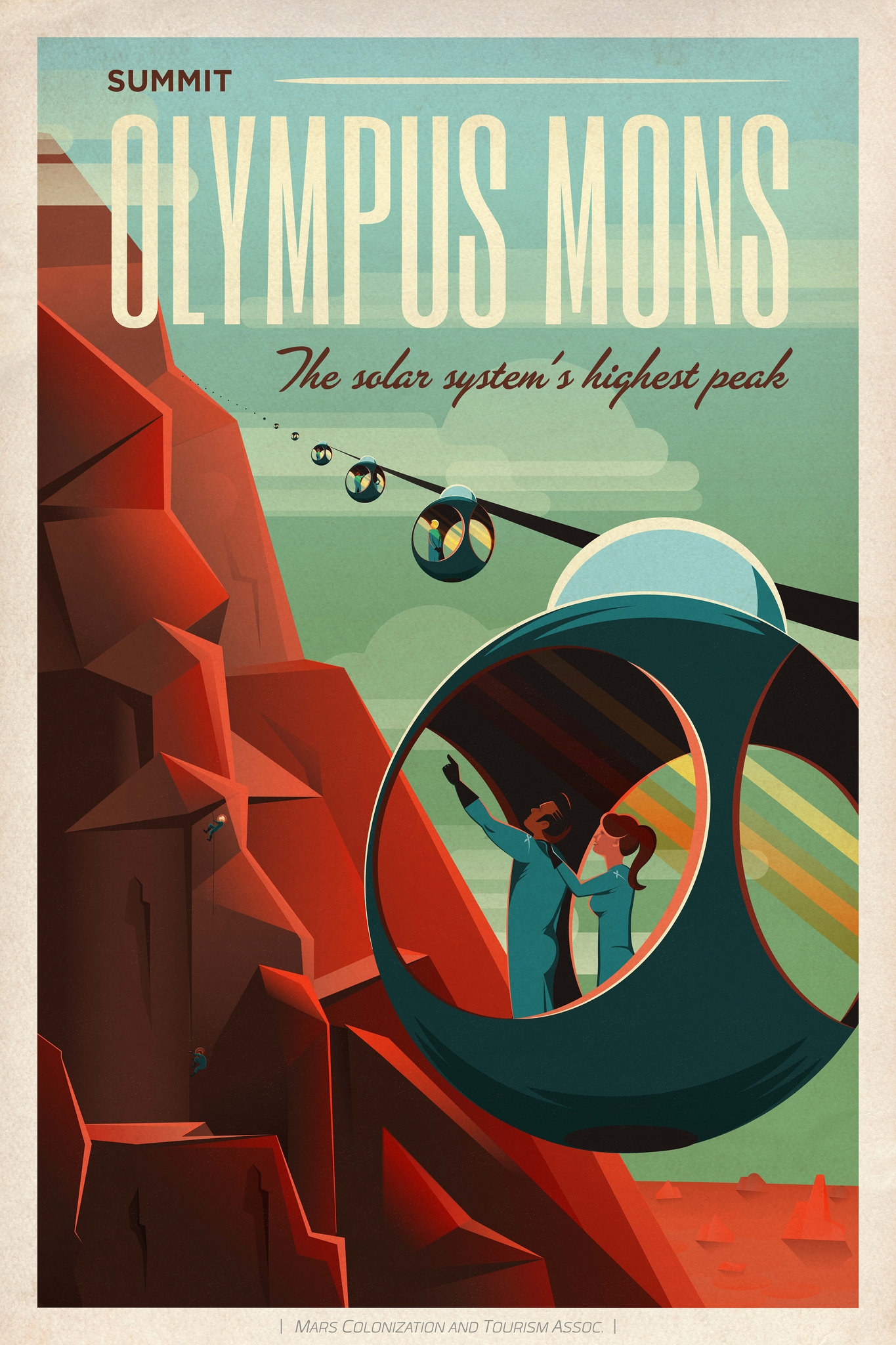
Credit: SpaceX
A set of posters has been issued by Elon Musk’s SpaceX underscoring the company’s “belief that a future where humanity is out exploring the stars is fundamentally more exciting than one where we are not,” as their website explains.
SpaceX is actively developing the technologies to make this possible, with the ultimate goal of enabling human life on Mars.
SpaceX designs, manufactures and launches advanced rockets and spacecraft. The company was founded in 2002 to revolutionize space technology, “with the ultimate goal of enabling people to live on other planets.”

Credit: SpaceX
Multi-planetary
Musk, as SpaceX’s CEO and Chief Designer, makes an argument for making life multi-planetary and going to Mars.
Go to this video:
https://www.youtube.com/watch?v=Ndpxuf-uJHE
For a look at the SpaceX Mars posters, go to:
https://www.flickr.com/photos/spacexphotos/
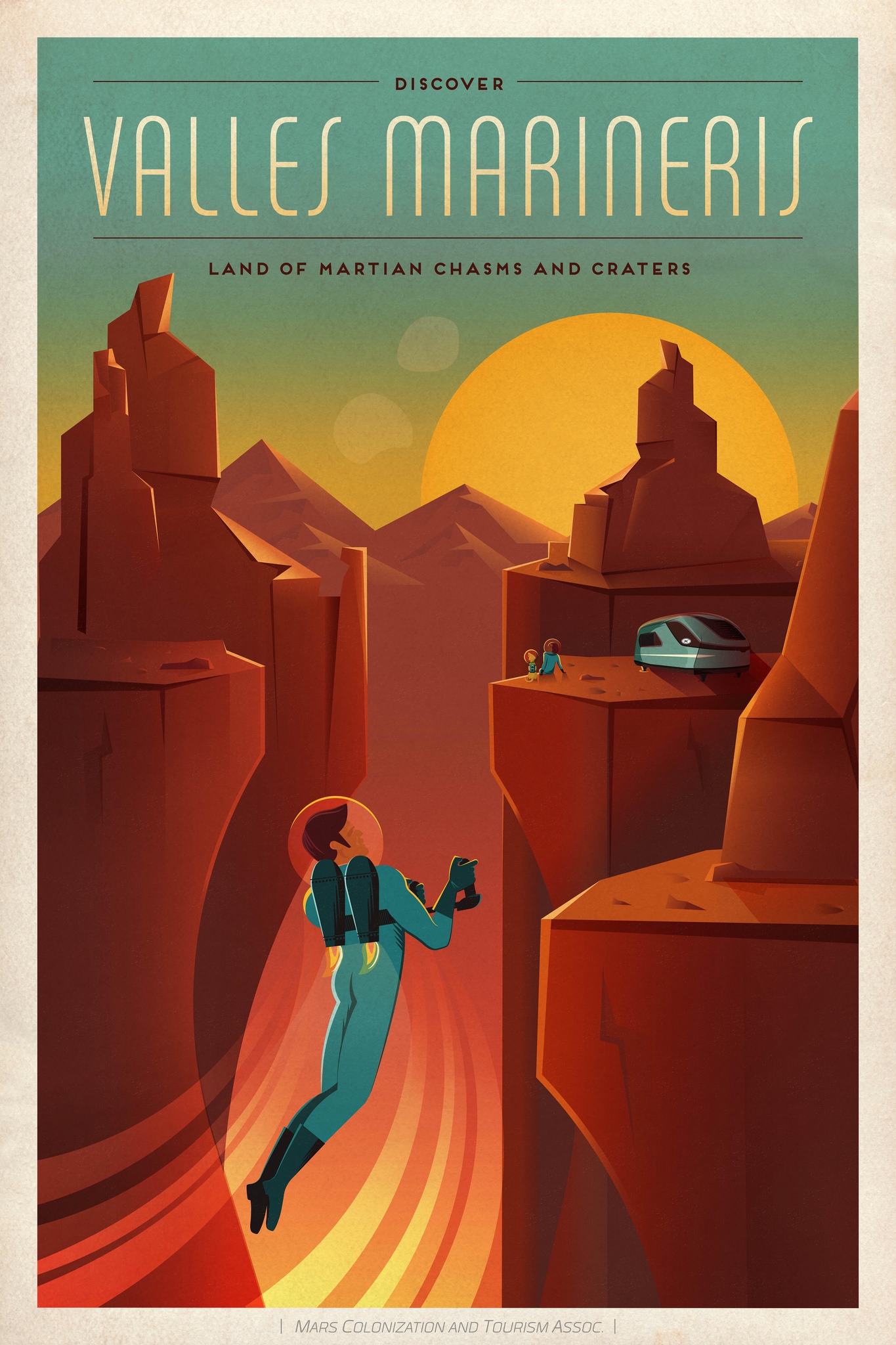
Credit: SpaceX

Curiosity image taken by the robot’s Front Hazcam: Left B on May 14,Sol 984.
Credit: NASA/JPL-Caltech
NASA’s Curiosity rover is experiencing excessive wheel slippage. So much so that controllers of the Mars machinery are studying new driving tactics.
Also, the rover is tilted 21 degrees, “the highest tilt of the mission so far,” explains Ken Herkenhoff of the U.S. Geological Survey’s Astrogeology Science Center in Flagstaff, Arizona.
Curiosity is on the flank of a small ridge on the Red Planet. The vehicle is high enough on the ridge, Herkenhoff notes, that the terrain to the southwest is visible in rover images.

Image from tilting Curiosity rover, taken by Navcam: Left B on May 14 on Sol 984.
Credit: NASA/JPL-Caltech
That new imagery will allow more complete evaluation of a traverse in that direction, he adds.
Autofocus software
A Sol 985 plan for Curiosity includes use of the Laser-Induced Remote Sensing for Chemistry and Micro-Imaging (ChemCam) instrument to observe a nearby rock called “Una” – to evaluate newly-installed ChemCam autofocus software.
“Of course we are hoping this test goes well and that ChemCam will return to more normal operations soon,” says Herkenhoff.
The rover’s Mastcam is also set to observe Una, as well as the ripples and small rocks near the rover, and outcrops toward the south.

Credit:
International Space Business Council, 2015
A new book offers the most in-depth source for understanding and finding a career in the space and satellite industry.
This book is designed for high school, college, and graduate students and job seekers of all ages.
It is my pleasure to announce the release of Space Careers, a completely-updated and revised version of the 1998 award-winning classic: Guide to Space Careers.
Fully-updated for 2015, the book is specially written for job seekers interested in the opportunities that the space and satellite industry present. Whether the reader is interested in satellite communications services, designing next generation rockets, planning future Mars missions, or monitoring the Earth’s environment, Space Careers will be a valued resource.
Career trajectory
Written by longtime space journalist Leonard David, entrepreneur Scott Sacknoff, and with a foreword from astronaut Buzz Aldrin, this award-winning book contains resources that enable the user to understand the varied activities of the industry so they can narrow and determine their areas of interest.
This guide helps you identify university programs and find scholarships and fellowships that can finance your career trajectory. It provides details on how and where to network, locate opportunities, and offers hundreds of profiles as well as links to industry organizations.
It does the work so you don’t have to.
But this book offers more than just a compilation of facts and data.
Valuable advice
Throughout the book you will find valuable advice to students and job seekers provided by leading industry professionals including Marillyn Hewson, the President & CEO of Lockheed Martin; Charles Bolden, the administrator of NASA; as well as engineers, scientists, and businesspeople working in the field.
Space Careers is a resource that needs to be shared, read, and used by students, educators, and people working in the STEM/STEAM fields [Science, Technology, Engineering, [Art] & Mathematics]. With the space industry seeking to identify and entice the next generation of workers, companies and institutions, you’ll find this volume a valuable resource.
For more details including bios of the authors, the table of contents, and ordering information, please visit:
Space Careers
By Leonard David and Scott Sacknoff
Foreword by Buzz Aldrin
International Space Business Council, 2015
ISBN: 978-1-887022-19-4
Retail Price: $20 USD
Pages: 224, trade paper

Credit: ECN
The big space question of today: Can future generations ever be as excited about space as past generations?
To look for the answer, take in this episode of “Engineering Live” offered by Electronic Component News (ECN).
The premise of this video is that the 1960s were arguably the most fascinating time in the world of space.
According to ECN, Sputnik had been launched just a few years prior and the entire decade ended with the first Moon landing. So what happened?
Despite surges in enthusiasm during the Curiosity Mars rover landing and flashes of obsession with superstar astronauts on the International Space Station, ECN explains that the excitement has waned in generations born after the Space Race.
In certain circles, ECN contends, the final frontier is revered as the next great Wild West, but it’s barely discussed by the general public. So what happened to the enthusiasm for space exploration? How are future generations encouraged? What are the benefits to a strong space program?
Expert panel
Listen to these panelists, moderated by Kasey Panetta, Editor of ECN:
— Rebecca Spyke, Director of International Science & Engineering at The National Science Foundation
— Elizabeth Bierman, President of the Society of Women Engineers and senior project engineer at Honeywell Aerospace
— Mamta Patel Nagaraja, Science Communications, NASA Science Mission Directorate
Recorded on May 1st, go to:
http://www.ecnmag.com/videos/2015/05/engineering-live-what-happened-our-fascination-space-demand

NASA’s Opportunity long-lived Mars rover used its Navigation Camera on Sol 4014 to image this feature.
Credit: Credit: NASA/JPL-Caltech/Cornell Univ./Arizona State Univ.
NASA’s veteran Mars rover – Opportunity – is taking in a perplexing geological feature on the Red Planet.
An elongated, shallow crater dubbed “Spirit of St. Louis” has a rock “spire” within the crater. The rocky feature toward the far end of the crater is about 7 to 10 feet (2 to 3 meters) tall, rising higher than the crater’s rim.
The Spirit of St. Louis Crater is unusually shaped and lies on the outer portion of the western rim of Endeavour Crater.
Endeavour spans about 14 miles (22 kilometers) in diameter, and Opportunity has been exploring its western rim for about one-third of the rover’s mission – which has lasted more than 11 years.
Opportunity has been on the prowl since early 2004.

Credit: NASA/JPL-Caltech/Cornell Univ./Arizona State Univ.
Volcanic neck?
Regarding the strange spire, it has been named “Lindbergh Mound” since it is in the Spirit of Saint Louis Crater, said Ray Arvidson, Mars Exploration Rover (MER) deputy principal investigator at Washington University in St. Louis.
“Several hypotheses are open right now,” Arvidson told Inside Outer Space, such as a mound of secondary debris by ejecta from some crater.

On the Opportunity trail!
Opportunity’s traverse map through Sol 4000
Total odometry as of Sol 4003 is 26.25 miles (42.25 kilometers).
Credit: NASA/JPL/Cornell/University of Arizona
The feature could be a volcanic neck or spire, Arvidson said, or perhaps an odd erosional relict representing more resistant materials within the crater.
“All are open right now and we are doing measurements on outcrops in and on the rim of the crater to help sort them out,” Arvidson concluded.

Former NASA Administrator, Sean O’Keefe, took part in discussions regarding the future of space activities in May 11 program held by the Center for Strategic and International Studies (CSIS).
Credit: CSIS
What’s the future of NASA and the global space community? What direction in space will the U.S. military take in the coming years?
These and many other issues were discussed for nearly one-and-a-half hours on May 11, thanks to presentations at the Center for Strategic and International Studies (CSIS) in Washington, D.C.
On stage: Sean O’Keefe, former Administrator of NASA (2001-2004), and General James Cartwright, former vice chairman of the Joint Chiefs of Staff.

General James Cartwright, Former Vice Chairman of the Joint Chiefs of Staff.
Credit: CSIS
The easy chair discussion was moderated by Dr. John Hamre, President and CEO of CSIS.
The discussion focused on new challenges the U.S. faces in maintaining its strategic advantage in space, and the implications of privatization for the future of U.S. leadership and innovation in civil space.
For a complete video replay, go to:
https://www.youtube.com/watch?v=YWhQ7jvX4BM
To listen to an audio recording, go to:
http://csis.org/multimedia/audio-us-strategy-civil-and-military-space

Credit: ULA
Workers are readying the Air Force X-37B space plane for its May 20 liftoff.
Known as the Air Force’s AFSPC-5 payload, the winged craft has been encapsulated inside a 5-meter diameter payload fairing. It was then mated to an Atlas V booster inside the Vertical Integration Facility at Cape Canaveral Air Force Station’s Space Launch Complex-41.
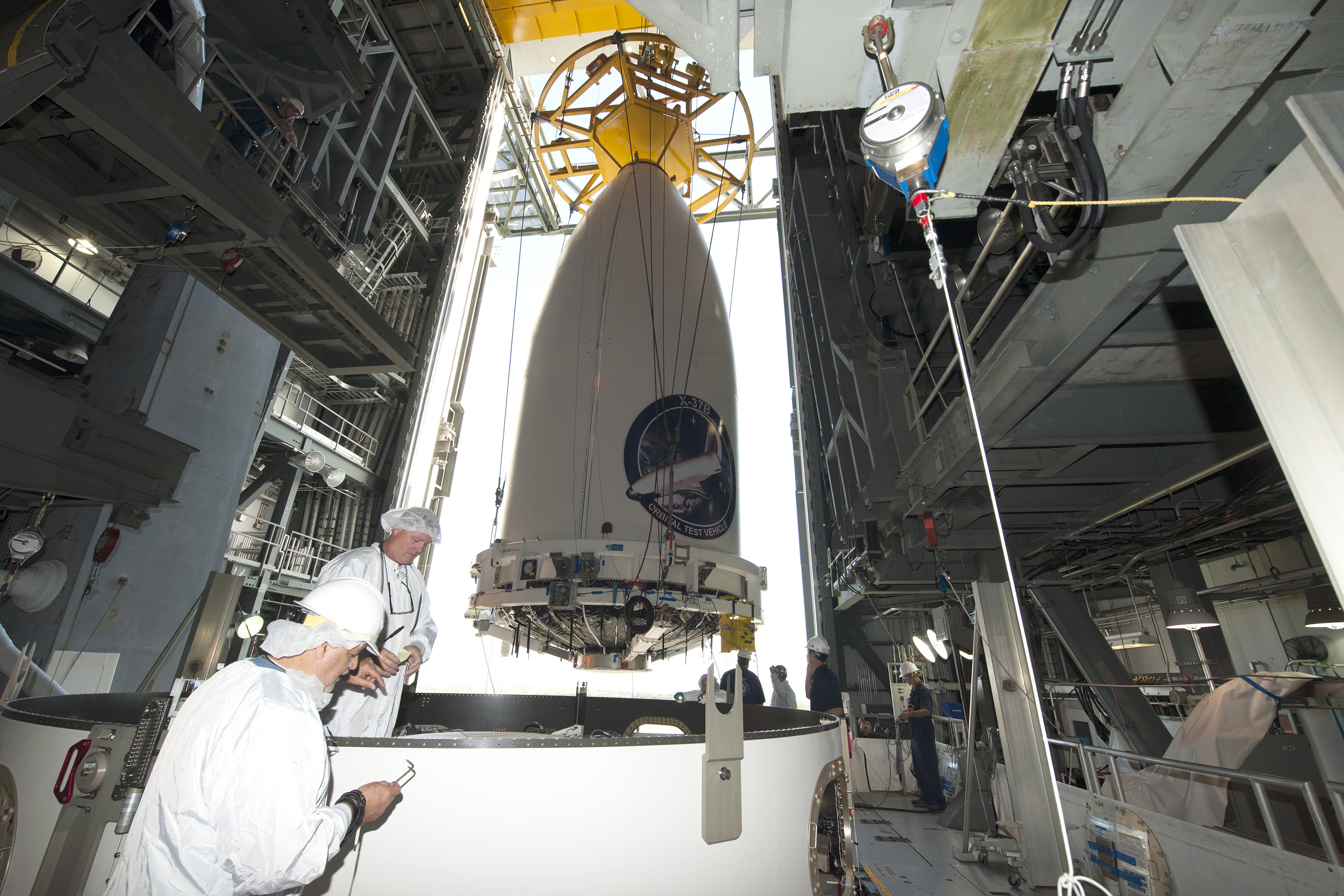
Credit: ULA
As the fourth mission of the secretive X-37B program, there is insight as to a few experiments that are to be conducted during its mission.
Materials exposed to space
NASA’s Materials Exposure and Technology Innovation in Space (METIS) investigation will onboard the X-37B. This experiment involves exposing almost 100 different materials samples to the space environment.
METIS is building on data acquired during the Materials on International Space Station Experiment (MISSE), which flew more than 4,000 samples in space from 2001 to 2013.
Electric propulsion
Another payload onboard the space plane is a Hall thruster experiment.
It is a type of electric propulsion device that produces thrust by ionizing and accelerating a noble gas, usually xenon. While producing comparatively low thrust relative to conventional rocket engines, Hall thrusters provide significantly greater specific impulse, or fuel economy.
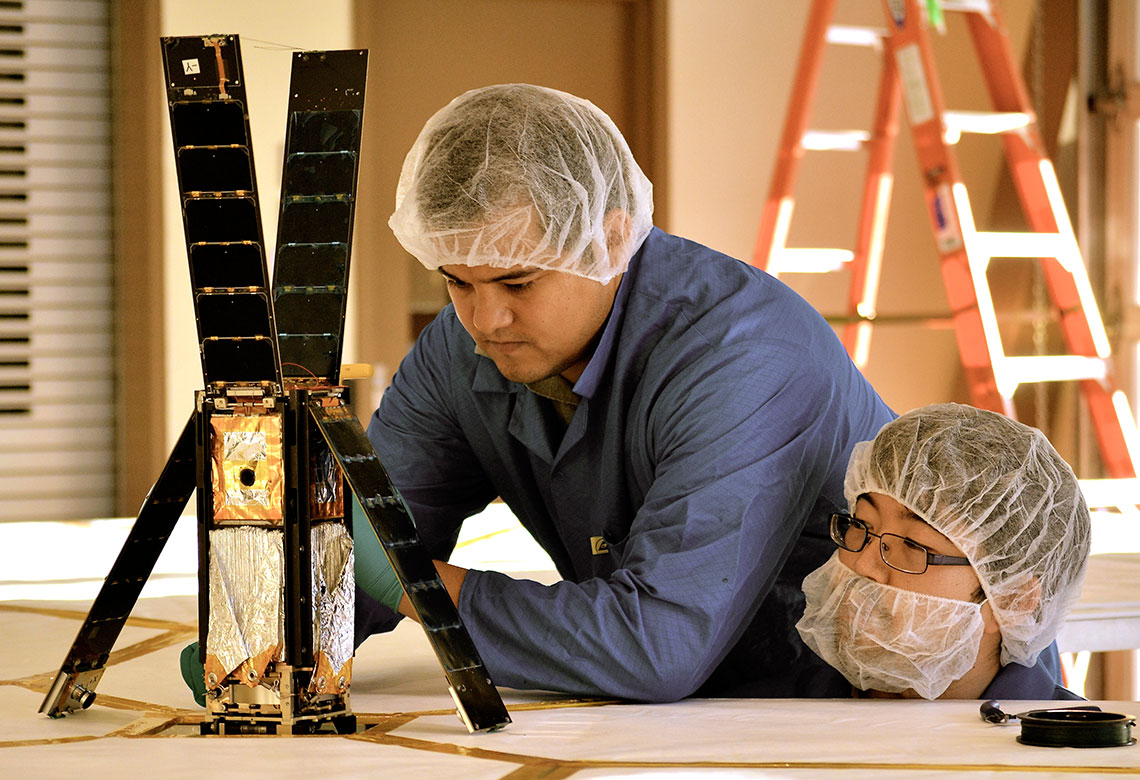
LightSail team members Alex Diaz (left) and Riki Munakata (right) prepare the spacecraft for a sail deployment test.
Credit: The Planetary Society
LightSail
Also part of the AFSPC-5 payload that’s hitchhiking its way into space is the Planetary Society’s LightSail.
This CubeSat is about the size of a loaf of bread.
According to the Planetary Society, once in space, LightSail’s solar arrays will swing open, revealing the inside of the spacecraft. Four tape measure-like metal booms slowly unwind from storage, unfolding four triangular, ultra-thin Mylar sails.
An informative Planetary Society LightSail video can be viewed at:

