Archive for the ‘Space News’ Category
 Author:
  July 1st, 2015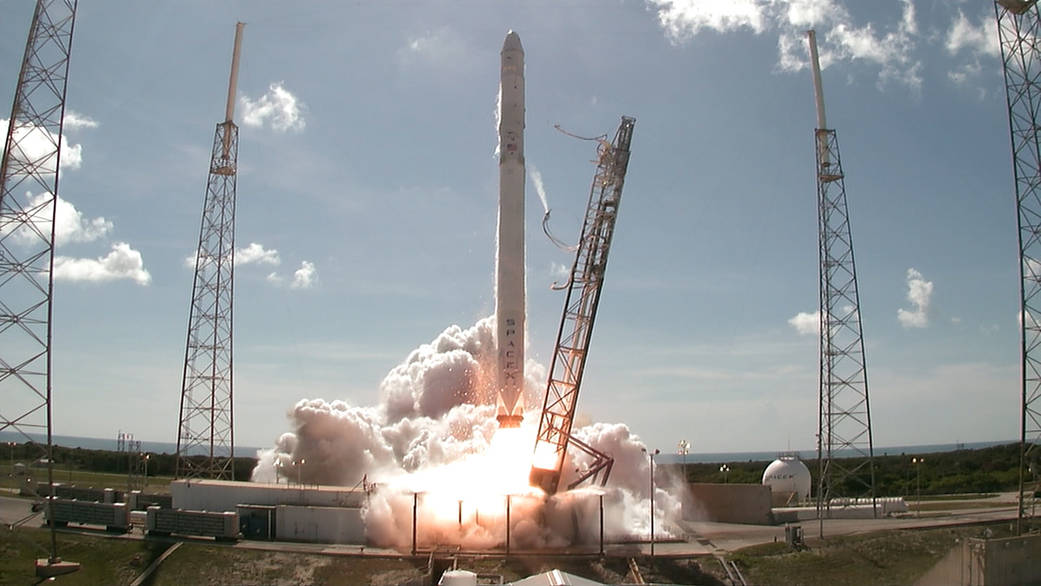
A SpaceX Falcon 9 rocket lifts off from Space Launch Complex 40 at Cape Canaveral Air Force Station. The Falcon 9 launched on time at 10:21 a.m. EST. After liftoff, an anomaly occurred. SpaceX is evaluating the issue.
Credit: NASA
Here’s a new story from me on the recent loss of the SpaceX Falcon 9 booster:
The June 28 failure of the commercial SpaceX Falcon 9 has put a dent in the rocket’s impressive track record. Whatever the root cause of the malfunction, fixing the problem, and returning to flight is paramount to fulfill billions of dollars launch orders.
There are a number of wait-and-watch ripple effects stemming from the booster catastrophe that are being flagged by space analysts I contacted:
How Will Sunday’s Rocket Explosion Affect SpaceX?
by Leonard David, Space.com’s Space Insider Columnist
July 01, 2015 11:05am ET
http://www.space.com/29822-spacex-rocket-failure-impact.html
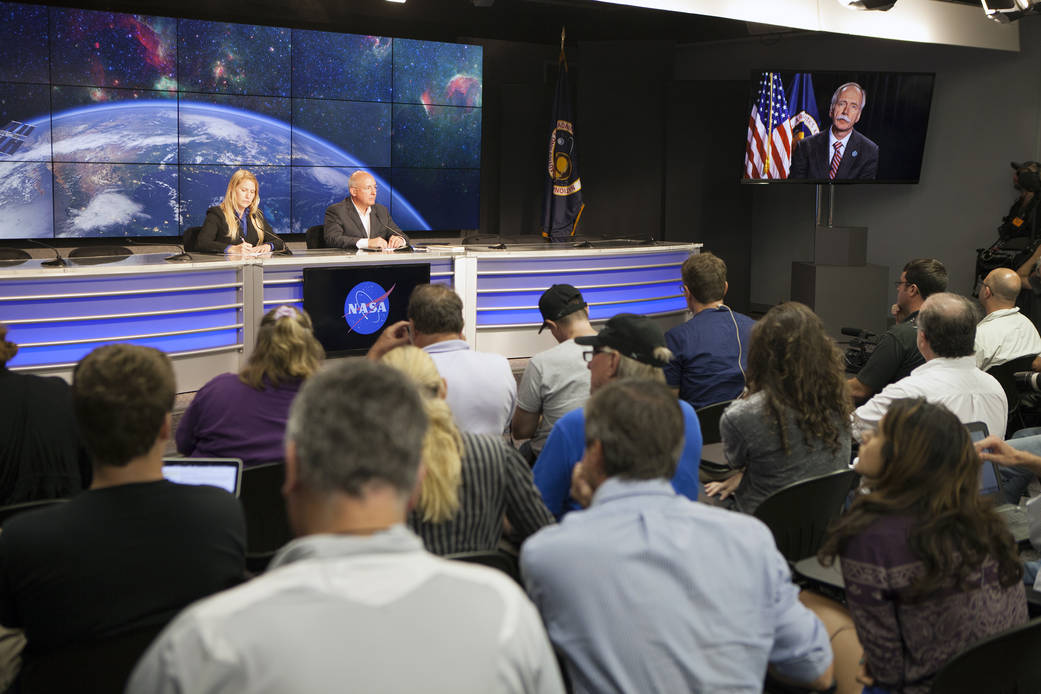
Post-failure press conference.
Credit: NASA
Note: During a post-launch press conference on June 28, mangers from SpaceX, NASA, and the Federal Aviation Administration discussed the mishap following the liftoff of the SpaceX CRS-7 mission from Space Launch Complex 40 at Cape Canaveral Air Force Station. The mission was to deliver supplies, hardware and other important cargo to the International Space Station.
Hans Koenigsmann, vice president of Mission Assurance at SpaceX, is leading the investigation of the cause of the issue.
Participants in the news briefing were:
— Gwynne Shotwell, president and chief operating officer of SpaceX (via phone)
— Bill Gerstenmaier, associate administrator of NASA’s Human Exploration and Operations Mission Directorate (via video from NASA Headquarters)
— Michael Suffredini, NASA’s International Space Station Program manager
— Pam Underwood, deputy division manager, Operations Integration Division, Federal Aviation Administrator.
To view the video, go to:
http://www.nasa.gov/feature/video-nasa-spacex-faa-discuss-launch-failure
 Posted in
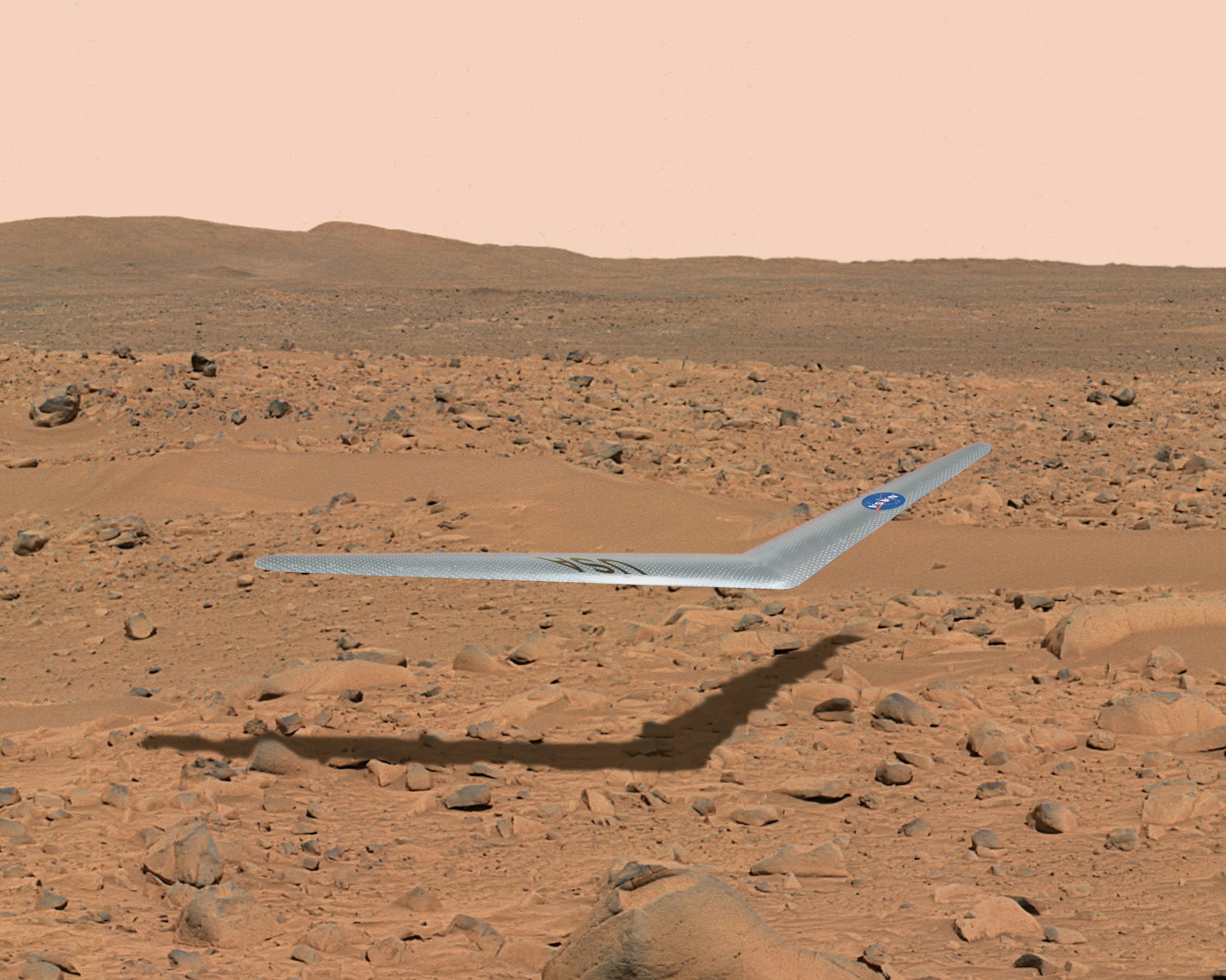
Illustration shows what a Prandtl-m might look like flying above the surface of Mars.
Credits: NASA Illustration / Dennis Calaba
A flying wing may be added to the tool kit for future exploration of the Red Planet.
An early design of such a craft is called the Preliminary Research Aerodynamic Design to Land on Mars, or Prandtl-m.
The concept, quite literally, is under the wing of a research group at NASA’s Armstrong Flight Research Center (AFRC) at Edwards, California.
Prandtl-m is planned to be ready for launch from a high altitude balloon later this year.
The craft would be released at about at 100,000 feet altitude, a sky-high zone that simulates the flight conditions of the Martian atmosphere, said Al Bowers, NASA Armstrong chief scientist and Prandtl-m program manager.
CubeSat deployed
Tests here on Earth are validating how the aircraft works, leading to modifications that will allow it to fold and deploy from a 3U CubeSat in the aeroshell of a future Mars-bound rover.
There is the prospect that the CubeSat could find its way onboard the aeroshell/Mars rover piggyback stack for Red Planet exploration in 2022-2024.
Once deployed from the CubeSat, Bowers said that Prandtl-m would stretch its wings and fly in the Martian atmosphere, gliding down and coming to full stop atop the Martian landscape.
“It would have a flight time of right around 10 minutes. The aircraft would be gliding for the last 2,000 feet to the surface of Mars and have a range of about 20 miles,” Bowers said. The aircraft’s wingspan, when deployed, would measure 24 inches and weigh less than a pound, he said.
Landing site verification
The Prandtl-m could zoom over some of the proposed landing sites for a future crewed Mars mission, Bowers said, “and send back to Earth very detailed high resolution photographic map images that could tell scientists about the suitability of those landing sites,” Bowers noted in an AFRC press release.

Air time on Earth. The proposed Prandtl-m — “m” for Mars — is based on the Prandtl-d seen coming in for a landing during a flight test in June. The aerodynamics offer a solution that could lead to the first aircraft on Mars.
Credits: NASA Photo / Ken Ulbrich
The Flight Opportunities Program, which is managed at NASA Armstrong, has agreed to fund two balloon flights during the next several years and potentially a sounding rocket flight following that to demonstrate how the flier would work on Mars, Bowers said.
Sounding rocket test
Riding on a sounding rocket, the prototype Mars wing, packed inside a CubeSat, would be released at 450,000 feet.
Falling back into the Earth’s atmosphere as it approaches the 110,000-to-115,000-feet altitude range, the glider would deploy just as though it was over the surface of Mars.
“If the Prandtl-m completes a 450,000-foot drop, then I think the project stands a very good chance of being able to go to NASA Headquarters and say we would like permission to ride to Mars with one of the rovers,” Bowers said.
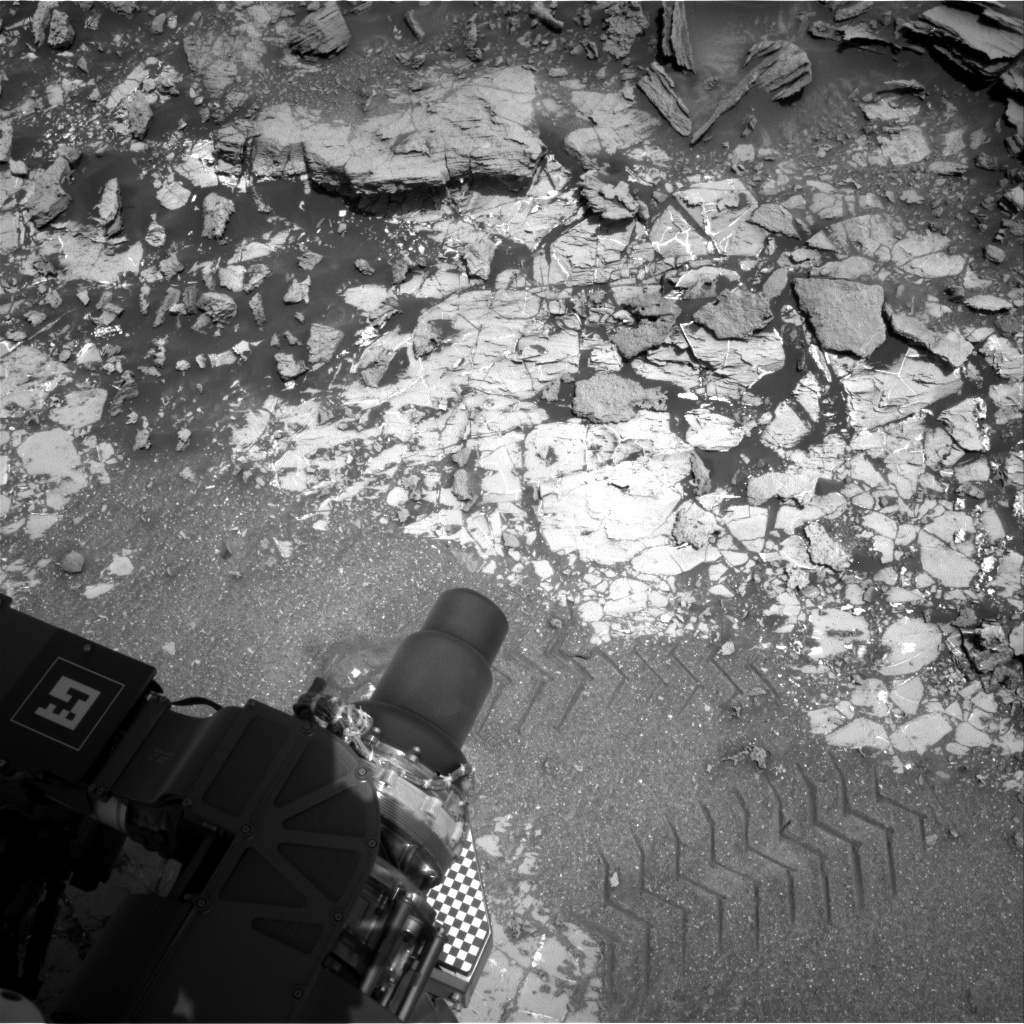
NASA’s Curiosity Mars rover is eyeing “Missoula” – a target that’s a ledge in the upper left portion of this Navcam image.
Credit: NASA/JPL-Caltech
NASA’s Curiosity Mars rover is busy imaging a number of targets – one of which is called “Missoula.”
“We refer to it as a dog’s eye mosaic, meaning that we use the MAHLI camera to take a series of images along a vertical face – essentially sticking our nose in there to get a good view,” Edgar explains.
The Mars Hand Lens Imager (MAHLI) is located on the turret at the end of the rover’s robotic arm.
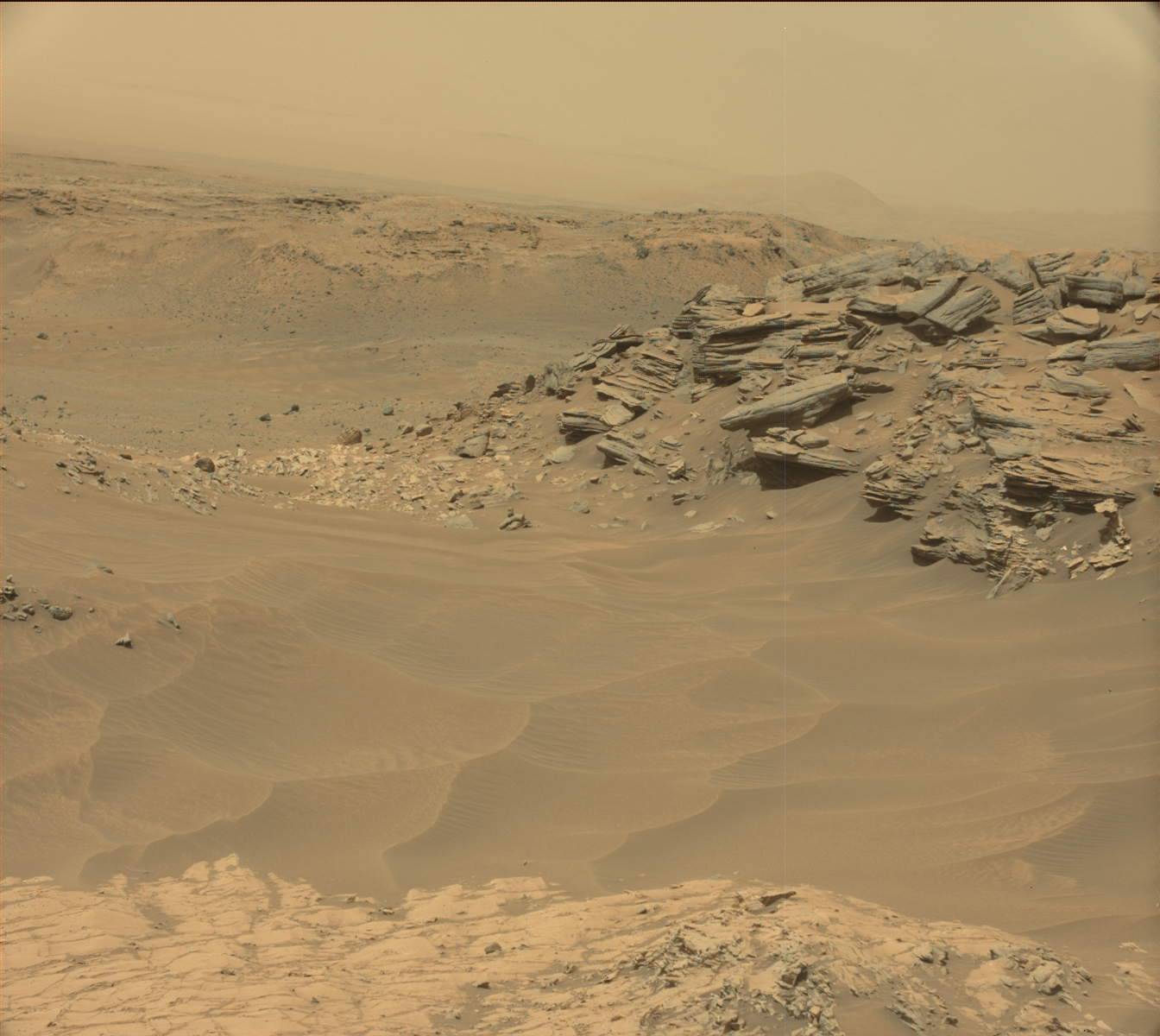
Mars as seen from
Curiosity rover on May 30.
Credit: NASA/JPL-Caltech/MSSS
Edgar says that the current plan for rover duties also includes several ChemCam observations along such targets as “Selow” and “Clark.”
Doing so would characterize any changes in chemistry from two geological units: the Pahrump unit into the Stimson unit, Edgar adds.
Another ChemCam assessment is focused on the target “Seeley” – a broken rock that exposes a fresh surface.

Mars Hand Lens Imager (MAHLI) image taken on June 28, Sol 1028. MAHLI is located on the turret at the end of the rover’s robotic arm.
Credit: NASA/JPL-Caltech/MSSS
Lastly, a Mastcam mosaic is to capture some of the surrounding mineral veins that Curiosity is exploring.
Planning is underway for working the rover during its Sol 1032.
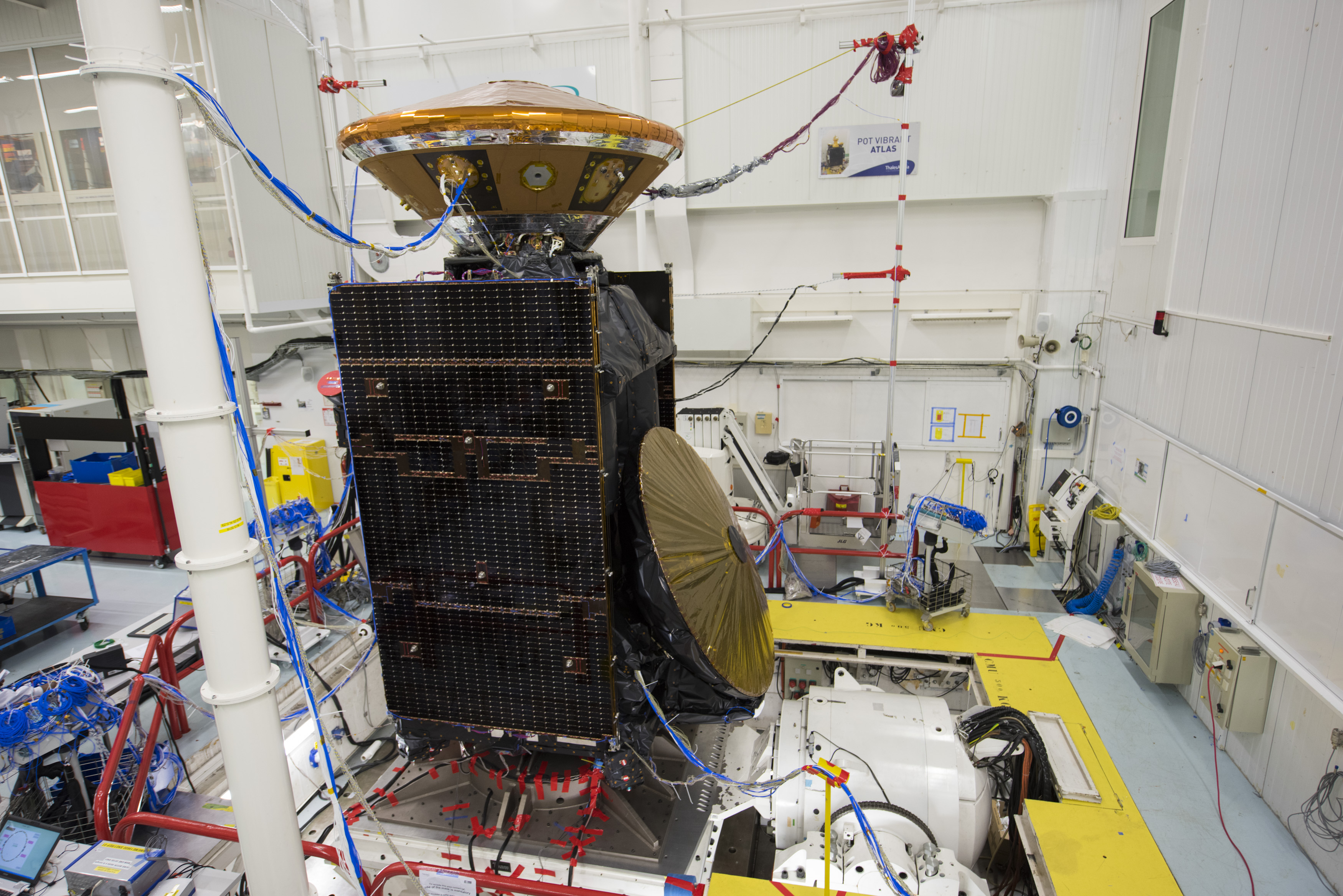
ESA’s ExoMars Trace Gas Orbiter (TGO) and Schiaparelli, also known as the ExoMars Entry, descent and landing Demonstrator Module are seen here during vibration testing at Thales Alenia Space, in Cannes, France.
Credit: ESA–S. Corvaja, 2015
Europe’s ExoMars spacecraft is almost complete for launch next year. ExoMars 2016 is nearing construction in its clean room at Thales Alenia Space in France.
The Mars-bound mission is a joint effort between the European Space Agency (ESA) and Russia’s Roscosmos. That sojourn consists of a Trace Gas Orbiter plus an Entry, Descent and Landing Demonstrator Module (EDM) called Schiaparelli.
ExoMars 2016 launch window is January 7-27 with the Orbiter and EDM hurled Marsward on a Russian Proton rocket. The two elements will fly to the Red Planet in a mated configuration.
Search for methane
The main objectives of this mission are to search for evidence of methane and other trace atmospheric gases that could be signatures of active biological or geological processes.
In addition, ExoMars 2016 will evaluate key technologies in preparation for ESA’s contribution to subsequent missions to Mars.
The orbiter itself will circle Mars to image surface features and study the composition of the atmosphere. The Trace Gas Orbiter will also serve as a data relay asset for the 2018 rover mission of the ExoMars program and until the end of 2022.

Prelude to Mars rover
ExoMars 2016 will send back information about the Martian atmosphere and the lander’s findings.
This information will inform the follow-on second part of the mission in 2018.
In that time period, a landed European rover will drill into the Martian surface, down some six feet (two meters) deep.
The rover will be trying to detect traces of organic molecules that indicate the presence of past or present life on Mars.
NOTE: ESA has issued an informative video on the upcoming 2016 mission and the 2018 rover, available here:

Phobos base concept.
Credit: New Space/ Mary Ann Liebert, Inc., publishers.
A new, cost-constrained U.S. strategy to send humans on Mars has been blueprinted.
The study team believes placing a crew on the Red Planet could be achieved within projected NASA budgets by minimizing new developments and relying mainly on already available or planned NASA assets.
This important study has been published in New Space, a peer-reviewed journal from Mary Ann Liebert, Inc., publishers.
“A Minimal Architecture for Human Journeys to Mars,” has been authored by a trio of experts from the Jet Propulsion Laboratory (JPL)/California Institute of Technology in Pasadena, California.
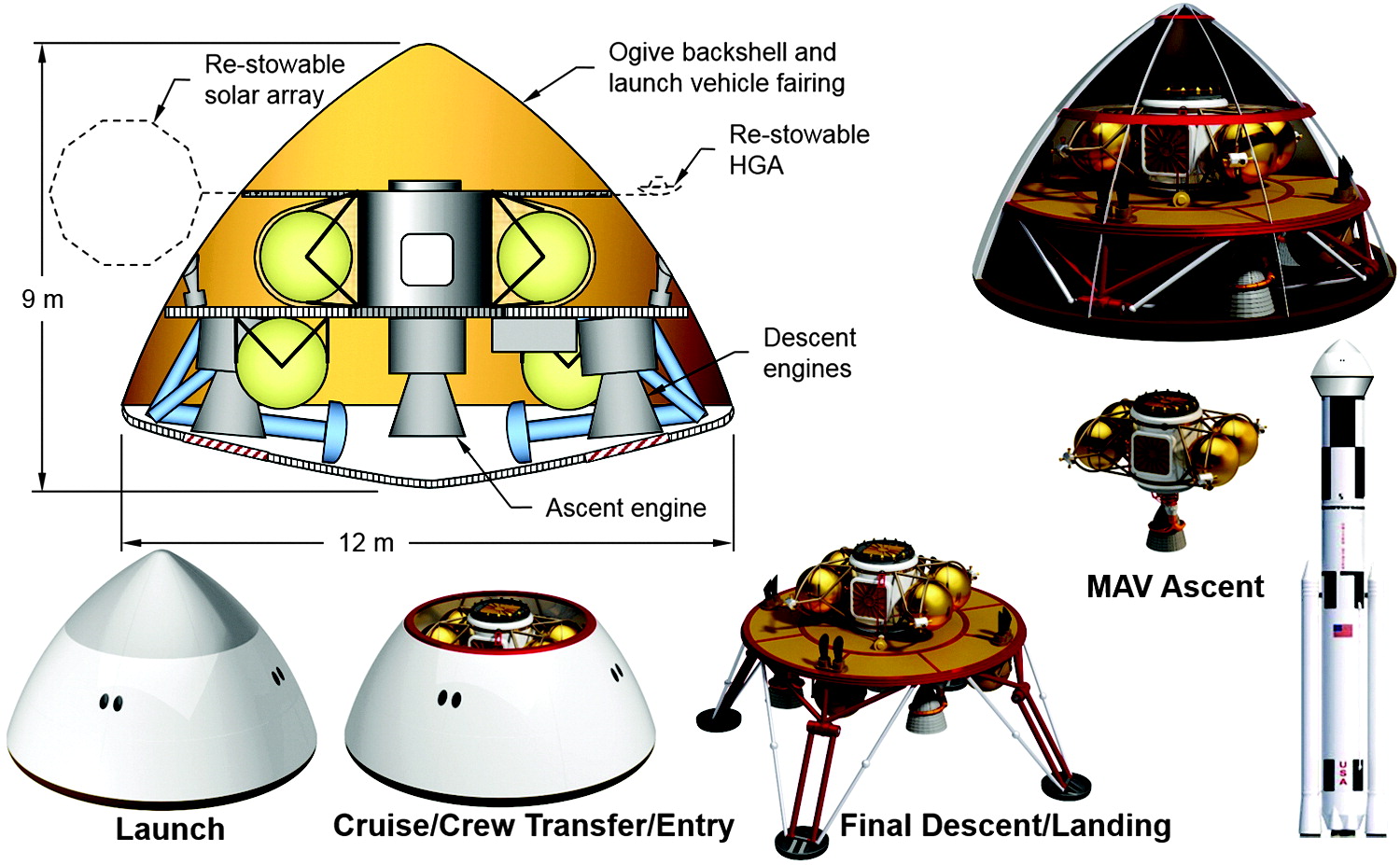
Credit: New Space/Mary Ann Liebert, Inc., publishers
They propose a long-term, stepwise series of missions to Mars that would begin with a crew landing on Mars’s moon Phobos in 2033, and followed by a short-stay mission in 2039 and a year-long landing in 2043.
In addition, the study is augmented by an informative editorial, “We Can Send Humans to Mars Safely and Affordably,” authored by New Space editor-in-chief, G. Scott Hubbard of Stanford University.
“With all of these previous technical and fiscal issues addressed, we can again believe that the dream of sending people to Mars is alive,” Hubbard writes. “The next step is to build a broad consensus around the goal and strategy for a long term, humans to Mars program.”
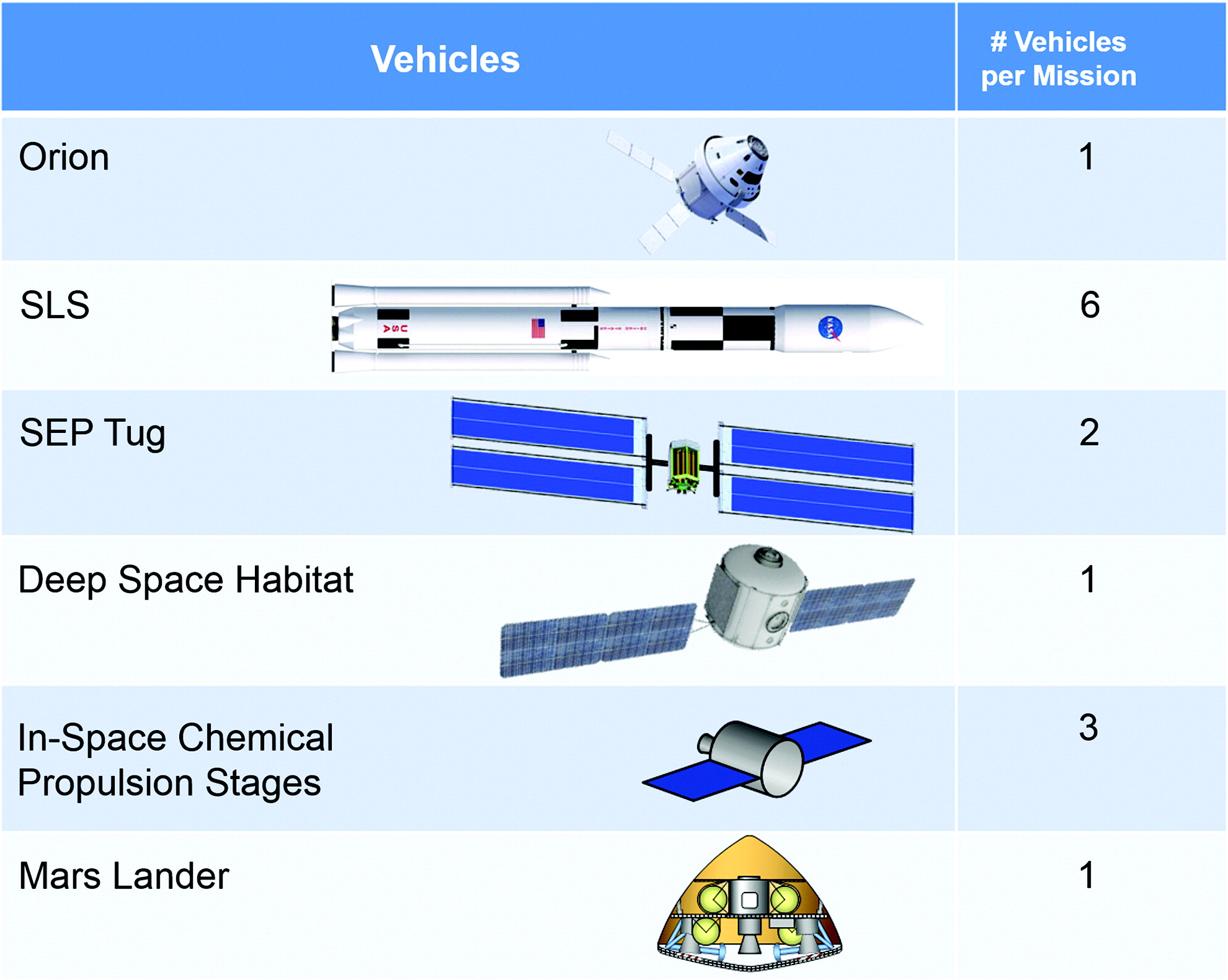
Credit: New Space/Mary Ann Liebert, Inc., publishers
The hope is that the ideas and principles introduced — in whole or in part — can be a useful input to the process of structuring an implementable human journey to Mars in our lifetime.
NOTE: Both the editorial and the detailed paper are available free on the New Space website until July 29, 2015.
Go to:

Opportunity’s Panoramic Camera imaged this area on Sol 4059.
Credit: NASA/JPL-Caltech/Cornell Univ./Arizona State Univ.
Word from ground controllers is that the Opportunity Mars rover is in good health after communication blackout.
The Earth-Mars Solar Conjunction command moratorium and communication blackout has ended. Telemetry is again being received from Opportunity. Normal tactical planning has resumed with the Sol 4059 (June 25, 2015) plan.
Opportunity is on the west rim of Endeavour Crater at the “Spirit of St. Louis” crater near the entrance of “Marathon Valley.”

Veteran Opportunity Mars rover snapped this photo following Earth-Mars Solar Conjunction on Sol 4059.
Credit: NASA/JPL-Caltech/Cornell Univ./Arizona State Univ.
The robot landed on Mars on Jan. 25, 2004, Universal Time (evening of Jan. 24, 2004, PST).
Since landing, the veteran rover has chalked up over 26 miles (42 kilometers) of exploration driving.

Credit: ALE
ALE CO. Ltd. is a Japan-based space technology company that wants to provide artificial shooting stars “any time, any place as you like.”
According to Lena Okajima, head of ALE in Tokyo, her group is working with experts in various Japanese universities to develop a spacecraft that can toss out tiny balls from Earth orbit to create on-demand shooting stars.

Shooting star chief, Lena Okajima, head of ALE in Tokyo.
Credit: ALE
“A particle will be released from the platform of our artificial satellite that is circulating the globe in a circular orbit utilizing a mass driver to penetrate the atmosphere,” notes the ALE website.
Want to make a wish upon a shooting star? You can be a paying customer for this on-demand planetary pyrotechnic sky service.
The released ball would plow through the Earth’s atmosphere at high-speed, blazing to brilliance and observable from the ground.

Shooting star hardware.
Credit: ALE
In fact, depending on your pre-disposed idea of how colorful you want your shooting stars, you can have ingredients introduced that alter the tint of the incoming object or objects.

Shooting star balls.
Credit: ALE
For more information on this kinetic killer of an app, go to:
https://www.linkedin.com/pub/lena-okajima/1a/915/243

Curiosity: Back on-line after solar conjunction.
Credit: NASA/JPL/USGS
“Mars has passed through solar conjunction, and reliable communication with the spacecraft at Mars is possible again,” explains Ken Herkenhoff, a member of the Curiosity Mars rover team.
As the team starts implementing the Sol 1027 plan, the NASA Curiosity rover’s Mastcam observations of several targets that were imaged just before solar conjunction are being reviewed – a look is underway to spot changes caused by winds or maybe Marsquakes, Herkenhoff notes.
Ground controllers were waiting for more data to be relayed by Mars orbiters to confirm that Curiosity is ready to resume science planning. But ground controllers have proceeded with tactical planning so that they would be ready when the data arrived.

This image was taken by Mastcam: Right (MAST_RIGHT) onboard NASA’s Mars rover Curiosity on Sol 1027 (2015-06-27 09:13:00 UTC).
Credit: NASA/JPL-Caltech/MSSS
Nearby targets
Herkenhoff of the U.S. Geological Survey’s Astrogeology Science Center in Flagstaff, Arizona, said the rover’s Mastcam is slated to look at the Sun to measure the amount of dust in the atmosphere.
Also, Curiosity’s Navcam will search for dust devils, and ChemCam/Mastcam will observe nearby targets “Piegan” and “Wallace.”
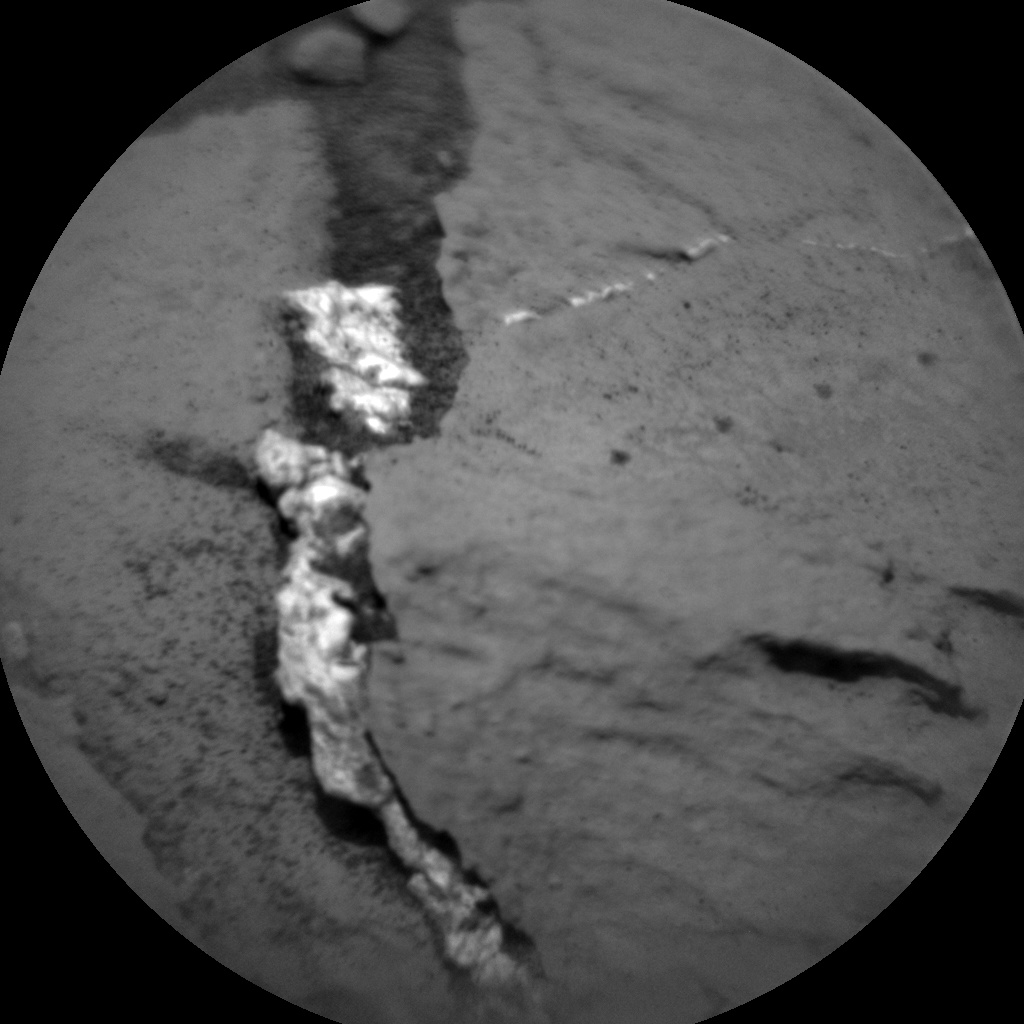
This image was taken by ChemCam: Remote Micro-Imager (CHEMCAM_RMI) onboard NASA’s Mars rover Curiosity on Sol 1027 (2015-06-27 08:30:21 UTC).
Credit: NASA/JPL-Caltech/LANL
On Sol 1028, the camera-carrying Curiosity robot arm will be used to take up-close images of the rocks and soil in front of the rover from various vantage points, to measure changes in their reflectance.
After dusk, rover instruments will measure three spots on a rock called “Big Arm” that was imaged during the day before solar conjunction.
Lastly, nighttime images, using LEDs for illumination, should “nicely complement” the daytime images of the rock, Herkenhoff said.
Back in action
Finishing off the weekend plan, on Sol 1029 the rover’s ChemCam instrument will acquire some calibration data and Mastcam will take a stereo mosaic of the outcrops to the east of the rover.
Overall, the word from the Curiosity downlink team is that the data acquired during conjunction show that the rover is in good health, and that the rover team is “go” for planning.
Bottom line from Herkenhoff: Curiosity “is back in action!”

Secretary of State John Kerry shakes hands with Chinese Vice Premier Wang Yang after they delivered closing statements at the conclusion of the U.S.-China Strategic and Economic Dialogue (S&ED) / Consultation on People-to-People Exchange (CPE) at the U.S. Department of State in Washington, DC.
Credit: State Dept Image /June 24, 2015
The seventh round of the U.S.-China Strategic and Economic Dialogue (S&ED) was held June 22-24, 2015, in Washington, D.C.
The two sides held in-depth discussions on major bilateral, regional, and global issues, including a number of space agenda items.
“The depth and breadth of our discussion at this year’s Strategic & Economic Dialogue has been significant,” said Secretary of State John Kerry, “and I think it is fair to say from my perspective, certainly – this is my third dialogue – that this has been perhaps one of the more constructive and productive in terms of the seriousness of the discussion that we’ve had on a very long, comprehensive agenda, with a host of important bilateral, regional, and global issues.
Space-related items
Under the banner of “Cooperation on Science, Technology, and Agriculture” several space-related items have been flagged, including space security, satellite collision avoidance, weather monitoring, climate research, and establishing regular civil space cooperation consultations.
Specifically, these are:
Space: The United States and China decided to establish regular bilateral government-to-government consultations on civil space cooperation. The first U.S.-China Civil Space Cooperation Dialogue is to take place in China before the end of October Separate from the Civil Space Cooperation Dialogue, the two sides also decided to have exchanges on space security matters under the framework of the U.S.-China Security Dialogue before the next meeting of the Security Dialogue.

Earth orbit is a junkyard of human-made space clutter.
Credit: Space Junk 3D, LLC. Melrae Pictures
Satellite Collision Avoidance: The United States and China reaffirmed that orbital collision avoidance serves the common interest of the two sides in the exploration and use of outer space for peaceful purposes. The two sides noted that the process for safely resolving an orbital close approach requires further consultation, with a view to building upon existing cooperation between the two sides in order to ensure timely resolution to reduce the probability of accidental collisions. The two sides further decided to continue bilateral government-to-government consultations on satellite collision avoidance and the long-term sustainability of outer space activities as part of the U.S.-China Civil Space Cooperation Dialogue.
Joint Research on Severe Weather Monitoring: The United States and China decided to enhance data and information exchange and cooperation on joint research and development of monitoring, warning, and risk assessment technologies for severe weather and climate, such as hurricanes (typhoons), strong convective weather events, droughts, high temperatures, and heat waves. These efforts are intended to jointly improve the two sides’ ability to respond to severe weather and climate events.
![Credit: Courtesy of SOHO/[instrument] consortium. SOHO is a project of international cooperation between ESA and NASA.](https://www.leonarddavid.com/wp-content/uploads/2015/06/suncombo1_prev.jpg)
Credit: Courtesy of SOHO/[instrument] consortium. SOHO is a project of international cooperation between ESA and NASA.

Credit: NASA
Climate Science and Climate Services: The United States and China enhanced cooperation and research in the areas of climate science and climate services, including extended-range forecasts, drought monitoring outlooks, El Nino-Southern Oscillation monitoring, outlooks of tropical atmosphere Madden-Julian Oscillation and monsoon monitoring. The two sides decided to enhance bilateral cooperation in climate services under the Global Framework for Climate Services.
Operational Forecast and Service of Space Weather: The United States and China enhanced cooperation and exchange in space weather monitoring programs, forecasts and services.
Tangible benefits
In remarks signaling the end of the U.S.-China Strategic and Economic Dialogue, Chinese Vice Premier Wang Yang noted: “With two days of intensive and orderly work, the seventh round of China-U.S. economic dialogue has achieved a full success. The two sides conducted candid and in-depth exchange of views on issues of overarching, long-term and strategic importance to the two economies and the world economy and reached over 70 important outcomes.”
Chinese State Councilor Yang Jiechi observed: “The two sides agreed to enhance exchanges and cooperation on counterterrorism, nonproliferation, law enforcement, and anti-corruption; space, science, and technology; customs, health, agriculture, forestry, transport, and local exchanges with a view to bring more tangible benefits to the people of our two countries.”

On November 14, 2014, Wang Zhaoyao, Director of the China Manned Space Agency, held a conversation with the delegation of NASA chief Charles Bolden.
Credit: CMSE
TBD: Where’s NASA?
Regarding the China and U.S. space agenda items, Marcia Smith, space policy analyst at SpacePolicyOnline.com commented:
“NASA and the White House Office of Science and Technology Policy (OSTP) have been prohibited by law from dealing with China on space cooperation on a bilateral basis for several years,” Smith noted.
The prohibition was originally inserted in the appropriations bills that fund NASA by Rep. Frank Wolf (R-VA), who chaired the House Appropriations Commerce-Justice-Science (CJS) subcommittee before retiring last year, Smith explained.
The final law that he put in place (P.L. 113-235, the Consolidated and Further Continuing Appropriations Act, 2015), which is in effect today, Smith added, states that no funds may be spent by NASA or OSTP to “develop, design, plan, promulgate, implement, or execute a bilateral policy, program, order, or contract of any kind to participate, collaborate, or coordinate bilaterally in any way with China or any Chinese-owned company unless such activities are specifically authorized by law after the date of enactment of this Act.”
The new House CJS chairman, Rep. John Culberson (R-TX), agrees with Wolf’s position and the prohibition is continued in the House-passed version of the FY2016 Commerce-Justice-Science appropriations bill (H.R. 2578), Smith said.

NASA chief, Charles Bolden, with Wang Zhaoyao, Director of the China Manned Space Agency, during meeting last November.
Credit: CMSE
Future meetings
“The agreement signed by Kerry reflects State Department activities with China, which are not prohibited by law,” Smith posted on her website.
“The State Department has a Bureau of Oceans and International and Scientific Affairs — often referred to as Oceans, Environment and Science (OES) — that oversees international civil space cooperation and presumably will be the official host of these [future U.S. – China space] meetings. If and how NASA will be involved apparently is yet to be determined,” Smith concluded.

Credit: NASA/LPI
NASA is moving forward on planting bootprints on the Red Planet.
The “First Landing Site/Exploration Zone Workshop for Human Missions to the Surface of Mars” will be held this October at the Lunar and Planetary Institute (LPI) in Houston, Texas.
The purpose of this workshop to be held October 27-30 is to identify and discuss candidate locations where humans could land, live, and work on the Martian surface.

Credit: NASA/LPI
Zoning in on Mars
This gathering will focus on “exploration zone” layout considerations. That is, identifying Regions of Interest (ROIs) that are located within approximately 60 miles (100 kilometers) of a centralized landing site.
ROIs are further defined as areas that are relevant for scientific investigation and honing the capabilities and resources necessary for a sustainable human presence
An exploration zone, or EZ, on Mars also contains a landing site and a habitation site that will be used by multiple human crews during missions to explore and utilize the ROIs within a selected zone.

Credit: Dan Durda
Multi-year process
Stemming from the meeting, candidate EZs will be used by NASA’s Human Exploration and Operations Mission Directorate (HEOMD) and Science Mission Directorate (SMD) as part of the multi-year process of determining where and how NASA would like to explore Mars with humans.
In the near term this process includes:
— Identifying locations that would maximize the potential science return from future human exploration missions
— Identifying locations with the potential for resources required to support humans
— Developing concepts and engineering systems needed by future human crews to conduct operations within an EZ
— Identifying key characteristics of the proposed candidate EZs that cannot be evaluated using existing data sets, thus helping to define precursor measurements needed in advance of human missions.

Credit: NASA
Future work
Existing and future robotic spacecraft will be tasked to gather data from specific Mars surface sites within the representative EZs to support these HEOMD and SMD activities.
This first meeting is likely to kick-start teams of scientists and engineers to flesh out exploration zones that emerge from the initial workshop.

