Archive for the ‘Space News’ Category
 Author:
  August 5th, 2015
Credit: Indie Galactic Space Jam
Indie Galactic Space Jam is going to be held on August 13th-16th in Florida.
Thursday’s opening is being held at the Orlando Science Center, and Friday through Sunday is at the Melrose Center.
“Our goal is to bring together people from various creative and technical fields to develop fun games that generate excitement among the public about space travel and exploration,” explains the Indie Galactic Space Jam website.
The games that are produced are geared to help promote interest in Science, Technology, Education and Math (STEM) education to the generations that will carry these concepts into the future.
Everyone is welcome to pitch their game ideas to the group. The best ideas will be used to make space games.
“Developing games in 48 hours is hard, exhausting, and laborious work that is also collaborative, thought provoking, exciting, rewarding, and fun,” note organizers of the Indie Galactic Space Jam.
Programmers, game designers, artists, musicians…all are welcome to take part.
“We’re looking for artists, programmers, game designers, UI & UX designers, sound designers, writers, poets, interpretive dancers, people excited about games, people excited about space, people who like to eat pizza, and people like you.”
For more information, go to:
http://indiegalacticspacejam.com/
 Posted in
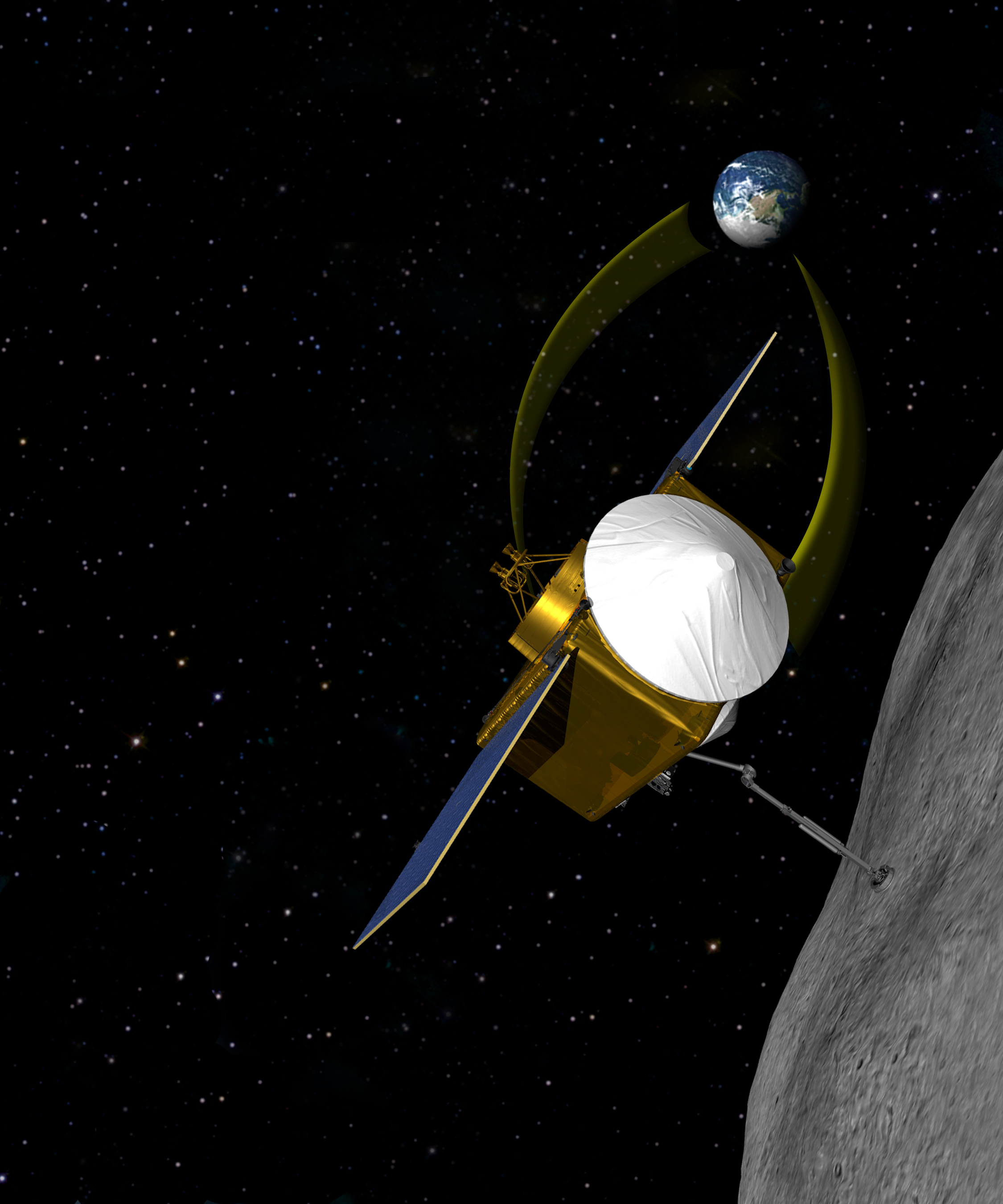
NASA Asteroid-Sampling Mission Readied for 2016 Launch.
Credit: NASA
An asteroid mission is undergoing final checkout for next year’s liftoff that kick-starts a 7-year roundtrip trek to become the first U.S. mission to haul back to Earth samples of a space rock.
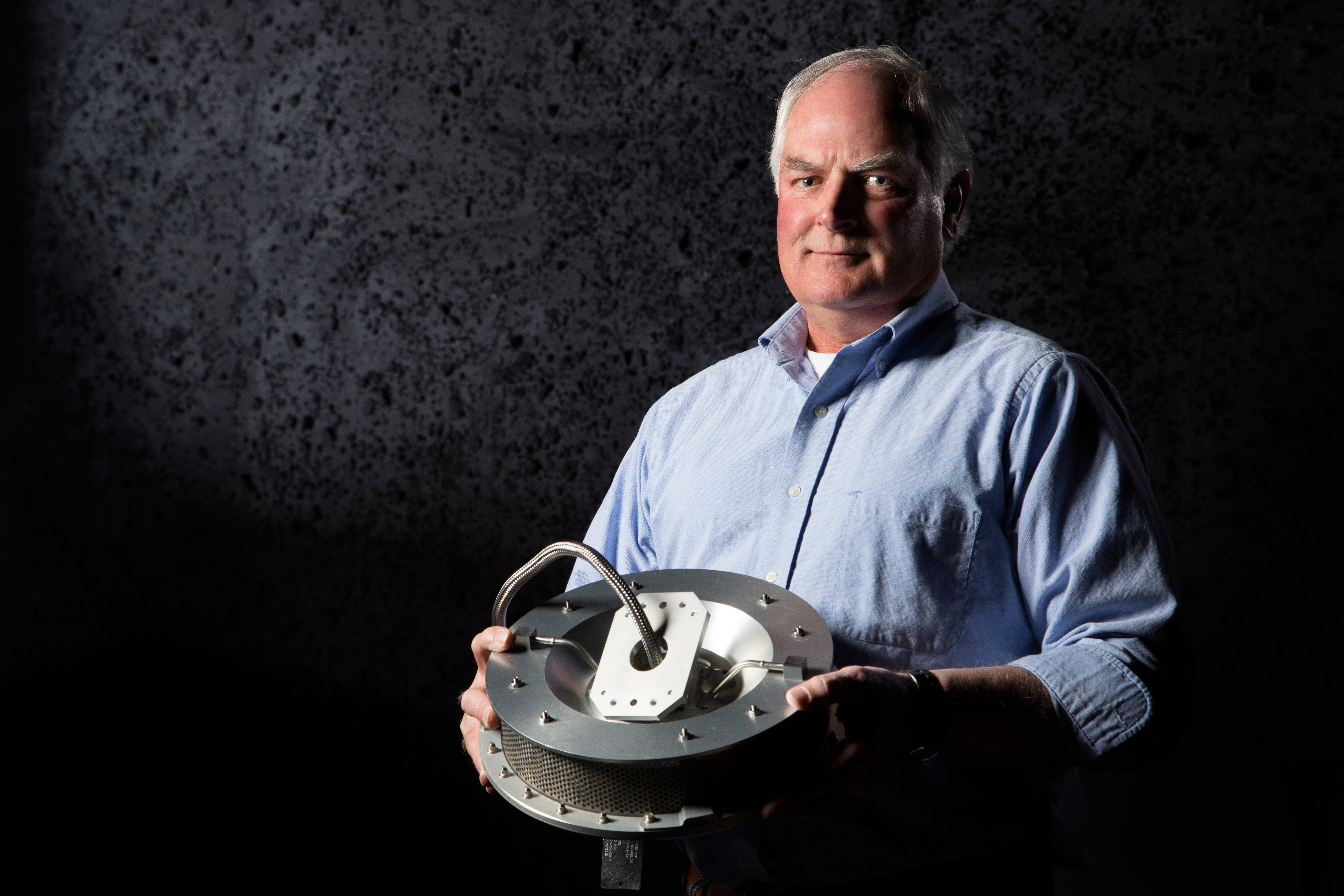
Jim Harris, Lockheed Martin Space Systems mechanical engineer holding the OSIRIS-REx Touch and Go Sample Acquisition Mechanism (TAGSAM).
Credit: Lockheed Martin
NASA’s Origins-Spectral Interpretation-Resource Identification-Security-Regolith Explorer, or OSIRIS-REx, is progressing through Assembly, Test, and Launch Operations (ATLO) at Lockheed Martin’s Space Systems Company.
To read my new Space.com story: NASA Asteroid-Sampling Mission Being Readied for 2016 Launch
Go to:
http://www.space.com/30144-nasa-asteroid-sampling-mission-osiris-rex.html

Image taken by Curiosity’s Navcam: Left B Sol 1061, August 1, 2015.
Image Credit: NASA/JPL-Caltech
Operators of the NASA Curiosity rover on Mars are pleased to report that drilling into “Buckskin” was successful.
Over the weekend, the plan called for more robotic arm activities, including transferring the sample to the scoop for inspection.
But first, the ChemCam remote micro-imager (RMI) has taken pictures of the new drill hole and Mastcam will image a potential location for eventually dumping the sample, reports Ken Herkenhoff of the USGS Astrogeology Science Center in Flagstaff, Arizona.
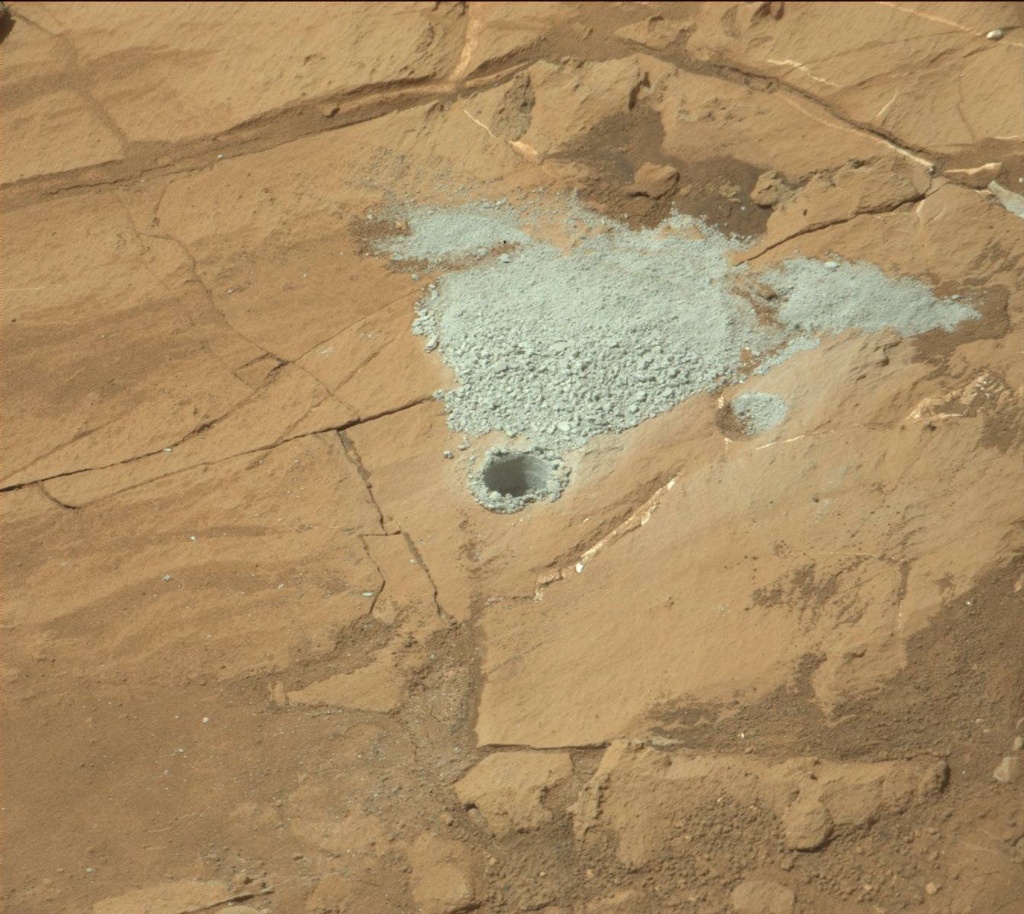
This image was taken by Mastcam: Right onboard NASA’s Mars rover Curiosity on Sol 1060, July 31, 2015.
Image Credit: NASA/JPL-Caltech/MSSS
Mineralogical analysis
Herkenhoff adds that the newly acquired sample will be sieved and a portion of the fine-grained material dropped into CheMin for mineralogical analysis overnight on Sols 1061-1062.
The Chemistry and Mineralogy instrument — or CheMin for short – can identify and measure the abundances of various minerals on Mars.

NASA’s Mars rover Curiosity acquired this image using its Mars Hand Lens Imager (MAHLI), located on the turret at the end of the Curiosity rover’s robotic arm.
Credit: NASA/JPL-Caltech/MSSS
In parallel, the Alpha Particle X-Ray Spectrometer (APXS) is to analyze and measure the potential sample dump location for comparison with future measurements of the dump pile.
Lastly, during the afternoon of Sol 1062, the rover’s robotic arm was to be moved out of the way so that Mastcam and ChemCam can observe the drill hole and tailings, as well as new targets “Diamond Point” and “Summer Hill,” Herkenhoff explains.
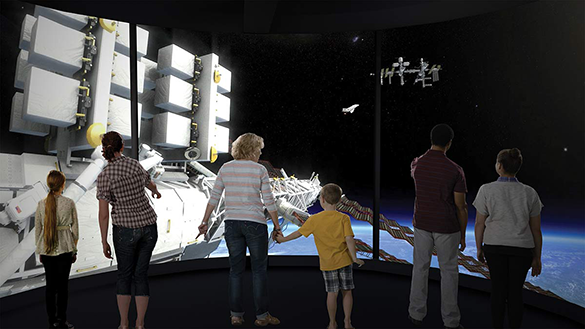
Credit: Evergreen Exhibitions
The space elevator, travel to Mars, futuristic spacecraft propulsion systems.
If you want to travel “above and beyond” you’ll be interested in a new interactive flight exhibition – one that just launched on a multi-city tour to major science centers and air-and-space museums worldwide.
Explored through five key themes that define flight and space travel – Up, Faster, Higher, Farther, and Smarter – Above and Beyond is the name of an education-based exhibition.
The unique exhibit made its worldwide debut in Washington, D.C. at Smithsonian’s National Air and Space Museum on August 1.
Space themes
Among the themes included in the unique exhibit:
— International Space Elevator
Ascend to Earth orbit aboard a simulated space elevator of the future. During your ascent, breathtaking scenery, digital displays and a virtual tour guide describe the aircraft, spacecraft and aerospace phenomena.
— Marathon to Mars
Are you ready to go to Mars? This Augmented Reality experience invites you to take on the physical and psychological challenges of the marathon journey, and lets you “try on” some potential solutions. You can even earn your own personal “Passport to Mars.”
— Future Spacecraft
Touch screen media and images of futuristic spacecraft propulsion systems give you a sneak peek at some exciting innovations designed to open up the space frontier to everyone and propel human astronauts farther than ever before.
— The Light Stuff
In an interactive hammer strength test and a weight comparison of fuselage sections, test and observe how lightweight composite materials—10 times stronger than steel—are helping aircraft and spacecraft fly farther with less fuel.
— Space Junk
Step up to a “Junker” station for a cosmic crusade against debris in space. In this virtual timed challenge, try to eliminate orbital debris surrounding Earth, using your choice of cutting-edge solutions.
Multi-city tour
Above and Beyond is designed to be the most interactive exhibition on aerospace ever to tour, with approximately 5,000 square feet of exhibition space, including a 180-degree immersive theater presentation, a high-tech media-rich historical timeline, a simulated space elevator ride, a challenge to design and test a supersonic fighter jet in a virtual high-speed flying competition, and an avatar-based motion-capture group experience that demonstrates flight like a bird.
The exhibit’s international multi-city tour will run through 2020
Following its premier at Smithsonian’s National Air and Space Museum, the 2015-2016 Above and Beyond tour schedule will include Dubai, St. Louis, Charleston, South Carolina, Riyadh, Seattle, London, Tokyo and Chicago.
Above and Beyond is produced by Evergreen Exhibitions in association with Boeing and in collaboration with NASA and the Smithsonian’s National Air and Space Museum.
For more information, go to:
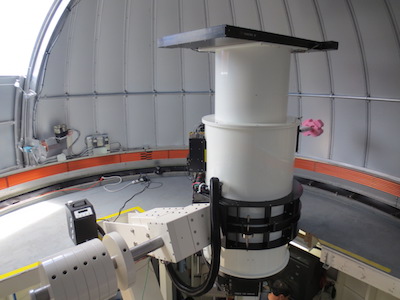
ATLAS#1 up and running on the Hawaiian Island of Maui.
Credit: ATLAS Team
The first Asteroid Terrestrial-impact Last Alert System (ATLAS) telescope is now in operation on Haleakala – on the Hawaiian Island of Maui.
ATLAS is an asteroid impact early warning system being developed by the University of Hawaii and funded by NASA.
When ATLAS is completed in 2015, it will consist of two telescopes, 100 miles apart, which automatically scan the whole sky several times every night looking for moving objects.
The promise of ATLAS is that it can provide one day’s warning for a 30-kiloton “town killer,” a week for a 5-megaton “city killer,” and three weeks for a 100-megaton “county killer.”
Fine-tuning
The telescope on Haleakala “is working well and producing useful images,” notes a posting on the ATLAS website. “We anticipate full resolution after some adjustments are made to the Schmidt corrector. The mount also performs well though it will require some fine-tuning to achieve ATLAS’ stringent tracking specifications.”
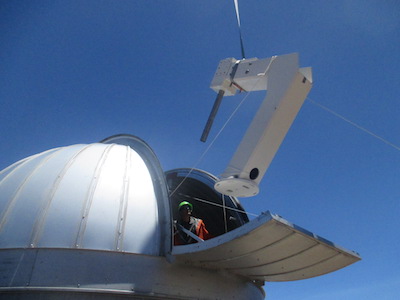
The mount for the Haleakala observatory is lifted into the dome.
Credit: ATLAS team
“All aspects of this whole system are very much under development right now. However, the existing system on Haleakala can survey the entire sky in a little more than one night, and we have begun accumulating images,” the ATLAS website update for July 30 adds.
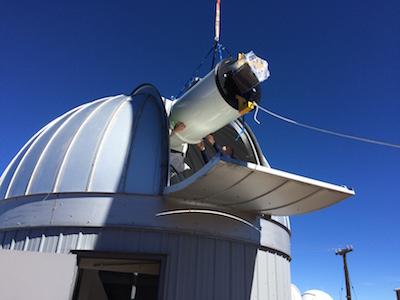
ATLAS#1 telescope gently lowered into Haleakala observatory.
Credit: ATLAS team
ATLAS Telescope #2 is to be situated on Mauna Loa.
In August, the ATLAS team is set to meet with representatives from NASA and South Africa during the International Astronomical Union meeting in Honolulu. Discussions are to focus on the possibility of a third ATLAS unit in South Africa.
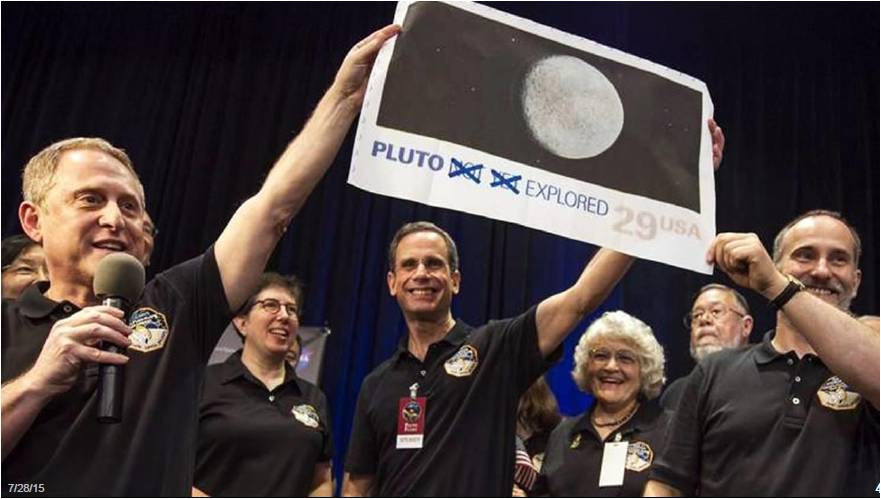
The U.S. House of Representatives’ Committee on Science, Space, and Technology held a hearing earlier this week, making use of a panel of experts to review space exploration of other worlds, today and in the future.
Held July 28, the purpose of the hearing was to review recent NASA achievements in exploring the solar system, including the exploration of Pluto and the asteroid Ceres, as well as assess future NASA missions under development, including a flagship mission to conduct a detailed survey of Jupiter’s moon Europa.
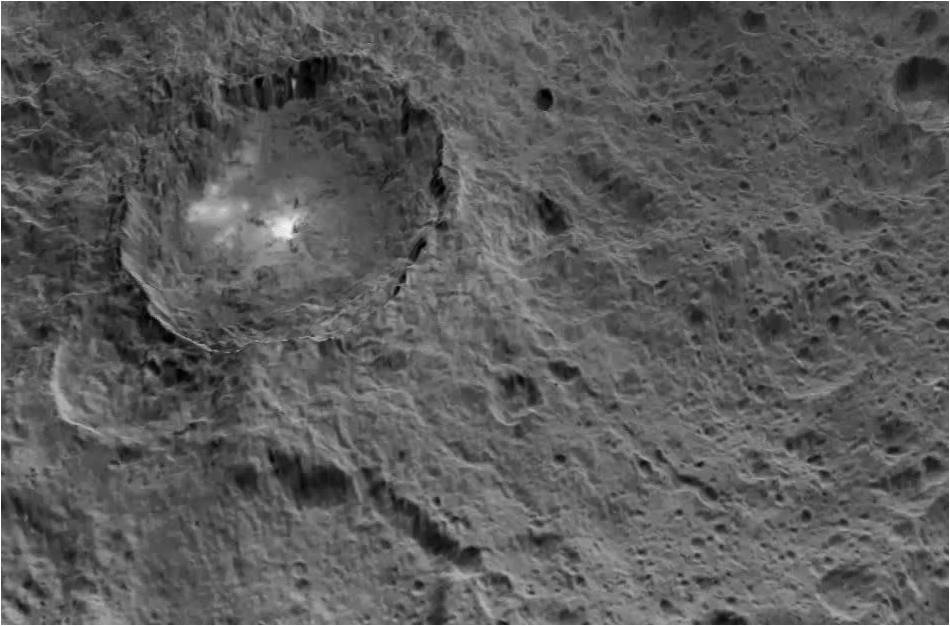
Exploring Ceres and Occator Crater with bright spots.
Credit: NASA/JPL
The testimony of the witnesses can be found here:
— Dr. John Grunsfeld, Associate Administrator, Science Mission Directorate, NASA
— Dr. Alan Stern, Principal Investigator, New Horizons Mission, Southwest Research Institute
— Dr. Christopher Russell, Principal Investigator, Dawn Mission; Professor of Geophysics and Planetary Physics, University of California Los Angeles
— Dr. Robert Pappalardo, Study Scientist, Europa Mission Concept, Jet Propulsion Laboratory, NASA
— Dr. Robert Braun, David and Andrew Lewis Professor of Space Technology, Georgia Institute of Technology
The hearing charter can be read here:
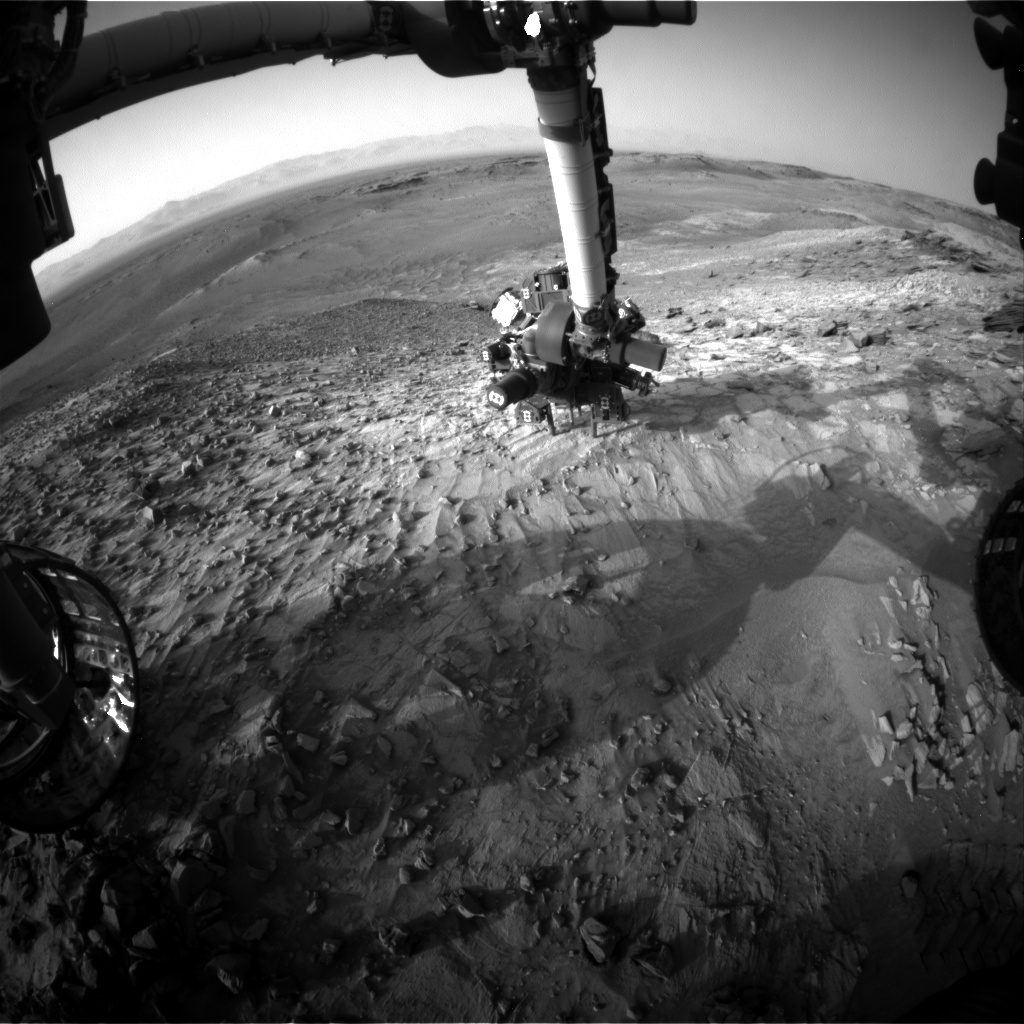
Image taken by Curiosity’s Front Hazcam: Left B, July 28 on Sol 1057.
Image Credit: NASA/JPL-Caltech
NASA’s Curiosity rover on Mars has made a “mini-start hole”, which is the name for a new type of initial drilling test, according to Ryan Anderson, a planetary scientist at the USGS Astrogeology Science Center in Flagstaff, Arizona.
The target is called “Buckskin” and the test will drill a small hole in the rock to help determine whether it is safe to go ahead with the full hole, Anderson adds.
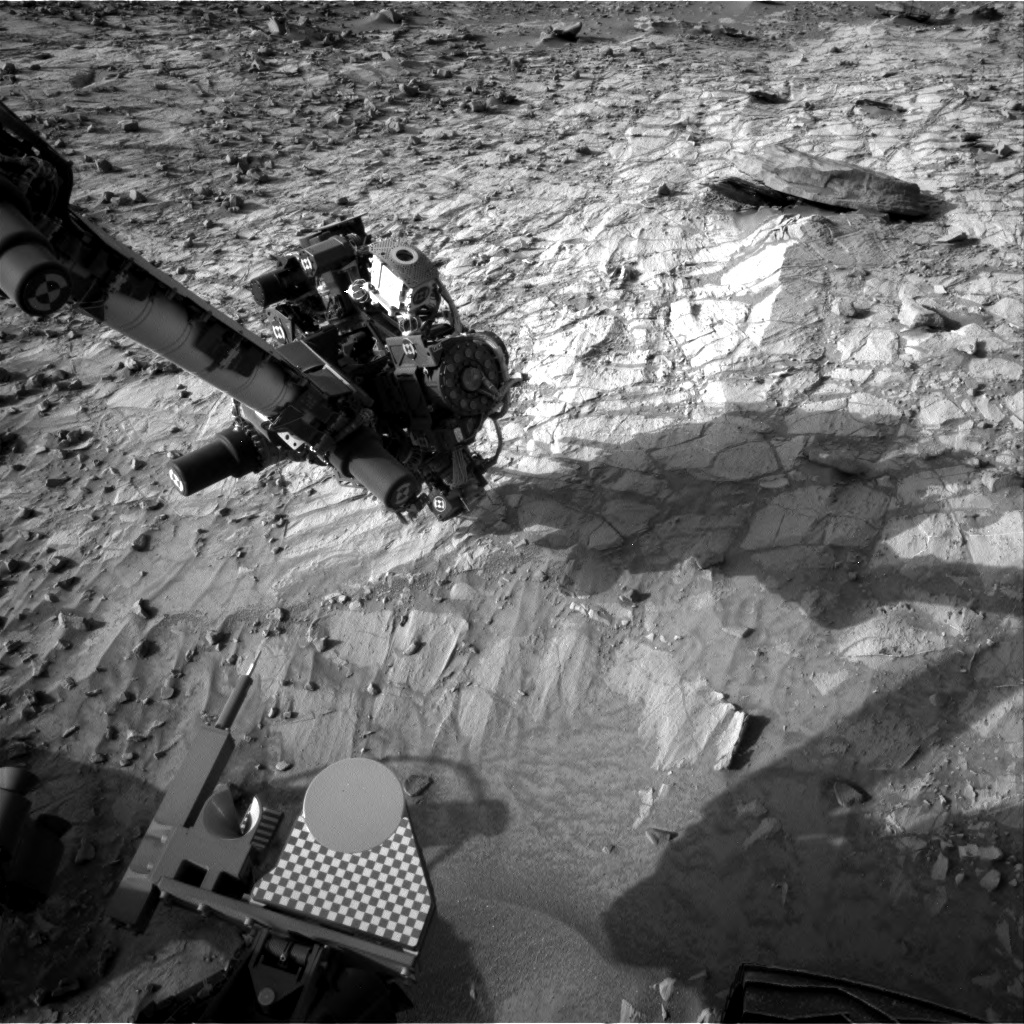
This image was taken by Curiosity’s Navcam: Right B on July 28, Sol 1057.
Image Credit: NASA/JPL-Caltech
“In addition to that test, we are planning a detailed study of the target “Ch-paa-qn” which means “shining peak” in the native Salish language of northern Montana,” Anderson explains. “This target is an isolated bright patch on the nearby outcrop, and we want to figure out if it is calcium sulfate like the white veins we see nearby, or if it is something else.”
The plan includes ChemCam active and passive observations of Ch-paa-qn, along with Mastcam multispectral images.

Curiosity’s Mars Hand Lens Imager (MAHLI), located on the turret at the end of the rover’s robotic arm took this image on July 28, 2015, Sol 1057.
Credit: NASA/JPL-Caltech/MSSS
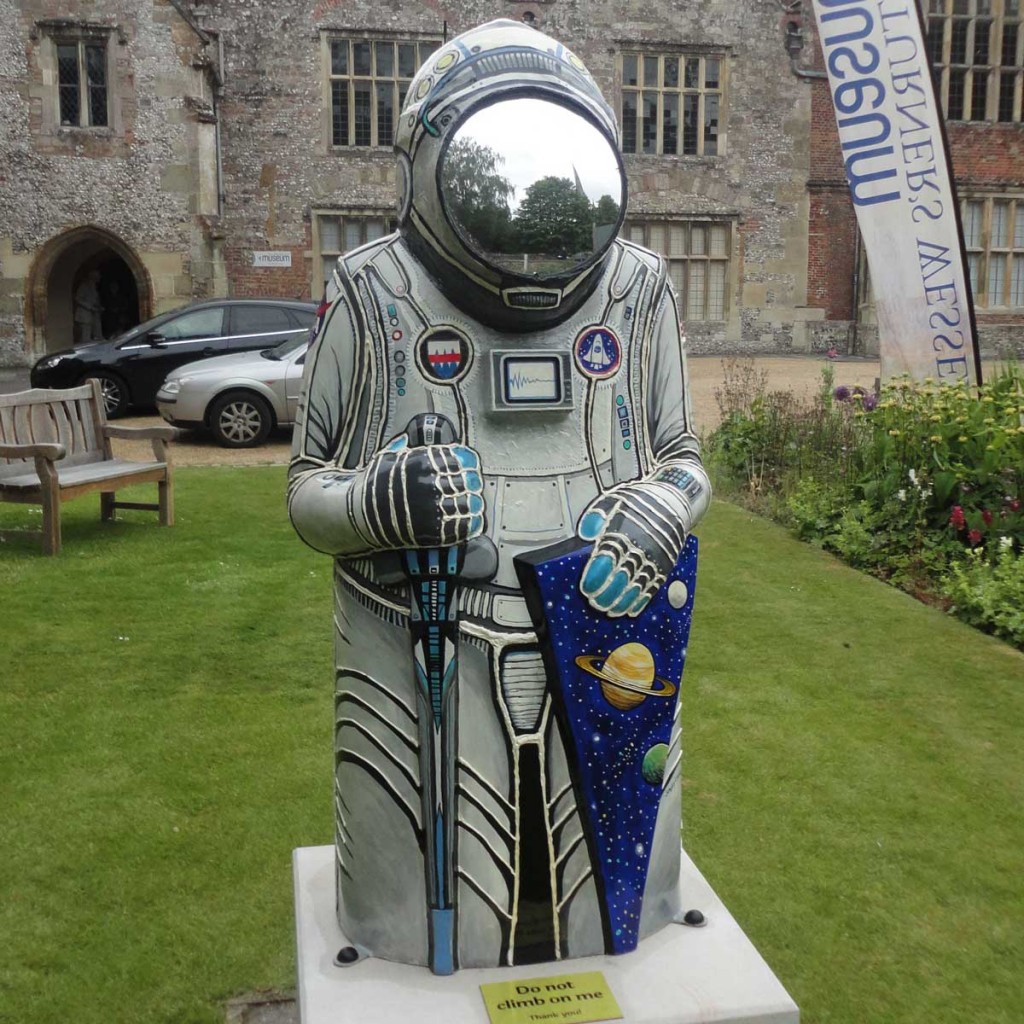
Well suited for space, Jenny Leonard’s Astro Baron.
Credit: The Barons’ Charter – Salisbury 2015
Among 25 well-dressed and decorated Barons on display in Salisbury, a cathedral city in Wiltshire, England, is “Astro Baron” – thanks to Jenny Leonard, a creative and skilled artist based in London.
The Trussell Trust, together with Wild in Art, is staging The Barons’ Charter Trail, called the biggest mass participation public art event ever seen in the city.
The Barons trail will be on display in parks, streets and public spaces across Salisbury for 12 weeks from June 12th to September 6, 2015.
This event is part of a celebration of 800 years since the sealing of Magna Carta. The Great Charter of Liberty — or Magna Carta — was written over eight centuries ago and is the most celebrated document in English history. It is at the very heart of the process that led to the rule of constitutional law.
Salisbury is home to perhaps the best preserved copy of Magna Carta and 2015 celebrates 800 years of its existence.
Space uniform
The Barons are on display in high-profile, specially designated locations throughout Salisbury. They have been decorated by local and regional artists and sponsored by a variety of businesses, organizations and individuals.
As a freelance artist and muralist, Jenny Leonard applied her talents to craft Astro Baron for the Salisbury Barons’ Trail.
According to Sophie Sinclair, a communications and social media assistant at The Trussell Trust in Bournemouth, United Kingdom, Leonard’s design reflects an astronaut, “inspired by her thinking about what interesting uniforms would suit the baron best.”
Outfitted with add-ons
Leonard’s view: “I thought the stance and shape of the baron template resembled an astronaut and it would be great to give it texture and turn it into something fun with lots of dials and information about space and the universe for children to explore and have their pictures taken with.”
Astro Baron comes outfitted with add-ons: including a back pack, helmet and visor. “I wanted to make it into a little character,” the artist said, “with buttons and details in the painted fabric to make it look like it’s from outer space!”
Sinclair adds that Astro Baron is a popular one on the trail, “and we’ve enjoyed seeing people taking space man poses next to it, as well as the mirror visor on the baron providing a great opportunity for selfies!”
For more information on this unique event go to:
http://www.thebaronscharter.org.uk/barons/
To view Jenny Leonard’s artistic works, go to:
Credit:
Joseph Lazio, JPL
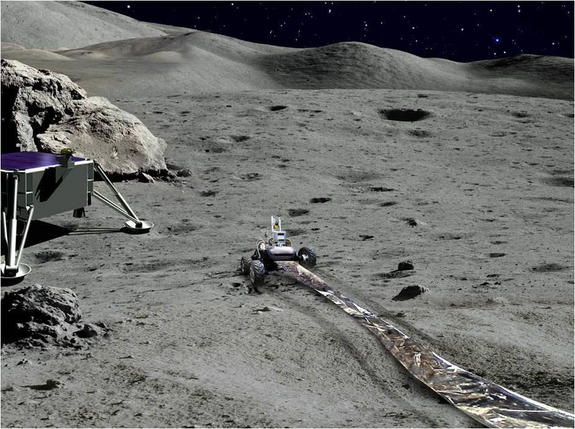
Robotic operations on the Moon are being investigated by university researchers – opening the door to laying out a radio telescope array on the lunar far side.
The rover would be commanded by astronauts in NASA’s Orion spacecraft, which would be hovering in a halo point near the lunar far side called Earth-moon Lagrange Point 2 (L2).
The university team is working hard to create software and hardware that mimics rover control to recognize potential problems with human-telerobotic operations, such as time lags and communication quality.
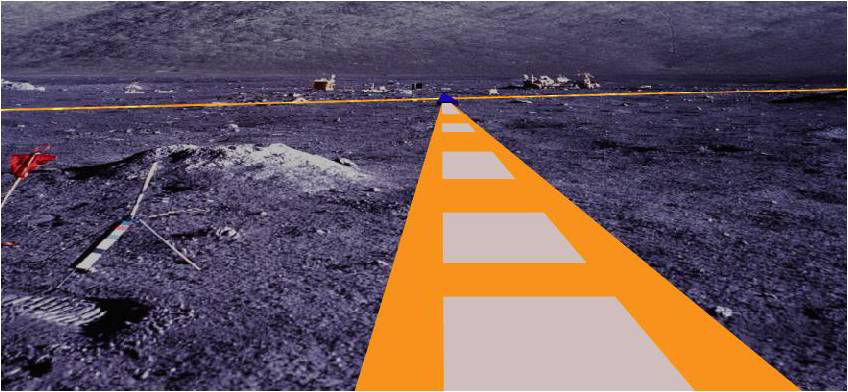
“Arms” of Kapton material spread out on the lunar surface could serve as a robust, lightweight backbone for an array of low-frequency antennas that could be deployed by a modest rover.
Courtesy: Jack Burns/University of Colorado, Boulder
Take a look at my new Space.com story on this promising research at:
How Robots Could Build a Radio Telescope on Far Side of the Moon
July 29, 2015 07:00am ET
http://www.space.com/30084-moon-far-side-rovers-radio-telescope.html
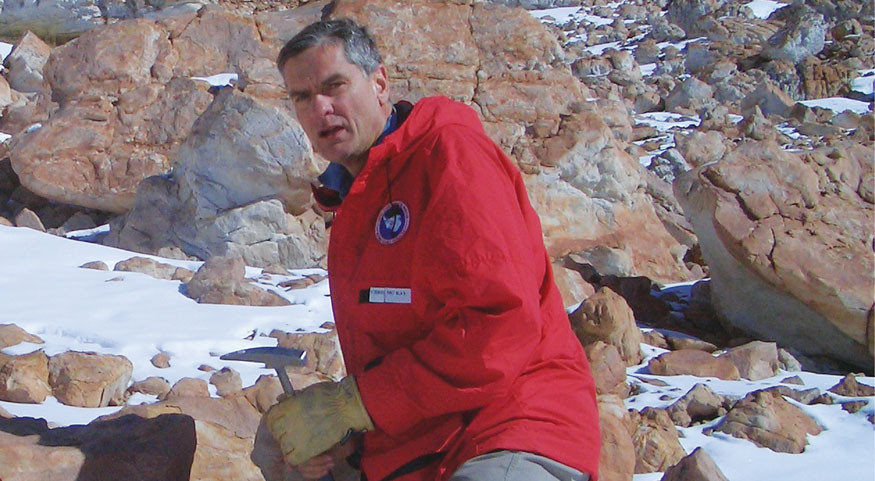
Leading Mars Underground member: Chris McKay
Credit: NASA
The question of whether life has ever existed on Mars has been at the center of a 50-year robotic exploration campaign that has seen an increasingly sophisticated armada of flyby missions, orbiters, landers and rovers dispatched to the red planet.
Christopher McKay, one of NASA’s most recognizable names in the field of astrobiology, argues that Mars probes to date have, quite literally, barely scratched the surface.
Check out my revealing SpaceNews profile of McKay’s views: “Drill Baby, Drill” at:
http://spacenews.com/qa-with-chris-mckay-senior-scientist-at-nasa-ames-research-center/

