Archive for the ‘Space News’ Category
 Author:
  August 20th, 2015
Russian built RD-180 engines.
Credit: United Launch Alliance
The RD-180 Rocket Engine Issue Guide has been authored by Travis Cottom, the Marshall Institute’s Program Associate for Defense and Space Policy.
This paper examines the politically and technologically complex options available to the United States in providing dependable rocket engines for space launch.
“The RD--180 has been a stalwart engine for the Atlas V rocket, but it may become unavailable at any time due to the continuing deterioration of U.S.-Russian relations,” explains Cottom.
Difficult position
“To ensure U.S. access to space, another launch vehicle and engine is needed. There are a few engine options available, but they will require several years to develop, test, and certify,” Cottom adds.
In Cottom’s view, rtiring the Delta IV put the U.S. in a difficult situation, “since it forces U.S. policymakers to choose between extending the use of the RD--180 or relying only on SpaceX for national security launches for an unknown period of time.”
This Issue Guide reviews the history of the Russian engine in U.S. launch vehicles, examines how use of the RD-180 engine became problematic, and considers the potential results of a ban of the RD-180 engine.
For the paper, go to:
http://marshall.org/space-policy/the-rd-180-rocket-engine-issue-guide/
 Posted in

Credit: Energia
The former Soviet Union’s Luna 9 is the first survivable landing of a human-made object on another celestial body.
That historic probe landed on the Moon on February 3, 1966. the plucky probe. The beach ball-shaped craft took the first photographs from the Moon’s harsh landscape.

Image from the Soviet Union’s Luna 9 Moon probe.
Credit: NASA
There’s a hunt on to find the true resting spot of Luna 9. And one researcher is closing in on the goods…maybe!
For more information on the whereabouts of Luna 9, go to my new story at Air & Space Magazine:
The Search for Luna 9
Fifty years later, researchers try to locate the first spacecraft to land on another world.
By Leonard David
Air & Space Magazine
September 2015

Credit: Mars Landing Site Steering Committee/T. Goudge, et al.
Space scientists and engineers are surveying dozens of landing zones for NASA’s Mars 2020 rover…and the early votes are in. But it took a martian-style form of “Rubric’s cube” to sort through and pinpoint ideal locales to achieve mission goals.

JPL’s Matt Golombek, co-chair of the Mars Landing Site Steering Committee, helps moderate site selection discussion.
Credit: Leonard David
Roughly 30 candidate landing areas were once on the reasonable roster. Regions of Interest (ROIs) in and near these landing sites have been mulled over for science potential – including having Red Planet machinery, for the first time, gather and stash samples for possible return to Earth by a future mission.
The intent of all this effort is to pick idyllic sites that have the geological and biological capacity to have preserved past martian life.

Mars experts gathered at 2020 Mars Rover landing site meeting.
Credit: Leonard David
Some 200 researchers and engineers took part in the second landing site workshop for the 2020 Mars Rover mission, held in Monrovia, California on August 4-6.
For a report on this meeting, go to my new Space.com story at:
Where Will NASA’s 2020 Mars Rover Land?
by Leonard David, Space.com’s Space Insider Columnist
August 20, 2015 07:01am ET
http://www.space.com/30320-nasa-2020-mars-rover-landing-site.html

After taking a low-angle selfie at its latest drilling site, NASA’s Curiosity Mars rover has departed the area called “Marias Pass,” where it had been working since May.
Credit: NASA/JPL-Caltech
In classic do-it-your style, NASA’s Curiosity Mars rover has produced a set of images of several visited sites on the Red Planet.
NASA’s Jet Propulsion Laboratory released the non-camera shy robot imagery. The rover uses a camera on its robotic arm for multiple images that were then stitched into self-portraits.

Round-Horizon Version of Curiosity’s Low-Angle Selfie at “Buckskin”.
Credit: NASA/JPL-Caltech/MSSS
The robot is now driving toward the southwest after departing a region where for several weeks it investigated a geological contact zone and rocks that are unexpectedly high in silica and hydrogen content. The hydrogen indicates water bound to minerals in the ground.
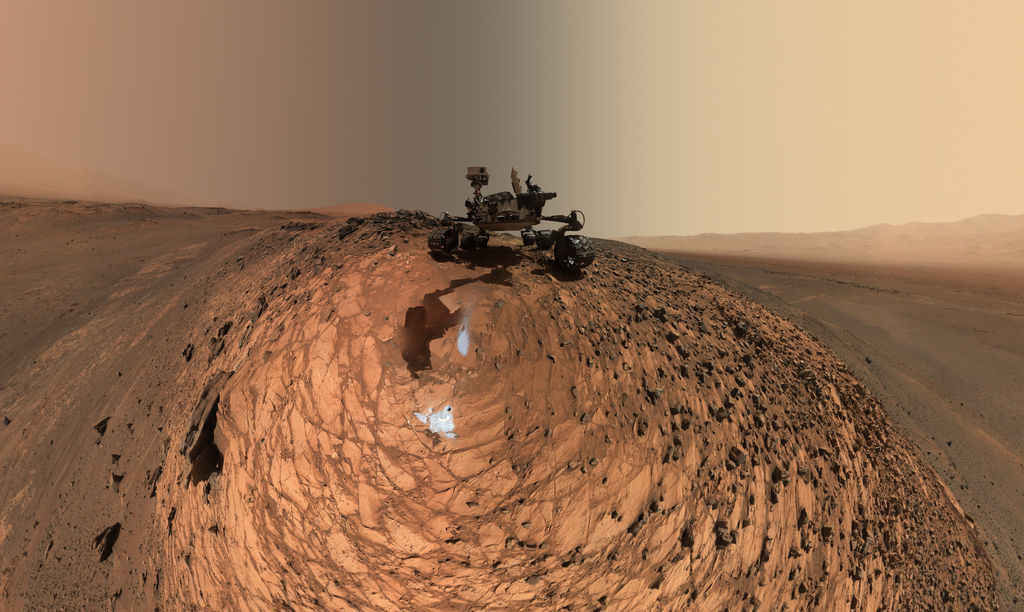
Curiosity Low-Angle Self-Portrait at “Buckskin” Drilling Site on Mount Sharp.
Credit: NASA/JPL-Caltech/MSSS
The main mission objective now is to examine layers of lower Mount Sharp for ancient habitable environments and evidence about how early Mars environments evolved from wetter to drier conditions.

Credit: NASA/Bill Ingalls
NASA Astronaut Drew Feustel, left, Actor Matt Damon, Director Ridley Scott, Author Andy Weir, and Director of the Planetary Science Division at NASA Headquarters Jim Green, participate in a question and answer session about NASA’s journey to Mars and the film ”The Martian,” Tuesday, Aug. 18, 2015, at the United Artist Theater in La Cañada Flintridge, California.

NASA scientists and engineers served as technical consultants on the film. The movie portrays a realistic view of the climate and topography of Mars, based on NASA data, and some of the challenges humankind faces as we prepare for human exploration of the Red Planet in the 2030s.
During a manned mission to Mars, Astronaut Mark Watney (Matt Damon) is presumed dead after a fierce storm and left behind by his crew. But Watney has survived and finds himself stranded and alone on the hostile planet. With only meager supplies, he must draw upon his ingenuity, wit and spirit to subsist and find a way to signal to Earth that he is alive.

Credit: 20th Century Fox
Millions of miles away, NASA and a team of international scientists work tirelessly to bring “the Martian” home, while his crewmates concurrently plot a daring, if not impossible rescue mission. As these stories of incredible bravery unfold, the world comes together to root for Watney’s safe return.
The movie is based on a best-selling novel, and helmed by director Ridley Scott, THE MARTIAN features Jessica Chastain, Kristen Wiig, Kate Mara, Michael Peña, Jeff Daniels, Chiwetel Ejiofor, and Donald Glover.

Actor Matt Damon, who stars as NASA Astronaut Mark Watney in the film “The Martian,” smiles after having made his hand prints in cement at the Jet Propulsion Laboratory (JPL) Mars Yard, while Mars Science Lab Project Manager Jim Erickson, left, and NASA Astronaut Drew Feustel look on, Tuesday, Aug. 18, 2015, at the JPL in Pasadena, California.
Credit: NASA/Bill Ingalls

Actor Matt Damon, who stars as NASA Astronaut Mark Watney in the film “The Martian,” talks on the phone with NASA Astronauts Scott Kelly and Kjell Lindgren who are onboard the International Space Station (ISS), while NASA Astronaut Drew Feustel looks on, Tuesday, Aug. 18, 2015, at the Jet Propulsion Laboratory in Pasadena, California.
Credit: Bill Ingalls/NASA
The Martian Official Trailer [HD] via 20th Century FOX. Go to:
https://www.youtube.com/watch?v=Ue4PCI0NamI
NOTE: Reality check for the Red Planet!
Mars enthusiasts around the world can participate in NASA’s journey to Mars by adding their names to a silicon microchip headed to the Red Planet aboard NASA’s robotic InSight Mars lander, scheduled to launch next year.
Submissions will be accepted until September 8th.

Curiosity’s Navcam Left B took this image on August 17, 2015, Sol 1077.
Image Credit: NASA/JPL-Caltech
For NASA’s Curiosity rover on Mars it’s Sol 1078.
In an update from Ken Herkenhoff of the USGS Astrogeology Science Center in Flagstaff, Arizona, before the Mars machinery began a drive away from a current location, the ChemCam and Mastcam were set to observe rock targets dubbed “Huson” and “Ignatius.”
Mastcam was also to image another rock called “Hodown.”
ChemCam looks at rocks and soils from a distance, firing a laser at the target to analyze the elemental composition of vaporized Martian rock and soil.

This image was taken by ChemCam: Remote Micro-Imager onboard NASA’s Mars rover Curiosity on August 17, Sol 1077.
Credit: NASA/JPL-Caltech/LANL
After the drive, an overnight Chemistry and Mineralogy (CheMin) instrument integration on a drill sample was planned. CheMin identifies and measures the abundances of various minerals on Mars.
The rover is scheduled to carry out atmospheric observations early on the morning of Sol 1079.

Credit: NASA/JPL Grotzinger
More Navcam atmospheric observations are planned later that sol, along with some ChemCam calibration activities.
Herkenhoff adds: “I’m glad that we are making good progress toward Mt. Sharp!”

Hurry up and go! Human versus robot on Mars.
Credit: NASA
Ok…yet another issue to consider for outbound space travelers.
Sure there’s radiation, palpitations during landing on a faraway world, or getting struck in the noggin by a meteorite.
Here’s a new one to come to grips with.
Prolonged spaceflight may give you a nasty case of diarrhea.
New research published by the Federation of American Societies for Experimental Biology (FASEB) reports in their journal that spaceflight may increase susceptibility to inflammatory bowel disease.
Specifically, when mice were subjected to simulated spaceflight conditions, the balance of bacteria and the function of immune cells in the gut changed, leading to increased bowel inflammation.
Messages from mice
“Our study provides useful insights on the cross-regulation of the mucosal immune system, epithelial barrier and commensal bacteria not only in humans in spaceflight or analog, but also in humans on Earth that undergo various stresses,” reports Qing Ge, study author from the Department of Immunology at Peking University Health Science Center in Peking, Beijing.
“We already know that a trip to Mars and back may well have serious, possibly permanent, effects on the bodies of the astronauts,” said Gerald Weissmann, Editor-in-Chief of The FASEB Journal.
Turns out, the hidden passengers on that mission — the bacteria in the gut of space travelers — will be affected as well, Weissmann adds in a FASEB press statement. “This lends further credence to the fact that life on Earth, including the microbiome, evolved under gravity and needs it to thrive.”
For more information, go to:

Curiosity Mars rover used MAHLI to view this damaged wheel on August 16, 2015, Sol 1076.
Credit: NASA/JPL-Caltech/MSSS
NASA’s Mars rover Curiosity has entered Sol 1077, landing on the Red Planet back in August 2012.
A self-inspection of its six wheels is periodically undertaken, keeping track of wheel wear and tear – damage that engineers keep an eye on.
For example, the robot’s Mars Hand Lens Imager (MAHLI) returned a new image of a Curiosity wheel on August 16.

This map shows the route driven by NASA’s Mars rover Curiosity through the 1073 Martian day, or sol, of the rover’s mission on Mars (August, 13, 2015).
Numbering of the dots along the line indicate the sol number of each drive. North is up. From Sol 1072 to Sol 1073, Curiosity had driven a straight line distance of about 142.79 feet (43.52 meters).
The base image from the map is from the High Resolution Imaging Science Experiment Camera (HiRISE) in NASA’s Mars Reconnaissance Orbiter.
Image Credit: NASA/JPL-Caltech/Univ. of Arizona
MAHLI is located on the turret at the end of the rover’s robotic arm.

Work has been underway on China’s Long March 5 and 6 rockets at a Tianjin test site. A large industrial base for rocket development is situated in north China’s Tianjin Municipality.
Credit: China Aerospace Science and Technology Corporation
The recent horrific explosions, loss of life and property, and lingering environmental issues at China’s port city of Tianjin may have a ripple effect that could affect China’s space program.
State-run news outlets in China note that the Tianhe-1 — a major supercomputer installation has been shut down — a move that some reports say is tied to China’s space program. The huge explosions broke windows at the National Supercomputing center, collapsing ceilings at parts of the center.
Furthermore, there are other space-related facilities in Tianjin’s Binhai New Area – supporting infrastructure for the development of China’s first space station, specifically the rockets that are to supply elements required for the large orbiting complex.
According to a report in India’s The Hindu, “Tianjin Blasts May Derail China’s Space Programme,” the rockets are slated for shipment from Tianjin harbor and, according to existing plans, head for China’s new spaceport in Wenchang.
As noted in a March Inside Outer Space story, work on all sections of the Long March 5 rocket tower was completed at a Tianjin test site, with the booster entering the full Arrow modal testing phase. Production of the Long March 5 and Long March 6 has been underway in a large industrial base in north China’s Tianjin Municipality.
Go to:
China’s Long March 5: Booster Progress Reported
https://www.leonarddavid.com/chinas-long-march-5-booster-progress-reported/
NOTE: Check out Marcia Smith’s SpacePolicyOnline.com review of the Chinese disaster. Go to:
Will Tianjin Explosion Impact China’s Space Program?

Image taken by Curiosity’s Mastcam Left on August 13, 2015, Sol 1073.
Image Credit: NASA/JPL-Caltech/MSSS
At week’s end the NASA Curiosity Mars rover was driven on sol 1074, putting itself in good position for weekend science – slated to involve the Sample Analysis at Mars (SAM) instrument. It will analyze some of the recent drill sample that the robot has collected.
“SAM activities will take up all of sol 1075. On sol 1076, we will use MAHLI [the Mars Hand Lens Imager] to check on the health of our wheels, and SAM will do its Evolved Gas Analysis (EGA) measurement on the sample,” reports Ryan Anderson of the USGS Astrogeology Science Center in Flagstaff, Arizona.

Another image taken by Curiosity Mastcam Left on Sol 1073, August 13, 2015.
Image Credit: NASA/JPL-Caltech/MSSS
If things remain on schedule, on sol 1077, Curiosity will use its ChemCam and Mastcam.
Mastcam has a 20×2 mosaic of an area called “Fournier”, followed by ChemCam observations of the targets “Butler”, “Evaro”, “Coldwater”, and “Alberton” and associated Mastcam documentation images. Navcam also has an atmosphere monitoring observation of the horizon to the north, Anderson adds.

Curiosity Mastcam Right image taken on August 12, 2015, Sol 1072.
Image Credit: NASA/JPL-Caltech/MSSS
“Later in the afternoon on sol 1077, ChemCam has a calibration observation and Mastcam has another observation of ‘Alberton’ to try to see textures highlighted by the lower sun angle. Navcam also has a couple more observations, watching for clouds and dust devils,” Anderson notes.
As always, dates of planned rover activities are subject to change due to a variety of factors related to the Martian environment, communication relays and overall rover status.

