Archive for the ‘Space News’ Category
 Author:
  September 9th, 2015
Curiosity Navcam Right B image taken on Sol 1099 September 9, 2015.
Image Credit: NASA/JPL-Caltech
NASA’s Curiosity Mars rover has made some impressive images of “Bridger Basin” and has been busy acquiring a large stereo mosaic of the far wall of that Basin.
The rover’s movement on Mars was halted on Sol 1098 after reaching some 43 feet (13 meters) of a planned trek of over 80 feet (25 meters), reports Ken Herkenhoff of the USGS Astrogeology Science Center in Flagstaff, Arizona.
The start-stop drive occurred because Curiosity could not confirm that the path ahead was safe.
Recent glitch
One recent glitch involves the Mars Reconnaissance Orbiter (MRO).
The last 5 relays of data through MRO have returned “significantly less data” than expected. If this problem continues, Herkenhoff notes, skimpy amounts of data will be available to plan another rover drive on Sol 1100.

Curiosity Mars rover is imaging Bridger Basin.
Credit: NASA/JPL-Caltech
“Fortunately, the MRO team understands the problem and knows how to correct it,” Herkenhoff points out, so there was a good chance that all the data needed would become available for rover planning purposes today.

NASA’s Mars rover Curiosity acquired this image using its Mars Hand Lens Imager (MAHLI), located on the turret at the end of the rover’s robotic arm, on September 7, 2015, Sol 1097.
Credit: NASA/JPL-Caltech/MSSS
Dates of future planned rover activities are always subject to change due to a variety of factors related to the Martian environment, communication relays and rover status.
 Posted in

The subjects must strictly adhere to the bedrest – one shoulder must remain on the mattress at all times.
Credit: DLR (CC-BY 3.0).
A German research facility is home for a bedrest study – an effort to learn how to minimize the negative effects of microgravity on their bodies.
The German Aerospace Center (Deutsches Zentrum für Luft- und Raumfahrt (DLR) “:envihab” research facility is set to evaluate a dozen men, aged 20 to 45 years old. The study is being carried out by DLR on behalf of the European Space Agency (ESA).
Their beds will be tilted at an angle of six degrees below the horizontal. Doing so results in their bodily fluids shifting towards the upper body. Bones and muscles in their lower part of their bodies lose strength as a result of the lack of movement.
The intention of the study is to investigate, among other things, whether exercise could serve as more suitable countermeasures to microgravity. Subjects will be confined to bedrest for two months with two weeks of experimental investigations and tests.
Active look at inactivity
The test subjects in the group will be training five or six times per week primarily by making small, powerful jumps in a horizontal position – ‘reactive jumps’.
“A short course of training with strong muscular focus…there has never been anything of this kind in space before,” explains Edwin Mulder, leader of the study and a scientist at the DLR Institute of Aerospace Medicine in a press statement.
Roughly 90 experiments will be carried out, in addition to studying the effects of inactivity on bones and muscles during the two months spent in bed.
Also on tap for study are changes to the cardiovascular system, sense of balance, the eyes, thermo-regulation, as well as the autonomic nervous system.
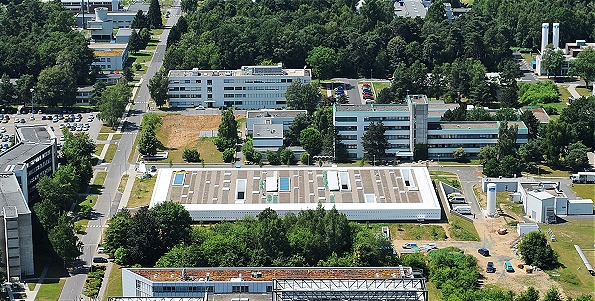
The DLR Institute of Aerospace Medicine.
Credit: DLR
Follow-up exams
The test subjects will undergo regular examinations and tests. All test subjects will be examined and tested for an additional two weeks following their time in bedrest.
After their stay in envihab, the test subjects will participate in five follow-up examinations over the next two years.
The DLR Institute of Aerospace Medicine is a one-of-a-kind, highly sophisticated medical research facility in Cologne. A one-story, 3500-square-meter, state-of-the-art space, :envihab (from the words “Environment” and “Habitat”) is used to explore the effects of extreme environmental conditions on humans and to determine possible countermeasures.

Credit: SASTIND

After releasing a test return capsule to Earth, the solar-powered service module first loitered at Earth-Moon L2 and then moved into orbit around the Moon.
Credit: CCTV/China Space Website
Chinese space officials have released new images of the Moon – apparently focused on the landing site of that country’s future Chang’e 5 lunar lander.
Target date for China’s ambitious robotic Moon probe mission is in 2017.
Chang’e 5 is slated to soft land on the moon, snag surface specimens, fly them into lunar orbit, then rocket those samples back to Earth.
Circumlunar mission
In a statement by the State Administration of Science, Technology and Industry for National Defense (SASTIND), the pictures have a resolution of roughly 3 feet (one meter).
The images were taken by China’s orbiting service module that was sent circling the Moon after a visit to the Earth-Moon Lagrangian L2 position last year.

Pre-launch photo shows China’s experimental craft that completed a circumlunar flight last year. Capsule evaluated technologies for a robotic lunar sample return effort slated for 2017 liftoff.
Credit: CASC/China Space
That service module was boosted on a Long March 3C rocket from China on October 24, 2014. It was part of China’s circumlunar mission that also saw flight of an experimental capsule – often called the Chang’ e 5-T1 test mission – that made a fiery, skip re-entry and parachute landing back to Earth. The capsule was recovered in Siziwangqi in Inner Mongolia of China on November 1, 2014.
Shakeout voyage
The long looping roundtrip between Earth and the Moon, then having the service module park itself in lunar orbit, mimics a variety of shakeout actions to be taken by the Chang’e 5 robotic lunar exploration project.
SASTIND noted that the current service module circuiting the Moon is in good condition and will carry out further scientific experiments to study the lunar gravity field.
For an interesting video that depicts China’s Chang’e 5 mission, go to:

Credit: Integrated Space Analytics
Here’s a way to take part in shaping humankind’s up and going trajectory into space. And to do so, everyone needs a plan and some guideposts on which you can hang your space helmet.
The Integrated Space Plan – an evolutionary matrix of capabilities — is billed as “the most comprehensive vision of the next 100 years of space development ever produced” – compiled into a single graphic.
Space history 101
In the late 1980s, Ron Jones – then working for Rockwell International – created the first Integrated Space Plan (ISP), a visual representation showing how major space infrastructure elements fit together.
Now a founding team member at Integrated Space Analytics, Jones continues to draw upon his architectural aplomb as an aerospace professional with 25 years of experience primarily at NASA, Martin Marietta, Rockwell, and Boeing.
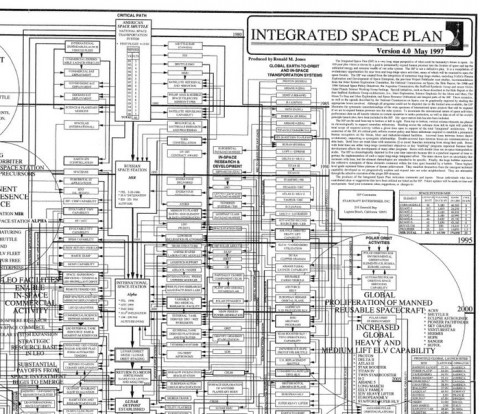
Excerpt of past 4.0 space future, circa 1997.
Credit: Integrated Space Analytics
Integrated Space Analytics was created by the Space Finance Group (SFG) in 2014. Members of SFG believed in the importance of the original Integrated Space Plan as a vehicle for teaching people about space.
A successful Kickstarter project campaign last summer made possible the funding of a new edition of the Plan. At present, work is progressing on developing a website that is an active and growing information resource for space professionals and others.
Guideposts up ahead!
The Integrated Space Plan is better described as a set of guideposts for things that will be needed, rather than a flowchart. The ISP is available in full-color poster format, but is also available for the first time through an interactive website.
Indeed, thanks to the Internet, a specially created website offers the Integrated Space Plan 2015, an edition that includes blocks linked to a page about the topic of the block.
“We encourage ideas and feedback from the global aerospace community as we begin to apply crowdsourcing techniques to human expansion into space,” notes Gary Bickford, Chief Technical Officer of Integrated Space Analytics (ISA).
“Over the next year, ISA will continue the Integrated Space Plan’s development with emphasis on Earth-Moon transportation architecture and lunar base definition needs,” Jones explains, “where the private sector is likely to play an evolving role.”
Adds Steven Jorgenson, Chief Financial Officer and Venture Capital advisor of ISA: “One of our objectives is to offer the private sector insights into areas of future participation in space development.”
For more information on the Integrated Space Plan, go to:

Artist’s concept of the Hedgehog robot, able to function regardless of which side lands up.
Credit: NASA/JPL-Caltech/Stanford
Rolling and tumbling on another world sounds like a bad and busting idea.
But a robot concept called Hedgehog could explore the microgravity environment of comets and asteroids by hopping and rolling around on them.
While a Mars rover can’t operate upside down, its wheels in the air, the Hedgehog robot can function regardless of which side lands up.
The project is being jointly developed by researchers at NASA’s Jet Propulsion Laboratory (JPL) in Pasadena, California; Stanford University in Stanford, California; and the Massachusetts Institute of Technology in Cambridge.
Spikes and flywheels
The JPL Hedgehog prototype has eight spikes and three flywheels. It weighs about 11 pounds (5 kilograms) by itself, but the researchers envision that it could weigh more than 20 pounds (9 kilograms) with instruments such as cameras and spectrometers.
The Stanford prototype is slightly smaller and lighter, and it has shorter spikes.
Both prototypes maneuver by spinning and stopping three internal flywheels using motors and brakes. The braking mechanisms differ between the two prototypes. JPL’s version uses disc brakes, and Stanford’s prototype uses friction belts to stop the flywheels abruptly.
Spreading out for discovery
Researchers are currently working on Hedgehog’s autonomy, trying to increase how much the robots can do by themselves without instructions from Earth.
Their idea is that an orbiting mothership would relay signals to and from the robot, similar to how NASA’s Mars rovers Curiosity and Opportunity communicate via satellites orbiting Mars. The mothership would also help the robots navigate and determine their positions.
A Hedgehog robot is relatively low-cost compared to a traditional rover, and several could be packaged together for flight.
The mothership could release many robots at once or in stages, letting them spread out to make discoveries on a world never traversed before.
Hedgehog is currently in Phase II development through the NASA Innovative Advanced Concepts (NIAC) Program.
Take a look at this new video on Hedgehog and its development by going to:
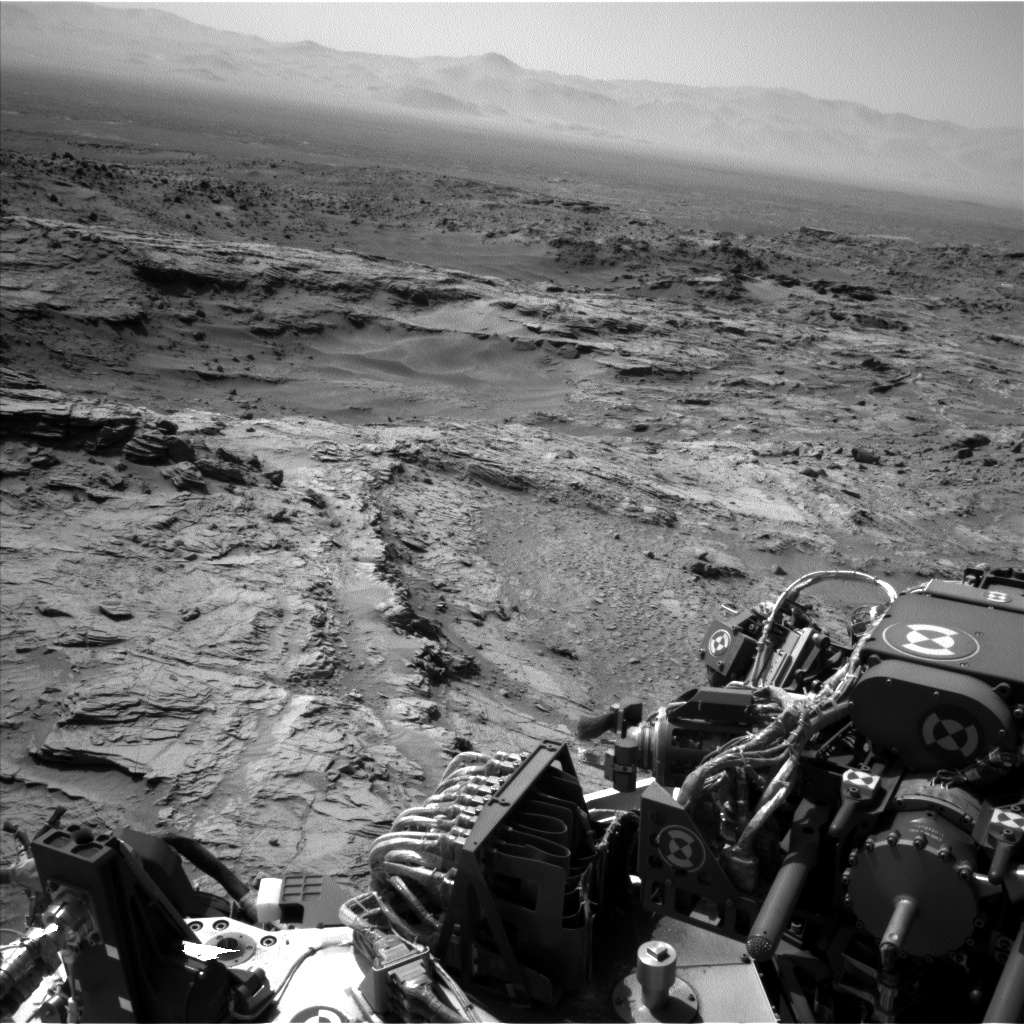
This image was taken by Navcam: Left B onboard NASA’s Mars rover Curiosity on September 3, 2015, Sol 1093.
Credit: NASA/JPL-Caltech
NASA’s Curiosity Mars rover is back on the road.
Earlier this week, successful “contact science” on the Stimson unit in the Williams area on Mars was done.
The robot is continuing on its drive towards Bridger Basin and eventually the Bagnold Dunes, reports Lauren Edgar, a research geologist at the USGS Astrogeology Science Center in Flagstaff, Arizona and a member of Mars Science Laboratory’s science team.
Dusting off Ledger
A set of observations using Curiosity’s Mastcam and ChemCam instruments were planned that were focused on “Interlake,” “Ledger,” and “Mackay Dome” targets.
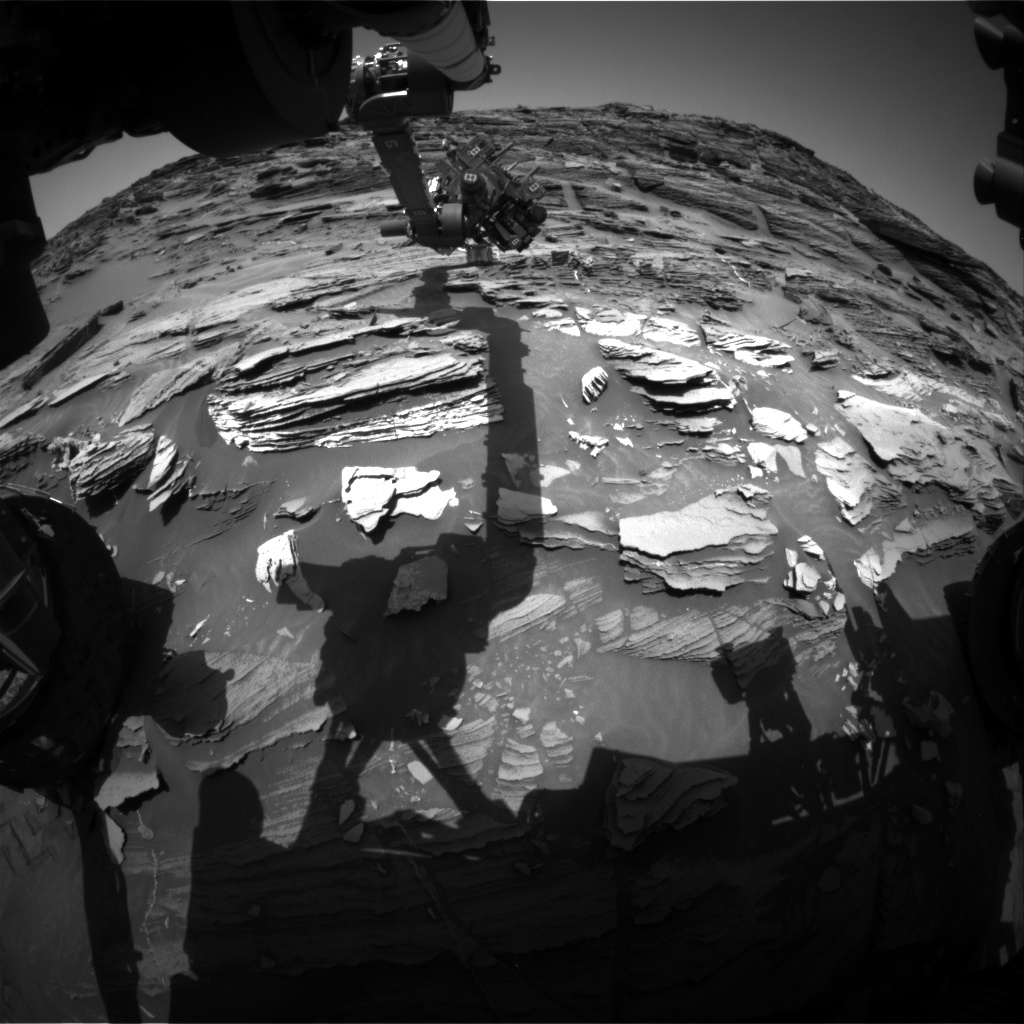
This image of Williams area was taken by Front Hazcam: Left B onboard NASA’s Mars rover Curiosity on September 2, 2015, Sol 1092.
Credit: NASA/JPL-Caltech
“Since ‘Ledger’ is a nice flat ledge,” Edgar notes, “it’s also a good target for the DRT [Dust Removal Tool], so we can brush away the dust to expose a fresh surface.”Mastcam was also to look at the Sun to measure the atmospheric opacity on Mars, Edgar adds.
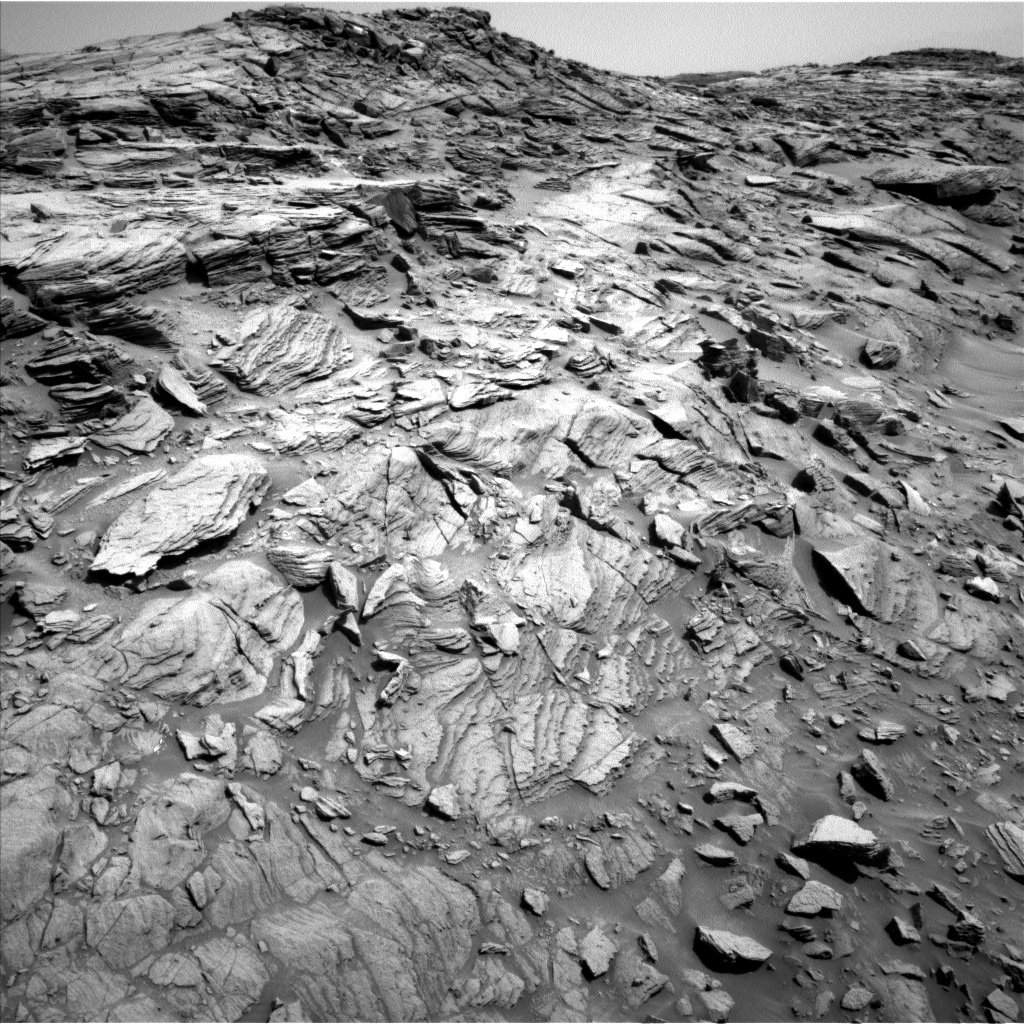
Curiosity’s Navcam: Left B on September 3, Sol 1093.
Credit: NASA/JPL-Caltech
“It’s exciting to be driving again, and I’m sure we’ll encounter some beautiful views as we continue to drive through this interesting terrain,” Edgar reports.
Credit: Northrop Grumman
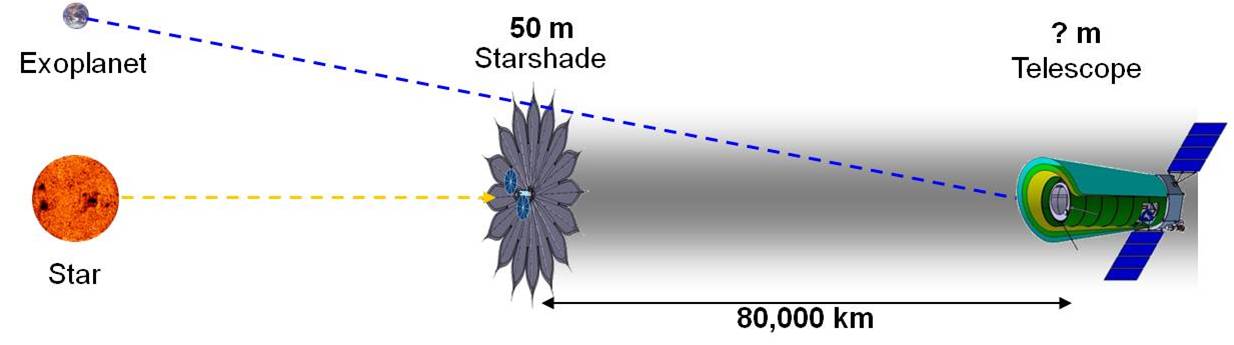
Testing is on-going to develop an in-space starshade that can block the light from a primary star while allowing light from dimmer orbiting planets to be spotted by future space-based telescopes.
Along with desert tests here on Earth, the McMath-Pierce Solar Telescope at Kitt Peak National Observatory in Arizona has been used to model a starshade’s ability to eventually find and characterize rocky worlds, like Earth.
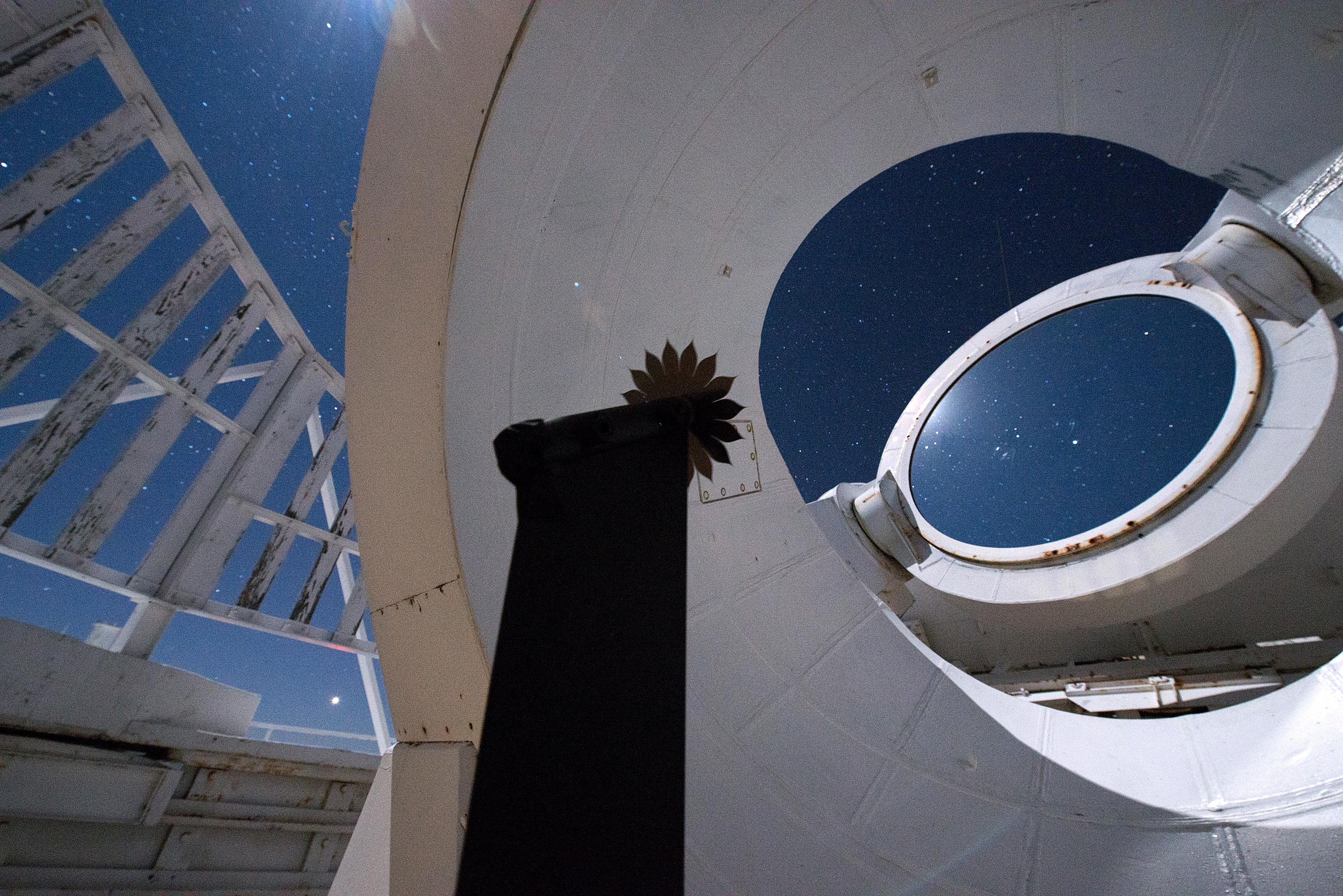
Technicians have made use of the McMath-Pierce Solar Telescope at Kitt Peak National Observatory in Arizona to assess and validate optical models of starshade designs.
Credit: Northrop Grumman/Robert Brown
A possible early use of a starshade may be tied to the Wide-Field Infrared Survey Telescope (WFIRST) – an orbiting telescope with a 2.4 meter primary mirror — the same size as the Hubble Space Telescope mirror – that was provided to NASA by the U.S. spy agency, the National Reconnaissance Office (NRO).
Check out my new Space.com story on this concept at:
How ‘Starshades’ Could Aid Search for Alien Life
http://www.space.com/30429-starshade-alien-life-search-wfirst-tech.html
Credit: ESA
Europe is ratcheting up the strategic significance of the Moon in a global space exploration endeavor.
For example, in the European Space Agency’s (ESA) Space Exploration Strategy it spells out the mission theme of “sustainable exploration of the Moon is integrated in the strategic exploration approach for Europe.”
A guiding principle in Europe is to implement exploration missions with humans and robots in a coordinated manner.
Key to realizing the Lunar Exploration Vision 2030 is the step-wise deployment of international exploration architecture. This vision envisages access for robots and humans to previously unexplored regions.
International vision
The ESA exploration strategy considers the Moon as the next destination for humans venturing beyond low Earth orbit and an integral element of the roadmap towards humans missions to Mars.
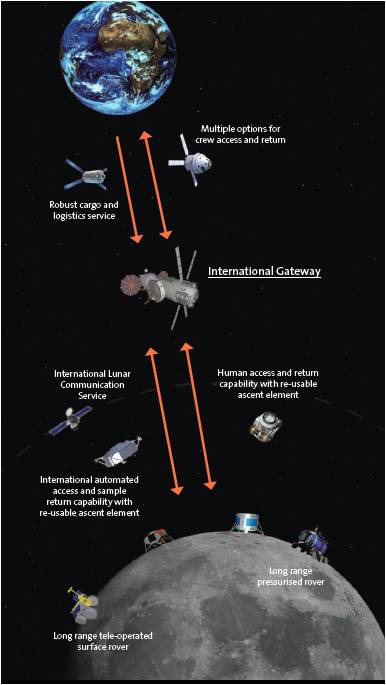
Credit: ESA
“The international vision for lunar exploration calls for a new era of coordinated human and robotic missions enabled by broad international cooperation,” explains former astronaut, Thomas Reiter, ESA Director of Human Spaceflight and Operations.
Reiter notes that the ISS program has demonstrated the importance of a robust international partnership for the station’s development, assembly, operations and effective utilization.
“Now is the time to build on this partnership and open it to new partners to continue the journey beyond low Earth orbit,” Reiter says.
Investments
There are investments by governments and private stakeholders in space exploration, such as:
— In Europe the program of Life and Physical Science in Space (ELIPS) helps understanding how humans can live and work in space.
— A Russian-lead Luna program that takes the next steps in automated exploration of the lunar surface.
— ESA already contributes to the critical path of human transpiration beyond low Earth orbit by providing the service module to the US-lead Orion vehicle.
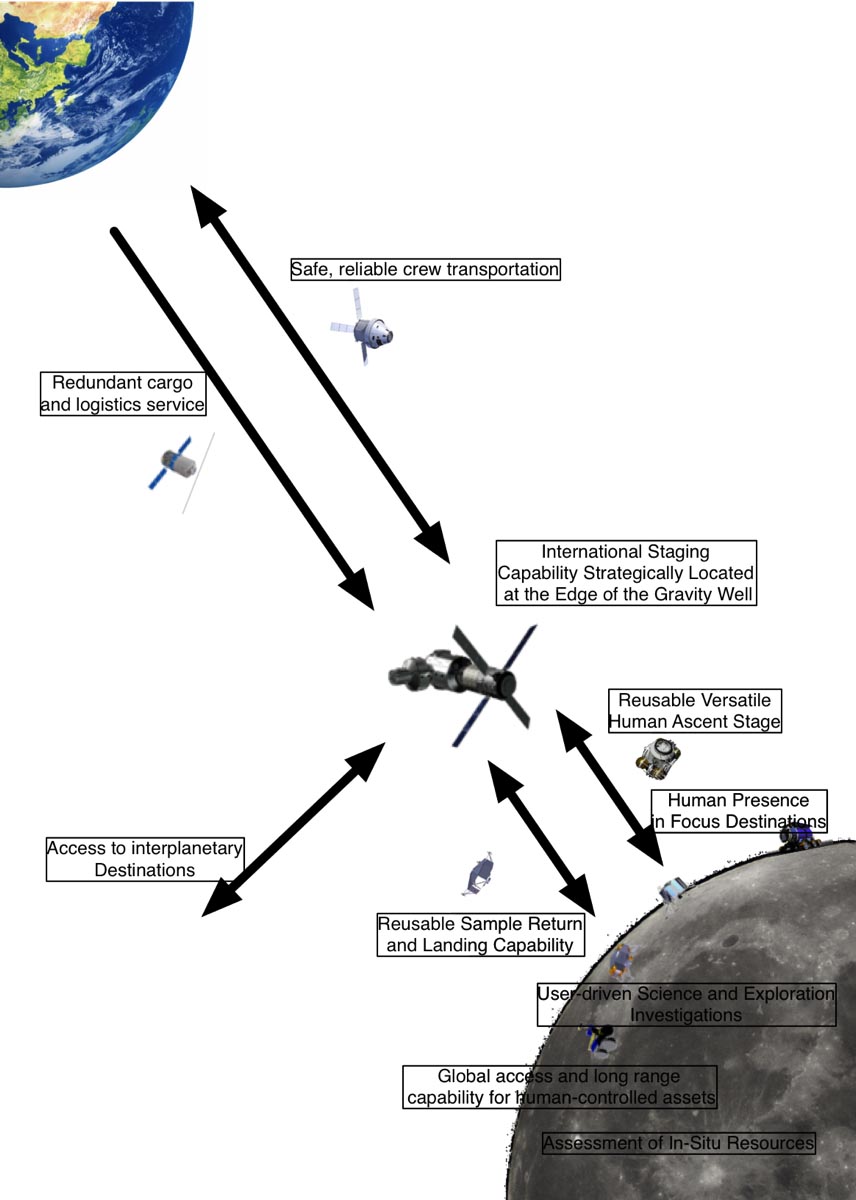
Credit: ESA
Sustainable and affordable framework
“This is the time to formulate a concrete vision of how to explore the Moon in the next decade in a sustainable and affordable framework,” explains an ESA brochure for an upcoming ESA-led symposium titled: International Symposium on MOON 2020-2030 – A New Era of Coordinated Human and Robotic Exploration.
The symposium will feature technical sessions addressing the strategies and challenges of human robotic cooperation on the Moon.
The meeting is to be held December 15-16 at ESA/ESTEC in Noordwijk, The Netherlands.
For more information, go to:

Curiosity Mastcam Left image taken on August 25, 2015, Sol 1085.
Credit: NASA/JPL-Caltech/MSSS
“Curiosity is currently making her way through some beautiful exposures of the Stimson unit,” reports Lauren Edgar of the USGS Astrogeology Science Center in Flagstaff, Arizona.
The rover completed a roughly 20-foot (6-meter) drive on Sol 1087 and Curiosity is in a good position for possible contact science early next week, Edgar adds.
Weekend work for the robot is that on Sol 1089 Curiosity is to drop off part of the Buckskin drill sample to the Sample Analysis at Mars (SAM) Instrument Suite.
The plan calls for dumping the Buckskin post-sieve sample, and analyze it with the Alpha Particle X-Ray Spectrometer (APXS).
Bedrock features
The schedule also includes Mastcam and Mars Hand Lens Imager (MAHLI) imaging to document the dump pile, Edgar adds. “Sol 1090 consists of several ChemCam observations of the targets “Fox Hills,” “OBriens Creek,” and “Bearpaw” to investigate the bedrock and local alteration features.”
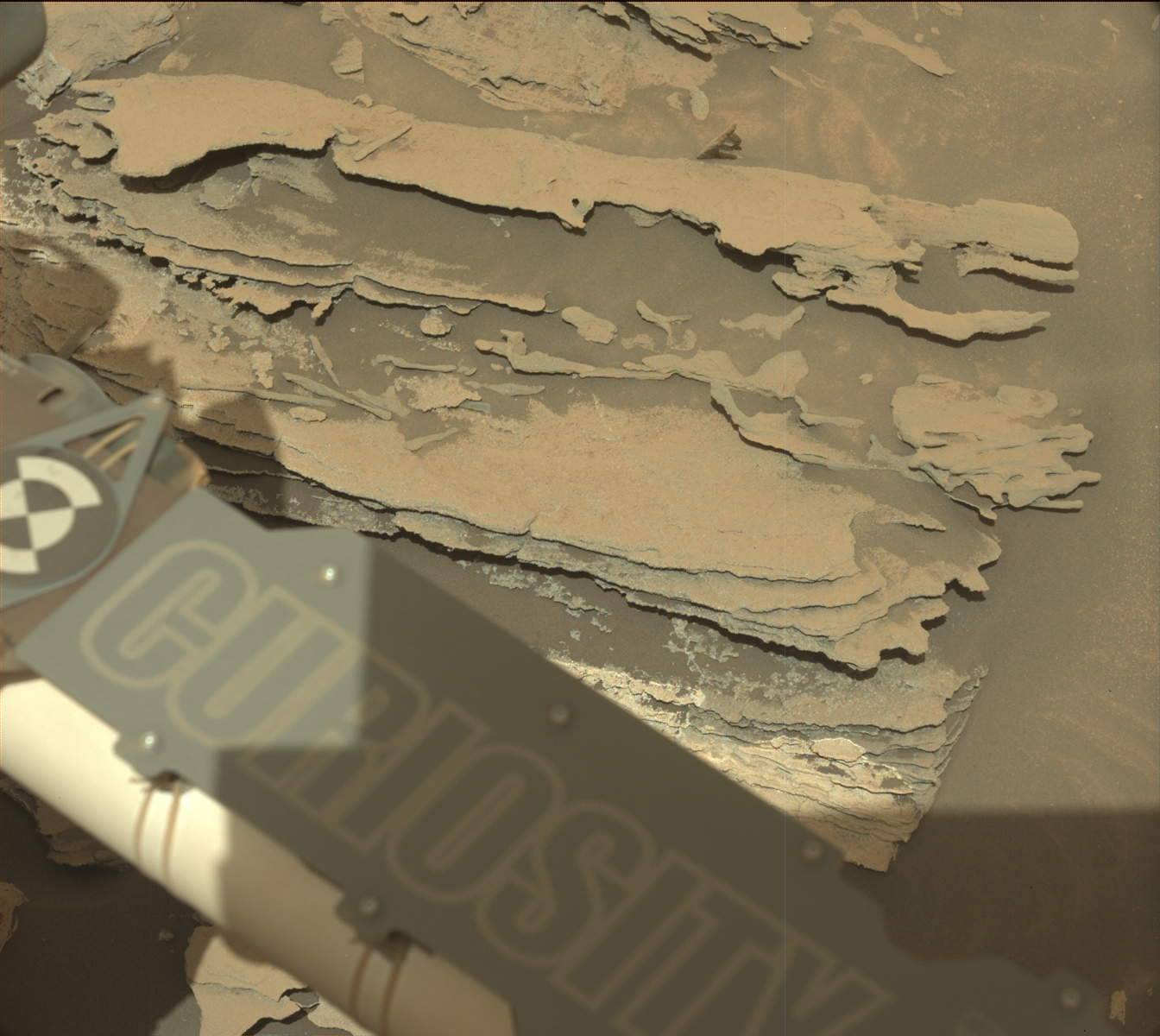
Curiosity Mastcam Left image taken on Sol 1087, August 28, 2015.
Credit: NASA/JPL-Caltech/MSSS
Also on tap is to acquire a large Mastcam mosaic to document the stratigraphy, and a Navcam deck pan for dust monitoring.
“This region has some particularly stunning views,” Edgar notes, “so I’m looking forward to seeing the new mosaics!”
Note: Dates of planned rover activities are always subject to change due to a variety of factors related to the Martian environment, communication relays and rover status.

Credit: Planetary Resources, Inc.
Planetary Resources, the asteroid mining company, has developed an informative list of several interesting and valuable near-Earth asteroid prospecting and mining targets in the Solar System.
According to the group, many of these targets are valued in the trillions of dollars.
How they go about selecting the targets – and the technology they are developing to expand that list is contained in their latest blog post.
Space drones
For one, at the group’s spacecraft factory in Redmond, Washington, Arkyd rendezvous prospectors are being built. These “space drones” are highly capable, low cost spacecraft that will be equipped with hyperspectral and infrared sensors.
These drones would swarm prospective targets and collect information on the composition of the asteroid, analyze that information on the spot, and send back that data to a team of experts at Planetary Resources.
Already in Earth orbit, the firm’s Arkyd 3R — deployed from the International Space Station (ISS) last July — that satellite is testing several underlying technologies headed for the Arkyd spacecraft.
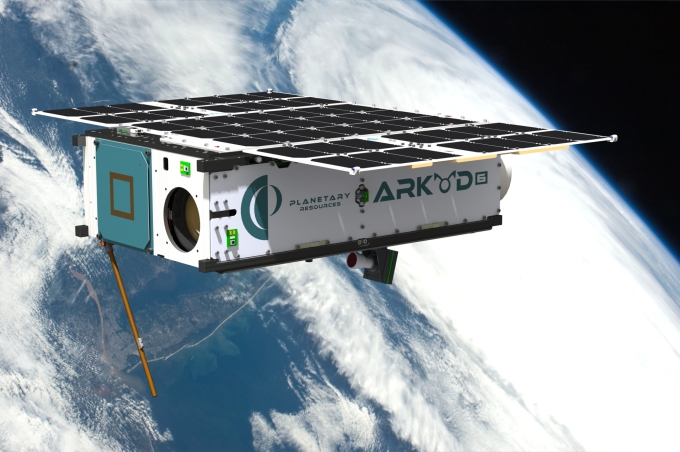
Arkyd 6, launching later this year.
Credit: Planetary Resources, Inc.
Slated for launch later this year, the Arkyd 6 (A6) is a slightly larger spacecraft that will carry the organization’s first infrared imaging sensor that can be utilized to identify water resources on asteroids.
Target list
“In the process of gathering additional data through our prospecting mission, we can begin to define the mission profile for extraction, and determine the final scope, cost, difficulty, and feasibility of the mission,” explains Caitlin O’Keefe, Director of Marketing at Planetary Resources, Inc.
“As we continue to gain more intelligence on the near-Earth asteroids and develop our prospecting technologies,” O’Keefe adds, “we will undoubtedly add even more exciting targets to our already growing list.”
To review a table and other information that explains the specific differences when considering a “good” target and a “non-ideal” target near-Earth asteroid, go to these edifying locations:
http://www.planetaryresources.com/2015/08/how-we-choose-our-asteroid-targets/
http://www.planetaryresources.com/asteroids/#asteroids-targets

