Archive for the ‘Space News’ Category
 Author:
  January 11th, 2016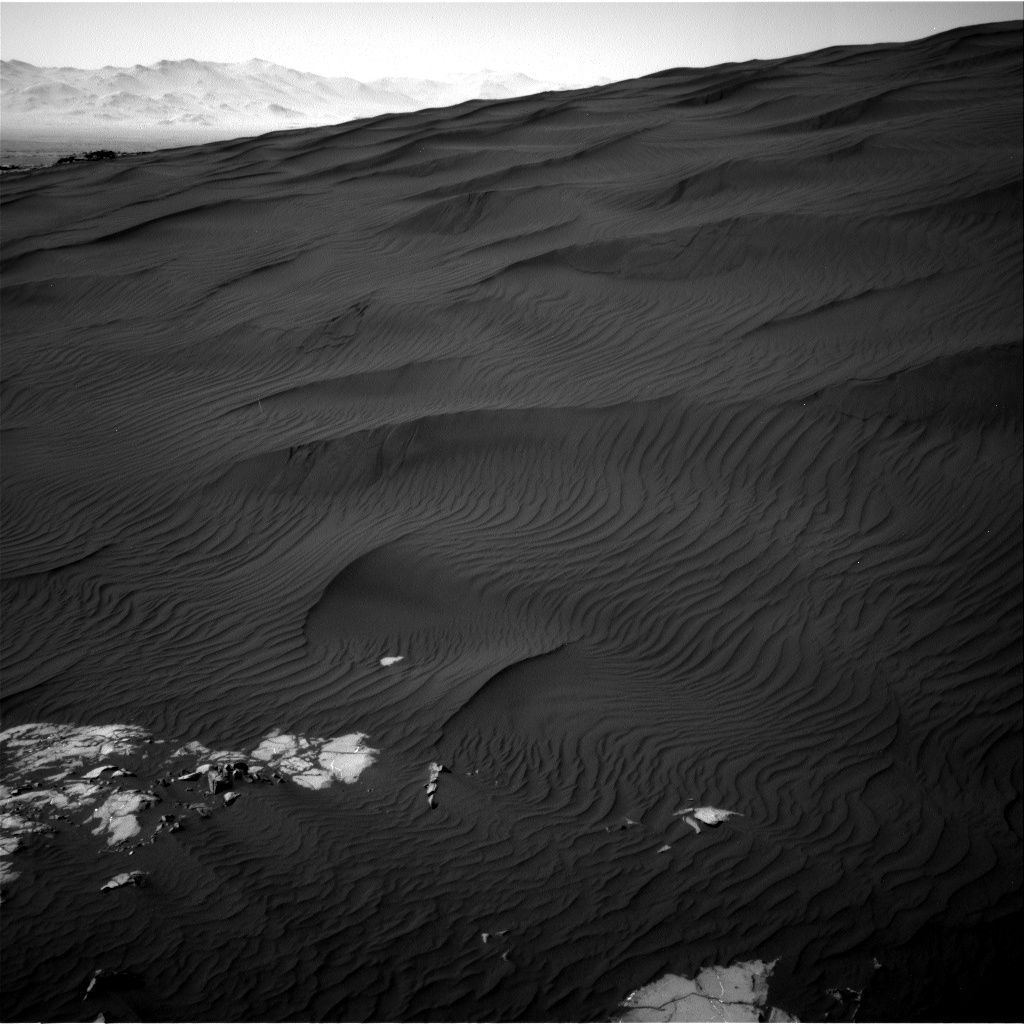
Curiosity’s Navcam Right B took this image on Sol 1216, January 7, 2016.
Credit: NASA/JPL-Caltech
(Update)
The Curiosity rover has recovered from a motor controller anomaly, reports USGS Mars scientist, Ken Herkenhoff. Tactical operations are back on track, with a drive to the dune sampling area planned for Sol 1221.
Late last week, the rover encountered an anomaly, reports Lauren Edgar, a research geologist at the USGS Astrogeology Science Center in Flagstaff, Arizona and a member of the Mars Science Laboratory science team.
The problem prevented any use of motors during Sol 1217, putting off “bump and scuff” action by the robot. A bump is a short drive, with Curiosity turning its right front wheel to create a scuff in the sand.
“No motors meant no drive and no scuff, and most of our planned activities did not occur,” Edgar explains. So the day turned into a recovery day, “first trying to assess what happened and why it happened, and then figuring out how to proceed.”
“Ultimately we delivered some ChemCam and Mastcam activities that will help to assess the composition of the soil, and search for any wind-driven movement of fines,” Edgar adds.
A weekend plan provided an opportunity to do several coordinated change-detection observations using both the robot’s Mastcam and Rover Environmental Monitoring Station (REMS) at multiple times throughout the day.
Looking ahead to this week, Edgar says, “we’re hoping to proceed with the bump and scuff to get back on track with the Namib Dune sampling activities!”
 Posted in

Rosetta’s Optical, Specroscopic, and Infrared Remote Imaging System (OSIRIS) acquired this image of Comet 67P/Churyumov-Gerasimenko on December 20, 2015 from a distance of 57 miles (91.5 kilometers).
Credit: ESA/Rosetta/MPS for OSIRIS Team/MPS/UPD/LAM/IAA/SSO/INTA/UPM/DASP/IDA
The European Space Agency’s (ESA) comet lander bounced to full stop on November 12, 2015 atop Comet 67P/Churyumov-Gerasimenko.
The last clear sign of life from the probe was received on July 9, 2015. Since then mum’s been the word.
But now planned for January 10th, ground controllers will, for the first time, send a command to Philae to spin up its flywheel. The hope is to impart some angular momentum to the lander as it sits silently on the comet.
Time running out
“At best, the spacecraft might shake dust from its solar panels and better align itself with the Sun,” explains Technical Project Manager Koen Geurts.
In the worst case, the lander will not receive the commands sent by engineers and scientists at the German Aerospace Center (Deutsches Zentrum für Luft- und Raumfahrt (DLR).

German Aerospace Center (Deutsches Zentrum für Luft- und Raumfahrt (DLR) in Cologne is home to the control center for the Philae comet lander.
Credit: DLR
DLR in Cologne is home to the control center for the Philae lander.
“Time is running out, so we want to explore all possibilities,” says DLR Project Leader Stephan Ulamec.
Lander-hostile
By the end of January things will become increasingly uncomfortable for Philae as the comet continues to move away from the Sun. Conditions on the comet will be “lander-hostile” and Philae’s mission is expected to come to a natural end, according to a DLR press statement.
“There is a small chance,” adds Cinzia Fantinati, an Operations Manager on the DLR control room team.
“We want to leave no stone unturned,” Fantinati explains. The communications unit on board Rosetta will remain active and continue to listen for a signal from Philae beyond mid-January.
ESA’s Rosetta orbiter that dispatched Philae will remain active until September 2016.
Rosetta is an ESA mission with contributions from its member states and NASA. Rosetta’s Philae lander is provided by a consortium headed by DLR, the Max Planck Institute for Solar System Research (MPS), the French Space Agency (CNES) and the Italian Space Agency (ASI).

Curiosity’s Navcam Left B took this image on Sol 1216 January 7, 2016.
Credit: NASA/JPL-Caltech
Just entering Sol 2017, the NASA Curiosity Mars rover took another spin of the wheels, traveling over 140 feet (43 meters) toward the Namib Dune sampling location.
“That meant that today we had to decide on our final sampling spot, and there were many different factors to consider,” advised Lauren Edgar, a research geologist at the USGS Astrogeology Science Center in Flagstaff, Arizona.
It has been busy trying to figure out our top science priorities, Edgar adds.

Curiosity’s Navcam Right B camera image taken on Sol 1215 January 6, 2016.
Credit: NASA/JPL-Caltech
“We eventually settled on a location that met all of our science objectives,” Edgar notes, “a sharp-crested ripple that would provide access to sample both coarse and fine-grained material, that was relatively dust free, implying more activity, and would allow a favorable rover orientation. Now we just have to hope that the drive and wheel scuff go smoothly!”
Curiosity is slated to drive toward the sampling location, and will turn the right front wheel to create a scuff in the sand.
“After the drive we’ll take more imaging to prepare for targeting in the weekend plan,” Edgar said. “In the afternoon, we’ll also use Mastcam for a change-detection observation of a nearby ripple…so I’m excited to see how the plan works out!”

Curiosity Rover’s Location for Sol 1215.
This map shows the route driven by NASA’s Mars rover Curiosity through the 1215 Martian day, or sol, of the rover’s mission on Mars as of January, 06, 2016.
Numbering of the dots along the line indicate the sol number of each drive. North is up. From Sol 1204 to Sol 1215, Curiosity had driven a straight line distance of about 172.01 feet (52.43 meters).
The base image from the map is from the High Resolution Imaging Science Experiment Camera (HiRISE) in NASA’s Mars Reconnaissance Orbiter.
Image Credit: NASA/JPL-Caltech/Univ. of Arizona
Planned rover activities are just that, subject to change due to a variety of factors related to the Martian environment, communication relays and rover status.

NASA has created a special office to deal with coordinating response to threatening near-Earth objects (NEOs).
Credit: Texas A&M
A major step has been taken to coordinate U.S. agencies and intergovernmental efforts to respond to future near-Earth objects that threaten Earth.
NASA announced today the creation of a Planetary Defense Coordination Office (PDCO).
Lindley Johnson, NASA’s current near-Earth object (NEO) program executive will lead the newly established office.

NASA’s Lindley Johnson will head the space agency’s new Planetary Defense Coordination Office.
Credit: Leonard David
The PDCO will reside within NASA’s Planetary Science Division, in the agency’s Science Mission Directorate in Washington, D.C.
“The formal establishment of the Planetary Defense Coordination Office makes it evident that the agency is committed to perform a leadership role in national and international efforts for detection of these natural impact hazards, and to be engaged in planning if there is a need for planetary defense,” said Johnson in a NASA statement.
Planetary defense duties
What will the office do?
- Supervision of all NASA-funded projects to find and characterize asteroids and comets that pass near Earth’s orbit around the Sun;
- Lead the coordination of interagency and intergovernmental efforts to plan response to any potential impact threats.
- Improve and expand on past efforts with other U.S. federal agencies and departments, such as the Federal Emergency Management Agency (FEMA).
- Continue to assist with the coordination across the U.S. government, including planning for response to an actual impact threat and working in conjunction with FEMA, the Department of Defense, other U.S. agencies, and international counterparts.
- Issue notices of close passes and warnings of any detected potential NEO impacts, based on credible science data.
Collaborative relationship
“FEMA is dedicated to protecting against all hazards, and the launch of the coordination office will ensure early detection and warning capability, and will further enhance FEMA’s collaborative relationship with NASA,” said FEMA Administrator Craig Fugate in a space agency press statement.
“Even if intervention is not possible, NASA would provide expert input to FEMA about impact timing, location, and effects to inform emergency response operations. In turn, FEMA would handle the preparations and response planning related to the consequences of atmospheric entry or impact to U.S. communities,” NASA explains in its announcement of the new PDCO.

Chelyabinsk sky rendering is a reconstruction of the asteroid that exploded over Chelyabinsk, Russia on Feb. 15, 2013. Scientific study of the airburst has provided information about the origin, trajectory and power of the explosion. This simulation of the Chelyabinsk meteor explosion by Mark Boslough was rendered by Brad Carvey using the CTH code on Sandia National Laboratories’ Red Sky supercomputer. Andrea Carvey composited the wireframe tail. Photo by Olga Kruglova.
Credit: Sandia National Laboratories.
According to a statement from the National Science Foundation (NSF):
“NSF welcomes the increased visibility afforded to this critical activity,” said Nigel Sharp, program director in the agency’s Division of Astronomical Sciences. “We look forward to continuing the fruitful collaboration across the agencies to bring all of our resources – both ground-based and space-based – to the study of this important problem,” he added.
Wake-up call
More than 13,500 near-Earth objects of all sizes have been discovered to date—more than 95 percent of them since NASA-funded surveys began in 1998. About 1,500 NEOs are now detected each year.
Considered a 21st century wake-up call, the Chelyabinsk super-fireball explosion over Russia in 2013 spotlighted dangers from the heavens – an event that helped prod international resolve to deal with NEOs in an organized manner.
For its part, NASA’s long-term planetary defense goals include developing technology and techniques for deflecting or redirecting objects that are determined to be on an impact course with Earth.
Reduce the risk
The recently passed federal budget for fiscal year 2016 includes $50 million for NEO observations and planetary defense, representing a more than ten-fold increase since the beginning of the President Obama administration.
Indeed, within the White House National Space Policy released on June 28, 2010, it notes under “Civil Space Guidelines” that the Administrator of NASA shall:
“Pursue capabilities, in cooperation with other departments, agencies, and commercial partners, to detect, track, catalog, and characterize near-Earth objects to reduce the risk of harm to humans from an unexpected impact on our planet and to identify potentially resource-rich planetary objects.”
For more information on NASA’s Planetary Defense Coordination Office, this website is to be updated with additional details:
https://www.nasa.gov/planetarydefense
NOTE: The idea of such an office has been years in the making. For example, go to my Space.com article from 2010:
Planetary Defense Coordination Office Proposed to Fight Asteroids
http://www.space.com/9356-planetary-defense-coordination-office-proposed-fight-asteroids.html
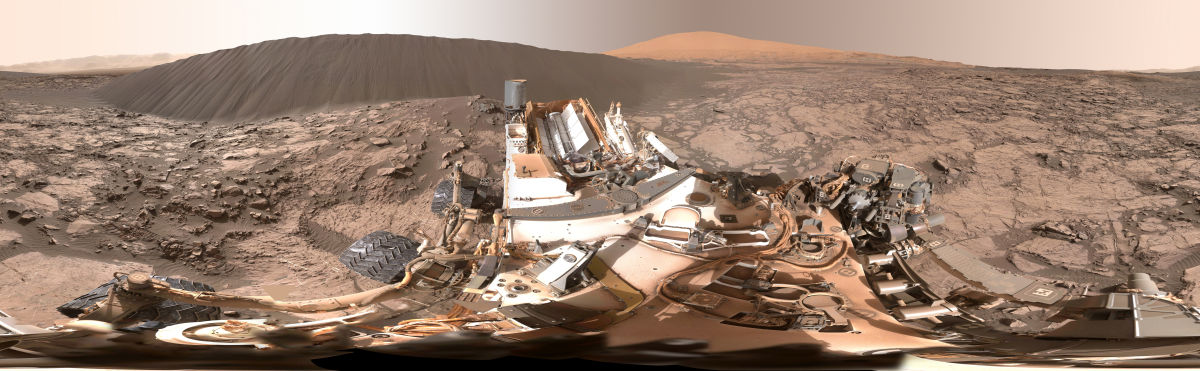
This view of the downwind face of “Namib Dune” on Mars covers 360 degrees, including a portion of Mount Sharp on the horizon. The site is part of the dark-sand “Bagnold Dunes” field along the northwestern flank of Mount Sharp. Images taken from orbit indicate that dunes in the Bagnold field move as much as about 3 feet (1 meter) per Earth year.
Credit: NASA/JPL-Caltech/MSSS
Working hard in Sol 1215 mode, NASA’s Curiosity Mars rover is partway through the first up-close study ever conducted of extraterrestrial sand dunes.
The rover is providing dramatic views of a dune’s steep face, where cascading sand has sculpted very different textures than the wavy ripples visible on the dune’s windward slope.
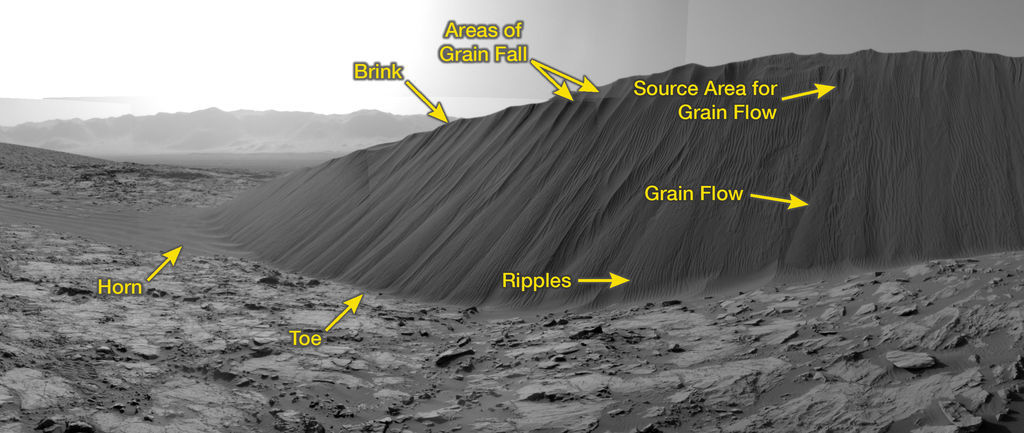
This view from NASA’s Curiosity Mars Rover shows the downwind side of “Namib Dune,” which stands about 13 feet (4 meters) high. The site is part of Bagnold Dunes, a band of dark sand dunes along the northwestern flank of Mars’ Mount Sharp.
Credit: NASA/JPL-Caltech
The downwind side of an active sand dune has a steep slope called a slip face.
New location
“After wrapping up our holiday investigation on the lee side of Namib Dune, it’s time to move to a new location along the dune to sample the chemistry and mineralogy of the sand,” reports Lauren Edgar, a research geologist at the USGS Astrogeology Science Center in Flagstaff, Arizona.
Recent rover tasks included checking out the wheels, followed by a long drive.
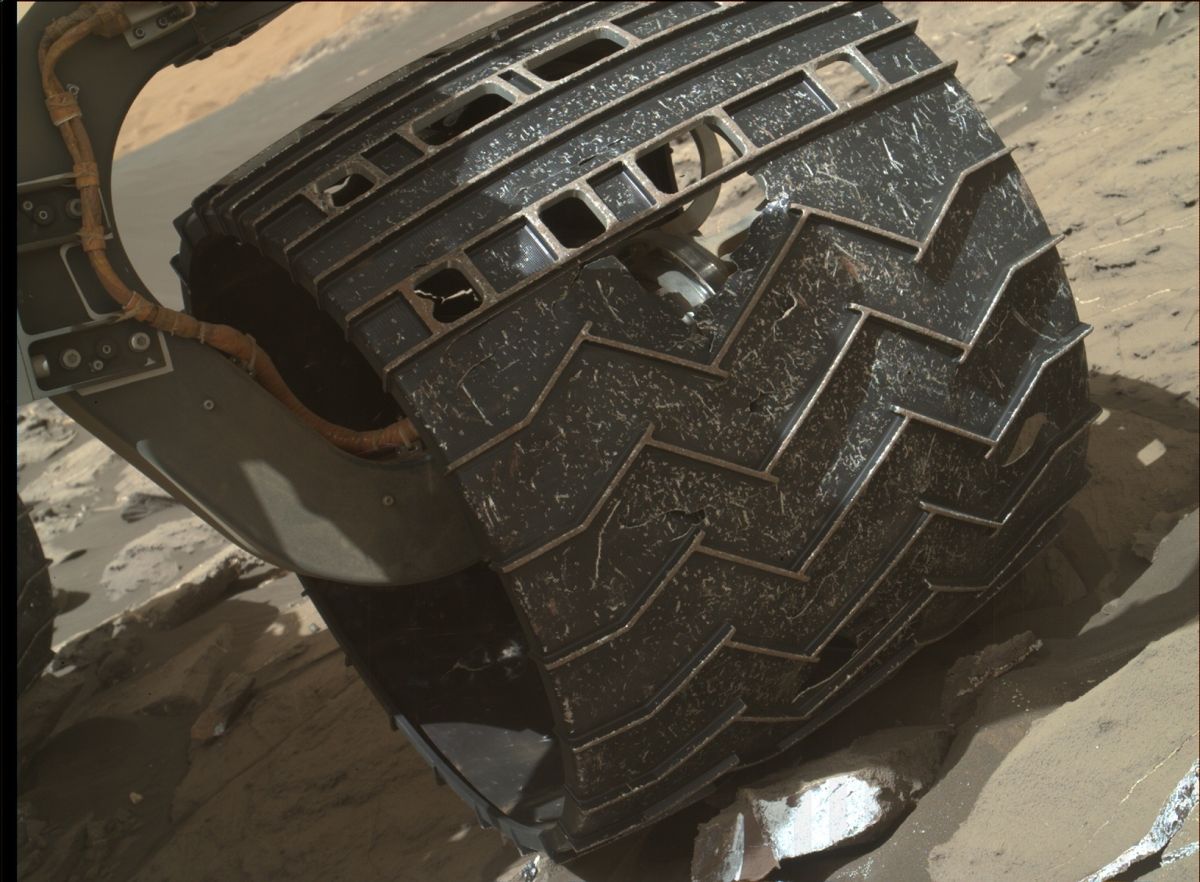
Taking a January 5 look at wheel damage using the Mars Hand Lens Imager (MAHLI), located on the turret at the end of the rover’s robotic arm.
Credit: NASA/JPL-Caltech/MSSS
The new site will allow easier access for sampling part of the active dune, Edgar adds.
The plan calls for the robot to perform a number of atmospheric monitoring activities, including several Navcam movies, and a passive sky observation.
According to the Jet Propulsion Laboratory (JPL), Curiosity’s dune-investigation campaign is “designed to increase understanding about how wind moves and sorts grains of sand, in an environment with less gravity and much less atmosphere than well-studied dune fields on Earth.”
Active dunes
The Bagnold Dunes that the Mars machinery is monitoring are active.
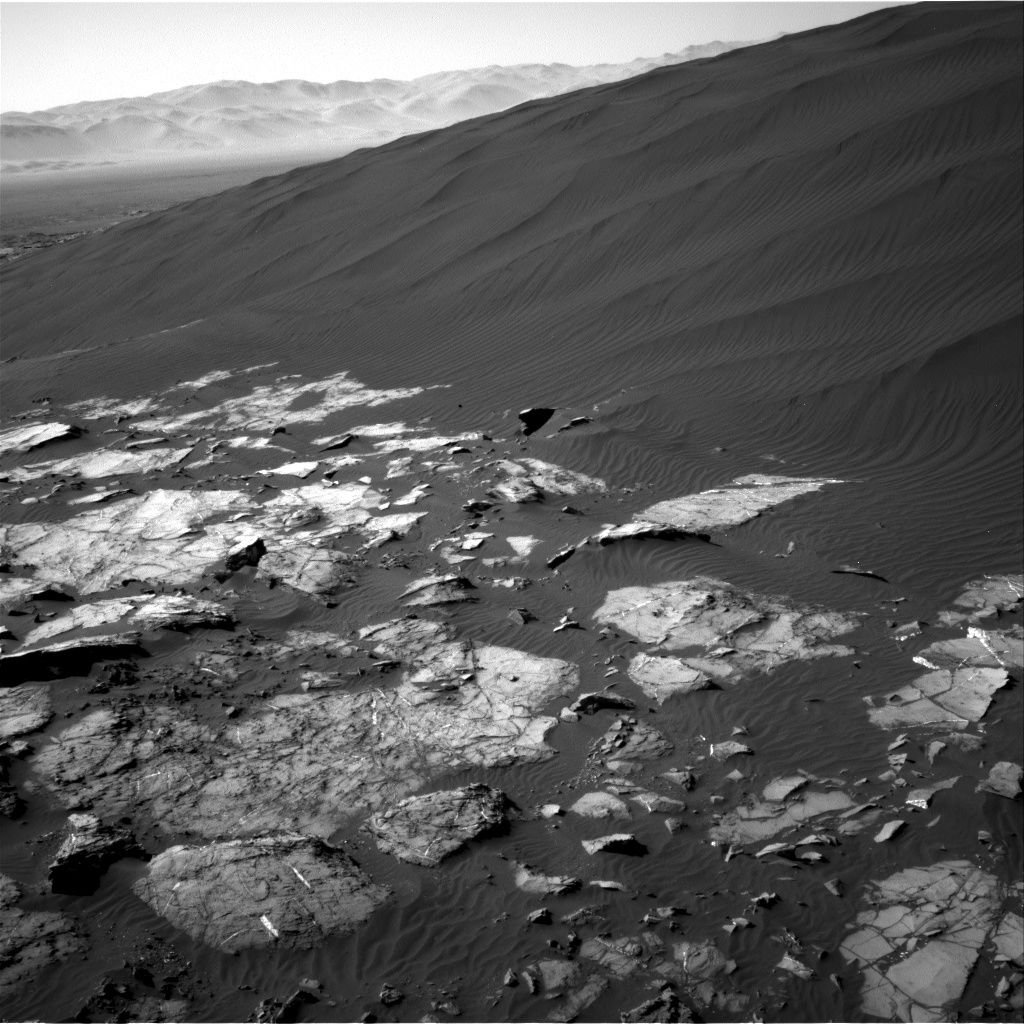
Curiosity Navcam Right B image taken on Sol 1215, January 6, 2016.
Credit: NASA/JPL-Caltech
“Sequential images taken from orbit over the course of multiple years show that some of these dunes are migrating by as much as a yard, or meter, per Earth year,” according to JPL.
No sand slide has yet been caught by Curiosity, “but the rover’s images of the Namib Dune slip face show where such slides have occurred recently.”
The dunes being surveyed are likely most active in Mars’ southern summer, rather than in the current late-fall season.

The ExoMars 2016 Schiaparelli module in Baikonur.
Credit: TsENKI via ESA
The European Space Agency’s ExoMars 2016 mission has drawn closer to the Red Planet – both the Trace Gas Orbiter and Schiaparelli entry, descent and landing craft are now at the Baikonur cosmodrome in Kazakhstan.
ExoMars 2016’s launch window via Russian Proton booster is approaching, opening on March 14th until March 25th.
The 1,323 pound (600 kilograms) Schiaparelli will ride to Mars attached to the Trace Gas Orbiter.
Landing module
Three days before the space mission reaches the Red Planet, Schiaparelli will separate from the orbiter that’s equipped to carry out a five-year tour-of-duty circling the Red Planet. The orbiter is equipped to study atmospheric gases potentially linked to present-day biological or geological activity.
The landing module is named in honor of the Italian astronomer Giovanni Schiaparelli, who mapped the Red Planet’s surface features in the 19th century.
Schiaparelli will enter the Martian atmosphere slowing in speed by aerobraking, then deploying a parachute, followed by liquid-propellant thrusters that will brake the craft further just above the surface of Mars.
At that moment, the vehicle’s thrusters turn off and Schiaparelli will drop to the ground. Its impact will be cushioned by a built-in crushable structure.

The entry, descent and landing demonstrator module, Schiaparelli, is part of ESA’s ExoMars 2016 mission. Schiaparelli is shown in its surface configuration after descent through the Martian atmosphere.
Credit: ESA/ATG medialab
Meridiani Planum targeted
Entry to landing is less than eight minutes, with Schiaparelli targeted for touchdown in the Meridiani Planum region of Mars.
Scientific sensors on Schiaparelli will collect data on the atmosphere during entry and descent, and others devices are to make local measurements at the landing site for a short period determined by its battery capacity.
Schiaparelli will remain a target for laser ranging from orbiters using a reflector carried onboard the landing module.

Credit: U.S. Air Force
Put away your movie popcorn and think of it as “Star Wars: The Force Awakens” – but for real.
The Air Force Space Command carried out the ninth Schriever Wargame at Schriever Air Force Base, Colorado. Taking place December 11-17, the Wargame was set in the year 2025 and explored critical space issues and use of space systems and services.
Here’s a look at what took place, as noted in my new Space.com story up today:
‘Star Wars’ for Real: US Military Wraps Up Space War Games
by Leonard David, Space.com’s Space Insider Columnist
January 04, 2016 06:00 am ET
http://www.space.com/31504-us-military-space-star-wars-games.html
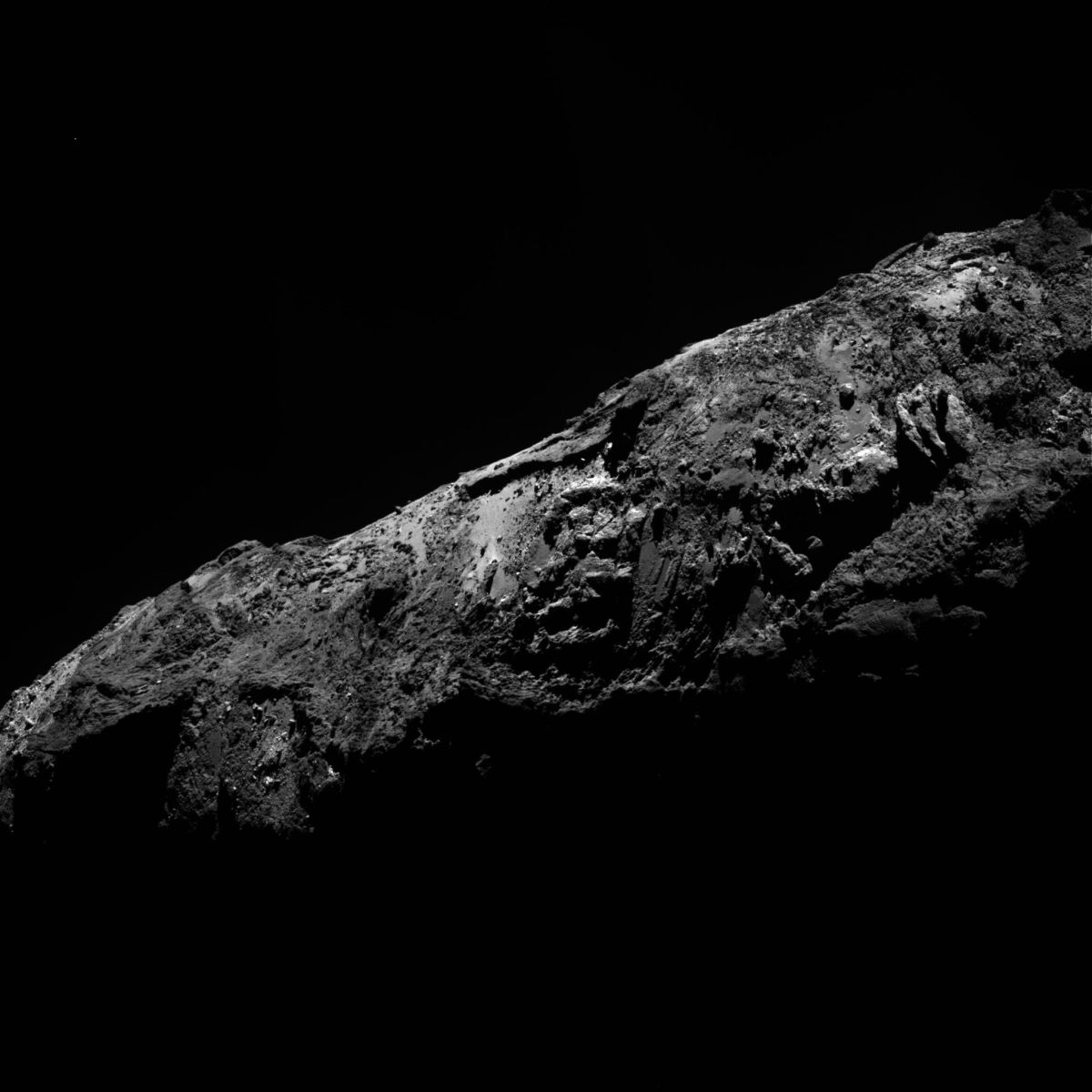
Rosetta image of comet taken on December 31, 2015 by the spacecraft’s OSIRIS narrow-angle camera from a distance of roughly 49 miles (79.6 kilometers) from the object.
Credits: ESA/Rosetta/MPS for OSIRIS Team MPS/UPD/LAM/IAA/SSO/INTA/UPM/DASP/IDA
The European Space Agency’s (ESA) Rosetta arrived at Comet 67P/Churyumov–Gerasimenko back in August 2014. After an initial survey and selection of a landing site, Rosetta unleashed the Philae probe on November 12 that bounced to a full-stop on the comet.
Still cruising along with the comet, ESA’s Rosetta spacecraft continues to produce outstanding images of the object, riding along with the celestial traveler through the Solar System.
“Now that we’re closer to the comet again we’re looking forward to seeing its surface in more detail. We’re also looking forward to sharing a fantastic view as Rosetta descends to the surface of the comet next September,” says Matt Taylor, ESA’s Rosetta project scientist.
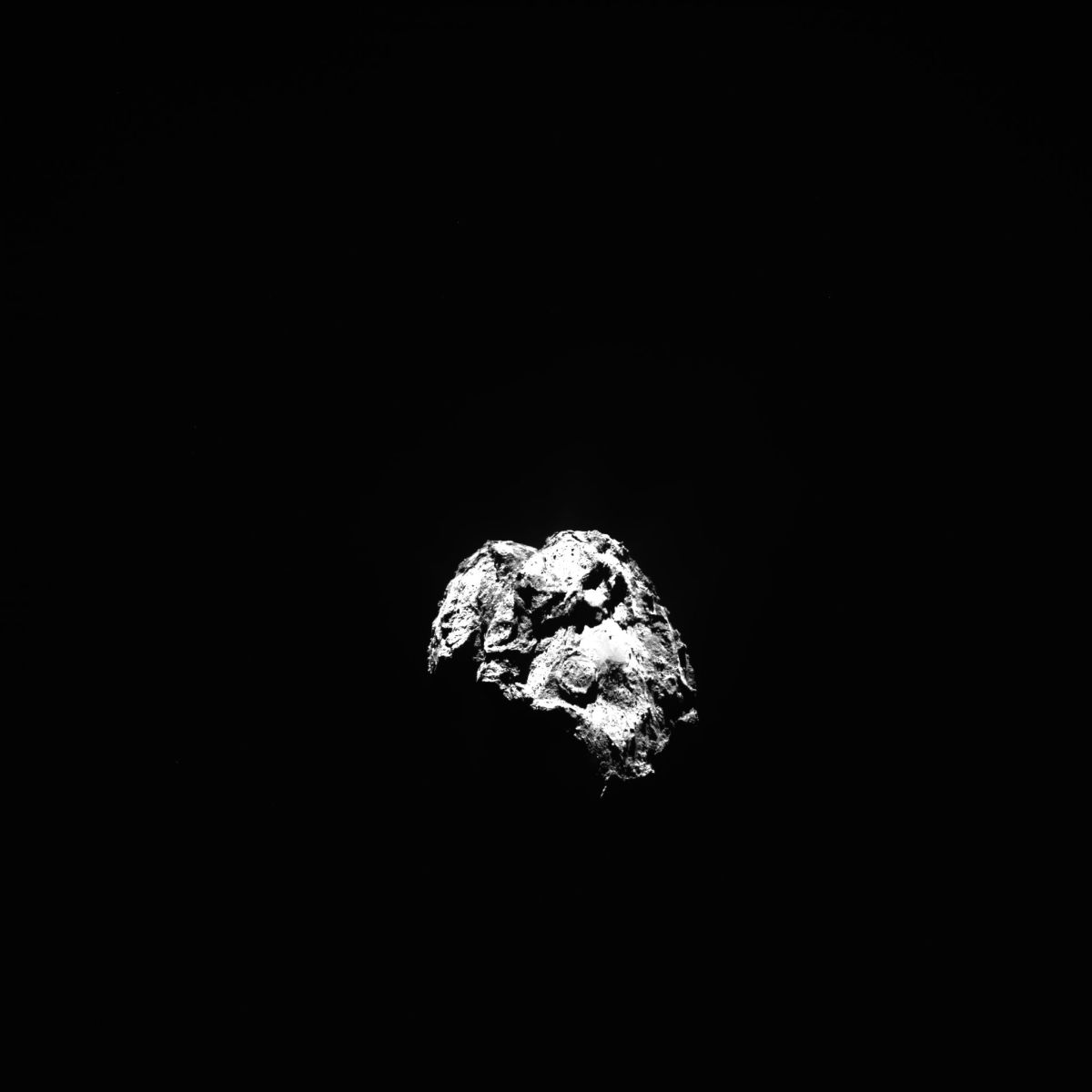
January 1, 2016 image of Comet 67P/ Churyumov–Gerasimenko taken by Rosetta’s Wide Angle Camera at roughly 50 miles (80 kilometers) distance from the object.
Credits: ESA/Rosetta/MPS for OSIRIS Team MPS/UPD/LAM/IAA/SSO/INTA/UPM/DASP/IDA
Rosetta was launched on March 2, 2004 by an Ariane-5 from Europe’s Spaceport in Kourou, French Guiana.
Check out this new video that pulls together details about Philae’s fall onto the comet at:
http://www.esa.int/spaceinvideos/Videos/2015/11/Reconstructing_Philae_s_flight
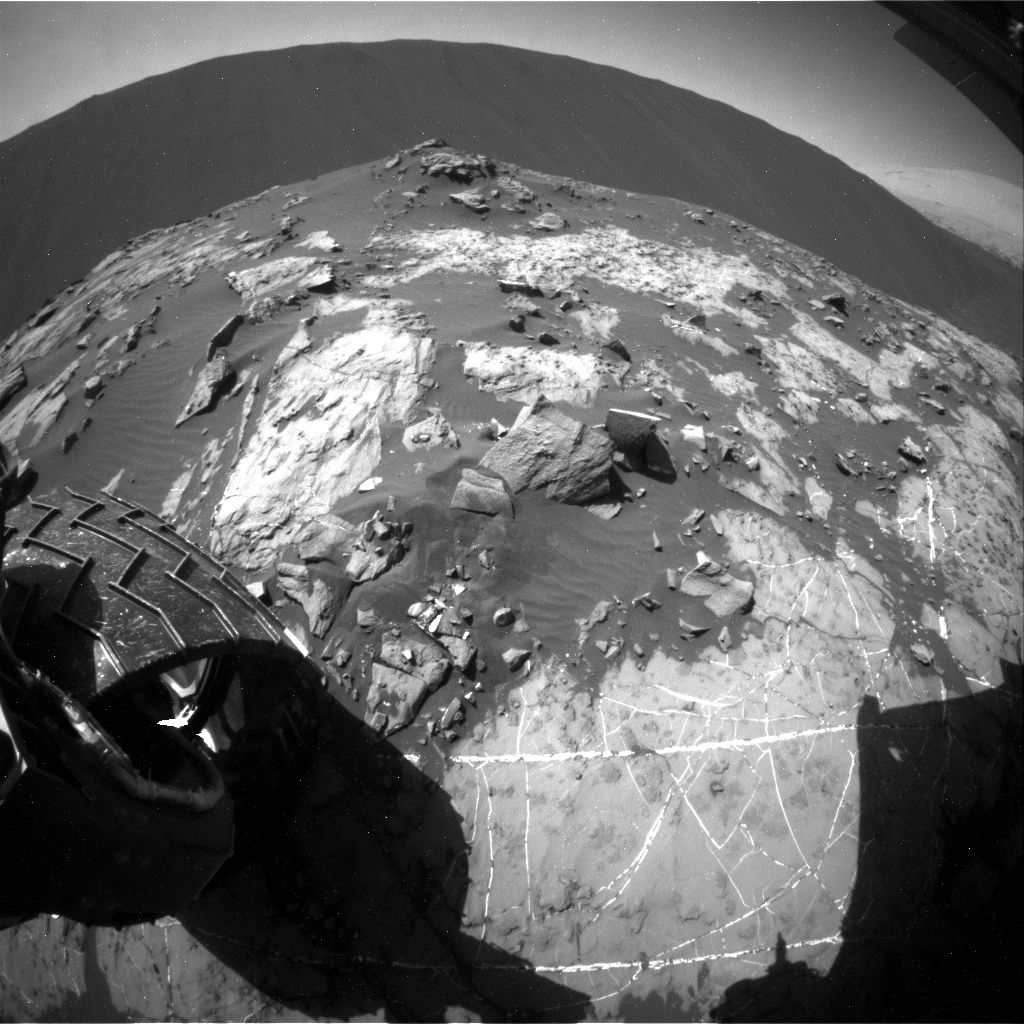
Rear Hazcam Left B image taken by NASA’s Mars rover Curiosity on Sol 1212, January 3, 2016
Credit: NASA/JPL-Caltech
NASA’s Curiosity Mars rover has entered Sol 1212 and has begun to transmit imagery in the New Year, 2016.
The machine continues to survey nearby dunes and ripples that are part of “Bagnold Dunes,” a band along the northwestern flank of Mount Sharp inside Gale Crater.
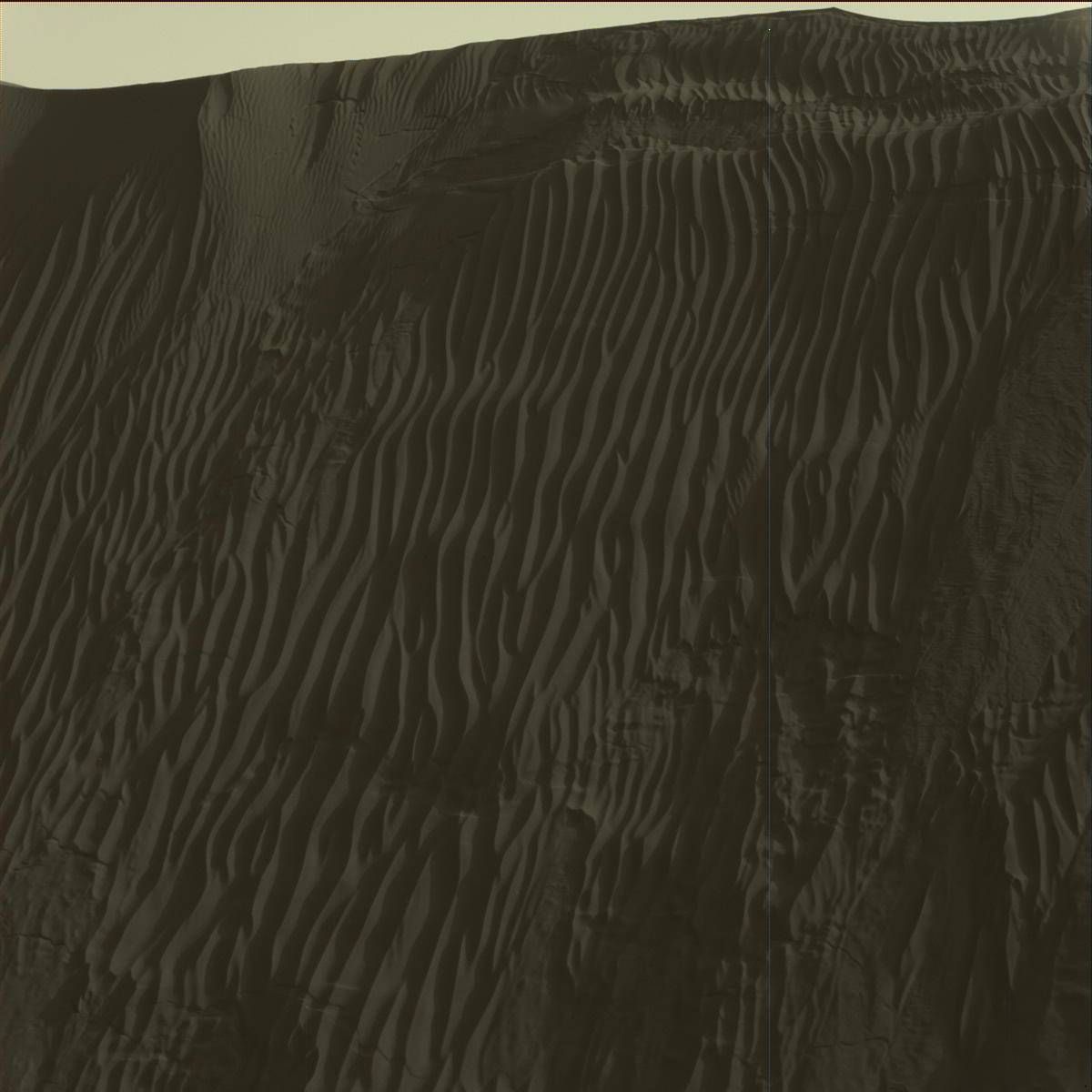
Curiosity Mastcam image taken on Sol 1211, January 2, 2016.
Credit: NASA/JPL-Caltech/MSSS
Landing on the Red Planet in August 2012, Curiosity’s long-term mission is to assess whether Mars ever had an environment able to support small life forms called microbes – to determine the planet’s “habitability.”

Curiosity’s Mastcam camera snagged this Sol 1211 image on January 2, 2016.
Credit: NASA/JPL-Caltech/MSSS
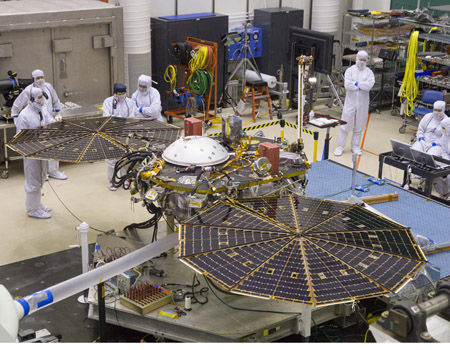
InSight Mars lander undergoing a solar array deployment test in the MTF clean room at Lockheed Martin.
Credit: Lockheed Martin
The recent decision by NASA to suspend the planned March 2016 launch of the Discovery-class InSight mission to Mars was due to unsuccessful attempts to repair a leak in a section of the prime instrument in the science payload.
That instrument was the sensitive Seismic Experiment for Interior Structure (SEIS).
The spacecraft’s name, InSight, says it all: Interior exploration using Seismic Investigations Geodesy and Heat Transport.
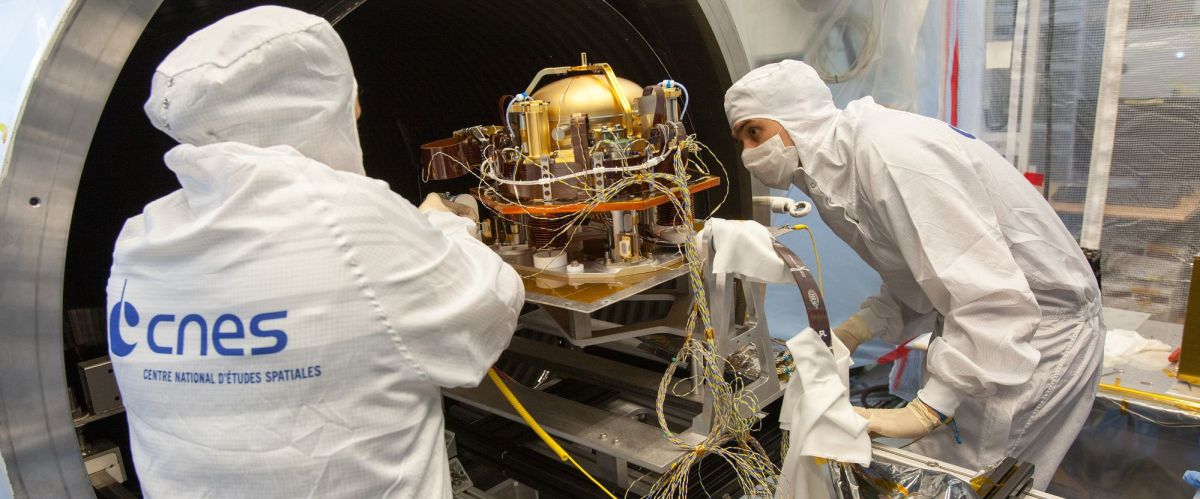
Preparing the SEIS instrument for thermal vacuum testing.
Credit: CNES /MALIGNE Frederick, 2015
Taking the pulse
SEIS is designed to capture the “pulse” of the Red Planet — its internal activity — by taking precise measurements of quakes and other internal commotion. Doing so equates to a better understand the planet’s history and structure.
Testing troubles
The sphere-shaped device itself is made of a series of measurement instruments, mainly composed of three French seismometers called VBB (Very Broad Band) and designed by the Institut de Physique du Globe de Paris (IPGP).
Overall, SEIS is an instrument provided by four European countries: France, Switzerland, United Kingdom and Germany.
The troubled SEIS had previously failed to retain vacuum conditions – a problem that was fixed. But during follow-up tests in extreme cold temperature (-49 degrees Fahrenheit/-45 degrees Celsius) another leak was detected.
Despite the repairs and the significant efforts of the teams, a cold pressure build-up, probably caused by a new leak, was detected on the sphere including the three low frequency seismometers of the IPGP and Sodern, a French company based in Limeil-Brévannes, near Paris, that specializes in space instrumentation.
NASA officials determined there was insufficient time to resolve another leak, and complete the work and thorough testing required to ensure a successful mission.
Finding a solution
“This is the first time a sensitive instrument is realized. We were very close to the result, a fault has occurred, requiring further investigations. Our teams will find a solution, but unfortunately not in time for the flight in 2016,” said Marc Pircher, Director of the Toulouse Space Center.
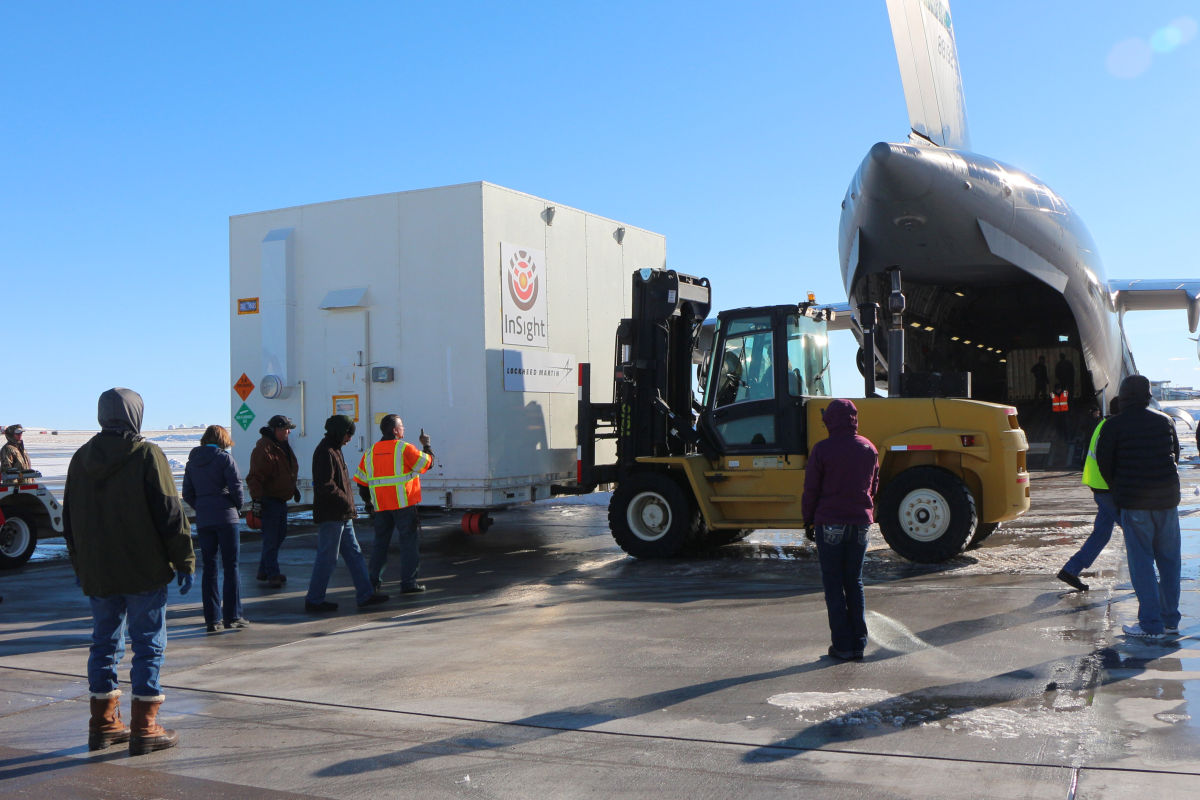
A Lockheed Martin team shipped NASA’s InSight Mars lander from Colorado where it was built to Vandenberg Air Force Base, California where it was slated for launch in March 2016.
Credit: Lockheed Martin
InSight was built by Lockheed Martin and delivered on December 16 to Vandenberg Air Force Base in California for its projected launch. With the 2016 launch canceled, the spacecraft is being returned from Vandenberg to Lockheed’s facility in Denver.
While at Vandenberg, within the Astrotech Space Operations facility, InSight was slated to undergo final processing including the installation and testing of the SEIS instrument, system-level checkout, propellant loading and a spin balance test.
“Our team worked hard to get the InSight spacecraft built, tested and shipped to the launch site on schedule. Although InSight won’t launch in March as planned, we will work closely with NASA, JPL and their partners to map out the path forward for the spacecraft and its important mission,” Lockheed Martin said in a statement provided to Inside Outer Space.
What next?
So what next for InSight…and getting its legs firmly down on Mars?
For legal and policy reasons, NASA can’t go any further than saying that the launch is suspended, explains W. Bruce Banerdt, Principal Investigator for the InSight Mission to Mars at the Jet Propulsion Laboratory in Pasadena, California.
“They have explicitly stated that the mission is not canceled, but there is a process they have to follow to decide whether and how they can extend us,” Banerdt told Inside Outer Space.
Cost cap
“Legally, there is a cost cap on a Discovery mission, and, as I understand it, they [NASA] have to go to Congress to get authorization to exceed that cap,” Banerdt said.

This artist’s concept depicts NASA’s InSight Mars lander fully deployed for studying the deep interior of Mars. Robot arm would deploy the sensitive Seismic Experiment for Interior Structure (SEIS) device, white object in foreground.
Credit: NASA/JPL-Caltech
NASA managers have expressed strong support for both the science of InSight and the mission itself, Banerdt said, “so I am optimistic that we will eventually get the go-ahead.”
Banerdt said that the InSight team is in the beginning stages of putting together a plan, with schedule and budget, to present to NASA for launching in 2018. “It will likely be at least a couple of months before any decision can be made, even provisionally,” he said.
For more information on the SES go to this video in French at:
https://www.youtube.com/watch?v=k3IOKszmnyo
For an English video on InSight, go to:
https://www.youtube.com/watch?v=7VVKyYhwfBk

