Archive for the ‘Space News’ Category
 Author:
  January 27th, 2016
Credit: Mary Ann Liebert, Inc. Publishers
The informative New Space journal is offering free access to an “uplifting” set of articles on the space elevator concept.
This free access to readers is available through February 29th.
Read now:
- Opening up Earth-Moon Enterprise with a Space Elevator
By Peter A. Swan
Go to:
http://online.liebertpub.com/doi/pdf/10.1089/space.2015.0025
- The Status of Space Elevator Infrastructures
By John M. Knapman and Peter A. Swan
Go to:
http://online.liebertpub.com/doi/pdf/10.1089/space.2015.0028
- A Historical Look at the Concept of Space Elevators
By David I. Raitt
Go to:
http://online.liebertpub.com/doi/pdf/10.1089/space.2015.0024
NOTE: Special thanks to New Space Editor-in-Chief Scott Hubbard and Mary Ann Liebert, Inc. publishers for making these new space elevator articles available.
 Posted in

Because the Centaurs cross the paths of the major planets, their orbits are unstable: some will eventually be ejected from the solar system, but others will be thrown onto trajectories bringing them inwards, therefore posing a danger to civilization and life on Earth.
Credit: Duncan Steel
All the hoopla over that “should be there” Planet 9 has spurred speculation about its danger to Planet 3 – Earth.
So far, just mathematical modeling and computer simulations suggest this way out world could have a mass about 10 times that of Earth. Furthermore, this purported planet would make one full orbit around the Sun, a period of time that takes between 10,000 and 20,000 years.
This still to be seen planet orbits about 20 times farther from the Sun on average than does Neptune (which orbits the Sun at an average distance of 2.8 billion miles).

This artistic rendering shows the distant view from Planet Nine back towards the sun. The planet is thought to be gaseous, similar to Uranus and Neptune. Hypothetical lightning lights up the night side.
Credit: Caltech/R. Hurt (IPAC)
Unnerving possibility
Is it reasonable to consider an unnerving possibility: whether the orbit of this still speculative globe might not arouse waves of objects to tumble inward into our solar system, placing our world in peril?
Inside Outer Space asked that question of Duncan Steel at the Center for Astrobiology, University of Buckingham, and Armagh Observatory in the UK.
Steel and his colleagues recently reported that the discovery of hundreds of giant comets in the outer planetary system over the last two decades means that these objects pose a much greater hazard to life than asteroids.
The giant comets — termed centaurs — move on unstable orbits crossing the paths of the massive outer planets Jupiter, Saturn, Uranus and Neptune. The planetary gravitational fields can occasionally deflect these objects in towards the Earth.

Planet 9 backers, Caltech professor Mike Brown and assistant professor Konstanin Batygin, have been working together to investigate distant objects in our solar system
Credit: Lance Hayashida/Caltech
Reassessment of extraterrestrial factors
More to the point, as Steel has written: “The discovery of many substantial objects in the outer solar system demands a reassessment of extraterrestrial factors putatively implicated in mass extinction events.”
Steel has calculated the terrestrial impact probability for all known asteroids and questions whether the old concept of single, random asteroid impacts causing mass extinctions is “deficient” given what is now known of the inventory of small bodies in the solar system.
Waves of objects
The “problem”, as such, Steel told Inside Outer Space, is stirring up trans-Neptunian objects (TNOs). “This Planet 9 would likely fit the bill. That is, we might expect waves of objects to come inwards whenever Planet 9 is near perihelion and thus enters a denser region of TNOs.”
Be clear that most of the objects out there will be far smaller than the TNOs detected to date, Steel adds, “big devils, they have to be, to be detectable.”
“If this Planet 9 exists, then it may show itself in other ways, such as a shower of comets entering the inner solar system whenever Planet 9 nears perihelion,” Steel says. “We might see the 20,000 year periodicity in cometary dust deposits on Earth, for example. A problem would be that we know that Earth’s climate cycle, due to terrestrial orbit variations, follows a similar periodicity.”

The six most distant known objects in the solar system with orbits exclusively beyond Neptune (magenta) all mysteriously line up in a single direction. Also, when viewed in three dimensions, they tilt nearly identically away from the plane of the solar system. New work by Caltech’s Batygin and Brown show that a planet with 10 times the mass of the Earth in a distant eccentric orbit anti-aligned with the other six objects (orange) is required to maintain this configuration.
Credit: Caltech/R. Hurt (IPAC)/Diagram created using WorldWide Telescope.
Jury still out
On the Planet 9 hypothesis, Steel points out: “The jury is out on this idea, and will be for some time. It’s a useful and interesting suggestion, not altogether unexpected. There are certain to be contrary ideas.”
But if the claims for a Planet 9 are correct, “then more TNOs with similar orbits to those identified should be discovered over the next decade, adding to the statistical weight of evidence,” Steel concludes.

Opportunity image from Navigation Camera on Sol 4266.
Credit: NASA/JPL
Still running after all those years!
NASA’s Opportunity rover landed on Mars 12 years ago this week. The veteran robot touched down on the Red Planet on Jan. 24, 2004, PST (early Jan. 25, UTC).
Opportunity is alive and well, working through the lowest-solar-energy days of the mission’s seventh Martian winter. It has been using a diamond-toothed rock grinder and other tools in recent weeks to investigate clues about the planet’s environmental history.
Opportunity is now exploring the western rim of a 14-mile-wide (22-kilometer-wide) crater named Endeavour, doing so since 2011. This winter, the rover is inspecting rocks on the southern side of “Marathon Valley – a feature that slices through Endeavor Crater’s rim from west to east.

A dozen years on Mars. Opportunity Mars rover snagged this image using its Navigation Camera on Sol 4266.
Credit: NASA/JPL
This is a location where observations by NASA’s Mars Reconnaissance Orbiter have mapped concentrations of clay minerals that would have formed under wet, non-acidic conditions.
“With healthy power levels, we are looking forward to completing the work in Marathon Valley this year and continuing onward with Opportunity,” said Mars Exploration Rover Project Manager, John Callas of NASA’s Jet Propulsion Laboratory, Pasadena, California.

History-making Viking Mars landers touched down on the Red Planet in 1976 – four decades ago this year.
Credit: NASA
The seminal Viking orbiter and lander Mars missions of the 1970s were a landmark enterprise, giving the U.S. a big plus in the Red Planet exploration column. That epic NASA saga of exploration took place 40 years ago this year.
Now, for the first time, over 300 artifacts from the Viking Mars Missions Education & Preservation Project (VMMEPP) are available to people around the world.
The artifact availability comes via a partnership between VMMEPP and the Google Cultural Institute. The Google Cultural Institute and its partners are putting the world’s cultural treasures at the fingertips of Internet users and are building tools that allow the cultural sector to share more of its diverse heritage online.
Virtual exhibition

Firm footing on Mars. Image taken by the first Viking Mars lander.
Credit: NASA
This new virtual exhibition enables users to see a complete set of the Viking Mission Bulletins that guided the public and press through mission preparation, launch and discoveries; a previously unpublished detailed specification for the Viking Meteorology Instrument; a unique White House document required for mission launch; and a 1967 Martin Marietta (now Lockheed Martin) Viking Sterilization Reference Booklet, representing early standards and procedures that would later become the industry standard that continues today.
Educate future generations
The Viking preservation work is being spearheaded by Rachel Tillman, Executive Director and Founder of VMMEPP.
“For our organization, this launch is significant, as it supports both of our key objectives with one singular event – to preserve the history of Viking and to inspire and educate future generations,” Tillman said in a press statement.

First panorama taken by Viking 2 Mars lander.
Credit: NASA
Viking Mars Missions Education & Preservation Project
Credit: VMMEPP
“Our resources are already being utilized by students from elementary through graduate school, aerospace professionals, and writers who will continue the cultural influence that Viking began,” Tillman added.
All in the Viking family
Tillman said that “it is personally important to us to honor the men and women of Viking, many of whom were never recognized for their roles. Viking brought conflicting interests and individuals together into a cohesive team and ‘family’ that changed the face and direction of space exploration.”
Resources
For more information on the Viking Mars Missions Education & Preservation Project (VMMEPP), go to:
http://www.thevikingpreservationproject.org
The initial Viking Mars Mission Education and Preservation Project Collection can be viewed at:
https://www.google.com/culturalinstitute/exhibit/the-viking-mars-mission/RQKiJsUJbOktIw

Landscape of the Imhotep region on Comet 67P/Churyumov–Gerasimenko.
Credit: ESA/Rosetta/MPS for OSIRIS Team MPS/UPD/LAM/IAA/SSO/INTA/UPM/DASP/IDA
The European Space Agency’s Rosetta orbiter cruising along with Comet 67P/Churyumov–Gerasimenko continues to churn out staggering up-close images of the celestial wanderer.
One of those images shows the comet area known as Imhotep.
This smooth dusty terrain covers about 0.8 square kilometers etched with curvilinear features stretching hundreds of meters and which have been found to change in appearance over time.
Many large boulders are scattered within the smooth terrain, including the boulder Cheops. Smaller but more numerous boulders are associated with exposed cliff faces and are most likely the product of erosion.
Water ice revealed
As noted in a European Space Agency (ESA) statement, in some debris falls, detailed analysis has revealed the presence of water ice on the comet.
Particularly eye-catching is the new image is distinctive layered and fractured material. Similar patterns are also seen in exposed cliff-like faces where Imhotep transitions into the Khepry region.
Lastly, a number of small round features are visible. They have a well-defined rim with a smooth interior and appear slightly raised from the surrounding material.
“One explanation for their appearance is that they are ancient sites of active regions covered by dust and are now being revealed by varying erosion of the overlying layers,” the ESA press statement explains.
To take your own cruise around the comet, make use of this viewer tool to aid navigation around the comet’s regions.

Up, up, and away! Blue Origin repeat success. January 22, 2016 liftoff from West Texas launch site.
Credit: Blue Origin
Chalk up yet another victory for Blue Origin, the “start-up and go” rocket company backed by Amazon.com founder and moneymaker, Jeff Bezos.
“The very same New Shepard booster that flew above the Karman line and then landed vertically at its launch site last November has now flown and landed again, demonstrating reuse,” reported Bezos via blog.
“This time, New Shepard reached an apogee of 333,582 feet (101.7 kilometers) before both capsule and booster gently returned to Earth for recovery and reuse,” Bezos explained.
The January 22, 2016 flight of the suborbital space tourism booster occurred at the West Texas launch site of Blue Origin.
“Launch. Land. Repeat” is the mantra from the rocketeers. “Our vision: millions of people living and working in space. You can’t get there by throwing the hardware away.”
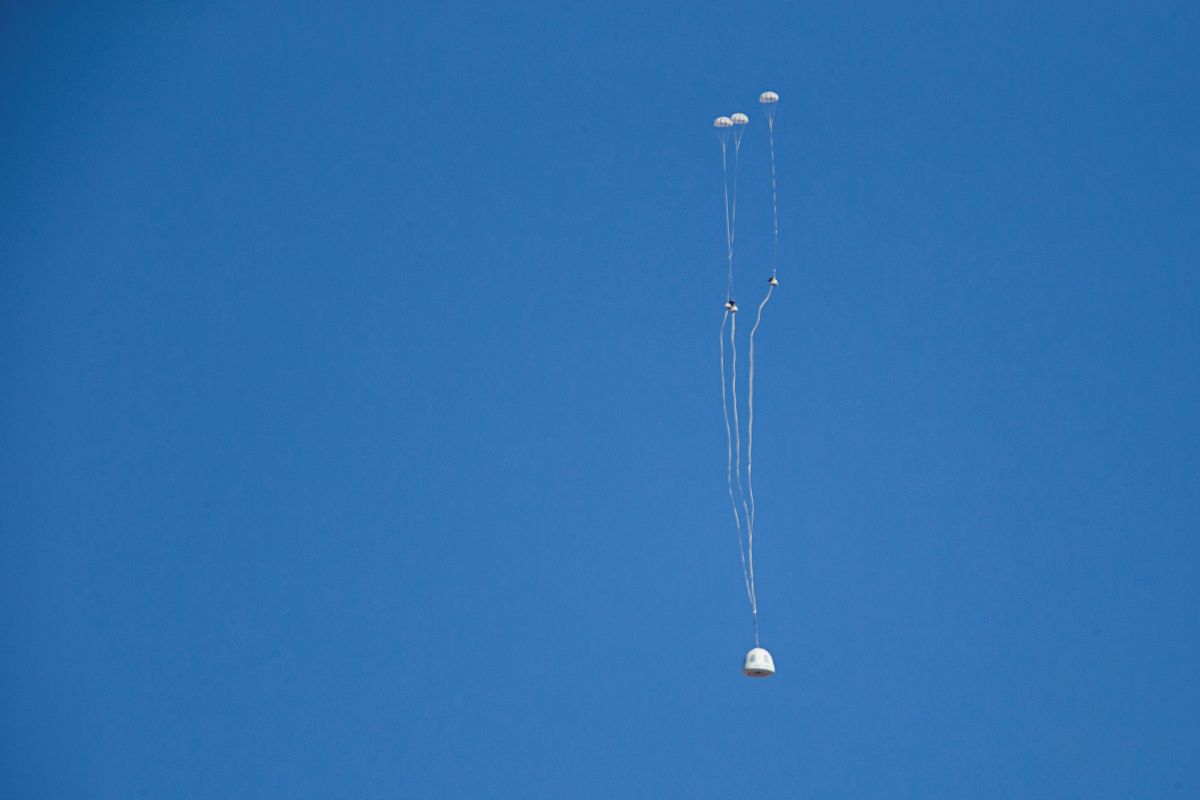
After stabilizing the crew capsule, the drogue parachutes extract the main parachutes for landing.
Credit: Blue Origin
New strategy
“Though wings and parachutes have their adherents and their advantages, I’m a huge fan of rocket-powered vertical landing,” Bezos said.
Data from last November’s mission, Bezos added, “matched our preflight predictions closely, which made preparations for today’s re-flight relatively straightforward.”
Bezos said that, thanks to new software, rather than the vehicle translating to land at the exact center of the pad, it now initially targets the center, but then sets down at a position of convenience on the pad, prioritizing vehicle attitude ahead of precise lateral positioning.
“New Shepard landings show this new strategy increases margins, improving the vehicle’s ability to reject disturbances created by low-altitude winds,” Bezos explained.
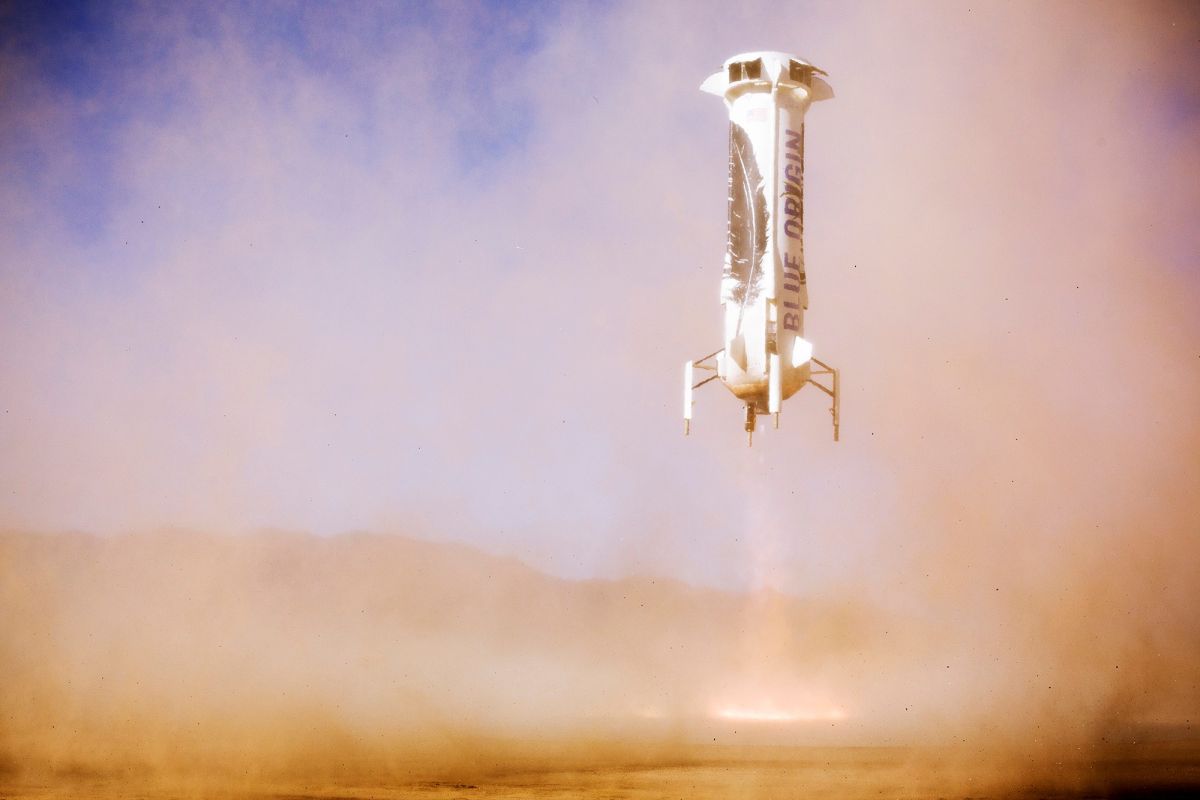
Blue Origin’s New Shepard booster executes a controlled vertical landing at 4.2 mph.
Credit: Blue Origin
Orbital vehicle
Bezos made note of work on Blue Origin’s orbital vehicle.
“We’re already more than three years into development of our first orbital vehicle,” Bezos advised. “Though it will be the small vehicle in our orbital family, it’s still many times larger than New Shepard. I hope to share details about this first orbital vehicle this year.”
Check out the posted video of the new test flight at:

Mars true-color globe showing Terra Meridiani.
Credits: NASA/Greg Shirah
A crew of Chinese volunteers will take part in a 180-day isolation study to mimic a human mission to Mars.
According to a January 21 report by the state-run People’s Daily, the four volunteers will be confined within a space capsule consisting of six giant “boxes” constructed by China’s Southern Research Institute of Space Technology.
The six giant boxes involve a low pressure tank, two plant tanks, a resources tank, a life support cabin and a crew cabin.
Capsule details
The crew cabin is 8.2 meters, or three stories high, and the minimum height of all the boxes is some 12 feet (3.6 meters).
The 180 cubic meters provided for the volunteers in the crew cabin is divided into nine parts, including a sleeping area, working and reading areas, cafeteria, gym and medical monitoring area, explains the People’s Daily.
Vegetables, fruits, staple crops and oil plants are cultivated within the 674 cubic meters of the plant tank.
In the resources tank, recycling and purification systems will deal with waste, including human waste, plant debris, waste water and exhaust gas.
Within in the life support area, food is to be stored and processed, and there is a water supply system and air purification system.

High-level experiments
The volunteers are to start the experiment after Spring Festival, with no specific time identified. Chinese New Year — also called Spring Festival — falls on February 8 this year.
The three men and one woman will experience 180 days of isolated life together and conduct more than 20 high-level experiments, including simulation of a journey to Mars, and the establishment of a base station on Mars, according to the People’s Daily report.
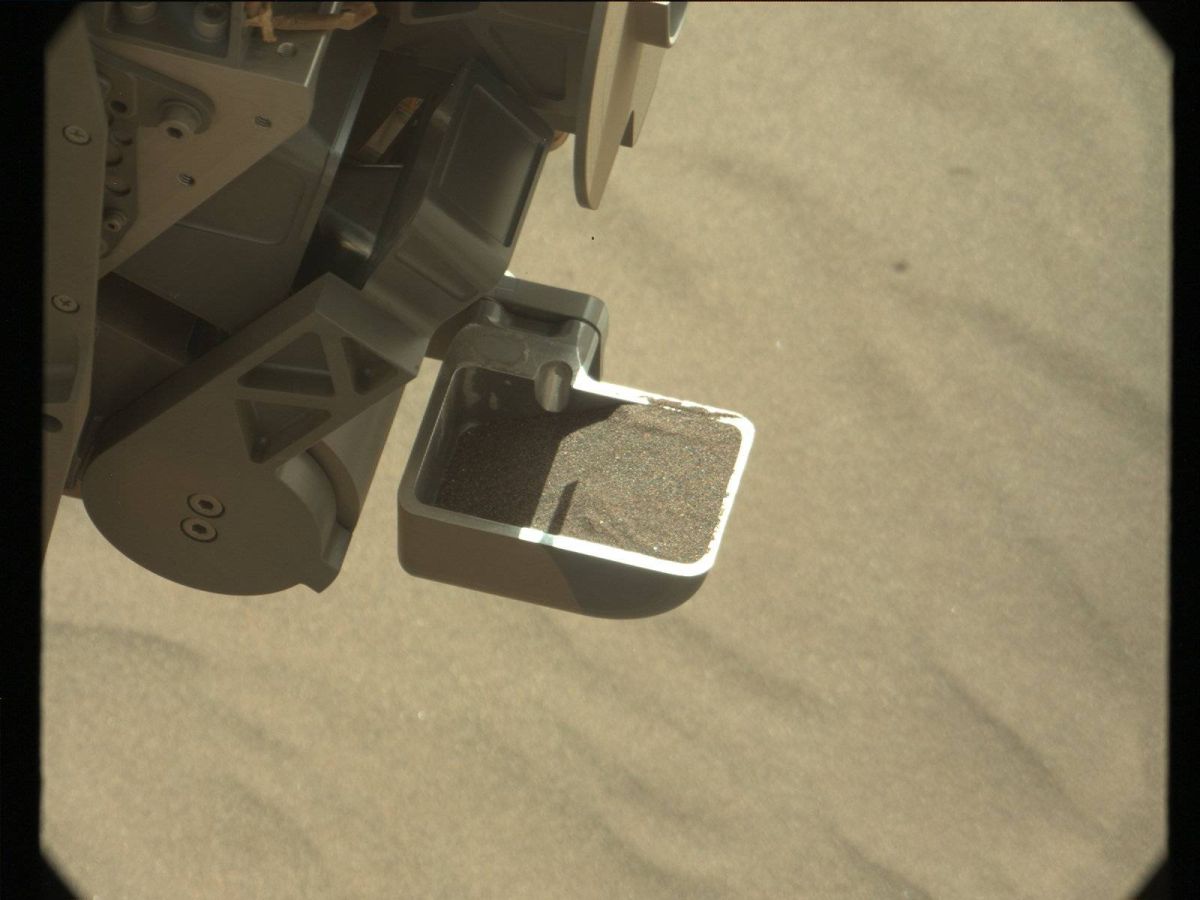
Curiosity Mastcam Right image taken on Sol 1228 January 19, 2016.
Credit: NASA/JPL-Caltech/MSSS
Today, the Curiosity rover on Mars is at work on Sol 1231.
Mars researchers are continuing their campaign to analyze “Namib Dune” – geared to dropping off a specimen of collected sand in the rover’s Sample Analysis at Mars (SAM) Instrument Suite.
Earlier, the sol 1230 plan called for a science block with some Chemistry & Camera (ChemCam), Mastcam, and Navcam observations.
“But unfortunately that had to be cut to save power, so those observations will have to happen over the weekend,” reports Ryan Anderson, a planetary scientist at the USGS Astrogeology Science Center and a member of the ChemCam team on the Mars Science Laboratory (MSL).
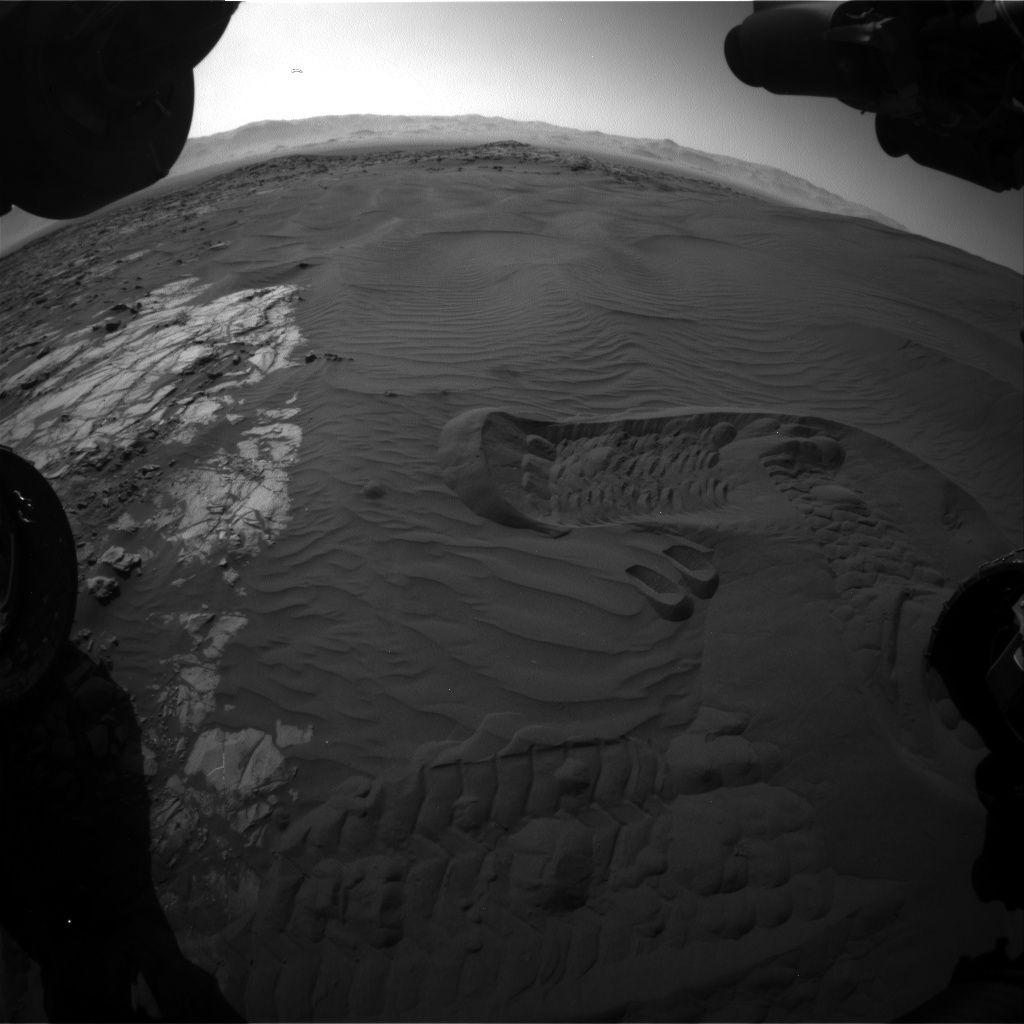
New image from Curiosity’s Front Hazcam Right B camera, taken on Sol 1230, January 22, 2016.
Credit: NASA/JPL-Caltech
Inlet outlook
With the science block removed, Anderson adds, the first activity on Sol 1230 was a Mastcam observation of the SAM inlet.
After this, the rover was slated to drop off a sample of sand for SAM to analyze.
Then while the arm is active, the Mars Hand Lens Imager (MAHLI) was to observe the dump piles, including some night-time observations using the built-in LEDs to illuminate the piles.
Curiosity’s Alpha Particle X-Ray Spectrometer (APXS) was also on tap to carry out a couple of overnight measurements on two of the dump piles, Anderson notes.
Sample handling system
On Sol 1231, the schedule was to start off with some Navcam and Hazcam images to document where the APXS was making its measurements, plus Mastcam observations of the SAM inlet again.
This is to be followed by some arm activities to clean out the components of the sample handling system.
“Then we’ll dive back in and collect another scoop of material from the dune, sieve it, and deliver it to SAM too. Finally, APXS will be placed on another of our dump piles for an overnight measurement. And of course [Rover Environmental Monitoring Station] REMS and [Dynamic Albedo of Neutrons] DAN will be collecting data each sol of the plan as usual,” Anderson concludes.
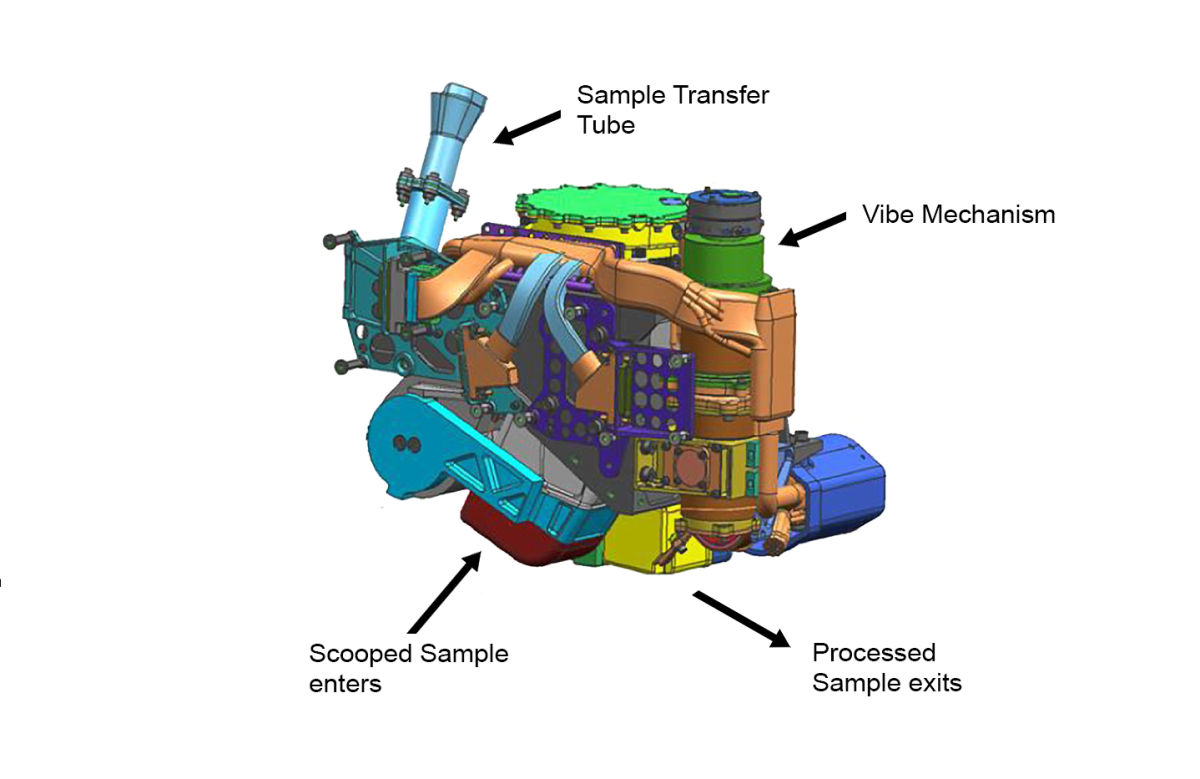
This false-color engineering drawing shows the Collection and Handling for In-Situ Martian Rock Analysis (CHIMRA) device. It scoops, sieves and delivers samples. CHIMRA is attached to the turret at the end of the robotic arm on NASA’s Curiosity Mars rover.
Credit: NASA/JPL-Caltech
Moves not previously used
According to the Jet Propulsion Laboratory Curiosity website, Curiosity’s current work is the first close-up study of active sand dunes anywhere other than Earth.
Furthermore, at its current location for inspecting an active sand dune, NASA’s Curiosity Mars rover is adding some sample-processing moves not previously used on Mars.
“Sand from the second and third samples the rover is scooping from ‘Namib Dune’ will be sorted by grain size with two sieves,” the JPL site adds. “The coarser sieve is making its debut, and using it also changes the way the treated sample is dropped into an inlet port for laboratory analysis inside the rover.”
Curiosity’s study of dunes is providing information about how wind moves and sorts sand particles in conditions with much less atmosphere and less gravity than on Earth, the JPL website explains.
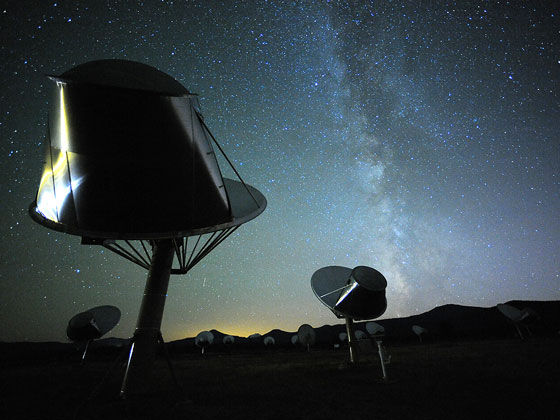
Search for ET – an ongoing enterprise. Allen Telescope Array is one of many attempts to answer: Are we alone?
Credit: Seth Shostak/SETI Institute
Forget that overused, hackneyed query: Are we alone?
Arguably, the real question at hand may be how to cope with crowds of extraterrestrial civilizations.
With increasing regularity we learn of exo-planet detection. But with those observations, is the prospect of locating other starfolk a sure bet?
For more details, please read my new Space.com story:
When Will We Make Contact with Intelligent Aliens?
by Leonard David, Space.com’s Space Insider Columnist
January 21, 2016 02:00pm ET
http://www.space.com/31662-alien-civilizations-when-make-contact.html

Credit: NASA, ESA, and the Hubble Heritage Team (STScI/AURA)
It’s no wonder we haven’t heard from extraterrestrials. That’s because they are long-gone, extinct.
Astrobiologists from Australian National University (ANU) call it the “Gaian bottleneck” – life on other planets would likely be brief and become extinct very quickly.
“Early life is fragile, so we believe it rarely evolves quickly enough to survive,” contends Aditya Chopra from the ANU Research School of Earth Sciences and lead author on a new paper published in the journal, Astrobiology.
Early microbial life on Venus and Mars, if there was any, failed to stabilize the rapidly changing environment, adds co-author Associate Professor Charley Lineweaver from the ANU Planetary Science Institute.

Different bottleneck scenarios and their fossil predictions. (A) Emergence Bottleneck. Life rarely emerges even on
wet rocky planets. Few planets will have life or even fossils of extinct life. On the few planets where life does emerge, it
persists for billions of years. (B) No Emergence Bottleneck. Life emerges with high probability and usually persists for billions
of years. Thus, life will be abundant on planets throughout the Universe. There will be many planets where life persisted for
billions of years and then went extinct. On the oldest uninhabited planets, fossils of complex life will be abundant. (C) Gaian
Bottleneck. Life emerges with some probability (possibly quite high), but it goes extinct within a billion years (green).
Alternatively, some small fraction of inhabited planets successfully pass through the Gaian bottleneck (light green). The Gaian
bottleneck model predicts that the vast majority of the fossils in the Universe will be from extinct microbial life.
Graphic: Astrobiology
Sliding into oblivion
They propose a potentially universal sequence of events on initially wet rocky planets, a kind of sliding scale into oblivion:
- Hot, high bombardment, uninhabitable.
- Cooler, reduced bombardment, continuous volatile loss.
- Emergence of life in an environment with a tendency to evolve away from habitability.
- Inability to maintain habitability, followed by extinction.
The scientists suggest new life would commonly die out due to runaway heating or cooling on their fledgling planets.
“One intriguing prediction of the Gaian Bottleneck model is that the vast majority of fossils in the universe will be from extinct microbial life, not from multicellular species such as dinosaurs or humanoids that take billions of years to evolve,” suggests Lineweaver.
Riding a wild bull
Chopra and Lineweaver conclude in their paper:
“Between the early heat pulses, freezing, volatile content variation, and runaway positive feedbacks, maintaining life on an initially wet rocky planet in the habitable zone may be like trying to ride a wild bull. Most life falls off. Life may be rare in the Universe, not because it is difficult to get started, but because habitable environments are difficult to maintain during the first billion years.”
To read this intriguing Astrobiology paper, go to:

