Archive for the ‘Space News’ Category
 Author:
  April 29th, 2016
On April 27, James Lovell spoke at MIT as a special guest, invited by the Department of Aeronautics and Astronautics.
Photo: Bill Litant
It was 46 years ago this month that the words “Houston…we’ve had a problem” shot across space to ground controllers on Earth.
On April 14, 1970, just 56 hours into the Apollo 13 mission to the Moon, those words were uttered by crew members aboard the spacecraft.
Apollo 13 was to be NASA’s third landing of humans on the Moon. The transit to the Moon by the crew members was not prime-time television.
“All three networks received the signal — nobody carried it. There was the Dick Cavett show … a rerun of ‘I Love Lucy,’ and a ballgame…even people in the control center were watching the ballgame,” recalls Apollo 13 commander, James Lovell, speaking Wednesday as a special guest invited to the Department of Aeronautics and Astronautics (AeroAstro) at the Massachusetts Institute of Technology (MIT).
Hiss, bang
Prior to the trouble, an oxygen tank explosion, “I said goodnight to everybody, turned off the camera, and was coming down the tunnel, when suddenly there was a ‘hiss, bang!’ and the spacecraft rocked back and forth, jets were firing, and there was noise all over,” Lovell explained.

James Lovell at MIT.
Photo: Bill Litant
“That explosion was the best thing to ever happen to NASA,” Lovell told the MIT audience. “It showed, really, the talent that NASA people had, in mission control and throughout the organization that turned an almost complete catastrophe into a successful recovery.”
Bomb waiting to go off
In a story written by Jennifer Chu of the MIT News Office, Lovell explained to his AeroAstro audience it was two weeks before launch of Apollo 13 that the spacecraft underwent its last test.
“As the countdown went on, we could see the whole spacecraft come to life,” Lovell said. “The test was successful — everything looked perfect.”
When the ground crew came by to empty the liquid oxygen tanks, which would be refilled before launch, they were unable to do so. It would take a month to replace the tanks, which would have delayed the mission. However, they noticed that one of the tanks was an old design — meant for Apollo 10 — that was configured with an oxygen-emptying tube and a heater.

“They figured, why not turn on the heater and boil the oxygen out and therefore save time? Not a bad idea, so that’s what they did,” Lovell said. “The day before liftoff, they filled it up once more with liquid oxygen. It was a bomb waiting to go off” because the fix actually damaged the internal elements of the tank.
Serious trouble
Shortly after Lovell ended a television broadcast back to Earth on April 14, a ‘hiss, bang!’ shook the spacecraft, he said. Checking the instrument gauges, he found that one oxygen tank was completely empty, while another was being rapidly depleted. As he looked out a side window, he witnessed a “gaseous substance, at high speed,” shooting out into space.
“That’s when that old lead weight went down in the bottom of my stomach,” Lovell added. “Because we needed oxygen for electricity, the third fuel cell would die, and because we used electricity to control our rocket engine, we’d lose the entire propulsion system. We were in serious trouble.”
Last maneuver
The cascade of spacecraft system failures that would follow — requiring the ingenuity of the Apollo 13 crew and ground controllers to safely bring back the astronauts to Earth — is a story captured in the 1995 Hollywood blockbuster “Apollo 13,” with Tom Hanks starring as Lovell.

Fred Haise (left), Jim Lovell, and Jack Swigert emerge from the recovery helicopter on-board the aircraft carrier Iwo Jima on April 17, 1970.
Credit Scan by Ed Hengeveld from Eric M. Jones Apollo 13 Image Library.
Underscoring Apollo 13’s reentry to Earth, “If you come in too shallow, it’ll be like skipping a stone across water, and you’re gone,” Lovell said. “If you come in too steep, the sudden deceleration will put you on fire like a meteorite and that will be it. … I guess I wouldn’t be here if that last maneuver wasn’t successful.”
To read the full account by Chu of Lovell’s MIT visit, go to:
http://news.mit.edu/2016/apollo-13-commander-james-lovell-0428
 Posted in

Credit: NASA, ESA, and the Hubble Heritage Team (STScI/AURA)
Just how crowded is it out there…or are we Earthlings a one-off species?
A just issued paper has tackled this long-standing puzzler. The research attempts to assign a new empirically valid probability to whether any other advanced technological civilizations have ever existed.
Bottom line: unless the odds of advanced life evolving on a habitable planet are astonishingly low, then human kind is not the universe’s first technological, or advanced, civilization.
Pessimism/optimism
The paper, published in Astrobiology, also shows for the first time just what “pessimism” or “optimism” equates to when it comes to estimating the likelihood of advanced extraterrestrial life.
A New Empirical Constraint on the Prevalence of Technological Species in the Universe has been authored by Adam Frank, professor of physics and astronomy at the University of Rochester and Woodruff Sullivan of the astronomy department and astrobiology program at the University of Washington.
Are humans unique and alone in the vast universe? The famous Drake equation is repeatedly invoked to help eek out an answer.
One aspect of the Drake equation remains a big question and is completely unknown: How long civilizations might survive.
“The fact that humans have had rudimentary technology for roughly ten thousand years doesn’t really tell us if other societies would last that long or perhaps much longer,” Frank explained in a University of Rochester press statement.
Dealing with odds
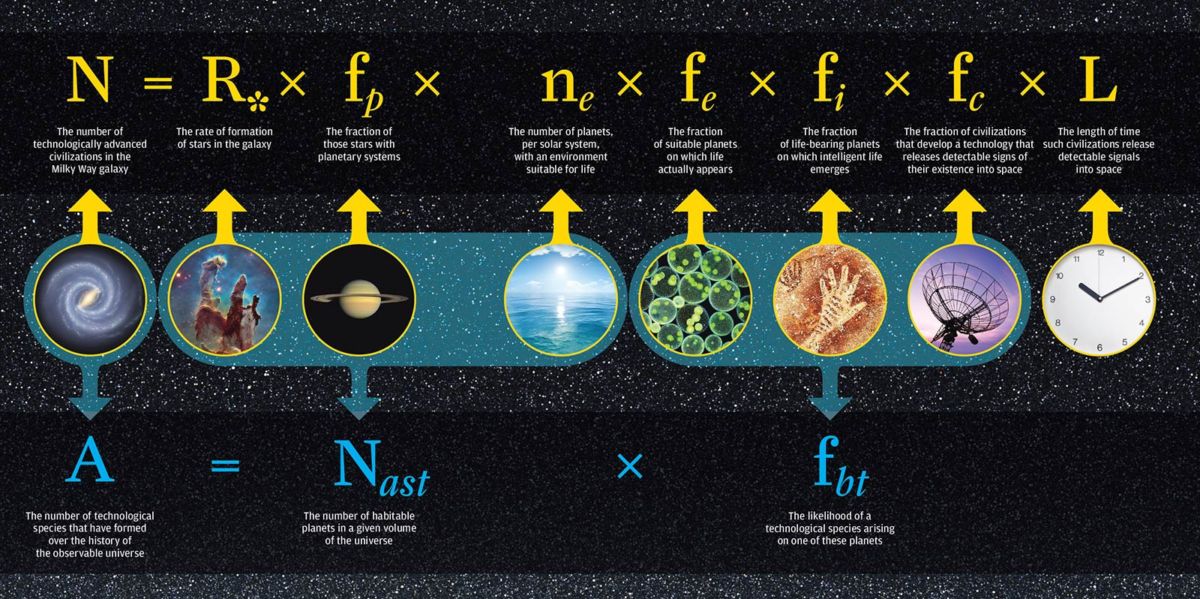
In 1961, astrophysicist Frank Drake developed an equation to estimate the number of advanced civilizations likely to exist in the Milky Way galaxy. The Drake equation (top row) has proven to be a durable framework for research, and space technology has advanced scientists’ knowledge of several variables. But it is impossible to do anything more than guess at variables such as L, the probably longevity of other advanced civilizations.
In new research, Adam Frank and Woodruff Sullivan offer a new equation (bottom row) to address a slightly different question: What is the number of advanced civilizations likely to have developed over the history of the observable universe? Frank and Sullivan’s equation draws on Drake’s, but eliminates the need for “L”.
Credit: University of Rochester
Frank and Sullivan calculate how unlikely advanced life must be if there has never been another example among the universe’s ten billion trillion stars, or even among our own Milky Way galaxy’s hundred billion.
The result?
Frank and Sullivan find that human civilization is likely to be unique in the cosmos only if the odds of a civilization developing on a habitable planet are less than about one in 10 billion trillion, or one part in 10 to the 22th power.
“One in 10 billion trillion is incredibly small,” says Frank. “To me, this implies that other intelligent, technology-producing species very likely have evolved before us.”
Take a read of this new research at:
http://online.liebertpub.com/doi/pdfplus/10.1089/ast.2015.1418

Credit: NASA
A new NASA technical memorandum has taken a hard look at the prospect of sustainable colonization of Mars, one that is safe, affordable, and nurtures independence of residents on the Red Planet from Earth.
Frontier In-Situ Resource Utilization for Enabling Sustained Human Presence on Mars has been authored by Robert Moses and Dennis Bushnell of NASA’s Langley Research Center in Hampton, Virginia. Moses is an aerospace engineer and Bushnell is chief scientist at the NASA center.
“There are massive resources on Mars obtainable from the atmosphere and extracted from the regolith which are capable of supporting human colonization,” the 55-page, April 2016 report explains. Using Martian resources, existing technologies could supply water, oxygen, fuel, and building materials “to relax the dependence on Earth during the buildup of a colony on Mars.”
Frontier technologies

Credit: NASA
On the to-do list is matching In-Situ Resource Utilization (ISRU) with frontier technologies, the report says, that include robotics, machine intelligence, nanotechnology, synthetic biology, 3-D printing/additive manufacturing and autonomy. “These technologies combined with the vast natural resources should enable serious, pre- and post-human arrival ISRU to greatly increase reliability and safety and reduce cost for human colonization of Mars,” the memorandum notes.
Wide range of needs
The sweeping and far-reaching NASA technical memorandum highlights the latest discoveries of water, minerals, and other materials on Mars that reshapes thinking about using the planet’s resources.
Technologies, new approaches, and new thought about Red Planet resources are spotlighted in the report, suggesting ISRU-related research areas. It also lays out an implementation strategy whereby the ISRU elements are phased into the mission campaign over time for enabling a sustainable human presence on Mars.

Credit: NASA/Pat Rawlings
And what’s the resource utilization on Mars upshot?
Doing so not only supports colonies on the Red Planet and crew return to Earth, says the report, but also missions to go elsewhere from low Earth orbit or from low Mars orbit, as well as space tourism in the inner solar system.
Live off the land
The currently known resources on Mars are huge, including extensive quantities of water and carbon dioxide – ideal for such things as life support, fuels and plastics.
Report co-author, Moses, tells Inside Outer Space: “Sustaining human presence on Mars looks affordable and safe when counting on extensive ISRU on the planet. The known resources on Mars open up a vast opportunity to make on Mars most of what’s needed at Mars to support pioneering there.”
Asks Moses, why not ISRU?
“What other ways are our pioneering astronauts to live off the land at Mars?”
Large-scale ISRU
Still, there’s work to do.

Credit: NASA/Pat Rawlings
Given the discovery of substantial amounts of water ice on Mars, however, the report flags a fact: There has not yet been a fully comprehensive study of large-scale ISRU on Mars.
ISRU could conceivably enable, given the immense resources now known to be available on Mars, the following:
- A habitat incorporating significant Galactic Cosmic Ray (GCR) protection via burial beneath 5 meters of regolith;
- Fuel for on-planet ascent, outbound, return and powered entry, descent and landing (EDL);
- Life support systems for food, water and breathable atmosphere; habitable temperatures and pressures; and 3-D printing and other manufacturing approaches (including synthetic biology) along with a variety of hardware including equipage and on-planet transport vehicles.
Off-planet Walmart
Utilizing extensive ISRU “could possibly be the gamechanger that achieves the requirements necessary for pioneering and ultimately colonization,” the report adds.
The report stresses that Mars can become the “proving ground” for many new technologies “that not only improve Earth independence but set up Mars to become the supply source for fuels, oxidizers, life support, spare parts, replacement vehicles, habitats, and other products” for space faring beyond low Earth orbit.
Indeed, using Mars-produced fuel and transforming Martian resources would constitute “an effective inner solar system Walmart for, eventually, nearly everything required for space faring and colonization,” the memorandum concludes.
NOTE: Many of the issues regarding the homesteading of Mars are to be featured in my new book — “Mars: Our Future on the Red Planet” — to be published by National Geographic this October. The book is a companion to the National Geographic Channel six-part series coming in November.

Credit: Dan Durda

Johann-Dietrich Wörner, Director General of the European Space Agency (ESA).
Credit: ESA–Stephane Corvaja, 2016
The European Space agency is pressing forward on its vision to establish a “Moon Village,” a product of international collaboration between space faring nations. This village would be a permanent lunar base for science, business, mining and even tourism.
The Moon Village concept was advocated by Johann-Dietrich Wörner, Director General of the European Space Agency (ESA) during the 32nd Space Symposium held in Colorado Springs, Colorado, April 11-14 and sponsored by the Space Foundation.
Wörner emphasized that the Moon Village would be an open station, for use by member states of ESA and for different states around the globe. The European strategy considers the Moon as the next destination for humans venturing beyond low Earth-orbit. Utilizing the Moon is seen as part of the roadmap towards human missions to Mars…and beyond, he said.
For access to my new Space.com story, go to:
Europe Aiming for International ‘Moon Village’
http://www.space.com/32695-moon-colony-european-space-agency.html
NOTE: Videos that detail the Moon Village are available here:

Earth’s Moon as seen from the International Space Station taken by ESA British astronaut, Tim Peake.
Credit: NASA/ESA

Inside look at one idea the European Space Agency is exploring in its formulation of a “Moon Village” that incorporates 3D printing.
Credit: ESA/ Foster + Partners

Credit: UNISEC Global
Given the growing aspirations of the smallsat community, a big concern is the mounting risk posed by orbital debris – and the potential contribution to the nagging problem by pico/nano/micro-satellites developers.
A contest is underway to suggest devices for expedited or controlled re-entry at the end of a satellite’s mission life.
To that end, the University Space Engineering Consortium (UNISEC) Global has put in place a Deorbit Device Competition – targeted at the university CubeSat community.
The competition is designed to facilitate the sharing of innovative solutions for debris mitigation and developing effective deorbit devices that can be demonstrated and validated with CubeSats.
Criteria
Any proposed deorbit device is to be evaluated according to the following criteria:
Effectiveness – How effectively and how fast can the device make the satellite de-orbit?
Mass and envelope at launch – Does the device fit CubeSat (1U-3U) at launch?
Cost – Is it affordable for university satellites?
Technical feasibility/Mechanical and electrical design – Is the device designed to function properly?
Impact on the satellite – Is the device (power, mass, weight, etc.) suitable for CubeSat?
Reliability – Is the device designed to fail with a low probability?
Safety – Does the device influence other satellites when it is launched?
Maintenance before launch – Is the device robust and hard to break?
User friendliness – Is the device easy to interface to the satellite?
Debris risk – Does the device generate risks in producing additional debris? Will it function even if satellite has problem in functioning?
Lingering litter

DragNET
Credit: MMA Design
As noted in a de-orbiting strategies review by Herman Styen earlier this year, abandoned satellites and rocket upper stages litter the environment around Earth. There is increased probability of collisions in Earth orbit. Furthermore, uncontrolled growth of the Earth orbiting debris population risks the safety of future operations.
Over the years, scads of solutions have been proposed, Styen notes, such as chemical and electric propulsion, electrodynamic tethers and deorbit sails.
The UNISEC Global competition is meant to improve awareness of the long-term sustainability of space activities.
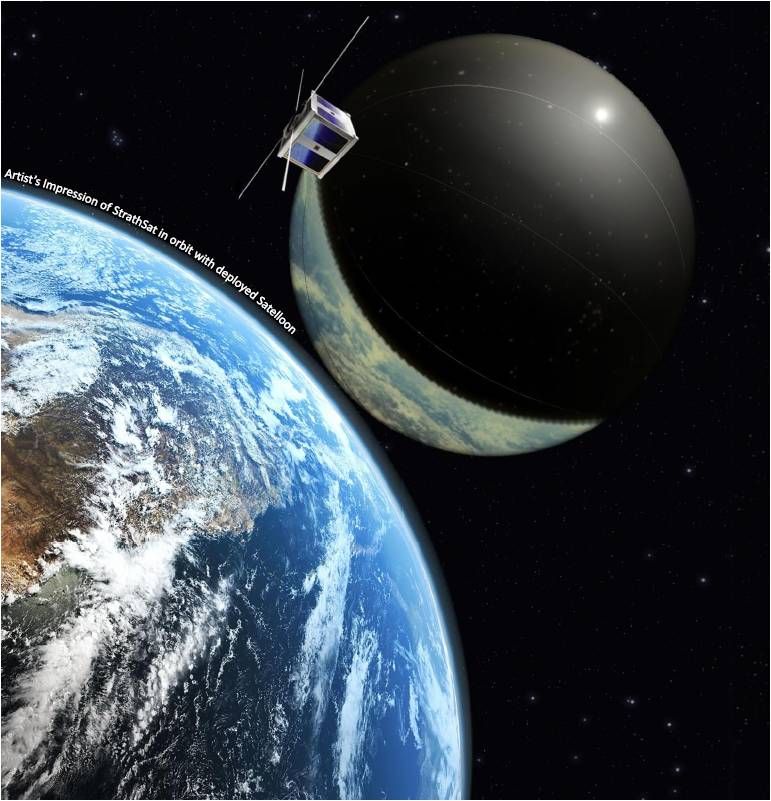
StrathSat idea uses deployable reflective balloon.
Credit: University of Strathclyde
Technical approaches
The Deorbit Device Competition (DDC) is organized to identify possible technical approaches for cost effective and innovative system concepts for the deorbit device.
“Space engineers, researchers, students and all interested in contributing to the harmonious space development will be welcome to join and share ideas and plans,” notes the DDC website.
Note: The deadline for concepts submitted as abstracts is at month’s end – April 30, 2016. (This has now been changed to May 31, 2016.)
Final presentations of accepted concepts will be held in Istanbul, Turkey on October 21, 2016.
Details regarding the competition are available at:

Credit: Satellite Applications Catapult
A low cost, domestic launch capability will be of significant strategic value to the space sector of the United Kingdom, according to a new report published by the Satellite Applications Catapult.
The “IGS Low Cost Access to Space” report focuses on the UK’s expertise in the small satellite market – a growing segment of the space sector, for which low cost access to space is key.
Market opportunities
This new report recommends actions for industry, Government, the Satellite Applications Catapult and academia, which will be required to capitalize on existing UK strengths in small satellite manufacturing, satellite applications and services, and future demand for commercial human spaceflight and microgravity research.
Stuart Martin, CEO of the Satellite Applications Catapult and Chairman of the Space Leadership Council Industry Advisory Group on Low Cost Access to Space, said the report addresses market opportunities that low cost access to space can offer, for small satellite launch, commercial human spaceflight, and for microgravity science research, “not just for the UK, but for Europe as a whole.”

Credit: Satellite Applications Catapult
Key findings
Among the key findings of the report:
- Low cost access to space is a key requirement for any major player in this sector, leading to increased economic benefits through satellite manufacturing, applications and services.
- An operational spaceport to support orbital access is a top priority: a spaceport will position the UK to take advantage of emerging demand for small satellite launch, commercial human spaceflight and microgravity research.

Credit: Satellite Applications Catapult
NOTE: For access to “IGS Low Cost Access to Space” and other related reports, go to:
 China is celebrating a “National Day of Space Flight,” spotlighting the launch of its first satellite, Dong Fang Hong No. 1, on April 24, 1970.
Surrounding the festivities, Chinese space officials have pointed to a number of upcoming and projected space initiatives – such as Moon and Mars spacecraft launches, piloted space flight and space station building, as well as evaluating reusable launch technology.

China’s Tiangong-1. Follow-on space lab has been modified to provide crews more room and support extended space-stays.
Credit: CMSE
Five-year plan
Over the years, China has launched the Long March series of carrier rockets for 226 times, with a success rate of over 96 percent, notes Xu Dazhe vice minister of the Ministry of Industry and Information Technology, administrator of the State Administration of Science, Technology and Industry for National Defense and administrator of the China National Space Administration.
Xu explained that in the year of 2016, the beginning of China’s 13th Five-Year Plan, China’s Mars Exploration Project has been officially approved, the National Civil Space Infrastructure Construction has been established, the Moon-bound Chang’e-4 mission has been initiated, the Chang’e-5 lunar project has entered a key stage, the Beidou Navigation System has accelerated integration with global networking and the “non-poisonous and pollution-free” Long March 5 and 7 boosters are due for their maiden flights this year.

China’s Yutu lunar rover took this image of Change’3 lander. New lunar landers are being readied for China’s next step in Moon exploration.
Credit: NAOC/Chinese Academy of Sciences
The Tiangong-2 space lab and Shenzhou-11 piloted craft, Gaofen-3 Satellite, Fengyun-4 Meteorology Satellite, Hard-X Ray Modulation Telescope Detection Satellite and Quantum Science Experiment Satellite will also be launched this year, Xu said.

Credit: National Astronomical Observatories of Chinese Academy of Sciences
Xu also noted that China has in place over 100 cooperation agreements signed with 30 state-level space institutions and international organizations. “Starting from this new point, we are willing to take a more open attitude and collaborate with other countries to compose a new chapter in space exploration and contribute to human welfare.”
Red planet rover
“The Mars mission marks China entry into the de facto phase of deep-space exploration. Even though our spacecraft have already entered deep space, we need the Mars mission to help us improve our understanding of deep space,” Xu said.
Xu has reported earlier that the Mars probe, to be launched around 2020, is expected to orbit the red planet, land and deploy a rover all in one mission, “which is quite difficult to achieve,” Xu added. He said that the Mars mission was approved by central authorities in January.
Stressing the mission’s importance and difficulty, Xu said that although China has sent spacecraft deep into space, “only by completing this Mars probe mission can China say it has embarked on the exploration of deep space in the true sense.”
Reusable rocket technologies
The state-run Xinhua news agency also reports that China is working on its own reusable rocket technologies.

Work has been underway on China’s new Long March boosters.
Credit: China Aerospace Science and Technology Corporation
According to Xinhua, Chinese rocket specialists have built a prototype model to test theories on reusable rocket booster landing subsystems. They have completed “experimental verifications” using “multiple parachutes” apparently attached to the booster, a source with China Academy of Launch Vehicle Technologies (CALT), developer of China’s Long March rocket series, said.
Ma Zhibin, deputy director of CALT’s aerospace department also confirmed to Xinhua that Chinese scientists are working on reusable rockets, although the technologies they employ may differ from those of Elon Musk and his SpaceX rocketeers.
“There is of course more than one way to do this … I believe we could see some serious results during the 13th Five-Year Plan period, Ma said, referring to the five years between 2016 and 2020.
Space lab living room
In related Chinese space news, Wang Zhongyang, spokesman with the China Academy of Space Technology (CAST), detailed more about the upcoming launch of the country’s second space lab –Tiangong-2 — slated for liftoff in the third quarter of this year.
Tiangong-2 is assigned various duties, carrying out space science experiments and repair tests as prelude to China’s first orbital space station, expected to be in service around 2022.
Wang said Tiangong-2 has been modified from its predecessor, Tiangong-1. Those modifications will make the space lab more livable for mid-term stays of crews.

China’s 60-ton medium-size space station is depicted in this artwork.
Credit: CNSA
“Unlike Tiangong-1, Tiangong-2 will be our first genuine space lab,” Wang said. A two-person Shenzhou-11 spacecraft is to be linked to Tiangong-2 in the fourth quarter of this year. The two male Chinese astronauts are expected to partake in a 30-day mission in the new space lab before returning to Earth.
The yet-to-be-identified Chinese astronauts are currently receiving training for the mission.
In 2017, Tiangong-2 and China’s first space cargo ship, Tianzhou-1, are to link up in the first half of next year. Tianzhou-1 is to be orbited via a next generation Long March-7 rocket. During that mission, Chinese space authorities are to verify key technologies such as in-space propellant refueling.

Curiosity Navcam Left B image taken on Sol 1319 April 22, 2016.
Credit: NASA/JPL-Caltech
At this writing, NASA’s Curiosity Mars rover is carrying out Sol 1320 duties.
“It’s always exciting when we get to drill a new sample on Mars,” notes Lauren Edgar, a research geologist at the USGS Astrogeology Science Center in Flagstaff, Arizona reports.

Curiosity Mastcam Left image taken on Sol 1315, April 18, 2016
Credit: NASA/JPL-Caltech/MSSS
Contact science went well on Sol 1319 Edgar explains, with a drill pre-load test suggested that the “Lubango” block might have moved slightly, but the plan is to drill in the weekend plan.
“In addition to the main drill activities, the plan includes several targeted science blocks, which will be used to characterize the drill location and search for the next potential drill site on unaltered Stimson bedrock,” Edgar points out.
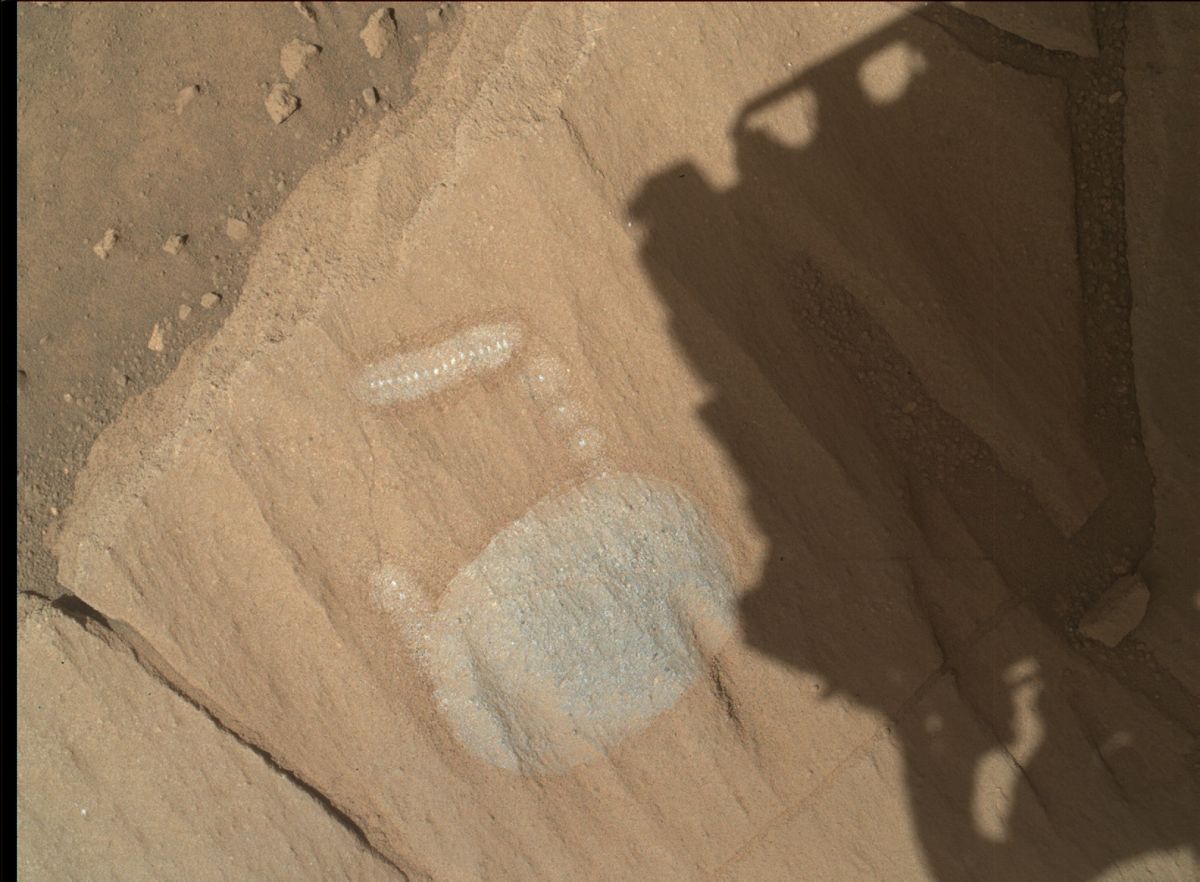
NASA’s Mars rover Curiosity acquired this image using its Mars Hand Lens Imager (MAHLI) on Sol 1319, April 22, 2016. MAHLI is located on the turret at the end of the rover’s robotic arm.
Credit: NASA/JPL-Caltech/MSSS
Fingers crossed
Also on the weekend plan is Mastcam multispectral characterization of the drill hole, followed by several Mastcam mosaics.
“The color information provided by Mastcam is really helpful in distinguishing altered versus unaltered bedrock. We also planned a small mosaic to assess a fracture that crosscuts an impact crater,” Edgar says.
The science script also calls for shooting several Chemistry & Camera (ChemCam) targets to assess the block that is set for drilling, and a few sites that the rover might bump to next.
Weekend science block includes an additional target to assess unaltered Stimson bedrock.
“Fingers crossed,” Edgar concludes, “for a successful drilling campaign!”

Curiosity inspection of its wheels using its Mars Hand Lens Imager (MAHLI) on April 18, 2016, Sol 1315.
Credit: NASA/JPL-Caltech/MSSS

Curiosity Mastcam Left image taken on Sol 1315, April 18, 2016
Credit: NASA/JPL-Caltech/MSSS
Wheel inspection
Curiosity also recently performed a detailed look at its wheels, monitored on a regular basis due to damage caused by the one-ton rover rolling over Mars rocks since landing in August 2012.

The Moon as seen from the International Space Station, taken by ESA British astronaut, Tim Peake.
Credit: NASA/ESA
The European Space Agency (ESA) has released an impressive and highly informative “Interactive Guide to the Moon.”
The why and how of lunar exploration is detailed, an authoritative blueprint that’s detailed and carved up into categories: Science, Technology and Missions.
Moon first strategy
ESA’s exploration strategy is in line with the Global Exploration Roadmap drawn up by the International Space Exploration Coordination Group. That European strategy considers the Moon as the next destination for humans venturing beyond low Earth-orbit. Doing so is viewed as an integral part of the roadmap towards human missions to Mars.
The new website looks at historic and future lunar missions characterized in 5 categories: landers, rovers, Apollo, orbiters and robotic sample return.
Human-robot partnership

Dusty legacy of Apollo. Europe’s blueprint adopts Moon-first approach as precursor to humans to Mars.
Credit: NASA
“Scenarios for robotic explorers foresee a stronger human-robot partnership,” the site explains. “The ESA-led study HERACLES envisions a first surface mission in the mid-2020s. This mission would collect samples using a rover that drives the material back to a rocket that would launch to a station orbiting the Moon. The crew aboard this outpost would retrieve the sample for further analysis.”
Looking to the future, the website explains that European and Russian space agencies are working together to send a lander to the Moon’s South Pole. The PROSPECT package aims at collecting and analyzing samples on the Moon and is being developed by ESA for the Russian Luna 27 mission, scheduled for flight in 2020.

Credit: Public Domain/Dylan O’Donnell
To explore this unique and info-packed site, go to:
China’s 60-ton medium-size space station is depicted in this artwork.
Credit: CNSA
China is supporting a national day of space – a date selected that salutes the country’s first satellite launching back in 1970.
April 24th will also note China’s ongoing aerospace activities as it marks the 60th anniversary of progress in that arena.
Space station module
Meanwhile, China’s state-run Xinhua news agency has reported that the core module of its space station – due for launch around 2018 — will be tagged “Tianhe-1” – a Chinese word for Milky Way or Galaxy.
Xinhua reports that Wang Zhongyang from the China Aerospace Science and Technology Corp. says that two space labs will be launched later and dock with Tianhe-1.” Wang adds that the construction of the space station “is expected to finish in 2022.”
That core module is to be orbited by the yet-to-fly Long March 5 booster headed for its maiden shakeout flight this September.
Wang points out that a space telescope akin to the Hubble Space Telescope will “be in a separate space unit and share orbit alongside the space station.” He also notes that if the International Space Station is retired by 2024, “China’s new space station will be the only operational one in outer space.”
Next piloted flight

Artist’s concept of the Tiangong-1 in Earth orbit. A Tiangong-2 is being readied for liftoff this September.
Credit: CMSA
Coming up this year is launch of the piloted Shenzhou 11 and Tiangong 2 space lab. This second space lab is to rocket into space in September.
A month later, Shenzhou 11 is slated to carry two astronauts that will dock with Tiangong 2.
In 2017, the maiden flight of China’s cargo ship, Tianzhou 1, is to dock with Tiangong 2. This supply ship is to be boosted by the Long March 7, a launcher also set to debut this year.

