Archive for the ‘Space News’ Category
 Author:
  June 17th, 2016
NASA’s Mars rover Curiosity acquired this image using its Mars Hand Lens Imager (MAHLI), located on the turret at the end of the rover’s robotic arm, on June 17, 2016, Sol 1373.
Credit: NASA/JPL-Caltech/MSSS
NASA’s Curiosity rover on Mars is now busily on task during Sol 1374.
A few Sols ago, the robot made a drive of 105 feet (32-meters), executing the maneuver exactly as planned.
That drive has given the rover a good view of the path toward the south, explains Ken Herkenhoff of the USGS Astrogeology Science Center in Flagstaff, Arizona.
Another drive of roughly the same distance was planned for Sol 1373, after some rover remote science observations.
Path ahead

Curiosity Mastcam Left image taken on Sol 1371, June 14, 2016.
Credit: NASA/JPL-Caltech/MSSS
Curiosity’s Mastcam is imaging the path ahead through all spectral filters, then the robot’s Chemistry & Camera (ChemCam) and the Right Mastcam will observe Stimson bedrock targets “Sesfontein” and “Swartbooisdrif,” reports Herkenhoff.
On Sol 1374, there is a planned use of software to autonomously acquire another ChemCam observation and the Left Mastcam will take a 3×2 mosaic of the same area.

Curiosity Navcam Left B image taken on Sol 1373, June 17, 2016.
Credit: NASA/JPL-Caltech
Dates of planned rover activities are subject to change due to a variety of factors, including communication relays and rover status.

Curiosity Navcam Left B image taken on Sol 1373, June 17, 2016.
Credit: NASA/JPL-Caltech
New map
A new map has been issued that depicts the Curiosity rover’s location for Sol 1373.
This map shows the route driven by NASA’s Mars rover Curiosity through the 1373 Martian day, or sol, of the rover’s mission on Mars (June, 17, 2016).
Numbering of the dots along the line indicate the sol number of each drive. North is up.
From Sol 1371 to Sol 1373, Curiosity had driven a straight line distance of about 98.09 feet (29.90 meters). Since touching down in Bradbury Landing in August 2012, Curiosity has driven 8.07 miles (12.98 kilometers).

Credit: NASA/JPL-Caltech/Univ. of Arizona
The base image from the map is from the High Resolution Imaging Science Experiment Camera (HiRISE) in NASA’s Mars Reconnaissance Orbiter.
 Posted in

China’s 60-ton medium-size space station is depicted in this artwork.
Credit: CNSA
China has made good on a previously stated interest in opening the airlocks on their future space station to other nations.
China expects that its space station will be operational around 2022 – a few years before the currently orbiting International Space Station is to reach its end-of-life.
The core module of China’s space station –Tianhe-1– is to be launched in 2018.
New agreements
According to a June 16 UN Information Service statement: “The United Nations Office for Outer Space Affairs (UNOOSA) and the China Manned Space Agency (CMSA) have agreed to work together to develop the space capabilities of United Nations Member States via opportunities onboard China’s future space station.”
New agreements set the stage for UNOOSA and CMSA to work together to enable United Nations Member States – chiefly developing countries — to conduct space experiments onboard China’s space station, as well as to provide flight opportunities for astronauts and payload engineers.
Space station utilization
“Space exploration is the common dream and wish of humankind. We believe that the implementation of the agreements will definitely promote international cooperation on space exploration, and create opportunities for United Nations Member States, particularly developing countries, to take part in, and benefit from, the utilization of China’s space station,” said CMSA Deputy Director General Wu Ping in a UN press statement.
Long March 7 first flight

Elements of China’s Long March 7 booster manufactured in Tianjin.
Credit: CASC
Meanwhile, China is set to launch its Long March 7 carrier booster this month, on June 25, according to media reports. This inaugural flight of the booster will depart from China’s new Wenchang Satellite Launch Center in southernmost Hainan Island.
This first Long March 7 flight carries a sub-scale version of a new re-entry capsule that is destined to support human spaceflight.
Cargo vessels
Long March 7 is designed to hurl Tianzhou cargo vessels to supplement space station operations. This supply ship is slated to fly early next year, latching up with and refueling the soon-to-be-orbited Tiangong-2 (Temple II) space lab.
Tiangong-2 is being final checked for its boost into Earth orbit this September.
If Tiangong-2 is successfully launched, a two-person Shenzhou-11 mission is to board the space lab this October for a month-long live-in.

A February look at China’s Shenzhou-11 piloted spacecraft in testing.
Credit: CCTV/framegrab via GBTimes.
Enter Long March 5
Lastly, yet another milestone for China will be the September maiden voyage of its Long March 5.
This “heavy lift” booster is not only assigned the duty to hurl space station modules into Earth orbit, it is on tap to enable robotic return sampling of the Moon and rocket a robotic lander/rover mission to Mars in 2020.
For a You Tube video on China’s Long March-7 rocket shipped to Hainan for its maiden flight, go to:
https://www.youtube.com/watch?v=bX6DOAYt-HU

Curiosity Mastcam Left image taken on Sol 1371, June 14, 2016.
Credit: NASA/JPL-Caltech/MSSS
NASA’s Curiosity rover on Mars is now in Sol 1373 – wheeling its way to the south. The robot is now on a heading for rolling up Mount Sharp.
Last weekend, the robot drove roughly 105 feet (32 meters) and is expected to make an additional drive in the days to come.
Through a gap
Lauren Edgar, a research geologist at the USGS Astrogeology Science Center in Flagstaff, Arizona reports that Curiosity is on this southward path that will eventually take it through a gap in active sand dunes, making it easier for the Mars machinery to traverse.
Over the past few days, the plan called for several Chemistry & Camera (ChemCam) and Mastcam observations of the Murray formation to assess variations in texture and chemistry.

Curiosity Front Hazcam Left B image taken on Sol 1372, June 15, 2016.
Credit: NASA/JPL-Caltech
“We also planned a small Mastcam mosaic to document some nearby cross-stratification and nodules, and a small MAHLI mosaic of the target “Berg Aukas” before driving away,” Edgar adds. MAHLI stands for the Mars Hand Lens Imager.
Also on the science menu is Mastcam observation to monitor the opacity of the atmosphere.
Climb the mountain head-on
“Now that we’ve skirted our way around the dunes and crossed the plateau, we’ve turned south to climb the mountain head-on,” points out Curiosity Project Scientist Ashwin Vasavada of NASA’s Jet Propulsion Laboratory, Pasadena, California.

This graphic maps the first 14 sites where NASA’s Curiosity Mars rover collected rock or soil samples for analysis using the rover’s onboard laboratory. It also presents images of the drilled holes where 12 rock-powder samples were acquired. At the other two sites Curiosity scooped soil samples.
“Since landing, we’ve been aiming for this gap in the terrain and this left turn. It’s a great moment for the mission,” Vasavada notes.
Meanwhile, a new Curiosity “self-portrait” has been released showing the robot at the “Okoruso” drill hole on Mars.

May 11, 2016 selfie of NASA’s Curiosity Mars rover at a drilled sample site called “Okoruso.” Note the veneer of windblown reddish particles on the deck of the robot.
Credit: NASA/JPL-Caltech/MSSS

Space cowboys? International lawyers are trying to agree on what legislation will be needed to control the exploration of mineral resources in space to avoid a new ‘Wild West’.
Credit: James Vaughan
There is a growing choir of experts calling for careful review of laws governing space exploration – specifically rules of the road to control the exploration of mineral resources in space to avoid a projected “Wild West.”
According to Olga Volynskaya, chief international law counsel of the Russian state commission for space activities:
“International law gives no answer to the most important issue in space commercialization,” explains Volynskaya writing in ROOM – the Space Journal. How best to balance public and commercial interests is on the table, observe experts, calling for better and clearer laws.
“It is alarming if the freedom of exploration and the use of outer space for peaceful purposes can be disregarded when it comes to national space operations,” Volynskaya states.
Space cowboys
As countries – and companies – begin to look to outer space for valuable resources, the idea of human colonies on the Moon, once the province of science fiction, is moving ever closer.
Our future in space “may not be a cloudless or a peaceful one” warns ROOM editor-in-chief, Igor Ashurbeyli.“The very nature of Homo Sapiens – or even that of Homo ‘gambliens’ – will not allow us to harness our ancient Earthly instincts. And we will live to see new space cowboys in lunar saloons and on space ranchos.”
Noted in a statement from the Journal, while outer space mining is a growing possibility, no one is quite sure whether it would be legal because international treaties governing commercial activity in space are out of date. At the same time, national governments, notably the United States, are developing legislation to pave the way for easier exploitation of space resources.

Experts gathered for 7th joint meeting of The Space Resources Roundtable (SRR) and the Planetary & Terrestrial Mining Sciences Symposium (PTMSS), held June 7-9 at the Colorado School of Mines in Golden, Colorado.
Credit: Leonard David
Extraterrestrial mining
These issues and others took center stage at the 7th joint meeting of The Space Resources Roundtable (SRR) and the Planetary & Terrestrial Mining Sciences Symposium (PTMSS), held June 7-9 at the Colorado School of Mines in Golden, Colorado.
There is renewed interest in In-Situ Resource Utilization (ISRU) activities for the Moon, Mars, and asteroids from space agencies around the globe, the international private sector, and academic institutions. Furthermore, there is recent legislation introduced for space-resource commercial exploitation – spurring increased discussion of the near- and long-term opportunities in this arena.
Market demand?
The meeting held earlier this month at the School of Mines was geared to promote a closer relationship between the space and mining sectors. The intent is to allow mining experts to network with space scientists and engineers, to share knowledge, and to foster collaboration.
For example, highlighted at the gathering:
- How space transportation systems can utilize space resources
- Market demand and utilization scenarios for space resources and their products
- The relationship between government-funded exploration and private ventures in identifying and using space resources, and how to develop public-private partnerships
- Property rights in space

Credit: Virginia Edition Publishing Company
Readable resources
For more information on these topics, go to:
http://www.csmspace.com/events/srr/
Also, take a look at the debate and discussion surrounding space exploration and exploitation issues, by going to:
For your library, take a read of a study by the International Academy of Astronautics that details space mineral resources (SMR) to benefit humanity as an economic “game changer.”
The study — Space Mineral Resources: A Global Assessment of the Challenges and Opportunities — shows how important it is to create a sound legal environment for SMR exploration and mining from both national and international perspectives, according to Secretary General of the China Institute of Space Law, Zhang Zhenjun, who served as co-editor of the study along with noted U.S. space lawyer, Art Dula.
For more information on this seminal study, go to Virginia Edition Publishing Company:
http://www.heinleinbooks.com/#!product/prd15/4235157661/space-mineral-resources

Unless reboosted to higher altitude, China’s over 8-ton Tiangong-1space lab is expected to fall to Earth late next year.
Credit: CMSE
Sky watchers are monitoring China’s retired space lab that may be headed for an uncontrolled fall to Earth.
Launched on September 29, 2011, Tiangong-1– meaning “Heavenly Palace” was used during Shenzhou-8 (unpiloted), Shenzhou-9 (piloted) and Shenzhou-10 (piloted) spacecraft missions.

Types of equipment used by amateur satellite tracker, Thomas Dorman, to keep a watchful eye on overhead satellite traffic.
Credit: Thomas Dorman
The over eight-ton craft is a stepping stone to China’s larger space complex to be constructed in Earth orbit around 2020.
Flying mode
Tiangong-1 completed its main duty following the piloted Shenzhou-10’s return to Earth in June 2013. The vessel then entered an in-orbit operation management phase. It went through switches in its flying mode, orbit maintenance maneuvers, and other activities.

Updated plot of the altitude history of China’s Tiangong-1 space lab after its launch on September 29, 2011.
Credit: T.S. Kelso
Questions are being raised as to the space lab’s overall health and whether or not it’s headed for an uncontrolled reentry in coming months.
For more information on this large chunk of Chinese junk, go to my new Space.com story at:
When Will China’s ‘Heavenly Palace’ Space Lab Fall Back to Earth?
By Leonard David, Space.com’s Space Insider Columnist
June 10, 2016 07:00 am ET
http://www.space.com/33140-china-tiangong-1-space-lab-falling-to-earth.html

Mars: Stinks to high heaven?
Credit: NASA/JPL
Thanks to robot explorers, Mars has been found to be a world of sulfur, acids, magnesium, iron, and perchlorates – all sun-baked and wrapped in a carbon dioxide-rich atmosphere.
But for future expeditions trudging across the Red Planet, what awaits them in terms of the scent of the place?
There may be a way to re-create whiffs of Mars right here on Earth.
If you have a nose for news, do read my new Space.com story:
What Does Mars Smell Like?

Courtesy: Mars City Design
A new crowd funding effort is underway to spur the design of a City on Mars – an essential step toward creating a sustained human presence on the Red Planet.
The Kickstarter platform is focused on the go-getting goal of living “off planet” Earth. The raised funds will help with travel and operational costs of getting Mars City Design competition finalists to Los Angeles for a Power Lab workshop this summer.
Real cities

Mars Research Facility by Matt Jennings.
Mars City Design’s mission is to create visionary blueprints for real cities to be built before humans truly migrate to Mars.
This undertaking includes:
- Establishing a module base of four people
- Growing it to a size of an entire city with over 1,000 inhabitants
- Applying this technological breakthrough for the benefit of Earth and testing the prototypes through 3D printing

“Instant Structure” by Reza Eslami and Asal Shokati
Survive and thrive
This past year a design competition was initiated where participants from all over the world were able to have their say on what humans would need – not just to survive on Mars, but to sustain life as done here on Earth.
Recently, as follow-up, Mars City Design launched a crowd funding campaign on the Kickstarter platform in hopes of beginning to achieve the ambitious goal of living off planet. The raised funds will help with travel and operational costs of getting Mars City Design competition finalists to Los Angeles for a Power Lab workshop this summer.
University workshop
This “Mars City Power Lab” summer workshop would be staged this year – September 15-27 — at the University of Southern California.
At this workshop, finalists will build working prototypes and confer with industry experts about their projects in terms of viability and enhancement.

Project “Dandelion” by Gabriel Vidal
The goal of the Kickstarter campaign is $30,000. Funds will allow finalists and experts to unite in one place for two weeks. The upshot of the event is to focus on developing the selected designs of the cities on Mars, to further the mission of creating the right blueprints for a city on Mars.
“A home on another planet…it starts with designing it. Our workshop will just do that, and you can be part of it,” explains Mars mastermind, Vera Mulyani, CEO of Mars City Design.
For more information on backing the Mars City initiative, go to:
https://www.kickstarter.com/projects/marscitydesign/a-city-on-mars?ref=nav_search
Additional information is available at:
Email: MarsCityDesign@Gmail.com
Twitter: @MarsCityDesign
Facebook: Mars City Design

Curiosity Mastcam Left image taken on Sol 1361, June 4, 2016.
Credit: NASA/JPL-Caltech/MSSS
NASA’s Curiosity rover on Mars is now in Sol 1364.
“The Oudam drill campaign continues to go well, with sample acquired and ready for analysis,” reports Ken Herkenhoff at the USGS Astrogeology Science Center in Flagstaff, Arizona.
The plan for Curiosity on Sol 1364 is to use the Chemistry and Camera (ChemCam) instrument to acquire passive spectra of the drill tailings and a Laser-Induced Breakdown Spectroscopy (LIBS) raster of the wall of the drill hole.
Dumping grounds
Later in the afternoon of Sol 1364, the unsieved portion of the drill sample is to be dumped on the ground and imaged by the rover’s Mars Hand Lens Imager (MAHLI) from 25 centimeters to support future planning, Herkenhoff explains.

Curiosity Mastcam Left image taken on Sol 1362, June 5, 2016.
Credit: NASA/JPL-Caltech/MSSS
In the current plan, after dark, the MAHLI – making use of its LEDs for illumination — will take pictures of the inside of the drill hole, the tailings, and the Chemistry & Mineralogy X-Ray Diffraction/X-Ray Fluorescence Instrument (CheMin) inlet.
The Alpha Particle X-Ray Spectrometer (APXS) is then to be placed on the drill tailings for an overnight integration.
Hartmann’s valley
Early on Sol 1365, Herkenhoff adds, the schedule calls for use of the rover’s right Mastcam to extend the mosaic of Hartmann’s Valley, adding 22 images.
That afternoon, the APXS is to be retracted and vibrated to clean it, Herkenhoff says, then the rover’s robotic arm will be moved out of the way for ChemCam and Mastcam observations of the drill tailings.

Curiosity Mastcam Left image taken on Sol 1362, June 5, 2016.
Credit: NASA/JPL-Caltech/MSSS
Curiosity’s Navcam is to be used to search for clouds both near the horizon and at zenith.
Finally, CheMin will analyze the drill sample overnight, Herkenhoff concludes.
Dates of planned rover activities are subject to change due to a variety of factors related to the Martian environment, communication relays and rover status.
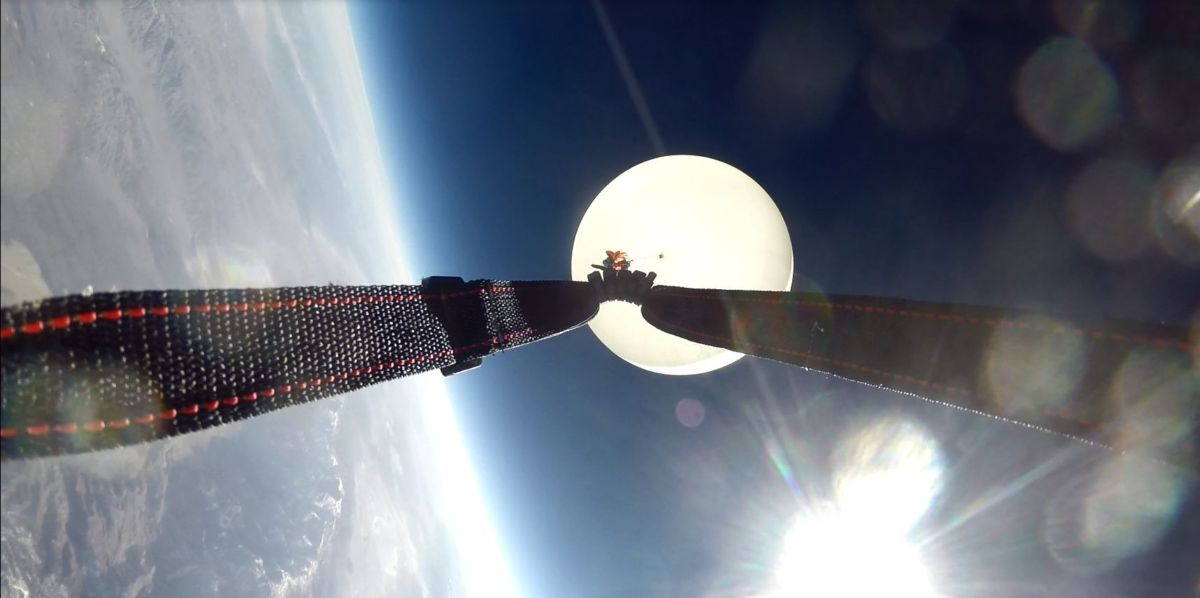
Credit: Earth to Sky Calculus
Now departing from the “Edge-of-Space Port” is where the Earth to Sky Calculus group release their helium-filled balloons, doing cutting-edge science in a little-explored realm 100,000 feet above the Earth – the stratosphere.
About once a week, these young researchers send their experiments aloft using helium balloons to search for new life forms in the stratosphere and to monitor the effects of cosmic radiation on Earth’s atmosphere.

Credit: Earth to Sky Calculus
Based in Bishop, California, Earth to Sky Calculus members let loose their sky-high experiments at an altitude of 8,500 feet in the Eastern Sierra mountain range.
Landing sites for parachuting payloads are typically located 10 miles to 70 miles away in the Death Valley National Park, White Mountains, and the Inyo Mountain range of California.
Wanted: sponsors
The club was formed in 2010 and has launched more than 100 research-grade balloons for exploration purposes.

Credit: Earth to Sky Calculus
The balloons carry payloads focusing on three kinds of research:
— Monitoring cosmic rays in the atmosphere
— Stress-testing Mars microbes
— Developing a biological radiation sensor
Earth to Sky Calculus has no grants or government support.
Each and every flight is paid for by small contributions usually amounting to no more than $500. That’s the minimum cost to launch a flight.
Sponsors have come from all walks of life: retirees, small business owners, parents who want to inspire their own children.

Credit: Earth to Sky Calculus
Sultans of swing
In exchange for a $500 donation, Earth to Sky will fly a birthday card, Christmas card, business logo, or small experiment to the edge of space.
For example, what do you give to that special someone who has everything, but has perfected their golf swing?
On May 25, 2016, the students of Earth to Sky Calculus flew a basket of space-helmeted golf balls to the edge of space, 119,000 feet (36.3 kilometers above Earth’s surface. After the carrier balloon popped at altitude, the balls parachuted back to terra firma, landing in the volcanic tablelands north of Bishop.

Credit: Earth to Sky Calculus
For $49.95 you can have one of these balls (space helmet included) along with a unique card showing the balls floating at the top of Earth’s atmosphere. The interior of the card tells the story of the flight and confirms that this gift has been to the edge of space and back again.
For more information on Earth to Sky Calculus, their experiments and special offerings go to:
To sponsor a flight, contact Tony Phillips at:
A February look at China’s Shenzhou-11 piloted spacecraft in testing.
Credit: CCTV/framegrab via GBTimes.
China’s next piloted space mission is progressing forward. Space engineers are final checking the Tiangong-2, the country’s space lab that reportedly will be rocketed into orbit this September.
Meanwhile, the still unnamed two-person crew for the Shenzhou-11 mission is in training for their October liftoff.
The booster for their fight, the Long March 2F launch vehicle, has passed assessment testing to support the Shenzhou-11 flight.
As a target space lab, Tiangong-2 and the Shenzhou-11 crew will latch up for an expected 30-day stay in Earth orbit.
Capacity expanded
“We plan to complete the medium-term stay mission in the space lab. It also involves a manned spacecraft, which will carry life necessities of the astronauts, thus capacity of Tiangong-2 were much expanded,” explains Zhu Congpeng, chief designer of spacelab systems for China’s manned space engineering project.
China’s 60-ton medium-size space station is depicted in this artwork.
Credit: CNSA
Tiangong-2 carries much more new equipment than its predecessor space lab, Tiangong-1. This next vehicle will test gear needed to build China’s larger space station, the core module of which is headed for launch in 2018.
“We also installed a mechanical arm that will carry out automatic repair outside of the space lab,” Zhu said.
Propellant resupply
A total of 14 experiments will be carried out in Tiangong-2, and most of relevant technologies will be used on application satellites, said Zhao Guangheng, chief designer of space application systems for China’s manned space engineering project.

Long March booster to hurl Shenzhou-11 recently passed final checks.
Credit: CASC
In a milestone for China’s space program, a space cargo ship — Tianzhou-1 — is slated for liftoff in the first half of next year. Once Tiangong-2 and the unpiloted cargo craft are docked on-orbit, a propellant resupply of the space lab is scheduled.
Check out this video that shows Chinese designers busy testing Tiangong-2 for its upcoming space mission.
Go to:
https://www.youtube.com/watch?v=jEQLzgLtDaU

