Archive for the ‘Space News’ Category
 Author:
  September 16th, 2025
The Commercial Space Federation (CSF) released a new report titled “Redshift: The Acceleration of China’s Commercial and Civil Space Enterprise and the Challenge to America.”
The CSF document offers a thorough review of China’s civil and commercial space activities over the past decade following the announcement of their “Space Dream” and implementation of the Belt and Road Initiative.
As a primary finding, the report focuses on China’s decade of steady progress in space, an effort that “is now reshaping the competitive landscape and may soon challenge U.S. leadership and commercial strength,” contends the assessment.
Define norms, capture markets
“The risks extend beyond technology to markets, partnerships, and governance, signaling a pivotal moment in global space competition,” the report notes. “What began as milestone-driven missions has become a state-backed campaign to define norms, capture markets, and build international coalitions across all segments of the space ecosystem.”

Furthermore, the report points out that over the past decade, China’s space enterprise has transformed rapidly, driven by sweeping policy reforms, surging investment, and an intentional merging of commercial, civil, and national security ambitions.
Altering the strategic landscape
This just-issued analysis suggests CSF, is underscored by China’s shift from aspirational planning to tangible achievement—changes that are fundamentally altering the strategic landscape for the United States and its partners.
Billed as a comprehensive, segment-by-segment assessment of China’s space progress and its implications for American interests, this CSF report “aims to serve both as a factual record of China’s emerging capabilities and as a risk assessment for U.S. industrial competitiveness and national security.”
To access the report – “Redshift: The Acceleration of China’s Commercial and Civil Space Enterprise and the Challenge to America” — go to:
https://commercialspace.org/wp-content/uploads/2025/09/CSF-Redshift-v6.pdf
 Posted in

Justin Cyrus, Lunar Outpost’s CEO and co-founder.
Image credit: Barbara David
ARVADA, Colorado – Lunar Outpost, a private space company, is putting the pedal to the metal on its lunar terrain vehicle (LTV), a large rover that Artemis astronauts will use to wheel across the moon’s dusty, crater-pocked landscape.
A tour of the Lunar Outpost’s Mission Control here offered an up-close look at the status of the group’s LTV design, the Eagle, and how use of its Autonomous Test Facility in Rye, Colorado is sharpening skills in motoring the off-Earth, off-road vehicle.

Lunar Outpost’s Eagle undergoes testing. Unit for driving on the Moon will feature special wheels and suspension design to gain traction on the lunar surface.
Image credit: Lunar Outpost
The design is “a mix between a dune buggy and a heavy-duty truck,” said Justin Cyrus, Lunar Outpost’s CEO and co-founder.
For more regarding Lunar Outpost’s Moon rover concept, go to my new Space.com story – “’We are ready to drive’: Take a look inside Lunar Outpost’s moon rover mission control (photos)” – at:
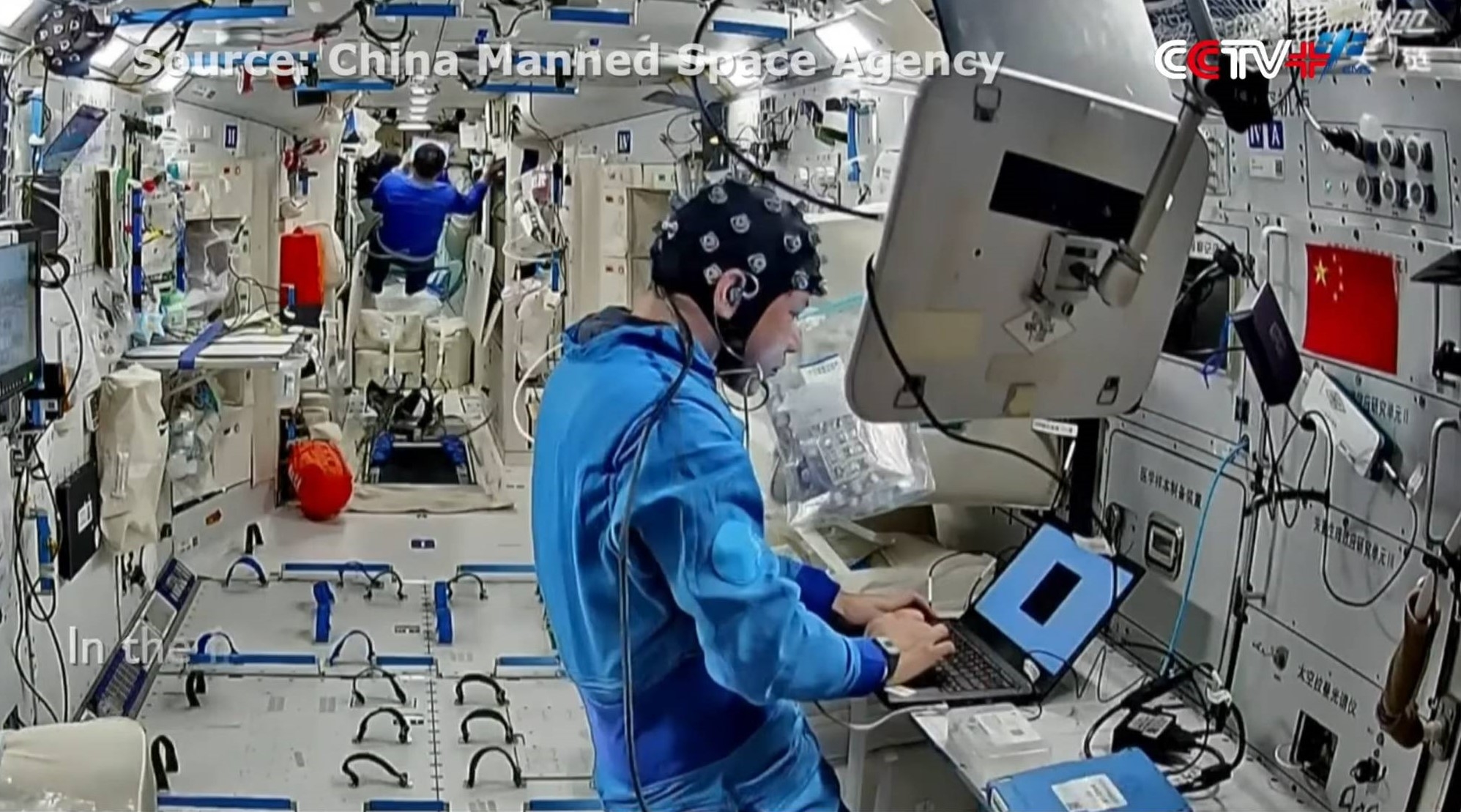
Image credit: CMSA/CCTV/Inside Outer Space screengrab
China’s Shenzhou-20 crew onboard the country’s Tiangong space station continue to advance a series of scientific experiments and perform other tasks.
According to the China Manned Space Agency (CMSA) the station trio have used laptops and specialized software to complete fine motor control and metacognitive monitoring experiments.
Brain research
The taikonauts also collected data with electroencephalograms — devices that measure electrical activity in the brain — for studies on visual-motion processing and cognition in microgravity, supporting ongoing research on Earth.
Additionally, the crew harvested and stored lettuce grown on board, before beginning a new round of cultivation of other plants.

Image credit: CCTV/CMSA/Inside Outer Space screengrab
Emergency drill
Station maintenance tasks continue, including replacement of ignition heads and burners in the orbiting outpost’s combustion facility. A scheduled full-system pressure emergency drill was also carried out between the crew and ground controllers, simulating a cabin depressurization scenario.
For health management, the crew conducted cardiopulmonary fitness tests, exercised regularly, and used neuromuscular stimulation devices to counteract muscle atrophy in microgravity.
For an overview, go to this China Central Television (CCTV)/CMSA video at:
https://www.facebook.com/share/v/17Np4DZRA8/

China’s Tiangong space station as imaged by MAXAR satellite.
Image credit: MAXAR

Image credit: Mars Guy/NASA/JPL Caltech/Inside Outer Space screengrab
Mars Guy focuses on the possible evidence for ancient life on the Red Planet.
“Perseverance has not found aliens or even a fossilized bone,” explains Mars Guy, “but as detailed in a newly released paper and announced by NASA this week, it may have found evidence for long dead microbes that lived in the mud of an ancient river.”

Image credit: NASA/JPL Caltech/Mars Guy/Inside Outer Space screengrab
To watch this new episode from Mars Guy, go to – “NASA announces potential biosignatures on Mars” – at:
Credit: NASA’s Scientific Visualization Studio/Visualizer Ernie Wright (USRA)
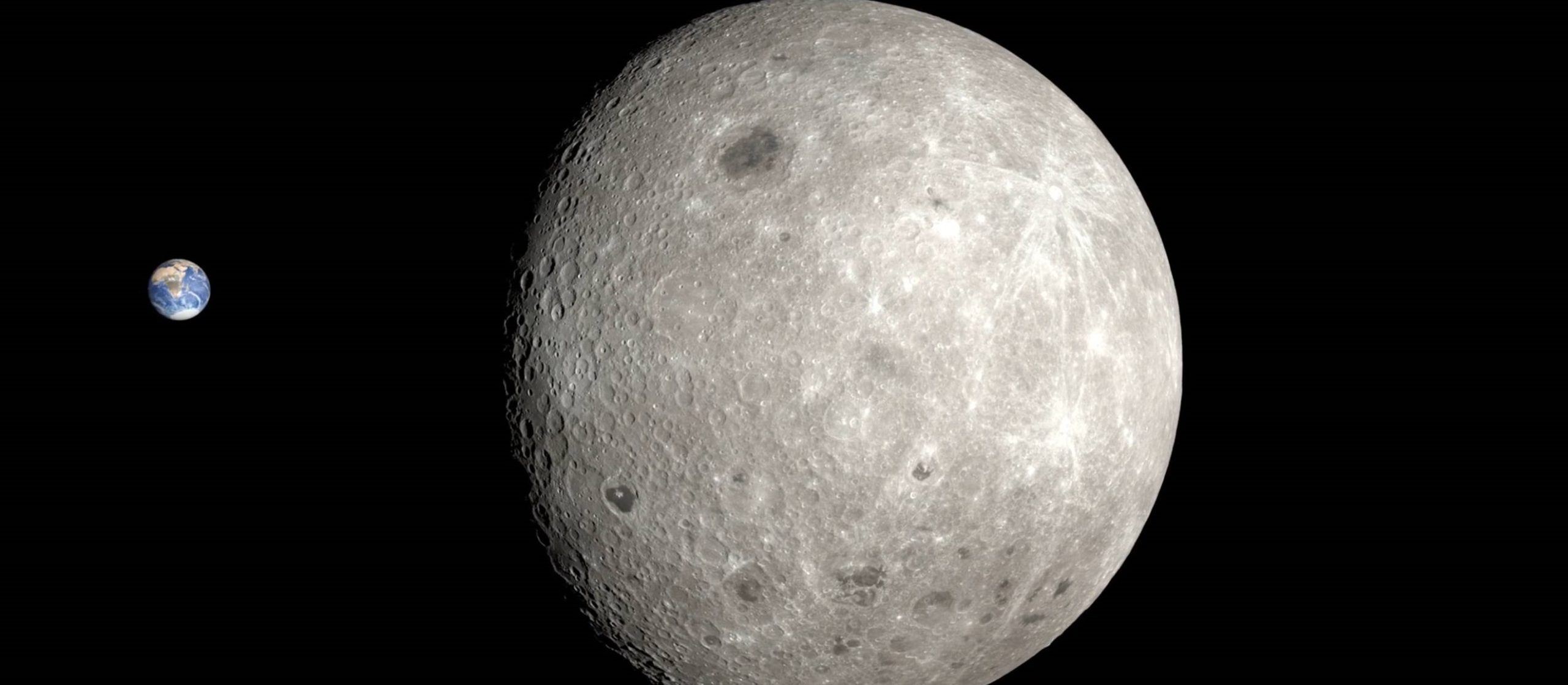
This visualization simulates what the crew of Artemis II might see out the window on the day of their closest approach to the Moon.
The video compresses 36 hours into a little more than a minute as it flies the virtual camera on a realistic trajectory that swings the spacecraft around the Moon’s far side.
This sample trajectory is timed so that the far side is fully illuminated when the astronauts fly by, but other lighting conditions are possible depending on when Artemis II actually launches.
The launch is currently scheduled for no later than April of 2026.
To view the video, go to:
https://svs.gsfc.nasa.gov/vis/a000000/a005500/a005536/a2_flyby_1min_1080p30.mp4

Four astronauts have been selected for NASA’s Artemis II mission: Commander Reid Wiseman, pilot Victor Glover, and mission specialist Christina Koch from NASA, and mission specialist Jeremy Hansen from the Canadian Space Agency.
Image credit: NASA

Up close and personal! Scene from Earth vs. the Flying Saucers circa 1956.
Image credit: Columbia Pictures
How best to restore public trust through transparency and whistleblower protection regarding Unidentified Anomalous Phenomena (UAPs)?
That was the core question seeking answers in a September 9 congressional House of Representatives hearing, held by the Task Force on the Declassification of Federal Secrets.
“This is about national security, government accountability, and the American people’s right to the truth,” said Representative Anna Paulina Luna (R-Florida). The lawmaker is chair of that task force, swearing in witnesses that under oath discussed their experiences and knowledge about UAPs, a rebranded term, rightly or wrongly, attached to Unidentified Flying Objects (UFOs).

Swearing in of witnesses at the September 9 congressional House of Representatives hearing, held by the Task Force on the Declassification of Federal Secrets.
Image credit: Inside Outer Space screengrab
I asked several experts from leading research groups on UAPs/UFOs concerning the hearing and their take-away messages.
For details, go to my new Space.com story – “UAP witnesses criticize Pentagon UFO office in Congressional hearing for ‘using science and coming up with answers’” – at:
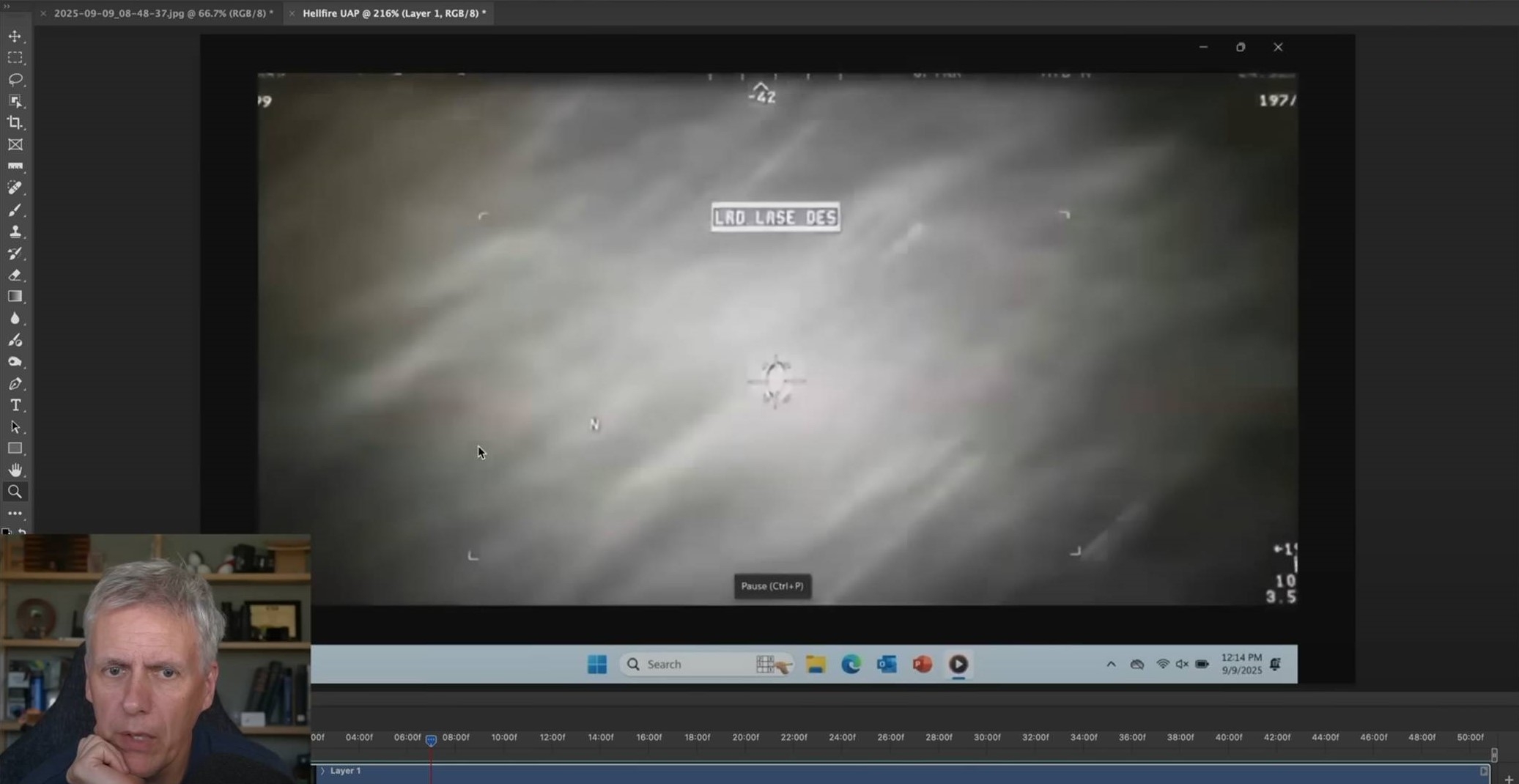
Image credit: Mick West/Inside Outer Space screengrab
NOTE: During the hearing new UFO/UAP video was shown. The footage was recorded off the coast of Yemen, reportedly by a military drone. What’s captured is a drone-fired Hellfire missile intercepting a purported UAP. The video stirred comments that no known craft of Earthly origin could take the impact and continue onward.
Mick West, a long-time UAP video analyst has another take on what’s being shown in that video. For his interpretation, go to:
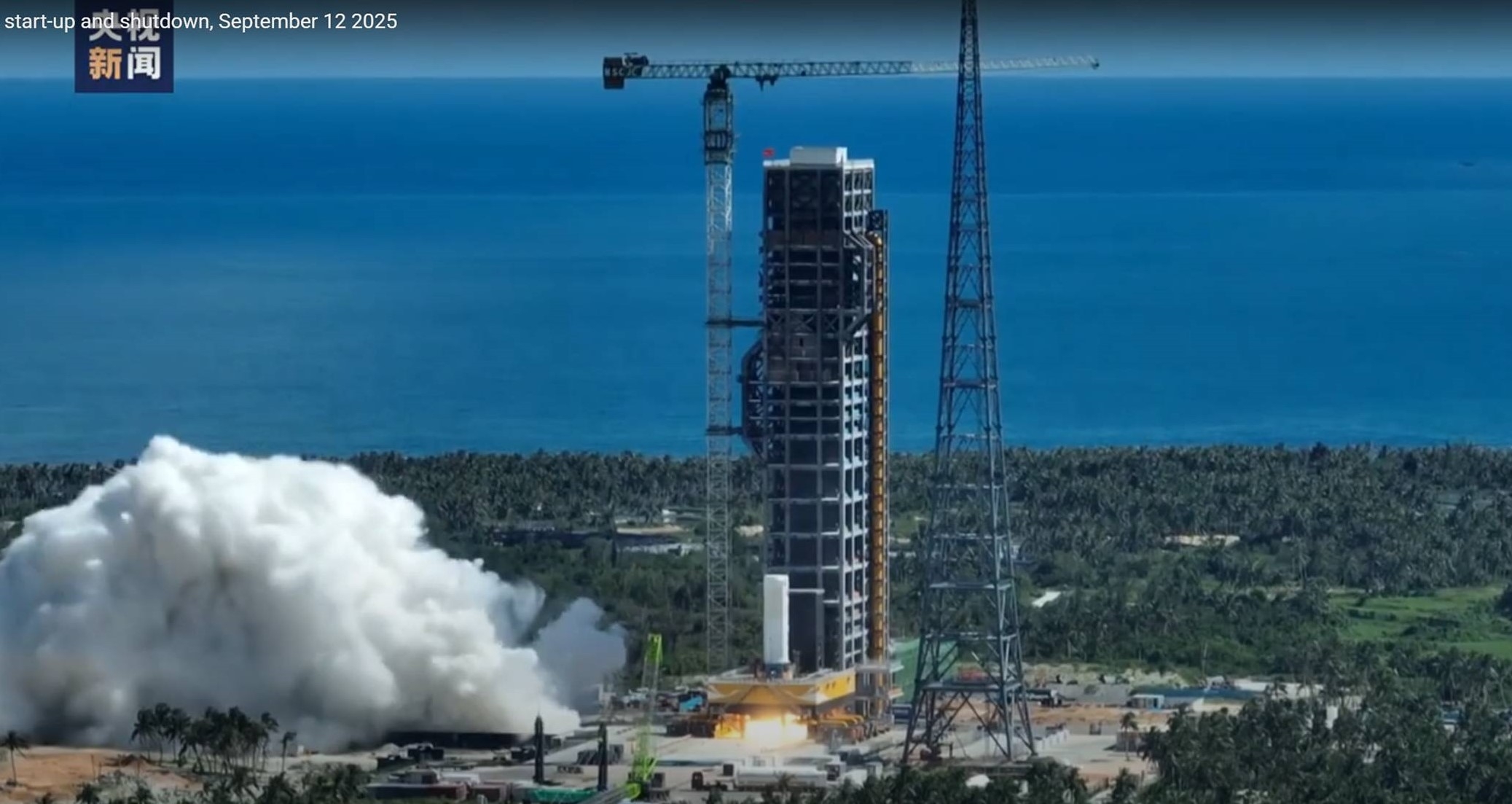
China’s powerful Long March-10 carrier rocket intended to support the country’s humans-to-the-Moon effort has successfully completed its second static fire test.
The September 12 test firing was held at the Wenchang Spacecraft Launch Site in the southern island province of Hainan.
According to China’s Xinhua news agency, all seven YF-100K engines were fired up, followed by a restart of several of the engines. Total test duration: 320 seconds.
The China Manned Space Agency (CMSA) stated that the test focused on evaluating the capabilities of the seven clustered engines of the rocket’s first stage for low-thrust operating condition and secondary restart condition, obtaining complete test data.

Image credit: CCTV/CNSA/Inside Outer Space screengrab
Two versions
An earlier test, the first of the two static fires to date, took place on August 15, with the thrust scale reaching nearly 1,000 tons – the largest such test ever conducted in China.
The Long March-10 carrier rocket is to serve China’s crewed lunar exploration missions. It will loft the piloted spacecraft and the lunar lander. The Long March-10 rocket is a three-stage rocket outfitted with two boosters.
The Long March-10A version is a two-stage reusable rocket, with its first stage designed to be recycled and reused. It will hurl the Mengzhou crewed spacecraft and the uncrewed Tianzhou cargo craft to support China’s space station program.
Go to video below.

Image credit: NASA
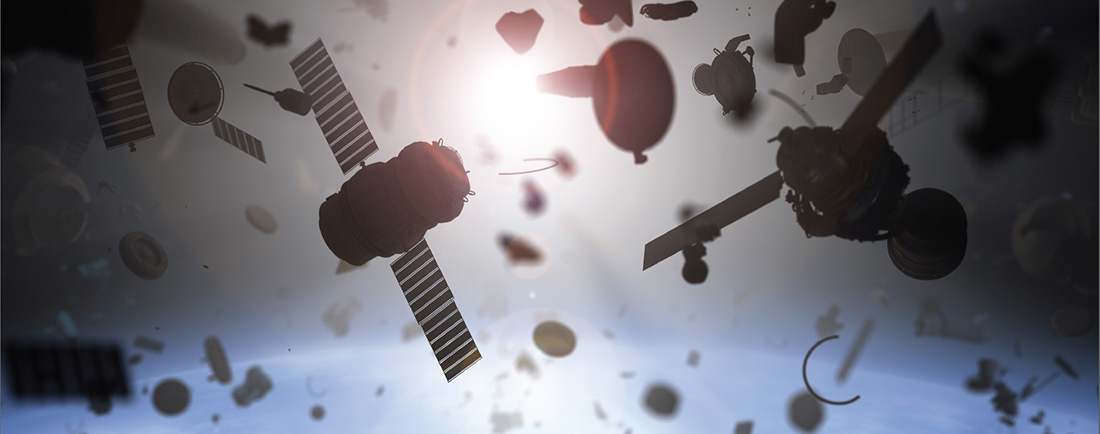
The International Space Station will be the on-orbit test site for a Capture Bag system to snag space debris.
Aerospace startup TransAstra Corporation has developed the system, capable of trapping objects of different shapes and sizes, even debris that is tumbling.
For the ISS investigation, the Capture Bag will be inflated inside Voyager Technologies’ Bishop Airlock on the orbiting outpost. The airlock provides isolation from the atmosphere of the ISS cabin and can be depressurized to mimic conditions in space.
Credit: The Aerospace Corporation/CORDS
Variety of sizes
The team will observe the bag’s deployment using four cameras in Bishop Airlock and one inside the Capture Bag system.
Capture Bag comes in a variety of sizes, from as small as a coffee mug to big enough to capture a 10,000-ton asteroid the size of a small building. Additionally, the technology is much simpler to control than a robotic arm and less expensive.
“We’ve tested Capture Bag extensively in vacuum conditions on the ground but deploying it in microgravity is the only way to be sure that we understand how this works,” said TransAstra CEO Joel Sercel.

Timeline for an Artificial Astronaut
Image credit: Pascal Lee
An emerging possibility is including “Artificial Astronauts” as actual crew members on human missions to Mars, and elsewhere in space.
These ruggedized space-rated artificial humans offer great advantages. Among them is that they would not require the large amounts of consumables needed to support humans. They could also perform spacewalks without a life-support system.

Another busy day on Mars!
Image credit: SpaceX
“I think humans will still go to space and explore Mars and beyond, but we will be in interesting company,” explains a Red Planet scientist.
For details, go to my new Space.com story — “’Artificial super astronauts’: How AI and robotics could help humanity settle Mars” – at:
Lee’s talk on this topic at the 2025 Space Robotics Workshop is now available at:

Artwork depicts three human astronauts on Mars with an artificial astronaut crew member who does not need a spacesuit.
Image credit: Pascal Lee/Google Gemini AI image generator

Image credit: Yannick Peings, Marik von Rennenkampff/AIAA
Restoring Public Trust Through UAP Transparency and Whistleblower Protection is being held today, September 9, 2025 at 10:00 am Eastern Daylight Time.
The hearing is being held by the Task Force on the Declassification of Federal Secrets.

Image credit: Statista
Witnesses and testimonies:
- Jeffrey Nuccetelli, U.S. Air Force Veteran
- Chief Alexandro Wiggins, UAP Witness
- George Knapp, UAP Journalist
- Dylan Borland, UAP Witness, U.S. Air Force Veteran
- Joe Spielberger (Minority Witness), Senior Policy Counsel, Project On Government Oversight
To view the hearing and read witness prepared testimony, go to: