Archive for the ‘Space News’ Category
 Author:
  December 7th, 2016
Big eye in space – the James Webb Space Telescope.
Credit: NASA
The James Webb Space Telescope (JWST) is one of NASA’s most complex and expensive projects, at an anticipated cost of $8.8 billion.
Now in the midst of significant integration and testing that will last the two remaining years until the planned October 2018 launch date, the JWST project will need to continue to address many challenges and identify problems, some likely to be revealed during its rigorous testing.

Credit: GAO
According to a new Government Accountability Office (GAO) report, “the continued success of JWST hinges on NASA’s ability to anticipate, identify, and respond to these challenges in a timely and cost-effective manner to meet its commitments.”
Independent analysis
This is the fifth report from the GAO on JWST.
This report assesses the extent to which JWST is (1) managing technological and developmental challenges to meet its schedule commitments, and (2) meeting its committed cost levels and managing its workforce plans.

Credit: NASA
To conduct this work, GAO reviewed monthly JWST reports, reviewed relevant policies, conducted independent analysis of NASA and contractor data, and interviewed NASA and contractor officials.
Resources
Take a look at this GAO review:
James Webb Space Telescope: Project Meeting Cost and Schedule Commitments but Continues to Use Reserves to Address Challenges. GAO-17-71, December 7, 2016.
Go to:
Report: http://www.gao.gov/products/GAO-17-71
Highlights: http://www.gao.gov/assets/690/681471.pdf
 Posted in

Curiosity Mastcam Right image of rover’s drill, taken on Sol 1541, December 6, 2016.
Credit: NASA/JPL-Caltech/MSSS
Now in Sol 1542, NASA’s Curiosity Mars rover continues to be plagued by a drill anomaly issue.
Investigation of the issue is continuing with more diagnostic tests planned.
“Again, no mobility or other arm activities will be planned, so the science team added only remote sensing observations,” reports Ken Herkenhoff of the USGS Astrogeology Science Center in Flagstaff, Arizona.
Bedrock targets
The rover’s Chemistry & Camera (ChemCam) is to be used to observe once again Hunters Beach to further investigate the chemical variations that the laser-induced breakdown spectroscopy (LIBS) instrument measured there previously.
Also on tap, ChemCam and Right Mastcam observations of bedrock targets “Sargent Mountain” and “Youngs Mountain.”
Curiosity’s Navcam and Mastcam are slated to take one more set of images at 8 AM on Sol 1543, to complete the photometry dataset started on Sol 1537, Herkenhoff adds.
Distant butte
Previously, Lauren Edgar of the USGS reported that a rover weekend plan returned some great remote sensing data, including a Mastcam image of “Ireson Hill” to investigate the stratigraphy exposed in a distant butte.

Curiosity Mastcam Right image of “Ireson Hill” taken on Sol 1539 December 4, 2016.
Credit: NASA/JPL-Caltech/MSSS
While rover engineers worked on assessing the drill fault, the science team decided to carry out remote sensing duties and change detection observations.
That plan started with ChemCam observations of “Hunters Beach” and “Gorham Mountain” to investigate the chemistry of the Murray bedrock.
“Then we’ll acquire a Mastcam tau and crater rim extinction image to characterize the amount of dust in the atmosphere, followed by a Navcam dust devil search,” Edgar says.
Movement of sand
The plan also included a series of Hazcam observations taken approximately every hour until sunset, Edgar adds, and this will provide a very thorough dataset to monitor the movement of sand based on time of day.

Curiosity Mastcam Left image taken on Sol 1541, December 6, 2016.
Credit: NASA/JPL-Caltech/MSSS
This is really important for planning Mars Hand Lens Imager (MAHLI) observations, “because we’ve noticed a lot of movement of fines through this area at this time of year, and we’ve mostly been taking MAHLI images with the dust cover closed to protect the instrument,” Edgar adds. “If we can better understand when and where the sand is most active, we can better plan MAHLI observations, and we can improve our understanding of the eolian environment.”
Eolian observations pertain to sand or rock material carried or arranged by the wind.

Credit: Eyal Gever
Put aside the sci-fi axiom that nobody can hear you scream in space…but what about laughter?
Israeli artist Eyal Gever is working on “#LAUGH (2016)” — a global collaborative art project — to be launched into Earth orbit. It is set to become the first piece of art to be fabricated on a zero-gravity 3D-printer aboard the International Space Station.
The project began in 2014, when Gever, a digital artist and entrepreneur with more than 18 years experience in developing proprietary 3D technologies, got a phone call from the private group, Made In Space. He was offered the opportunity to become the first artist to make art in space.
“What would you do if you could create art in zero gravity?” was the high-bar challenge they set for him.
Universal appeal
From the view of Made In Space, if humanity is one day soon to thrive in space, then creating art and culture in space is equally as important as sending people into space and the technology to support them.
According to Gever, he knew that the project carried onerous responsibilities and that the subject he picked would have to have universal appeal, one that was neither country nor culturally-specific.

Talented artist, Eyal Gever, is preparing first 3D printed artwork.
Credit: Eyal Gever
Crowd-sourced laughter
After working on a range of ideas, he settled on #Laugh — a 3D sculpture fabricated from a sound simulation of crowd-sourced laughter.
People from all around the world can record themselves laughing, visualize it via an app and share it with their friends.
The laughter with the most shares and re-tweets after three months will be sent to the International Space Station to be 3D-printed and then released into orbit.
“The earliest cave paintings were of human hands which were a way of proclaiming and celebrating the presence of humanity,” says Gever.
“#Laugh will be the 21st century version of that,” Gever explains, “a mathematically-accurate encapsulation of human laughter, simply floating through space, waiting to be discovered.”
Public shout-out
To create a “#Laugh star” with just the sound of your voice and/or vote for your favorite star to be created in space, go to the site below.
Note that you have until midnight on December 31, 2016 to get the most “likes” and have your star 3D-printed in space onboard the International Space Station.
To take part in the art project, go to this iTunes site:
https://itunes.apple.com/gb/app/laugh-create-art-in-space/id1166572680?mt=8
For more information on this artistic effort, go to:

Virgin Spaceship Unity (VSS Unity) touches down after flying freely for the first time after being released from Virgin Mothership Eve (VMS Eve) on December 3, 2016 in the Mojave Desert.
Credit: Virgin Galactic
The sky above the Mojave Air and Space Port in California on December 3 was the site of Virgin Galactic’s first drop test of Spaceship Unity (VSS Unity).
VSS Unity’s test flight also marks the first time that a vehicle built by Virgin Galactic’s sister organization — The Spaceship Company — has flown fully under its own control.
VSS Unity was piloted by Mark Stucky and Dave Mackay, with pilots Mike Masucci and Todd Ericsson as well as flight test engineer Dustin Mosher in the WhiteKnightTwo drop plane.
Light and slow
For this initial glide test flight, VSS Unity was flying “light and slow,” achieving a maximum speed of approximately Mach 0.6 while gliding home from an altitude of 50,000 feet.

Virgin Spaceship Unity (VSS Unity) glides for the first time after being released from Virgin Mothership Eve (VMS Eve) over the Mojave Desert on 3rd, December 3, 2016.
Credit: Virgin Galactic
The one hour 20 minute flight, particularly the 10 minutes of free flight for SpaceShipTwo, permitted “our pilots, mission controllers, and ground crew collected valuable data,” noted a Virgin Galactic press statement.
An initial look at the data as well as feedback from VSS Unit’s two pilots indicate that the flight went extremely well, according to Virgin Galactic, “but we’ll take the time to properly and thoroughly analyze the vehicle’s performance before clearing the vehicle for our next test.”
Back to the skies
The December 3 test flight was the fifth flight of VSS Unity (and the 218th flight of WhiteKnightTwo), following several recent Captive Carry flights, in which the spaceship remains attached to the mothership.
Saturday morning’s glide flight was the first of many.
“We have not yet reached the rocket powered phase of the test flight program…first we need to gather test flight data to confirm our analyses and calculations about how VSS Unity will perform in a wide variety of real-world flight conditions,” explains the Virgin Galactic statement.
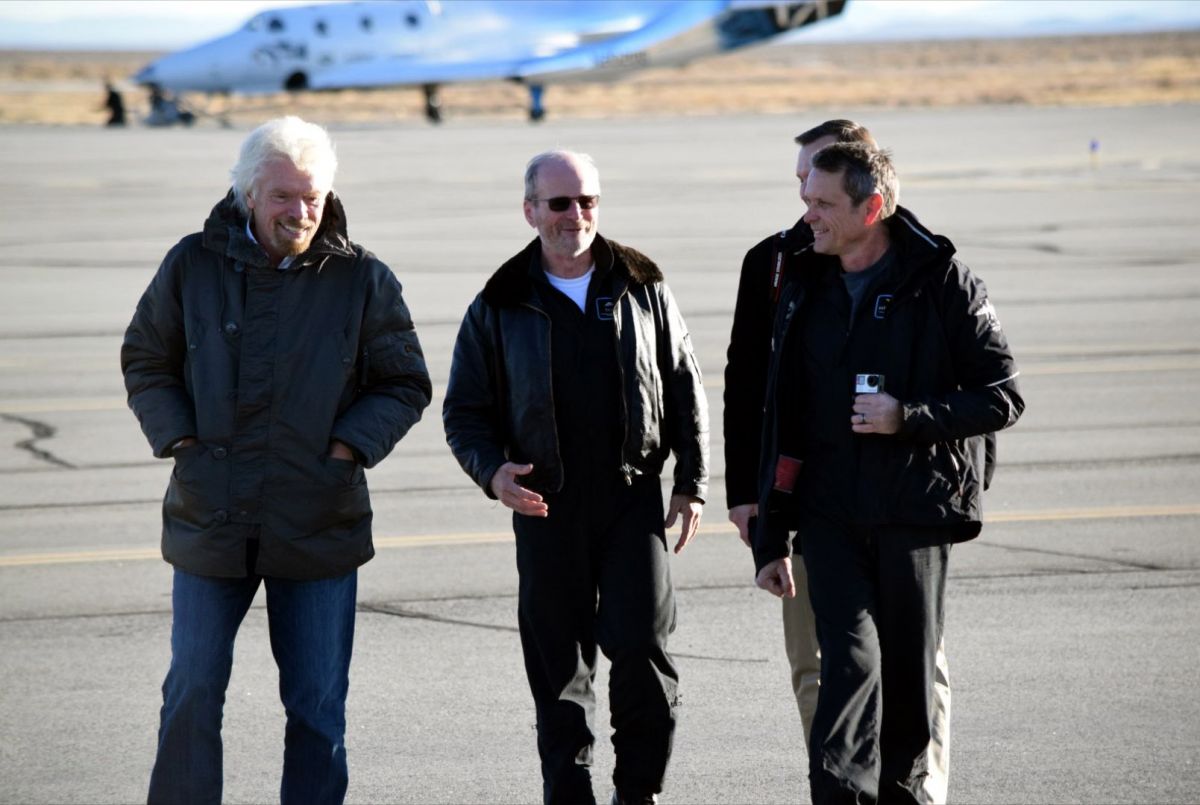
Virgin Galactic’s founder Sir Richard Branson and George Whitesides, CEO of Virgin Galactic and The Spaceship Company, congratulate Chief Pilot Dave Mackay and Test Pilot Mark Stucky after first glide flight of Virgin Spaceship Unity (VSS Unity) in Mojave Desert on December 3, 2016.
Credit: Virgin Galactic
“We’re looking forward to getting back into the skies as soon as the engineers say we are ready to do so,” concludes the Virgin Galactic press statement.
2014 mishap
The first drop test of the craft comes after a major mishap involving a SpaceShipTwo vehicle back in October 2014.
That incident was caused by premature deployment of the craft’s feather reentry tail section during powered flight. That mistake lead to breakup of the vehicle and death of the craft’s co-pilot, Michael Alsbury, with the pilot, Peter Siebold, receiving severe injuries. He successfully deployed his parachute after the craft disintegrated in the air.
The Virgin Galactic SpaceShipTwo/WhiteKnightTwo system is intended to offer commercial, pay-per-view suborbital flight to the edge of space, with tourists departing and landing at Spaceport America in New Mexico.
For video and imagery of the drop test, go to:
http://www.image.net/virgingalactic

Mars true-color globe showing Terra Meridiani.
Credits: NASA/Greg Shirah
NOTE: Frank White is the author of the seminal work — The Overview Effect: Space Exploration and Human Evolution — first published in 1987, re-issued in 1998 with a third edition of the book released in 2014.
The Overview Effect is an on-going phenomenon that impacts various aspects of world culture in the New Space Age. One of the principal areas of shifted awareness that accompanies the Overview Effect is our view of Earth’s environment, a shift that has affected space travelers circling our planet, as well as at lunar distance.
As part of my research for writing the new National Geographic book, Mars: Our Future on the Red Planet, I asked Frank White to consider a Mars Overview Effect.
Here is a new essay by White on this topic, and I’m pleased to publish it on my Inside Outer Space website:
New Thoughts on Mars
By Frank White
Mars has fascinated human beings for centuries, and the question is, “Why?” Our connection with the Red Planet makes us wonder if there is a “Mars Effect” that draws us to it. This would different from the “Overview Effect,” which resulted from seeing the Earth from orbit or the moon.
Our attraction to Mars began with viewing it through telescopes and has continued as we have sent orbiters and rovers there. We have always seen it from a distance, and we will continue to see it from a distance until we send our first astronauts to its surface.

Percival Lowell and his depiction of Martian canals, shown in this sketch of the Red Planet, circa 1895.
Credit: Lowell Observatory
From the beginning, people have imagined that they were seeing things there. The Italian astronomer Giovanni Schiaparelli saw lines on the surface that he called canali, (channels) which was mistranslated in English as “canals.” This in turn led to an entirely fanciful story told by the American astronomer Percival Lowell about Martians who were running out of water and desperately digging canals to survive.
This is not the place to recount the entire history of human fascination with Mars, which would include, of course, the famous “invasion” by Martians in 1938, staged by Orson Wells, which terrified a nation and set the tone for tales of extraterrestrial attacks. However, it is worth mentioning that the “father of modern rocketry,” Robert Goddard, was said to have had a vision of Mars while sitting in a cherry tree, and this led to his invention of liquid-fueled rockets.
Influence on the human psyche
Today, people are still seeing things on Mars, this time through the eyes of spacecraft orbiting the planet, and rovers on its surface. Perhaps most famous is the “Face on Mars,” which looks like the Sphinx staring up from the surface. Since rovers like Spirit, Opportunity, and Curiosity have been snapping multiple photos of the environment around them, people have been reporting everything from strange lights to spacecraft to beings.
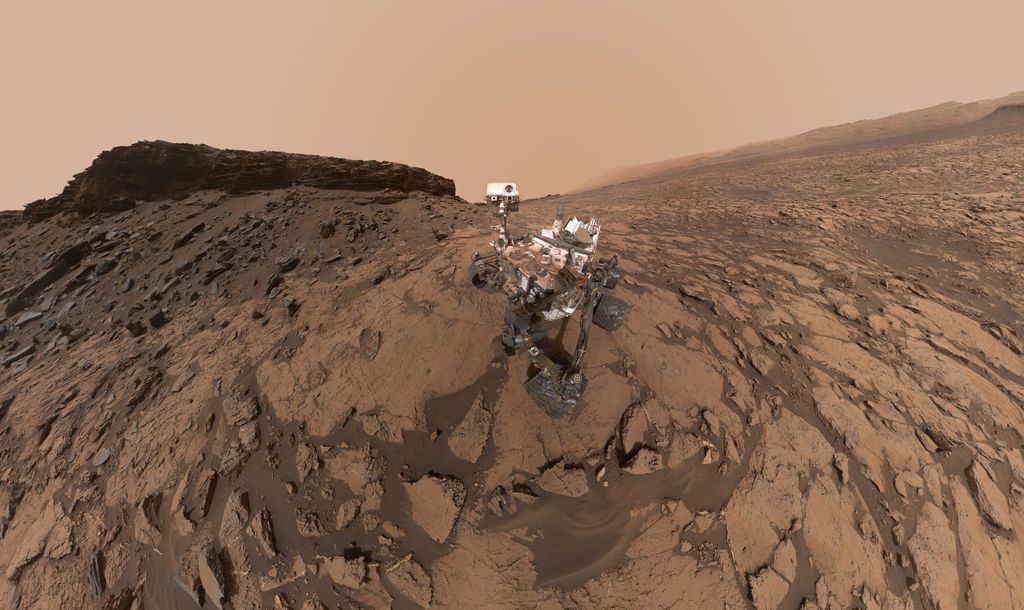
Self-portrait shows NASA’s Curiosity Mars rover at the “Quela” drilling location in the scenic “Murray Buttes” area on lower Mount Sharp. The panorama was stitched together from multiple images taken by the Mars Hand Lens Imager (MAHLI) camera at the end of the rover’s arm. The scene combines approximately 60 images
Credit: NASA/JPL-Caltech/MSSS
Being enticed to go to Mars by seeing intriguing features through telescopes or rover cameras is a powerful component of the “Mars Effect,” which seems to draw people to a place so far away from home. Ultimately, this influence of Mars on the human psyche remains a mystery, and perhaps that is as it should be, at least for now.
Overview moments
However, as one who is interested primarily in the view of the Earth from space and in space (“The Overview Effect”), I am focused more on what space travelers will see of their home planet as they move farther away and closer to Mars. There will be several “Overview Moments” that we can expect as the human “Journey to Mars” gets underway.
The first will be when the astronauts go beyond the moon and see the Earth from a distance greater than 240,000 miles. At that point, the Earth will still be visible as a planet, but in a new and different way. It will be unique, as was the moment when Yuri Gagarin went into orbit and became the first person to directly experience the Overview Effect, and the time when the Apollo 8 astronauts turned their cameras around and showed us the whole Earth (and, later, Earthrise).
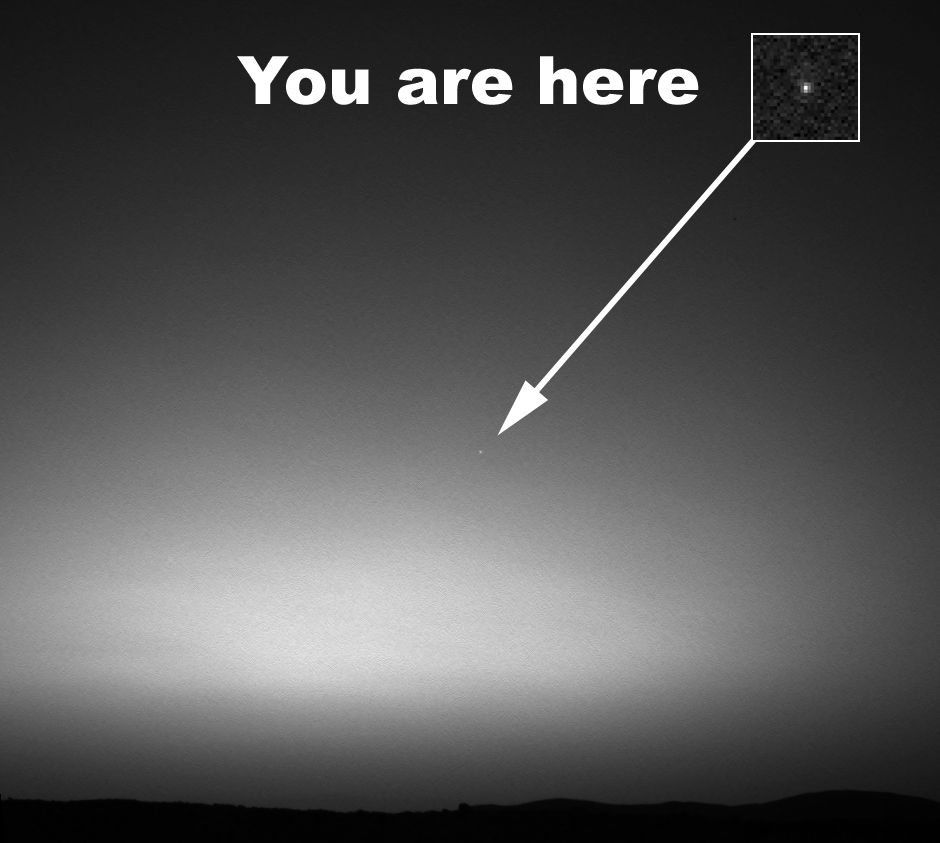
Earth From Mars image was captured in 2004 by NASA’s Mars Exploration Rover Spirit on March 8, 2004.
Credit: NASA/JPL/Cornell/Texas A&M
The second will be that moment when we can no longer see the Earth as a planet, but more like an unblinking star, the way we now see Mars. In other words, we will need a telescope to discern any details on our own planet. This will take place at some point on the journey outward, and will become solidified in the mind when astronauts land on the surface and the Earth is a constant in the Martian sky.
Copernican Perspective
Nick Kanas, MD, a psychiatrist, has called attention to “Earth out of view,” and points out that it will be an unprecedented moment in history. He also notes that we do not know what the impact of the experience will be. I agree with that statement. We should note that the rovers have sent back pictures of the Earth as seen from the surface of Mars, so that will not be new to people who remain behind, but it will be significant for the first astronauts who make the journey.

Credit: Bob Sauls – XP4D/Explore Mars, Inc. (used with permission)
Regardless, this will be the time when the a new shift in perspective, which I have called the Copernican Perspective, takes hold, and the humans having the experience began to feel more a part of the solar system and less a part of the Earth.
While there are many fascinating aspects of our efforts to become a multi-planet species, including how we can survive on a planet like Mars, we should not lose sight of the fact that the most significant aspects of space exploration may well be continuously unfolding understandings of the human place in the universe – a fundamental and irreversible shift in our collective identity.
For information on the book: The Overview Effect: Space Exploration and Human Evolution, go to:
For the 2014 edition, go to:
http://arc.aiaa.org/doi/book/10.2514/4.103223
For information on the Overview Institute, go to:
http://www.overviewinstitute.org/

Curiosity Front Hazcam Right B image taken on Sol 1536, December 1, 2016.
Credit: NASA/JPL-Caltech
The report from ground zero on Mars is that the Curiosity rover has encountered a drill fault.
The robot is now in Sol 1537, and reports Ken Herkenhoff of the USGS Astrogeology Science Center in Flagstaff, Arizona:
“Unfortunately, the much-anticipated rotary-only drilling experiment did not even start due to a drill fault that is currently being investigated,” he reports.

Curiosity Mastcam Right image of drill taken on Sol 1537, December 2, 2016.
Credit: NASA/JPL-Caltech/MSSS
Scramble plan
This type of drill fault appears to be unrelated to the previous short circuits during percussion, but more study is needed, Herkenhoff adds. “So the tactical planning team had to scramble to put together a plan while the drill experts work to recover from this anomaly.”

Curiosity Mastcam Left image taken on Sol 1535, November 30, 2016.
Credit: NASA/JPL-Caltech/MSSS
Herkenhoff notes that, luckily, the fault did not preclude non-drilling arm activities, “so we picked the bright target ‘Thomas Bay’ for contact science.”
Science observations
The Curiosity science team was able to fit remote science observations into the plan: A Navcam cloud movie, a Right Mastcam mosaic of “Squid Cove,” Mastcam measurements of dust in the atmosphere, and a small Mastcam stereo mosaic of “Baldwin Corners.”
At various times of day, the robot’s Navcam and Mastcam were to image the ground toward and opposite the azimuth of sunset to measure the photometric (light scattering) properties of the rocks and soils near the rover.

Curiosity Mastcam Right image taken on Sol 1535, November 30, 2016.
Credit: NASA/JPL-Caltech/MSSS
Curiosity’s Chemistry & Camera (ChemCam) and the Right Mastcam were also slated to observe bedrock target “Compass Harbor” and vein targets “Bartlett Narrows” and “Birch Point.”
Dusty lens?
“After drill diagnostics are performed, more Mastcam dust measurements and images of ‘Hulls Cove’ and ‘Big Heath’ are planned,” Herkenhoff notes.
Also, images using the robot’s Mars Hand Lens Imager (MAHLI) were to focus on the closing of a dust cover and find the best time to take images in full sunlight.

Mars Hand Lens Imager (MAHLI) is located on the turret at the end of the rover’s robotic arm. MAHLI took this image through protective dust cover on December 1, 2016, Sol 1536.
Credit: NASA/JPL-Caltech/MSSS
“Since the fine-grained Sebina sample was dumped, we are concerned about material blowing onto MAHLI’s lens and sticking to it,” Herkenhoff points out.
Editor’s Note: I’ve taken a quick scan of new images from MAHLI and this issue looked to have occurred. However, word is that the MAHLI images that look as if they are dusted-over were acquired with the dust cover closed, through its Lexan(TM) window. The dust cover received a thin film of dust during Sol 0 terminal descent. That film has never really cleaned itself off, but researchers are able to image through it.

Credit: ISECG
The International Space Exploration Coordination Group (ISECG) has just published the summary of its upcoming Science White Paper: “Scientific Opportunities Enabled by Human Exploration Beyond Low-Earth-Orbit.”
The science white paper will inform the next edition of the Global Exploration Roadmap, expected in late 2017.
The paper was developed by ISECG agencies together with a Science Advisory Group, including representatives from the international scientific community and reflecting the views and inputs from an open interaction with this community.
Ideal location
According to the white paper, the next step beyond low-Earth orbit and the International Space Station is the Moon.
“The vicinity of the Moon is the ideal location as the next step in the expansion of human space activity from the International Space Station leading to investigations of the Moon, asteroids, and Mars,” the document states.
“This deep space environment enables testing and validation of habitation systems and related operations techniques, while remaining close enough to Earth as we learn to manage exploration mission risks. Increasingly longer duration missions to a habitat in the deep space environment enable study of the interplay of radiation, microgravity and isolation on human health, valuable for future spaceflight to more distant destinations, notably Mars, as well as health research on Earth.”
Credit: ISECG
Exploration infrastructure
As explained in the white paper, that type of infrastructure can support cubesats and small satellites by providing services such as deployment and communication relay.
Furthermore, it can facilitate remote controlled robotic exploration on the lunar surface. It can also be used for investigations in areas such as astronomy, fundamental physics, collecting interplanetary materials, and heliophysics.”
Shared horizon goal
The newly released document notes that Mars is the “shared horizon goal” driving sustainable human exploration.
Mars has the greatest similarity to Earth in past and current planetary processes, and may have the best record of when life started in our Solar System and of catastrophic change in planetary evolution,” the document explains.
Asteroid research
Regarding asteroids, the documents observes that “the presence of humans, whether on a returned asteroid boulder in the lunar vicinity or on an asteroid in its native orbit, will permit placement of complex instruments on the asteroid surface, as well as the ability to sample surface and subsurface sites to obtain information on the ancient history of the Solar System which larger, evolved planetary bodies have lost.”
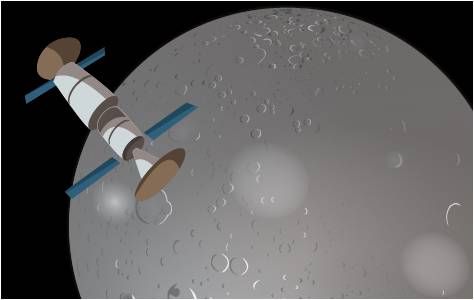
Credit: ISECG
The document adds that the ISECG “will also work to better understand the internal structures of Near-Earth Asteroids, a vital part of the puzzle needed in order to develop mitigation strategies for addressing threats from an Earth-bound asteroid.
ISECG agencies
Participating space agencies in the ISECG are:
In alphabetical order: ASI (Italy), CNES (France), CNSA (China), CSA (Canada), CSIRO (Australia), DLR (Germany), ESA (European Space Agency), ISRO (India), JAXA (Japan), KARI (Republic of Korea), NASA (United States of America), NSAU (Ukraine), Roscosmos (Russia), UKSA (United Kingdom).
For more information on the ISECG, go to:

Long March-5 ready for first liftoff.
Credit: CASC via GBTimesThis year alone has seen a series of noteworthy successes in China’s blossoming space program.
It was a big year for China’s space program.
A Chinese checklist of successes includes their longest piloted space mission; first use of a new Kennedy Space Center-like spaceport, the Wenchang Satellite Launch Center on Hainan Island off China’s southern coast; maiden flights of the Long March-7 and their heavy-lifter, the Long March-5.
Shoot for the moon
Both boosters are essential to an expansive space agenda – one dedicated to lofting and sustaining that nation’s multi-modular space station as well as, quite literally, shooting for the Moon.

2013 group shot…China’s Chang’e 3 lander and Yutu rover.
Credit: Chinese Academy of Sciences
And there’s more to come…take a read of my new Scientific American article:
China’s Big Year in Space Sparks Excitement and Speculation
The Chinese space agency launched a new space lab, sent up its longest crewed mission ever and tested out powerful new rockets
By Leonard David on November 30, 2016
Go to:

Curiosity Navcam Right B image taken on Sol 1533, November 28, 2016.
Credit: NASA/JPL-Caltech
Update Dec. 1st: Now in Sol 1536, NASA’s Curiosity Mars rover has completed a cross-contamination experiment and cleaning of CHIMRA went well, “so we are ready to drill into the Precipice target!”
That’s the word from Ken Herkenhoff of the USGS.
Past drilling activities have made use of both rotation and percussion, but percussion has caused intermittent short circuits occasionally since Sol 911. Being the case, the Sol 1536 plan calls for testing the ability of the drill to acquire a sample using rotation only, without percussion.

Curiosity Navcam Left B image taken on Sol 1535, November 30, 2016.
Credit: NASA/JPL-Caltech
“We expect that the Precipice target is soft enough that the experiment will go well, but of course we won’t know until we try! Drilling and associated imaging will require enough power and time that additional observations could not be added to the plan,” Herkenhoff adds.
The rover had a productive Thanksgiving weekend, reports Lauren Edgar, a research geologist at the USGS Astrogeology Science Center in Flagstaff, Arizona.
Dump pile
During Sol 1534, the plan was to use the robot’s Mars Hand Lens Imager (MAHLI) of the post-sieve dump pile from the previous drill sample (“Sebina”).

Drill time on Mars! Curiosity Mastcam Right image taken on Sol 1534, November 29, 2016.
Credit: NASA/JPL-Caltech/MSSS
That was to be followed by acquisition of Chemistry & Camera observations and Mastcam multispectral observation of the dump pile, Edgar notes.
In addition, the rover was on tap to clean out any remnants of the previous sample in order to prepare for a new one.
Linear feature
Also slated was use of ChemCam’s long distance Remote Micro-Imager (RMI) to produce a mosaic that investigates a linear feature observed from the powerful HiRISE camera system onboard the high-flying NASA Mars Reconnaissance Orbiter.

Curiosity Mastcam Right image taken on Sol 1534, November 29, 2016.
Credit: NASA/JPL-Caltech/MSSS
The full drill hole is planned for Sol 1536, Edgar explains.
New word from Ken Herkenhoff, also of the USGS, is that the current drill campaign continues to go smoothly.
Cross-contamination experiment
A Sol 1535 plan was dominated by an experiment to see if any Sebina sample material is left inside the drill bit chamber from the previous drilling. “This is motivated by the fact that we only used vibration to transfer that sample from the drill bit assembly into CHIMRA [the Collection and Handling for In-Situ Martian Rock Analysis device] rather than also using percussion.
“So it’s a “cross-contamination experiment” designed to see if the vibration didn’t do a complete job back when we first drilled Sebina,” Herkenhoff says. “Lots of images of the sieve and other parts of CHIMRA will be taken to verify that the system is clean.”
Laser shots
These activities will take a fair amount of time and power, Herkenhoff adds, but scientists were able to squeeze a few remote science observations into the plan. ChemCam will shoot its laser at bedrock targets named “West Tremont” and “Eastern Head,” and the Right Mastcam will image the same targets.

Zap patrol: The Laser-Induced Remote Sensing for Chemistry and Micro-Imaging instrument identifies atomic elements in martian rocks.
Credit: NASA/JPL-Caltech/LANL/J.-L. Lacour, CEA
Curiosity’s Left Mastcam will also examine fracture patterns at “Sawyer’s Cove.” Finally, Navcam will search for clouds north of the rover.
As always projected rover activities are subject to change due to a variety of factors related to the Martian environment, communication relays and rover status.

Credit: U.S. Air Force
CNN is ready to drop on the TV watcher a special report – “War in Space: The Next Battlefield” – airing Tuesday, November 29th at 9 p.m. Eastern Time.
“The stakes couldn’t be higher. How the US responds to this new threat could determine who wins the defining conflict of the 21st century,” explains a CNN overview on the television show.

The first X-37B Orbital Test Vehicle waits in the encapsulation cell of the Evolved Expendable Launch vehicle on April 5, 2010 at the Astrotech facility in Titusville, Fla. Half of the Atlas V five-meter fairing is visible in the background.
Credit: U.S. Air Force
Advanced capabilities
Those featured in the show include: Gen. John Hyten, head of US Strategic Command; Gen. William Shelton, former head of Space Command; and Peter Singer, who advises the Defense Department on space threats and authored “Ghost Fleet: A Novel of the Next World War,” which runs through a scenario of space war.
America is “quietly developing advanced capabilities” that could, some day, have defensive or offensive missions in space, explains a CNN promo on the show.
Sounding the alarm
New weapons include the US Navy’s Laser Weapons System, or LAWs, the US military’s first operational laser weapon now deployed in the Persian Gulf on board the USS Ponce. Also, add in the X-37B, a pilotless space drone resembling the space shuttle without windows or a cockpit, a craft that has already flown multiple missions to space, CNN explains.
Russia and China are making rapid advances, with some of the most senior military commanders sounding the alarm that this is a war — the next world war and the first to extend beyond the confines of Earth – one that America could lose.
For more information on this CNN production, go to:
http://www.cnn.com/2016/11/28/politics/space-war-us-military-preparations/index.html

Credit: The University of Pennsylvania Press
Heavenly ambitions
For more information on this topic and related issues, take a look at this book, Heavenly Ambitions – America’s Quest to Dominate Space by Joan Johnson-Freese, Professor in the Department of National Security Affairs at the Naval War College.
Chapters include: “Space: The Final Cold War Frontier”; “Space Weapons: Fact and Fiction”; and “Globalizing Space.”
Resources
For more information on this book, published by The University of Pennsylvania Press, go to:
http://www.upenn.edu/pennpress/book/14608.html
Listen to this podcast by Johnson-Freese at:
http://www.upenn.edu/pennpress/podcast/pp_podcast_johnsonfreese.mp3

Also, check out the latest from Johnson-Freese, Space Warfare in the 21st Century: Arming the Heavens.
This book examines the recent shift in US space policy and the forces that continually draw the US back into a space-technology security dilemma.
The dual-use nature of the vast majority of space technology, meaning of value to both civilian and military communities and being unable to differentiate offensive from defensive intent of military hardware, makes space an area particularly ripe for a security dilemma.
For more information on this offering, go to:

