Archive for the ‘Space News’ Category
 Author:
  December 14th, 2016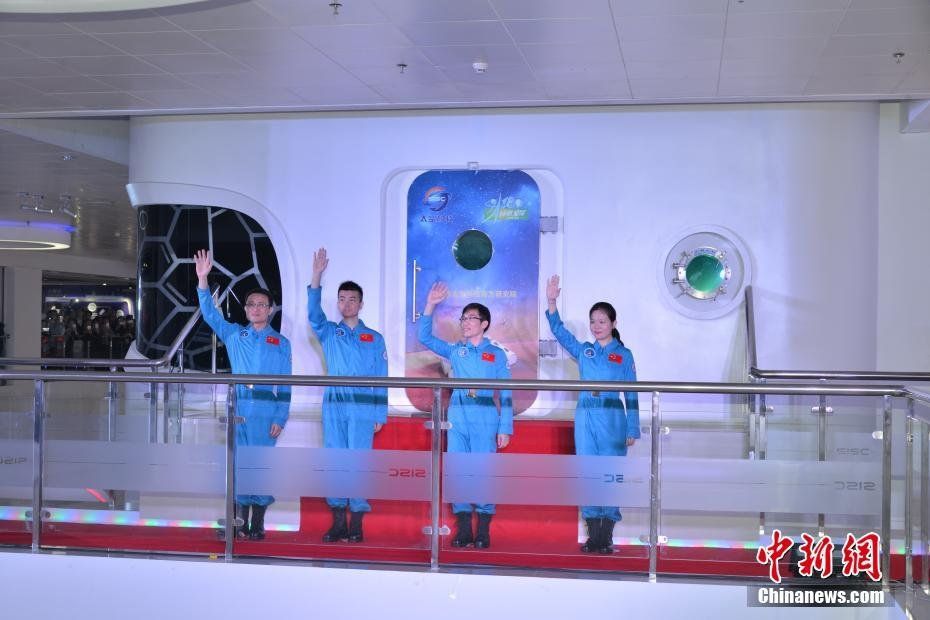
Four volunteers are back on Earth after completing a 180-day space simulation.
Credit: CNS
Chinese researchers have completed a 180-day “survival experiment” that simulated a deep space human trek.
Since June 17, four Chinese volunteers — three men and one woman — lived inside a sealed space capsule situated in Shenzhen, south China’s Guangdong Province. They emerged from their off-world mock-up mission on December 14, local time.
The six-month experiment involved volunteers Tang Yongkang, Luo Jie, Wu Shiyun and Tong Feizhou.
An objective of the space simulation was to test technologies that could support China’s deep-space exploration projects. The effort is evaluating how food, water, and oxygen can be used and recycled under controlled conditions.
More than a dozen Chinese and overseas institutions are involved in the experiment, including the Astronaut Center of China, Harvard University and the German Aerospace Center.
Sealed capsule
The 1,340-cubic-meter sealed capsule has a floor space of 370 square meters, and is divided into eight compartments, including passenger compartments, resource compartments and greenhouse compartments.

Credit: CCTV-Plus
According to CCTV-Plus, the volunteers cultivated about 25 different kinds of plants in the capsule, including wheat, potatoes, sweet potatoes, soybeans, peanuts, lettuce, edible amaranth and Chinese cabbage. The plants are part of a large ecological treatment system that helps recycle and regenerate oxygen and water that will reduce the dependency on outside supplies.
Researchers engaged in the simulation have been monitoring and observing how a hermetic environment affects physiological changes, biological rhythms, sleep patterns and emotional well-being.
Tai Chi
In a CCTV-interview, volunteer Tang said that as time sped by, the psychological pressure of being in the confined capsule gradually built up.

Chinese researchers developed a series of Tai Chi moves specifically for use by the volunteers.
Credit: CCTV-Plus
“I think (the pressure has risen) during the middle and later stages of the experiment, around three quarters of the way through. But maybe everyone differs. During this period, the pressure on emotions and other areas might be comparatively higher,” said Tang prior to departing the facility.
To deal with stress, Chinese researchers developed a series of Tai Chi moves specifically for use by the volunteers.
“According to those of us inside the capsule, it did help in soothing our emotions. But further detailed statistical analysis is needed before we reach a specific conclusion,” said volunteer Tong.
New homes off-planet
Li Yinghui, head of the 180-day survival experiment in the sealed module, explained to CCTV-Plus:
“To develop new homes [on other planets], the first problem to be solved is how to survive there, including an environment for living, air for breathing, food, and then health security. So design of this experiment was aimed at such exploration targets.”
For a video look at the sealed space capsule and the volunteers, go to:
http://cd-pv.news.cctvplus.com/2016/1214/8038612_Preview_8010.mp4
http://pv.news.cctvplus.com/2016/1212/8038424_Preview_1481546069993.mp4
http://l3-pv.news.cctvplus.com/2016/0615/8024222_Preview_1465991623125.mp4
 Posted in
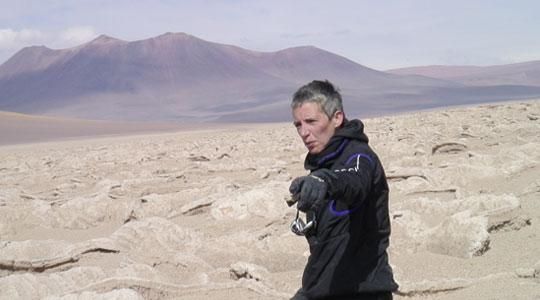
Nathalie Cabrol, Director of the Carl Sagan Center for the Study of Life in the universe at the SETI Institute.
Credit: SETI Institute
Are there ways in which biology and its environment co-evolve? The answer could give essential insight into how we might search for extraterrestrial life.
Today, December 14th, Nathalie Cabrol, Director of the Carl Sagan Center for the Study of Life in the universe at the SETI Institute, will give the prestigious Sagan Lecture at the fall meeting of the American Geophysical Union (AGU) in San Francisco.
Life elsewhere
“On Earth, as soon as life gained a foothold, it began to modify the planet’s environment. Subsequent generations inherited changed surroundings, and introduced their own environmental modifications,” says Cabrol.
“Understanding how this process might have worked on a world with environmental conditions other than Earth’s,” Cabrol adds, “could help in our exploration for life elsewhere.”
Extraterrestrial interplay
The interplay of environment and life is a central theme of astrobiology, and Cabrol will describe how studying its workings can help in the search for ancient or extant biology on Mars.

Curiosity Mastcam Right image taken on Sol 1521, November 15, 2016.
In its early days, the environments of Mars and Earth were similar, although they eventually diverged dramatically. So understanding the succession of physical and environmental processes in Mars’ first 700 million years is essential to envision what adaptation strategies life would have had to make to survive on the Red Planet, and which biosignatures could be preserved and possibly found.
Tune in resources
The Sagan Lecture is webcast and made available as an archived presentation on the AGU website.
Session: B32D Sagan Lecture
Program: Biogeosciences
Day: Wednesday, 14 December 2016
Time: 10:25 – 11:15 AM PST
Location: Moscone West, San Francisco
For more information, go to:
http://www.seti.org/seti-institute/news/dec-14-nathalie-cabrol-presents-sagan-lecture-agu-2016
To view the event, go to:
AGU on Demand: http://fallmeeting.agu.org/2016/virtual-options/

Credit: NASA
NASA’s Curiosity Mars rover continues to investigate higher and younger strata on the central mountain of Gale Crater, adding information about water-rich ancient environments in this part of Mars.
Since reaching the base of the mountain two years ago, the rover has examined more than half the vertical extent of a 180-meter-thick geological formation that provides a record of long-lived lake and groundwater environments.
Factors favorable for life
Analysis of rock composition at multiple sites is providing new evidence about how the environmental conditions evolved over time, including factors favorable for life, if it ever was present. Some ingredients may foreshadow what the mission will find at planned destinations farther up the mountain.
YouTube Video published on Dec 13, 2016 from the American Geophysical Union (AGU) meeting this week.
Participants:
- Joy Crisp, NASA Jet Propulsion Laboratory, Pasadena, California, U.S.A.;
- Thomas Bristow, NASA Ames Research Center, Moffett Field, California, U.S.A.;
- Patrick Gasda, Los Alamos National Laboratory, Los Alamos, New Mexico, U.S.A.;
- John Grotzinger, California Institute of Technology, Pasadena, California, U.S.A.
Go to:
Credit: CCTV-Plus
A 180-day “survival experiment” is near its end mid-week.
Four Chinese volunteers — three men and one woman — have been living inside a sealed space capsule in south China’s Shenzhen City.
An objective of the space simulation is to test technologies that could support China’s deep-space exploration projects. The effort is evaluating how food, water, and oxygen can be used and recycled under controlled conditions.
More than a dozen Chinese and overseas institutions are involved in the experiment, including the Astronaut Center of China, Harvard University and the German Aerospace Center.
Sealed capsule
The 1,340-cubic-meter sealed capsule has a floor space of 370 square meters, and is divided into eight compartments, including passenger compartments, resource compartments and greenhouse compartments.

Credit: CCTV-Plus
According to CCTV-Plus, the volunteers cultivated about 25 different kinds of plants in the capsule, including wheat, potatoes, sweet potatoes, soybeans, peanuts, lettuce, edible amaranth and Chinese cabbage. The plants are part of a large ecological treatment system that helps recycle and regenerate oxygen and water that will reduce the dependency on outside supplies.
Researchers engaged in the simulation have been monitoring and observing how a hermetic environment affects physiological changes, biological rhythms, sleep patterns and emotional well-being.
New homes off-planet
Li Yinghui, head of the 180-day survival experiment in the sealed module, explained to CCTV-Plus:
“To develop new homes [on other planets], the first problem to be solved is how to survive there, including an environment for living, air for breathing, food, and then health security. So design of this experiment was aimed at such exploration targets.”
For a video look at the sealed space capsule and the volunteers, go to:
http://pv.news.cctvplus.com/2016/1212/8038424_Preview_1481546069993.mp4
http://l3-pv.news.cctvplus.com/2016/0615/8024222_Preview_1465991623125.mp4

Curiosity Navcam Left B image taken on Sol 1544, December 9, 2016.
Credit: NASA/JPL-Caltech
An update from Ryan Anderson of the USGS Astrogeology Science Center: “Unfortunately, one of the drill diagnostics early in the plan indicated a problem, which prevented most of the other activities for the weekend (including the arm motion and drive) from happening.”
So the upshot is that Curiosity remains sitting at “Precipice” for Sol 1548-1549.
More drill diagnostics are being called for.
Presently, the robot is in Sol 1548 as of this posting.
Now in Sol 1547, NASA’s Mars Curiosity rover’s troubled arm-mounted drill is back using standard commands.
“This is great news, and the anomaly response team has cleared the rover for use of the arm and driving, but not yet drilling,” reports Lauren Edgar, a Research Geologist at the USGS Astrogeology Science Center in Flagstaff, Arizona.
Fracture patterns
A recent plan had the rover wrap up work at the “Precipice” location and drive to a nearby site to investigate interesting fracture patterns.
A three-sol weekend plan was to start with another Mastcam tau and crater rim extinction observation to monitor dust in the atmosphere, Edgar notes. This was to be followed by Chemistry & Camera (ChemCam) observations of “The Anvil” and “Blue Hill” to investigate variations in chemistry in the Murray bedrock.

Curiosity Mastcam Left image taken on Sol 1545, December 10, 2016.
Credit: NASA/JPL-Caltech/MSSS
Dataset
Curiosity was also slated to take a Mastcam mosaic to provide additional context for the “Precipice” site. Following that activity, the script called for Mars Hand Lens Imager (MAHLI) imaging of “Echo Lake,” “Beachcroft,” and “The Anvil,” with a short Alpha Particle X-Ray Spectrometer (APXS) integration on “Beachcroft” and an overnight integration on “Echo Lake.”
“This should return a great dataset to understand the chemistry and sedimentary structures here,” Edgar explains.
Unusual color variation
On the second sol, Curiosity was scheduled to acquire a ChemCam observation of “Western Head,” an area that showed some unusual color variation.
“We’ll also extend the Mastcam mosaic of “Squid Cove” and take a couple of Navcam movies to monitor the atmosphere. Throughout the plan we’ll take several front and rear Hazcam images for additional change detection observations,” Edgar adds.

Curiosity ChemCam Remote Micro-Imager photo taken on Sol 1546, December 11, 2016.
Credit: NASA/JPL-Caltech/LANL
There was also slated to be an overnight Sample Analysis at Mars (SAM) Instrument Suite activity using the Evolved Gas Analysis (EGA) that makes use of the residual derivatization vapor in the sample manipulation system.
Curiosity was set for third sol work, driving toward the region with fractures, and take post-drive imaging to prepare for possible contact science this week.

Join me on Wednesday, December 14, 2016 when I’ll be a guest on the popular radio show, Coast to Coast, hosted by George Noory.
I’ll be discussing my new book, Mars: Our Future on the Red Planet, research on space travel, and a number of other topics.
Coast to Coast AM is a national radio talk heard by millions of listeners on approximately 564 stations in the U.S., Canada, Mexico and Guam.
For more information on the broadcast, go to:
http://www.coasttocoastam.com/show/2016/12/14
For radio stations and where to Listen to Coast to Coast AM, go to:

Mars true-color globe showing Terra Meridiani.
Credits: NASA/Greg Shirah
Billions of dollars later, oodles of exploration dollars have been spent on a key question: Is there life on Mars? The answer remains a head-scratcher following decades of studying Mars up-close and personal.
The perplexing nature of slam-dunking a life on Mars finding was talked about during a National Academies of Sciences’ Space Studies Board meeting on “Searching for Life Across Space and Time.”
This community workshop was held on December 5-6, 2016 at the Beckman Center in Irvine, California.

Credit: Viking Mars Missions Education & Preservation Project (VMMEPP).
False positive
It was 1976 when the dual NASA Viking landers successfully touched down on the Red Planet. Their prime directive was to hunt for evidence of life.
Both landers strong-armed Mars; each used a robotic arm to scoop up a sample of the Martian soil for study by a biology instrument to test for metabolic activity, and a gas chromatograph/mass spectrometer (GCMS) to scan the soil for organic molecules and water.

Credit: NASA/Ben Clark
One biology experiment, Labeled Release (LR), was designed to detect microbes present in the soil. The experiment did indicate metabolism. The other two biology investigations, however, did not find any evidence of biological activity. The Viking science team believed that the LR data had probably been skewed by unexpected non-biological properties of Martian soil, resulting in a false positive. That call remains controversial to this date.
Ambiguity
Viking’s box of biological experiments was a “huge engineering challenge,” recalled Ben Clark at the workshop. He developed the x-ray fluorescence soil analyzers for the Viking missions and is now with the Space Science Institute in Boulder, Colorado.

Credit: Tom Dahl
Those three life-detection experiments all had to fit into a less than a one cubic foot box, Clark said, because NASA did not allocate a Saturn V rocket to the mission, as previously expected. “It ended up being the most expensive instrument that had ever been developed for spaceflight at that time…and perhaps still rivals that.”
Regarding the LR experiment, “there was a big bottom line of uncertainty as what was actually found,” an ambiguity that remains today to some extent, Clark said.
Sample return
“The major accomplishments by Viking…first of all it was the first real search on another location for biomarkers by a robotic spacecraft system,” Clark said. Viking’s biology experiment was the first, and to date the last, search for actual metabolic activity on Mars.

Credit: Martin Marietta/Ben Clark
“My feeling is that sample return is the way we’re going to understand this…and it’s probably going to take that,” Clark said. “You could also try to do more experiments on Mars, but we can do so much more in the laboratories here on Earth.”
Noting that a proposal was advocated in 1972 to send a Viking lander to Mars outfitted with a sample return rocket, Clark said that idea did not move forward. “We have a saying in our community that Mars sample return is always 10 years away.”
Survival mode
Fast forward from Viking after more than 40 years, is there life on the Red Planet?

Data from the Viking biology experiments, which is stored on microfilm, has to be accessed using a microfilm reader. A NASA archival team worked to digitize the data to make it more accessible.
Credit: NASA/David Williams
“I’m going to take the position that we now know information that makes it more likely than perhaps we felt at the time that there is — or should be — life on Mars,” Clark said.
“Although there were two Viking spacecraft, and they landed thousands of miles apart, we learned by our measurements that they were sampling the exact same type of soil, a global unit because of the giant dust storms that periodically envelop the entire planet,” Clark later told Inside Outer Space.
“What we have learned from the rover missions is that Mars has some amazing diversity in water-lain sediments,” Clark said. “We now know that it has many great geochemical ingredients available and that the atmosphere in the past had many of the molecules that stimulate life.”
Teaser: latent life
Perhaps on Mars today, life is latent, Cark suggested. “Life on Earth is dormant many times and goes for long periods in a survival mode and it could be happening on Mars between obliquity cycles.”
Obliquity is the changing degree of tilt of Mars’ orbital axis — known to slowly increase and decrease over a 100,000-year cycle.
So what life is there today on the Red Planet may be dormant. “We may have to tease it to get it out,” Clark added. “The history of our exploration of the Red Planet is that Mars fools us most of the time.”
Clark’s bottom line: “We just need to keep going and keep looking. Mars is turning out to be extraordinarily diverse and rich.”
Smaller, cheaper rovers
Also speaking at the workshop, Caltech’s John Grotzinger, a geobiologist and former chief scientist for the Curiosity rover mission that’s now dutifully exploring Mars.

Curiosity Mars rover on the prowl since landing in August 2012.
Credit: NASA/JPL/Caltech
Grotzinger said that he advocates for smaller and cheaper rovers, dispatched to varying places on Mars. “We can partner with private industry,” he said. “It’s a new paradigm.”
There’s no need for the full monty of science gear onboard robot probes to Mars, Grotzinger said, “in order to ask a very specific question of a very specific place.”
In detailing NASA’s Curiosity rover’s trek on Mars for the last four years, toward its main science destination, the foothills of Mount Sharp, Grotzinger said the robot’s investigations have been a “gold mine” to help scope out the environmental history of Mars.
Chemical reactor
Curiosity findings point to a series of long-lived streams and lakes that existed some billions of years ago, resulting in sedimentary deposits in Gale Crater. That sedimentary basin is a “chemical reactor,” Grotzinger emphasized. Primary igneous minerals are being converted under different chemical circumstances into different minerals, he said.
“We’re not sure what all this means but it’s pretty exciting for habitability,” Grotzinger added.

“Lamoose” rock on Mars.
Credit: NASA/JPL-Caltech/MSSS
Microfossil preservation
In his talk, Grotzinger singled out Curiosity imagery of “Lamoose” rock from the “Marias Pass” area of Mount Sharp – a fragment that has unusually high concentrations of silica.
Silica is a rock-forming compound containing silicon and oxygen, commonly found on Earth as quartz. High levels of silica could indicate ideal conditions for preserving ancient organic material, if present.
Lamoose could be his favorite rock, said Grotzinger…“the best rock that Curiosity could ever find that we would bring back to Earth and look for microfossils preserved in it.”
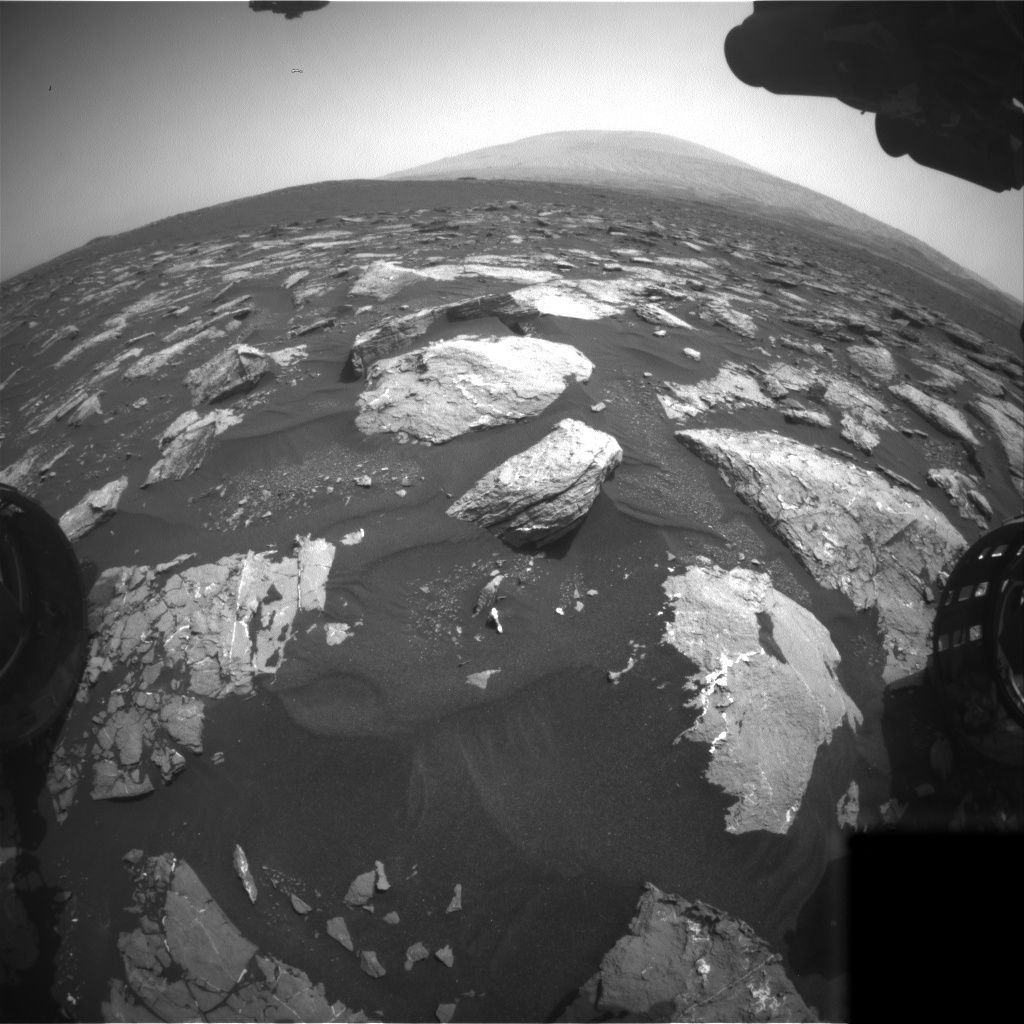
Curiosity Front Hazcam Left B image taken on Sol 1543, December 8, 2016.
Credit: NASA/JPL-Caltech
NASA’s Curiosity Mars rover is now in Sol 1544, still plagued by a problem in its drilling equipment.
Among a set of possible drill issues being assessed: a brake on the drill feed mechanism did not disengage fully or that an electronic encoder for the mechanism’s motor did not function as expected.
Curiosity is at a site on lower Mount Sharp selected for what would be the mission’s seventh sample-collection drilling of 2016.
Drill diagnostics
Reports Ken Herkenhoff of the USGS Astrogeology Science Center in Flagstaff, Arizona, since Sol 1542 drill diagnostics did not complete as intended, and as a consequence, neither did some of the later science activities.

Credit: NASA/JPL-Caltech
Therefore, those tests and activities from Sol 1542 were to be planned again on Sol 1543.
That plan firstly called for the rover’s Chemistry & Camera (ChemCam) to shoot its laser at a target near Hunters Beach, called “Bracy Cove,” and at the bright layers just above “The Anvil.”
“Opportunistic Derivitization” experiment
Late in the afternoon, ChemCam was to perform a routine observation of its titanium calibration target, the Left Mastcam was on the schedule to acquire a 5×1 mosaic of “Squid Cove,” and the rover’s Rear Hazcam was set to take another image to look for changes due to winds.
Overnight, the Sample Analysis at Mars (SAM) Instrument Suite was to perform an Opportunistic Derivitization experiment on a sample from Cumberland that has been carried since early in the landed mission.
This experiment has been some time in the making and should improve SAM’s ability to characterize the organic molecules within that sample,” Herkenhoff explains.

Curiosity Mastcam Right image taken on Sol 1542, December 7, 2016.
Credit: NASA/JPL-Caltech/MSSS
Clouds and dust
Early in the morning of Sol 1544, Curiosity’s Navcam was to search for clouds and dust devils; Mastcam was slated to measure dust in the atmosphere; and both cameras were to re-attempt the photometry observations that were planned the previous day.
As always, dates of planned rover activities are subject to change due to a variety of factors related to the Martian environment, communication relays and rover status.
Climbing to higher (younger) ground
At the rover’s current location, it has driven 9.33 miles (15.01 kilometers) since landing inside Mars’ Gale Crater in August 2012. That includes more than half a mile (more than 840 meters) since departing a cluster of scenic mesas and buttes — called “Murray Buttes” — in September 2016.
Curiosity has climbed 541 feet (165 meters) in elevation since landing, including 144 feet (44 meters) since departing Murray Buttes.
The rover is climbing to sequentially higher and younger layers of lower Mount Sharp to investigate how the region’s ancient climate changed, billions of years ago.

Credit: CCTV
China’s latest set of space travelers — astronauts Jing Haipeng and Chen Dong – held a press briefing on Wednesday. It was their first public appearance since the return of the Shenzhou-11 manned spacecraft on November 18, after a three-week quarantine period.
The Shenzhou-11 piloted spacecraft blasted off on Oct. 17, 2016, then latched up with the Tiangong-2 space lab.
Rookie report
Chen was quick to note that his commander took care of the rookie flyer.
“Once in orbit, he told me about how to control the body, and advised me to take more rest so as to adapt to the weightless environment as quickly as possible. In the days up there, he suggested to me to eat more and often checked about my sleep quality,” Chen said. “He would hand me a towel when he saw me sweat while riding the bike for exercise. He would also hand me some water, warm water to my mouth. For bed time, he would tell interesting stories about his previous flights, including stories while he served in the air force. He was very considerate taking care of me, in every respect.”

Image snagged by the Banxing-2 microsatellite that was deployed from the Tiangong-2 shows Shenzhou-11 (above) and Tiangong-2 docked in orbit on October 23, 2016.
Credit: Chinese Academy of Sciences via GBTimes
Perfect mission
According to CCTV-Plus, for his part, Jing said his third space travel was relaxing and he really enjoyed it.
“We had been trained numerous times for the mission before we went into space. Chen Dong didn’t make even a slightest error up there, that’s for one; and for two, he made no mistake when we were implementing our mission in space,” Jing recounted. “Therefore, we have met the overall requirement of the mission and the task, and lived up to the expectations of our superiors. It is zero error and zero slip. It is, therefore, a perfect mission, with a perfect result through a perfect process,” he said.
The Chinese space adventurers spent 33 days in space, a record in China’s space program. They also conducted nearly 40 experiments while in orbit. Both of them are in good condition after rounds of physical therapy and exercise.
To view video files on the astronaut press meeting, go to:
Also, go to:
http://cd-pv.news.cctvplus.com/2016/1208/8038103_Preview_1481201915729.mp4
Credit: ESA/DLR
Take a trip down Mawrth Vallis – a dried-up outflow channel Mars.
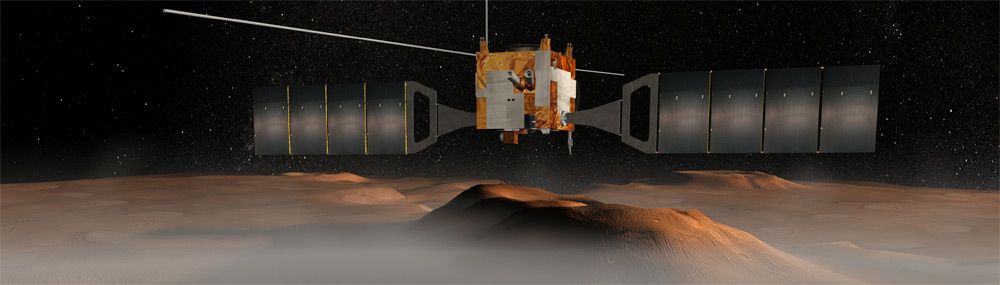
This visual trek comes courtesy of the High Resolution Stereo Camera (HRSC) operated by the German Aerospace Center (Deutsches Zentrum für Luft- und Raumfahrt; DLR) on board the European Space Agency’s Mars Express spacecraft.

The first all-European mission to another planet – Mars Express – was launched on June 2, 2003. On board the spacecraft was the High Resolution Stereo Camera (HRSC), which was developed by the DLR Institute of Planetary Research. HRSC was the first camera system on a planetary mission to systematically acquire high-resolution, three-dimensional image data in color.
Credit: Deutsches Zentrum für Luft- und Raumfahrt e. V. German Aerospace Center (DLR)
Digging down
Mawrth Vallis is one of the potential targets for the second part of ESA’s ExoMars mission (2020), in which a rover will analyze rock samples down to a maximum depth of two meters.
The valley may have been capable of supporting life in the past. Some scientists even think it is possible that traces of life might still exist in the valley’s lower layers.

ExoMars 2020 rover.
Credit: ESA
Scientists from the Freie Universität Berlin have created a simulated overflight animation along the course of the valley from the digital terrain model calculated at the DLR Institute of Planetary Research.
Friendly to life?
Mawrth Vallis is thought to be an ideal locale for the search for life on Mars based on a couple of reasons:

Mawrth Vallis is one of four candidate landing sites under consideration for the ExoMars 2018 mission. It is one of the oldest outflow channels on Mars, at least 3.8 billion years old.
Credit: ESA/DLR/FU Berlin & NASA MGS MOLA Science Team
- Firstly from the volume of hydrated (water-retaining) minerals that can be identified using the cameras and spectrometer data from the various Mars spacecraft in orbit around the planet.
- Secondly, it is known from Earth that such clay minerals form in comparable – neither acidic nor alkaline – water. Such environmental conditions are also thought to be particularly friendly to life.
Visual field trip
Mawrth Vallis is roughly Approximately 373 miles (600 kilometers) long and up to 1.2 miles (two kilometers) deep.
Numerous impact craters and light and dark deposits can be seen. The light, layered sediments are among the largest deposits of sheet silicates on Mars. These clay minerals are found in numerous places and are an indication that liquid water existed in this region.
Mawrth Vallis is a potential ExoMars 2020 landing site target that is under consideration, as are Oxia Planum, Aram Dosum and Hypanis Vallis.
For your visual field trip, go to:
http://www.esa.int/spaceinvideos/Videos/2016/12/Fly_over_Mawrth_Vallis

