Archive for the ‘Space News’ Category
 Author:
  March 4th, 2017
China presses forward on its space station work.
Credit: CMSE
China is pushing forward on its plans to establish a space station in the 2020s.
A first step is flying its cargo resupply spacecraft, the Tianzhou-1, set for liftoff next month.
Meanwhile, China is readying a space station core module for flight in 2018, one of many segments that will comprise the orbiting complex due for completion around 2022.
Assembly of that central module — named “Tianhe-1” — has already been completed and tests are currently under way, reports Bao Weimin of the China Aerospace Science and Technology Corp. (CASC).
Outpost longevity
The Chinese space station will initially be much smaller than the current International Space Station (ISS), but could be expanded for future scientific research and international cooperation, according to the country’s space officials.

Wenchang Space Launch Center in south China’s Hainan Province.
Credit: CCTV
Given present plans to retire the ISS in 2024, China’s space station will be the only country with a permanent space station.
According to Bao, as reported by the state-run Xinhua news agency, the Chinese outpost will function in orbit for “dozens of years,” adding that all key parts of the facility are designed to be serviceable and replaceable.

China’s cargo ship will dock with the now-orbiting Tiangong-2 space lab and refuel that facility.
Credit: CMSE
In-orbit re-fueling
In mid- or late April, the Tianzhou-1 supply ship will depart from the Wenchang Space Launch Center in south China’s Hainan Province – launched atop a Long March-7 Y2 carrier rocket. If successfully placed into orbit, it will dock with the now-orbiting Tiangong-2 space lab three times and carry out experiments and tests.
Xinhua reports that, during the journey, Tianzhou-1 will orbit on its own for about three months and together with Tiangong-2 for about two months after their rendezvous.
Tianzhou-1’s flight will check and verify such technologies as supply of goods, in-orbit re-fueling and fast automated rendezvous and docking.
With tasks completed, the autopiloted Tianzhou-1 will fall back to Earth while Tiangong-2 is to remain in orbit and continue conducting experiments.

China’s Chang’e 3 Moon lander and Yutu rover. Next step is returning lunar samples back to Earth via the Chang’e-5.
Credit: Chinese Academy of Sciences
Moon lander
Also on China’s active space agenda for this year is a Long March-5 boost in November from Wenchang of the Chang’e-5 robotic Moon lander, a mission focused on landing, gathering select lunar materials for return to Earth.
According to Chinese news services, the over 8-ton Chang’e-5 is comprised of four parts: the “orbiter” “lander” “ascender” and a “returner” – an Earth reentry module.
If successful, the Chang’e-5 mission would be the first lunar sample return to Earth in over 40 years.
The former Soviet Union successfully executed three robotic sample return missions: Luna 16 returned a small sample (101 grams) from Mare Fecunditatis in September of 1970; February 1972, Luna 20 returned 55 grams of soil from the Apollonius highlands region; Luna 24 retrieved 170.1 grams of lunar samples from the Moon’s Mare Crisium (Sea of Crisis) for return to Earth in August 1976.
To view a video on readying the Chang’e-5 for its Mon mission, go to:
https://www.youtube.com/watch?v=oishjEeEcZE
Watch a video on Tianzhou-1 preparation at:
http://cd-pv.news.cctvplus.com/2017/0304/8044541_Preview_8570.mp4
 Posted in
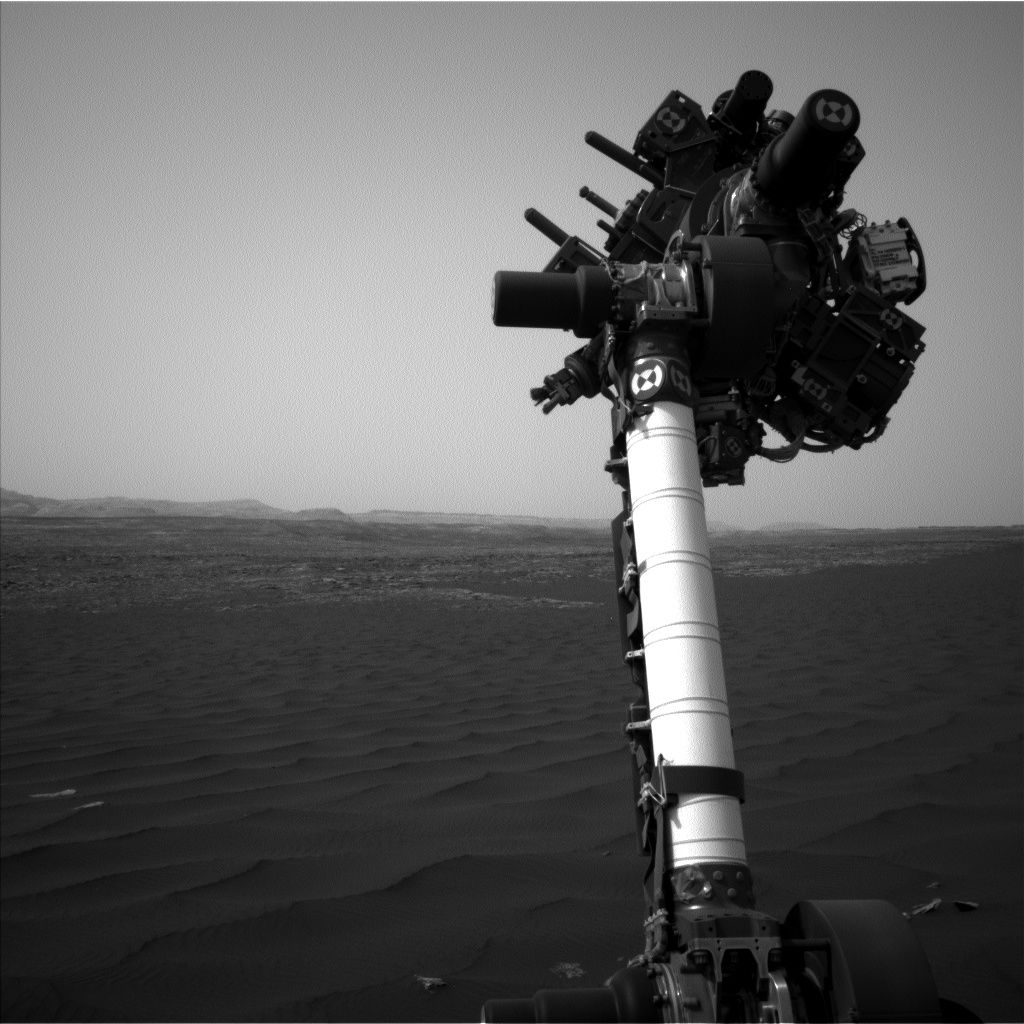
Curiosity Navcam Left B image taken on Sol 1625, March 2, 2017.
Credit: NASA/JPL-Caltech
NASA’s Curiosity Mars rover is now performing Sol 1627 science duties.
There is good news, explains Lauren Edgar, a research geologist at the USGS Astrogeology Science Center in Flagstaff, Arizona.
The Mars Hand Lens Imager (MAHLI) cover was successfully opened and the instrument is marked healthy again.
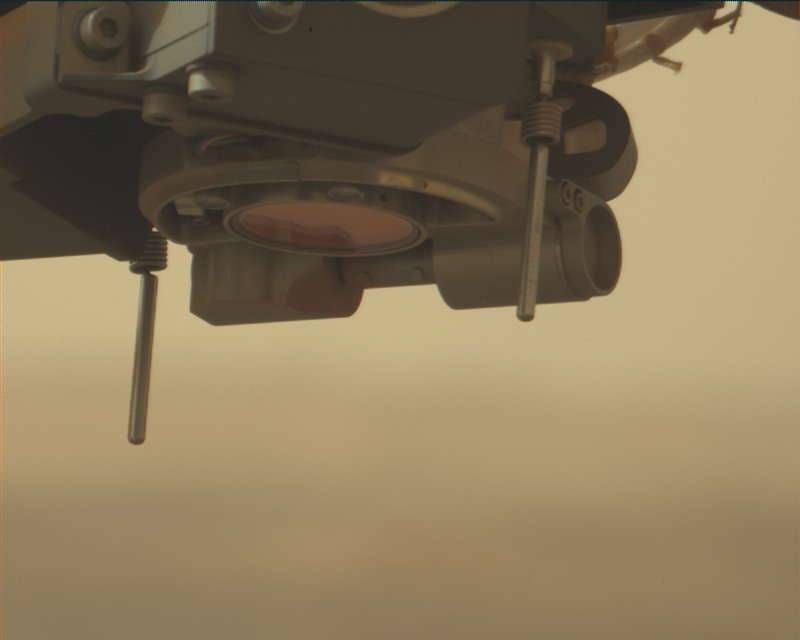
Curiosity Mastcam Right image of Mars Hand Lens Imager (MAHLI) dust cover taken on Sol 1625, March 2, 2017.
Credit: NASA/JPL-Caltech/MSSS
“That means it’s time to close the cover, and if that’s successful, drive away toward the next stop in the Bagnold Dunes Campaign,” Edgar adds.
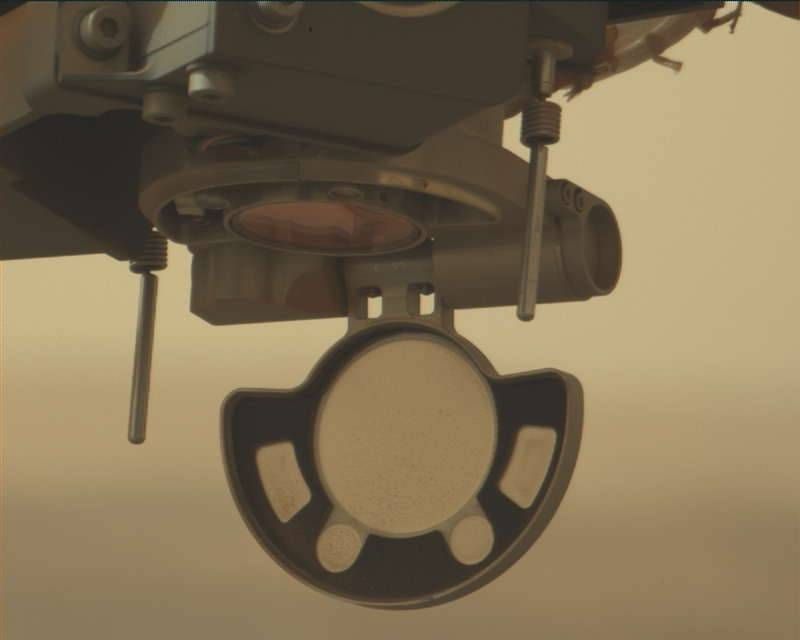
Curiosity Mastcam Right image of Mars Hand Lens Imager (MAHLI) dust cover taken on Sol 1625, March 2, 2017.
Credit: NASA/JPL-Caltech/MSSS
Ripple and bedrock observations
Curiosity is to acquire Chemistry & Camera (ChemCam) observations on “Swanback” and “Rangely” to assess the composition of a ripple crest and a bright patch of bedrock.
“We’ll also use Mastcam to image the rover deck to monitor the movement of fines. In the afternoon, we’ll close the MAHLI cover and run a few more diagnostics,” Edgar reports.
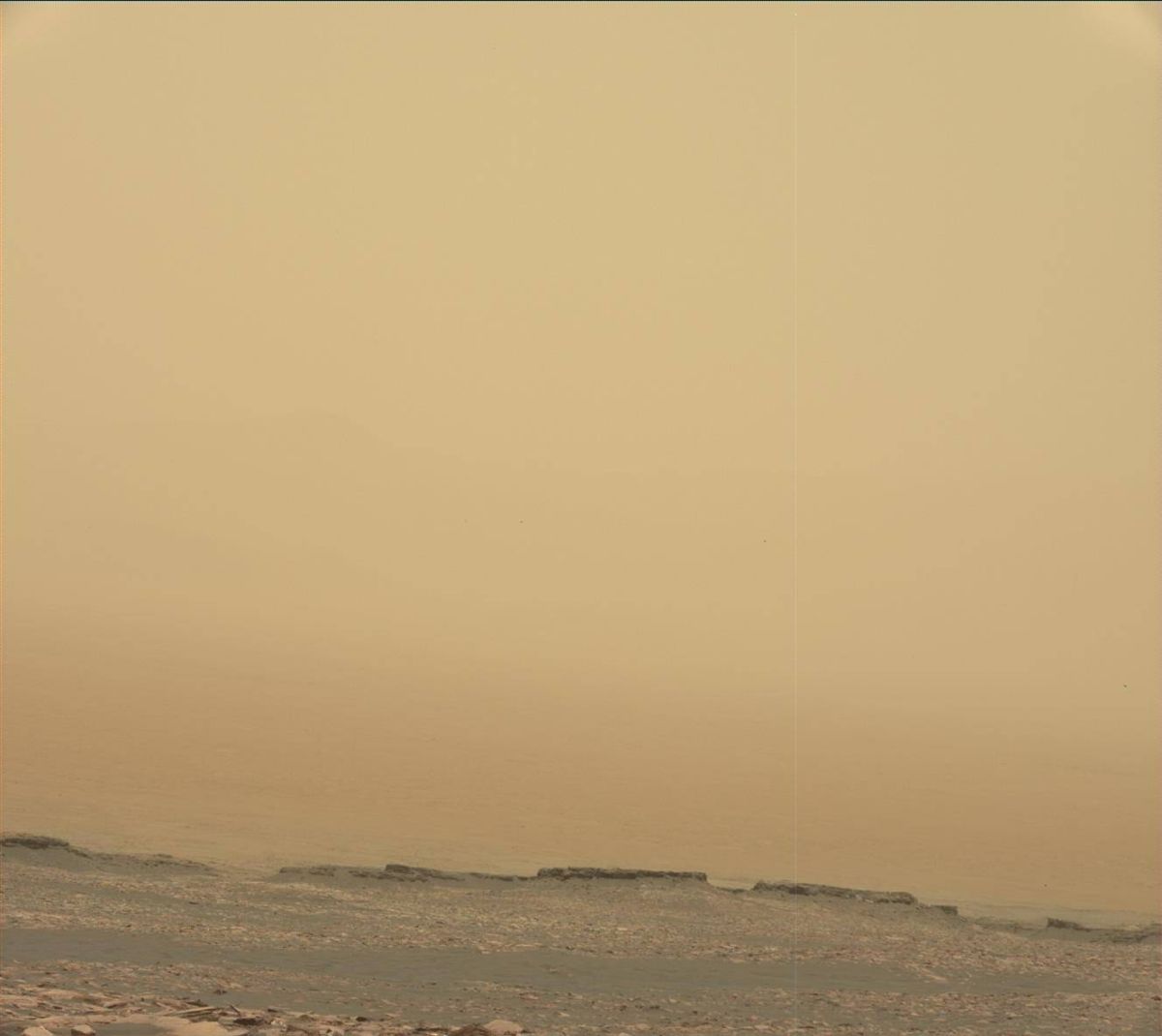
Curiosity Mastcam Left image taken on Sol 1625, March 2, 2017.
Credit: NASA/JPL-Caltech/MSSS
Monitor atmospheric dust
Also on tap for the rover on the weekend is an early science block for environmental monitoring, including Navcam and Mastcam observations to look for clouds and monitor the amount of dust in the atmosphere.
Additionally, the robot’s Navcam will search for dust devils.
Plans call for Mastcam to acquire a large mosaic of the stratigraphy exposed beneath a hematite ridge, and ChemCam will target “Thorofare” to assess the composition of veins in the local bedrock.
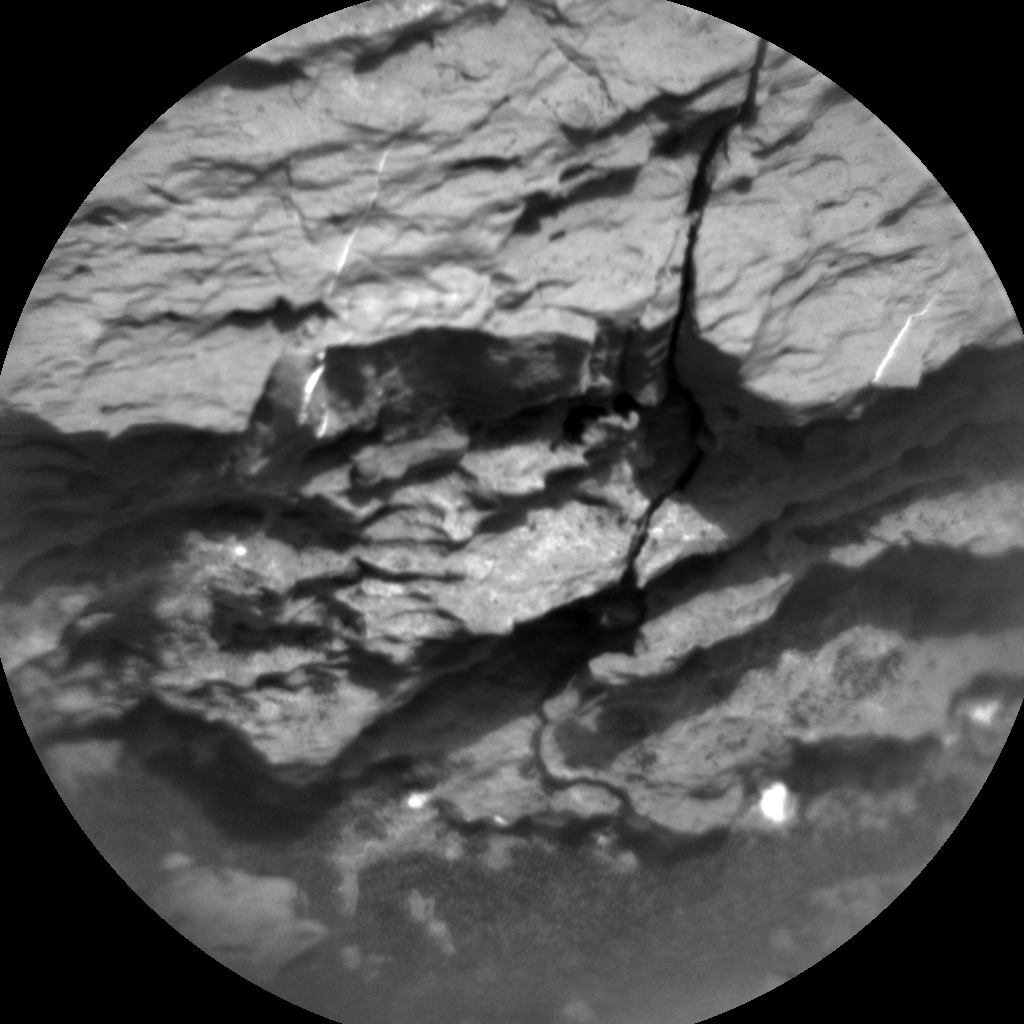
Curiosity ChemCam Remote Micro-Imager photo acquired on Sol 1626, March 3, 2017.
Credit: NASA/JPL-Caltech/LANL
Next up: new views!
“We’ll also acquire a long distance ChemCam RMI mosaic to monitor the slope of Mt. Sharp and look for changes,” Edgar says, and the rover’s Mastcam will continue to image and monitor changes in sand movement.
The plan also calls for Curiosity to drive further to the south, and take post-drive imaging to prepare for targeting next week.
Curiosity planners have also scheduled more environmental monitoring activities, follow-up to an autonomously-selected ChemCam target, and carry out ChemCam calibration activities.
“Looking forward to driving again,” Edgar concludes, “and getting a new view!”

Hu Hao, the chief designer of the third phase of China’s lunar exploration program.
Credit: CCTV-Plus
China space officials are underscoring the attributes of its Chang’e-5 lunar lander and return sample project.
Chang’e-5 is slated to become the country’s first lunar probe to automatically collect samples, launch on the Moon, and engage in an auto-pilot docking in lunar orbit, according to Hu Hao, the chief designer of the third phase of China’s lunar exploration program.
“The preparation of Chang’e 5 lunar probe is advancing steadily according to schedule,” Hu explains.
Challenges and breakthroughs
As reported by CCTV-Plus, the Chinese craft is scheduled for shipping to the Wenchang launch complex in August, then prepped for launch atop a Long March 5 carrier rocket around November.

Credit: CCTV-Plus
Hu notes that there are several challenges and breakthroughs the Chang’e-5 is going to make.
As for the primary task of collecting samples on the Moon, Hu said “one is using a drill. After the probe lands on the Moon, the drill will be used to collect samples beneath the surface. The other is to use a mechanical arm to collect samples on the surface, which contains unique information of the Moon.”
Return leg
Then there’s the return leg from the Moon back to Earth.
“We also have to design a docking in lunar orbit,” Hu added. “After the docking, the samples will be transferred, from the ascending part to the reentry capsule. This is also a complicated process.”

China’s Moon program intends to support a lunar sample return in 2017.
Credit: Chinese Academy of Sciences
En route from lunar orbit, the reentry capsule is to fly back to Earth at roughly 11.2 kilometers per second.
Important link
Chang’e-5 is an important link in the whole lunar exploration project, Hu notes, a three-step initiative of flying around the Moon, landing on the Moon and returning to Earth.
Chang’e-1 and Chang’e-3 completed the first two steps, with Chang’e-5 set to complete the last step of returning to Earth.
China is readying a Long March-5 rocket for liftoff in the first half of this year. Following that launch, the timing of Chang’e-5’s flight will be determined.

Following a circumlunar voyage in 2014, a return capsule parachuted to Earth. This test was a prelude to China’s Chang’e-5 lunar mission being readied for its return sample mission later this year.
Courtesy: China Space
Technology roadmap
“To be realistic, [the lunar probe] will provide our scientists with qualified lunar samples for research, which will enable us to have a deeper understanding of the Moon,” Hu points out. “Technologically, a technology roadmap is necessary because it will be a good technological basis for our following deep space explorations and manned space travels to the Moon and other planets.”
Also on China’s Moon exploration agenda, Chang’e-4 — a backup probe for the Chang’e-3 — is slated to be launched in 2018. That probe is targeted to achieve the first ever soft-landing on the far side of the Moon.
For a view of Chang’e-5 preparations, go to these CCTV-Plus videos:
http://cd-pv.news.cctvplus.com/2017/0301/8044288_Preview_6255.mp4
http://pv.news.cctvplus.com/2017/0303/8044438_Preview_3189.mp4
http://pv.news.cctvplus.com/2017/0303/8044462_Preview_8867.mp4

Rocketeer Jeff Bezos.
Credit: Blue Origin
Amazon.com billionaire, Jeff Bezos, is detailing his plans to transform low Earth orbit and create an Amazon-like delivery system to support future human settlement of the Moon.
Blue Origin’s New Shepard Team is the winner of Aviation Week’s 60th Annual Space Laureate.

Liftoff of suborbital space tourism, backed by Amazon founder Jeff Bezos.
Credit: Blue Origin
New Shepard is only the first step in fulfilling Blue Origin owner Jeff Bezos’ vision of using ever larger reusable rockets to send an entire economy into Earth orbit and beyond.
The Bezos space business plans follow the recent Elon Musk SpaceX statements regarding their intention to lob two paying customers around the Moon in late 2018 via the company’s Dragon 2 space capsule.
Following the Laureate Award presentations held at Washington’s National Building Museum on March 2, Bezos talked to Aviation Week & Space Technology Editor-in-Chief Joe Anselmo and the audience at the awards dinner about the importance of expanding into the solar system.
Bezos is also slated to speak during SATELLITE 2017, being held March 6-9 in Washington, D.C.
Check out this video of Bezos at the March 2 awards dinner at:
https://www.youtube.com/watch?v=tjz2vP3zPhE
Meanwhile, here is an exclusive look at the Bezos plan to set up Amazon-like delivery for ‘future human settlement’ of the Moon, reported by the Washington Post:
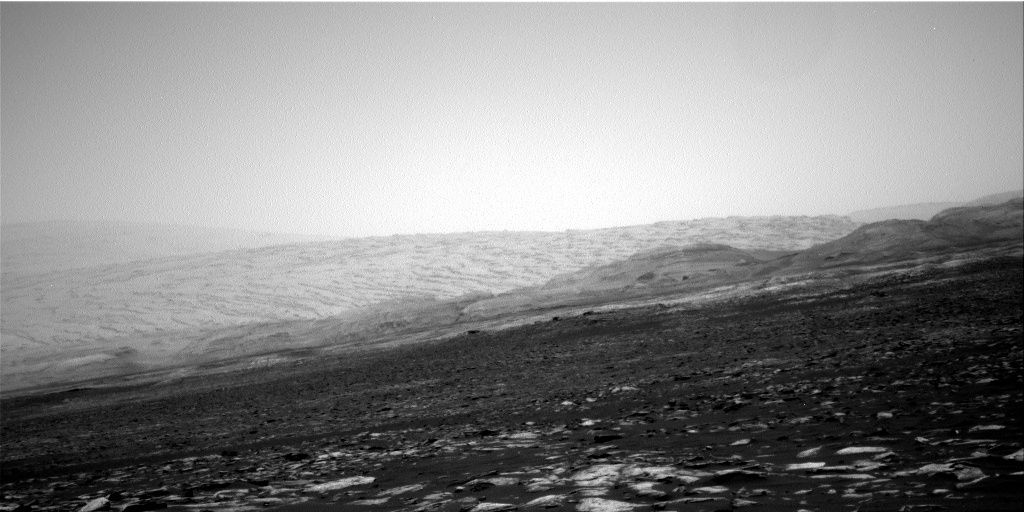
Curiosity Navcam Right B image taken on Sol 1624, March 1, 2017.
Credit: NASA/JPL-Caltech
NASA’s Curiosity Mars rover is now completing tasks during Sol 1625 operations.
Lauren Edgar, a research geologist at the USGS Astrogeology Science Center in Flagstaff, Arizona reports: “We’re still at the second stop of the Bagnold Dune campaign,” with the robot running a few more Mars Hand Lens Imager (MAHLI) diagnostics and focusing on targeted remote sensing.
Mt. Sharp observation
Curiosity has on the task list Chemistry and Camera (ChemCam) observation of a ripple crest and a long distance Remote Micro-Imager (RMI) look for changes on the slope of Mt. Sharp.
“We’ll also use Navcam to search for dust devils, and Mastcam will survey the color and opacity of the atmosphere,” Edgar reports.
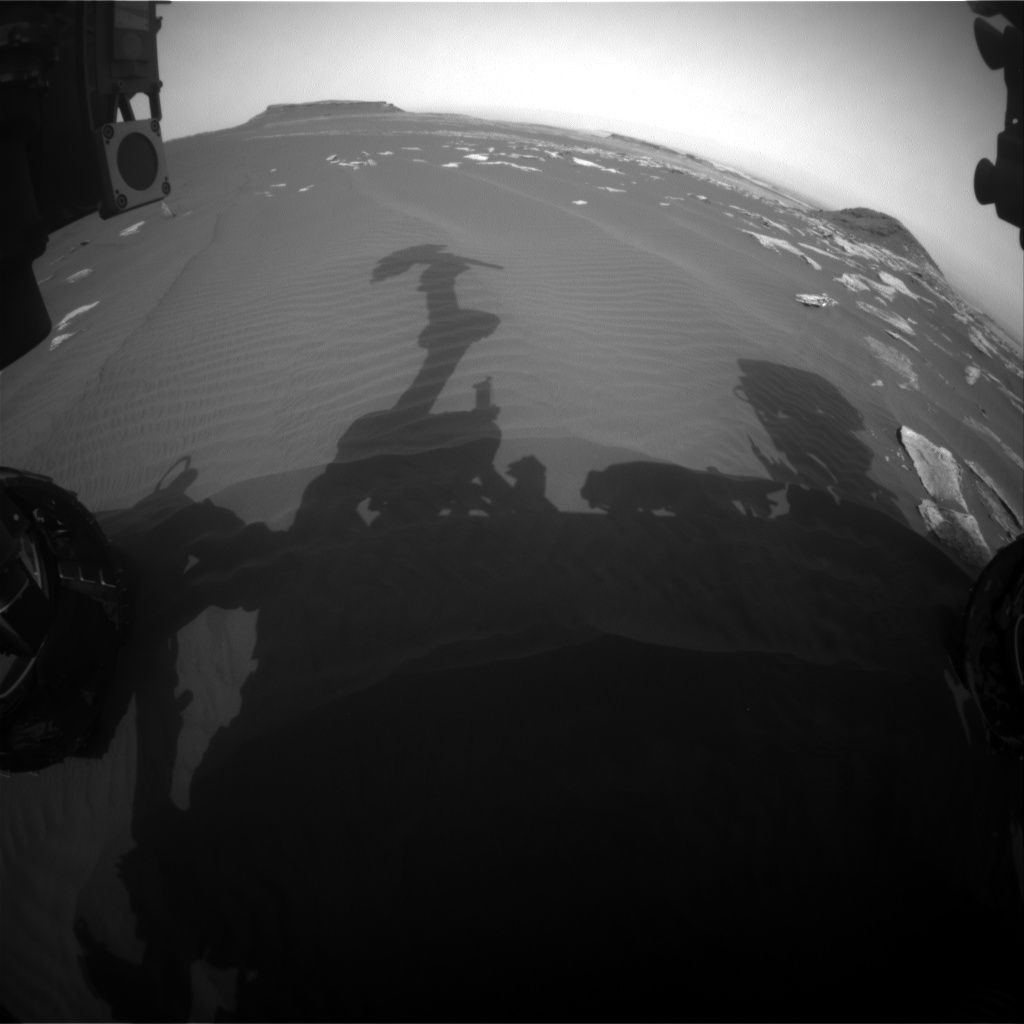
Curiosity Front Hazcam Left B image taken on Sol 1624, March 1, 2017.
Credit: NASA/JPL-Caltech
Also on tap are ChemCam observations of “Allagash” and “Hersey” to investigate some bedrock with interesting color variations.
Mastcam and Navcam will also be used to monitor the atmosphere and search for dust devils.
Ripple activity
On the schedule is use of the robot’s Alpha Particle X-Ray Spectrometer (APXS), continuing to collect data for thermal characterization.
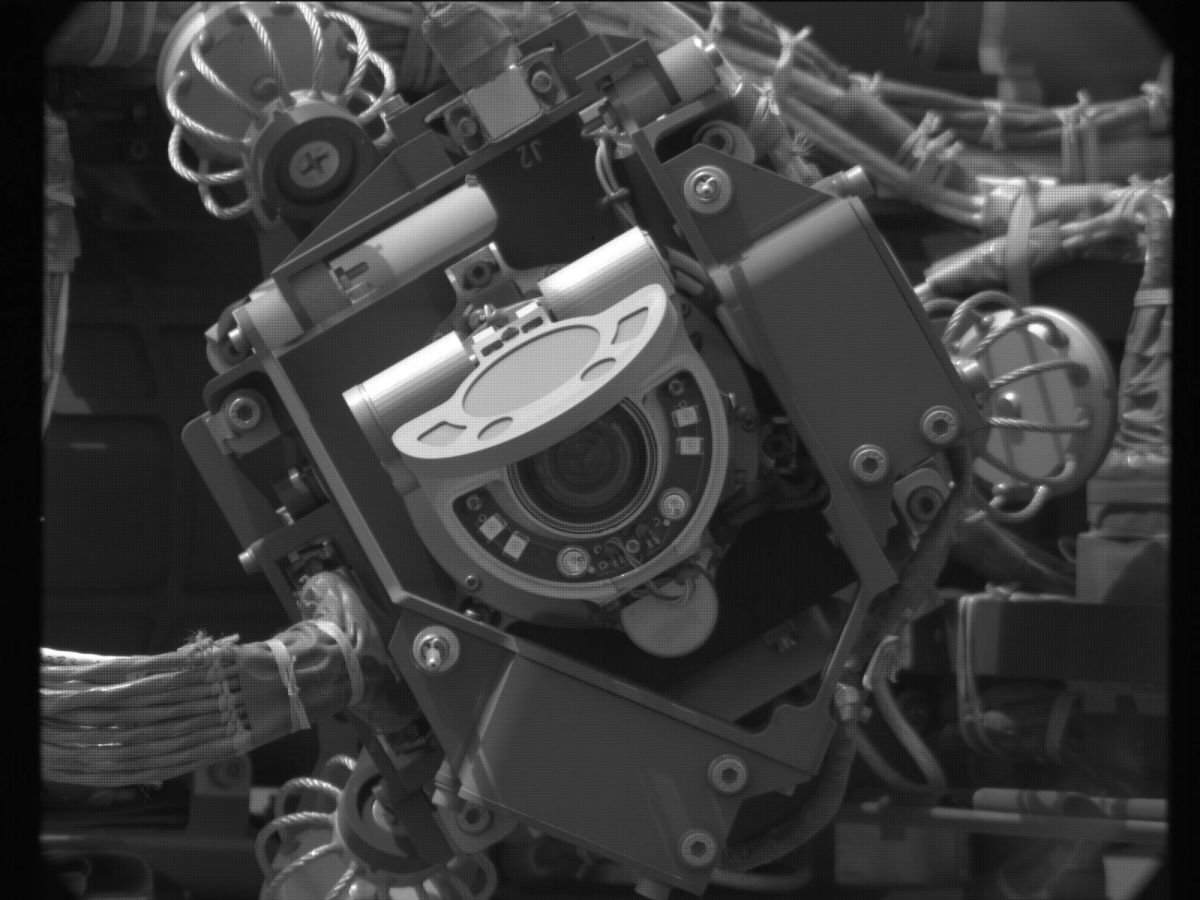
Curiosity Mastcam Right image taken on Sol 1623, February 28, 2017. Robot’s self-inspection of its Mars Hand Lens Imager (MAHLI) system.
Credit: NASA/JPL-Caltech/MSSS
Throughout the plan, Curiosity will repeat several Mastcam and Mars Descent Imager (MARDI) images to monitor changes in sand movement.
“These change detection observations have produced a great dataset that shows some awesome ripple activity,” Edgar concludes.
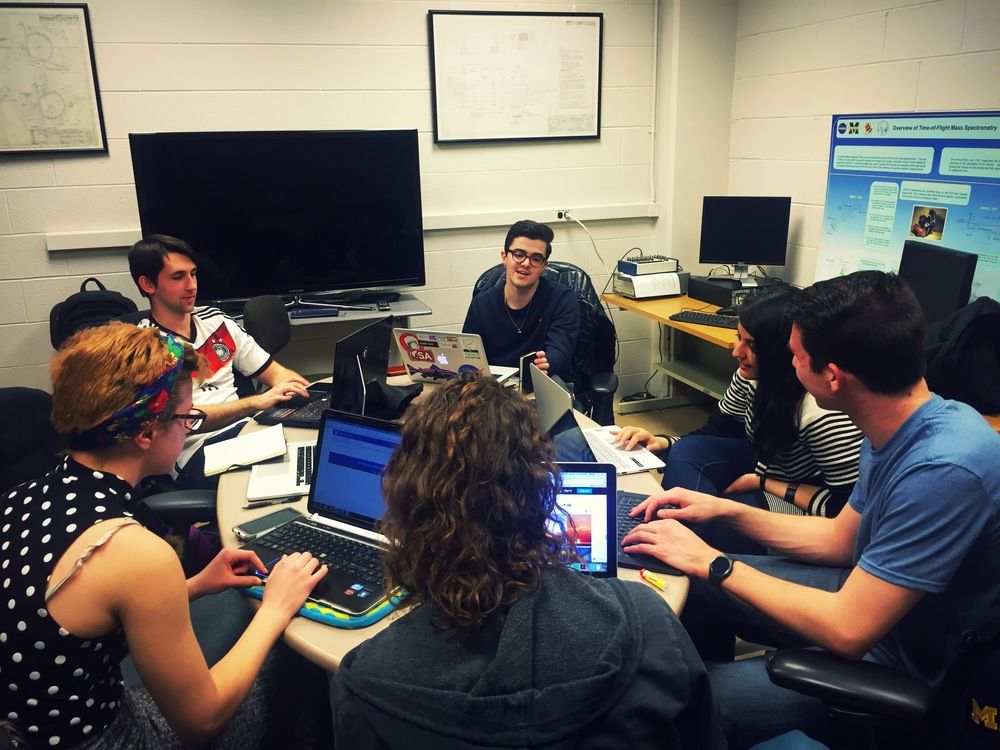
The Michigan Bicentennial Archive (M-BARC) team. Their CubeSat work is dedicated to designing, creating, and launching the first ever space time capsule.
Credit: M-BARC
A multi-disciplinary team at the University of Michigan (U-M) is scoping out a space time capsule.
Called the Michigan Bicentennial Archive (M-BARC) team, their CubeSat work is dedicated to designing, creating, and launching the first ever space time capsule.
It would be an artifact that commemorates the bicentennial of the University of Michigan. The CubeSat must survive the rigors of launch and space for 100 years.

Credit: M-BARC
Also, this small satellite would have its own propulsion system. The team is currently comparing electric and chemical thruster systems for use in the CubeSat.
Storing interviews
The student team is gathering content that will be sent up inside the spacecraft. A considerable amount of the project involves collecting representative media from throughout the University, providing the future recipients of the time capsule with an accurate representation of the University and state of Michigan in 2017.
The CubeSat would contain interviews from 1,000 members of the U-M community and an experiment to test DNA as a medium for storing data in space.

CubeSat design effort is geared to creating a time capsule for space.
Credit: U-M/M-BARC
Storing 1,000 interviews – and protecting this material from radiation – is not an easy task.
The team is working with the Lurie Nanofabrication Facility at the university to nanoprint 8 to 30 GB of data on a 1-inch silicon chip. At least ten chips will be placed at different orientations in the satellite to provide backups in case of cubesat collisions.
DNA experiment
According to a U-M story on the M-BARC effort, radiation also plays an important role in the team’s DNA radiation experiment which tests the genetic code’s ability to store information in space.
One microgram of DNA can hold 900 terabytes of data, equal to roughly 11,000 iPhones.
The team explains that sending physical packages of information out into the cosmos – like that onboard the Voyager spacecraft — it would be worth finding out if the DNA storage technique works. If so more information can be lobbed into space by this method, contrasted to the Voyager record, or even on solid state drives.

Record-toting Voyager spacecraft.
Credit: NASA/JPL
Multidisciplinary
As detailed on the M-BARC website, the multidisciplinary venture involves five distinct sub-teams:
- Bus team is designing the space vehicle itself, as well as the nanoprinting technology that will house our time capsule data.
- Orbit, Launch, and Propulsion team is investigating propulsion methods and determining where the time capsule will be located in space for 100 years.
- Tracking team is devising a way to locate the time capsule from Earth as it orbits for the next century.
- Public Relations team is crafting the content that will exist in the time capsule, managing donations and fundraising, and making sure this project gains momentum at the University of Michigan and beyond.
Location via laser
The team expects construction of at least the payload portion of the CubeSat to begin in the middle of the Winter 2017 semester. The payload includes the DNA experiment and data chips containing interviews.
In due course, say the next century, U-M hopes to retrieve the time-capsule by using a laser to locate the satellite via onboard reflectors.
Visit the M-BARC website at:
Go to this informative video of the project at:

This artist’s rendering depicts NASA’s Mars 2020 rover, with its robotic arm extended.
Credit: NASA/JPL-CALTECH
Deciding on where best to plunk down NASA’s Mars 2020 on the Red Planet rover is not an easy choice, and is spot-on with controversy.
On one hand, the scientific bonus of having a souped-up mega rover meet Martian real estate is one thing. But it turns out that the Mars 2020 stands as a watershed moment, perhaps a bridge to nowhere in Mars exploration planning for NASA.

Where will NASA’s next Mars rover explore? Artwork depicts meeting of Mars machinery: The Mars 2020 rover wheels up to the dead, stuck-in-sand Spirit rover in the Columbia Hills.
Credit: James Rice/Joel Hagen/NASA
Multi-Mars probes
Meanwhile, putting aside the tossing of America’s next rover onto the Red Planet, there are other similar efforts in that same time period heading for a Mars landing in 2021, expressly the European Space Agency’s ExoMars 2020 rover, a Chinese Mars lander, as well as Elon Musk’s entrepreneurial enterprise that now intends to lob its first uncrewed Dragon capsule to the Martian surface that same year.
For more details on the NASA Mars 2020 rover mission, discussion and debate, please go to my new Space.com story:
Should NASA’s Next Mars Rover Tread New Ground?
March 1, 2017 07:00am ET
http://www.space.com/35866-nasa-mars-2020-rover-landing-site.html

Laser spotting Mars sand dunes. Curiosity Mastcam Right image taken on Sol 1621, February 26, 2017.
Credit: NASA/JPL-Caltech/MSSS
NASA’s Curiosity Mars rover is performing a range of Sol 1623 tasks, with a two-sol plan scoped out that’s devoted to remote sensing and Mars Hand Lens Imager (MAHLI) diagnostics.
The plan is to kick off with arm activities to better understand the fault that MAHLI experienced last week, reports Lauren Edgar, a research geologist at the USGS Astrogeology Science Center in Flagstaff, Arizona.

Curiosity Mastcam Right image taken on Sol 1620, February 25, 2017.
Credit: NASA/JPL-Caltech/MSSS
Interesting color variations
Then the plan involves Chemistry and Camera (ChemCam) investigation of “Dunn Brook.”
“The target shows some interesting color variations so ChemCam will be used to investigate changes in composition,” Edgar explains. “We’ll also acquire a ChemCam observation of “Leighton,” to study the coarse sand grains at the crest of a ripple.”
Also on tap is use of Curiosity’s Navcam to look for dust devils and clouds, in response to orbital observations that suggest recent increasing atmospheric opacity, Edgar adds.

Curiosity Mars Hand Lens Imager (MAHLI) image taken on Sol 1619, February 24, 2017. MAHLI is located on the turret at the end of the rover’s robotic arm.
Credit: NASA/JPL-Caltech/MSSS
Targeting features
On the second sol, Mastcam is on schedule to acquire a multispectral observation on “Dunn Brook,” and will be used to document the previous Alpha Particle X-Ray Spectrometer (APXS) locations at “Tomhegan” and “Waweig.”
“We’ll also acquire a Mastcam image for deck monitoring to assess the movement of fines, and an upper tier Navcam mosaic to enable us to target features on Mt. Sharp,” Edgar notes.

Mars rover Curiosity Front Hazcam Left B image taken on Sol 1622, February 27, 2017.
Credit: NASA/JPL-Caltech
The second sol plan includes a number of environmental monitoring observations, using both Mastcam and Navcam to monitor the color and opacity of the atmosphere and search for dust devils.
The plan also includes an APXS thermal characterization test and a number of change detection observations.
By the way, Curiosity has taken nearly 391,000 images since its landing in August of 2012.

The left side of this 360-degree panorama from NASA’s Curiosity Mars rover shows the long rows of ripples on a linear shaped dune in the Bagnold Dune Field on the northwestern flank of Mount Sharp.
The view is a mosaic of images taken with Curiosity’s Navigation Camera (Navcam) on Feb. 5, 2017, during the 1,601st Martian day, or sol, of the rover’s work on Mars. The view is centered toward west-southwest, with east-southeast on either end. A capped mound called “Ireson Hill” is on the right.
Credit: NASA/JPL-CALTECH

An artificial magnetosphere of sufficient size
generated at L1 allows Mars to be well protected by
the magnetotail.
Credit: J.L.Green, et al.
Transforming Mars to make it more livable for humankind could involve creating an artificial magnetosphere for the Red Planet.
This idea has been suggested by a team of researchers, presenting the concept at the Planetary Science Vision 2050 Workshop 2017 being held this week in Washington, D.C.
Arid and cold
Their paper – A Future Mars Environment for Science and Exploration – notes that today, that planet is an arid and cold world with a very thin atmosphere that has significant frozen and underground water resources.
Mars’ thin atmosphere not only prevents liquid water from residing permanently on its surface and makes it difficult to land missions since it is not thick enough to completely facilitate a soft landing.
The research paper, led by James Green, Director of the Planetary Science Division at NASA Headquarters, explains that when Mars lost its protective magnetosphere, three or more billion years ago, the solar wind was allowed to “directly ravish” the Red Planet’s atmosphere.

Scene from “Mars,” a National Geographic Channel miniseries due to air in November.
Credit: National Geographic, Imagine, RadicalMedia, Robert Viglasky
Simulation tools
A new approach to greatly enhance Mars’ atmosphere to a higher pressure and temperature can be appraised by a number of existing simulation tools that reproduce the physics of the processes that model today’s Martian climate.
A series of simulations can be used, the research team asserts, to assess how best to largely stop the solar wind stripping of the Martian atmosphere and allow the atmosphere to come to a new equilibrium.
Models hosted at the Coordinated Community Modeling Center (CCMC) can be used to simulate a magnetic shield, and an artificial magnetosphere, for Mars. The CCMC is situated at NASA’s Goddard Space Flight Center in Greenbelt, Maryland.
“My approach was to see if we could force nature to do it,” NASA’s Green told Inside Outer Space. “It will be a progress report. But we have some fascinating results already,” he said.
Mars L1
That modeling involves generating a magnetic dipole field at the Mars L1 Lagrange point within an average solar wind environment.
New research is starting to emerge revealing that a miniature magnetosphere can be used to protect humans and spacecraft.

Credit: Monash University
In the future it is quite possible, the research team suggests, that an inflatable structure(s) can generate a magnetic dipole field at a level of perhaps 1 or 2 Tesla (or 10,000 to 20,000 Gauss) as an active shield against the solar wind.
“A greatly enhanced Martian atmosphere, in both pressure and temperature, that would be enough to allow significant surface liquid water would also have a number of benefits for science and human exploration in the 2040s and beyond,” the researchers explain.
“Open air” greenhouses
An enhanced Mars atmosphere, among a list of benefits, would allow larger landed mass of equipment to the surface, shield against most cosmic and solar particle radiation, extend the ability for oxygen extraction, and provide “open air” greenhouses to exist for plant production.

A future Mars protected from the direct solar
wind should come to a new equilibrium allowing an extensive atmosphere to support liquid water on its
surface.
Credit: J.L.Green, et al.
“These new conditions on Mars would allow human explorers and researchers to study the planet in much greater detail and enable a truly profound understanding of the habitability of this planet,” the research team concludes. “If this can be achieved in a lifetime, the colonization of Mars would not be far away.”

The Museum of Contemporary Art on the Moon (MOCAM for short) was conceived in 2016 by visual artist Julio Orta. The concept is seen as a response to the inevitable creation of human communities on the moon in the near future.
According to a MOCAM mission statement:
“Although governments and private entities are working on tourism and colonization of the moon, they seem to have no concern whatsoever for the arts because they are not seen as a source of profit.”

Inaugural show
MOCAM is dedicated in displaying the most interesting, cutting edge, relevant art from the world.
MOCAM is on the watch for emerging artists, new works, and proposals from curators.
An inaugural show, Mystic Hyperstitians in the Heart of Empire, has been curated by Joey Cannizzaro, an undisciplinary artist, curator, and critic. The shows are currently presented on MOCAM’s website.
The intent is that the shows would be on display in the physical museum on the Moon.
Lunar acreage
One small step for art has been taken by Orta last year, procurement of 20 acres on the Moon via LunarLand.com.

Courtesy: Julio Orta
According to a “Moon Deed,” the property is located just South of craters Helicon and Leverrier, in an area identified as D6, Quadrant Charlie, Lot Number 1/0581-0600.
LunarLand.com’s website notes that since 1980, over 300 million acres have been sold.
Museum complex
The Moon-based museum architecture has been designed by Mauricio Mastropiero a Mexican architect.
“The Mountain” will be the first component built, and will host a visitor center, temporary galleries, storage areas, dressing rooms, restrooms, sleeping rooms, a restaurant, and a store.
The Moon structure also consists of the “Central Patio.” It is one the main areas for the exhibition of contemporary art. This outdoor esplanade features 480 poles used as structure for a light architecture that can be configured depending on different exhibition needs. This is a space to experience art under the moon’s natural environment.
At the core of the complex is “The Plateau”, a two-story building that levitates using electromagnetic technology. As the principal gallery, the interior of this building also features a controlled atmosphere and hosts the main exhibitions. The second level of this rotating building is the highest point of the museum, a viewpoint to gaze beyond its physical limits.

Resources
MOCAM is accepting proposals for 2017 shows.
For more information on the Museum of Contemporary Art on the Moon, go to:
For a video detailing the effort, go to:

