Archive for the ‘Space News’ Category
 Author:
  April 26th, 2017
Curiosity Front Hazcam Right B image taken on Sol 1678, April 26, 2017.
Credit: NASA/JPL-Caltech
It’s official!
NASA’s Curiosity Mars rover has racked up over 10 miles (16.12 kilometers) since landing at 10:32 p.m. PDT, August 5, 2012.
The robot is now performing Sol 1678 science duties.
Up Mt. Sharp
A recent report by Abigail Fraeman via the USGS Astrogeology Science Center in Flagstaff, Arizona underscores the rover’s drive sessions as it continues up Mt. Sharp, studying the Murray formation along the way.
“A big part of the science team strategy for exploring the Murray formation, the group of rocks that are the lowest and oldest in Mt. Sharp, has been to systematically characterize their changing chemistry and mineralogy,” Fraeman explains. “Understanding how these properties vary with elevation gives us insight into changing conditions in the geologic processes that deposited and altered these rocks during burial.”

Curiosity Navcam Left B image taken on Sol 1678, April 26, 2017.
Credit: NASA/JPL-Caltech
Perched on rocks
Last week, because two of Curiosity’s wheels were perched on rocks during Friday’s planning, researchers were unable to safely use the arm to measure their chemistry using the Alpha Particle X-Ray Spectrometer (APXS).
Once the rover wheels were in good contact with the underlying terrain, a remote sensing block was adjusted and instead scientists uses the morning time to take advantage of the opportunity for contact science.

Curiosity Mastcam Left image acquired on Sol 1677, April 25, 2017.
Credit: NASA/JPL-Caltech/MSSS
“The area directly in front of the rover was filled mostly with sand, but we were pleased to find there was a small patch of Murray bedrock that we were able to reach with the arm and that wasn’t filled with white veins,” Fraeman adds. “While veins and filled fractures are extremely interesting and frequently targeted for study, their presence in the field of view of the APXS makes it more difficult to understand the changing chemistry of the primary Murray bedrock.”

Mars Hand Lens Imager (MAHLI), located on the turret at the end of the rover’s robotic arm, took this image on Sol 1675, April 23, 2017.
Credit: NASA/JPL-Caltech/MSSS
Geologic context
Recently, Curiosity investigated a contact science target dubbed “Casco Bay” and observations were planned of the target using both Mars Hand Lens Imager (MAHLI) and the APXS.
Also planned were taking Mastcam color images to help document the geologic context of the robot’s surroundings. Environmental science also requested a dust devil movie plan. “After our morning science block, we planned another drive to continue our way up Mt. Sharp,” Fraeman concludes.
Traverse map
Meanwhile, a newly released map shows Curiosity’s traverse through Sol 1677.

Ten mile map.
Image Credit: NASA/JPL-CALTECH/University of Arizona
This map shows the route driven by NASA’s Mars rover Curiosity through the 1677 Martian day, or sol, of the rover’s mission on Mars, as of April 25, 2017.
Numbering of the dots along the line indicate the sol number of each drive. North is up. The scale bar is 1 kilometer (roughly 0.62 mile).
From Sol 1676 to Sol 1677, Curiosity had driven a straight line distance of about 108.88 feet (33.19 meters), bringing the rover’s total odometry for the mission to 10.01 miles (16.12 kilometers).
The base image from the map is from the High Resolution Imaging Science Experiment Camera (HiRISE) in NASA’s Mars Reconnaissance Orbiter.
 Posted in

Reaching new heights – Ye Chenguang, the holder of Chinese record for skydiving.
Credit: CCTV-Plus
A record setting skydiver in China has announced an edge of space plunge slated to be the longest and fastest free fall jump. The jump is also a bid to boost safety in human space travel and further space science research.
Ye Chenguang, the holder of Chinese record for skydiving, officially announced in Beijing on Tuesday that he will do a dive of 43,000 meters next year.
Beating the mark
Ye broke the Chinese record for skydiving last year in the United States by jumping from 10,000 meters. He said he wants to challenge the current skydiving world record of 41,419 meters set by Alan Eustace.
Google executive, Eustace, jumped from over 130,000 feet in 2014, beating the mark set by the Austrian Felix Baumgartner in 2012.

Google executive, Alan Eustace departs Earth for record setting dive from space in 2014.
Credit: Paragon
In a CCTV-Plus interview, Ye said: “We have started the project since 2013. Last year, I made the new Chinese record by jumping from 10,000 meters. Actually, this is just a small part of our space diving project, and we will have jumps from 20,000 and 30,000 meters later. If nothing goes wrong, we will officially challenge the highest record by jumping from 43,000 meters in July or August next year.”
Air is rare
Ye’s space dive involves use of a high-flying, balloon-carried protective cabin and a special space diving suit.
“After Chenguang gets off the cabin, his space suit will supply him with oxygen for less than half an hour,” said Ding Langnuo, the technical consultant of Ye Chenguang’s space diving committee.
“So he will have limited time to deal with emergency. As air is very rare at high altitude, the space diver is liable to experience violent spins and faint,” Ding told CCTV-Plus.
Cosmic dust
Ye is now undergoing zero gravity and wind tunnel training in China and other countries, with a 1.0 version space suitmodel of the protection cabin ready.
“Through the space dive, I want to collect more space data,” Ye added. “Emergency may happen when a rocket launches, so astronauts can use the data to study how to escape. These data will also help the National Astronomical Observatories [under the Chinese Academy of Sciences] collect cosmic dust for further study of components of cosmic materials.”
For a CCTV-Plus video of the space diving Ye, go to:
http://cd-pv.news.cctvplus.com/2017/0425/8048822_Preview_3764.mp4
Also, go to this video spotlighting the 2014 space dive by Alan Eustace at:

Credit: Lockheed Martin

Credit: CGTN
China’s Tianzhou-1 cargo spacecraft has performed an automated docking with the orbiting Tiangong-2 space lab today, according to Beijing Aerospace Control Center.
Tianzhou-1 was lofted atop a Long March-7 Y2 booster on Thursday evening from Wenchang Space Launch Center in south China’s Hainan Province.
According to the country’s space planners, the cargo ship and Tiangong-2 space lab will carry out two additional dockings.

Artist concept of the Tianzhou-1 cargo resupply spacecraft now in Earth orbit.
Credit: CMSE
Docking plan
According to CCTV-plus, the second docking will be conducted from a different direction, which aims to test the ability of the cargo ship to dock with a future space station from different directions. A third and final docking will use fast-docking technology. It normally takes about two days to dock, while fast docking will take only six hours.
A 29-step refueling script will takes place over several days.
Goods and propellant
The Tiangong-2 space lab has been in Earth orbit since September 15, 2016.
State-run media reports that the supply ship is loaded with roughly six tons of goods and propellants. The combination of Tianzhou-1/Tiangong-2 is to have a two-month flight and conduct in-orbit liquid propellant refueling as well as carry out various experiments.

Credit: CMSA
Tianzhou-1 is China’s largest and heaviest spacecraft with a total length of 35-feet (10.6 meters), 11-feet (3.35 meters) in maximum diameter and weighs 13 tons.
“Now Tianzhou-1 and Tiangong-2 have formed a rigid, combined unit,” said Huang Zhen, an engineer from the flight control decision support group at the Beijing Aerospace Control Center.

Larger Chinese space station to be constructed on orbit in the 2020s.
Credit: CMSA
Smooth docking
“Tiangong-2 has taken over Tianzhou-1’s functions. They used to be two separate spacecraft, so to make them a combined body we need to properly integrate relevant resources and information. Therefore, we are planning to shut down other functions, like cutting off the power supply to the docking equipment,” Huang said during a CCTV-Plus interview. “The docking process went very smoothly today. Now the combined unit is quite stable. As planned, we will make preparations for refueling tomorrow and replenish both fuel and oxidizing agent to the Tiangong-2 space lab,” he said.

Credit: CSIS
Space station steps
The now unoccupied Tiangong 2 space laboratory — or “Heavenly Palace 2” — is the facility where two astronauts spent a month last October in China’s longest ever piloted space trek – a Shenzhou-11 mission that totaled 33 days.
The Tianzhou-1/Tiangong-2 mission is viewed by China’s space planners as a crucial step toward the country’s goal of establishing a permanent space station around 2022.
For CCTV-Plus video about the docking, go to:
http://cd-pv.news.cctvplus.com/2017/0422/8048514_Preview_1733.mp4
http://cd-pv.news.cctvplus.com/2017/0422/8048531_Preview_8056.mp4

The Atacama Large Millimeter/submillimeter Array (ALMA) in northern Chile’s Atacama desert.
Credit: ESO/B. Tafreshi (twanight.org)
Unexplained phenomena, strange behavior, and what kinds of signals might extraterrestrials generate?
Day Two of Breakthrough Discuss was held at Stanford University ending a ground-breaking conference that brought together the world’s leading astronomers, engineers, astrobiologists, and astrophysicists.
TRAPPIST-1 system
The meeting included a review of TRAPPIST-1, which has seven temperate planets, including three in the habitable zone. The planets were discovered using small ground-based telescopes, and there were “so many transits we couldn’t make sense of them,” noted astronomer Michaël Gillon.

NASA’s Spitzer Space Telescope has revealed the first known system of seven Earth-size planets around a single star.This artist’s concept allows us to imagine what it would be like to stand on the surface of the exoplanet TRAPPIST-1f, located in the TRAPPIST-1 system in the constellation Aquarius.credit:
Credit: NASA/JPL-Caltech
Gillon described how observations from several telescopes were used to study the TRAPPIST-1 system, including the Kepler spaceborne observatory to confirm the existence of the planets, as well as the Spitzer space telescope to ascertain their orbits.
Similarly, a suite of telescopes, including Hubble and the James Webb Space Telescope, could be used in the future to search for signs of water and atmospheres on planets that may be detected by the next generation of giant ground-based telescopes.
Unexplained phenomena
A wide-ranging discussion, chaired by the SETI Institute’s Jill Tarter, focused on how studies of unexplained phenomena might lead to new discoveries in astrophysics, or possible evidence of activity by civilizations inhabiting other star systems.

How advisable is it to make contact with ET?
Credit: José Antonio Peñas/SINC
Panelists underscored the odd variations in brightness of a star to searches for stars that might suddenly disappear and described a variety of creative ways to search large, time-domain survey datasets for events of interest.
Also discussed is how modern machine learning algorithms could allow looks for strange behavior in data without making presuppositions about the kinds of signals extraterrestrials might generate. A great deal of work is required to rule out natural astrophysical explanations before resorting to claims of intelligent aliens
Proposed during the meeting is revision to the Rio Scale that is used to assess the credibility of ET claims.

Credit: Breakthrough Initiatives
Starshot thinking
The meeting included updates on the ambitious Breakthrough Starshot plan to send spacecraft to nearby stars.
Explained by experts:
- How a gram-scale camera attached to a sail propelled by a powerful ground-based laser beam might reach Proxima b during our lifetime, traveling at 20 percent of the speed of light. Feasibility studies will be completed during the next five years, potentially leading to the construction of a kilometer-scale ground station, and the launch of many small, relatively inexpensive spacecraft to explore nearby star systems.
- Starshot technology could enable craft to travel from Earth to the Moon in an hour, to Mars in under a day, and to nearby stars in a couple of decades.
- There are materials science and engineering challenges in designing a sensor package to fit on a thin silicon wafer, and returning data to Earth, but there is optimism that ongoing technological developments would make this “watershed moment in human history” possible in the near future.
- A “photogravitational assist” technique might enable a spacecraft traveling at 20 percent of the speed of light to use photons from the Alpha Centauri system as a brake to enter orbit rather than rapidly flying by.
Spectral features
Closing out the day, other speakers discussed how a suite of observations, both remote, and in-situ, could detect spectral features of vegetation, light glinting from oceans, and signs of water and oxygen in planetary atmospheres.

Credit: Breakthrough Initiative
The conference also closed with a panel on science goals and instrumentation for Breakthrough Starshot.
Breakthrough Discuss was hosted by Stanford University’s Department of Physics and the Harvard-Smithsonian Center for Astrophysics and sponsored by the Breakthrough Initiatives. Breakthrough Discuss is an annual academic conference focused on life in the Universe and novel ideas for space exploration.
Breakthrough Initiatives are a suite of scientific and technological programs exploring the big questions around life in the Universe, such as are we alone? What are the nearest habitable planets? And can we become an interstellar civilization?
For more information, go to:
https://breakthroughinitiatives.org
Note: All videos from the two-day event are available to view on the Breakthrough Facebook page. You can view by following this link:
https://m.facebook.com/pg/BreakthroughPrize/videos/
Special thanks to Kayla Engebretsen for information used in this article.
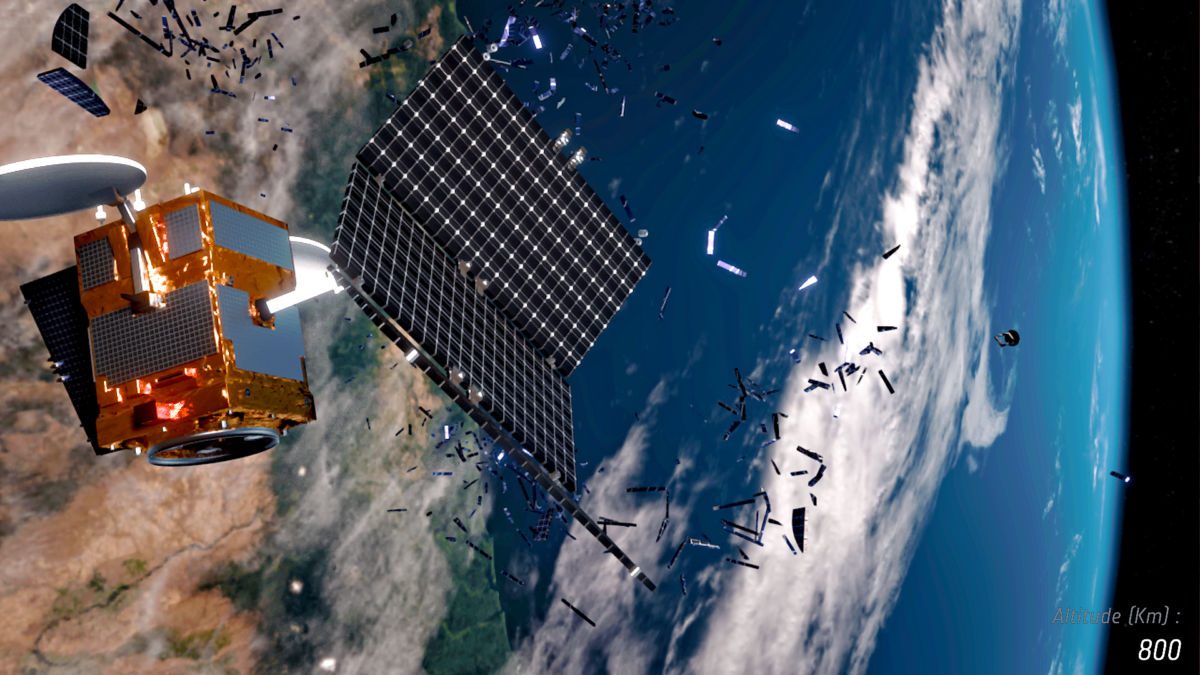
As of April 2017, more than 290 break-ups in orbit have been recorded since 1961. Most were explosions of satellites and upper stages – fewer than 10 involved accidental and intentional collisions.
Credit: ESA/ID&Sense/ONiRiXEL, CC BY-SA 3.0 IGO
A volley of worrisome messages came from the week-long 7th European Conference on Space Debris held this week at the European Space Agency’s (ESA) mission control centre in Darmstadt, Germany.
According to an ESA statement that focused on findings from the meeting, the take-away message:
“Despite progress in technology, and in understanding the space environment, the need for significantly increasing the pace in applying proposed measures to reduce debris creation has been identified.”
Urgent threat
The scientific gathering in Darmstadt was dedicated to space debris with participants from governments, space organizations, academia and industry sharing information and the latest research into the debris threat and on new technologies aimed at mitigating debris creation and reducing the orbital debris population.

At the 7th European Conference on Space Debris, the world’s largest scientific gathering dedicated to the topic, over 350 participants from governments, space organizations, academia and industry shared information and the latest research into the debris threat and on new technologies aimed at mitigating debris creation and reducing the orbital debris population.
Credit: ESA/J. Mai
“There was wide agreement that the continuing growth in space debris poses an urgent threat to economically and scientifically vital orbital regions,” according to the ESA overview.
Key observations
As this year’s meeting drew to a close, key observations include:
- The prospect of large constellations of several hundreds of satellites in critical orbital regimes has been identified as a potential additional challenge.
- There is a consensus that debris mitigation strategies defined long ago are important today as never before.
- Implementation of orbital debris countermeasures is still a challenge, and this has the utmost importance in view of plans to deploy constellations of hundreds of satellites in space.
- Active removal of objects is now necessary to reverse the debris increase, and researchers have seen evidence that the environment in some orbital regions has already reached a critical state.
- There is evidence that fewer than half of the satellites that should be deorbited at end of life are actually commanded to do so. There is no enforceable international regime to ensure this.
- Applicable technologies to approach, capture and safely deorbit a large and massive target object are being studied. These range from sensors for the inspection of defunct space objects and their dynamics, capture technologies including nets, robotic arms and harpoons, up to system aspects of a removal mission.
- Work is progressing on ESA’s e.Deorbit, a demonstration mission for the removal of a large ESA-owned target object. This effort has now reached a high maturity level of preparation.
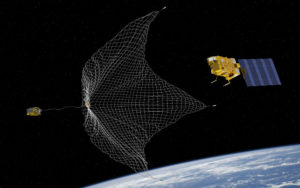
One capture concept being explored through ESA’s e.Deorbit system study for Active Debris Removal – capturing the satellite in a net attached to a tether.
Credit: ESA–David Ducros, 2016

Numbers game
According to ESA, since 1957, more than 5,250 space launches have led to an on-orbit population today of more than 23, 000 tracked debris objects.
Only about 1,200 are functional spacecraft. The remaining are classified as space debris and no longer serve any useful purpose.
A large percentage of the routinely tracked objects are fragments from the approximately 290 breakups, explosions and collisions of satellites or rocket bodies that are known to have occurred.
An estimated 750,000 objects larger than 1 centimeter and a staggering 166 million objects larger than 1 millimeter are thought to reside in commercially and scientifically valuable Earth orbits.
“It’s the classic ‘tragedy of the commons’…except it’s happening in space and could ruin modern technological society for everyone,” said Holger Krag, Head of ESA’s Space Debris Office and conference chair.

Credit: CCTV
China’s automated Tianzhou-1 supply craft, launched on Thursday, has performed orbital adjustments in preparation for docking with the Tiangong-2 space laboratory on Saturday.
The Tianzhou-1 is set for three docking attempts with the unoccupied space lab that has been in orbit since last September. The cargo craft will fuel the facility at each docking attempt to test resupply technology.
Artist concept of the Tianzhou-1 cargo resupply spacecraft now in Earth orbit.
Credit: CMSE
During the cargo ship’s three-month stay in Earth orbit, refueling of the Tiangong-2 space lab is spotlighted as key to China’s ambition to build and sustain a permanent space complex in the 2020s.
Stem cell research
In a series of stories by the state-run Xinhua news service, the now orbiting Tianzhou-1 carries a number of scientific experiments. These types of experiments are expected to be followed-up by crews visiting China’s space station in the future.
Among the experiments is stem cell research to investigate the effects of microgravity on embryonic stem cell proliferation and differentiation. Performed by the Institute of Zoology of the Chinese Academy of Sciences, the supply spacecraft is carrying embryonic stem cells and embryoid bodies of mice.
Scientists will observe the process of their proliferation and differentiation in space as parallel experiments will be conducted on the ground to compare the results.
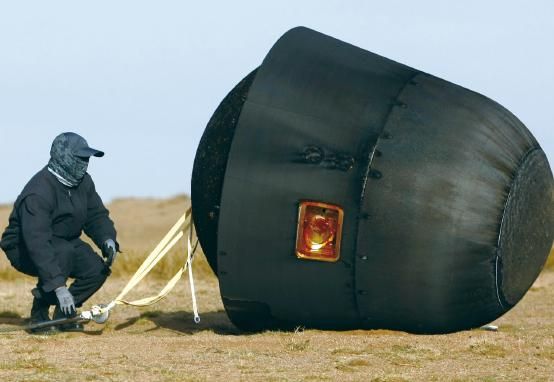
China’s SJ-10 – a recoverable capsule carrying science experiments.
Credit: China Daily
Previously, the research team conducted a series of space life science experiments on China’s recoverable satellites Sj-8 and Sj-10. Research into embryonic stem cells on China’s future space station would be focused culturing functional tissues, such as heart, kidney, liver and spleen tissues.
Human reproduction
Another experiment is targeted on the effect of microgravity on human reproductive capacity. This Tianzhou-1 experiment from Tsinghua University aims to study the effects of the space environment on human reproduction, beginning with the study of microgravity on human stem cells and germ cells. Will microgravity affect the differentiation of human embryonic stem cells and the formation of germ cells?
This experiment on Tianzhou-1 will last 30 days. “Scientists on the ground will remotely control the research equipment to change the cell-culture medium to induce the human embryonic stem cells to differentiate into germ cells. Images of the cells under the microscope will be transmitted to Earth,” Xinhua reports.
Larger Chinese space station to be constructed on orbit in the 2020s.
Credit: CMSA
Bone loss
Also onboard the Tianzhou-1 is a medicine to treat bone loss, a malady that impacts space travelers – but also is a health issue on Earth. Osteoporosis is the seventh most common disease in the world. Each year it causes 8.9 million cases of fractures worldwide.
This Tsinghua University experiment in microgravity will evaluate the effect of 3-hydroxybutyric acid (3HB) in preventing osteoporosis. Scientists will compare osteoblast cell samples treated and not treated with 3HB. Microscope images taken of the experiment in the cargo craft will be transmitted down to Earth.

Artist rendering of the Directed Energy Interstellar Study.
Credits: P. Lubin
A second day of provocative presentations is underway today at Breakthrough Discuss 2017, an event being held at Stanford University.
The second and final day will assess the significance of the newly discovered exoplanets for the long-term Breakthrough Starshot endeavor, a program spearheaded by Yuri Milner to develop a practical interstellar space probe.
According to a press statement from Breakthrough Discuss, highlights of speakers yesterday described the state of the art in observations of planets around nearby stars.

Swarm of laser-sail spacecraft leaving the solar system.
Credit: Adrian Mann
Promising targets
Obtaining pictures of planets is difficult, and most are found using indirect methods. These methods have shown that most stars have planets in short-period orbits, and since most stars in the galaxy are red dwarfs, these provide promising targets when searching for habitable worlds.
Many planets around these stars have recently been reported, including Proxima Centauri b, and LHS 1140 b and the TRAPPIST-1 system.
NASA’s Spitzer Space Telescope has revealed the first known system of seven Earth-size planets around a single star.This artist’s concept allows us to imagine what it would be like to stand on the surface of the exoplanet TRAPPIST-1f, located in the TRAPPIST-1 system in the constellation Aquarius.credit:
Credit: NASA/JPL-Caltech
Although red dwarfs have high X-ray and UV radiation, and planets around them are more likely to be tidally locked (one side always in fierce daylight and the other in cold night), they are long-lived stars, potentially allowing plenty of time for life to arise.
Living colors
The difficulty of imaging planets even around nearby stars is compounded when trying to measure their colors to find indications of life.
But telescopes that will come online in the mid-2020s will have the capability to detect “biosignatures” in exoplanet atmospheres. By looking for signatures of oxygen and methane, that are naturally destroyed over time if not replenished by such processes as living organisms, perhaps in the next 10 to 15 years we will have found another world where humans could breathe.

New Horizons Principal Investigator Alan Stern of Southwest Research Institute (SwRI), Boulder, CO., left, Johns Hopkins University Applied Physics Laboratory (APL) Director Ralph Semmel, center, and New Horizons Co-Investigator Will Grundy Lowell Observatory hold a print of an U.S. stamp with their suggested update since the New Horizons spacecraft explored Pluto in July 2015. Credit: (NASA/Bill Ingalls)
It was noted that 70 years of observations of Pluto saw it simply as a point of light, until the New Horizons probe yielded in-situ measurements of Pluto as a world in its own right. Therefore, what on-the-spot observations of habitable zone planets around nearby M-dwarfs might be possible in 70 years’ time?
Sounds of silence
The findings from the first year of Breakthrough Listen observations of around 700 nearby stars, placing sensitive limits on the presence of engineered emission from these targets was noted.

Green Bank Telescope (GBT) has joined in the search, receiving roughly $2 million per year for 5 years. The 100-meter GBT is the world’s largest fully steerable radio telescope, located in West Virginia.
Credit: NSF
Although no convincing signs of extraterrestrial intelligence have yet been found, the speakers and audience expressed optimism and enthusiasm for what would be possible with the next generation of searches.
Starshot
As the closest known exoplanet, Proxima b is the current primary target for Starshot, which aims to develop the technology to send gram-scale spacecraft travelling at 20 percent of the speed of light to Alpha Centauri, some 4.367 light-years away.
Credit: Breakthrough Initiatives
Starshot mission leaders Avi Loeb, Philip Lubin and Zac Manchester are among the distinguished participants at today’s Breakthrough Discuss.
Breakthrough Initiatives are a suite of scientific and technological programs exploring the big questions around life in the universe, such as: Are we alone? What are the nearest habitable planets? And can we become an interstellar civilization?
Resources
The conference today, Friday, April 21, will be broadcast on Facebook Live at:
http://www.Facebook.com/BreakthroughPrize
Viewers are encouraged to join in the conversation and submit questions, which have the opportunity to be answered by the panelists in real-time.
Start times for all sessions will also be posted on the Breakthrough Facebook page.
For more information on the program, including a detailed schedule, please visit:
https://breakthroughinitiatives.org/Events
For detailed information on Breakthrough Initiatives, go to:
https://breakthroughinitiatives.org
Special thanks to Kayla Engebretsen for information used in this article.
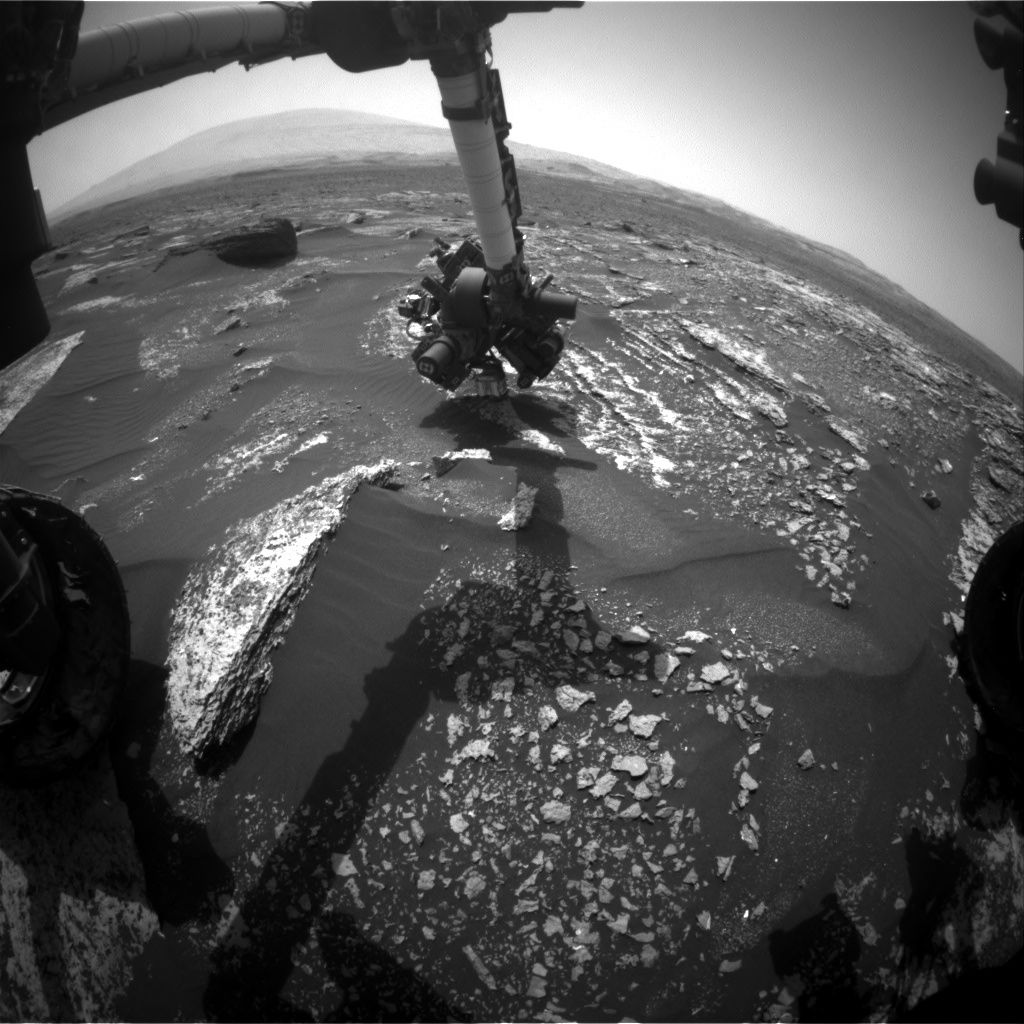
Curiosity Front Hazcam Left B image acquired on Sol 1671, April 18, 2017.
Credit: NASA/JPL-Caltech
NASA’s Curiosity Mars rover is now performing Sol 1673 duties.
In a report from the USGS Astrogeology Science Center in Flagstaff, Arizona, Michelle Minitti reports: “There’s nothing like a day of technical difficulties to make you appreciate when it all works!”
Minitti explains that the Curiosity science team bounced back from a challenging planning day with a vengeance, scripting a full suite of observations of rock and sky surrounding the robot.
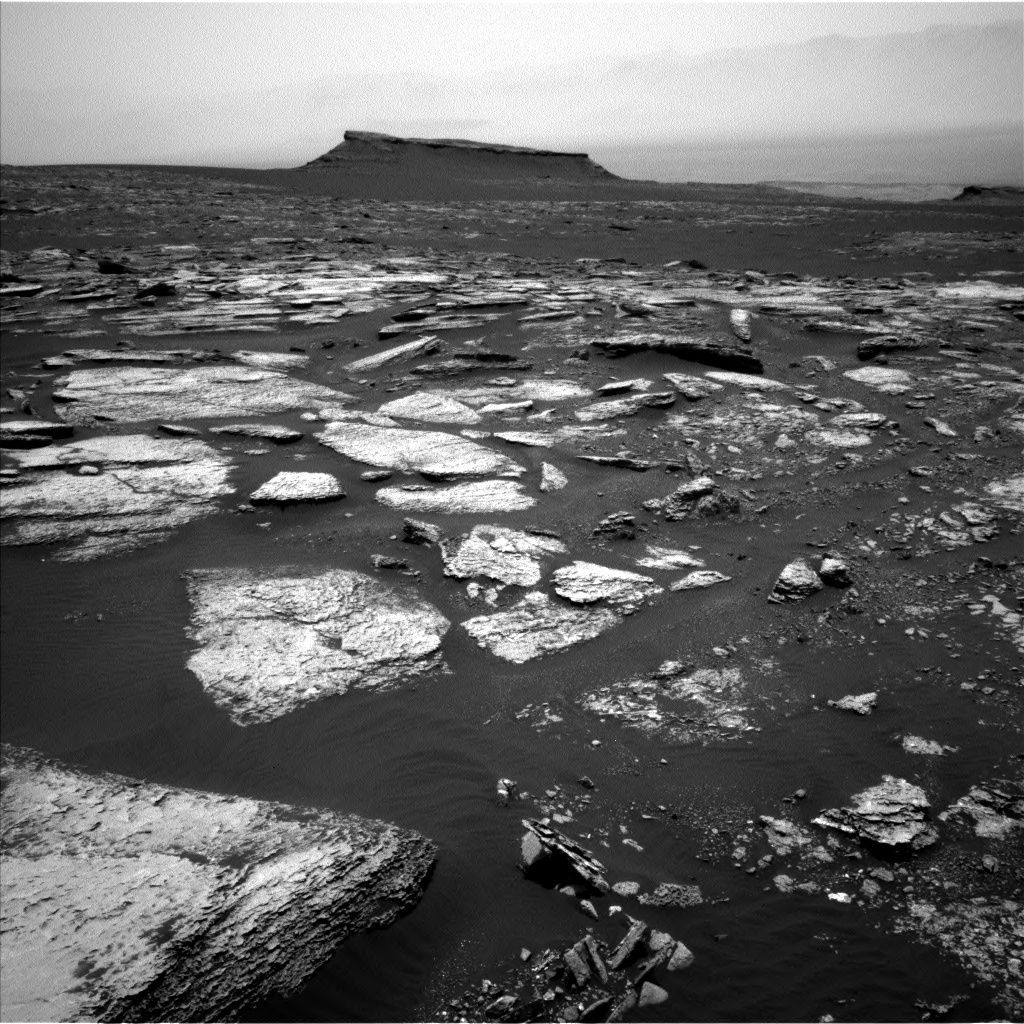
Curiosity Navcam Left B image taken on Sol 1672, April 20, 2017.
Credit: NASA/JPL-Caltech
Catching the team’s eye
A drive of 75 feet (23 meters) on Sol 1673 put Curiosity alongside Murray bedrock blocks “that appeared to be capped with a different material, with a darker color and smoother texture relative to the Murray,” Minitti notes.
The two materials, separated by what looked like bright-toned, sulfate vein material, caught the team’s eye, leading them to plan multiple observations of these materials.
The “Sorrento Harbor” target aimed to capture the transition from the Murray bedrock to the vein material, and the “Bean Point” target investigated a gray patch among the vein material.
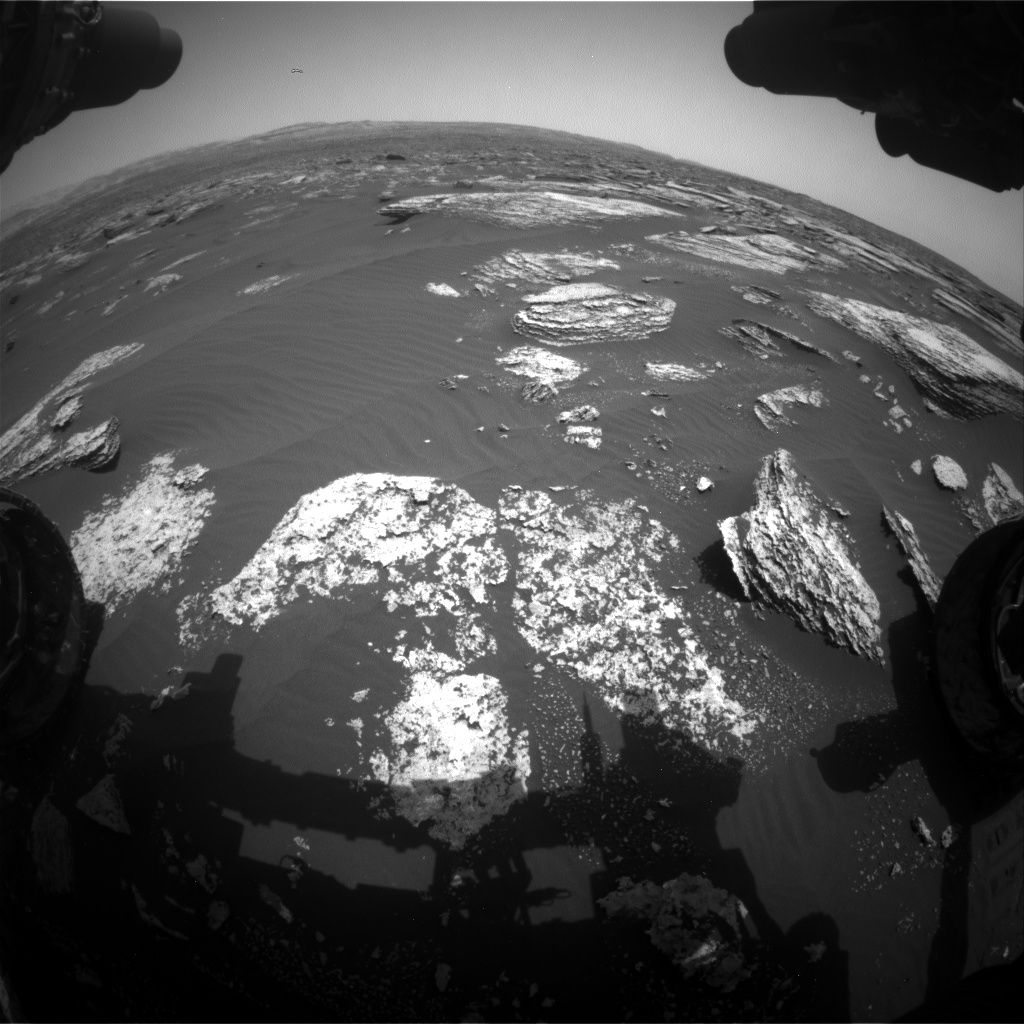
Curiosity Front Hazcam Right B image taken on Sol 1672, April 20, 2017.
Credit: NASA/JPL-Caltech
“This gray patch resembled similar gray patches targeted over the last several weeks given their unique textures and chemistries,” Minitti adds.
Dip investigating
A second target, “Cape Levi,” is another patch of this material in front of the rover. The “Chimney Peak” target, a raster across multiple layers of Murray bedrock, rounded out targeted Chemistry & Camera (ChemCam) activities.
“We imaged all the ChemCam targets, acquired a mosaic covering the contact between the darker, smoother capping material, the sulfate vein material, and the underlying Murray, and a stereo mosaic of the “Moxie Mountain” outcrop to investigate the dip of the Murray formation at this spot,” Minitti explains.
The skies of Gale crater were scanned by the robot, a variety of images and movies to look for clouds and variations in atmospheric properties.
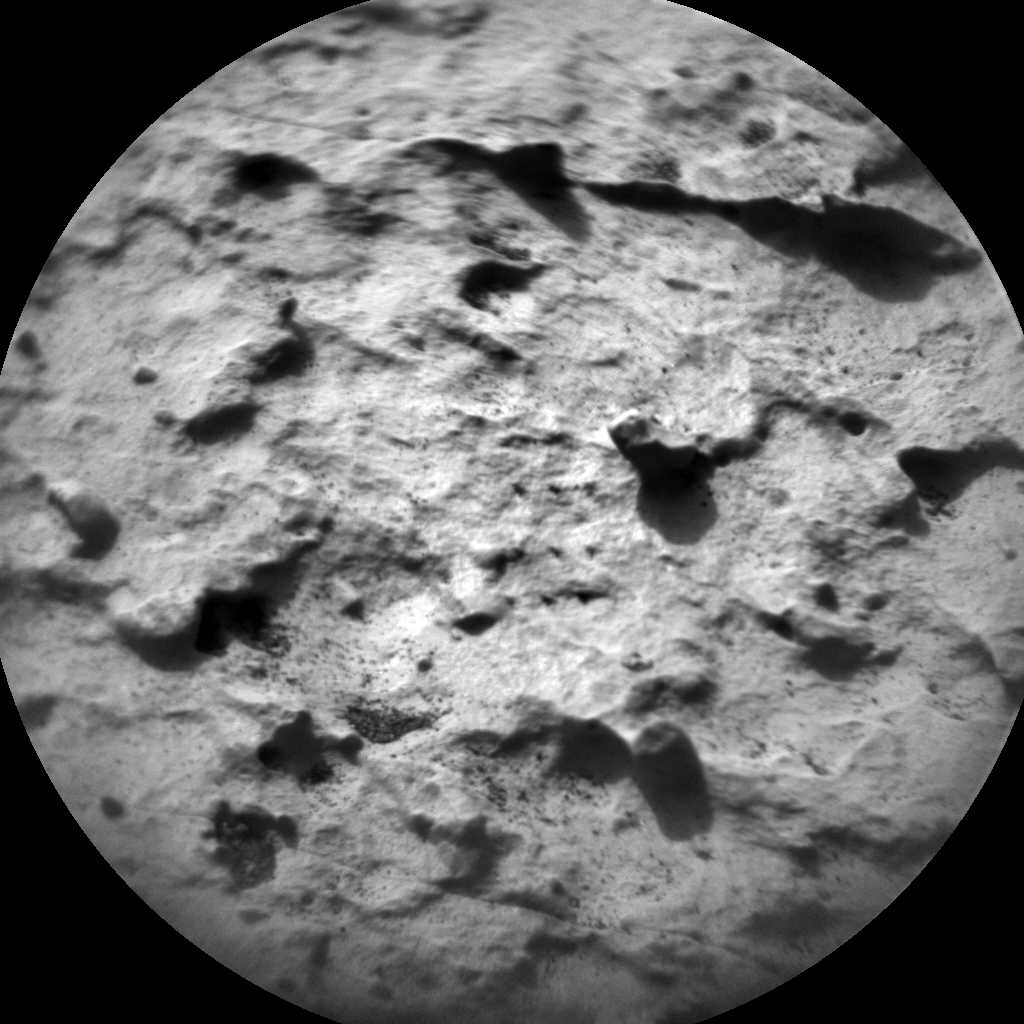
Curiosity ChemCam Remote Micro-Imager photo acquired on Sol 1672, April 20, 2017.
Credit: NASA/JPL-Caltech/LANL
Weekend drive paths
“Given the sand-covered terrain a few meters ahead of the rover, the rover planners kept today’s drive fairly conservative,” Minitti adds, “to give us a better look at possible drive paths for the weekend.
The plan calls for Curiosity to drive up to a nice curb of bedrock for weekend targeted and contact science.
“The arm unstow after our drive will give our post-drive images with Navcam and Mastcam an unobstructed view of our weekend work (play?) space,” Minitti concludes.

Credit: Michael Carroll via Chris McKay
A new plan for the “terraformation” of Mars has been scripted by a research team – a blueprint for the red planet to terraform a site on Mars in 2036.
Called the Lake Matthew Team their Mars Terraformer Transfer (MATT) concept is designed to accelerate Mars exploration, settlement and commercial development.

Mars Terraformer Transfer (MATT) plan makes use of the Shepherd to steer an impactor into Mars.
Credit: Optonicus Corporation
City-region development
“Terraformation need not engineer an entire planetary surface. A city-region is adequate for inhabitation. MATT hits this mark,” explains the group’s website.
Key to the plan are a Shepherd satellite and a small body shepherded for use as an impactor. That impacting body injects heat into Martian bedrock, producing melt water for a lake that persists for thousands of years within the warmed impact zone.
On Mars, the “Omaha Crater” bedrock will remain warm to the touch for thousands of years.

Omaha Crater layout.
Credit: Lake Matthew Team
MATT habs
“Whereas prior designs of habitation structures (habs) were limited to thousands of cubic meters, MATT habs can scale to millions of cubic meters – stadium scale, or greater,” the website notes. Furthermore, the impact site’s treated lake water is sufficient to cover and protect subaqueous domes.

The Omaha Crater site has abundant ground ice to fill and refill the crater’s Lake Matthew.
Credit: Lake Matthew Team
“With scaling, the first Mars habs transition quickly into settlements, with capacity for self-sufficiency, even provisioning of expeditions worldwide. This cuts the Earth-shipped cargo mass, and the expense, of crewed missions,” the website explains.
Museum display
“The MATT Shepherd’s long mission ends with a small adjustment of the satellite’s orbit, placing it into a Mars-resonant orbit that is a bit like an Aldrin cycler orbit,” team members told Inside Outer Space.”
“This positions the Shepherd for retrieval by the colonists at a later date, notionally for museum display on Mars.”
For more information on the group and its Mars Terraformer Transfer (MATT) idea, go to:

