Archive for the ‘Space News’ Category
 Author:
  May 17th, 2017
Credit: NASA
On the Launchpad: Return to Deep Space was staged by The Atlantic on Tuesday, May 16th.
The Atlantic event surveyed a shifting landscape of new technologies, exploring the cosmos by gathering experts on the growing space industry and the future of space and extraterrestrial travel. This informative event was underwritten by Hewlett-Packard.
Where will the next space race take us, what are the challenges facing the mission and what do we need to know, build and create to get there?
Video postings
The Atlantic has posted a set of video presentations, showcasing the event speakers that included:
— Senator Ted Cruz, (R-TX); Chairman, US Senate Subcommittee on Space, Science and Competitiveness
— Robert Lightfoot, Acting Administrator, NASA
— Mary Lynne Dittmar, Executive Director, Coalition for Deep Space Exploration
— Michael Lopez-Alegria, Principal, MLA Space LLC; Former Astronaut, NASA
— Chris Carberry, CEO and Co-Founder, Explore Mars, Inc.
— Robert Zubrin, Founder, Mars Society
Launchpad segments
Welcome to On the Launchpad: Return to Deep Space by AtlanticLIVE
2:29
The Future for NASA / On the Launchpad
by AtlanticLIVE
26:11
Making the Checklist / On the Launchpad
by AtlanticLIVE
20:17
Making the Mission to Mars Compute: Underwriter Perspective
by AtlanticLIVE
13:17
The Tools for the Task / On the Launchpad
by AtlanticLIVE
29:48
The View From The Hill: Senator Ted Cruz / On The Launchpad
by AtlanticLIVE
26:53
Preparing the Body and Mind / On the Launchpad
by AtlanticLIVE
To view these seven videos, go to:
https://www.youtube.com/watch?v=S7-9TRhjHyw&list=PLwj46yNDLyTU0_Mk58F72t0urwIjgrsw-
 Posted in

Credit: Rocket Lab
Rocket Lab is about to open a 10-day launch attempt window from May 22, 2017 for the maiden launch of the firm’s Electron rocket.
The launch, titled ‘It’s a Test’, will take place from Rocket Lab’s private orbital launch site, Launch Complex 1, on the Māhia Peninsula, New Zealand.
Learn and iterate
According to the group’s leader and chief rocketeer, Peter Beck, ‘It’s a Test’ is all about gathering data. “There are over 20,000 channels collected during the flight. We will use this information to learn and iterate,” he explains on the group’s website.
“As with any new rocket, there are a lot of factors that come together ahead of a test and we’re not going to fly unless we’re ready,” Beck adds. “It’s highly possible we will scrub multiple attempts as we fine tune and wait for favorable weather conditions.”

Rocket Lab’s private orbital launch site, Launch Complex 1, on the Māhia Peninsula, New Zealand.
Courtesy Spaceflight
Spaceflight purchase
Meanwhile, Spaceflight, announced today the purchase of a Rocket Lab Electron rocket to expand dedicated rideshare capacity. This is the second rocket purchase for Spaceflight, following the purchase of a SpaceX Falcon 9 rocket and the expansion of its launch services to include dedicated rideshare missions.
“There are numerous rideshare launches each year to Sun Synchronous Orbit, but getting to 45 to 60 degrees is hard to find, and can cost the equivalent of buying an entire rocket,” explains Curt Blake, President of Spaceflight’s launch business. “We are thrilled to be working with Rocket Lab to enable our customers’ remote sensing missions that require high revisit time over North America, Europe, and the Middle East,” Blake adds in a company press statement.
Resources
Tune into Rocket Lab’s website at:
For more information on Spaceflight, go to:

Credit: GAO
A just-released Government Accountability Office (GAO) report dives into the cost and schedule performance of NASA’s portfolio of major projects.
The overall finding is that NASA’s cost and schedule performance continued to improve, “but this trend may be difficult to sustain,” the GAO reports.
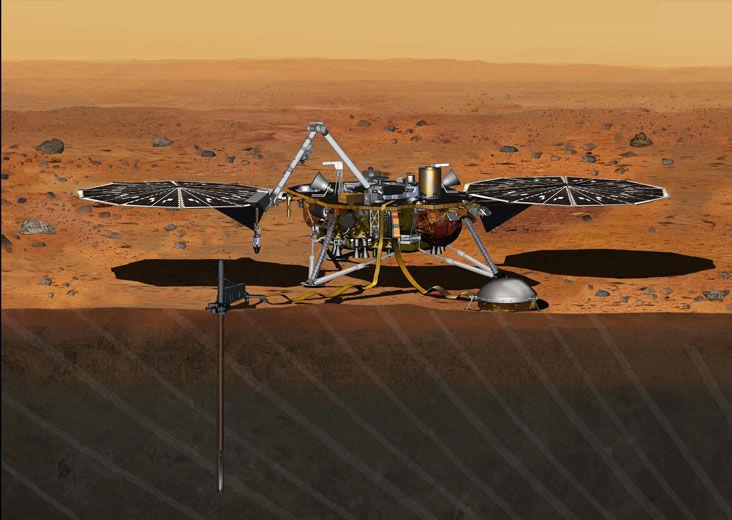
InSight Mars lander.
Credit: NASA/JPL
Current trend
According to the GAO, the current trend is driven by two main factors: (1) most projects are being executed within their cost and schedule baselines; and (2) new projects, which are less likely to have experienced cost and schedule growth, were added to the portfolio.
However, two projects—a Mars seismology instrument and lander and an upgrade to the NASA’s space communications network—experienced significant cost or schedule growth in 2016.
A third of the NASA projects that GAO appraised — including two of the most expensive ones (the Orion crew vehicle and Space Launch System) – “are at a stage when problems are most likely to occur.”

NASA’s Space Launch System.
Credit: NASA
Snapshot looks
The GAO report provides an annual snapshot for 2017 of how well NASA is planning and executing its major acquisition projects.
In March 2016, GAO found that projects continued a general positive trend of limiting cost and schedule growth, maturing technologies, and stabilizing designs, “but that NASA faced several challenges that could affect its ability to effectively manage its portfolio,” the GAO reported.
To read the full GAO report, and listen to a podcast regarding NASA: Assessments of Major Projects GAO-17-303SP (Published: May 16, 2017) – go to:

Curiosity Navcam Right B image acquired on Sol 1696, May 14, 2017.
Credit: NASA/JPL-Caltech
NASA’s Mars Curiosity rover is busy at work carrying out Sol 1697 duties.
Reports Michelle Minitti, a planetary geologist at Framework in Silver Spring, Maryland, Curiosity is continuing its detailed investigation of a suite of outcrops within the vicinity of the robot.

Curiosity Navcam Right B image acquired on Sol 1696, May 14, 2017.
Credit: NASA/JPL-Caltech
Varied outcrop structures
“As we climb up Mount Sharp, recently over slopes of 4-6 degrees, we have seen more varied outcrop structures and chemistries than the rest of the Murray formation, and such changes catch the collective eye of the team,” Minitti notes.
One target in the robot’s workspace in particular is “Mason Point” receiving the “royal treatment” Minitti adds, with five separate science observations directed at this feature.
“The reason it will receive such attention is that it will be brushed by the Dust Removal Tool (DRT), removing the thin veneer of obscuring dust that has settled on the rock surface,” Minitti points out.

Curiosity Front Hazcam Left B image acquired on Sol 1696, May 14, 2017.
Credit: NASA/JPL-Caltech
Texture and grain size
From the brushed Mason Point target, Curiosity will take Mars Hand Lens Imager (MAHLI) photos to study the target’s texture and grain size, the Chemistry and Camera (ChemCam) and Mastcam spectra of the light reflected off the surface to constrain mineralogy, and an Alpha Particle X-Ray Spectrometer (APXS) analysis to get chemistry.
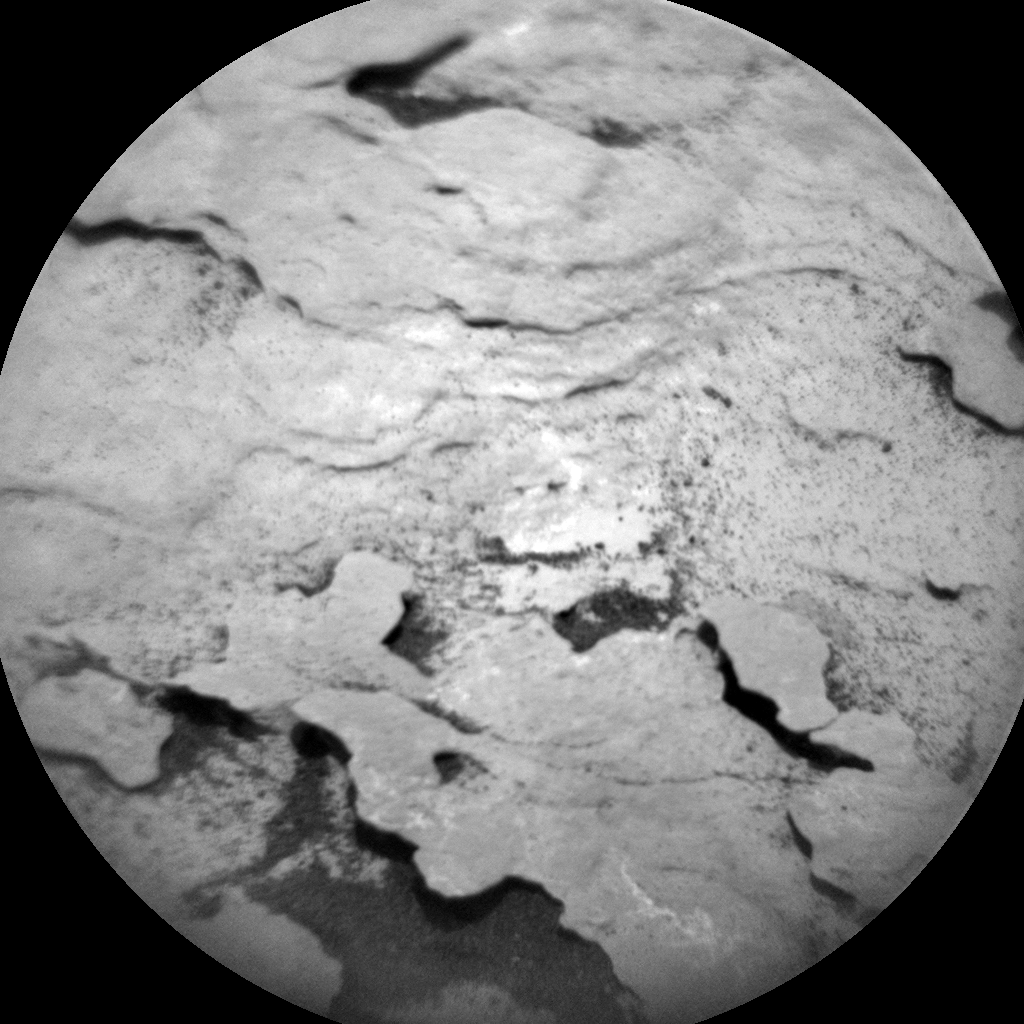
Curiosity ChemCam Remote Micro-Imager photo acquired on Sol 1697, May 15, 2017.
Credit: NASA/JPL-Caltech/LANL
“We will also analyze the chemistry of Mason Point with a ChemCam raster, but before it is brushed. Why? ChemCam’s laser not only probes chemistry, it clears dust! The comprehensive and complementary datasets obtained from Mason Point will further our understanding of this target better than any single analysis would alone,” Minitti explains.
Prominent layering
Mason Point will get the most focused attention, but the analysis of many other targets will help the science team probe the overall variety of the rocks in this area.
MAHLI, APXS and ChemCam are slated to study “Mitchell Hill,” a bedrock target exhibiting prominent layering.
ChemCam will also shoot “Mount Gilboa” to gather not only chemistry but grain size data for this target. Mastcam mosaics centered on Mitchell Hill and “Manchester Point” will capture orientations of layers in these targets that might help reveal how the layers formed.
MAHLI monitoring
“In a change of pace from looking at rocks, Curiosity invested time in the plan acquiring images with MAHLI that monitor the health and performance of the instrument,” Minitti adds. “MAHLI imaged her calibration target, which contains well known color and geometric targets that offer a test of instrument performance.”
Minitti reports that MAHLI also imaged the APXS calibration target, a slab of finely polished basalt that serves as a chemistry standard for APXS.

Curiosity Mastcam Right image taken on Sol 1695, May 13, 2017.
Credit: NASA/JPL-Caltech/MSSS
Sky flats
“MAHLI then turned her eye to the sky, purposely acquiring images of featureless parts of the sky,” Minitti explains. “These images, called sky flats, help reveal the presence of dust on the MAHLI lens. Just like dentist appointments, calibration ‘checkups’ occur about every six months. Happily, MAHLI checkups are pain free.”
The plan calls for Curiosity’s drive over 164 feet (50 meters) along the rover’s strategic drive path, as Mastcam and Navcam obtain a number of images and movies used to measure the amount of dust in the atmosphere, scan the atmosphere for dust devils, and search the sky overhead and near the horizon for clouds.
These environmental observations will be complemented by Dynamic Albedo of Neutrons (DAN) passive and active measurements that seek subsurface hydrogen; Radiation Assessment Detector (RAD) measurements that monitor the radiation environment at the surface; and Rover Environmental Monitoring Station (REMS) measurements used to produce regular Martian weather reports.
New map
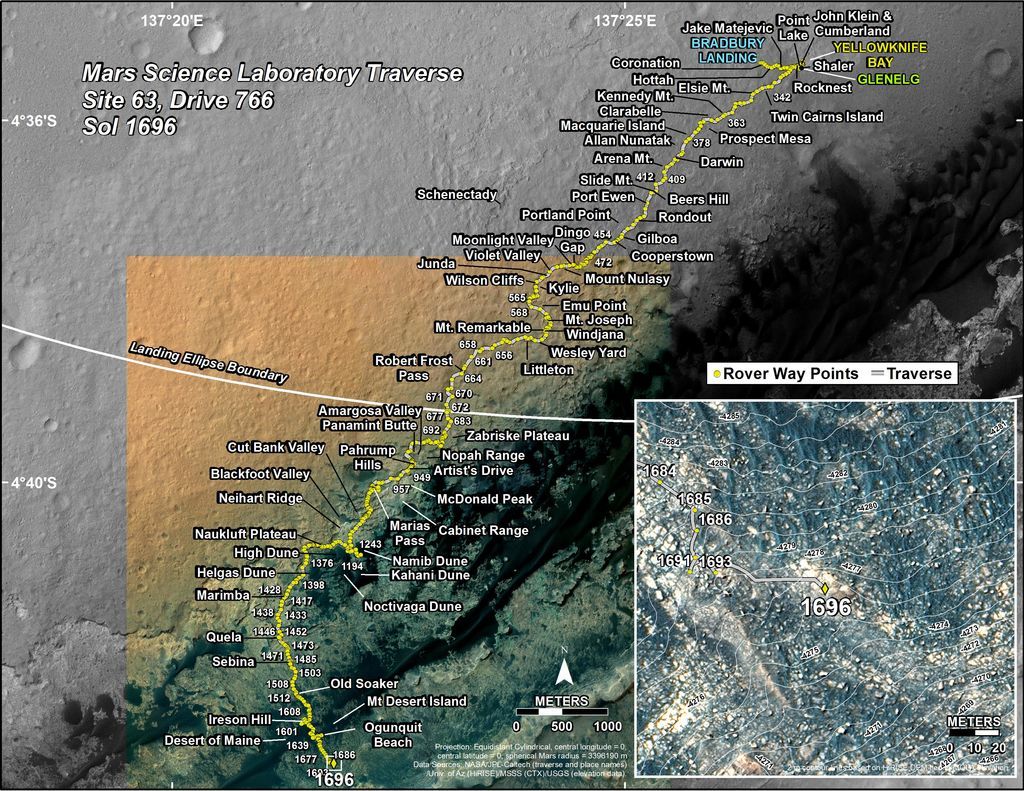
A Curiosity traverse map through Sol 1696 has been issued.
CREDIT: NASA/JPL-CALTECH/UNIV. OF ARIZONA
This map shows the route driven by NASA’s Mars rover Curiosity through the 1696 Martian day, or sol, of the rover’s mission on Mars (May 14, 2017).
Numbering of the dots along the line indicate the sol number of each drive. North is up. The scale bar is 1 kilometer (~0.62 mile).
From Sol 1693 to Sol 1696, Curiosity had driven a straight line distance of about 148.52 feet (45.27 meters), bringing the rover’s total odometry for the mission to 10.19 miles (16.40 kilometers).
The base image from the map is from the High Resolution Imaging Science Experiment Camera (HiRISE) in NASA’s Mars Reconnaissance Orbiter.
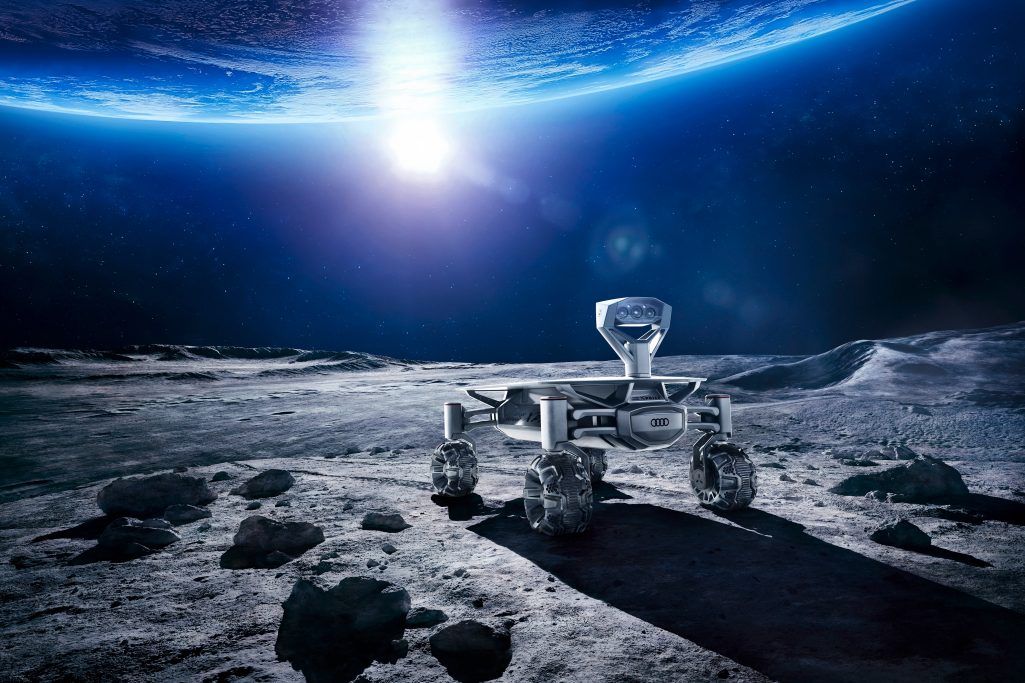
Credit: Part-Time Scientists/Audi
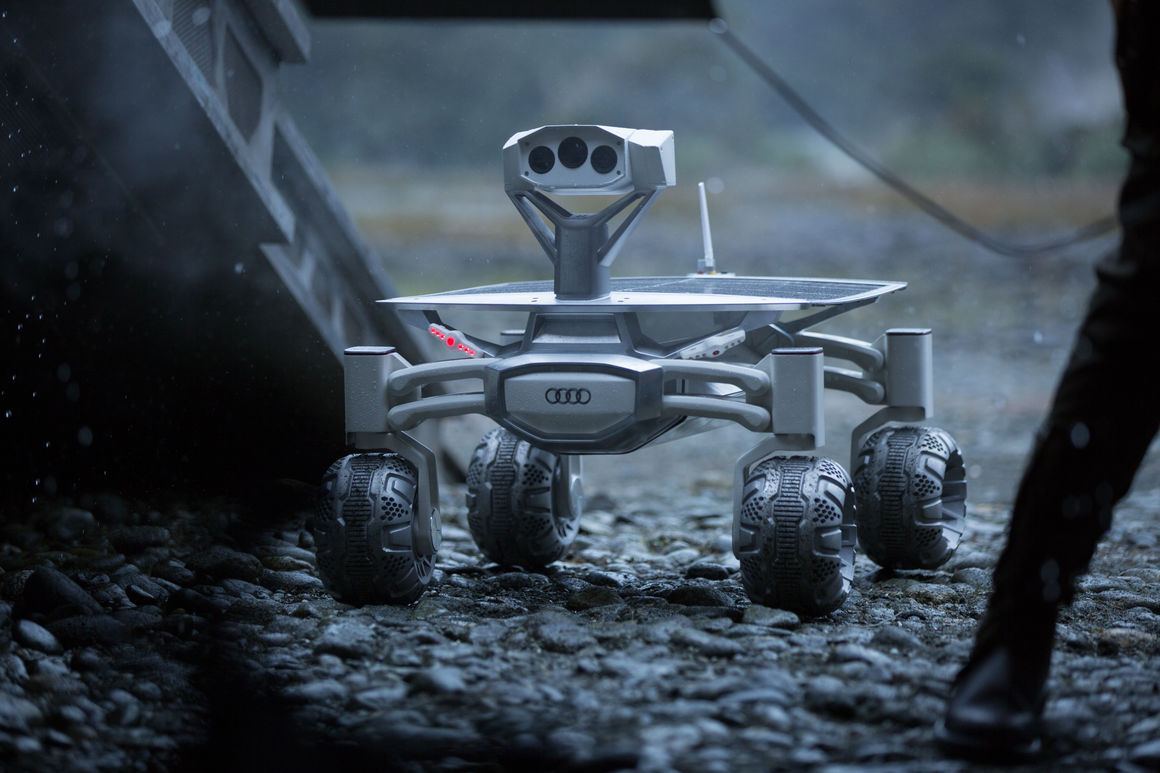
This month’s release of the sci-fi film “Alien: Covenant” has a robotic guest star, the Audi lunar quattro – a Moon rover developed in cooperation with a German start-up – “Part-Time Scientists.”
The Audi lunar quattro celebrates its film debut in Ridley Scott’s sci-fi blockbuster “Alien: Covenant” which premieres worldwide this month. Audi experts have developed the Audi lunar quattro in cooperation with the German start-up “Part-Time Scientists”. It will soon embark on an actual mission to space.
Alien: Covenant/Audi lunar quattro.
Credit: Audi/Twentieth Century Fox Film Corporation
Dark and dangerous
The movie’s director Ridley Scott has integrated the Audi lunar quattro into the film that has a crew of the colony ship Covenant, bound for a remote planet on the far side of the galaxy, discovery what they think is an uncharted paradise. The plot thickens and turns dark and dangerous.
The Audi lunar quattro is an integral part of the Covenant mission and is deployed to navigate and assess the challenging, strange landscape of a new planet.
Credit: Audi
All-wheel drive
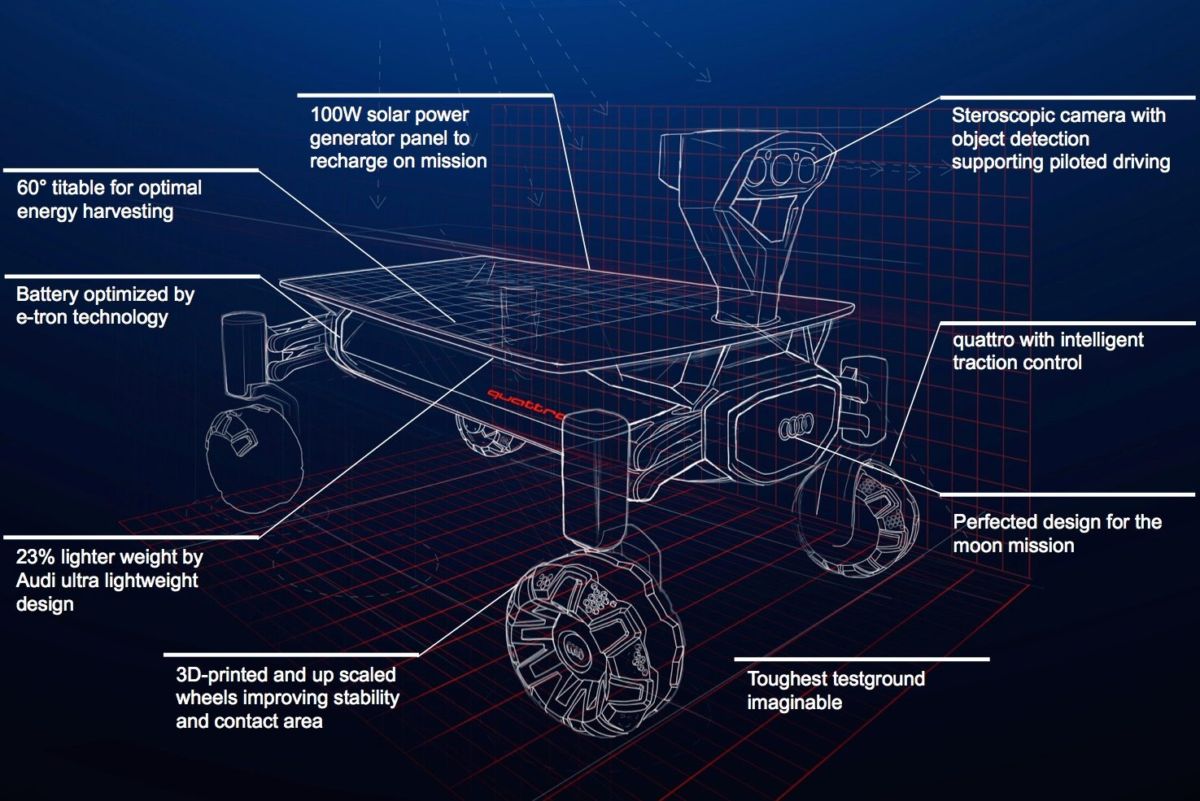
The Audi lunar quattro is preparing for an actual mission to the Moon.
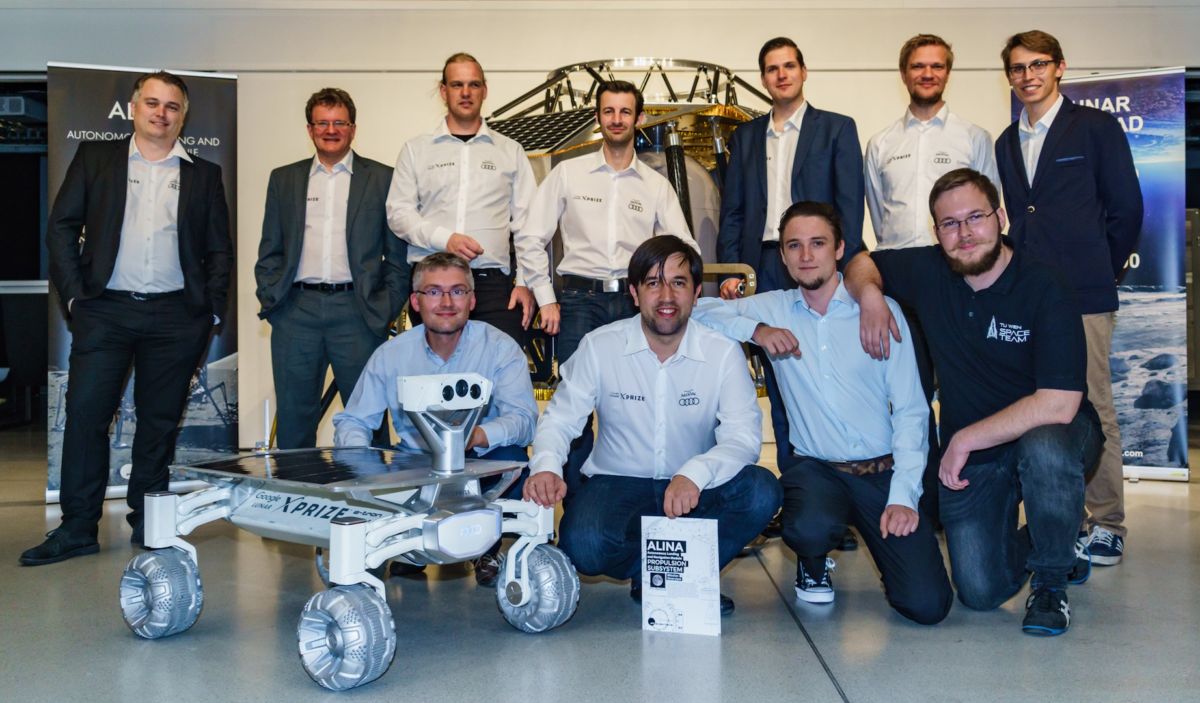
A team led by Robert Böhme, founder and CEO of “Part-Time Scientists” has been busily developing the lunar rover.
Audi experts have supported the Berlin-based start-up, in particular with Audi’s all-wheel drive expertise (quattro technology), know-how in lightweight construction, experience in developing vehicles with electric and plug-in hybrid motors (e-tron), and with design optimization.

Artistic look at ALINA soft-lander on the Moon.
Credit: Part-Time Scientists
Moon-bound mobility
The result is that the Audi lunar quattro is 85 percent aluminum, produced by the 3D metal printer at Audi’s headquarters in Ingolstadt. A pivoting solar panel supplies the rover with energy. According to the car manufacturer look for an advanced Audi lunar quattro setting its course for the Moon in the near future.
Taking part in the Google Lunar XPRIZE, the Part-Time Scientists have the goal to soft land two lunar rovers in travel distance to the Apollo 17 landing site using ALINA, a fully autonomous soft landing vehicle. The team consists of around 70 members contributing across 3 continents with a fixed staff of 35 based in Germany.
Credit: Part-Time Scientists
Resources
NOTE: There is a treasure-trove of photos, videos regarding the movie appearance of the Audi lunar quattro and the ongoing work of Part-Time Scientists.
Go to these websites for more information:
http://mission-to-the-moon.com/
http://www.audi.com/en/innovation/mttm/alien-covenant.html
Lastly, check out this link:
Mission to the Moon: from the human project to the humanity project
Best-selling author Frank Schätzing offers insight into 4 billion years of human history and demonstrates the evolutionary necessity of space travel. Now the time has come to head for new horizons – driven by cutting-edge technology and our ancient genetic heritage: the human pioneering spirit.
http://www.audi.com/en/innovation/mttm/frank-schaetzing.html

Credit: NASA/Langley
On the Launchpad: Return to Deep Space is being staged by The Atlantic on Tuesday, May 16th.
The Atlantic will survey a shifting landscape of new technologies, exploring the cosmos by gathering experts on the growing space industry and the future of space and extraterrestrial travel.
Where will the next space race take us, what are the challenges facing the mission and what do we need to know, build and create to get there?
Among the event speakers:
- Senator Ted Cruz, (R-TX); Chairman, US Senate Subcommittee on Space, Science and Competitiveness
- Robert Lightfoot, Acting Administrator, NASA
- Mary Lynne Dittmar, Executive Director, Coalition for Deep Space Exploration
- Michael Lopez-Alegria, Principal, MLA Space LLC; Former Astronaut, NASA
- Chris Carberry, CEO and Co-Founder, Explore Mars, Inc.
- Robert Zubrin, Founder, Mars Society
This event that will be aired live (also archived) and runs from 1:00-5:00 pm ET on Tuesday, May 16 and is being held at the Newseum/Knight Conference Center in Washington, D.C.
For more information, go to:
https://www.theatlantic.com/live/events/on-the-launchpad/2017/

Mars – what is our future on the Red Planet.?
Credit: ESA/D. O’Donnell – CC BY-SA IGO
At the recent Humans to Mars Summit in Washington, D.C. I was pleased to serve as moderator of an evening panel program: Risky Business – Risk Tolerance and Space Exploration.
Joining me in the discussion:
— Penny Boston (NASA: Astrobiology Institute)
— John Grunsfeld (former Astronaut; former NASA Associate Administrator)
— Tiffany Montague (former Manager, Google Space Projects; Explore Mars Board Member)
— Richard “Rick” M. Davis (NASA, Science Mission Directorate, Assistant Director).
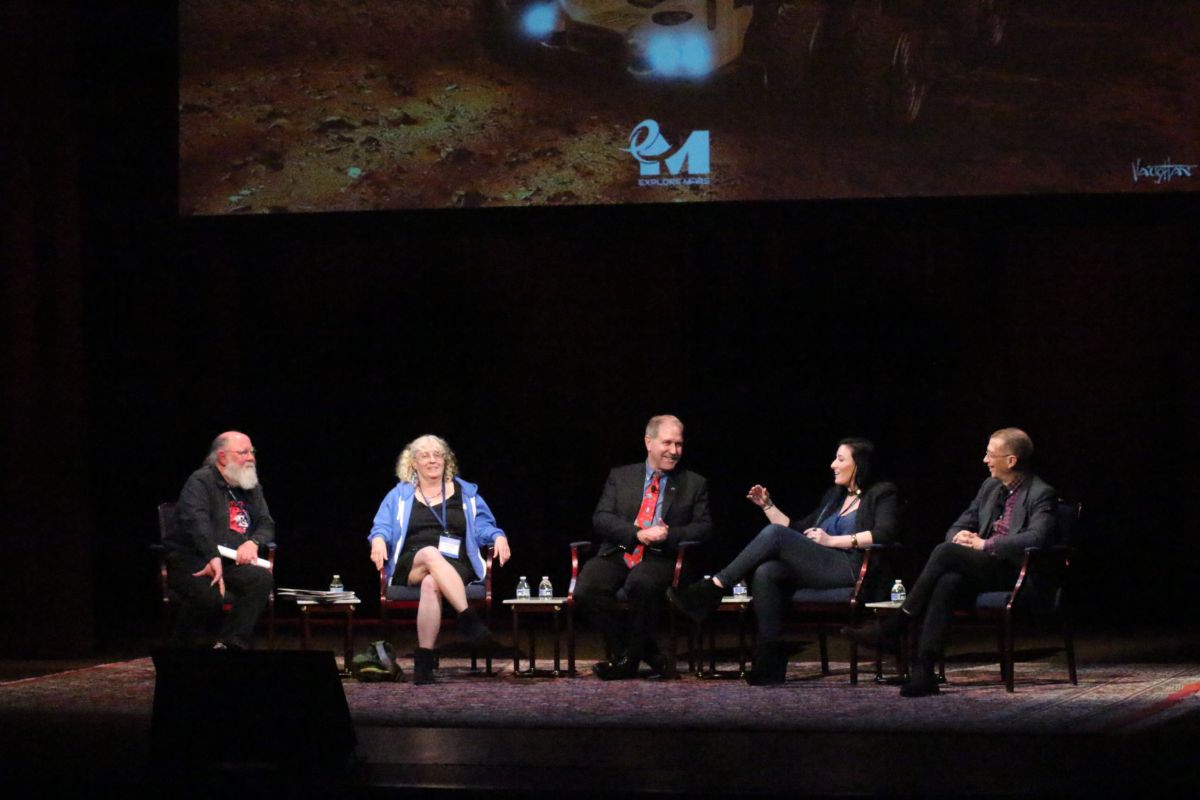
Humans to Mars panel session on risk and space exploration featuring, left to right: Leonard David (moderator); astrobiologist Penny Boston; former astronaut John Grunsfeld; Tiffany Montague (former Manager, Google Space Projects; and Richard “Rick” Davis (NASA, Science Mission Directorate, Assistant Director).
Credit: Barbara David
Trashing Earth?
BTW: I kicked off that panel with moderator’s prerogative by showing a short clip:
New Rule: Make Earth Great Again on Real Time with Bill Maher (HBO) – Stop Trashing Earth Because We’ve Got Mars as ‘Back-Up’ (Video).
Aired on April 21, 2017, in honor of Earth Day, Maher called on his fellow humans to save this planet instead of trying to colonize Mars. I felt it important to show the video clip as an example of a particular attitude regarding Mars – a public risk that should be heard by those advocating humans to Mars.
For viewing that Maher video, go to:
https://www.youtube.com/watch?v=mrGFEW2Hb2g
Resources
For an overview of the Humans to Mars panel discussion, go to Elizabeth Howell’s Space.com story at:
Risky Business: At Mars Conference, Experts Discuss Threats to Space Travelers
http://www.space.com/36798-humans-to-mars-experts-discuss-risks.html

Credit: U.S. Air Force
The threat of space warfare was spotlighted in recent testimony by Daniel Coats, Director of National Intelligence in a May 11 hearing of the U.S. Senate Select Committee on Intelligence.
Coats reviewed the worldwide threat assessment of the U.S. intelligence community, noting an appraisal that “Russia and China perceive a need to offset any U.S. military advantage derived from military, civil, or commercial space systems and are increasingly considering attacks against satellite systems as part of their future warfare doctrine.”

Destructive systems
Coats reported that both countries “will continue to pursue a full range of antisatellite (ASAT) weapons as a means to reduce U.S. military effectiveness.”
Some new Russian and Chinese ASAT weapons, including destructive systems, Coats added “will probably complete development in the next several years. Russian military strategists likely view counterspace weapons as an integral part of broader aerospace defense rearmament and are very likely pursuing a diverse suite of capabilities to affect satellites in all orbital regimes.”
Directed energy weapons
China and Russia are also advancing directed energy weapons technologies for the purpose of fielding ASAT systems “that could blind or damage sensitive space-based optical sensors,” Coats pointed out. “Russia is developing an airborne laser weapon for use against U.S. satellites. Russia and China continue to conduct sophisticated on-orbit satellite activities, such as rendezvous and proximity operations, at least some of which are likely intended to test dual-use technologies with inherent counterspace functionality.”
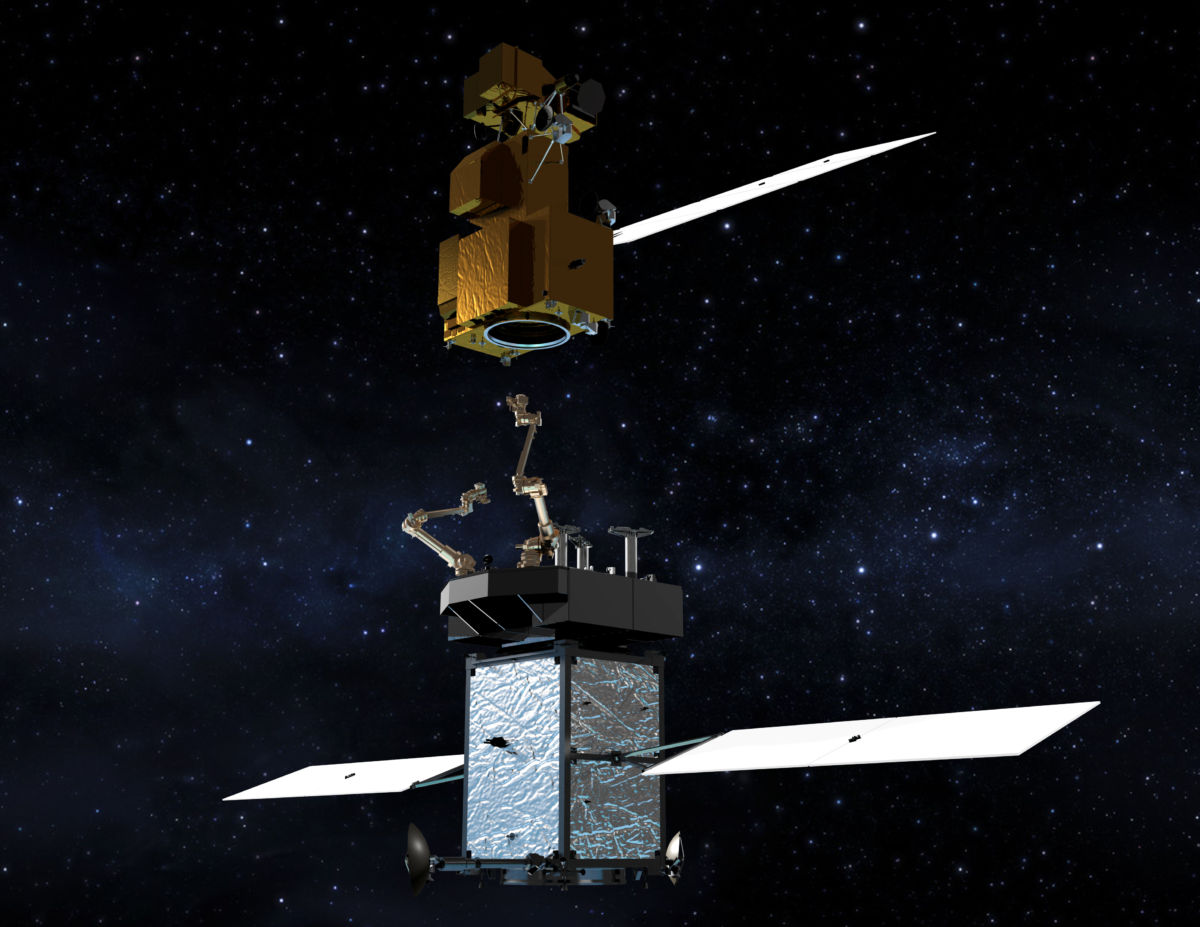
Satellite servicing is being explored by multiple nations, including the United States. Shown here in this artist’s rendering is the NASA Restore-L servicer as it extends its robotic arm to grasp and refuel a client satellite on orbit.
Credit: NASA
Space robotics
Coats testified that space robotic technology research for satellite servicing and debris-removal might be used to damage satellites.
“Such missions will pose a particular challenge in the future, complicating the U.S. ability to characterize the space environment, decipher intent of space activity, and provide advance threat warning,” Coats said in written testimony.
Electronic warfare
Additionally, the global threat of electronic warfare (EW) attacks against space systems will expand in the coming years in both number and types of weapons, Coats noted.
“Development will very likely focus on jamming capabilities against dedicated military satellite communications (SATCOM), Synthetic Aperture Radar (SAR) imaging satellites, and enhanced capabilities against Global Navigation Satellite Systems (GNSS), such as the US Global Positioning System (GPS),” Coats explained.
To read the Coats testimony — Worldwide Threat Assessment of the US Intelligence Community – can be viewed here:
https://www.dni.gov/files/documents/Newsroom/Testimonies/SSCI%20Unclassified%20SFR%20-%20Final.pdf

Collage of proposed DARPA XS-1 craft.
Credit: DARPA
The Defense Advanced Research Projects Agency (DARPA) may soon award a contract for the XS-1 spaceplane.
According to Air Force Magazine, DARPA has entered the final stages of a “downselect” to choose one company to proceed into the flying phase of the spaceplane.
Three companies
In Phase 1 of XS-1, DARPA awarded prime contracts to three companies, each working in concert with a commercial launch provider: The Boeing Company (working with Blue Origin, LLC); Masten Space Systems (working with XCOR Aerospace); and Northrop Grumman Corporation (working with Virgin Galactic).
However, according to the Air Force Magazine posting, the Phase II contractor won’t necessarily be chosen from the three Phase I participants.
Aircraft-like frequency
“After downselect, a critical design review would take place in 2018 and a series of flights could be made as early as 2020. One of the program requirements is to fly 10 suborbital or orbital missions in as many days, achieving space operations with ‘aircraft-like’ frequency, DARPA said. If successful, a ‘public-private partnership’ model of operating the vehicles could be adopted, DARPA documents show,” Air Force Magazine’s John Tirpak reports.

Early DARPA artwork of the XS-1.
Credit: DARPA
Technical goals
According to the DARPA website, XS-1 has four primary technical goals:
- Fly 10 times in a 10-day period (not including weather, range and emergency delays) to demonstrate aircraft-like access to space and eliminate concerns about the cost-effectiveness and reliability of reusable launch.
- Achieve flight velocity sufficiently high to enable use of a small (and therefore low-cost) expendable upper stage.
- Launch a 900- to 1,500-pound representative payload to demonstrate an immediate responsive launch capability able to support both DoD and commercial missions. The same XS-1 vehicle could eventually also launch future 3,000+- pound payloads by using a larger expendable upper stage.
- Reduce the cost of access to space for 3,000+-pound payloads, with a goal of approximately $5 million per flight for the operational system, which would include a reusable booster and expendable upper stage(s).
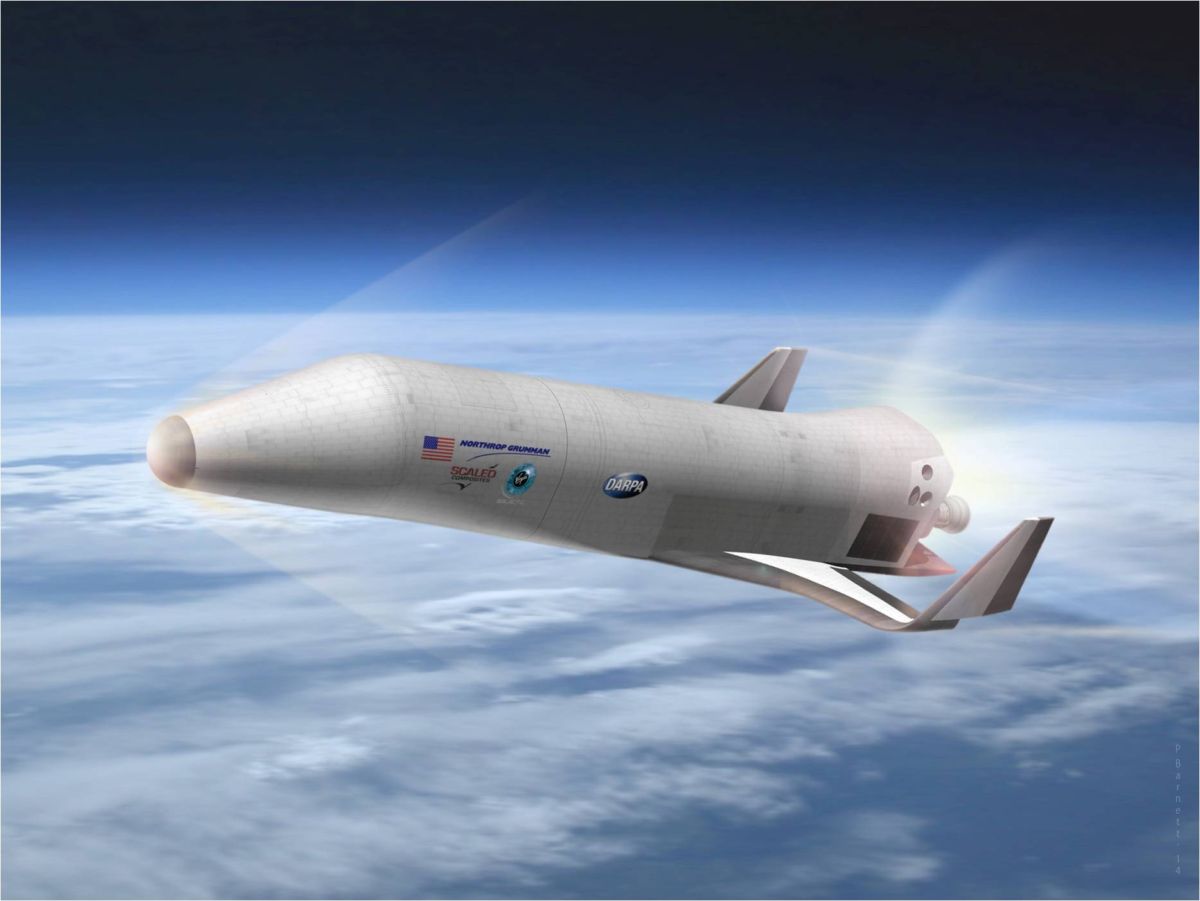
One of three firms vying for XS-1.
Credit: Northrop Grumman
Low-cost, recurring flight capability
“Structures made of advanced materials, cryogenic tanks, durable thermal protection, and modular subsystems would make possible a vehicle able to launch, fly to high speeds and then land in a condition amenable to rapid turnaround and launch with the next payload. Reusable, reliable propulsion would also be essential for a low-cost and recurring flight capability,” adds the DARPA website.

Credit: Fight for Space
Where is your space program?
In 1962, President John F. Kennedy proclaimed that NASA would send astronauts to the Moon by the end of the decade. The “space race” inspired an entire generation to pursue careers in science, technology and engineering, creating the technological boom of the 1990s.
As the balance of world power shifted, interest in space exploration declined and NASA became old news.
In-depth interviews
Fight for Space lands in theaters and on demand May 19, a striking presentation that features such stellar notables as: Neil deGrasse Tyson, Jim Lovell, Story Musgrave, Rick Tumlinson, James Muncy, Marcia S. Smith, Bill Nye, John Logsdon, Gene Kranz, and Jeff Greason.

Paul Hildebrandt is the Director, Writer, and Producer of Fight for Space.
Credit: Fight for Space
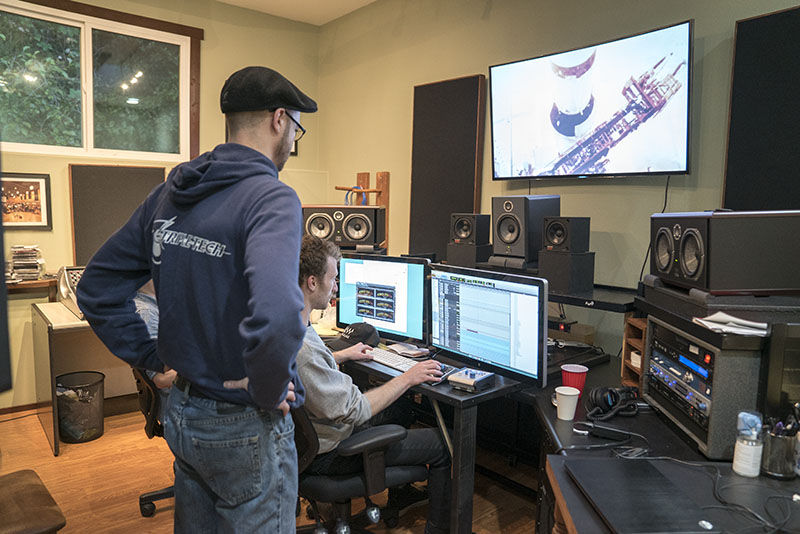
SkyMuse audio team.
Credit: Fight for Space
Fight for Space examines the past, present and future of the U.S. space program through in-depth interviews with the world’s leading experts on space travel, including astronauts Jim Lovell & Story Musgrave, astrophysicist Neil DeGrasse Tyson, engineers, space industry entrepreneurs and others.
Resources
Restored film footage from the National Archives and years of historical research take you on an exciting journey from the beginning of NASA, into the future, re-awakening our sense of wonder, discovery and desire to reach for the stars.
Following ad, go to this trailer at:
For more information on this important documentary film, go to:

