Archive for the ‘Space News’ Category
 Author:
  June 1st, 2017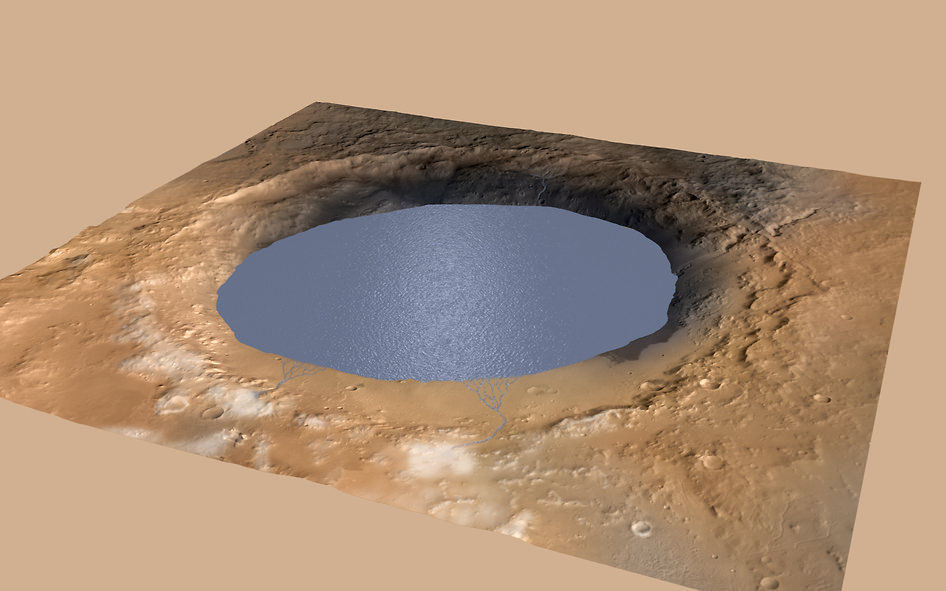
Simulated view of Gale Crater Lake on Mars depicts a lake of water partially filling Mars’ Gale Crater, receiving runoff from snow melting on the crater’s northern rim. Evidence of ancient streams, deltas and lakes that NASA’s Curiosity Mars rover mission has found in the patterns of sedimentary deposits in Gale Crater suggests the crater held a lake such as this more than three billion years ago, filling and drying in multiple cycles over tens of millions of years.
Credit: NASA/JPL-Caltech/ESA/DLR/FU Berlin/MSSS
Evidence is stacking up from NASA’s Curiosity rover on Mars that an ancient lake in Gale Crater would have provided multiple opportunities for different types of microbes to survive.
Early rover findings point to the presence of a lake more than three billion years old in the crater. New research suggests that the lake had chemical and physical properties very similar and common to lakes on Earth.
Chemical conditions
A new study has defined the chemical conditions that existed in the lake, research that utilized Curiosity’s research tools to determine that Gale Lake was stratified. Stratified bodies of water exhibit sharp chemical or physical differences between deep water and shallow water.
In Gale’s lake, shallow water was richer in oxidants than deeper water.
Chemical conditions that existed in the lake on Mars, a research team reports, could have supported microbial life, including those that thrive in oxidant-rich conditions, those that thrive in oxidant-poor conditions, and those that inhabit the interface between both conditions.

Joel Hurowitz science team member on the Mars Science Laboratory (MSL) Curiosity rover.
Credit: Stony Brook University
Co-existing environments
“These were different, co-existing environments in the same lake,” said geoscientist Joel Hurowitz, an Assistant Professor in the Department of Geosciences at Stony Brook University. He is lead author of a paper titled Redox stratification of an ancient lake in Gale crater, Mars, set to be published in the June 2 edition of the journal Science.
“This type of oxidant stratification is a common feature of lakes on Earth, and now we have found it on Mars,” Hurowitz added in a university press statement.
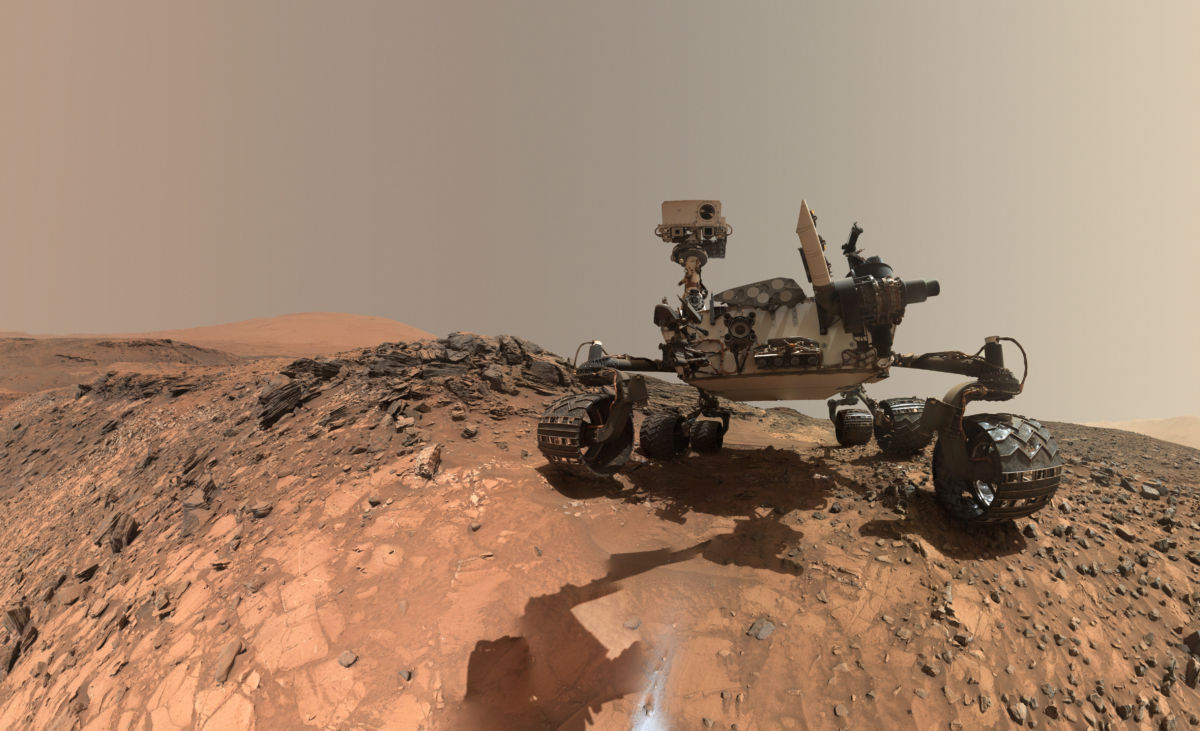
Curiosity Mars rover: On the prowl for science since August 2012.
Credit: NASA/JPL
Quiet waters
The international team of 22 scientists (co-authors of the paper) also document fluctuations in the climate of ancient Mars.
The method the team used for detecting changes in ancient climate conditions on Mars resembles how ice cores are used to study past temperatures on Earth. It is based on comparing differences in the chemical composition of layers of mud-rich sedimentary rock that were deposited in quiet waters of the lake.
 Posted in

Self-imposed selfie of NASA’s Curiosity Mars rover.
Credit: NASA/JPL-Caltech/MSSS
Mars has been found to have had liquid water much longer than previously believed. This new finding further expands the window for when life might have existed on Mars. However, whether this groundwater could have sustained life remains to be seen.
The new finding is reported in a paper published today in Geophysical Research Letters, a journal of the American Geophysical Union.
Halos
This research focuses on lighter-toned bedrock that surrounds fractures and comprises high concentrations of silica — called “halos” — that have been found in Gale crater on Mars.
The true detective is the NASA Curiosity rover. Mosaics of images from the navigation cameras on the wheeled robot show these halos that comprise high concentrations of silica. That indicates liquid groundwater flowed through the rocks in Gale crater longer than previously believed, explains Jens Frydenvang, a scientist at Los Alamos National Laboratory and the University of Copenhagen and lead author of the paper.

Marias Pass observations: Mars Hand Lens Imager mosaic acquired on sol 1065. View is toward the southeast, and the summit of Aeolis Mons (Mount Sharp) is observed in the background. Colored dots represent the locations of ChemCam Murray formation observations; colors indicate the mean bedrock silica content. The dark-toned bedrock and loose cobbles at the upper right are Stimson formation rocks.
Credit: Frydenvang, J., et al. (2017)
Groundwater
“The goal of NASA’s Curiosity rover mission has been to find out if Mars was ever habitable, and it has been very successful in showing that Gale crater once held a lake with water that we would even have been able to drink,” Frydenvang states in a Los Alamos National Laboratory press statement.
Frydenvang adds: “But we still don’t know how long this habitable environment endured. What this finding tells us is that, even when the lake eventually evaporated, substantial amounts of groundwater were present for much longer than we previously thought…thus further expanding the window for when life might have existed on Mars.”
This new study buttresses recent findings by another Los Alamos scientist who found boron on Mars for the first time. Boron also indicates the potential for long-term habitable groundwater in the planet’s past.
Resources
For the research letter, “Diagenetic silica enrichment and late-stage groundwater activity in Gale crater, Mars,” go to:
http://onlinelibrary.wiley.com/doi/10.1002/2017GL073323/full
Also, go to this new video at:
https://www.youtube.com/watch?v=CwN-tN9H_d8&feature=youtu.be

Credit: Christaan van Heijst
An eye-catching reentry of a Chinese rocket body was viewed by aircraft pilots winging their way over the Atlantic
Thanks to a Facebook posting by Dutch pilot, Christaan van Heijst, he has shared in-flight images of the space junk plowing through the atmosphere, as seen from the cockpit May 27.

Credit: Christaan van Heijst
Satellite watchers suggest the intruding flotsam was a Chinese CZ-4 rocket body, tagged as 2014-049C. That rocket was used to launch Gaofeng 2, notes Marco Langbroek of Leiden, Netherlands.

Credit: Christaan van Heijst
The pilot reports: “While both of us were gazing at the spectacle of the moonless sky above with a warm cup of coffee in our hands…suddenly I noticed something in the corner of my eye. I looked to my right and to my own surprise I saw a huge group 7-10 of bright yellow lights move parallel to our track with a much faster speed and very high altitude. This was not an airplane, nor was it a meteorite.”
Read the pilot’s unique Facebook posting here:
https://www.facebook.com/christiaan.vanheijst/posts/10155340803292090

SpaceX Red Dragon makes use of Supersonic Retro-Propulsion (SRP) to land on Mars.
Credit: SpaceX
As 2020 draws closer, look for an armada of international spacecraft launching that have Mars in their respective target sights – including a prospective takeoff of Elon Musk’s SpaceX uncrewed Red Dragon capsule.
Although details of the SpaceX Red Dragon thrust and thirst for Mars is spotty, one landing site is known to be under consideration.
A candidate locale is a lobe of the possibly ice-rich smooth unit in Mars’ Arcadia Region.
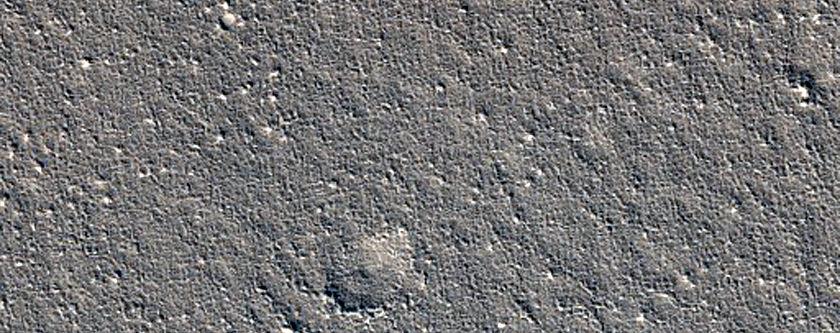
Candidate Red Dragon landing spot – Arcadia Planitia, a smooth plain on Mars that appears to have large quantities of ice near the surface.
Credit: University of Arizona/Mars Reconnaissance Orbiter’s High Resolution Imaging Science Experiment (HiRISE).
Red planet plans
Repeatedly this year, SpaceX front man Paul Wooster has provided some sketchy but captivating Red Planet plans by Musk’s private company.
For example, a few months ago Wooster told a Mars-hungry science audience that an unpiloted SpaceX Red Dragon flight to Mars, able to deliver roughly one ton of useful payload, is being considered for 2020. Indeed, other Red Dragons could follow every two years or so, he said, when Earth-Mars alignments are ripe for the interplanetary crossing.
Rumors have it, but far from confirmed is that SpaceX might be readying two Red Dragons for a Mars 2020-2021 trek. Insiders suggest not.

SpaceX’s Elon Musk has a visionary space agenda for Mars.
Credit: Rob Varnas
Express male/female
SpaceX’s Wooster is a lead in the technical development of SpaceX’s Mars architecture and vehicles, including both Red Dragon and human-scale systems. He is also the Manager of Spacecraft Guidance Navigation and Control at SpaceX.
All the pioneering SpaceX work is part of Elon Musk’s express mail thoughts of hurling males and females to colonize the Red Planet.
“First and foremost is to learn how to land large payloads on Mars,” Wooster explains. Experiments carried onboard Red Dragon robotic landers, for instance, are expected to evaluate on-the-spot propellant production. Made-on-Mars oxygen, water and fuel can be processed from icy reserves. Toss in use of the carbon dioxide–rich Martian atmosphere for useful products.

Credit: SpaceX
Plop down target
SpaceX has been busily working with NASA and non-NASA landing site experts to plot and pick locales for plopping down a SpaceX Red Dragon.
Meanwhile, SpaceX’s Wooster says that choosing a site is driven by the quantity of water the firm is looking for…and that’s thousands of tons.
One such Red Dragon touchdown place that is “quite promising” Wooster says is Arcadia Planitia, a smooth plain on Mars that appears to have large quantities of ice near the surface.
Ice is nice
Already tapped by SpaceX is the super-sleuth of all Mars orbiting cameras – NASA’s Mars Reconnaissance Orbiter’s High Resolution Imaging Science Experiment (HiRISE).
HiRise has been used to chart the possible SpaceX Dragon landing site.
“We are following the procedures used for other landing sites” via the Jet Propulsion Laboratory (JPL), Alfred McEwen told Inside Outer Space.
McEwen is the principal investigator for HiRise at the University of Arizona in Tucson. “But this is a candidate site…they haven’t chosen the actual landing site,” he adds.
Ice is nice. That’s the view from Marsologist Chris McKay at NASA’s Ames Research Center. While not expert about Arcadia Planitia, “I can say that low latitude sites with ice that is near that surface will be prime landing site for human exploration. The alternative is go get the water from hydrated minerals like sulfates,” he told Inside Outer Space.

One scientific scenario – could a SpaceX Red Dragon haul back to Earth Mars samples?
Credit: NASA/Ames
Helping hand
Whatever the landing target is for a SpaceX Red Dragon prime, NASA is offering a helping hand, in multiple ways.
NASA is slated to support SpaceX’s 2020 Red Dragon mission with tracking by the Deep Space Network (DSN) throughout the mission, explains Chad Edwards, Manager, Mars Relay Network Office, Chief Technologist, Mars Exploration Directorate at the Jet Propulsion Laboratory in Pasadena, California.
In addition, Edwards points out, NASA’s relay-equipped orbiters (Mars Reconnaissance Orbiter, MAVEN, and Odyssey) will provide high-rate, energy-efficient relay communications for Red Dragon once at Mars, including acquisition of telemetry and tracking data during the critical period of entry, descent, and landing.
Relay support
NASA is particularly interested in Red Dragon’s footed-feel atop Mars terrain that would demonstrate the successful use of Supersonic Retro-Propulsion for the first time at Mars. The DSN would support telemetry and command services throughout the lander’s surface mission, Edwards adds.

SpaceX Red Dragon on Mars.
Credit: SpaceX
“This DSN and Mars relay support to Red Dragon will be provided during a particularly busy period,” Edwards notes, with NASA, the European Space Agency, the Indian Space Research Organization, and the United Arab Emirates ready to hurl hardware Marsward in that same time period. All that Mars machinery is slated to arrive in early 2021.
Also, add in up to nine other missions, from NASA, ESA, and ISRO, already operating at Mars, Edwards explains. “NASA is currently conducting detailed loading studies to assess our ability to meet the telecommunication and tracking needs of all these missions during this period,” he said.
X marks the spot: complex issues
SpaceX getting to Mars is not fraught without perplexing questions.
For instance, won’t supersonic retro propulsion blow away the shallow top soil (50 centimeters depth on average) and expose the ground ice around the lander?
Furthermore, as that ground ice is potentially inhabited and grows at high obliquity, is there a serious problem with planetary protection?
Question: Can SpaceX ignore the planetary protection guidelines?
Additionally, rumors have it that SpaceX is likely to cancel or delay its Mars mission from 2020.
According to Inside Outer Space sources, there is a simple reason:
SpaceX is under pressure from NASA to maintain (or stop slipping) the Commercial Crew Development Vehicle (CCDV) schedule. NASA is extremely anxious to extract itself from the Russian Soyuz dependence. Insiders say that SpaceX has a huge amount of revenue at stake and are in “a precarious cash flow position,” a source said.
One recent decision, apparently, is to descope the propulsive landing on solid ground for the Dragon 2. At least initially, they decided to stick with the proven Dragon 1 parachute landing in water for the initial crew flights. That saves about 6 months of test schedule, Inside Outer Space was advised.
Meanwhile, colonizing Mars looms large on the SpaceX horizon.

Credit: Columbus Earth Center
Author and space philosopher Frank White coined the phrase “the Overview Effect” and defined it as “a cognitive shift in awareness” linked to “the experience of seeing first-hand the reality that the Earth is in space.”
The first international Overview Symposium is being held June 9-10 in Kerkrade, the Netherlands. The setting is the impressive Columbus Earth Center.
An international team of researchers, psychologists, philosophers, and scientists will facilitate keynotes, lectures, workshops, and debates. The unique audio-visual Earth gazing installation at the venue, Columbus Earth Center, as well as the latest in VR technology, will be experienced and analyzed by attendees of the symposium.
Common goal
Experts believe that the experience of this effect can greatly contribute to greater unity and peace among the populations of the Earth and the creation of a common goal: preservation and caring for the planet.

From space, borders and conflicts that divide humanity vanish. What remains is a shift in worldview and a shared need to protect the Earth.

The symposium will also mark the foundation of the Overview Laboratory Europe by Columbus Earth Center to continuously investigate and inform people about the existence, nature, and potential of the Overview Effect.
Resources
For more information on the symposium, go to:
https://www.overviewsymposium.com/
Also, go to:
http://www.columbusearththeater.nl/en/columbus
To view a special “zoom in & out” of the symposium venue in 2017: the Columbus Earth Center in Kerkrade, Netherlands, go to:
https://www.youtube.com/watch?v=eCcBvi37fNE
Lastly, go to this informative and stunning video regarding the Overview Effect, go to:

Curiosity Front Hazcam Right B image taken on Sol 1707 May 26, 2017.
Credit: NASA/JPL-Caltech
Now in Sol 1708, NASA’s Curiosity Mars rover is inspecting “White Ledge” along with “an otherworldly jumble of in-place bedrock, tilted rocks, sand with small ripples, and local pebbly debris piles,” reports Roger Wiens, Curiosity’s Chemistry & Camera (ChemCam) principal investigator at Los Alamos National Laboratory in New Mexico.
“Vera Rubin Ridge continues to loom larger in the rover’s forward view, although progress is somewhat slow due to the difficult terrain,” Wiens explains.
The robot just made a drive of 52 feet (16 meters).

Curiosity Navcam Left B image acquired on Sol 1707, May 26, 2017.
Credit: NASA/JPL-Caltech
Stay warm
“Just 20 sols ago we passed the northern vernal equinox, but the rover is ‘down under’ (at 4 degrees south latitude), so we’ve just started the fall season. For those readers in the Earth’s northern hemisphere, it’s like about October 1 on Earth. Over the next half of a Mars year (or nearly one Earth year) the rover will have a little less power for driving, arm deployment, and instrument activities as it spends a little more energy keeping itself warm,” Wiens reports.
The body of the rover is kept warm by a fluid loop that distributes heat from the radioisotope thermoelectric generator (RTG) to the rover body, but the extremities (arm, wheels, and mast) need to be heated electrically.
“As a result, the rover will take one day to recharge its battery this weekend,” Wiens comments. “It’s a holiday weekend in the U.S. and much of Europe, so why shouldn’t Curiosity have a day off too?”

Curiosity Mastcam Left image taken on Sol 1705, May 24, 2017.
Credit: NASA/JPL-Caltech/MSSS
No holiday
Upcoming, there’s a “soliday,” but that’s not a rover holiday Wiens noted.
“In fact, it’s not a day on Mars at all. Rather, it’s an extra day we have on Earth every 37 Mars days due to the shorter day on Earth,” Wiens says. “So Mars has one less day for this holiday weekend. All told, the rover will be working two days this weekend.”
Wiens said that the “beautiful White Ledge” that’s right in front of the rover is captivating, so the science team has decided to spend two Mars days doing lots of analyses.
That involves interrogating the ledge with two different arm placements, an evening Alpha Particle X-Ray Spectrometer (APXS) integration on a location named “Patty Lot Hill,” and an APXS night integration on “White Ledge” after using the dust removal tool (DRT).
Curiosity’s Mars Hand Lens Imager (MAHLI) is slated to take images of these targets the following sol.
Extra precaution
“We are taking extra precautions in case the rather thin ledge breaks when we place the arm on it. We are also interrogating the ledge with Mastcam and ChemCam,” Wiens pointed out.
Other ChemCam targets include “Shooting Ledge” (a rocky ridge just behind “White Ledge”), “Middle Ledge” behind and to the left, and “Halfway Mountain,” a sand ripple crest.
Curiosity’s Sample Analysis at Mars (SAM) Instrument Suite is doing an atmospheric measurement. The robot’s Rover Environmental Monitoring Station (REMS) and Radiation Assessment Detector (RAD) are taking measurements this weekend too, “so it is an ‘all-instruments’ weekend,” Wiens adds, except for the Chemistry & Mineralogy X-Ray Diffraction/X-Ray Fluorescence Instrument (CheMin).

Curiosity Mastcam Left image taken on Sol 1705, May 24, 2017.
Credit: NASA/JPL-Caltech/MSSS
Good vantage point
Curiosity is posed to drive “to a good vantage point,” Wiens concludes, roughly 60 feet (20 meters) from its present spot.
“We also managed to slip in Mastcam Sun observations and a ChemCam sky spectral observation on Tuesday morning — Sol 1712 — before the next uplink of activities from Earth,” Wiens concludes.
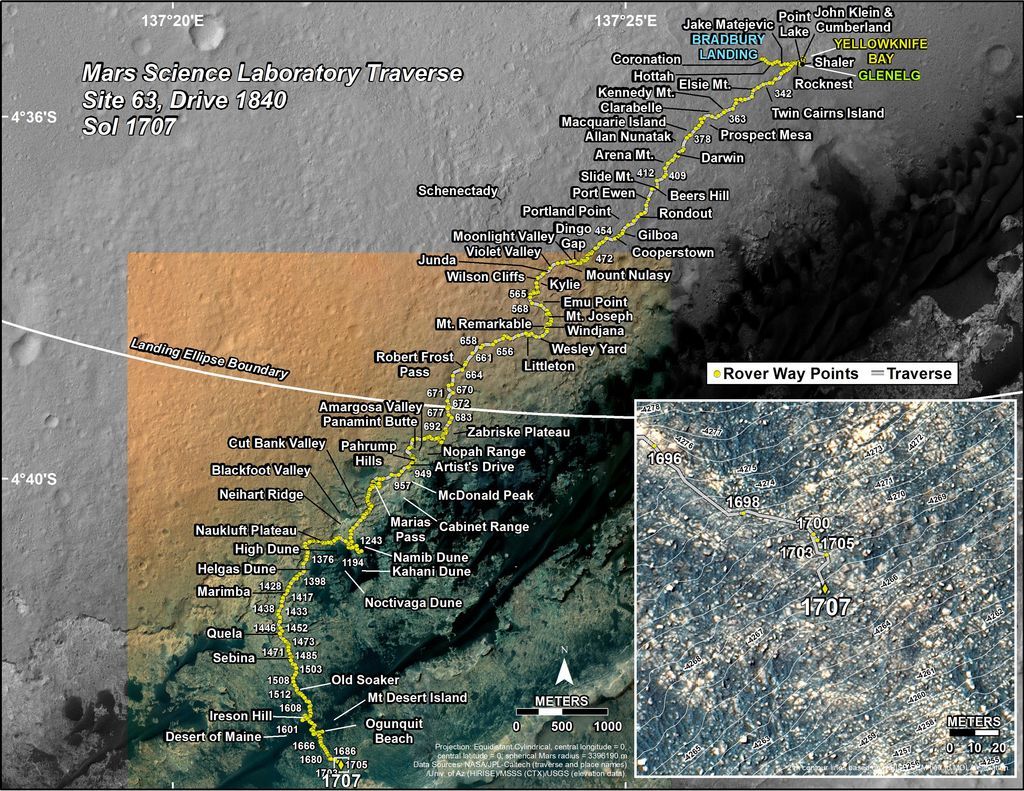
Credit: NASA/JPL-CALTECH/UNIV. OF ARIZONA
Travelogue map
Just issued is a Curiosity traverse map through Sol 1707.
This map shows the route driven by NASA’s Mars rover Curiosity through the 1707 Martian day, or sol, of the rover’s mission on Mars (May 26, 2017). Numbering of the dots along the line indicate the sol number of each drive. North is up. The scale bar is 1 kilometer (~0.62 mile).
From Sol 1705 to Sol 1707, Curiosity had driven a straight line distance of about 45.15 feet (13.76 meters), bringing the rover’s total odometry for the mission to 10.26 miles (16.52 kilometers).
The base image from the map is from the High Resolution Imaging Science Experiment Camera (HiRISE) onboard NASA’s Mars Reconnaissance Orbiter.

From left to right: Arnold Aldrich, Mercury, Gemini, Apollo, Skylab, Apollo-Soyuz, Space Shuttle Program Management; Michael Collins, Gemini 10, Apollo 11; Walt Cunningham, Apollo 7; Harrison Schmitt, Apollo 17; Al Worden, Apollo 15.
Credit: The Ohio State University/Kevin Fitzsimons
Earlier this month, former Apollo astronauts, current and former NASA administrators, space managers and engineers, and an expert on space law were among the panelists on the Ohio State University (OSU) campus for the Armstrong Space Symposium.
The May 8 event preceded the formal installation of aerospace innovator John M. Horack as the university’s first Neil Armstrong Chair in Aerospace Policy.
Moon or Mars?
Discussion centered on whether humans should venture next to the Moon or Mars, how to get there, and who will get there first.
Apollo 15 astronaut Al Worden advised: “I think there may be a confluence of events in the world today that will predicate another landing on the Moon, but it won’t be [by the United States]…I think it might be China.”

Apollo astronaut, Al Worden.
Credit: The Ohio State University/Kevin Fitzsimons
Countering that view is Apollo 17’s Jack Schmitt, but added that he did agree that China has big ambitions in space. “They understand what we taught them with Apollo,” he said. “Dominating space is a critical step toward dominating the geopolitical culture of the Earth.”
Retiring looks
Worden said that he favors Mars as the next target for exploration, but suggested that being an 85-year-old retiree gives him the ideal mix of patience and fortitude for the tedious months-long journey.
“I can sit all day and watch TV and not get bored,” Worden suggested. “Send an old man!”

Apollo 11’s Michael Collins.
Credit: The Ohio State University/Kevin Fitzsimons
Apollo 7’s Walt Cunningham explained why he and his fellow astronauts felt they were up to the task back then, despite their young age: “We were all fighter pilots and test pilots, and we knew what we could do.”
Looking at today’s commercial space ventures such as SpaceX, Apollo 11’s Michael Collins said that they don’t have the imprimatur of the U.S. government, but they are more agile. Still, he added: “I don’t think [Elon] Musk understands the enormity of a Martian mission. It makes Apollo look like child’s play.”
Resources
To catch up with the Armstrong Space Symposium and Chair Installation, go to these informative videos:
https://www.youtube.com/playlist?list=PLgv9uq_bmKelH9ZwuYaUqEeoLxd0bzcKr
Also, an overview of the event is available by Pam Frost Gorder of University Communications at The OSU. Go to:
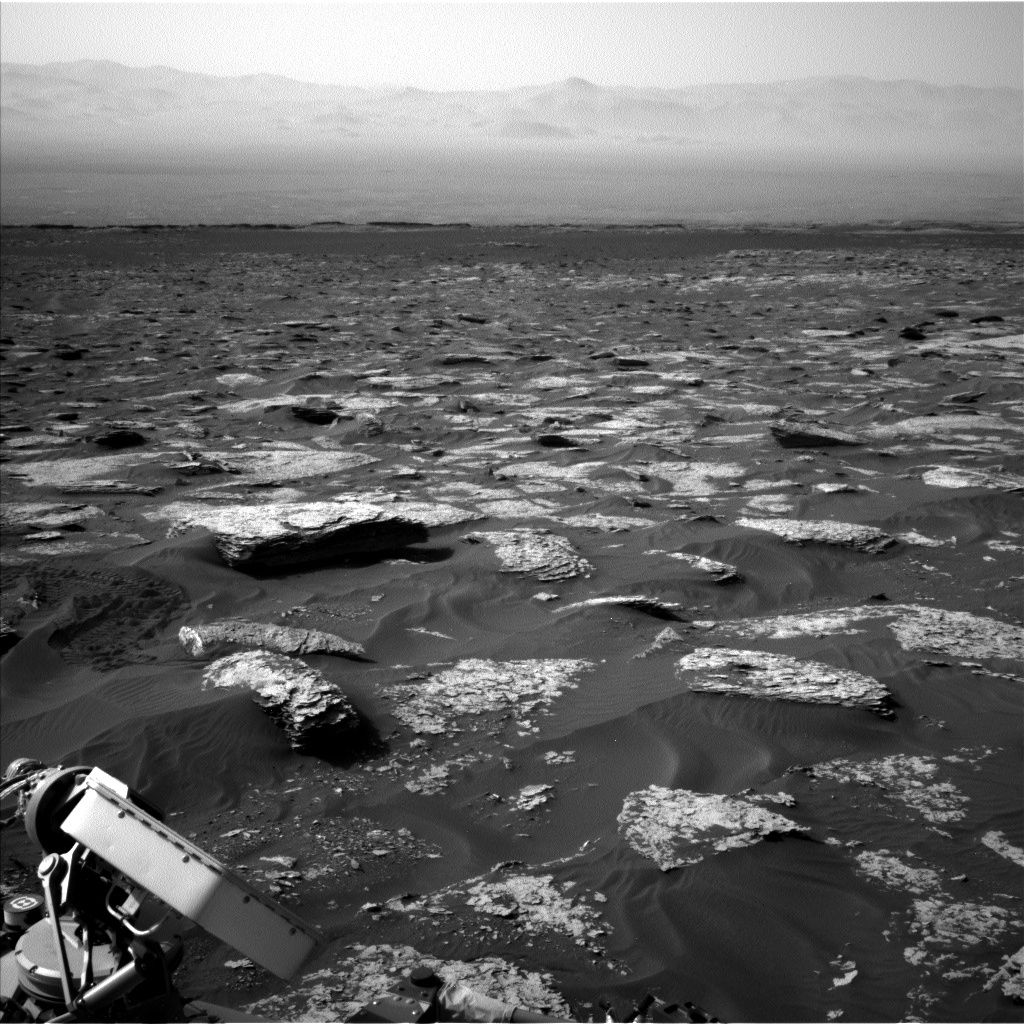
Curiosity Navcam Left B image taken on Sol 1705, May 24, 2017.
Credit: NASA/JPL-Caltech
Now in Sol 1707, the NASA Curiosity Mars rover recently completed a drive of 48 feet (14.6 meters).
Following that drive, scientists decided against robot arm activities due to a lack of compelling targets and in deference to making the next drive longer.
Bedrock science
Michael Battalio, an atmospheric scientist at Texas A&M University reports that on Sol 1707, the rover’s Chemistry & Camera (ChemCam) will capture a raster of the “White Cap Mountain” bedrock, as well as a patch of dark undisturbed soil called “French Hill Pond.”
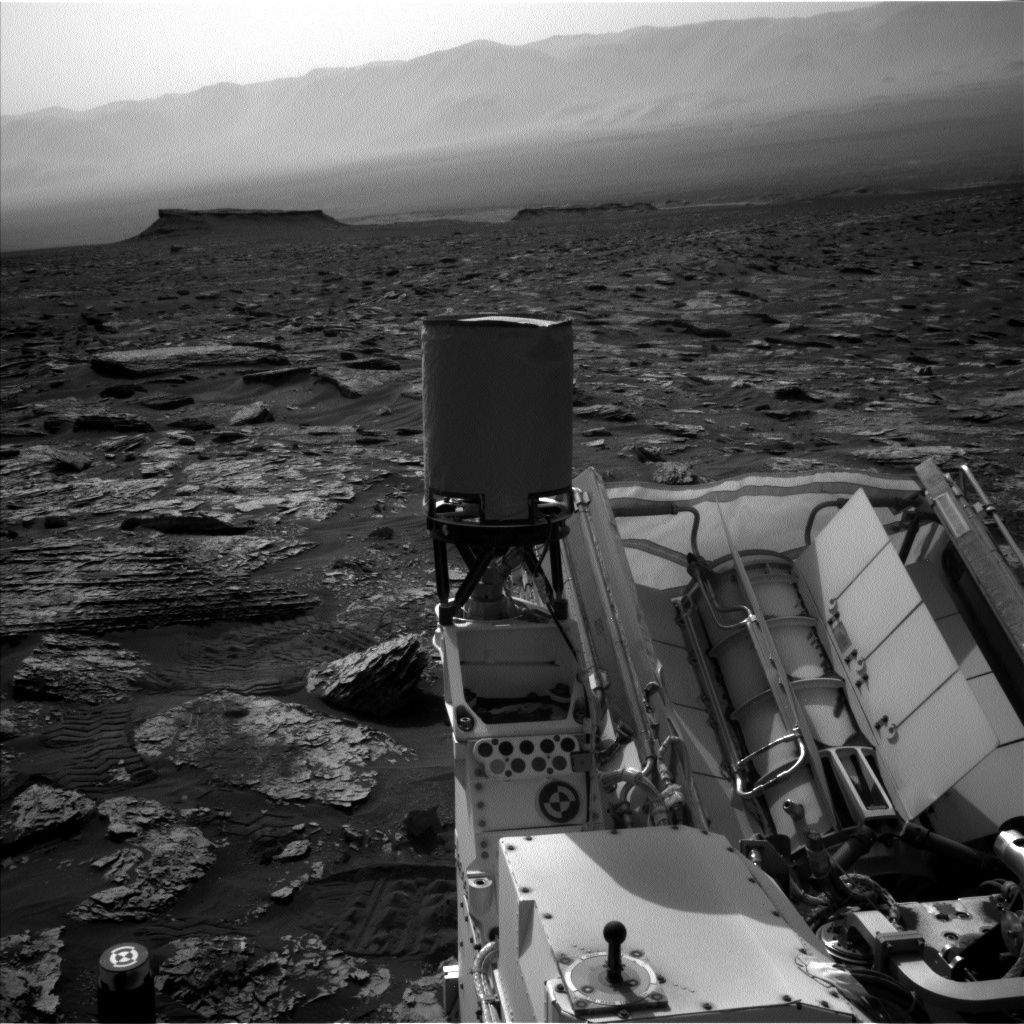
Curiosity Navcam Left B image taken on Sol 1705, May 24, 2017.
Credit: NASA/JPL-Caltech
Curiosity’s Mastcam is slated to document all of the ChemCam targets and will image “Googings Ledge” – a large, darker bedrock — and “The Twinnies,” a shadowed bedrock exposure cut off which are sedimentary members of the Murray formation, as well as “Soward Island,” which has exposed bedrock layers.
Next drive
Battalio notes that after a planned drive of nearly 100 feet (30 meters), ChemCam will perform an Autonomous Exploration for Gathering Increased Science (AEGIS) automated activity, and Navcam will document Curiosity’s new position.
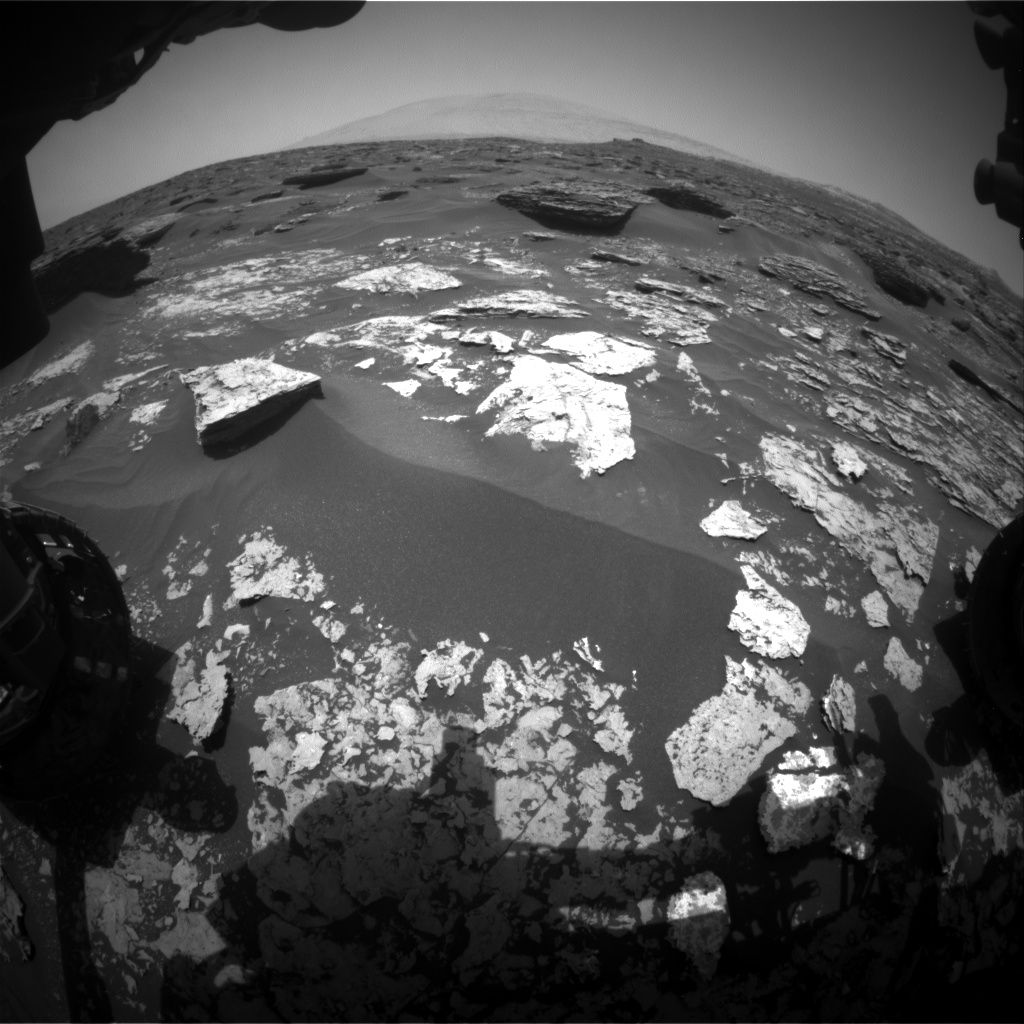
Curiosity Front Hazcam Left B image taken on Sol 1706, May 24, 2017.
Credit: NASA/JPL-Caltech
Curiosity’s Sample Analysis at Mars (SAM) Instrument Suite is on tap to perform a methane dual enrichment activity on Sol 1709, which will compare a methane-enriched atmospheric sample to a non-enriched sample, Battalio adds.
When SAM takes atmospheric methane or oxygen measurements, Mars environmental specialists like to obtain a ChemCam passive sky observation within a few sols for an independent comparison. However, the times initially available in the plan around mid-sol to place a passive sky, Battalio points out, were not compatible with possible pointing azimuths, as we are so close to the new year (northern hemisphere spring equinox).
Weekend plan: power restrictions
“In anticipation of potential power restrictions in the weekend plan, we attempted a long morning imaging suite a couple of sols early, which would include a passive sky measurement; however, we were forced to defer those plans due to power restrictions in the current plan,” Battalio reports.
“Instead of losing the science time altogether, we noticed that the mid-sol time was compatible for taking a ChemCam calibration measurement. This calibration will be taken on Sol 1708 in preparation for the next passive sky,” Battalio explains. “This just proves that while doing science on another planet can be frustrating at times, it is always rewarding.”
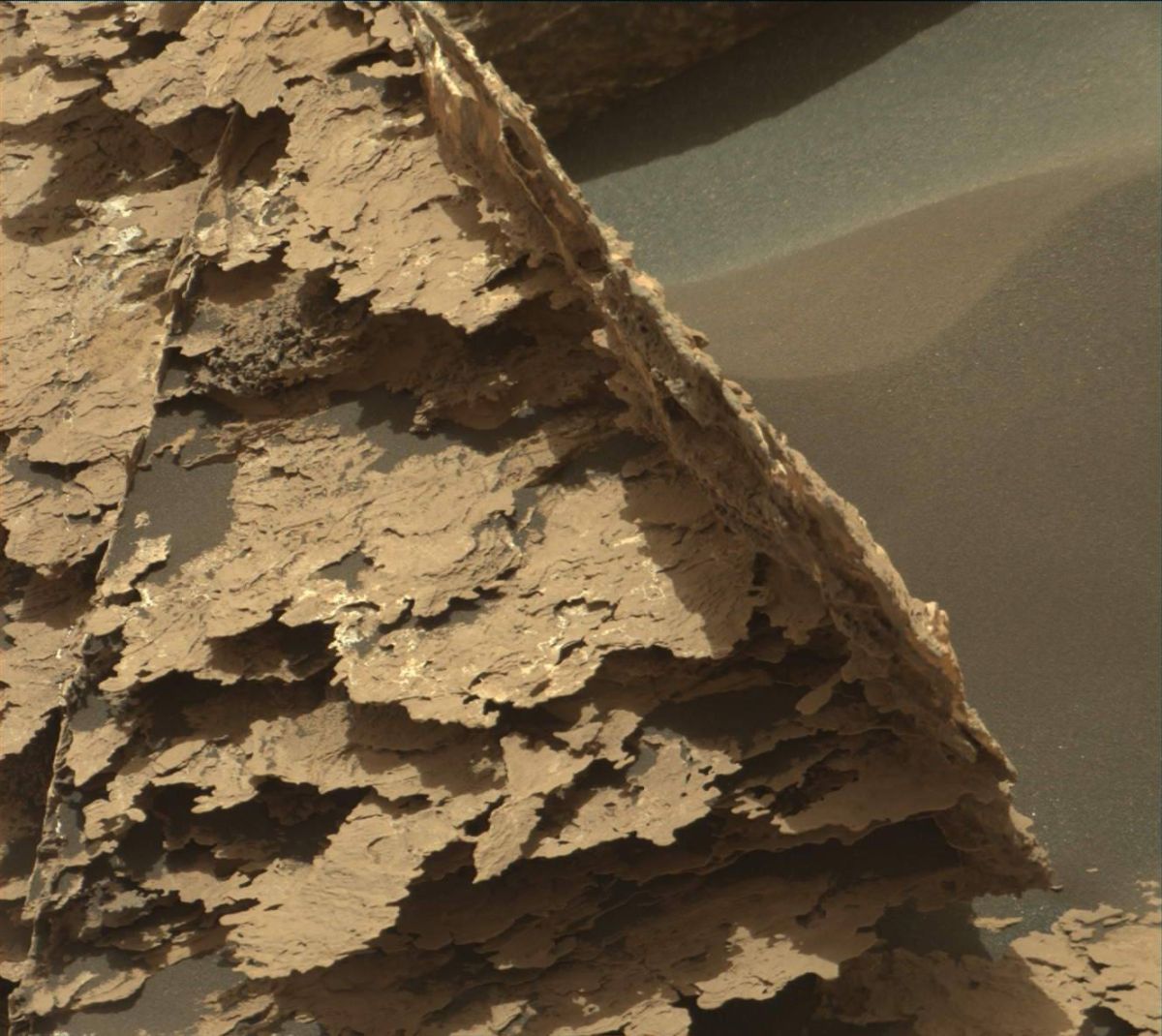
Curiosity Mastcam Right image taken on Sol 1705, May 23, 2017.
Credit: NASA/JPL-Caltech/MSSS
Ingest time
On Sol 1708, the plan calls for a 30-minute Navcam dust devil movie to be taken around noon on Sol 1708.
The robot’s Rover Environmental Monitoring Station (REMS) is also slated to capture the standard top-of-the-hour 5 minute observations and 19 hour-long observation blocks, Battalio says, which will include observations during the “ingest times” of the SAM methane activity.

Curiosity Mastcam Left image taken on Sol 1705, May 24, 2017.
Credit: NASA/JPL-Caltech/MSSS
Also, the Dynamic Albedo of Neutrons (DAN) experiment will take approximately 9 hours of passive and 20 minutes of post-drive active observations.
Road map
Meanwhile, a new Curiosity traverse map through Sol 1705 has been issued.

IMAGE CREDIT: NASA/JPL-CALTECH/UNIV. OF ARIZONA
This map shows the route driven by NASA’s Mars rover Curiosity through the 1705 Martian day, or sol, of the rover’s mission on Mars (May 22, 2017). Numbering of the dots along the line indicate the sol number of each drive. North is up. The scale bar is 1 kilometer (~0.62 mile).
From Sol 1703 to Sol 1705, Curiosity had driven a straight line distance of about 23.43 feet (7.14 meters), bringing the rover’s total odometry for the mission to 10.25 miles (16.50 kilometers).
The base image from the map is from the High Resolution Imaging Science Experiment Camera (HiRISE) onboard NASA’s Mars Reconnaissance Orbiter.

Earth orbit is a junkyard of human-made space clutter.
Credit: Space Junk 3D, LLC. Melrae Pictures
A passionate plea to curb space waste issues – that’s at the heart of a patent pending Solar Space Waste Incineration System.
According to John Arwood the idea is a unique step forward in dealing with the growing problem of orbiting space waste and junk. His system, he explains, is a solution that can provide a way of managing waste from orbiting inhabited structures to prevent adding to the problem of orbiting space garbage.
Burning up trash
“This solution will also be able to remove non-functioning satellites by towing them to the Sun for solar incineration,” Arwood’s website explains. At a distance of approximately 1.1 million miles from the Sun, the invention and its entire cargo would be incinerated by the Sun’s heat.
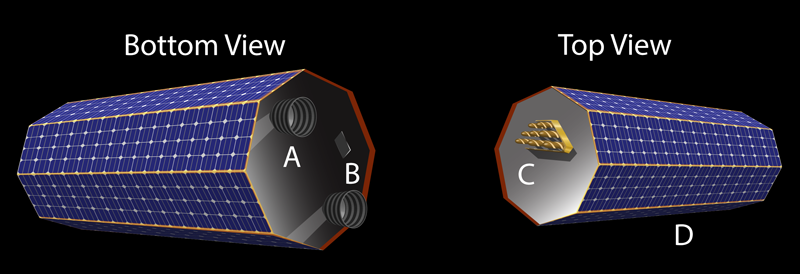
Patent Pending: Solar Space Waste Incineration System.
Credit: Space Waste Solutions
“An advantage of this method of incineration over using the Earth’s atmosphere is that this prevents adding unintended residual by-products to the atmosphere,” Arwood explains.
Given that there are at least 23,000 orbiting objects larger than 2-4 inches and far more objects of smaller sizes, Arwood notes that much of this space debris contains toxic and hazardous materials.
Waste not
“We must respond to the challenge of cleaning up this existing space waste while developing strategies that support growth in space tourism and exploration,” Arwood’s website points out.
By tapping the talents and technology of the waste management industry and other approaches, “we can find realistic solutions to existing and future space waste problems.”
Every inhabited building, hotel, home, space station, etc must properly plan for the sanitary handling and disposal waste. Types of waste to consider might be both human and material in nature.

Week of June 17th: Global Garbage Man Day
Credit: Garbage Man Day
Space tourism
Looking out to the emerging space tourism industry and comfy homes for space travelers, Arwood asks: What is the plan for disposing of the old lighting, furniture, building materials, etc? Are they simply ejected into orbit to join the over 23,000 existing pieces of space junk already cluttering the heavens? Can the waste be incinerated or recycled on location? Is it collected and transported back to Earth for proper disposal?
“No matter the answers, now is the time to ask the questions,” Arwood concludes. “Developing space waste solutions for the emerging space tourism industry will make your Earth orbiting hotel stay much more enjoyable in the future.”
For more information on Space Waste Solutions, go to:
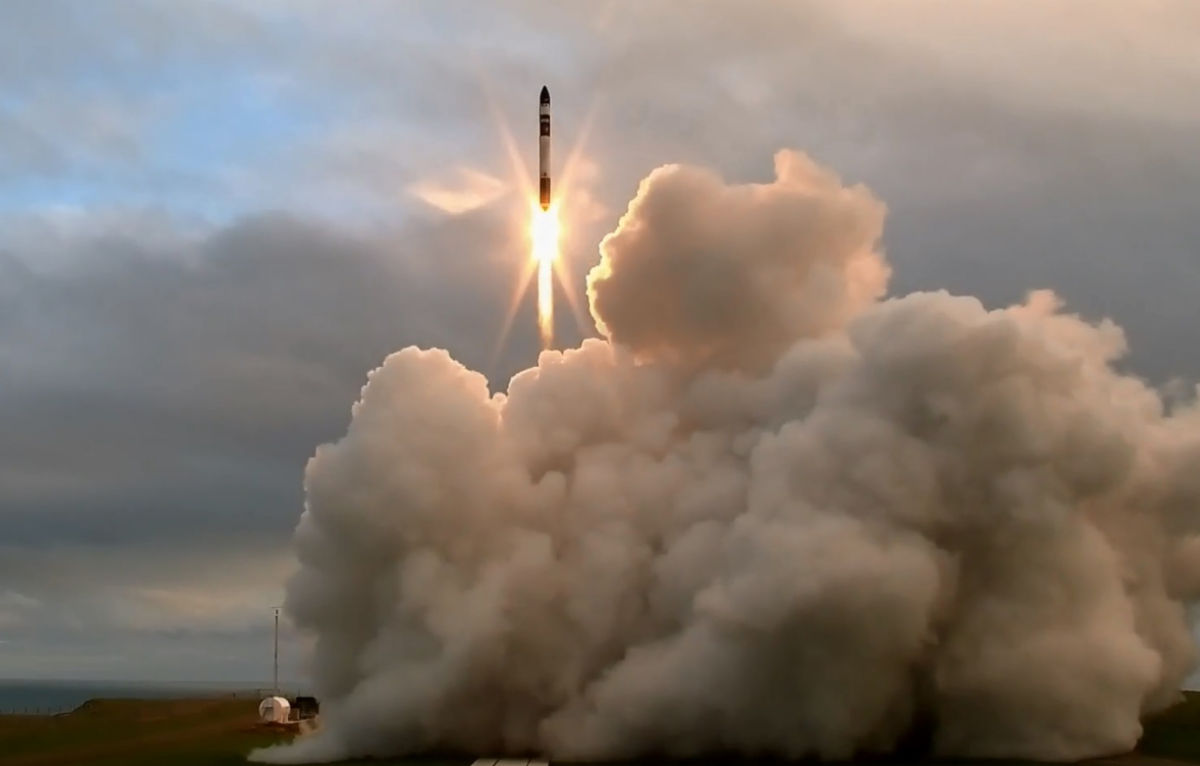
Putting some zeal into New Zealand – Rocket Lab’s Electron booster lifts off on maiden flight.
Credit: Rocket Lab
The private Rocket Lab orbital-class booster was successfully launched from the Mahia Peninsula in New Zealand.
While the Electron rocket’s maiden flight was heralded by the group, the vehicle did not reach orbit.
Peter Beck, CEO and founder of Rocket Lab, said in a press statement: “It was a great flight. We had a great first stage burn, stage separation, second-stage ignition and fairing separation. We didn’t quite reach orbit and we’ll be investigating why, however reaching space in our first test puts us in an incredibly strong position to accelerate the commercial phase of our program, deliver our customers to orbit and make space open for business.”
Next tests
The launch was the first of three test flights scheduled for this year.
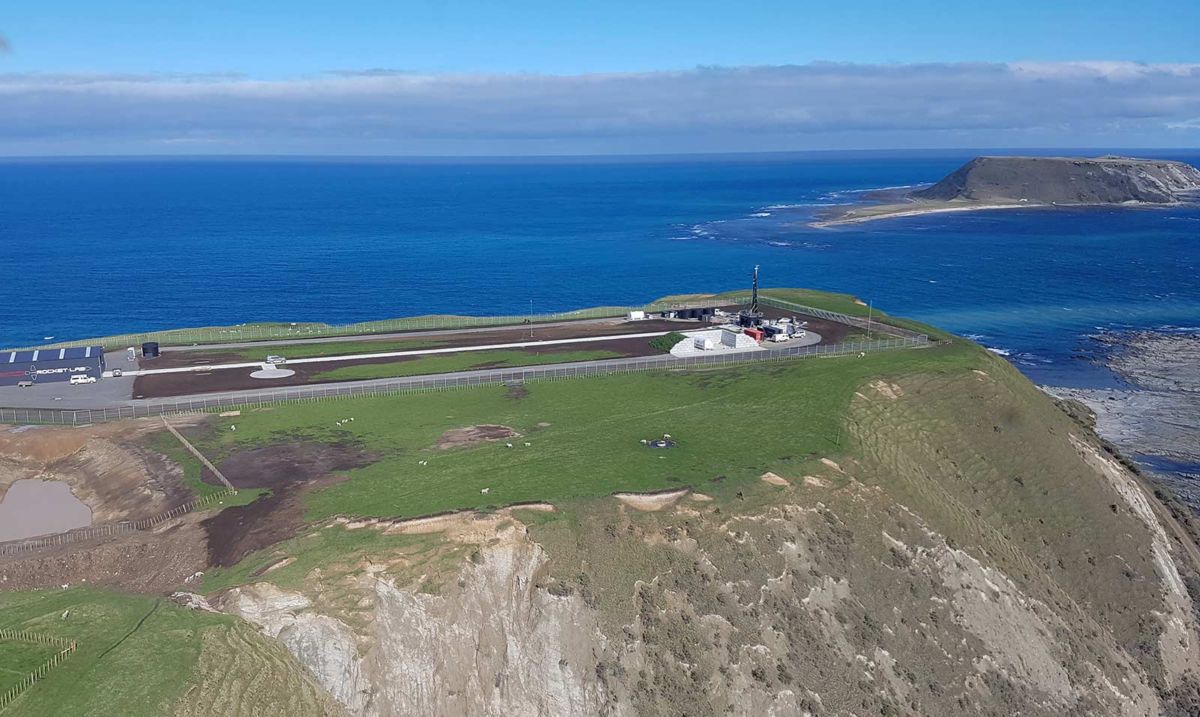
Rocket Lab’s New Zealand launch site.
Credit: Rocket Lab
Rocket Lab will target getting to orbit on the second test and look to maximize the payload the rocket can carry.
According to the private group, at full production, Rocket Lab expects to launch more than 50 times a year, and is regulated to launch up to 120 times a year.
Rocket Lab’s commercial phase will see Electron fly already-signed customers including NASA, Spire, Planet, Moon Express and Spaceflight.
Space economy
According to the newly created New Zealand Space Agency: “New Zealand’s unique location and conditions make it an attractive choice for an increasing amount of space activity.”

Credit: Mark Gee
The site explains that one of the world’s first private orbital launch ranges is sited on our North Island’s east coast ready for frequent rocket launches.
“High altitude balloons are lifting off from the South Island, and a new research institute plans to develop satellite data products to drive regional economic growth,” the site adds.
“We have scientists involved in international astronomy teams searching for planets orbiting distant stars, and companies and students building satellites. We have engineers and technologists working in space-related activities such as in advanced materials and rocketry. Our space economy is taking off!”
Visible sign
In a post-launch statement, the rocket launch is viewed as a huge step for New Zealand’s space industry by the country’s Minister for Economic Development, Simon Bridges.
“Today’s successful launch is a major milestone in the development of New Zealand’s space industry,” Bridges said in a press statement. “It is the first visible sign of a space industry in New Zealand and is an achievement Rocket Lab, and all New Zealanders can be proud of.”
The statement also notes that New Zealand is now one of 11 countries currently able to launch satellites into space from their own territory and the first to launch from a fully private orbital launch range.
Space tourism
“The potential benefits for our economy are very significant. These include opportunities to grow in areas related to the space industry such as research, materials development and testing, and to attract other space related companies to set up in New Zealand, and even space tourism,” Bridges said. “The Government is supportive of any industry that grows our economy through high-tech, innovative highly skilled activities.”
A range of government agencies, led by the Ministry of Business, Innovation and Employment, is also ensuring launch activities are safe and secure.
“We hope the launch will encourage others to come to New Zealand and enjoy the same attractive features that Rocket Lab is taking advantage of, including good access to orbits, clear skies, a skilled workforce and an innovation friendly environment,” Bridges concluded
Go to this Electron launch video:
https://twitter.com/RocketLabUSA/status/867612663764762624
For more information on Rocket Lab, go to:

