Archive for the ‘Space News’ Category
 Author:
  July 7th, 2017
Curiosity Front Hazcam Right B image taken on Sol 1748, July 7, 2017.
Credit: NASA/JPL-Caltech
Now in Sol 1749, NASA’s Curiosity Mars rover has been scoping out sandy ripples in its workspace.

Curiosity Navcam Right B photo taken on Sol 1748, July 7, 2017.
Credit: NASA/JPL-Caltech
Here are some new, just-in photos:

Curiosity Navcam Left B image acquired on Sol 1748, July 7, 2017.
Credit: NASA/JPL-Caltech

Laser shots clearly observable in this ChemCam Remote Micro-Imager photo acquired on Sol 1748, July 7, 2017.
Credit: NASA/JPL-Caltech/LANL
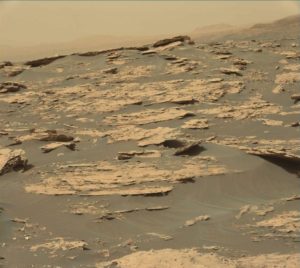
Curiosity Mastcam Left image taken on Sol 1747, July 6, 2017.
Credit: NASA/JPL-Caltech/MSSS
 Posted in
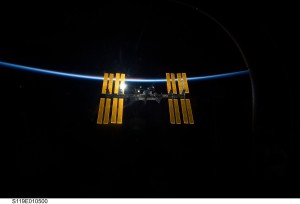
International Space Station.
Credit: NASA
A Chinese experiment flown onboard the International Space Station is back in Florida, fresh from its trek into Earth orbit.
The Beijing Institute of Technology experiment is aimed at studying the effects of the space radiation environment on DNA and the changes in mutation rate. It is the first-ever Chinese experiment flown to the orbiting complex.
“Everything went according to our plan,” notes Deng Yulin, who led the Chinese experiment. “All the data sent back looks good,” Deng told China’s Xinhua news agency early this week.
The Chinese experiment was brought to the space station under an agreement with Houston-based NanoRacks, which offers services for the commercial utilization of the orbiting complex.

NanoRacks Chief Executive Officer, Jeffrey Manber (right) signs contract to fly Chinese experiment onboard the International Space Station.
Credit: BIT
Roundtrip stats
Tucked inside the SpaceX CRS-11 Dragon supply ship, China’s experiment was launched on June 3, later linking up with the ISS, roughly 36 hours after liftoff. ISS astronauts conducted studies using the device with data sent back to the Chinese researchers.
Dragon returned to Earth on July 3 with more than 4,000 pounds (1,860 kilograms) of cargo, including the Chinese experiment.
The 8-pound (3.5 kilogram) experiment is keyed to answer questions about space radiation and microgravity-related mutations among antibody-encoding genes and how does it happen?
The Beijing Institute of Technology NanoLab remained confined to the NanoRacks platform on the ISS – and did not interface with the station or NASA’s IT infrastructure and systems. There was no transfer of technology between NASA and China.

Space Life Science Lab (SLSL) in Cape Canaveral, Florida.
Credit: Space Florida
Analyze the data
“The Beijing Institute of Technology NanoLab has been delivered to Space Life Science Lab (SLSL) in Cape Canaveral, Florida and all was nominal with the payload return,” reports Abby Dickes, Director of Marketing, Communications & Special Events for NanoRacks LLC.

Mary Murphy, NanoRacks senior Internal Payloads Manager (and the manager of the Beijing Institute of Technology (BIT) project) with Chinese space research team. The BIT NanoLab was officially checked out and handed over for launch at the Space Life Science Lab (SLSL) in Cape Canaveral, Florida. This handover occurred on the morning of May 31, 2017, prior to the June 3 SpaceX CRS-11 Dragon supply ship launch.
Credit: NanoRacks
The researchers from the Beijing Institute of Technology (BIT) are currently at the SLSL and will soon begin to analyze the data from their experiment,” Dickes told Inside Outer Space. “NanoRacks will be joining the BIT team on Sunday to commemorate the return.”

Curiosity Mastcam Left image taken on Sol 1746, July 5, 2017.
Credit: NASA/JPL-Caltech/MSSS
NASA’s Curiosity Mars rover is now busily at work carrying out Sol 1748 science tasks.
As reported by Ken Herkenhoff, a planetary geologist at the USGS in Flagstaff, Arizona, the current rover menu involves another touch-and-go given that there is bedrock in the robot’s arm workspace. So the tactical science team selected a block named “Tupper Ledge” for contact science.
Following Alpha Particle X-Ray Spectrometer (APXS) measurements of the elemental chemistry of Tupper Ledge and the Mars Hand Lens Imager (MAHLI) takes a full suite of images of the same target, Herkenhoff notes that the robot’s arm will be stowed to allow Chemistry and Camera (ChemCam) and Right Mastcam observations of a soil target called “No Man’s Land” and a bedrock target dubbed “Sugar Loaves.”

Curiosity Navcam Right B photo taken on Sol 1747, July 7, 2017.
Credit: NASA/JPL-Caltech
Weekend ripple
Curiosity’s Navcam is slated to then search for clouds above the horizon and the Right Mastcam will snap a couple pictures of “Harris,” a trough in the dark sand.
A drive by Curiosity is scheduled to involve placing the crest of a sand ripple in Curiosity’s arm workspace to allow contact science on the ripple this weekend.

Curiosity Navcam Left B image acquired on Sol 1747, July 6, 2017.
Image Credit: NASA/JPL-Caltech
Wheel scuff
“A wheel scuff of the ripple was added by the Rover Planners, which should allow the interior of the ripple to be observed,” Herkenhoff adds.

Curisoity Front Hazcam Right B image acquired on Sol 1747, July 6, 2017.
Credit: NASA/JPL-Caltech
After the drive and standard post-drive imaging by the rover, its Navcam will search for clouds overhead and the Dynamic Albedo of Neutrons (DAN) instrument will make another active measurement of hydrogen in the near-subsurface.

Credit: NASA/Aubrey Gemignani
1:25 P.M. EDT
Here is the official White House Transcript of U.S. Vice President Pence and chair of the newly renewed National Space Council, today at the Kennedy Space Center in Florida.
THE VICE PRESIDENT: Hello, Florida! (Applause.)
Senator Rubio, Senator Nelson, Congressman Posey, Congressman DeSantis, Attorney General Bondi, Commissioner Putnam, acting Administrator Lightfoot, Director Cabana, all the leaders of industry and business who are gathered here today, Dr. Buzz Aldrin — (applause) — and all the great men and women of NASA and the Kennedy Space Center, it is my great honor to be with you here today at the dawn of a new era of space exploration in the United States of America. (Applause.)
And I bring greetings from the man who is going to make that happen, his admiration for all of you gathered here and for America’s storied history in space is boundless; and he is committed each and every day to American leadership at home, around the world, and in the boundless expanse of space, the 45th President of the United States of America, President Donald Trump. (Applause.)
In his Inaugural Address, the President rededicated our nation to once again lead in the heavens, and in his words “unlock the mysteries of space.”
With this President, it’s always about leadership — American leadership. And that begins at home, by putting the security and prosperity of America first. Today, we will speak of this President’s vision for American leadership in space. But between those two spheres, in Warsaw, Poland today, we were reminded that the American President is the leader of the free world. (Applause.)
American leadership
Today, President Trump stood in Krasinski Square in a rebuilt Warsaw, giving testament to the power of free peoples to assert their own destinies and claim their own futures.
The President noted in his words that as long we know our history we will know how to build a future, saying that Americans know that a strong alliance of free, sovereign, and independent nations is the best defense for our freedoms and our interests.
The President took the opportunity to challenge our allies to work together to confront forces that threaten over time to undermine those values and erase the bonds of culture, faith, and tradition that make us who we are. And he called on all of our allies in the West to what he called a “commitment of will,” and he reminded us that the defense of the West ultimately rests in his words “not only on means but also on the will of our people to prevail.”
Finally, he reminded the world today that our own fight for the West does not begin on a battlefield, it begins with our minds, our wills, our souls, our freedom — and that our survival depends on the bonds of history, culture, and memory.
My fellow Americans, that’s what American leadership looks like on the world stage. (Applause.)

Gateway to the stars
And today I come to assure you, the men and women of NASA, and all those at this Gateway to the Stars, where the aspirations of the American people have taken flight that under President Donald Trump America will lead in space once again. (Applause.)
Just last week, President Trump declared that America is in his words “going to be leading” in exploration and discovery “like we’ve never led before.” Welcome to a new era of American leadership in space. (Applause.)
I can’t think of a better place to deliver this message than here at the Kennedy Space Center, named for a President who challenged America to undertake, as he said, “the most hazardous and dangerous and greatest adventure on which man has ever embarked.”
The Kennedy Space Center is the heart and soul of our nation’s space program, where science fiction has become science fact for generations. Just this past Saturday, this center celebrated its 55th birthday. And for 55 years, you have relentlessly expanded our horizons and given us so many national heroes.
Here, the crew of Apollo 11 set sail for the Sea of Tranquility on the moon. Here, you launched America’s Space Shuttles and America’s astronauts to orbit this Blue Marble. Here, the Hubble Space Telescope, the New Horizons, and so many other technological wonders lifted off from Earth to give us a glimpse of our fellow planets, the distant stars, and the infinite galaxies that are a window into our very past.
And from this “Bridge to Space,” our nation will return to the Moon, and we will put American boots on the face of Mars. (Applause.)

Credit: ESA/NASA
Earth giving birth
My friends, the missions that began at the Kennedy Space Center are carved into the mantle of American greatness. And more than that, they’re etched into the hearts and minds of the American people.
Generations of Americans have marveled at and been inspired by what you do here. We’ve joined in your countdowns, rejoiced in your successes, and we’ve grieved with you in your sorrows — because the missions that start at the Kennedy Space Center have captivated the American people and carried our hopes and dreams into the heavens as almost no other national initiative.
I caught a passion for the space program when I was just a little boy in a small town in Southern Indiana. Some of the most precious memories of my youth were gathered around a black-and-white television, watching images of American heroes making history.
As a member of Congress, I asked to serve on the NASA subcommittee, and I had the privilege, along with my wife and children, to attend several space shuttle launches.
I really have no doubt that my son, who is now a Marine Corps aviator, was inspired to serve as a 10-year-old boy when we sat in the grandstands here at the Kennedy Space Center and watched in awe as America’s heroic astronauts hurtled into space.
I said at the time, that to see the sights and sounds of a launch at here Cape Canaveral was like seeing the Earth giving birth to a piece of the sun and sending it home.
And you’re the ones who make it possible. So give yourselves a round of applause for making miracles happen, for making science fiction, science fact here at the Kennedy Space Center. (Applause.)
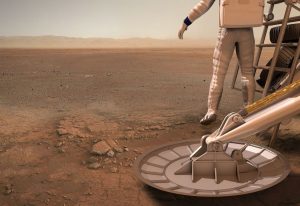
Credit: Bob Sauls – XP4D/Explore Mars, Inc. (used with permission)
Make new history
The truth is that your work breaks new ground and breaks records in equal measure. And serving each and every day with this President, I can say with confidence: The American space program has a champion in the President of the United States. (Applause.)
President Trump has a deep appreciation for the vital work that NASA does each and every day. That was on full display earlier this year when in the Oval Office President Trump signed the first NASA reauthorization act in more than seven years. (Applause.)
Surrounded by many of these same members of Congress who join us here today, after the bill’s signing, President Trump renewed our nation’s commitment to, in his words “NASA’s mission of exploration and discovery” — because he knows that every day, the men and women of NASA inspire the American people and enrich the American spirit.
President Donald Trump is already ensuring that NASA has the resources and support you need to make new history from this place; inspire new generations and advance American leadership in the boundless frontier of space — of that you can be assured.
Allow me just to take a moment to single out Senator Rubio and Senator Nelson and all the distinguished members of Congress who are here with us today. Would you all mind standing and allowing everyone here to show our appreciation for the great champions of human exploration in space that all of you are? Please rise, and give these leaders in the House and in the United States Senate a big round of applause, would you, please? (Applause.) Thank you so much.
President Trump’s vision for space, though, is much larger than NASA alone. Our President is transforming our entire space policy to seize the opportunities of the 21st century and unleash the infinite potential of the cosmos for the American people.

U.S. President Trump signing brings back the National Space Council.
Credit: White House
Up and running
Extending our nation’s leadership in space is one of the greatest challenges of our day. And just as we have risen to the challenges that came before, so too we will rise to meet the new challenges that lie ahead.
That’s why just last Friday, President Donald Trump signed an executive order to relaunch the National Space Council and guide a new era of space leadership by the United States of America. (Applause.)
After being dormant since 1993, I’m proud to report that the National Space Council is up and running once again. And it will be my great honor, as Vice President of the United States, to serve as its chair. (Applause.)
As the President said last week, the National Space Council, in his words, “will be a central hub guiding space policy within the administration,” filling a void that’s existed in America for nearly a quarter-century.
This is actually the third iteration of the National Space Council. American Presidents from Eisenhower to Kennedy, Johnson to Nixon to George H.W. Bush all turned to the National Space Council for assistance and advice.
It was under the first National Space Council’s watch that America put a man in space, put a man on the moon — and with less than a decade between them. And the second council saw our nation through the close of the Cold War, as space became ever more important to our national security.
Reenergize pioneering spirit
As you men and women of NASA know, the American people have never lost our passion to explore space and uncover its secrets. But for nearly 25 years, our government’s commitment seems to have not matched the spirit American people. But I’m here to tell you that as we still enter this new century, we will beat back any disadvantage that our lack of attention has placed, and America will once again lead in space for the benefit and the security of all our people and all of the world. (Applause.)
Our National Space Council will reenergize our pioneering spirit in space. It will restore our confidence and the confidence that we can and will achieve the impossible — just like you all here at NASA have done so many times in the course of my life. It will ensure that America once again takes our rightful place as the vanguard of humanity’s historic rendezvous with the future in the outer limits of space.
The council will bring together leaders from the President’s administration including our Secretaries of State, Defense, Commerce, Transportation, and Homeland Security, the Chairman of the Joint Chiefs of Staff, our National Security Advisor, our intelligence leadership, and the NASA Administrator. And I look forward to holding the first meeting of the National Space Council before the summer is out. (Applause.)
President Trump has given the Council the duty in his words to “advise and assist” his administration regarding national space policy and strategy, and we’ll be busy doing just that.
We’ll review our current policy and our long-range goals and coordinate national space activities — from national security to commerce to exploration and beyond.
And crucially, at the President’s direction, we will, in his words, foster close coordination, cooperation, technology and information exchange among all the stakeholders and sectors involved in space activity — including government agencies, the armed forces, and leaders from the realms of private industry and the academic world. We will bring the best of America together once again to lead with Americans in space. (Applause.)

Rocketeer Jeff Bezos and his commercial rocket firm, Blue Origin.
Credit: Blue Origin
User advisory group
As the President said last week, the National Space Council intends to draw on the expertise and insights of scientists, innovators, and business leaders in a whole new way.
These leaders, whom the President and I will be naming in the coming weeks, will form a User Advisory Group. And I know with confidence that their work will dramatically enhance our space policy in the days ahead just as it has in the past.
I’m particularly excited to see the increased collaboration with our burgeoning commercial space industry so much in evidence here at the Kennedy Space Center. I’m really sorry that I missed the successful commercial launch that took place last night. I was praying for rain at the Kennedy Space Center so we might see that rocket go up today.
But the truth is we’re going to continue to foster stronger partnerships between government agencies and innovative industries across this country because both have so much to offer one another.
In fact, Kennedy Space Center is proof that public and private sectors can achieve more by working together than they could ever achieve apart. This center is today the world’s premier multi-use spaceport, and that truth will only continue to grow. (Applause.)
In conjunction with our commercial partners, we’ll continue to make space travel safer, cheaper, and more accessible than ever before.
The truth is that American business is on the cutting edge of space technology. And under President Trump’s leadership, and with the guidance of the National Space Council, we’ll tap into the limitless well of American innovation because there is no problem the American people can’t solve, no barrier we can’t break down, no objective we can’t achieve when we bring the full force of our national interest and creativity to bear.
Settle that frontier
The American spirit is as limitless as space itself. And so we will bring that spirit fully to bear on the trials that lie ahead. If we can dream it, we can do it. And under President Trump, we will achieve more in space than we ever thought possible.
President Trump observed just last week, “the human soul yearns for discovery,” and I would say that’s especially true for those of us who have the privilege to call ourselves Americans. Under President Donald Trump’s leadership, we will reorient America’s space program toward human space exploration and discovery for the benefit of the American people and all of the world. (Applause.)
We will return our nation to the moon. We will go to Mars, and we will go still further to places that our children’s children can only imagine.
We will maintain a constant presence in low-Earth orbit, and we will develop policies that will carry human space exploration across our solar system and ultimately into the vast expanse of space.
As the President has said, space is in his words the “next great American frontier.” And like the pioneers that came before us, we will settle that frontier with American leadership, American courage, and American ingenuity.
As we once again lead in space exploration, we will continue to make the investments and presence in space to ensure the safety and security of the American people. Space is vital to our national security. I saw it firsthand when I visited Schriever Air Force Base just a few weeks ago. And I can assure you, under President Donald Trump, American security will be as dominant in the heavens as we are here on Earth. (Applause.)
The tasks that lie before us requires the highest levels of courage, commitment, and dedication. The challenges will be difficult. But difficulty brings out America’s best, and America’s best can’t be beaten by anybody at any time.
Get back to winning
Some 55 years ago, the namesake of this base, President John F. Kennedy, declared that America would put a man on the moon before the decade was out, a feat unlike any imagined in human history.
As he said at the time, we were willing to accept the challenge, and unwilling to postpone it, and that challenge is one in his words — “one which we intend to win.” And with your forbearers here at the Kennedy Space Center and Houston and all across NASA, we did win the race to the moon. (Applause.)
We won the race a half-century ago, and now we will get back to wining in the 21st century and beyond.
Under the leadership of President Donald Trump and with the guidance of the National Space Council, the United States of America will usher in a new era of space leadership that will benefit every facet of our national life.
We will strengthen our economy. We will unlock new opportunities, new technologies, and new sources of prosperity. We will inspire our children to seek education in science, technology, engineering, and math. We’ll enhance our common defense and advance the security of the American people.
But most of all, under President Trump’s leadership, we will renew the American spirit itself.
I know in my heart that today the heavens are closer than ever before. We’re restarting a journey that will take us to new heights of knowledge, new heights of accomplishment. And above all, I know with confidence that we will reach those new heights of American leadership with American values and American ingenuity.
As President Trump said last week in his words, “It is America’s destiny to be the leader amongst nations on our adventure into the great unknown.”
And with the National Space Council, we will grab that destiny with both hands and go to work with each and every one of you.
Future beckons
So let us go forth and start this new chapter of that adventure. Let us have the courage and the confidence that’s always defined who we are as Americans. And let us do what our nation has always done since its very founding and beyond: We’ve pushed the boundaries on frontiers, not just of territory but of knowledge. We’ve blazed new trails, and we’ve astonished the world as we’ve boldly grasped our future without fear.
And as we go, let us have faith — faith that as we enter this new era of exploration and discovery, that this rising generation of American explorers and innovators will once again deliver on the hopes and aspirations of our people just like you’ve done before.

Credit: ESA/Hubble & NASA
And as this new generation of astronauts suits up, let them have the faith that they do so surrounded by the prayers of the American people with the absolute assurance that as they rocket into the heavens, they do not go alone.
For as the Psalmist teaches us, if we rise on the wings of the dawn, if we go up to the heavens, even there His hand will guide us, and His right hand will hold us fast.
My friends, the future beckons — and so do the furthest depths of space. Together, as one nation and one people, we will raise our eyes to gaze with wonder at the stars and once again renew our commitment to reach out our hands and touch the heavens.
With confidence in all of you and with confidence in the strong vision and leadership of President Donald Trump, I know America will lead in space once again.
Thank you. God bless you and God bless the United States of America. (Applause.)
END
1:46 P.M. EDT

The Red Planet as seen by Europe’s Mars Express.
Credit: ESA/D. O’Donnell – CC BY-SA IGO
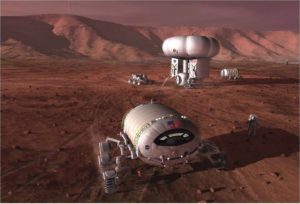
Although the Martian surface has been suspected for some time to have toxic effects, a new study suggests that it may be highly damaging to living cells.
Indeed, the environment on Mars may be more harmful to Earth-based life forms than previously thought.
Researchers in the UK Center for Astrobiology and School of Physics and Astronomy in Edinburgh investigated the potential reactivity of perchlorates and their effect on Bacillus subtilis, a bacterium found on spacecraft and common in soils and rocks.
Perchlorate purgatory
Researchers investigated the behavior of chemical compounds — called perchlorates — which are found on the surface of the Red Planet. They found that, when exposed to UV light whilst in environmental conditions mimicking those on Mars, the chemicals can kill bacteria commonly carried by spacecraft.
Their findings could have implications for potential contamination from robotic and human exploration of Mars.
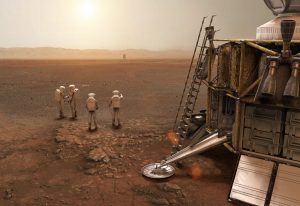
Credit: Bob Sauls – XP4D/Explore Mars, Inc. (used with permission)
Death of bacterial cells
The study also suggested that the effect of perchlorates can be compounded by two other types of chemicals found on Mars’ surface: iron oxides and hydrogen peroxide.
In experiments in which all three were present, the combination led to a more than 10-fold increase in death of bacterial cells compared with perchlorates alone.
Scientists have speculated on the influence that perchlorates may have on the habitability of the planet, since their discovery there several years ago.
Important implications
Their experiments showed that when magnesium perchlorate was exposed to UV radiation similar to that on Mars, it became capable of killing bacteria much more effectively than UV light alone. At concentrations of perchlorate similar to those found on the Martian surface, cells of B. subtilis quickly died.
Lead investigator, Jennifer Wadsworth of the UK Center for Astrobiology and School of Physics and Astronomy explains in a press statement: “Our findings have important implications for the possible contamination of Mars with bacteria and other materials from space missions. This should be taken into account in designing missions to Mars.”
Credit: NASA/Pat Rawlings
Charles Cockell at the UK Center for Astrobiology, School of Physics and Astronomy at the University of Edinburgh is a co-investigator.
To read “Perchlorates on Mars enhance the bacteriocidal effects of UV light” published in Scientific Reports go to:

The invented material is so thin that hundreds of layers could fit on the tip of a needle.
Credit: ANU
A new nano material appears promising to shield astronauts from harmful radiation.
Scientists at the Australian National University in Canberra report that the material is so thin that layers could fit on the tip of a needle and could be applied to any surface, including spacesuits.
Ultra-thin film
ANU’s Mohsen Rahmani notes that the material can reflect or transmit light on demand with temperature control, opening the door to technology that protects astronauts in space from harmful radiation.

Associate Professor Andrey Miroshnichenko (left) and Dr. Mohsen Rahmani demonstrate how the nano material can reflect or transmit light on demand with temperature control. Credit: Stuart Hay, ANU
“Our invention has a lot of potential applications, such as protecting astronauts or satellites with an ultra-thin film that can be adjusted to reflect various dangerous ultraviolet or infrared radiation in different environments,” explains Rahmani, an Australian Research Council (ARC) Discovery Early Career Research Fellow at the Nonlinear Physics Centre within the ANU Research School of Physics and Engineering.
Array of applications
Co-researcher Associate Professor Andrey Miroshnichenko said the invention could be tailored for other light spectrums including visible light, which opens up a whole array of innovations, including architectural and energy saving applications.

The sample here contains hundreds of thousands of nanoparticles that manipulate the incoming light.
Credit: Stuart Hay, ANU
Lei Xu, a co-lead researcher from the Nonlinear Physics Center within the ANU Research School of Physics and Engineering points out that achieving cost-efficient and confined temperature control such as local heating is feasible. “Much like your car has a series of parallel resistive wires on the back windscreen to defog the rear view, a similar arrangement could be used with our invention to confine the temperature control to a precise location.”
The research is published in Advanced Functional Materials:
http://onlinelibrary.wiley.com/doi/10.1002/adfm.201700580/abstract
Go to video at:

Vice President Pence will chair the National Space Council.
Credit: White House
U.S. Vice President Mike Pence and designated driver of the newly anointed National Space Council will visit NASA’s Kennedy Space Center in Florida on Thursday, July 6.
NASA TV and the agency’s website will air live coverage for parts of the visit starting at noon EDT with Air Force Two’s arrival at Kennedy’s Shuttle Landing Facility runway, followed by a special address to the center’s workforce in KSC’s Vehicle Assembly Building at 1 p.m.
KSC tour
The vice president is slated to tour KSC and learn more about the center’s work as a multi-user spaceport for commercial and government clients, as well as see the agency’s progress toward launching from U.S. soil on spacecraft built by American companies, and traveling past the moon, and eventually on to Mars and beyond with the help of NASA’s new Orion spacecraft and Space Launch System rocket.
To view the Thursday July 6 event, go to:
https://www.nasa.gov/multimedia/nasatv/#public
Also, go to this overview of the new National Space Council – promises and pitfalls, at:
https://www.leonarddavid.com/national-space-council-next-steps/

Assembling Mars-bound spacecraft requires ultra-clean conditions.
Credit: NASA/JPL
New research suggests that spacecraft clean rooms are more “room” than clean.
As multiple nations lob spacecraft to Mars, there’s always concern that Red Planet-bound vehicles are providing a free ride to organic material and microbes. That material can pollute a place that was beforehand thought immaculate.
Moreover, unintentional inoculation of Mars with Earthly microorganisms or other contaminants could imperil the scientific validity of spotting a true Martian bio-signature from an Earth-transported organism.

Inoculation of Mars with Earthly microorganisms could imperil the scientific validity of spotting a true Martian bio-signature. Shown here is NASA’s Mars 2020 rover now in development.
Credit: NASA/JPL
Special care
While special care is given to probes headed outward to Mars — or other destinations that may be a site with a potential for past or present life – turns out that spacecraft clean rooms are due for increased scrutiny.
For more details on this bio-worry, go to my new Space.com story at:
Spacecraft Clean Rooms Have Some Dirty Little Secrets
By Leonard David, Space.com’s Space Insider Columnist
July 5, 2017 07:10am ET
https://www.space.com/37392-spacecraft-clean-rooms-not-so-clean.html
International Space Station.
Credit: NASA
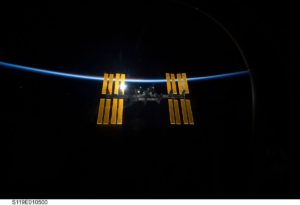
SpaceX’s Dragon cargo spacecraft returned to Earth today, loaded with science samples including the first Chinese experiment to fly onboard the International Space Station.
China’s Xinhua news agency reports that the experiment from the Beijing Institute of Technology was aimed at studying the effects of the space radiation environment on DNA and the changes in mutation rate.
“Everything went according to our plan,” reports Deng Yulin, who led the Chinese experiment. “All the data sent back looks good,” Deng told Xinhua.
The Chinese experiment was brought to the space station under an agreement with Houston-based NanoRacks, which offers services for the commercial utilization of the orbiting complex.

SpaceX booster departs on cargo supply mission June 3, 2017.
Credit: SpaceX
The SpaceX CRS-11 was launched on June 3, later linking up with the ISS, roughly 36 hours after liftoff.
Transfer ceremony
Deng said he will soon fly to Florida, where a ceremony of transfer of the experiment between NanoRacks and his team is scheduled for Friday.
The Chinese research involves no technology transfer between NASA and China.
Xinhua had reported earlier that the 8-pound (3.5 kilogram) experiment is keyed to answer questions, such as: “Does the space radiation and microgravity cause mutations among antibody-encoding genes and how does it happen?”
ISS astronauts conducted studies using the device with data sent back to the Chinese researchers.
For more information, go to:

Artist concept of NASA’s Double Asteroid Redirection Test (DART) spacecraft. DART, which is moving to preliminary design phase, would be NASA’s first mission to demonstrate an asteroid deflection technique for planetary defense.
Credits: NASA/JHUAPL
NASA is moving forward on the first-ever mission to demonstrate an asteroid deflection technique for planetary defense – the Double Asteroid Redirection Test (DART) mission. But there are a few hurdles to overcome.
While current law directs the development of the DART mission, DART is not identified as a specific budget item in the Administration’s Fiscal Year 2018 budget.
As an element of the joint NASA/European Space Agency’s Asteroid Impact and Deflection Assessment (AIDA) mission, DART would be the kinetic impactor while the ESA Asteroid Impact Mission (AIM) provides assessment capabilities.
However, ESA’s AIM has yet to be approved.
Target body
The target for DART is an asteroid that will have a distant approach to Earth in October 2022 and then again in 2024. The asteroid is called Didymos – Greek for “twin” – because it’s an asteroid binary system that consists of two bodies: Didymos A, about one-half mile (780 meters) in size, and a smaller asteroid orbiting it called Didymos B, about 530 feet (160 meters) in size. DART would impact only the smaller of the two bodies, Didymos B.

The European Space Agency’s Asteroid Impact Mission is joined by two triple-unit CubeSats to observe the impact of the NASA-led, and once named, Demonstration of Autonomous Rendezvous Technology (DART) probe with the secondary Didymos asteroid, planned for late 2022.
Credit: ESA – ScienceOffice.org
ESA’s AIM would observe the asteroid before impact to determine its properties and study the effect of the collision on the double asteroid system Didymos.
If the ESA/AIM mission is not available, telescopes and radar would assess Didymos pre impact and following the collision.
NASA approval
DART is being designed and would be built and managed by the Johns Hopkins Applied Physics Laboratory. DART is moving from concept development to preliminary design phase following NASA’s approval on June 23.
The DART Mission is being developed under the auspices of NASA’s Planetary Defense Coordination Office. NASA established this office to coordinate planetary defense related activities across NASA, and coordinate both US interagency and international efforts and projects to address and plan response to the asteroid impact hazard.
Published on June 30, 2017, go to this animation showing the Double Asteroid Redirection Test (DART) mission that would demonstrate how a kinetic impact could potentially redirect an asteroid as part of NASA’s planetary defense program:

