Archive for the ‘Space News’ Category
 Author:
  July 17th, 2017
Enter the e-nose.
Credit DLR
A synthetic nose – the e-Nose – has been developed to sniff out environmental conditions that foster elevated microbial growth of bacteria and fungi. These organisms attack the materials on the International Space Station (ISS).
The device successfully sniffed microbial contamination in the Russian ISS sector from December 2012 to May 2013 by analyzing substances that microorganisms emit into the closed atmosphere of the orbiting facility.
According to the German Aerospace Center (Deutsches Zentrum fuer Luft- und Raumfahrt; DLR) the e-Nose will be upgraded together with the Russian partner, the Institute for Biomedical Problems (IBMP): a modified e-Nose is scheduled to start measuring in 2018 the astronauts’ health and stress levels by analyzing their exhalation gases.
 Posted in
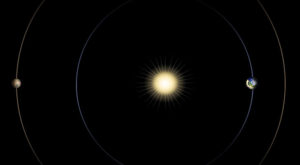
This month, movements of the planets will put Mars almost directly behind the Sun, from Earth’s perspective, causing curtailed communications between Earth and Mars.
Credit: NASA/JPL
Now in Sol 1756, NASA’s Curiosity Mars rover will cease operations this weekend. The team will check on the rover on August 4 and re-start full operations on August 7.
“In the meantime, Curiosity might just get lonely,” reports Roger Wiens, a geochemist at Los Alamos National Laboratory in New Mexico. He is Principal Investigator for Curiosity’s Chemistry and Camera (ChemCam) instrument.
Solar conjunction
Reason for ceasing Curiosity operations: a solar conjunction.
“Planetary scientists take their vacations when the planets align,” Wiens reports. “In our case it is because communications with Mars are blacked out when the Red Planet goes behind the Sun. It is called a solar conjunction. Afterwards, Mars will re-appear in our terrestrial skies early in the morning, just before sunrise. As the Earth chases the Red Planet, Mars will rise earlier until at opposition, when the Earth passes Mars a little over a year from now, the Red Planet will be directly overhead at midnight, e.g., directly behind Earth, relative to the Sun.”

Curiosity Front Hazcam Left B image taken on Sol 1754, July 13, 2017.
Credit: NASA/JPL-Caltech
Facing steep ridge
A recent rover drive of 125 feet (38 meters) brought the mileage traveled by the robot since landing in August 2012 to just over 10.6 miles (17 kilometers).
The rover is now facing a steep, 65 feet (20 meter) high section of the Vera Rubin ridge. A recent image from the rover’s front Hazcam looks straight up the ridge. (photo at right)
“We won’t climb it here; there’s a gentler slope to the east,” adds Wiens.
The rover team has decided not to drive any further before conjunction.

Curiosity Mastcam Right photo acquired on Sol 1753, July 12, 2017.
Credit: NASA/JPL-Caltech/MSSS
Curiosity is on a roughly 8 degree slope right now “and the team didn’t want to risk a lot of slip just before conjunction,” Wiens explains.

Curiosity Mastcam Right image taken on Sol 1754, July 13, 2017.
Credit: NASA/JPL-Caltech/MSSS
The team planned the last ChemCams pre-conjunction, with targets “Jimmies Ledge” and “Jennys Nubble.” Mastcam will take a 2-image mosaic of the top portion of the ridge. The robot’s Navcam was in the plan, used to make a dust devil movie and a suprahorizon movie looking south, Wiens concludes.

Curiosity Mastcam Right image taken on Sol 1752, July 11, 2017.
Credit: NASA/JPL-Caltech/MSSS

Artist’s concept of the Tiangong-1 in Earth orbit.
Credit: CMSA
The United Nations Office for Outer Space Affairs (UNOOSA) has reissued a notification by China on the future uncontrolled re-entry of the country’s Tiangong-1 space lab.
On March 16, 2016, the Tiangong-1 ceased functioning and to date the spacecraft has maintained its structural integrity.
The space lab’s operational orbit is under constant and close surveillance by China. Its current average altitude is 217 miles (349 kilometers) and it is decaying at a daily rate of approximately 525 feet (160 meters), according to the notification.
Re-entry date
The lab’s re-entry is expected between October 2017 and April 2018. According to the calculations and analysis that have been carried out, most of the structural components of Tiangong-1 will be destroyed through burning during the course of its re-entry.
“The probability of endangering and causing damage to aviation and ground activities is very low,” the notification adds.

Artist’s view of Tiangong space lab
Credit: CMSE
Taking measures
The notice advises that China attaches great importance to the re-entry of Tiangong-1 and will take the following measures in terms of monitoring its fall and providing public information:
— China will enhance monitoring and forecasting and make strict arrangements to track and closely keep an eye on Tiangong-1 and will publish a timely forecast of its re-entry
— China will make use of the international joint monitoring information under the framework of the Inter-Agency Space Debris Coordination Committee in order to be better informed about the descent of Tiangong-1.
— China will improve the information reporting mechanism. Dynamic orbital status and other information relating to Tiangong-1 will be posted on the website of the China Manned Space Agency (www.cmse.gov.cn) in both Chinese and English. In addition, timely information about important milestones and events during the orbital decay phases will be released through the news media
— As to the final forecast of the time and region of re-entry, China will issue the relevant information and early warning in a timely manner and bring it to the attention of the United Nations Office for Outer Space Affairs and the Secretary-General of the United Nations by means of “note verbale” through diplomatic channels.
Leftovers
Tiangong-1 was launched into Earth orbit on September 29, 2011. It conducted six successive rendezvous and dockings with spacecraft Shenzhou-8 (uncrewed), Shenzhou-9 (piloted) and Shenzhou-10 (piloted) as part of China’s human space exploration activities. The vehicle weighed (18,740 pounds (8,500 kilograms) at launch.

Credit: The Aerospace Corporation’s Center for Orbital and Reentry Debris Studies (CORDS).
According to the Aerospace Corporation, based on Tiangong-1’s inclination, the lab will reenter somewhere between 43° North and 43° South latitudes. As for leftovers, “it is highly unlikely that debris from this reentry will strike any person or significantly damage any property,” adding: “potentially, there may be a highly toxic and corrosive substance called hydrazine on board the spacecraft that could survive reentry. For your safety, do not touch any debris you may find on the ground nor inhale vapors it may emit.”
The Aerospace Corporation will perform a person and property risk calculation for the Tiangong-1 reentry a few weeks prior to the event.

Curiosity Navcam Right B image acquired on Sol 1754, July 13, 2017.
Credit: NASA/JPL-Caltech.
NASA’s Curiosity rover is performing Sol 1754 science tasks, recently carrying out pre-drive science followed by a drive and making untargeted observations, reports Abigail Fraeman, planetary geologist at NASA/JPL in Pasadena, California.
“There were a variety of light and dark colored veins near the rover that were visible in the Navcam images, so the science team decided to spend our pre-drive science time investigating the chemistry and morphology of these features,” Fraeman says.

Curiosity Front Hazcam Left B photo taken on Sol 1754, July 13, 2017.
Credit: NASA/JPL-Caltech
Coordinated Chemistry and Camera (ChemCam), as well as Mastcam observations, were planned on light and dark veins in targets named “Hockomock Bay” and “Hells Half Acre.” Also, Mastcam-only observation of dark layers in a target named “High Sheriff” is on the schedule, Fraeman explains.
Watching for mobility challenges
“The next major chunk of time in Sol 1754 will be spent driving towards Vera Rubin Ridge,” Fraeman reports, with scientists and engineers casting eyes toward any geologic features in the terrain that could present mobility challenges.

Curiosity Mastcam Left image acquired on Sol 1753, July 12, 2017.
Credit: NASA/JPL-Caltech/MSSS
“We’ll be driving through a bunch of fractured bedrock and sandy areas as we head closer to our third official Vera Rubin Ridge approach imaging location,” Fraeman points out. “Because we’ve seen such spectacular sedimentary structures in our previous images of the ridge, we decided to try to get as close as possible to the vertical exposures of the lower portion of the Vera Rubin Ridge for this imaging stop. I can’t wait until we get there.”
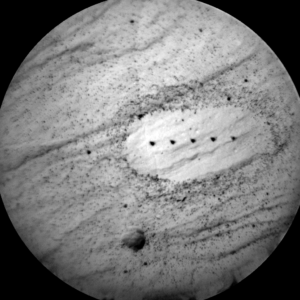
Curiosity ChemCam Remote Micro-Imager (CHEMCAM_RMI)
photo taken on Sol 1753 , July 12, 2017.
Credit: NASA/JPL-Caltech/LANL
Productive day
Lastly, on the plan is snapping a quick picture with Curiosity’s stowed Mars Hand Lens Imager (MAHLI), Fraeman concludes, and “that should give us a great view to the north back towards where we started from on Aeolis Palus almost five years ago. All in all, Sol 1754 should be a very productive day on Mars.”
Conjunction location

Opportunity Panoramic Camera image acquired on Sol 4785.
Credit: NASA/JPL
Meanwhile, elsewhere on Mars and now in Sol 4787 operations, the veteran Opportunity rover is parked in its conjunction location at the entrance to Perseverance Valley, on the southern side of the Valley, tilted to the north to be nice and sunny for its solar panels, explains Ray Arvidson of Washington University in Saint Louis. He is deputy principal investigator of the rover mission.

Opportunity Front Hazcam image taken on Sol 4787.
Credit: NASA/JPL
“We are currently planning a suite of sols to carry the rover over solar conjunction, with the last plan to be developed on July 18th,” Arvidson told Inside Outer Space. Communication and planning start again in early August, he adds.
Winter operations
After coming out of conjunction Opportunity will move toward winter operations, going from topographic lily pad to lily pad (north facing slopes), likely proceeding down the Valley in small steps, Arvidson explains.

Opportunity Panoramic Camera image acquired on Sol 4786.
Credit: NASA/JPL
“We have finished looking at the putative channel systems leading from the west to the entrance to Perseverance Valley,” Arvidson notes. Work is in progress about what Opportunity observations have told scientists about the valley its putative catchment.
Wheel-world worries
The veteran rover – landing on Mars in January 2004 — has been suffering from wheel worries.
Arvidson explains that for rover driving, Earth controllers either command tank turns so as not to not have the robot use its rear steering actuators. That is being done, or the rover just does turns with only modest rear wheel turns, like less than 10 to 15 degrees azimuthal rotation of those wheels.
Opportunity’s front right steering actuator is permanently rotated in about 8 degrees and has been that way since the sol 400s, Arvidson points out. Robot operators did get the robot’s left front wheel rotated back from its roughly 30 degree outward value to straight ahead. Rover controllers will not be using these two front wheel steering actuators, he adds.

Credit: SETI Institute
The best way to find laser flashes from another civilization is to always look everywhere
The SETI Institute in Mountain View, California has released details of “Laser SETI: First Ever All-Sky All-the-Time Search – an essential capability when looking for intermittent signals.
Flash drive
The first flash from the group is they’ve launched a fund raising drive.
While Laser SETI is exceedingly cost efficient, astronomy-grade cameras must be purchased and optics fabricated.
The SETI Institute has established funding levels needed to advance to a fully operational system.

Credit: ESA/Hubble & NASA
Aliens: on-the-air, all the time?
According to Bill Diamond, President and CEO of the SETI Institute:
“The Universe we call home is vast! It’s also nearly 14 billion years old so it’s very difficult to imagine that we are alone. Yet extraterrestrial life still eludes our efforts to find it. Now you have a chance to be a part of the technology that can change that forever.”
For the last 50 years, whether the extraterrestrials are wielding massive radio transmitters or high-powered lasers, those carrying out SETI experiments have assumed that the aliens are on-the-air, all the time.

Credit: SETI Institute
Circumvent an assumption
“But that might not be right,” Diamond responds. “After all, would these other-worldly beings relentlessly target our solar system if, like the overwhelming majority of galactic stars, they’re more than 100 light-years away — far enough that they haven’t learned we’re here, because our own signals haven’t yet reached them?”
Laser SETI is the first experiment to circumvent this assumption, Diamond adds, “because it’s designed to find a very short ping that doesn’t stay on all the time — it can detect a laser flash as short as a microsecond; and one that might not repeat for days, weeks, or even longer.”
Resources
For detailed information on this new SETI effort and their Indiegogo campaign, go to:
Also, take a look at this informative video:

Birds-1 constellation wings its way after launch from the ISS.
Credit: NASA
Back in February of this year, an Indian Space Research Organization rocket deployed over a hundred miniature spacecraft into Earth orbit, the largest stream of petite spacecraft, called CubeSats, dispensed into space courtesy of a single heave-ho booster.
On July 7 a volley of five cubesats carrying amateur radio payloads — dubbed the BIRDS-1 constellation — were hurled into Earth orbit shotgun-style from the Japanese Kibo module attached to the International Space Station.

GomX-4B with GomX-4A Credit GomsSace
Then there’s an upcoming Russian liftoff of a Soyuz booster set to loft a primary payload along with over 70 hitchhiking small satellites fabricated by a diverse set of countries. That gaggle of CubeSats ready to pepper Earth orbit have different jobs, from collecting GPS radio occultation and ship tracking data and performing Earth-remote imaging tasks to shaking out attitude control and propulsion technologies.

NASA’s PhoneSat 2.5, launched in April 2014, used commercial smartphone technology for low-cost development of basic spacecraft capabilities.
Credit: NASA
Heavenly headache?
For now CubeSats’ popularity is clearly on the upswing.
First used as teaching tools and for technology demonstrations, their utility to perform more complex science duties and serve as the backbone of commercial services is gaining traction.
What remains to be seen is whether or not their proliferation adds to the heavenly headache of dealing with the escalating hazard of Earth-orbiting debris.
For more information, go to my new Scientific American story:
Sweating the Small Stuff: CubeSats Swarm Earth Orbit
By Leonard David on July 12, 2017
https://www.scientificamerican.com/article/sweating-the-small-stuff-cubesats-swarm-earth-orbit/

Curiosity Navcam Right B image taken on Sol 1751, July 10, 2017.
Credit: NASA/JPL-Caltech
Curiosity performed a “jam-packed” weekend of contact and remote science on some beautiful sand deposits, reports Rachel Kronyak, a planetary geologist from the University of Tennessee in Knoxville.
The Mars machinery is now wrapping up Sol 1752 duties.
Long-distance mosaic
A current plan uses the rover’s Chemistry and Camera (ChemCam) to target “Grogg Ledge,” a small patch of Murray bedrock in front of Curiosity. ChemCam will also use its Remote Micro-Imager (RMI) to take a long-distance mosaic of an interesting portion of Vera Rubin Ridge.
“After our ChemCam activities, we’ll take a suite of Mastcam mosaics to finalize our coverage of the sand deposits that we looked at over the weekend,” Kronyak adds.

Curiosity Navcam Left B image acquired on Sol 1752, July 11, 2017.
Image Credit: NASA/JPL-Caltech
Drive ahead
Curiosity is slated to then drive, take some post-drive images, and perform a post-drive Autonomous Exploration for Gathering Increased Science (AEGIS) observation – novel autonomy software.
Also on tap is conducting a Sample Analysis at Mars (SAM) Instrument Suite Electrical Baseline Test (EBT), Kronyak notes, which is designed to periodically monitor SAM’s electrical functions.

Curiosity Mastcam Left photo taken on Sol 1751, July 10, 2017.
Credit: NASA/JPL-Caltech/MSSS
The rover is due to carry out a series of environmental monitoring activities, including standard Rover Environmental Monitoring Station (REMS) and Dynamic Albedo of Neutrons (DAN) measurements during the day, and an early morning suite too.
New road map
A new road map of Curiosity’s wheeling and dealing with Mars through Sol 1751 has been issued.

Credit: NASA/JPL-Caltech/University of Arizona
The map shows the route driven by NASA’s Mars rover Curiosity through the 1751 Martian day, or sol, of the rover’s mission on Mars (July 10, 2017).
Numbering of the dots along the line indicate the sol number of each drive. North is up. The scale bar is 1 kilometer (~0.62 mile).
From Sol 1748 to Sol 1751, Curiosity had driven a straight line distance of about 18.36 feet (5.60 meters), bringing the rover’s total odometry for the mission to 10.52 miles (16.93 kilometers).
The base image from the map is from the High Resolution Imaging Science Experiment Camera (HiRISE) in NASA’s Mars Reconnaissance Orbiter.

Credit: SpaceNews
While the impact from the recent China Long March 5 booster failure is still unknown, space engineers in that country are working on the bold Chang’e-5 lunar return sample mission.
The mooncraft was originally targeted for a November liftoff atop a Long March 5 booster. It would depart from the newly completed Wenchang Space Launch Center in south China’s Hainan Province.

Apollo 15 image captures landing locale of China’s Chang’e-5 Moon lander – the Mons Rümker region in the northern part of Oceanus Procellarum.
Credit: NASA
If successful, this robotic vehicle would tote back to Earth the first lunar samples in over 40 years.
What is known is that Chang’e-5’s landing site was announced last month during the Global Space Exploration Conference (GLEX) 2017 meeting held in Beijing: the Mons Rümker region within a part of the moon’s Oceanus Procellarum.
What’s more, lunar scientists are very excited about that landing locale – and for good reason.
Here’s my recent story in SpaceNews on this ambitious Chinese mission:

Credit: ASDReports
A new report has assessed the nanosatellite and microsatellite market, an appraisal that projects out to 2022 the worldwide demand for small spacecraft.
Based on mass, the smallsat market has been segmented into 1 kg-10 kg (nanosatellite) and 11 kg-100 kg (microsatellite).
Based on application, the nanosatellite and microsatellite market has been segmented into communication, Earth observation and remote sensing, scientific research, biological experiment, technology demonstration and verification, academic training, mapping and navigation, and reconnaissance.
Key factors
“The low manufacturing cost of miniature satellites is one of the key factors expected to drive the growth of the nanosatellite and microsatellite market,” the new assessment notes. “The nanosatellite and microsatellite market is projected to grow from USD 1.21 billion in 2017 to USD 3.49 billion by 2022, at a Compound Annual Growth Rate (CAGR) of 23.7% during the forecast period,” explains ASDReports, a research group in Amsterdam, the Netherlands.
Factors such as the high demand for miniature satellites in Earth observation applications, low manufacturing cost of miniature satellites, and increased investments in nanosatellite and microsatellite technologies are expected to drive the growth of the market.
However, the study cautions that the implementation of stringent regulations pertaining to the increasing number of satellites being launched can restrain the growth of the market.

Credit: NASA
Services segment
ASDReports explains that, based on component, the service segment is estimated to be the largest segment of the nanosatellite and microsatellite market in 2017.
Services offered by companies in the market include planning and satellite design, mission management, engineering services, science services, testing, support, and all such services needed for the efficient operation of nanosatellites and microsatellites.
The growth of the services segment can be primarily attributed to the high demand for vendors of nanosatellites and microsatellites that provide support services, in addition to developing and designing miniature satellites.
Earth observation
As for the services that small satellites can provide, the new study points out that the Earth observation and remote sensing segment is expected to be the largest segment of the market in 2017.

Earth remote sensing spacecraft.
Credit: Planet
“The high mobility of nanosatellites and microsatellites, due to their compactness, makes them ideal to forecast disasters with no delay in reporting time and track various weather-related phenomena, such as hurricanes, lightning, polar lights, or natural catastrophes.”
Largest, fastest-growing markets
North America is estimated to be the largest market for nanosatellites and microsatellites in 2017, due to the high demand for these satellites from NASA and the U.S. Department of Defense, as well as research organizations and companies in the telecommunication sector.
Europe is expected to be the fastest-growing market for nanosatellites and microsatellites during the forecast period. “The market in Europe includes the U.K., Russia, Germany, and France, who are rapidly gaining technological leadership in satellite manufacturing. The market for nanosatellites and microsatellites in Europe is expected to witness the highest growth during the forecast period due to the increased demand for missions that provide data for Earth observation and scientific exploration.”
Resources
For more information on this new ASDReports study “Nanosatellite and Microsatellite Market by Component (Hardware, Software & Data Processing, Services, Launch Services)”, go to:
https://www.asdreports.com/news-26674/nanosatellite-microsatellite-market-worth-349-bn-usd-2022

Curiosity Front Hazcam Right B image acquired on Sol 1749, July 8, 2017.
Credit: NASA/JPL-Caltech
NASA’s Curiosity rover on Mars is wrapping up Sol 1749 science tasks.
“Curiosity has intentionally scuffed a nearby sand ripple, which has gifted the team with an exceptional view of the interior of these small sand deposits,” reports Michael Battalio and atmospheric scientist from Texas A&M University in College Station, Texas.

Curiosity Navcam Left B image acquired on Sol 1748, July 7, 2017.
Credit: NASA/JPL-Caltech
“The majority of the weekend’s activities will consist of lots of targeted science on the scuff, as there is no nearby bedrock for Curiosity to observe,” Battalio adds. “This is in contrast to the past week where quick documentation of local changes in stratigraphy of the bedrock as we drive closer to Vera Rubin Ridge was the priority.”
Ripple crest
Battalio notes that several targets were selected for observations around the scuff including the undisturbed ripple crest that is grayer with coarse grains, “Enchanted Island,” the undisturbed ripple side that is redder and finer-grained, “Thomas Little Toes,” and the wall of the scuff that cuts through the ripple, “Ile Damour.”

Curiosity Navcam Left B image taken on Sol 1748, July 7, 2017.
Credit: NASA/JPL-Caltech
These targets will be imaged by the robot’s Mars Hand Lens Imager (MAHLI) with particular focus on imaging the wall of the scuff to detect any layering within the interior of the ripple that has been uncovered.
Curiosity’s Alpha Particle X-Ray Spectrometer (APXS) will perform extended integrations on Thomas Little Toes and Enchanted Island.
Safety precautions
“Unfortunately, an APXS integration will not be performed on Ile Damour, and MAHLI will remain 5 centimeters away from this target to ensure safety of the instruments by not bringing the arm too close to the ripple at the risk of the side of the ripple collapsing,” Battalio reports. “Mastcam will also image these areas for comparison of grain size, color, and composition to previously observed ripples.”
On the schedule is use of the rover’s Chemistry and Camera (ChemCam) to target Enchanted Island for comparison to two other ripple crest targets and Ile Damour to detect differences in grain size and composition in comparison to the targets on the ripple surface.
Change detection
Two other areas along and near the crest of the un-scuffed ripple will be targeted by Mastcam and ChemCam: “Verona” is slightly away from the crest of the ripple, and “Merrymeeting Bay” is at the base of the ripple crest.
“These two additional targets were selected to compare differences in grain size and composition and detect changes in color across the surface of the ripple,” Battalio explains. “An interesting wrinkle in planning was ordering the observations so that ChemCam activities on the wall of the scuff (the Ile Damour target) occurred after any imaging from MAHLI, in case actively shooting the fragile wall side disturbed or shifted the sand along the scuff wall.”

Curiosity Navcam Left B image acquired on Sol 1748, July 7, 2017.
Credit: NASA/JPL-Caltech
Unusual selfie
Before the science activities with the arm, Battalio says, Curiosity will take “a rather unusual selfie of sorts” by pointing MAHLI directly into the eye of Mastcam to look at the Mastcam sunshade. This measurement is being taken to ensure that grains of sand are not interfering with Mastcam tau measurements – the amount of dust within the atmosphere of Mars.

Curiosity Mastcam Left image acquired on Sol 1748, July 7, 2017.
Credit: NASA/JPL-Caltech/MSSS
Curiosity is scheduled to drive away from the sand ripple to make some progress towards the next stop in the Vera Rubin Ridge imaging campaign before conjunction. Mastcam and Navcam will take standard post-drive imaging.
Battalio adds that two different dust devil surveys will be taken to attempt to observe any nearby convective vortices.
New road map
A new Curiosity traverse map through Sol 1748 has been released.
This map shows the route driven by NASA’s Mars rover Curiosity through the 1748 Martian day, or sol, of the rover’s mission on Mars (July 07, 2017).

Credit: NASA/JPL-Caltech/University of Arizona
Numbering of the dots along the line indicate the sol number of each drive. North is up. The scale bar is 1 kilometer (~0.62 mile).
From Sol 1747 to Sol 1748, Curiosity had driven a straight line distance of about 18.09 feet (5.51 meters), bringing the rover’s total odometry for the mission to 10.52 miles (16.92 kilometers).
The base image from the map is from the High Resolution Imaging Science Experiment Camera (HiRISE) in NASA’s Mars Reconnaissance Orbiter.

