Archive for the ‘Space News’ Category
 Author:
  August 3rd, 2017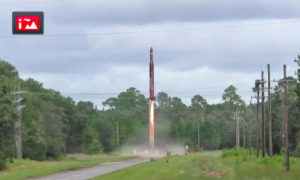
Credit: Vector
Vector, a micro satellite space launch company, flew today a suborbital flight of its B0.002 test vehicle, a full-scale prototype of the company’s Vector-R launch vehicle.
This flight also marked the first launch out of Spaceport Camden in Georgia, which was originally used by NASA in the 1960’s for ground-based static fire testing of large solid rocket motors.
Orbit ability: 2018
“Since our inception, Vector has been committed to making space open for business,” said Jim Cantrell, CEO and co-founder of Vector. based in Tucson, Arizona. He added that the company is “on the fast-track” to get to an orbital capability in 2018.
A primary objective of today’s test was the demonstration and evaluation of a next-generation 3D additively manufactured engine injector developed through a collaborative research program with NASA Marshall Space Flight Center.

Credit: Vector
GalacticSky satellites
According to a Vector press statement, this most recent test of the Vector-R launch vehicle comes on the heels of a $21 million Series A funding round led by Sequoia Capital, with participation from Shasta Ventures and Lightspeed Venture Partners.
With this most recent round of funding, Vector will accelerate the company’s flight test series, develop its first GalacticSky satellites, open its Silicon Valley Headquarters and break ground on a rocket factory in Pima County, Arizona.
Go to video link at:
https://mobile.twitter.com/vectorspacesys/status/893180679470465025/video/1
For more information on Vector, visit:
 Posted in
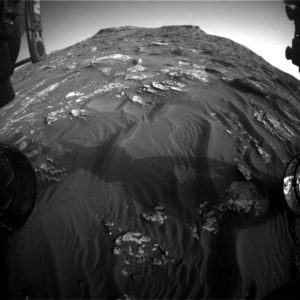
Curiosity Front Hazcam Left B image taken on Sol 1771, July 30, 2017.
Credit: NASA/JPL-Caltech
Now in Sol 1775, NASA’s Curiosity Mars rover has begun to return imagery from the Red Planet. Images for Sol 1774 have been posted from the Front Hazard and Rear Avoidance Cameras.
Last month, movements of the planets put Mars almost directly behind the Sun, from Earth’s perspective, causing curtailed communications between Earth and Mars.
Anniversary ahead
Meanwhile, there’s an anniversary coming for Curiosity. The robot landed near Mount Sharp five years ago this week: August 5, 2012.
Mission controllers at NASA’s Jet Propulsion Laboratory in Pasadena, California received radio confirmation and first images on that date from Curiosity after the rover’s touchdown using a new “sky crane” landing method.

Sky Crane lowers Curiosity Mars rover onto the surface of the Red Planet.
Credit: NASA/JPL-Caltech
Science duties
Since touchdown on the Red Planet, Curiosity rover has been reconnoitering Gale Crater and surrounding territory, wheeling about to discern the history of Mars and its potential to support life.
As of Sol 1754, the wheeled Mars machinery has driven roughly 10.57 miles (17.01 kilometers).
For a newly released JPL video, take a tour of Curiosity’s landing site, Gale Crater, at:
https://youtu.be/Q-uAz82sH-E?list=PLTiv_XWHnOZpzQKYC6nLf6M9AuBbng_O8
Also, go to this new video showing imagery taken by Curiosity following five years of wheeling about on Mars:
https://www.youtube.com/watch?v=O0nPFaBU98k

Credit: ESA/NASA
Hawaii is cranking up the volume regarding an International MoonBase Summit.
The goal is to create an action plan that will culminate with the building of Moon Base prototypes on Earth, followed by a sustainable settlement on the Moon. An early goal is to develop a prototype Moon Base in Hawaii to further international operations on the Moon.
The International MoonBase Summit (IMS) will convene a team of leading scientists, educators and entrepreneurs, from space agencies and industries worldwide, to advance the development and implementation of an international base on the Moon.
The summit is to be staged October 1- 5 at the Mauna Lani Hotel and Bungalows, Kohala Coast on Hawaii’s Big Island. This gathering is sponsored by the International Moonbase Alliance, LLC.

Credit: LPI
Essential resources
According to an IMS statement, delegates to the meeting will focus on identifying essential resources and technological capabilities required to enable and sustain lunar-based operations. Through the promotion of international collaborations, and public-private partnerships intent is to reduce costs, enhance benefits and accelerate timetables for lunar settlements.
“We will build on discussions and recommendations from the Lunar Exploration and Analysis Group (LEAG), the European Lunar Symposium, the International Space Development Conference, the NewSpace Symposium, the International Astronautical Congress (IAC), and other space forums worldwide, to formulate an integrated strategy for establishing the proposed multinational lunar base,
according to the statement. “We also will demonstrate why Hawaii is one of the best places on Earth to develop a prototype Moon Base.”

Inside look at one idea the European Space Agency is exploring in its formulation of a “Moon Village” that incorporates 3D printing.
Credit: ESA/ Foster + Partners
Alliance
The IMS will conclude with the formation of an International MoonBase Alliance (IMA), comprised of representatives from Summit working groups. Accordingly, the IMA will continue to pursue the resources and milestones identified during the summit, as well as oversee and facilitate the design and development of a prototype lunar base in Hawaii to both enable and support international operations on the Moon.
The goal is to create an action plan that will culminate with the building of Moon Base prototypes on Earth, followed by a sustainable settlement on the Moon. The IMS delegates will focus on identifying essential resources and technological capabilities required to enable and sustain lunar-based operations. Through the promotion of international collaborations, and public-private partnerships we can reduce costs, enhance benefits and accelerate timetables for lunar settlements.

The Earth straddling the limb of the Moon, as seen from above Compton crater.
Credit: NASA/GSFC/Arizona State University
Human migration
In broad terms, an IMA vision statement: “Humankind will become a multi-planetary species. The International MoonBase Alliance is the vanguard of the next great wave of human migration. We must go with humility, respect and aloha. Only with this spirit, will we voyage to and settle on the Moon, Mars and beyond
The mission of the International MoonBase Alliance is to unite space agencies, space companies and humanity to build sustainable settlements on the Moon, Mars and beyond.
For more information, go to:

Image from first refueling test as craft approached space lab in April.
Credit: CGTM
China’s Tianzhou-1 robotic cargo spacecraft has released a CubeSat.
The Xinhua news agency reports the test deployment is showcasing China’s intentions to use the country’s future space station to launch more micro/nanosatellites and provide other in-orbit services.
Signals from the CubeSat were received by ground technicians right after the release, according to the China Aerospace Science and Technology Corporation (CASTC).
The Tianzhou-1 supply craft toting the CubeSat rocketed from the Wenchang Space Launch Center on April 20. After 104 days, the CubeSat was released by the cargo spacecraft, the Xinhua story notes.
Noted space analyst, Phil Clark, tells Inside Outer Space that the CubeSat deployment was 07:03 UT on August 1 and the 3U CubeSat is called Silu (“Silk Road”) 1.

Artist’s drawing of CubeSat deployment from China’s resupply craft.
Credit: CGTN
Refueling in Earth orbit
China’s Tianzhou-1 has repeatedly linked up with the Tiangong-2 space lab to evaluate refueling in Earth orbit, the first docking taking place on April 27 and their second on June 15.

Credit: CMSA
Back in mid-June, the cargo spacecraft began independent operation, backing away from theTiangong-2 space lab. Ground controllers initiated a separation of Tianzhou-1 from the space lab. The cargo ship stopped at a distance of nearly 400 feet (120 meters) in front of the Tiangong-2.
Fast docking
The cargo spacecraft is to carry out a “fast docking” with Tiangong-2 and a third in-orbit refueling – an event reportedly to occur near the end of the supply ship’s six-month mission.
Tianzhou demonstrating the fast docking procedure with Tiangong 2 is a simulation to mimic future crew and cargo spacecraft dockings with the orbital space station in six hours after launch.

Larger Chinese space station to be constructed on orbit in the 2020s.
Credit: CMSA
Prelude to space station
Following Russia and the United States, China is the third country to master refueling techniques in space, a capability the country needs for building and sustaining a permanent space station in the mid-2020s.
“As the International Space Station is set to retire in 2024, the Chinese space station will offer a promising alternative, and China will be the only country with a permanent space station,” explains an earlier report from CCTV.
Booster failure
Still somewhat hazy, however, is what impact the July 2 failure of the Long March-5 booster will have. The second flight of that powerful vehicle failed to deliver the Shijian-18 communications satellite into orbit.
The Long March-5 is a key element in China’s projected space station plans, as well as to carry out deep space exploration initiatives. For instance, that booster is slated to hurl moonward this coming November China’s robotic Chang’e-5 lunar return sample mission.

Credit: Fusion Media Group (FMG)
Get a first-hand, realistic look at many of the technologies and equipment considered for a human missions to Mars.
An immersive VR experience is now available from Fusion Media Group (FMG) Labs in New York City.
Mars 2030 is an immersive VR experience now available for HTC Vive, Oculus Rift and Steam PC, with PlayStation VR debuting soon. Mars 2030 is available for download now for $14.99, alongside a complimentary version for educators and museum staff.
Virtual journey
Users can take a virtual journey to the Red Planet that includes 15 square miles (40 square kilometers) of Martian landscape accurately mapped and modeled from real Mars orbital satellite data.

Credit: Fusion Media Group (FMG)
Mars 2030 includes a range of features using actual data from the leading experts on Mars human mission planning. Martian terrain is modeled via custom Hi-RISE imagery from NASA’s Mars Reconnaissance Orbiter.

Credit: Fusion Media Group (FMG)
Symphony score
Immersion is the primary focus, with graphics and sound that draws the user into Mars’ beauty. “The experience utilizes ambisonic audio filtered to match Mars’ atmospheric pressure and sound propagation, alongside an original score from the London Symphony Orchestra that features situational music cues designed to heighten the emotion of exploring the Red Planet,” explains a company press statement.
Simulating what Mars travelers may use in the future, Mars 2030 features the Augmented Information System, an AR environment accessed using touch controllers to pinpoint astronaut location and set waypoints.

Credit: Fusion Media Group (FMG)
Touch screens
Customizable touch screens with haptic feedback display crucial information in the suit and rover, including control switches, biometric data, life support gauges and more. The experience features interactive objects to inspect and bring back to the lab for scientific research and analysis.

Credit: Fusion Media Group (FMG)
MARS 2030 is the inaugural release for FMG Labs and developed in collaboration with of over a dozen space laboratories including NASA Johnson Space Center, NASA Langley Research Center, and NASA Jet Propulsion Laboratory.
Visit the Mars 2030 website for more information and store download links:

Credit: FryxGames
Terraforming Mars: A Resource Management Game by Jacob Fryxelius was released late last year and has become a popular game to help tame the Red Planet.
The game board features corporations that are competing to transform Mars into a habitable planet by spending vast resources, and using innovative technology to raise temperature, create a breathable atmosphere, and make oceans of water.
Control a corporation
As terraforming progresses, more and more people will immigrate from Earth to live on the Red Planet.
According to promotional material, in Terraforming Mars, a player controls a corporation with a certain profile. Play project cards, build up production, place your cities and green areas on the map, and race for milestones and awards!
Will your corporation lead the way into humanity’s new era?

Credit: FryxGames
Recede or expand?
The Terraforming Announcement: “Since its inception in 2174, the World Government has continually strived for global unity and peace. Our mission is to be humanity’s shared tool for shaping a better future. Earth is overpopulated and resources are dwindling. We now face the choice either to recede, or to expand into space to find new homes for humanity. For this reason, we need to turn Mars into a habitable planet.”

Credit: FryxGames
World government
“The terraforming of Mars is an endeavor so great that it will take the united effort of mankind to accomplish. The World Government will therefore inaugurate a Terraforming Committee, and instate a universal tax for this purpose. Any corporation or enterprise contributing to the terraforming process will be generously rewarded by the Committee. We believe that these measures will, eventually, result in a habitable planet for our descendants. Thank you for your attention! – Levi Uken, World Government communicator, January 16, 2315 AD.”
Resources:
http://www.fryxgames.se/games/terraforming-mars/
http://www.fryxgames.se/TerraformingMars/TMRULESFINAL.pdf
Isaac Fryxelius, the graphic designer of Terraforming Mars, has put together an official tutorial for the game.
Go to this video series on Youtube:
https://www.youtube.com/playlist?list=PLs_NsVEJH6TUpYXCk3SGtQwAA1nHwcE9a

As depicted in this illustration, Cassini will plunge into Saturn’s atmosphere on Sept. 15, 2017.
Credit: NASA/JPL-Caltech
With NASA’s Cassini spacecraft set to end its exploration of Saturn on September 15, 2017 by plunging into the atmosphere of that ringed world, it is worth noting how that impressive mission was enabled by the use of nuclear power and how, if action isn’t taken soon, the U.S. may lose the capability to do future outer-planet flagship missions like Cassini.
That’s the view of Gary Bennett, now retired from NASA headquarters where he served as Manager of Advanced Space Power Systems. He also worked on the General-Purpose Heat Source Radioisotope Thermoelectric Generator (GPHS-RTG) program as Director of Safety and Nuclear Operations at the U.S. Department of Energy.

Cutaway view of a General Purpose Heat Source RTG.
Credit: NASA
Milestone missions
For almost 20 years, the Cassini spacecraft has been powered by three GPHS-RTGs, Bennett points out, each capable of producing 300 watts of electrical power at the start of the mission.
Originally, the GPHS-RTG was developed for the Ulysses solar-polar mission then GPHS-RTGs were added to the Galileo mission to Jupiter.

Voyager spacecraft.
Credit: NASA/JPL
Most recently, the GPHS-RTG is powering the New Horizons spacecraft which successfully flew past Pluto and is now on its way for a 2019 flyby of the Kuiper Belt Object (KBO) 2014 MU69.
“The GPHS-RTG built on the successful technology employed to power the two Voyager spacecraft which are celebrating 40 years in space this year,” Bennett adds. The Voyager power sources are known as Multi-Hundred Watt RTGs (MHW-RTGs).]

New Horizons spacecraft encountering a Kuiper Belt Object.
Credit: Johns Hopkins University Applied Physics Laboratory/Southwest Research Institute (JHUAPL/SwRI)
Dire situation
“Currently, the U.S. has only a limited supply of ‘old’ plutonium-238, the radioisotope that provides the thermal power for the GPHS-RTG,” Bennett explains. “The situation is so dire that in 2009 the National Research Council’s Aeronautics and Space Engineering Board issued the report Radioisotope Power Systems: An Imperative for Maintaining U.S. Leadership in Space Exploration.”

Credit: NRC
Bennett concludes that, “during the forthcoming celebrations of the successes of the Cassini mission and of the 40th anniversary of the launches of the two Voyager spacecraft it should be noted that these missions were enabled by nuclear power and, unless action is taken, that option may not be available in the future.”
To view that 2009 National Research Council report, go to:

Credit: ESA – P.Carril
An observational campaign using an actual close approach of an asteroid will exercise planetary defense preparedness.
The asteroid – 2012 TC4 – will be used on October 12th to test, for the first time, NASA’s network of observatories and scientists who work with planetary defense.
Vishnu Reddy of the University of Arizona’s Lunar and Planetary Laboratory first suggested the staging of cosmic Homeland Defense.
“So we proposed an observational campaign to exercise the network and test how ready we are for a potential impact by a hazardous asteroid,” Reddy explains in a university press statement.

Vishnu Reddy of the University of Arizona’s Lunar and Planetary Laboratory first suggested the staging of cosmic Homeland Defense.
Credit: Bob Demers/UANews
Recover, track, characterize
The goal of the TC4 exercise is to recover, track and characterize the space rock as a potential impactor in order to flex the entire system from observations, modeling, prediction and communication.
The incoming asteroid measures between 30 and 100 feet. And that’s roughly the same size as the asteroid that exploded over Chelyabinsk, Russia, on February 15, 2013.
TC4 was discovered by the Pan-STARRS 1 telescope on October 5, 2012, at Haleakala Observatory on Maui, Hawaii. The space rock will whisk by Earth’s surface at a scant 4,200 miles (6,800 kilometers) distance.

On Oct. 12, 2017, asteroid 2012 TC4 will safely fly past Earth. Experts say they cannot yet predict exactly how close it will approach, but are certain it will come no closer to Earth than 4,200 miles (6,800 kilometers). Credit:: NASA/JPL-Caltech
Team effort
“This is a team effort that involves more than a dozen observatories, universities and labs across the globe so we can collectively learn the strengths and limitations of our planetary defense capabilities,” adds Reddy, who is coordinating the campaign for NASA’s Planetary Defense Coordination Office – the federal entity in charge of coordinating efforts to protect Earth from hazardous asteroids.
“This is the perfect target for such an exercise because while we know the orbit of 2012 TC4 well enough to be absolutely certain it will not impact Earth, we haven’t established its exact path just yet,” said Paul Chodas, manager of NASA’s Center for Near-Earth Object Studies (CNEOS) at the Jet Propulsion Laboratory in Pasadena, California. “It will be incumbent upon the observatories to get a fix on the asteroid as it approaches, and work together to obtain follow-up observations than make more refined asteroid orbit determinations possible,” Chodas said in a JPL press statement.

Credit: NASA Ames Research Center
A team at NASA’s Ames Research Center has created a simulated lunar environment to study lighting conditions experienced at the unexplored poles of the Moon.
Because of low angle sunlight and soil that reflects light like a blanket of fresh snow, navigating the lunar surface at the poles could be hazardous for rovers.
Obstacles
The team uses a “Lunar Lab” testbed at Ames – a 12-foot-square sandbox containing eight tons of JSC-1A, a human-made lunar soil simulant.
Craters, surface ripples and obstacles are shaped with hand tools, and rocks are added to the terrain in order to simulate boulder fields or specific obstacles. Then they dust the terrain and rocks with an added layer of simulant to produce the “fluffy” top layer of lunar soil, erasing shovel and brush marks, and spreading a thin layer on the faces of rocks.
Each terrain design in the testbed is generated by statistics based on common features observed from spacecraft around the Moon.

A set of photos from over 2,500 pairs of stereo camera images taken from at least 12 scenarios of recreated craters and rock formations that Wong and his team collected to accurately simulate the lighting conditions at the Moon’s poles. The goal is to improve the stereo viewing capabilities of robotic systems to effectively navigate unknown terrain and avoid hazards at the Moon poles.
Credits: NASA/Uland Wong
Stereo imaging
Explains Uland Wong, a computer scientist at NASA’s Ames Research Center in Silicon Valley: “It’s very difficult to be able to perceive anything for a robot or even a human that needs to analyze these visuals, because cameras don’t have the sensitivity to be able to see the details that you need to detect a rock or a crater.”
Early results of the research show that stereo imaging is promising for use on rovers that will explore the lunar poles.
One mission concept is NASA’s Resource Prospector and it could be the first robot to navigate in the polar regions of the Moon.

NASA’s Resource Prospector that could be the first robot to navigate in the polar regions of the Moon.
Credit: NASA Ames Research Center
“And in order to do that,” Wong adds, “we have to figure out how to navigate where nobody’s ever been.”
This research is funded by the agency’s Advanced Exploration Systems and Game Changing Development programs.
NASA’s Solar System Exploration Research Virtual Institute provides the laboratory facilities and operational support.
Special thanks to Kimberly Katina Minafra at NASA Ames for her reporting on this lunar research.
Go to this engaging video at:

Credit: NASA
NASA has initiated a contest seeking packaged and deployed concepts for a radiation shield that would envelop the habitation portions of a Mars spacecraft.
“We are seeking novel folding/origami-based patterns and concepts for packaging a large radiation shield within a single launch vehicle that can be deployed around a Mars vehicle in cis-Lunar space,” according to NASA fact sheet on the challenge.
Major concern
One of the major concerns to humans embarking on interplanetary space travel is the space radiation environment and the resulting damage to the human body.
“So, we want to focus on what we know works in protecting humans from space radiation and figure out how to construct a large shield on an interplanetary space vehicle,” NASA explains.

Credit: Inspiration Mars Foundation
Wanted: creative ideas
This challenge seeks creative ideas that can be shown using diagrams, graphics, 3D models, or animations that at a minimum show the stowed and deployed configurations
At least one winner will receive an award of $500. However, multiple submissions may be selected for prize amounts between $100-$500, depending on the submission evaluation.
The opening date of the challenge was 7/26/2017, with a closing date of 8/15/2017.
For more information on this challenge, go to:
Also, go to:
https://www.nasa.gov/feature/develop-an-origamifolding-concept-for-radiation-shield-packingdeploying

