Archive for the ‘Space News’ Category
 Author:
  August 10th, 2017
In this image, north is up and the bright crater at the upper right is Theophilus. The dark ring in the image is due to the pattern formed by the transmitting and receiving antennas.
Credit: Image courtesy Bruce A. Campbell, Smithsonian’s Air and Space Museum, GBT Green Bank Observatory/AUI/NSF, Arecibo Observatory.
A striking new radar view of the Moon has been produced, one that reveals craters and other geological features hidden beneath the lunar surface.
Astronomers from the Smithsonian’s Air and Space Museum have used the Arecibo and Green Bank radio telescopes to produce the image.
Radar signals were transmitted from the Arecibo telescope in Puerto Rico and received at the Robert C. Byrd Green Bank Telescope in West Virginia.
This technique can probe many meters below the surface of the Moon, just like ground-piercing radar on Earth.
Hidden from view
According to a Green Bank Observatory press statement, by using radar, lunar structures that can’t be seen in optical images are possible because they’re hidden from view under the layer of dust and rubble that covers the Moon’s surface.

Credit: GBT Green Bank Observatory
Reason for the radar scanning?
Scientists are searching for unseen structures of lunar geology, such as lava-flow complexes and buried craters.
The image released is of the Moon’s southeastern highlands, showing the densely cratered surface formed as the result of more than four billion years of meteorite impacts. The radar can distinguish the age of some craters. Younger impact craters have enhanced “radar return,” showing bright floors and surrounding areas due to rocky material that has not yet been worn away by very small meteorites.

Courtesy of the NAIC – Arecibo Observatory, a facility of the NSF
Assets used
The Green Bank Observatory is a facility of the National Science Foundation operated by Associated Universities, Inc., under a cooperative agreement with the National Science Foundation.
Planetary radar at Arecibo is funded by the NASA Near-Earth Object Observations program managed by USRA.
 Posted in

For All Moonkind, Inc Logo (PRNewsfoto/For All Moonkind, Inc)
A proposed multi-part plan to obtain international protection of the Apollo Lunar Landing Sites is being rolled out today at the Starship Congress 2017 in Monterey, California.
For All Moonkind, Inc. is a non-profit organization which seeks to work with the United Nations and the international community to preserve each of the six human lunar landing sites as part of our human heritage.

Group calls for protection of the six human exploration sites on the Moon.
Credit: NASA
The strategy to be pursued will utilize an international team of space lawyers, policymakers and marketers to achieve the organization’s goals.
For All Moonkind wants to be able to deliver a formal plan – already vetted by national space agencies – to the UN Committee on the Peaceful Uses of Outer Space in the summer of 2018.

Credit: For All Moonkind
Sobering wake-up call
Recently, For All Moonkind called the auction by Sotheby’s of the Apollo 11 Contingency Lunar Sample Return Bag used by astronaut Neil Armstrong a “sobering wake-up call.” But it wasn’t the sale itself that was disturbing, the group argues.

Courtesy: For All Moonkind
“People need to wake-up and recognize the space doesn’t belong to billionaires, it belongs to all of us,” Angela Crawford, a spokesperson for the group, told Inside Outer Space. “And we should all keep a keen eye on what goes on up there.”
Private moon rovers
Similarly, the group is keeping a watchful eye on the Google Lunar XPRIZE, calling it a tremendous and welcome effort to jump start a commercial space economy.
“But the promise of private rovers on the Moon perhaps as early as this year spotlights the fact that there is nothing to stop anything or anyone from running over humankind’s first footprints on the Moon. That should alarm everyone,” notes Michelle Hanlon, the co-founder of For All Moonkind.
For more information about For All Moonkind, go to:

Five years since it landed near Mount Sharp on Mars in August 2017 and nearly three years since reaching the base of the mountain, NASA’s Curiosity Mars rover is climbing toward multiple layers of Mount Sharp visible in this view from the rover’s Mast Camera.
Credit: NASA/JPL-Caltech
Now in Sol 1780, NASA’s Curiosity Mars rover has entered its first full day of operations after conjunction and the fifth anniversary of its landing in August 2012.
“Curiosity remained healthy over the month long break, so without missing a beat, Curiosity is ready to resume the Vera Rubin Ridge imaging campaign and the trek up Mt. Sharp,” reports Michael Battalio, an atmospheric scientist at Texas A&M University in College Station, Texas.
Drill feed testing
First in a new plan are several drill feed tests that will take up the bulk of the plan’s time.
The geology group is resuming regular science activities by investigating a couple of targets with the rover’s Mastcam, Battalio adds, to look for changes over conjunction, including “Bodge Sands” and “Machias Bay.”

Curiosity Front Hazcam Left B image acquired on Sol 1779, August 8, 2017.
Credit: NASA/JPL-Caltech
Curiosity’s ChemCam is set to target “Huckins Ledge” and “Mackerel Ledge,” with Mastcam providing additional imaging of those targets.

Sky Crane lowers Curiosity Mars rover onto the surface of the Red Planet on August 6, 2012, 05:17 UTC.
Credit: NASA/JPL-Caltech
Soliday
“Tuesday is a ‘soliday’ to adjust the timing of the slightly longer Mars day back to a regular Earth schedule, so there will be no tactical planning,” Battalio notes. “Waiting for conjunction to finish requires patience from everyone,” he points out, but it is especially frustrating for the Mars environmental scientists.
Unlike the geology group who can confidently know that all the science in front of them before conjunction will still be there once regular communication resumes, “the weather on Mars keeps happening regardless of whether we actively direct Curiosity to observe or not,” Battalio explains.

Self-portrait of Curiosity located at the foothill of Mount Sharp back on October 6, 2015.
Credit:
NASA/JPL-Caltech/MSSS
The first plan for the rover ensures that the gap of environmental observations was as short as possible. Navcam will image for clouds, scan for dust devils across the crater basin, and measure dust towards the crater rim.

The Golden Record cover shown with its Earth instructions so ET can play its contents.
Credit: NASA/JPL
When NASA lofted two spacecraft — Voyager 1 and 2 — on a grand tour of the solar system, each probe carried a golden record containing a message for any extraterrestrial intelligence that might encounter it, perhaps billions of years from now.
Called the Voyager Interstellar Record, it could be the last vestige of our civilization after we are gone forever.
Audio/visual voyage
Thanks to Ozma Records in Mill Valley, California, you can take an audio and visual voyage soaking up the contents of the golden record.

The Voyager record producers are: David Pescovitz, co-founder of Ozma Records; Timothy Daly, co-founder of Ozma Records; and Lawrence Azerrad (LADdesign, a graphic design and visual designer.
Sound, images, science
The record tells a story of our Earth expressed in sounds, images, and science: Earth’s greatest music from myriad peoples and eras, from Bach and Beethoven to Blind Willie Johnson and Chuck Berry, Benin percussion to Solomon Island panpipes. Natural sounds—birds, a train, a baby’s cry, a kiss—are collaged into a lovely audio poem called “Sounds of Earth.”

Box set
Credit: Ozma Records
There are spoken greetings in dozens of human languages—and one whale language—and more than 100 images encoded in analog that depict who and what we are.

2 x CD record book
Credit: Ozma Records
Resources
The Voyager Golden Record is available in two formats, a 3x LP box set for $98.00 or 2 x CD record book at $50.00.
Take a look at this video detailing this effort at:
To order, go to:

Stanford’s Space Rendezvous Laboratory is working on a two-satellite system, called mDOT, to image objects near distant stars. Much like the moon in a solar eclipse, one spacecraft would block the light from the star, allowing the other to observe objects near that star.
Credit: Space Rendezvous Laboratory
Micro-spacecraft and satellite formation-flying can be a key enabler in the quest to spot exoplanets orbiting distant stars.
Stanford University researchers are working on mDOT – standing for Miniaturized Distributed Occulter/Telescope.
Simone DAmico’s, director of the Space Rendezvous Laboratory at Stanford University is leading the work on mDOT. He is also assistant professor of aeronautics and astronautics at Stanford.
Two-satellite system
A two-satellite system, mDOT could image objects near distant stars. Much like the moon in a solar eclipse, one spacecraft would block the light from the star, allowing the other to observe objects near that star.
One craft – known as a starshade – would position itself like the moon in a solar eclipse, blocking out the light of a distant star, so a second spacecraft with a telescope could view the nearby exoplanets from within the shadow cast by the starshade.
Flower-like starshade
According to a Stanford news release, the system includes two parts: a 3-meter diameter starshade on a 100-kilogram microsatellite and a 10-centimeter diameter telescope on a 10-kilogram nanosatellite.

Space Rendezvous Laboratory researchers inside the Testbed for Rendezvous and Optical Navigation, a new facility where they test spacecraft motion in highly realistic illumination conditions.
Credit: Space Rendezvous Laboratory
The starshade and telescope would be deployed in high Earth orbit with a nominal separation of less than 1,000 kilometers.
At launch, the starshade would be folded along the sides of the dishwasher-sized microsatellite. Once in orbit, the starshade unfolds into a flower-like shape.
Direct glimpse
The miniaturized mDOT can’t resolve Earth-like planets because they are still too close to their parent stars. It could, however, provide a direct glimpse at another star system’s equivalent of Jupiter or help characterize exo-zodiacal dust concentrations around nearby stars.
The primary objective of the proposed mDOT is to provide a low-cost flight demonstration of starshade technology to increase the confidence of the scientific community in the capabilities of a full-scale observatory.

Credit: Waterville Opera House
Most of the cast and crew of One Way Trip to Mars are now in Maine, on final approach to taking off and premiering the rock opera at the Waterville Opera House August 24-27.
One Way Trip to Mars – an innovative hybrid rock opera — has been likened to the tradition of The Who’s Tommy and David Bowie’s Ziggy Stardust,
The storyline for this dramatic rock opera was inspired by actual plans by several space agencies to send human missions to Mars within the next 10 to 20 years.
All-star cast
After recent auditions in New York City involving more than 200 qualified applicants 12 actors were chosen. The production team has returned to Maine with the all-star cast.
This piece of musical theater is seen as an appealing way to give voice to some of the most pressing concerns of our time while also making commentary on the best qualities of human nature, hope and the power of love.
The rock opera features 24 songs by Maine musicians Peter Alexander and Johannah Harkness, and is directed by Dennis St. Pierre.

Credit: Waterville Opera House, Maine
Space scenario
Pepe Nufrio will be Paolo “Cruze,” the first astronaut to travel to Mars on a one-way mission. Fantine Pritoula will star as Cassandra, Paolo’s life partner and fellow astronaut who is sent to join him when conditions on Earth deteriorate. Nacole Palmer stars as Madeleine, Cassandra’s best friend and confidant; and Cory Gibson stars as Hector, heroic head of the space agency.
Rennie Weingart stars in the dancing role she has developed as the embodiment of “Mars,” while Marta Rymer, Evan Michael Smith, Maigan Kennedy, David Curtis, Renee Gagner, Jackson Mattek, and Elora Von Rosch perform in a variety of roles in the Ensemble.
Resources
To help support the theatrical premiere of One Way Trip to Mars, go to:
https://www.indiegogo.com/projects/theatrical-premiere-of-one-way-trip-to-mars-rock#/
Also, check out this video introduction to the opera at:
To buckle up and get tickets for One Way Trip to Mars, go to:

Credit: Quintar
The group, Quindar, repurposes NASA’s visual and audio archives to create an improvisational, electronic journey through memorable days of the early space age.
The pieces are a result from collaboration between Mikael Jorgensen of the musical group, Wilco, and art historian/curator James Merle Thomas.
New album
These “ear-do-wells” have taken inspiration from “Quindar tones” and other sounds from NASA’s audio archives to create a new musical album, called Hip Mobility.

Credit: Quintar
What are Quindar tones? My guess is that everyone reading this posting has heard them!
The purpose of Quindar tones – beeps — is to trigger the ground station transmitters when there is an outgoing transmission from Earth.
Listen up
Give an ear to:
“Honeysuckle This Is Houston”
https://www.youtube.com/watch?v=CEpMM76NCwo
“Apollo 17 – Geology Station 1 – Steno Crater”
https://www.youtube.com/watch?v=wrB6uCV2F0k
“Twin-Pole Sunshade for Rusty Schweickart”
https://www.youtube.com/watch?v=vUbmNfZwuGY
For more information on Quindar, go to:
Also, view this video interview at:

Voyager spacecraft
Credit: NASA/JPL
On September 5 the Voyager 1 will cross its own “time zone” – cruising the vacuum void for four decades.
To spotlight that fact, NASA is asking the public to create messages to Voyager. One of those communiques will be selected for beaming up to the faraway spacecraft.
So you’re invited to send via social media a short, uplifting #MessageToVoyager and all that lies beyond it.
With input from the Voyager team and a public vote, one of these messages will be picked for NASA to beam into interstellar space on Sept. 5, 2017—the 40th anniversary of Voyager 1’s launch.
Rules
As for what and how you can submit a #MessageToVoyager, here are the guidelines:
- Messages can have a maximum of 60 characters (A-Z, 0-9, spaces and punctuation)
- Tag submissions #MessageToVoyager
- Post messages on Twitter, Instagram, Facebook, Google+ or Tumblr
- Privacy settings on submission posts must be public to be considered
- Submissions must be received by 11:59 p.m. PDT on Aug. 15, 2017
- JPL, NASA and the Voyager team will select their top picks
- The public will choose the winning message by poll on this page from these top picks
Record setting
The Golden Record cover shown with its Earth instructions so ET can play its contents.
Credit: NASA/JPL
Both Voyager 1 and 2 have been likened to time capsules, intended to communicate a story of our world to extraterrestrials.
The Voyager message is carried by a phonograph record, a 12-inch gold-plated copper disk containing sounds and images selected to portray the diversity of life and culture on Earth.
Both launched in 1977, Voyager 1 is in “Interstellar space” and Voyager 2 is currently in the “Heliosheath” — the outermost layer of the heliosphere where the solar wind is slowed by the pressure of interstellar gas.
Resources
For more information on sending your communiqué to Voyager 1, go to:
https://www.jpl.nasa.gov/voyager/message/?linkId=40511444
For an overview of the “Golden Record” on the Voyager spacecraft, go to:
https://www.jpl.nasa.gov/voyager/golden-record/whats-on-the-record/
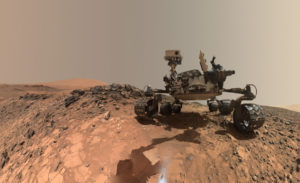
Curiosity Mars rover: On the prowl for science since August 2012.
Credit: NASA/JPL
Two NASA Mars rovers are on the upswing to start operations after a solar conjunction stand-down.
Now in Sol 1776, NASA’s Curiosity Mars rover is “easing back into mission planning” reports Ken Herkenhoff, a planetary geologist at the USGS in Flagstaff, Arizona.
“As the solar conjunction stand-down comes to an end, we are easing back into operations planning, focusing on Sol 1780, which will be planned in detail on Monday,” explains Herkenhoff.
Drill diagnostics continues
“The focus of the Sol 1780 plan will be more diagnostic testing of the drill and our last opportunity to examine the current arm workspace using the remote sensing instruments,” Herkenhoff adds.
This coming Tuesday will be a “soliday,” with no tactical planning.
A Wednesday (Sol 1781) plan for the Mars report was changed to move a drive of Curiosity earlier, allowing return of more data needed for Thursday (Sol 1782) planning.
“This required deleting the remote science block from the Sol 1781 plan, but a touch-and-go is still planned,” Herkenhoff notes. “We received the data we need to plan contact science and discussed potential targets. So we got a good head start on Sol 1780 planning, and look forward to returning to tactical operations next week!”
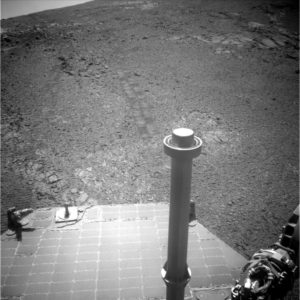
Opportunity Navigation Camera Sol 4793.
Credit: NASA/JPL
Opportunity operations
Meanwhile, also gunning up for more science duty is NASA’s Opportunity rover. It too is back in operation.
“We are at the top of Perseverance Valley, finishing up some stereo and color imaging,” explains Ray Arvidson of Washington University in Saint Louis. He is deputy principal investigator of the rover mission.
Opportunity is on tap to carry out Microscopic Imager (MI) and Alpha Particle X-Ray Spectrometer (APXS) work for the cobble called Parral, and likely will start driving down the valley on Monday’s plan, Arvidson told Inside Outer Space.
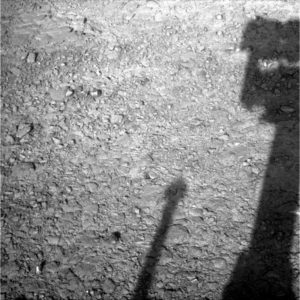
Panoramic Camera Sol 4792.
Credit: NASA/JPL
Arvidson said Opportunity faces minimum insolation on October 31st “so we are in the winter campaign.”
Ahead for the veteran Mars robot is to do roughly a 65 foot (20 meter) drive “down the valley from north facing slope to north facing slope (lily pads), stopping to do stereo and color imaging, and acquiring MI and APXS data for targets of interest,” Arvidson concludes.

The first X-37B Orbital Test Vehicle waits in the encapsulation cell of the Evolved Expendable Launch vehicle on April 5, 2010 at the Astrotech facility in Titusville, Fla. Half of the Atlas V five-meter fairing is visible in the background.
Credit: U.S. Air Force
The classified X-37B program is readying the next mini-shuttle for launch, this time atop a SpaceX Falcon 9. According to an FAA manifest, the August launch date and window is yet to be determined.
U.S. Air Force spokesperson, Captain Annmarie Annicelli, advised Inside Outer Space: “At this time, I do not have the launch date to release.”
Launch site for the X-37B – Orbital Test Vehicle-5 – is launch complex 39A at the Kennedy Space Center in Florida.
Four previous flights
The U.S. Air Force X-37B is an unpiloted miniature space plane.
According to the USAF, one onboard OTV-5 payload is the US Air Force Research Laboratory’s (AFRL) Advanced Structurally Embedded Thermal Spreader or ASETS-11. It will test experimental electronics and oscillating heat pipes in the long duration space environment.

The X-37B Orbital Test Vehicle mission 4 (OTV-4), the Air Force’s unmanned, reusable space plane, landed at NASA’s Kennedy Space Center Shuttle Landing Facility May 7, 2017.
Credit: USAF
Four previous X-37B missions were all lofted by United Launch Alliance (ULA) Atlas 5 rockets—a joint venture by Lockheed Martin and Boeing.
The last flight of the vehicle — OTV-4 — conducted on-orbit experiments for 718 days, extending the total number of days spent on-orbit for the OTV program to 2,085 days, according to the U.S. Air Force.
On May 7, 2017, OTV-4 landed at NASA’s Kennedy Space Center Shuttle Landing Facility – a first for the program as all previous missions ended with a tarmac touchdown at Vandenberg Air Force Base in California.

The U.S. Air Force’s X-37B Orbital Test Vehicle 4 is seen following its landing at NASA ‘s Kennedy Space Center Shuttle Landing Facility in Florida May 7, 2017.
Credit: U.S. Air Force courtesy photo
Record shattering
Flights of the craft have repeatedly broken its own long-duration record.
The first OTV mission began April 22, 2010, and concluded on Dec. 3, 2010, after 224 days in orbit.
The second OTV mission began March 5, 2011, and concluded on June 16, 2012, after 468 days on orbit.
An OTV-3 mission chalked up nearly 675 days in orbit when it landed Oct. 17, 2014.
The OTV-4 conducted on-orbit experiments for 718 days during its mission, extending the total number of days spent on-orbit for the OTV program to 2,085 days.

Last Air Force’s X-37B Orbital Test Vehicle mission touched down at NASA ‘s Kennedy Space Center Shuttle Landing Facility May 7, 2017.
Credit: Michael Martin/SAF
Shuttle lookalike
The robotic mini-space plane is one of two known reusable X-37B vehicles that constitute the space plane “fleet.” Appearing like a miniature version of NASA’s now-retired space shuttle orbiter, the reusable military space plane is 29 feet (8.8 meters) long and 9.6 feet (2.9 meters) tall, and has a wingspan of nearly 15 feet (4.6 meters).

Back to hangar for another flight day. U.S. Air Force X-37B/OTV-4 is rolled into facility after its May 7 landing at Kennedy Space Center.
Credit: Michael Martin/SAF
The space drone has a payload bay about the size of a pickup truck bed that can be outfitted with a robotic arm. It has a launch weight of 11,000 pounds (4,990 kilograms) and is powered on orbit by gallium arsenide solar cells with lithium-ion batteries.
Built by Boeing, the X-37B is managed by the Air Force Rapid Capabilities Office to perform risk reduction, experimentation and concept of operations development for reusable space vehicle technologies.

