Archive for the ‘Space News’ Category
 Author:
  September 9th, 2017
Curiosity Front Hazcam Right B image taken on Sol 1810, September 8, 2017.
Credit: NASA/JPL-Caltech
Now in Sol 1811, the Curiosity Mars rover has wheeled up to the steepest part of Vera Rubin Ridge that it will encounter along its climb and has unobstructed views across the lowlands of Gale crater to the rear of the rover.
The scene is improving as the air becomes clearer heading into the colder seasons, reports Roger Wiens, a geochemist at the Los Alamos National Lab in New Mexico. He is the Principal Investigator for Curiosity’s Chemistry & Camera (ChemCam) instrument.

Credit: NASA/JPL-Caltech/University of Arizona

This Curiosity Navcam Right B image from Sol 1807 captures a cliff face just to the left of the rover. The image is tilted due to the to the unusually high 15.5 degree tilt of the rover as it climbs the ridge. Part of Mount Sharp is in the background.
Credit: NASA/JPL-Caltech
New map
Meanwhile, a new Curiosity traverse map through Sol 1809 has been issued showing the route driven by the rover since landing in August 2012.
Numbering of the dots along the line indicate the sol number of each drive. North is up. The scale bar is 1 kilometer (~0.62 mile).
From Sol 1807 to Sol 1809, Curiosity had driven a straight line distance of about 28.90 feet (8.81 meters), bringing the rover’s total odometry for the mission to 10.79 miles (17.36 kilometers).

Curiosity Rear Hazcam Right B image acquired on Sol 1810, September 8, 2017.
Credit: NASA/JPL-Caltech
The base image from the map is from the High Resolution Imaging Science Experiment Camera (HiRISE) in NASA’s Mars Reconnaissance Orbiter.

Curiosity Mastcam Right image taken on Sol 1809, September 7, 2017.
Credit: NASA/JPL-Caltech/MSSS

Curiosity Mastcam Left image acquired on Sol 1809, September 7, 2017.
Credit: NASA/JPL-Caltech/MSSS
 Posted in
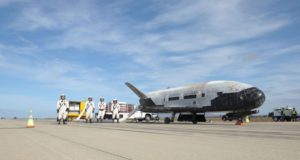
Technicians tend Air Force X-37B space plane after tarmac touchdown.
Credit: U.S. Air Force
This one-day symposium on September 6, 2017 was hosted by the Center for Strategic & International Studies (CSIS) Aerospace Security Project.
As both the U.S. military’s dependence on space and the threats posed to space systems have grown, some in Congress and the space community have called for sweeping changes in how space forces are organized, trained, and supported within the military.
Both the House and Senate versions of the National Defense Authorization Act for FY 2018 contain language that would significantly reorganize military space forces and authorities.

Credit: U.S. Air Force
Warfighting domain
The symposium explored how the military space enterprise should be organized given the increasing importance of space as a warfighting domain.
Speakers examined previous efforts to reorganize military space forces, problems that need to be addressed, and the pros and cons of different organizational models that have been tried in other parts of the military.
The Symposium agenda includes talks by Deborah Lee James, former Secretary of the Air Force and Rep. Mike Rogers (R-AL), leading advocate for a Space Corps and General Robert Kehler, USAF (ret.).
To view the program, go to this video at:

Image showing where transits of our Solar System planets can be observed. Each line represents where one of the planets could be seen to transit, with the blue line representing Earth; an observer located here could detect us.
Credit: 2MASS /A. Mellinger/R. Wells
There are thousands of known exoplanets. That raises the question, is Earth under the watchful eye of other starfolk?
A group of scientists from Queen’s University Belfast and the Max Planck Institute for Solar System Research in Germany have turned exoplanet-hunting on its head.
Their new study takes a look at how an alien observer might be able to detect Earth using methods now in use.
Transits of Earth
They find that at least nine exoplanets are ideally placed to observe transits of Earth, in the new research published in the journal Monthly Notices of the Royal Astronomical Society.
The team identified sixty-eight worlds where observers on those planets would see one or more of the planets in our Solar System transit the Sun.
Nine of these planets are ideally placed to observe transits of Earth. But none of the worlds are deemed to be habitable.
Undiscovered worlds
However, the research team estimated that there should be approximately ten (currently undiscovered) worlds that are favorably located to detect the Earth and are capable of sustaining life as we know it.
Still, to date, no habitable planets have been discovered from which a civilization could detect the Earth with our current level of technology.

Diagram of a planet (e.g. the Earth, blue) transiting in front of its host star (e.g. the Sun, yellow). Left: The lower black curve shows the brightness of the star noticeably dimming over the transit event, when the planet is blocking some of the light from the star. Right: How the transit zone of a Solar System planet is projected out from the Sun. The observer on the green exoplanet is situated in the transit zone and can therefore see transits of the Earth.
Credit: R. Wells
Best viewing
The team identified parts of the distant sky from where various planets in our Solar System could be seen to pass in front of the Sun – so-called ‘transit zones’ — concluding that the terrestrial planets (Mercury, Venus, Earth, and Mars) are actually much more likely to be spotted than the more distant ‘Jovian’ planets (Jupiter, Saturn, Uranus, and Neptune), despite their much larger size.
In a press statement, lead author Robert Wells, a PhD student at Queen’s University Belfast said: “Larger planets would naturally block out more light as they pass in front of their star. However the more important factor is actually how close the planet is to its parent star – since the terrestrial planets are much closer to the Sun than the gas giants, they’ll be more likely to be seen in transit.”
Future work
The team’s plans for future work include targeting transit zones to search for exoplanets, in the hopes of finding some which could be habitable.
The new work “Transit Visibility Zones of the Solar System Planets”, R. Wells, K. Poppenhaeger, C.A. Watson, R. Heller, is published in the Monthly Notices of the Royal Astronomical Society.
A copy of the paper is available from:

U.S. Rep. Jim Bridenstine
President Trump’s nomination of Congressman James Bridenstine to lead NASA has sparked both praise and criticism from various quarters.
For example, U.S. Sen. Ted Cruz (R-Texas), chairman of the Senate Subcommittee on Space, Science and Competitiveness said: “I applaud President Trump for nominating Rep. Jim Bridenstine to be the next NASA administrator,” the lawmaker said.
“I am confident that as the next NASA administrator, Jim will work hard to advance our national space policy goals, expand human space exploration and secure America’s leadership in space,” Cruz said.
Then there are comments from Florida’s senators Republican Marco Rubio and Democrat Bill Nelson. They have questioned the nomination of Oklahoma Congressman Jim Bridenstine, explaining a “politician” shouldn’t lead the nation’s space program.
Space pedigree
“Mr. Bridenstine will advance the commercial space sector, often referred to as “new space,’” views Milton “Skip” Smith, co-chair of Sherman & Howard’s Space Law Practice. He is one of sixteen space industry leaders and lawyers on the Board of Directors of the International Institute of Space Law.
“Although he is sure to draw criticism from both parties due to his lack of a space ‘pedigree,’ he is one of the few people who can step into the NASA Administrator’s position and lead NASA further away from a large government bureaucracy and towards an organization that efficiently and effectively manages major space activities instead of doing them.”

NASA Administrator, James Webb.
Credit: NASA
Qualifications
Bridenstine as the next NASA Administrator “has raised questions about what qualifications are needed to serve in that position,” points out Marcia Smith of SpacePolicyOnline.com. “Eleven men have served as Administrator of NASA since the agency was created in 1958. Some media sources are reporting that all of them had degrees in science or engineering or had served as an astronaut. That is not correct,” she explains.
Choice at hand
Noted Moon exploration expert, Paul Spudis, has also chimed in with thoughts on the job of NASA Administrator.
“To Senators Rubio and Nelson: Do you want a meaningful, productive and successful national space program? If so, you will support the President’s nomination of Jim Bridenstine for NASA Administrator,” Spudis suggests.
“However, if you are content with the debilitating and pointless status quo – the stagnation and withering of NASA – then it is understandable that you might want someone other than Jim Bridenstine at the helm. That is the choice at hand,” Spudis concludes.

NASA logo
Wanted: American space renaissance
Bridenstine is a former executive director of the Tulsa Air and Space Museum & Planetarium and is author of the American Space Renaissance Act (H.R. 4945).
The mission of H.R. 4945 — The American Space Renaissance Act (ASRA) — is to permanently secure the United States as the preeminent spacefaring nation. The ASRA has three key objectives: Project military strength and protect our space based capabilities; provide certainty to encourage commercial space innovation; and promote stability, accountability, and mission clarity at NASA

Credit: NASA
Moon backer
Late last year, Bridenstine wrote a blog post, “Why the Moon Matters,” explaining that “from the discovery of water ice on the Moon until this day, the American objective should have been a permanent outpost of rovers and machines, with occasional manned missions for science and maintenance, in order to utilize the materials and energy of the Moon to drive down the costs and increase the capabilities of American operations in cis-lunar and interplanetary space.”
To read that post in full Moon status, go to:
https://bridenstine.house.gov/blog/?postid=772
To take a look at H.R.4945 – The American Space Renaissance Act, go to:
https://www.congress.gov/bill/114th-congress/house-bill/4945
Also, go to:
https://bridenstine.house.gov/space/
Reading matters
As the Bridenstine nomination moves forward through Congress, here’s a collection of items worth a read:
- Will Thomas of FYI from the American Institute of Physics: “NASA Nominee Jim Bridenstine Has Bold Vision for Space, Unclear Intentions for Science” Go to:
- Marcia Smith of SpacePolicyOnline.com has created a new fact sheet summarizing the educational background and professional experience of previous NASA Administrators. Go to:
https://spacepolicyonline.com/wp-content/uploads/2017/09/NASA-Administrators.pdf
- Marc Caputo of Politico: “Rubio, Nelson blast Trump’s NASA pick” Go to:
http://www.politico.com/story/2017/09/01/marco-rubio-bill-nelson-trump-nasa-jim-bridenstine-242269
- Paul Spudis essay: Thoughts on the job of NASA Administrator” Go to:
http://www.spudislunarresources.com/blog/thoughts-on-the-job-of-nasa-administrator/

The Moon as seen from the International Space Station, taken by ESA British astronaut, Tim Peake.
Credit: NASA/ESA
A House Committee on Science, Space, and Technology held today “Private Sector Lunar Exploration.”
The hearing’s purpose focused on NASA support of private sector exploration of the Moon through various programs.
The private sector is also investing their own funding in the hopes of serving a future market for transportation, cargo delivery, and surface operations – including on-the-spot resource utilization.

Cargo carrying Peregrine lander.
Credit: Astrobotic
Missions being readied
For example:
- Moon Express plans to launch a mission to the Moon later this year or early next year.
- Astrobotic recently announced a mission in 2019.
- Blue Origin disclosed its “Blue Moon” concept last spring.
- The United Launch Alliance and SpaceX have also indicated plans to operate in cislunar space in the near-future.
The Hearing reviewed these efforts, and NASA’s role, in order to better understand the challenges and opportunities that they present.
Witnesses
Here are the hearing witnesses and their respective written testimony:
- Jason Crusan, Director, Advanced Exploration Systems, NASA
- Bob Richards, Founder and CEO, Moon Express, Inc.
- John Thornton, Chief Executive Officer, Astrobotic Technology, Inc.
- Bretton Alexander, Director of Business Development and Strategy, Blue Origin
- George Sowers, Professor, Space Resources, Colorado School of Mines
A statement of Space Subcommittee Chairman Brian Babin (R-Texas) on private sector lunar exploration is available here at:

The cost of propellant if shipped from earth (blue) or sourced in space (green).
Credit: ULA/Sowers
To watch the hearing video, go to:
https://www.youtube.com/watch?time_continue=10&v=nlKkwqGjGTc

Credit: Long Now Foundation
A seminar by Carolyn Porco on “Searching for Life in the Solar System” is part of The Long Now Foundation’s seminars about long-term thinking.
Planetary scientist Carolyn Porco led the imaging team of the Cassini mission to Saturn, which is about to complete its 20-year exploration of the entire system of rings and moons.
Porco has authored over one hundred scientific papers and also served as the imaging scientist of the Voyager mission to the outer solar system in the 1980s.
The Long Now Foundation fosters long-term thinking and responsibility in the framework of the next 10,000 years. Stewart Brand is president of The Long Now Foundation and co-founder of Revive & Restore.
To watch this seminar, visit the Carolyn Porco Seminar Page at:
http://longnow.org/seminars/02017/jul/24/searching-life-solar-system/
For more information on the Foundation, go to:

Credit: Boeing
Boeing, the maker of the robotic Air Force X-37B space plane, has issued a new video.
The video was released as part of the SpaceX launch today as prelude to the program’s Orbital Test Vehicle (OTV-5) mission.
Long duration record
Flights of the craft in the past have repeatedly broken its own long-duration record.
The first OTV mission began April 22, 2010, and concluded on Dec. 3, 2010, after 224 days in orbit.
The second OTV mission began March 5, 2011, and concluded on June 16, 2012, after 468 days on orbit.
An OTV-3 mission chalked up nearly 675 days in orbit when it landed Oct. 17, 2014.

The X-37B Orbital Test Vehicle mission 4 (OTV-4), the Air Force’s unmanned, reusable space plane, landed at NASA’s Kennedy Space Center Shuttle Landing Facility May 7, 2017.
Credit: USAF
On May 7, 2017, OTV-4 landed at NASA’s Kennedy Space Center Shuttle Landing Facility – a first for the program as all previous missions ended with a tarmac touchdown at Vandenberg Air Force Base in California. The OTV-4 conducted on-orbit experiments for 718 days during its mission, extending the total number of days spent on-orbit for the OTV program to 2,085 days.
Built by Boeing
Built by Boeing, the robotic mini-space plane is one of two known reusable X-37B vehicles that constitute the space plane “fleet.”
Appearing like a miniature version of NASA’s now-retired space shuttle orbiter, the reusable military space plane is 29 feet (8.8 meters) long and 9.6 feet (2.9 meters) tall, and has a wingspan of nearly 15 feet (4.6 meters).
Technicians tend X-37B space plane after tarmac touchdown.
Credit: U.S. Air Force
The space drone has a payload bay about the size of a pickup truck bed that can be outfitted with a robotic arm. It has a launch weight of 11,000 pounds (4,990 kilograms) and is powered on orbit by a solar cell-laden array.
To view the just-released video, go to:

Official SpaceX OTV-5 mission patch.
Credit: SpaceX
For the first time, SpaceX’s Falcon 9 rocket was used to launch the reusable U.S. Air Force’s X-37B Orbital Test Vehicle (OTV). Previously, the robotic space drone was launched atop an Atlas 5.
This is the fifth mission of the X-37B program.
Launch time
SpaceX launch of OTV-5 from Launch Complex 39A (LC-39A) at NASA’s Kennedy Space Center in Florida took place on Thursday, September 7 at 9:50 a.m. EDT or 13:50 UTC.
Following stage separation, Falcon 9’s first stage successfully landed at SpaceX’s Landing Zone 1 (LZ-1) at Cape Canaveral Air Force Station, Florida.
Here is the playback of the launch, along with a new Boeing video detailing the X-37B program:
https://www.youtube.com/watch?v=9M6Zvi-fFv4

The U.S. Air Force’s X-37B Orbital Test Vehicle 4 is seen after landing at NASA ‘s Kennedy Space Center Shuttle Landing Facility in Florida on May 7, 2017.
Credit: U.S. Air Force courtesy photo
Experimental payloads
The X-37B missions are under the wing of the Air Force Rapid Capabilities Office.
According to a U.S. Air Force Space Command statement: “The fifth OTV mission continues to advance the X-37B’s performance and flexibility as a space technology demonstrator and host platform for experimental payloads.”
Additionally, the statements notes: “This mission carries small satellite ride shares and will demonstrate greater opportunities for rapid space access and on-orbit testing of emerging space technologies. Building upon the fourth mission and previous collaboration with experiment partners, this mission will host the Air Force Research Laboratory Advanced Structurally Embedded Thermal Spreader payload to test experimental electronics and oscillating heat pipe technologies in the long duration space environment.”
Many firsts
Also noted by the Air Force statement is that this fifth OTV mission will be launched into, and landed from, a higher inclination orbit than prior missions to further expand the X-37B’s orbital envelope.
The X-37B Orbital Test Vehicle mission 4 (OTV-4), the Air Force’s unmanned, reusable space plane, landed at NASA’s Kennedy Space Center Shuttle Landing Facility May 7, 2017.
Credit: USAF
“The many firsts on this mission make the upcoming OTV launch a milestone for the program,” said Randy Walden, the director of the Air Force Rapid Capabilities Office. “It is our goal to continue advancing the X-37B OTV so it can more fully support the growing space community.”
The X-37B program completed its fourth mission on May 7, 2017, landing at the Kennedy Space Center after 718 days in orbit and extending the total number of days spent in orbit by X-37B vehicles to 2,085.

Credit: AFRL
On the manifest
While the total manifest on the space plane is classified, it has been announced that onboard the OTV-5 is the U.S. Air Force Research Laboratory’s (AFRL) second Advanced Structurally Embedded Thermal Spreader (ASETS-II) flight experiment.

Cutaway of an oscillating heat pipe (OHP) showing its microchannel pattern.
Credit: AFRL
The ASETS-II experiment is managed by the AFRL Space Vehicles Directorate located at Kirtland Air Force Base, New Mexico.
ASETS-II will measure the microgravity performance, startup characteristics, and long term performance of an oscillating heat pipe (OHP) on orbit.
The ASETS-II experiment is made of three low-mass, low-cost OHPs and an electronics/experiment control box.

ASETS-II
Credit: AFRL
According to AFRL, the OHP is a simple, wickless heat pipe capable of rejecting more than 200 times the maximum heat load of an axially grooved heat pipe, and transporting more than 45 times more heat than copper.

Curiosity Navcam Right B image from Sol 1807, September 5, 2017.
Credit: NASA/JPL-Caltech
Now in Sol 1908, NASA’s Curiosity rover is on a steep roll up Vera Rubin Ridge.
In a report by Roger Wiens of the Los Alamos National Laboratory in New Mexico, he calls it a “Thread of Life Ledge” at elevation -4,202 meters.”
“Curiosity is on the steepest part of Vera Rubin Ridge that it will encounter along its climb,” Wiens says. “The machine is performing superbly,” he adds, having recently driven over 90 feet (28 meters) and having climbed nearly 60 feet (18 meters) vertical elevation in four planning sols.
The rover’s current elevation is -4202 meters.

Curiosity Mastcam Left image acquired on Sol 1807, September 5, 2017.
Credit: NASA/JPL-Caltech/MSSS
Extreme elevations
Wiens notes that Mars has far more extreme elevations than the continents on Earth, and it is reflected in the elevations of the landing sites to date.
For example, Curiosity landed at almost the same elevation as Viking 2 which landed in 1976 at -4.5 kilometers. Curiosity could pass the elevation of Phoenix, which landed in 2008 at -4.14 kilometers. The highest-elevation successful landing site to date was Opportunity, in Meridiani Planum, at -1.44 km. All elevations are measured relative to the mean planet radius, Wiens observes.
Unobstructed viewing
“Curiosity now has great, unobstructed views across the lowlands of Gale crater to the rear of the rover. The view is improving as the air becomes clearer heading into the colder seasons,” Wiens explains.
As scripted, rover instrument activities for Sol 1809 called for a Dynamic Albedo of Neutrons (DAN) passive observation, as well as a Rover Environmental Monitoring Station (REMS) and Radiation Assessment Detector (RAD) “get data” observations.
Also on tap is a short Alpha Particle X-Ray Spectrometer (APXS) observation of “Chamberly,” and four Mars Hand Lens Imager (MAHLI) images with stereo.

Curiosity Navcam Right B image from Sol 1807, September 5, 2017.
Credit: NASA/JPL-Caltech
Linescans
Wiens notes that Curiosity’s Chemistry and Camera (ChemCam) is shooting a 10-point linescan of “Chamberly” at 1.5 milliradian spacing, as well as 5-point linescans of “Locust Island Ledge” and, of all names, “Thread of Life Ledge.”
The robot’s Mastcam is providing documentation of these targets as well as imaging “Scrag Island,” “Wohoa Bay,” and “Shutdown Mountain.”

Curiosity Mars Hand Lens Imager (MAHLI) of nodules on the Red Planet. MAHLI is located on the turret at the end of the rover’s robotic arm. Image acquired on Sol 1807, September 5, 2017.
Credit: NASA/JPL-Caltech/MSSS
Going to take you higher!
A planned drive of Curiosity is anticipated to be around 32 feet (10 meters), taking the rover higher on the ridge.
A second sol of activity for the robot is to include a 360 degree dust devil survey with Navcam, Mastcam monitoring of the rover deck, and a new ChemCam target that will be self-selected by onboard autonomous software.
The rover is slated to also image the work space around its new location, Wiens concludes.

Curiosity Mastcam Left image acquired on Sol 1805, September 3, 2017.
Credit: NASA/JPL-Caltech/MSSS
As for NASA’s Curiosity robot busy at work on Mars, “someone get that rover a water bottle and some trail mix!”
That’s the view of Michelle Minitti, a planetary geologist at Framework in Silver Spring, Maryland.
Now in Sol 1807, Curiosity is on a steep trail, driving up 20 degree slopes on the flank of Vera Rubin Ridge. “Curiosity will acquire an amazing variety of science observations of the ridge rocks,” Minitti reports.
Long list of tasks
There’s a long list of science tasks assigned to Curiosity directly related to the long list of geologic features surrounding the rover on the ridge.
“The rover is now parked on many of the bedding structures observed from farther down the ridge, and the science team selected several particularly nice examples – the targets “Jordans Delight,” Mount Waldo,” and “Three Bush Island” – for detailed Mastcam imaging,” Minitti notes. “Other features of interest were the gray, rounded nodules observed all around the rover.”

Curiosity Front Hazcam Right B photo taken on Sol 1806, September 4, 2017.
Credit: NASA/JPL-Caltech
Inspecting nodules
On the plan was use of the Chemistry and Camera to shoot a collection of those nodules embedded in the bedrock at “Toothacher Island.”
The robot’s Mars Hand Lens Imager (MAHLI) and Alpha Particle X-Ray Spectrometer (APXS) were to acquire images and chemistry data from a collection of loose nodules at “Gunning Rocks,” followed by a Mastcam multispectral observation of the target.
Mastcam will also image “Cobscook Bay,” another collection of loose nodules.
Bedrock veins
Minitti adds that the ChemCam will gather data from an example of the long, straight, veins apparent in the bedrock in front of the rover at “Narragaugus,” and keep track of the bedrock chemistry at a small vertical exposure of bedrock, “Phoebe Ledge.”

Curiosity Navcam Left B image acquired on Sol 1806, September 4, 2017.
Credit: NASA/JPL-Caltech
ChemCam, APXS and MAHLI will uniquely analyze another bedrock target, “Robinson Rock.” Both before and after ChemCam shoots the target, MAHLI will acquire tightly spaced, overlapping images of the target which will be used to build a small-scale digital elevation model (DEM) of the surface.
“The goal is to be able to measure the ChemCam laser pits in the DEM,” Minitti notes. “Of course, the ChemCam shots will also provide chemistry of Robinson Rock complementary to the APXS analysis of the target.”
Dust load in atmosphere
After a drive of roughly 88 feet (27 meters), Curiosity will be in a spot right below the smooth bedrock cap on the lower part of the Vera Rubin Ridge. Before and after that drive, the robot will tear her eyes off the rocks and scan the skies above Gale, Minitti reports.
“At both early morning and late afternoon times, Curiosity will assess the dust load in the atmosphere, and acquire images and movies seeking dust devils and clouds,” Minitti adds.
The plan calls for Curiosity to utilize its Rover Environmental Monitoring Station (REMS), the Radiation Assessment Detector (RAD) and make passive Dynamic Albedo of Neutrons (DAN) measurements. DAN will actively sense the Vera Rubin Ridge subsurface after the drive, Minitti concludes.

