Archive for the ‘Space News’ Category
 Author:
 November 2nd, 2017

U.S. Rep. Jim Bridenstine
On November 1, there was a “contentious” nomination hearing for Rep. Jim Bridenstine (R-OK) to be NASA Administrator, split along partisan lines.
Bridenstine answered questions for most of the two-and-a-half hour hearing.
Democratic Senators questioned his credentials and viewpoints about climate change, sexual harassment and other issues that could affect how he runs the agency and its personnel. Republicans defended him and chafed at the tenor of the hearing. The committee will vote on the nomination on November 8.
That’s part of the appraisal by Marcia Smith, editor of SpacePolicyOnline.com.

Democrat, Sen. Bill Nelson (D-FL).
Credit: Hearing screen capture/Inside Outer Space
Technical qualifications
In Smith’s posting, she explains:
The committee’s top Democrat, Sen. Bill Nelson (D-FL), has made no secret of his disapproval from the beginning. The Senator laid out his case that Bridenstine is not the person for the job, questions Bridenstine’s technical qualifications to run the agency and be the final arbiter on safety decisions regarding the three new human spacecraft that will debut in the next two years. Nelson also thinks that it is inappropriate for a politician to run an agency that should be apolitical.
Change of climate
Two of the more substantive issues were Bridenstine’s views on climate change considering that NASA spends almost $2 billion a year on earth science research and whether he has the technical qualifications to lead the agency at a time when three new vehicles — the commercial crew systems Crew Dragon and Starliner plus NASA’s own Orion — will be making their maiden flights.

DSCOVR spacecraft view of the entire sunlit side of Earth.
Credit: NASA
“In the past, Bridenstine had indicated that he did not accept the scientific consensus that the climate is changing because of human activity,” Smith notes. At the nomination hearing, he said that he accepts that humans are a cause of climate change, but would not go as far as to say that it is the primary cause. He went on to say that NASA is the only agency in the world that can do the kind of science needed to answer questions like that, Smith reports.
Bridenstine views
On other issues, Smith posts a number of Bridenstine opening statements or in answer to questions, such as:
— NASA needs a consensus-driven agenda based on the national interest;
— If confirmed, he will build on the work accomplished by NASA under the previous administration, and follow the NASA Transition Authorization Act, appropriations bills, and the Decadal Surveys produced by the National Academies;
— He agrees with the Trump Administration’s goal of sending humans to Mars with the Moon as a proving ground;

Credit: ESA/NASA
— He will work to promote a NASA culture where safety, transparency, and independent oversight are celebrated;
— He wants to drive the commercial space economy further out beyond Earth;
— He will lead a space technology program to develop solar electric propulsion, in-space robotic assembly, and closed-loop environmental control and life support systems to form the foundation of a future expansion of economic activity in low Earth orbit and beyond;
— Bridenstine wants to leverage everything the United States and its international partners have to offer so NASA can carry out not only exploration missions back to the Moon and on to Mars, but Earth Science, Planetary Science, Heliophysics, Astrophysics and Aeronautics Research;
— He supports the Orion program 100%; and
— His “highest ambition is for NASA to remain apolitical.”
The committee announced that it would mark up Bridenstine’s nomination next week, on November 8, at 9:45 am ET.
To read Marcia Smith’s full posting on the nomination hearing, go to:
Contentious Bridenstine Nomination Hearing Splits Along Party Lines – UPDATE
For more detail on the hearing’s give and take, check out SpacePolicyOnline live tweets (@SpcPlcyOnline).
 Posted in


CASSIOPeiA power-beaming satellite.
Credit: Ian Cash/Chris Moore
A new Solar Power Satellite (SPS) concept has been advocated and dubbed CASSIOPeiA, short for Constant Aperture, Solid-State, Integrated, Orbital Phased Array).
This SPS design has no rotating (or otherwise moving) parts, yet maintains a constant solar collecting area directly facing the Sun while its retrodirective microwave beam is steered to an Earth-based rectifying antenna.

CASSIOPeiA power-beaming satellite.
Credit: Ian Cash/Chris Moore
Establishing a market
Ian Cash of SICA Design Ltd, presented the new SPS concept during a Space Solar Power Workshop held last month in Montreal, Canada.
Cash reported that the simplicities and mass-savings inherent in a solid state SPS design “will enable a single payload, self-deploying SPS to pay back the energy costs over the first few months of operation, retiring the technical and financial risks before progress is made towards multi-terrawatt levels of power delivery from geosynchronous orbit.”
CASSIOPeiA offers a means to initiate beamed solar power from near-space “in the next few years, establishing a market for the reusable launch vehicles to follow,” Cash suggested.
The concept was aired at the 5th Annual IEEE International Conference on Wireless for Space and Extreme Environments (WISEE 2017), held on October 10 to 12, 2017 at Concordia University, Montréal, QC, Canada.
For a copy of his paper, go to:
A video of Cash explaining the CASSIOPeiA is available at:

Next year promises to be a milestone-making period of time in space exploration.
In 2018, just under a 100 missions are expected to take off, leaving in their wake a number of questions, such as, with private companies getting increasingly involved in the space race, who will be rocketing to success? Will NASA lead the way or be overtaken by the likes of SpaceX?
An interesting and thoughtful infographic has been prepared by the UK’s RS Components.
Busy year
Among next year’s space activities, take note:
- NASA’s InSight seismology probe is expected to land on Mars.
- China is to continue its robotic exploration of the Moon.
- The European Space Agency (ESA) will be lofting their first mission to Mercury, with BepiColombo, set to reach its destination in 2025.
- Japan’s Hayabusa-2 spacecraft will arrive at its target – asteroid Ryugu, then return a sample to Earth in December 2020.
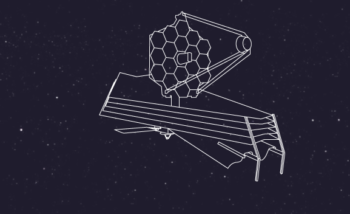
James Webb Space Telescope.
Credit: RS Components. - India is slated to launch the Chandrayaan-2 to the Moon, an orbiter, lander and a rover.
- NASA’s long-awaited James Webb Space Telescope is set to head for the heavens.
To view this new graphic by RS Components, go to:
http://uk.rs-online.com/web/generalDisplay.html?id=2018-space-race

Curiosity Front Hazcam Left B image taken on Sol 1861, October 31, 2017.
Credit: NASA/JPL-Caltech
“We are starting to suspect that Vera Rubin Ridge might be cursed,” reports Ryan Anderson, a planetary geologist at the USGS in Flagstaff, Arizona.
“After the challenges we faced last week, we were hoping for a successful weekend plan but alas, it was not to be. Over the weekend Curiosity’s arm didn’t heat up as much as it was supposed to, so the arm activity failed and most of the weekend plan was lost,” Anderson adds.
Keep trying
The game plan now is to try, try again.
NASA’s Curiosity rover is now in Sol 1861.
The Sol 1861-1862 plan is to see another attempt at dropping off the “Ogunquit Beach” sample in the Sample Analysis at Mars (SAM) Instrument Suit, followed by SAM Evolved Gas Analysis (EGA) of the sample. SAM will heat the sample and measure what gases are produced.
Remote sensing recovery
On sol 1862, the plan calls for a science block where scientists will try to recover some of the remote sensing that was planned for the past weekend. This will begin with a Mastcam mosaic that builds upon some previous Mastcam images of “Region 7”, followed by Chemistry and Camera (ChemCam) and Mastcam observations of the bedrock targets “Schmidtsdrif” and “Estecourt” as well as the soil target “Lisbon.”

Curiosity Rear Hazcam Left B photo acquired on Sol 1861, October 31, 2017.
Credit: NASA/JPL-Caltech
Anderson notes that the science block will end the way it began, with another Mastcam mosaic building upon a different previous mosaic of an area currently called “Region 6.”
Drive ahead
Navcam is slated to also watch for clouds overhead and Mastcam will do a routine observation of the rocks and soil near the rover to check for any changes.
“Hopefully we have seen the worst of Vera Rubin Ridge’s ‘curse,’” Anderson concludes, “and we’ll be able to finish this SAM analysis and start driving again shortly!”

Credit: Elon Musk/SpaceX
A new attitude poll of more than 600 Americans regarding business in space has been conducted by the Brodeur Partners’ Space Group.
Is space still relevant? Survey says yes, but only if it’s personal.
According to the group, the new survey found that Americans:
- See national security as the top space activity;
- Support private sector activity in space, however, they want some degree of government regulation, especially privacy protection;
- Expect space development to directly benefit Earth;
- Believe that the U.S. is a leader, if not the leader, in space technology.

Credit: Brodeur Partners’ Space Group.
Private Sector Role
While historically space has been a government activity, Americans today actually prefer private over government investment in space-based activities. According to the survey, a majority of Americans actually support government financial incentives for those private space companies.
Earthly Benefits
At the same time, nearly two-thirds (65 percent) of Americans believe that government investments should be in those space programs that have an immediate benefit to life on Earth.
The survey also found that space tourism needs to make the case that it will benefit the majority of the population: three-quarters (75 percent) of Americans agree that space travel will only benefit a few wealthy people. Support is also tepid for government investment in deep space exploration: less than a majority (46 percent) of Americans support spending government money to send a mission to Mars.

Virgin Spaceship Unity (VSS Unity) touches down after flying freely for the first time after being released from Virgin Mothership Eve (VMS Eve) on December 3, 2016 in the Mojave Desert.
Credit: Virgin Galactic
Privacy Paramount
Everyone expects the skies to soon be filled with small satellites capturing increasingly detailed data about activities on Earth. Americans are wary of the privacy implications: strong majorities believe there should be privacy limitations on satellite companies capturing this data (72 percent), and government should have a regulatory role regarding private companies engaged in space enterprises (61 percent).
National Security
Space-based systems operators promise to improve life on Earth in a variety of ways, including communications, climate, navigation and crop monitoring. None is more important to our respondents than defense, the clear priority among seven services mentioned. At the same time, the survey suggests that people may not realize the important role that space commerce plays in everyday activity like GPS and navigation systems.
Global Leadership
A solid majority of Americans believe the U.S. is a leader in space technology, with over one third of Americans saying we are “the clear global leader.” Fewer consider us the clear leader in medical technology, energy, automotive and environmental technology.

Credit: US Air Force
Beyond planet opportunities
The Boston-based Brodeur Space Group was launched in September 2017 to help clients seize opportunities beyond this planet. Emerging companies are developing satellites, organizing tours of space, planning to mine asteroids, and imagining cities on Mars.
For more information on the survey and the Brodeur Space Group, go to:

Credit: Axiom Space
Axiom Space of Houston, Texas is promoting its skills in building the world’s first privately-owned International Commercial Space Station.
The goal of Axiom’s international commercial space station is to stimulate growth of the low Earth orbit (LEO) user community. To do so, the group sees itself as providing additional and expanded services at the International Space Station (ISS) and allowing a seamless transition to the Axiom station when ISS is retired.
The Axiom Space strategy is to allow NASA to realize their mandate to transition the multibillion-dollar LEO market to the private sector.

Credit: Axiom Space
Space market
Axiom is underscoring several points:
- The space market exceeds $330 billion today and some estimates show that number growing to over $2.7 trillion by 2030. Human spaceflight is one of the sectors within the space market positioned for greatest growth.
- There are two main forces pushing the growth of human spaceflight. The first is the many countries who want to join the family of space-faring nations. The second is the burgeoning area of in-space manufacturing that serves industries across the globe.
- There are big opportunities ahead for investors as the governments who own the International Space Station prepare to turn the space station business over to the private sector.
Investor insights
Axiom has issued an interesting document: Investor Insights: The Promise of Human Spaceflight.
To view the document, go to:
Also, go to this informative video:

Laser propulsion
Credit: Q. Zhang
Experts in interstellar travel have picked future candidates to make the first extrasolar trek.
Their names: Caenorhabditis elegans and Tardigrades, otherwise known as water bears.
“These are real interstellar passengers” says Philip Lubin, head of the Starlight program at the University of California, Santa Barbara (UCSB).
“We are developing the capability to test whether terrestrial life, as we know it, can exist in interstellar space by preparing small life forms…C. elegans and radiation resistant Tardigrades…which are ideal candidates to be our first interstellar travelers,” Lubin explains.

Caenorhabditis elegans – ubiquitous species of nematode.
Courtesy: J. Rothman
Directed energy
Lubin spoke last month and updated his research findings supported by NASA’s Innovative Advanced Concepts (NIAC) program.
At the university, Lubin, his students and research colleagues have established the Starlight program, known as DEEP-IN (Directed Energy Propulsion for Interstellar Exploration) and DEIS (Directed Energy Interstellar Studies), the NASA-supported work to use large scale directed energy to propel small spacecraft to relativistic speeds to enable humanity’s first interstellar missions.

Water-dwelling micro-animals called Tardigrades.
Courtesy: J. Rothman
The bottom line for interstellar travel: “It will not be easy,” Lubin says. “There are many difficult technical issues. It will not be cheap. But it is possible.”
Laser focused
Humanity’s first interstellar missions will ride a beam of laser light. Indeed, the work of Breakthrough Initiatives in San Francisco – via its Breakthrough Starshot effort — is spurring a revolution in spacecraft miniaturization that can contribute to the development of “StarChips” that are centimeter- and gram-scale. Lubin is a project leadership member.

Shrinking spaceships.
Credit: P. Lubin
The Starchip wafer work is progressing, Lubin advises, and is “boldly going where no chip has gone before.”
In his “Directed Energy for Relativistic Flight” report to NIAC, Lubin cited collaboration with the lab of Joel Rothman in the Department of Molecular and Cellular Developmental Biology at UCSB Santa Barbara.
The upshot, Lubin noted, is that Caenorhabditis elegans, or C. elegans for short, a ubiquitous species of nematode found in soil samples world-wide, and the water-dwelling micro-animals called Tardigrades, are perfect candidates to be “our first interstellar travelers.”
Rothman told Inside Outer Space that much of the Caenorhabditis elegan literature calls them soil nematodes, but they are generally found in mulch piles with rotting fruits world-wide.”
Star trek traits
Lubin’s team explains that, before we ever have the technology to send humans to other stars, a plan is to send tiny animals that have been shown to tolerate extreme environments of cold, heat, the vacuum of space, extreme dehydration, high accelerations (tens of thousands of g’s), and high doses of radiation – and survive unscathed.
These minuscule creatures have already been propelled into space. They’ve travelled into low Earth orbit during the Space Shuttle program and have also flown on the International Space Station.
C. elegans and tardigrades have a number of traits that make them model passengers for long interstellar voyages, reports Lubin and his study group.
“Besides being microscopic, and thus conveniently fitting on our first interstellar wafer craft, they can be frozen and put into a state of anhydrobiosis, meaning they can be dehydrated and put into suspended animation. When they are re-hydrated, they wake up as good as new!”
UCSB’s Rothman advises via e-mail: “We can do one or the other (or both) but anyhydrobiosis doesn’t require freezing and vice-versa.”

A revolution in spacecraft miniaturization is underway.Credit: P. Lubin
Wake-up calls
Scientists in the UCSB Rothman Lab are studying the behavior of these tiny subjects to better understand their behavior and needs before sending them into space.
Scientists in the Lubin Lab, in the Starlight Program, are figuring out what kind of tiny chambers to design for them, where to place them on “wafersats,” and how to wake them up at various points in the journey and remotely observe their behavior.
Key questions to ponder: Will they survive? Could they take root on another planet with water? And then there’s the question – how did they get to Earth in the first place? Could they have come here from some other solar system?
Rich broth…seed source?
Rothman advises Inside Outer Space: “There is no reasonable doubt that worms and tardigrades arose on this planet from the earliest terrestrial organisms. The question really is how did life get to the Earth in the first place? Did it spontaneously arise in the rich broth of the early seas of the young planet or was it seeded from another distant source?”
Furthermore, Rothman notes that although it’s reasonable to wonder whether the simplest life forms (bacteria) might have come to Earth from another solar system, “it is virtually certain that all complex life forms, including animals arose on this planet during the long process of biological evolution that began about 4 billion years ago, shortly after the planet could even conceivably sustain life. That conclusion is based in part on the universality of the genetic code, metabolic pathways, and the structure of many universally proteins, as well the evolutionary relationships throughout the tree of life that can be inferred from the analysis of extant genomes.”
Interstellar mandate
In his NIAC-sponsored work, Lubin underscored the major challenges ahead for directed energy interstellar flight.
“Clearly there are many technical challenges. This is a long-term humanity changing program,” Lubin says. The biggest challenge is that NASA, the U.S. government does not plan 30-50 years ahead in space. Perhaps a public/private alliance is needed. Similarly, what may be required is a new division of NASA or new agency whose mandate is interstellar flight.

Shooting for the stars! UCSB team.
Credit: P. Lubin
How do we maintain the drive towards this goal? Interstellar travel necessitates a dedicated program over a long period, and the U.S. should lead in this transformation, Lubin concludes.
For more information on Starlight – Directed Energy for Relativistic Interstellar Missions work, go to:
http://www.deepspace.ucsb.edu/projects/starlight

Curiosity Navcam Right B image taken on Sol 1858, October 28, 2017.
Credit: NASA/JPL-Caltech
The Curiosity Mars rover is now in Sol 1858, busily engaged in performing a “working weekend,” reports Mark Salvatore, a planetary geologist at the University of Michigan in Dearborn.
“Following a series of setbacks this week, Curiosity is on track to have a productive, albeit stationary, weekend,” Salvatore explains.
Series of headaches
Last week’s communication issue and possible difficulties in delivering the “Ogunquit Beach” sample to the Sample Analysis at Mars (SAM) instrument, Salvatore adds, “have given the science team a series of headaches as we try to make progress along Vera Rubin Ridge.”

Curiosity Rear Hazcam Left B image acquired on Sol 1857, October 27, 2017.
Credit: NASA/JPL-Caltech
Regarding the sample, the NASA robot’s Mastcam images last week showed that the sample may not have made it into the SAM instrument, reported Rachel Kronyak, a planetary geologist at the University of Tennessee in Knoxville last week. As a precautionary measure, it was decided to forego the analysis due to a chance that the SAM sample cup is empty.
In addition, the team discovered an error with the left Mastcam data transfer that has marked the instrument temporarily “sick” and is preventing researchers from acquiring new data from it until after the weekend plan. “Nonetheless, the team is optimistic moving into the weekend, and has planned a really nice suite of observations,” Salvatore notes.
One more time
Curiosity is slated to try one more time to deliver the Ogunquit Beach sample to the SAM instrument, and SAM will hopefully perform an evolved gas analysis (EGA) on the sample overnight on the first evening of the weekend plan.

Curiosity Front Hazcam Left B image taken on Sol 1858, October 28, 2017.
Credit: NASA/JPL-Caltech
Curiosity is to spend the majority of Saturday sleeping and recharging, as the EGA analyses requires significant power to perform.
Toward the end of Saturday, Curiosity will image and brush a patch of flat bedrock in front of the rover named “Sibasa” and will analyze this patch of bedrock with the Alpha Particle X-Ray Spectrometer (APXS) instrument to accurately characterize the chemistry of this region. This will be an overnight measurement.
Local surroundings
On Sunday, Curiosity will spend two hours investigating the local surroundings with Mastcam images as well as ChemCam laser-induced breakdown spectroscopy (LIBS) measurements, Salvatore reports.
ChemCam is slated to analyze four separate targets: “Schmidtsdrif,” “Sibasa,” “Lisbon,” and “Estecourt.”

Curiosity ChemCam Remote Micro-Imager image acquired on Sol 1856, October 26, 2017.
Credit: NASA/JPL-Caltech/LANL
Salvatore points out that Schmidtsdrif is a potentially hematite-rich target that is similar to iron-rich targets identified earlier by Curiosity. Sibasa is the brushed and imaged target that was also analyzed using the APXS instrument. Lisbon is a patch of dark soil near the rover. Estecourt is a raised block of material that is also similar to a previous sol’s target, and these analyses will hopefully allow for comparisons between targets.
“Mastcam imaging will not only document these ChemCam targets, but will also be used to acquire additional images further away from the rover to inspect the nature of the Vera Rubin Ridge from this location, and to help us plan for future traverses,” Salvatore notes. As the left Mastcam instrument is currently unavailable, all imaging will be done with Mastcam’s right “eye.”
Science ahead
With all of the headaches that arose last week, “the science team and rover planners have managed to again arrange for some wonderful science to be done with the resources that are currently available,” Salvatore says.

Curiosity Mastcam Right photo taken on Sol 1856, October 26, 2017.
Credit: NASA/JPL-Caltech/MSSS
On Monday, rover researchers may have accomplished a successful EGA analysis on Ogunquit Beach, will have used the APXS instrument to characterize Sibasa, and will have a plethora of new Mastcam and ChemCam observations to understand this section of the Vera Rubin Ridge.
“Hopefully all of your weekends,” Salvatore concludes, “will be more relaxing than Curiosity’s!”
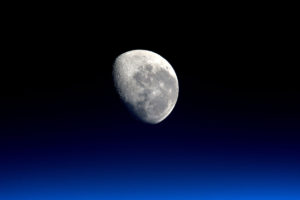
Earth’s Moon as seen from the International Space Station taken by ESA British astronaut, Tim Peake.
Credit: NASA/ESA
The Lunar Exploration Analysis Group (LEAG) has issued a “Consensus Meeting Findings” document that outlines multi-year milestones to put U.S. astronauts back on the Moon, encourages private sector lunar efforts, utilizes the Moon’s resources and develops a lunar economy.
Those milestones are required to show progress toward “return[ing] American astronauts to the Moon,” the LEAG document adds, “not only to leave behind footprints and flags, but to build the foundation we need to send Americans to Mars and beyond” by developing a robust lunar economy.

Early concept of Deep Space Gateway
Credit: NASA
Deep space thoughts
LEAG states that “any development of the proposed Deep Space Habitat/Gateway should be specifically designed to support long-term human and robotic presence on the lunar surface. If the decision is made to proceed with the proposed Deep Space Habitat/Gateway, decisions such as the orbit, design, and capabilities of the proposed infrastructure, as well as commercial and international opportunities, should be driven by the strategic direction to return U.S. astronauts to the lunar surface.”
The Moon “remains the cornerstone of planetary science and is an absolutely pivotal destination for science missions impacting our understanding of the entire Solar System,” the LEAG document explains.

The Earth straddling the limb of the Moon, as seen from above Compton crater.
Credit: NASA/GSFC/Arizona State University
Milestones ahead
The LEAG document flags “the paramount strategic objective” of human lunar return that is advocated by the newly re-activated National Space Council, headed by U.S. Vice President, Mike Pence.
LEAG’s document suggests the following milestones to enable the Nation’s “new strategic direction.”
1-2 Years
— Demonstrate NASA’s ability to deliver cargo- and crew-capable infrastructure via NASA’s Space Launch System (SLS) to cislunar space.
— Commercial sector demonstrates lunar access capability.
— NASA procures payload opportunities on commercial and international missions (i.e., procures commercial lunar missions services and funds selected science/exploration instruments to ride on them).
— NASA calls for Public-Private Partnerships (PPPs) and international partnerships for the establishment of infrastructure to enable surface access and navigation.
— Procurement of independent economic studies of the impact of using the Moon’s resources — also called In-situ Resource Utilization (ISRU) — on sustaining a permanent human presence on the Moon and growing the Lunar Economy.

NASA’s Resource Prospector that could be the first robot to navigate in the polar regions of the Moon.
Credit: NASA Ames Research Center
3-5 years
— Commercial sector demonstrates lunar surface access and return to Earth capability.
— ISRU technology validation on the lunar surface.
— Deployment of robotic prospecting explorers to the Moon.
— Develop experiments to use existing samples to promote and develop ISRU technologies.
5-10 years
— Development of ISRU pilot plants and fuel depots.
— Continued missions to the lunar surface for exploration and science.
— Human lunar landings.
Private sector and markets

Credit: Foster+Partners
The LEAG community encourages NASA to include the private sector in developing the architecture requested by the National Space Council for establishing a presence on the lunar surface.
“This could start with LEAG (including its Commercial Advisory Board, or CAB) involvement in NASA studies regarding establishing a robust near-term surface access program for robots and humans, establishing a lunar power and communications-navigation infrastructure, as well as demonstrating the abundance and usefulness of lunar resources (and creating a market for these),” the document explains.
Building bridges
Jointly chartered by the Science Mission Directorate (SMD) and the Human Exploration and Operations Mission Directorate (HEOMD), LEAG blends members of both communities, building bridges and synergies between science, exploration, and commerce whenever and however possible.
LEAG has a standing Commercial Advisory Board to offer programmatic insights into the capabilities provided by industry.
As a community-based, volunteer-driven, interdisciplinary forum, LEAG membership is open to all members of the lunar exploration community and consists of lunar and planetary scientists, life scientists, engineers, technologists, human system specialists, mission designers, managers, policymakers, and other aerospace professionals from government, academia, and the commercial sector.
The LEAG Consensus Meeting Findings stem from an October 10-12 meeting held at the Universities Space Research Association (USRA) in Columbia, Maryland.

Concept of view from a deep space habitat
Credit: ESA
The idea of a Deep Space Gateway has garnered high-level interest within the European Space Agency (ESA).
A recent ESA call for academic or industrial research ideas has been issued to discern benefits from such a deep space crewed spaceship in lunar vicinity – one that also enables access to the Moon’s surface.
Broad categories
Research areas for the Deep Space Gateway may fall into broad categories: Life Sciences, Physical Sciences, Solar System Science, Earth Sciences, and Astronomy and Astrophysics, as well as technology and other areas of a more applied nature.
The Deep Space Gateway is envisioned to host crewed missions and operate without crew in between. This facility is planned to be built and operated during the 2020’s as humanities next step beyond low Earth orbit and out into the Solar System.
Staging post
The notional Deep Space Gateway could serve as a staging post for exploration missions to the lunar surface and eventually to other deep space destinations, including Mars. It is also seen as a platform in a location where the human and technological challenges of long duration human missions in deep space can be investigated and addressed.
“The platform is being prepared through international cooperation, led by the partner agencies of the International Space Station,” an ESA document explains, also involving NASA, The Japan Aerospace Exploration Agency (JAXA) and the Canadian Space Agency (CSA).
“The technical definition of the Deep Space Gateway is driven by the technical needs of preparing deep space human exploration. It could also support opportunistic scientific research,” ESA adds.
Potential orbits
A number of potential orbits have been reviewed for the Deep Space Gateway, to determine their suitability for missions on terms of the operations of a habitat, access and return for crew and access to the lunar surface.

Credit: ESA
Additionally, the Deep Space Gateway should have the ability to move between orbits as needed for different missions.
Of orbits that have been reviewed, Near Rectilinear Halo Orbits and Earth-Moon L2 Halo orbits were found to be technically favorable.
Lunar vicinity science
Scientific areas that could benefit from human operations in lunar vicinity include:
- Lunar surface science using tele-presence
- Collecting and returning planetary material
- Understanding the Effects of Deep Space Radiation and Fractional Gravity
- Observation post for monitoring Earth’s climate
- A platform for astronomical observations
- Fundamental physics
- Heliophysics
Early concept of Deep Space Gateway
Credit: NASA
Cruise phase investigations
In addition, a number of “opportunistic investigation areas” have been identified for the cruise phase to the Moon, such as:
— Monitor lunar exosphere evolution of the whole Moon through a monthly cycle;
— Quantify impact flashes through the lunar night (clouds get in the way on Earth);
— Monitor human physiology and biomedical changes as the habitat or vehicle moves from within to outside the Earth’s magnetic field (assuming humans are present);
— Install cosmic dust/micrometeorite collectors;
— Target the habitat trajectory to facilitate a lunar eclipse of the Sun to study coronae/Sun composition that is undistorted by Earth’s atmosphere;
— Monitor Earth exosphere (geocorona) in the far ultraviolet which extends half way to the Moon and try to estimate the radiation pressure and its accurate extension which might change with solar activity.
A workshop on research opportunities for the Deep Space Gateway will be held in early December at the European Space Research & Technology Center (ESTEC), Noordwijk.

