Archive for the ‘Space News’ Category
 Author:
  September 26th, 2017
This picture of the Curiosity arm’s shadow on the ground was taken just before a fault.
Front Hazcam Right B image taken on Sol 1826, September 25, 2017.
Credit: NASA/JPL-Caltech
Now in Sol 1827, NASA’s Curiosity rover has faulted itself and is staying put on Vera Rubin Ridge.
“Just when we thought we were going to leave this spot on Mars, we found ourselves stuck here for yet another sol,” reports Scott Guzewich, an atmospheric scientist at NASA’s Goddard Space Flight Center in Greenbelt, Maryland.
Recovery mode
This time, a fault during one of Curiosity’s arm activities caused scientists to toss out plans for the past two sols. Those plans included a drive of the robot to the next waypoint in the Vera Rubin Ridge science campaign.
Curiosity is in a recovery mode, Guzewich adds. For Sol 1827, “It’s déjà vu all over again.”

Curiosity Navcam Left B photo acquired on Sol 1827, September 26, 2017.
Credit: NASA/JPL-Caltech
Third attempt
The current plan calls for Curiosity controllers to make their third attempt to complete science activities at the rover’s current stop, including Chemistry and Camera (ChemCam) and Mastcam targets of nearby bedrock: “Sherwood Forest”, “Tableland”, and “Troll Valley.”
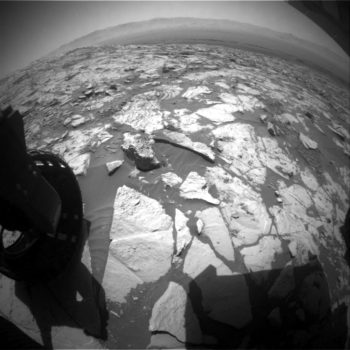
Curiosity Rear Hazcam Right B Sol 1827 September 26, 2017
Credit: NASA/JPL-Caltech
“We were also able to plan a Mastcam image of a target named “Elf Woods” that was originally intended for the weekend plan, but had to be removed for power consideration,” Guzewich concludes. “Following these science activities, Curiosity will drive approximately 10 meters [33 feet] closer to our third stop on Vera Rubin Ridge.”
 Posted in

European Space Agency astronauts train in terrestrial lava tubes. Credit: ESA/L. Ricci
The first systematic comparison of lava tube candidates on the Earth, Moon and Mars has been completed. What’s the upshot for underground caves?
Lava tubes, underground caves created by volcanic activity, could provide protected habitats large enough to house streets on Mars or even towns on the Moon.
New research on lava tubes has been presented at the European Planetary Science Congress (EPSC) 2017 in Riga. The work is already being used in the European Space Agency’s astronaut training program.
Tunnel sizes
According to Riccardo Pozzobon in the Department of Geosciences at the University of Padova in Italy: “The comparison of terrestrial, lunar and martian examples shows that, as you might expect, gravity has a big effect on the size of lava tubes.”

Cave diving on Earth is spurring increased interest in use of lava tubes on the Moon and Mars.
Credit: ESA/S. Sechi
On Earth, Pozzobon says, lava tubes can be nearly 100 feet (thirty meters) across. In the lower gravity environment of Mars, there is evidence for lava tubes that are 820 feet (250 meters) in width. “On the Moon, these tunnels could be a kilometer or more across and many hundreds of kilometers in length.”
“These results have important implications for habitability and human exploration of the Moon but also for the search of extraterrestrial life on Mars,” Pozzobon adds. “Lava tubes are environments shielded from cosmic radiation and protected from micrometeorites flux, potentially providing safe habitats for future human missions. They are also, potentially, large enough for quite significant human settlements.”

Artist’s impression of the radar instrument to probe for lava tubes beneath the lunar surface.
Credit: NASA/U. Trento
Lunar radar system
In a separate talk at EPSC, Leonardo Carrer and colleagues of the University of Trento in Italy presented a concept for a radar system specifically designed to detect lava tubes on the Moon from orbit.
A mission carrying this instrument “would enable a crucial step towards finding safe habitats on the Moon for human colonization,” Carrer reports.
Go to this video detailing the European Space Agency’s Pangaea 2016 cave work:
https://www.youtube.com/watch?v=fWsUHjVDJbY

Courtesy: Mars City Design
The Mars City Design group is working hard to provide an innovation platform for thought leaders to share and develop their ideas into sustainable products, with the dream to build a city and the lifestyles for the Red Planet, for Earth and beyond.
A 2nd Annual Gala Award Ceremony 2017 is being staged this October, featuring 2017 winners, space experts, and Mars pioneers, as well as some Hollywood celebrities.

Credit: Mars City Design
Eighth sense: biotune
According to Vera Mulyani, CEO & Founder of Mars City Design, a 2016 winner in the health category just received funding for a new venture, Eighth Sense. “This company will develop an innovative biotune device to help maintain the psychological wellbeing of our astronauts during the long duration of flight.”
This year, the winning designs of Mars City Challenges 2017 will be spotlighted in an October 12 gala/fund raiser, held at the Skirball Cultural Center in Los Angeles, California. Attire: “something red, strange, fun, and shiny.”

Credit: National Geographic
Honorary guest
An honorary guest for this upcoming event is Sammi Rotibi, a major actor in the Ron Howard National Geographic-produced series MARS and Quentin Tarantino’s Django Unchained.
For more information, go to:
Also, check out the 2017 Mars City Designs at:
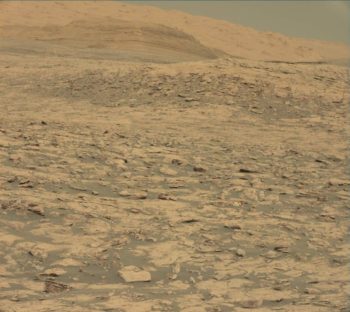
Curiosity Mastcam Left image acquired on Sol 1822, September 21, 2017.
Credit: NASA/JPL-Caltech/MSSS
NASA’s Mars Curiosity rover is now carrying out Sol 1824 duties.
“Curiosity continues her traverse across the lowermost portions of Vera Rubin Ridge, where she continues to investigate the interesting rock textures and colors ahead,” reports Mark Salvatore, a planetary geologist from the University of Michigan in Dearborn. “Our current location is quite dusty, which motivated the science team to focus on a relatively quick characterization of the surrounding bedrock.”

Curiosity Mastcam Left photo taken on Sol 1822, September 21, 2017.
Credit: NASA/JPL-Caltech/MSSS
Before a rover drive, Curiosity was on tap to create a high-resolution Mastcam mosaic of a region to the southwest of its current location.
“This region was identified from orbit as a potential region of interest, as it shows a relatively steep slope with some potentially interesting bedrock exposures,” Salvatore notes. “Ever since ascending onto Vera Rubin Ridge, Curiosity has been making progress towards this location to determine whether it is worth investigating from close-range.”
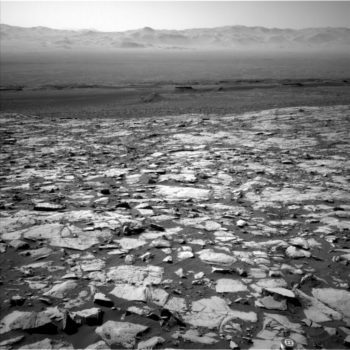
Curiosity Navcam Left B photo taken on Sol 1822, September 21, 2017.
Credit: NASA/JPL-Caltech
Blanket the area
Salvatore explains that the region doesn’t appear all that different from the parts of the ridge that Curiosity has already been exploring. “So, instead of continuing the southwest drive towards this location, the team decided to blanket the area in high-resolution color imagery before turning to the east-southeast and towards another region of interest.”

Curiosity Front Hazcam Right B image acquired on Sol 1822, September 21, 2017.
Credit: NASA/JPL-Caltech
Updating the rover’s planned traverse path using both orbital and ground-based data is very common, Salvatore points out, “and this decision by the science team highlights how collaborative discussions and the ability to adjust plans in real-time can both save time and maximize the scientific return of the mission.”
Uplink issue
A network communications problem on Earth, however, resulted in a Sol 1823 plan not being uplinked to the roving robot. That resulted in Curiosity performing a “runout” sol when only basic activities are performed, reports Scott Guzewich, an atmospheric scientist at NASA’s Goddard Space Flight Center in Greenbelt, Maryland.
“But we picked up right where we left off…and created a packed list of science activities to keep Curiosity busy over the weekend,” Guzewich adds. “We recovered the lost science on targets ‘Sherwood Forest’ and ‘Tableland’” which includes Chemistry and Camera (ChemCam) and Mastcam examinations of both and contact science on Sherwood Forest, he notes.
Fantasy-themed target
Another fantasy-themed named target was added in ‘Troll Valley’ that will be examined by contact science with the rover’s Mars Hand Lens Imager (MAHLI) and Alpha Particle X-Ray Spectrometer (APXS) and remotely by ChemCam and Mastcam.

Curiosity Rear Hazcam Right B photo taken on Sol 1822, September 21, 2017.
Credit: NASA/JPL-Caltech
Also planned was an extensive suite of environmental monitoring, including a ChemCam passive sky observation, Guzewich explains, where the ChemCam instrument is used without the laser to study atmospheric dust, ice, and gases.
Mastcam and Navcam images are to determine the amount of dust in the atmosphere as well as search for clouds. “We are entering the cloudy time of year on Mars and expect more clouds over the next several months,” Guzewich says.
Curiosity is slated to drive to the third stop of its Vera Rubin Ridge science campaign, stopping near a small, dark-toned ridge.
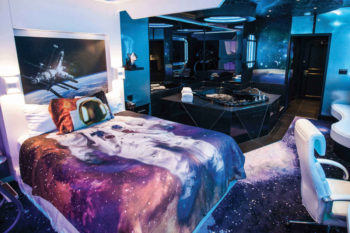
In space sleep time. Courtesy: Fodor’s Travel
Fodor’s Travel has posted an engaging story on space-themed rooms and suites at various price points that can be booked.
“Some merely nod to the theme, while others fully embrace it. Whether you’re traveling with a crew or Han Solo, these 10 picks will have you adding Tang and a spacesuit to your packing list,” writes Michele Shapiro, the author of “Room service to Major Tom!”

Courtesy: Fodor’s Travel
Immersive hotel
The article lifts off by looking at the immersive hotel in Orlando that will open as part of Star Wars: Galaxy’s Edge, the highly anticipated addition to Walt Disney World, “which promises to put guests smack in the middle of a battle between the First Order and the Resistance.”
Go to:
http://www.fodors.com/news/photos/stay-in-outer-space-right-here-on-earth

Discovery of SMART-1 impact site thanks to an eagle-eyed researcher and high resolution Lunar Reconnaissance Orbiter images.
Credit: P Stooke/B Foing et al 2017/ NASA/GSFC/Arizona State University
In the lost and now found category of Moon probes add the European Space Agency’s first lunar mission, SMART-1 to the list.
Thanks to the sharp-eyed Phil Stooke, of Western University, Ontario, using high-resolution images from NASA’s Lunar Reconnaissance Orbiter (LRO), the spacecraft’s impact site has been discovered.
The spacecraft was sent into a controlled impact with the lunar surface 11 years ago.

European Space Agency’s SMART-1 lunar orbiter.
Credit: ESA
Hard, grazing, bouncing landing
Explains Bernard Foing, ESA SMART-1 Project Scientist: “SMART-1 had a hard, grazing and bouncing landing at two kilometers per second on the surface of the Moon. There were no other spacecraft in orbit at the time to give a close-up view of the impact, and finding the precise location became a ‘cold case’ for more than 10 years.”
The next steps will be to send a robotic investigator, Foing adds, “to examine the remains of the SMART-1 spacecraft body and ‘wings’ of the solar arrays.”

Another view of SMART-1 crash site, as spotted within high resolution Lunar Reconnaissance Orbiter images.
Credit: P Stooke/B Foing et al 2017/ NASA/GSFC/Arizona State University
Ricochet rocketry
Images from LRO show white ejecta, over 20 feet (seven meters) across, from the first contact.
A north-south channel has then been carved out by the SMART-1 spacecraft body, before its bouncing ricochet.
“We can make out three faint but distinct ejecta streams from the impact, about 40 meters long and separated by 20-degree angles,” Foing reports in a paper delivered this week at the European Planetary Science Congress (EPSC) 2017 in Riga.
The crash scene of SMART-1 is 34.262° south and 46.193° west, consistent with the coordinates of impact calculated initially, according to a EPSC press statement.

So long, goodbye trajectory of ESA’s SMART-1 spacecraft that ended with impact on the lunar surface.
Credit: ESA – C.Carreau, CC BY-SA 3.0 IGO
Tested new technology
SMART stands for Small Missions for Advanced Research in Technology.
SMART-1 is the first of ESA’s Small Missions for Advanced Research in Technology. It traveled to the Moon using solar-electric propulsion and carrying a battery of miniaturized instruments.
As well as testing new technology, SMART-1 did the first comprehensive inventory of key chemical elements in the lunar surface. It also investigated the theory that the Moon was formed following the violent collision of a smaller planet with Earth, four and a half thousand million years ago.
The operational mission of the SMART-1 orbiter ended on September 3, 2006 when the craft ended its journey in Lacus Excellentiae – the “Lake of Excellence” plain.

Image from first refueling test as craft approached space lab in April.
Credit: CGTM
China’s first resupply craft – Tianzhou-1 – has been deorbited under orders from ground controllers.
Following a set of braking maneuvers, the cargo ship was purposely destroyed late Friday (Beijing time) as it plunged into the Earth’s atmosphere.
Repeat dockings
Tianzhou-1 operations involved repeat dockings and refueling of Chinas Tiangong-2 space lab after the resupply vehicle entered Earth orbit on April 20th.

China’s cargo ship right approaches Tiangong-2 space lab in artist’s view.
Credit: CMSE
The space lab was unoccupied during the link-ups.
For the past five months, reports the Xinhua news agency, Tianzhou-1 and Tiangong-2 accomplished a trio of refueling sequences: On April 27, a second refueling on June 15 and a final one on September 16.
Chinese space officials view the refueling and repeat dockings as prelude to the country’s building of a larger space station in the mid- 2020s.

Arizona-based Biosphere 2.
Courtesy: University of Arizona
The iconic Biosphere 2 is largely remembered by its housing of crews — dubbed “Biospherians” — sealed inside the large facility in the early 1990s – built to learn more about self-sustaining space habitats.
Two missions, between 1991 and 1994, sealed Biospherians inside the huge terrarium-like glass enclosure to measure survivability.
One-of-a-kind
Thanks to an endowment from American businessman, Edward P. Bass – a key founder in creating Biosphere 2 – it will tackle some of the century’s most critical questions in food, water and energy security.
The University of Arizona (UA) received the multi-million dollar gift to support the one-of-a-kind facility. UA researchers are probing questions about environmental change, management of finite and dwindling natural resources, and policies to protect the Earth’s fragile ecosystems.

Biosphere 2 layout.
Credit: University of Arizona
In 2016, the UA reaffirmed its commitment to Biosphere 2 as a University-wide hub for environmental research and public engagement when the facility and its operations were moved to the Office for Research, Discovery & Innovation.
The University of Arizona has supported Biosphere 2 research since it took over management of the facility in 2007. More than 900,000 people have visited Biosphere 2 since 2007, according to a UA press statement.
Earth sciences
Based in Oracle, Arizona, Biosphere 2 houses the Landscape Evolution Observatory, or LEO, the world’s largest laboratory experiment in earth sciences.
LEO consists of three identical hill slopes, each measuring 100 feet long and 40 feet wide. A network of more than 1,800 sensors embedded in the soil tracks the flow of water, helping scientists answer questions about how physical and biological processes control the evolution of landscapes and how time and climate change affect water flowing through landscapes.
Biosphere 2’s simulated rainforest is being utilized to study how plants cope with high temperatures and drought to better understand how climate change may affect forests from the Amazon to Arizona.

Visitors explore Biosphere 2.
Credit: Steven Meckler
Other work includes experimenting with agrivoltaics, which involves growing plants beneath solar panels, pairing renewable energy with agriculture to increase energy efficiency and reduce evaporation.
New research heights
“As one of our nation’s top 25 public research institutions, we are poised to take Biosphere 2 to new heights in the coming decade,” explains Kimberly Andrews Espy, the UA’s senior vice president for research.
“We are committed to its continuing success,” Espy adds, “the place where researchers from a variety of disciplines at the UA and across the world will come together to uncover the systems-level mechanisms that support complex ecosystems to evaluate new solutions for adaptation to the changing conditions.”
To learn more and to plan a visit to Biosphere 2, go to:
Also, go to this aerial overview of Biosphere 2 from Southeast Hoverworks at:

Curiosity Front Hazcam Right B image taken on Sol 1821, September 20, 2017.
Credit: NASA/JPL-Caltech
NASA’s Curiosity Mars rover is carrying out science duties in Sol 1822. It’s “onward and upward” for the robot, reports Lauren Edgar, a planetary geologist; at the USGS in Flagstaff, Arizona.
On Sol 1821, Curiosity successfully completed contact science activities at “Pennessewassee” and “Passadumkeag,” Edgar notes. “Perhaps in an effort to get to more easily pronounceable rock targets, today’s tactical team planned a nice long drive towards our next waypoint on Vera Rubin Ridge.”
Clouds above
The scripted Sol 1822 plan begins with a Navcam movie to look for clouds above the northern rim of the crater. Then Curiosity will turn its attention towards nearby bedrock targets, using both Mastcam and its Chemistry and Camera (ChemCam) instrument to assess the spectral character of a recent dust removal target called “Passadumkeag” and to assess the composition and sedimentary structures exposed at “Hypocrites Ledge.”
“We’ll also use Mastcam to monitor the movement of fines on the rover deck,” Edgar explains.

Curiosity Navcam Left B photo taken on Sol 1819, September 18, 2017.
Credit: NASA/JPL-Caltech
Gearing up for drive
Then Curiosity will gear up for a drive of roughly 130 feet (40 meters), as the robot works its way towards the next waypoint.
Downlink data volume was a recent challenge, so the team had to think carefully about the priorities of post-drive imaging to prepare for possible touch-and-go contact science and other remote sensing in the next plan.

Curiosity Rear Hazcam Right B image acquired on Sol 1821, September 20, 2017.
Credit: NASA/JPL-Caltech
Mountain-climbing robot
The afternoon post-drive imaging block also contains some extended Navcam coverage for additional geologic context and targeting, as well as two Navcam observations to search for clouds and monitor the wind direction near the zenith, Edgar notes.
“With drives like these,” Edgar concludes, “we’re really reminded that we have a mountain-climbing robot on Mars!”

Curiosity Mastcam Right image of rover brushes, taken on Sol 1818, September 17, 2017. Credit: NASA/JPL-Caltech/MSSS
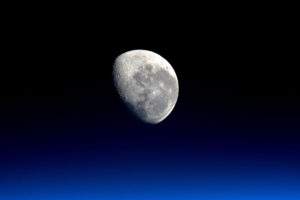
Earth’s Moon as seen from the International Space Station taken by ESA British astronaut, Tim Peake.
Credit: NASA/ESA
The European Space Agency (ESA) has issued an announcement of opportunity centered on the advancement, maturation and demonstration of lunar In-Situ Resource Utilization (ISRU) technologies.
ESA wants to demonstrate critical technologies in the end-to-end ISRU process chain for production of oxygen at the lunar surface.

In-Situ Resource Utilization
Credit: ESA–K. Oldenburg
Also they want harness expertise to characterize the ISRU feedstock at a location which is representative of those which will be visited by future human missions.
Objectives
The objectives of this activity are:
- to identify a candidate ISRU payload, payload suppliers and partners interested in jointly enabling research and development
- to identify commercial providers for lunar surface delivery and communications services
- to study two mission concepts and their implementation feasibility.
- select one successful mission concept in a final ESA review.
In a statement released today, ESA wants a return to the Moon to be sustainable and based on partnerships – not only with international space agencies but also with business. “A commercial approach may just be the ticket – literally and figuratively – to making it happen.”

Lunar base made with 3D printing
Credit: ESA/Foster + Partners
Roaming charges
“ESA wants to buy a ride on a commercial lander to deliver our precious research equipment safely to the surface. Once there, we are ready to pay the ‘roaming charges’ to talk to our hardware,” explains the statement.
“We are looking to invest in the development and pay for the use of technology that can turn indigenous lunar material into oxygen and water, critical resources for sustaining future human operations in deep space.”
Service providers
ESA is inviting service providers with the right ideas to take part in a one-year study that will shape this In-Situ Resource Utilization Demonstrator Mission.
For more information and details on how to submit proposals, go to:
http://www.esa.int/About_Us/Business_with_ESA/How_to_do/Open_Invitations_to_Tender
http://emits.sso.esa.int/emits/owa/emits_online.showao?typ1=7377&user=Anonymous

