Archive for the ‘Space News’ Category
 Author:
 December 2nd, 2017
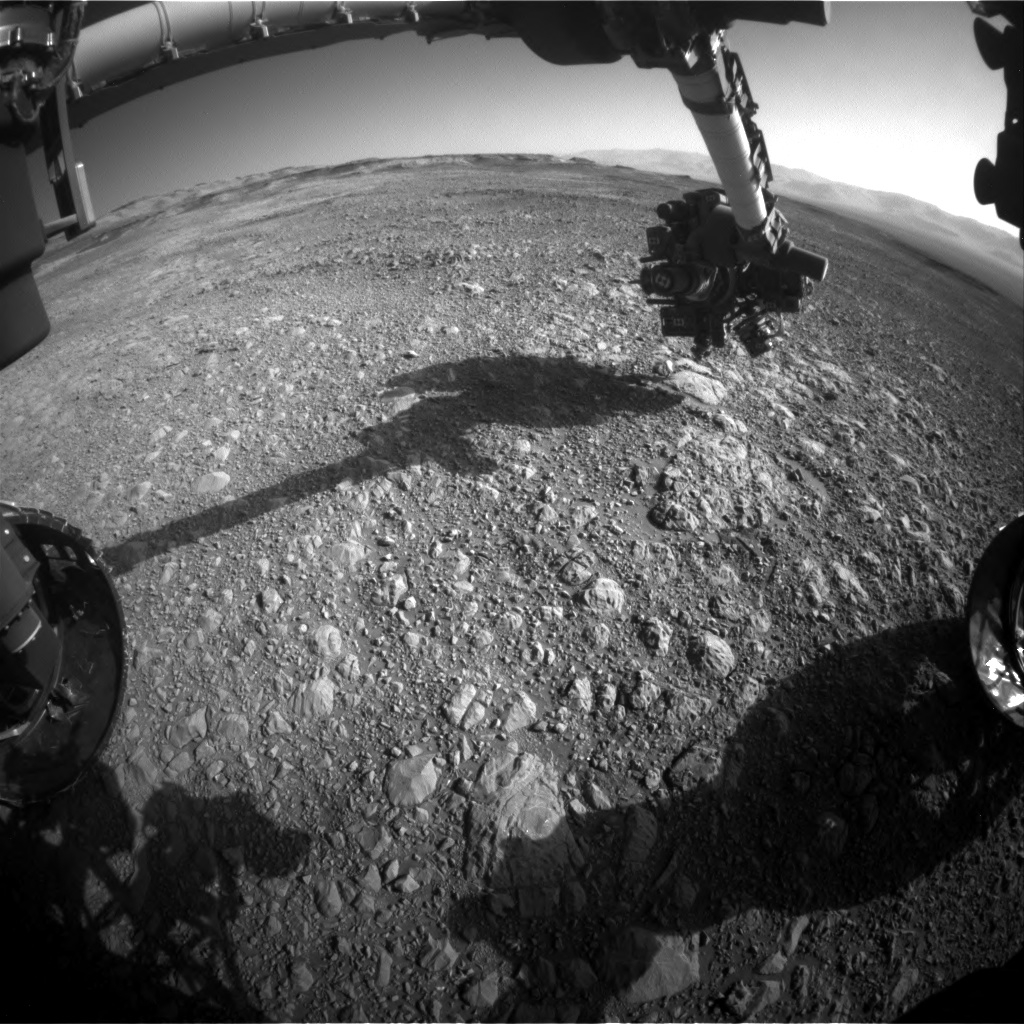
Curiosity Front Hazcam Left B image taken on Sol 1892, December 2, 2017.
Credit: NASA/JPL-Caltech
NASA’s Curiosity Mars rover is closing out Sol 1892 duties.
Late last week, Mark Salvatore, a planetary geologist at the University of Michigan in Dearborn, reported the rover was preparing to hit the road for a next stop on Vera Rubin Ridge.
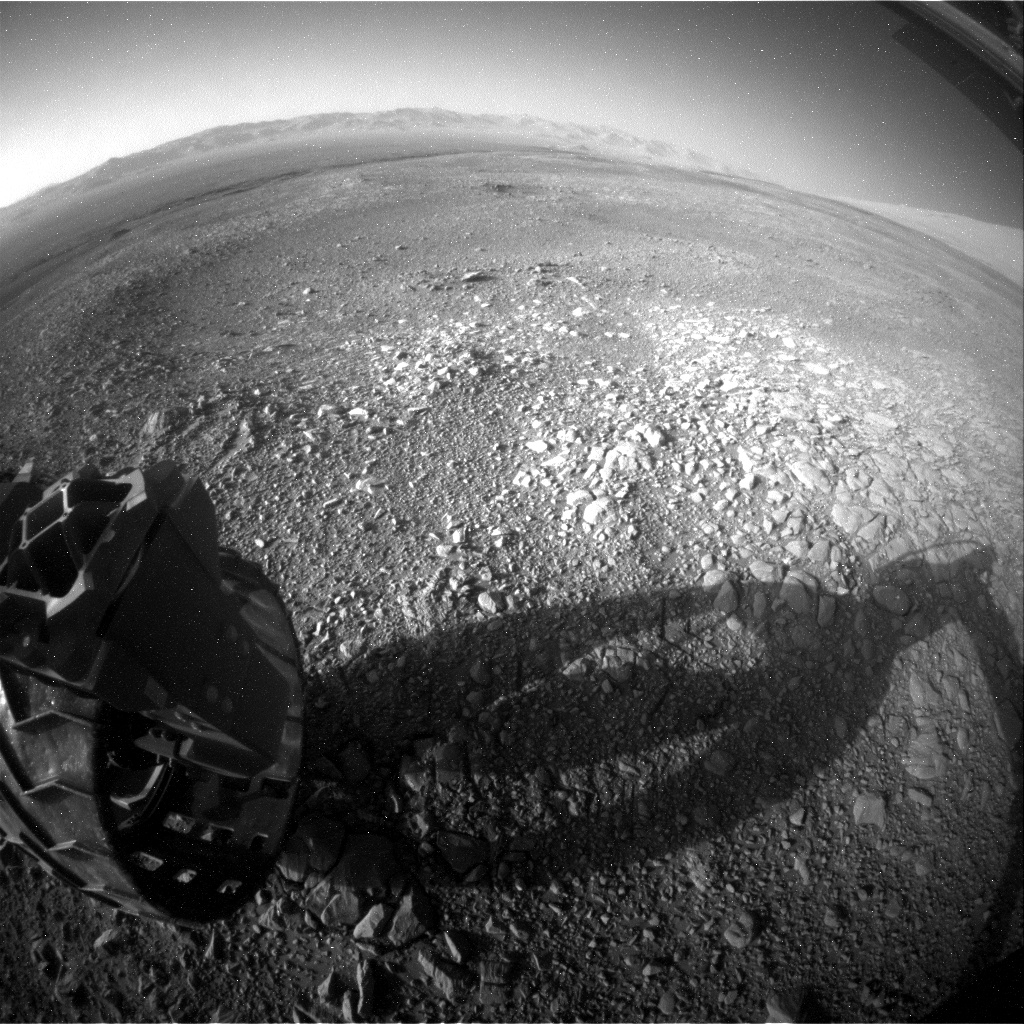
Curiosity Rear Hazcam Left B photo acquired on Sol 1892, December 2, 2017.
Credit: NASA/JPL-Caltech
Unique patch of terrain
Curiosity’s Mastcam was slated to take a multispectral image of the region where the robot will be headed over the next few days, Salvatore said, “in an effort to fully characterize the spectral diversity of this location and to compare with orbital remote sensing data.”
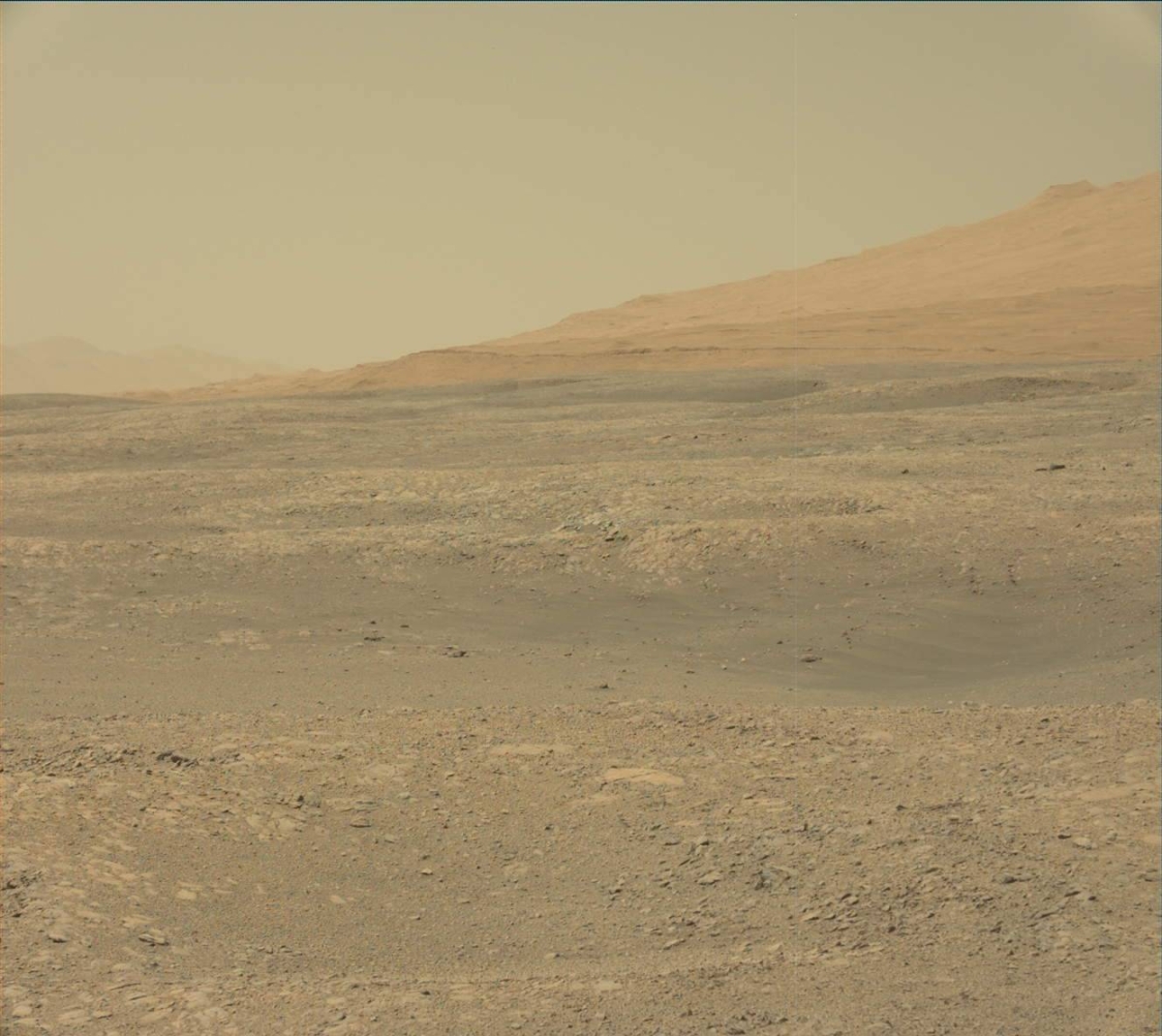
Curiosity Mastcam Left image taken on Sol 1891, December 1, 2017.
Credit: NASA/JPL-Caltech/MSSS
The rover is slated to continue wheeling to the southeast, headed for a “unique patch” of terrain that appears interesting in high-resolution orbital data. “The hope is to reach this unit on this drive, as that will allow the science team to investigate this interesting region over the duration of the weekend’s plan,” Salvatore added.
Credit: NASA/JPL-Caltech/Univ. of Arizona
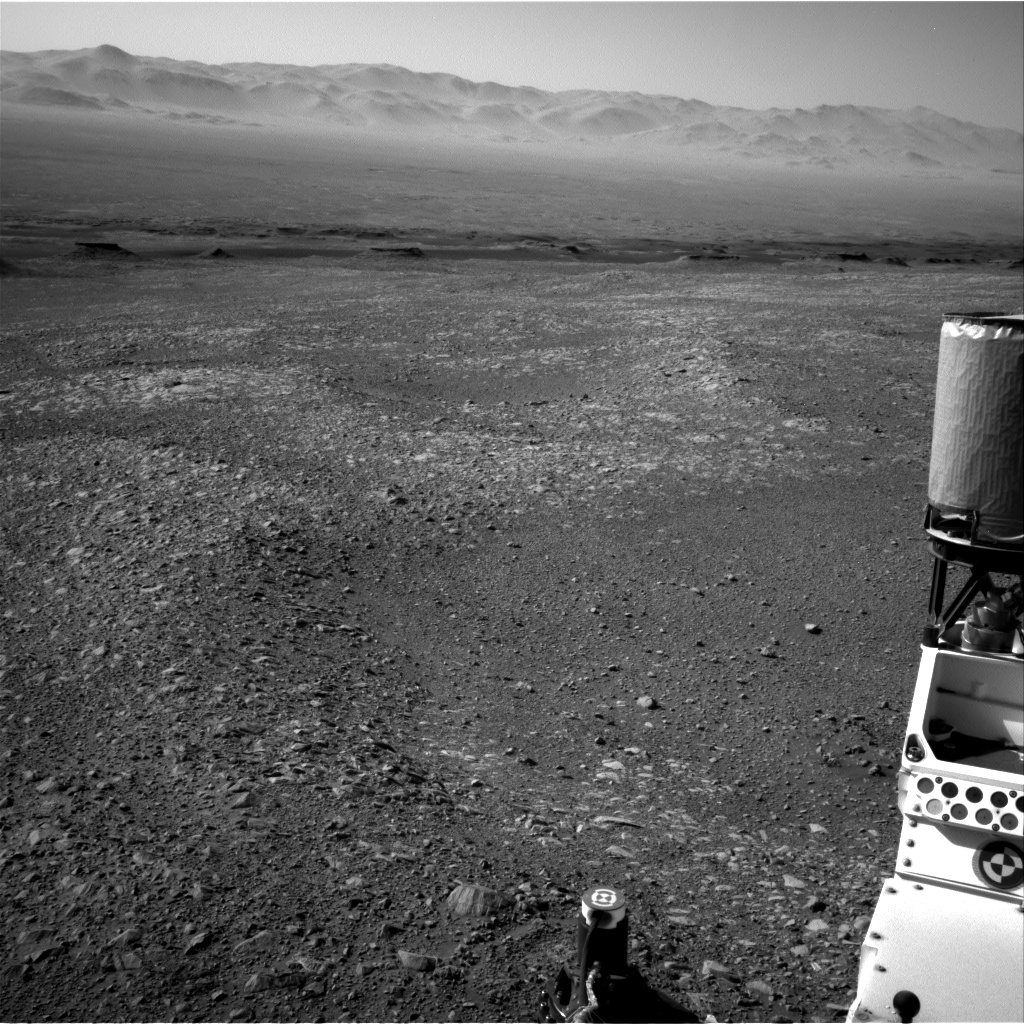
Curiosity Navcam Right B photo acquired on Sol 1891, December 1, 2017.
Credit: NASA/JPL-Caltech
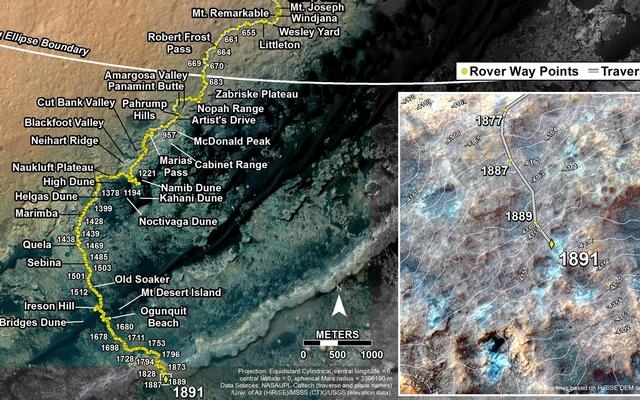
Traverse map
Meanwhile, a new Curiosity traverse map has been issued.
The map shows the route driven by NASA’s Mars rover Curiosity through the 1891 Martian day, or sol, of the rover’s mission on Mars (December 01, 2017).
Numbering of the dots along the line indicate the sol number of each drive. North is up. The scale bar is 1 kilometer (~0.62 mile).
From Sol 1889 to Sol 1891, Curiosity had driven a straight line distance of about 45.65 feet (13.91 meters), bringing the rover’s total odometry for the mission to 11.06 miles (17.81 kilometers).
The base image from the map is from the High Resolution Imaging Science Experiment Camera (HiRISE) in NASA’s Mars Reconnaissance Orbiter.
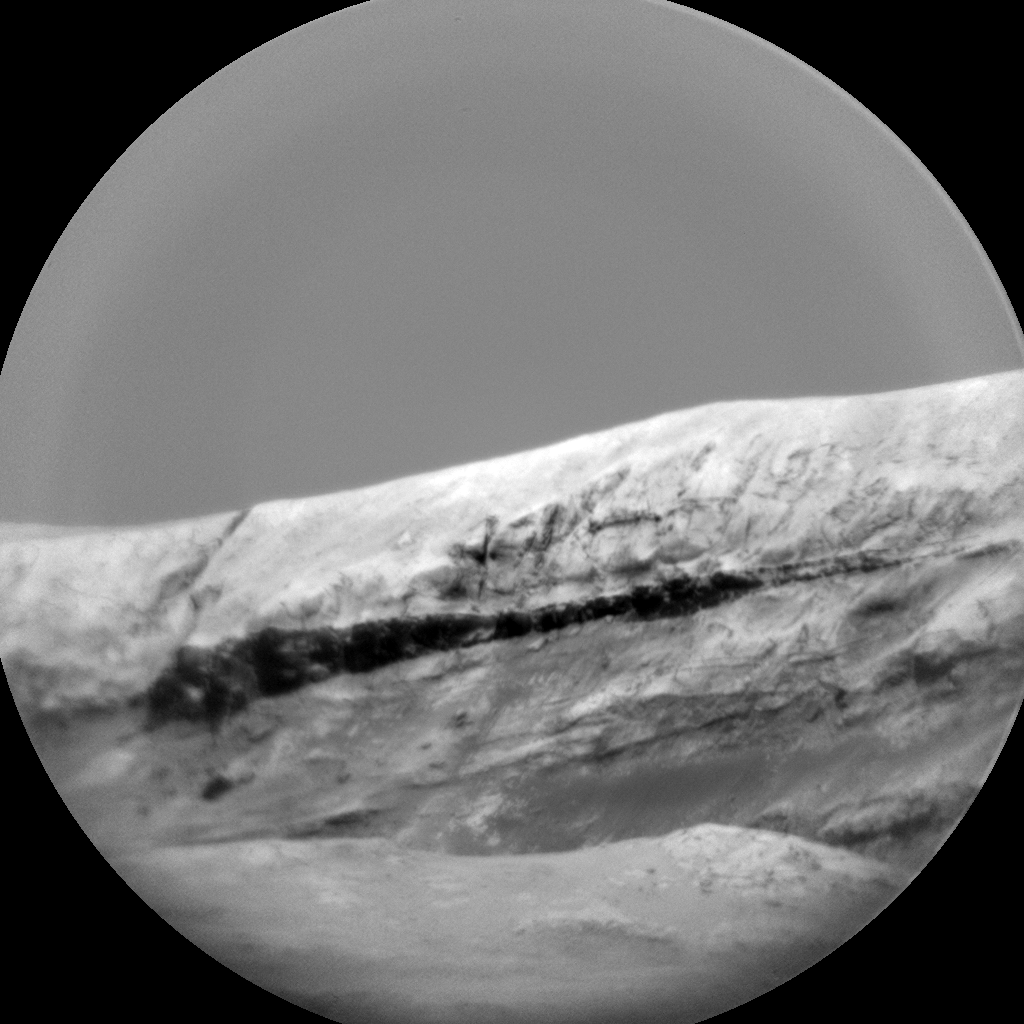
Curiosity ChemCam Remote Micro-Imager photo taken on Sol 1891, December 1, 2017.
Credit: NASA/JPL-Caltech/LANL
 Posted in


Credit: Budweiser
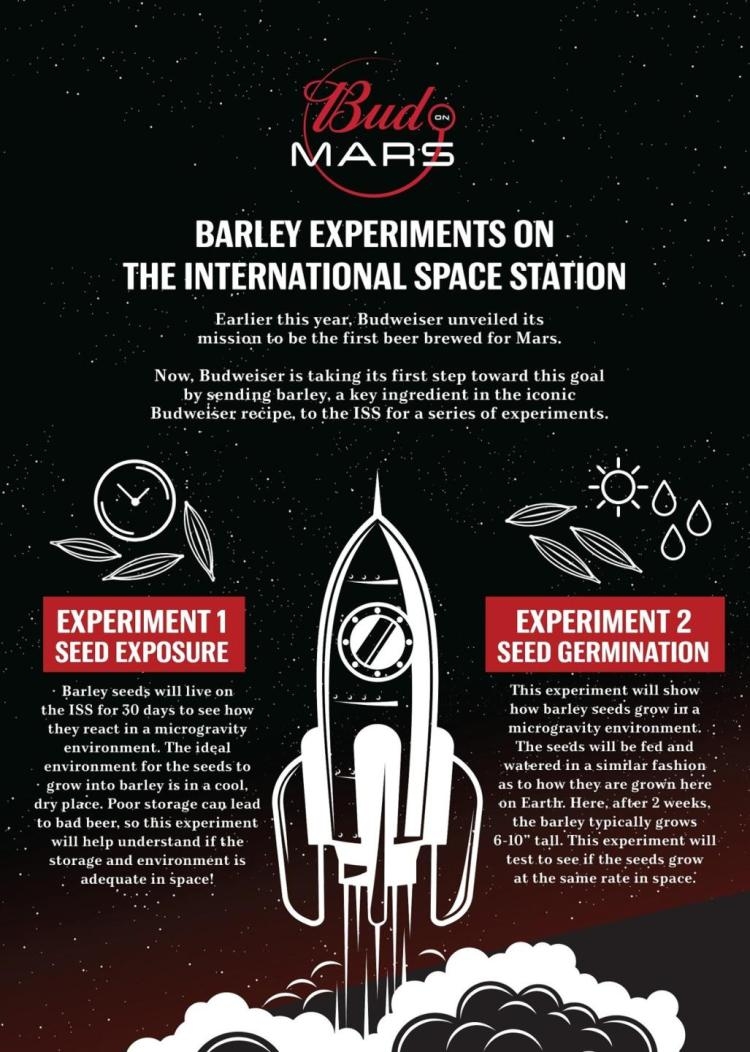
Budweiser recently announced plans to send barley seeds to space, one of the key ingredients in beer. The company wants to determine if it’s possible to make and drink beer on Mars.
Barley samples are to be flown to the International Space Station later this month.
Credit: Budweiser
But a new poll indicates that Americans aren’t particularly anxious for a taste of Martian brew.
Survey findings
A new Rasmussen Reports national telephone and online survey finds:
- Just 11% of American Adults say they are more likely to buy a beer that is brewed on Mars.
- Thirty-three percent (33%) say they’re less likely to buy a space beer.
- While 45% say the beer’s origin would have no impact on their beer-buying decision.
- Another 11% are not sure.
Credit: Budweiser
“Sampling” error?
The national survey of 1,000 American Adults was conducted on November 26-27, 2017 by Rasmussen Reports.
The margin of sampling error is +/- 3 percentage points with a 95% level of confidence.
Field work for all Rasmussen Reports surveys is conducted by Pulse Opinion Research, LLC.

Credit: NASA
A new Global Exploration Roadmap (GER) to be issued early next year will detail international strategies for returning to the Moon.
One aspect of the roadmap is how best governments can work with commercial companies to provide communications relay services, as well as early delivery of cargo/scientific instruments to the lunar surface. A major thrust is utilization of the Moon’s resources.
These and other return to the Moon plans were detailed during a NASA community workshop on the GER, held November 29-30 at the space agency’s Ames Research Center at Moffett Field, California.
Phased approach
The GER is a publication authored by NASA and the other 14 space agencies that comprise the International Space Exploration Coordination Group (ISECG). The roadmap outlines a phased approach to achieving the common goal of sending humans to the surface of Mars.
The next road map will outline a “common pathway,” for multiple nations to return to the Moon, for exploration, science, and begin applying resource utilization strategies, explains Kathy Laurini, NASA senior advisor for exploration and space operations, and current chair of the ISECG.

Credit: NASA
Start small
NASA itself is pushing forward on working with commercial companies to help anchor its “new found interest in the moon” – a strategy that will start small and is expected to grow over time.
Like NASA, the European Space Agency is appraising partnership links to private firms that have the Moon in their sights.
The third version of the GER is planned for publication in early 2018. The most recent version was published in 2013, and is accessible at:

Curiosity Navcam Right B image taken on Sol 1890, November 30, 2017.
Credit: NASA/JPL-Caltech
NASA’s Curiosity Mars rover has wheeled over 11 miles since landing in August 2012. The robot has just entered Sol 1891.

Curiosity Navcam Right B image acquired on Sol 1889, November 29, 2017.
Image Credit: NASA/JPL-Caltech
A new Curiosity traverse map through Sol 1889 has been issued.

Credit: NASA/JPL-Caltech/Univ. of Arizona
This map shows the route driven by NASA’s Mars rover Curiosity through the 1889 Martian day, or sol, of the rover’s mission on Mars (November 30, 2017).
Numbering of the dots along the line indicate the sol number of each drive. North is up.
The scale bar is 1 kilometer (~0.62 mile).
From Sol 1887 to Sol 1889, Curiosity had driven a straight line distance of about 106.61 feet (32.49 meters), bringing the rover’s total odometry for the mission to 11.05 miles (17.79 kilometers).
The base image from the map is from the High Resolution Imaging Science Experiment Camera (HiRISE) in NASA’s Mars Reconnaissance Orbiter.
(click on map to enlarge)

ChemCam Remote Micro-Imager photo taken on Sol 1890, November 30, 2017.
Credit: NASA/JPL-Caltech/LANL

Notional Deep Space Gateway.
Credit: NASA
NASA has begun to roll out a return to the Moon strategy.
Taking part in a Global Exploration Roadmap (GER) workshop, NASA officials have started to outline potential back to the Moon strategies.
The GER is a publication authored by NASA and the other 14 space agencies that comprise the International Space Exploration Coordination Group (ISECG). The roadmap outlines a phased approach to achieving the common goal of sending humans to the surface of Mars.

Credit: NASA
Additionally, NASA officials are fleshing out use of the cis-lunar situated Deep Space Gateway. Mission concepts for cislunar space, the Moon and Mars and functions that may be suited for possible commercial services are being discussed.

Credit: NASA
Common vision
This new update of the Global Exploration Roadmap features contributions from space agency partners as they share their common vision for missions beyond low-Earth orbit over the next decades, explains Kathy Laurini, NASA senior advisor for exploration and space operations, and current ISECG chair.
“This workshop continues our commitment to engaging with stakeholders in industry and academia to inform GER development,” Laurini adds. “Many of our international partner space agencies will support this workshop and use the opportunity to engage their stakeholder communities.”

Credit: NASA
Collective effort
The ISECG is a voluntary, non-binding international coordination mechanism through which individual agencies may exchange information regarding interests, objectives, and plans in space exploration with the goal of strengthening both individual exploration programs as well as the collective effort.
The third version of the GER is planned for publication in early 2018. The most recent version was published in 2013, and is accessible at: https://go.nasa.gov/1oRhy1z

Credit: Rocket Lab
Rocket Lab, a US aerospace company with operations in New Zealand, will open a ten-day launch window from Friday December 8, 2017 NZT to carry out the company’s second test launch of the Electron rocket.
During this time a four-hour launch window will open daily from 2:30 p.m. NZT.
Māhia Peninsula
The test launch, titled “Still Testing,” will take place from Rocket Lab’s Launch Complex 1 on the Māhia Peninsula, New Zealand.
This projected flight follows on from the inaugural Electron test carried out on May 25, 2017. That maiden launch failed to enter orbit, but the group has analyzed more than 25,000 channels of data from flight one to attempt reaching Earth orbit on flight two.
Payloads
The upcoming Still Testing will carry an Earth-imaging Dove satellite for Planet and two Lemur-2 satellites for Spire for weather and ship tracking, enabling Rocket Lab to gather crucial data and test systems for the deployment stage of a mission.
Still Testing is the second of three test launches planned from Launch Complex 1 ahead of commercial operations, however if the vehicle performs nominally throughout the second test the commercial phase may be accelerated.
Video stream
For the first time, a live video stream will be available approximately 15 minutes prior to a launch attempt at:

Curiosity Navcam Right B image taken on Sol 1887, November 27, 2017.
Credit: NASA/JPL-Caltech
Now in Sol 1889, NASA’s Curiosity Mars Rover is “back to the grind,” post-holiday, reports Scott Guzewich, an atmospheric scientist for NASA Goddard Space Flight Center in Greenbelt, Maryland.
“While many of us spent the holiday weekend relaxing with friends and family,” Guzewich notes, “Curiosity took no rest on Mars and continued working hard today.”
The Thanksgiving plan for the robot included some unusual activities, but is now back to more typical operations with a “touch-and-go” sol on the agenda.

Possible impact crater termed “Beit” (the round-looking feature in the middle of this Curiosity Navcam Left B image acquired on Sol 1887, November 27, 2017
Credit: NASA/JPL-Caltech
Possible impact crater
On the first sol of the plan, Mars researchers scheduled contact science with its Alpha Particle X-Ray Spectrometer (APXS) and Mars Hand Lens Imager (MAHLI).

Wheel inspection. Curiosity Mars Hand Lens Imager (MAHLI), located on the turret at the end of the rover’s robotic arm, acquired this image on Sol 1887, November 26, 2017.
Credit: NASA/JPL-Caltech/MSSS
In addition to a Chemistry and Camera (ChemCam) observation of a rock target termed “Lyttelton” and then Mastcam imaging of a possible impact crater nearby termed “Beit.”
Following that, Curiosity will drive approximately 130 feet (40 meters) toward its next stop of the Vera Rubin Ridge science campaign, Guzewich adds.

Curiosity ChemCam Remote Micro-Imager photo taken on Sol 1888, November 28, 2017.
Credit: NASA/JPL-Caltech/LANL
Fan-like deposit
The second sol of the plan will have Curiosity dedicated to remote-sensing science, including a long-distance image with ChemCam of a fan like deposit closer to Mt. Sharp in addition to Navcam movies searching for dust devils and clouds, Guzewich concludes.

NASA’s Space Launch System (SLS) makes use of powerful solid rocket motors.
Credit: NASA
The Earth’s stratosphere is under assault by rocket engine emissions and also polluted by reentering space debris. While space transportation plays a vital and increasing role in Earth’s economic system, rockets uniquely emit gases and particles directly into the middle and upper atmosphere. That exhaust from hundreds of launches accumulates and alters atmospheric radiation patterns.

An Orbital ATK Cygnus cargo ship plunges into the Earth’s atmosphere in a fiery finale. Vaporization of discarded space hardware equals dust production – a process that is not well understood.
Credit: ESA/NASA
This troublesome outlook is exasperated given the predicted pace of rocket launches by increasing numbers of nations in the coming decades.
Here’s my new Space.com story on this topic, posted today at:
Spaceflight Pollution: How Do Rocket Launches and Space Junk Affect Earth’s Atmosphere?
By Leonard David, Space.com’s Space Insider Columnist
November 27, 2017 06:35am ET
https://www.space.com/38884-rocket-exhaust-space-junk-pollution.html

Credit: IBMP RAS
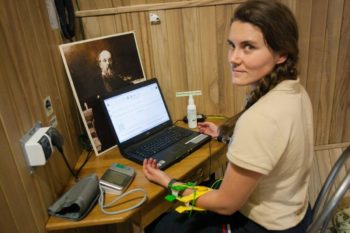
A simulated Moon mission has been wrapped up by the Institute of Biomedical Problems of the Russian Academy of Sciences (IBMP RAS) in cooperation with NASA.
The 17-day experiment focused on long-term space travel, but centered on use of the proposed cis-lunar Deep Space Gateway. Eyed for the 2020s, this facility could be a collaborative partnership between Roscosmos, Russian’s federal space agency, and NASA.

Credit: IBMP RAS
Called the SIRIUS (Scientific International Research in Unique Terrestrial Station) project, the simulated space voyage began on November 7, involving three men and three women. SIRIUS-17 crew members carried out an agenda of scientific experiments during their mission. The crew of the isolation experiment: Kikina Anna Yuryevna; Luchitskaya Elena Sergeevna; Lysova Natalia Yuryevna; Rukavishnikov IlyaVyacheslavovich; Serov Mark Vyacheslavovich and Viktor Fetter.
Personal space
The SIRIUS -17 mission focused on a simulated flight to the Moon. This international isolation experiment mimicked travel to the Moon, surveying the lunar surface by rovers, and trekking back to Earth.
During the 17-day isolation, scientists studied the distribution of roles in teamwork and leadership, interaction between men and women, their personal space, biochemistry. New systems of psychological support were applied, and new principles for the distribution of elbow room in spacecraft were also introduced.

Credit: IBMP RAS
Credit: IBMP RAS
Follow-on missions
NASA is also slated to work with the IBMP to conduct at least three follow-on missions: a four-month mission in 2018, an eight-month mission in 2019, and a 12-month mission in 2020.

Credit: IBMP RAS

MARS 500 Session training in the IMBP module.
Credit: IBMP RAS
The Moscow-based IBMP RAS complex was previously utilized for the “Mars 500” project – a set of “flights” carried out 2007-2011 that included a 520-day simulated voyage to the Red Planet.
IBMP maintains international scientific and technical ties under cooperative agreements with space agencies and research centers in the U.S., France, Germany, Italy, Canada, Japan, Austria, the Republic of Korea, China and other countries.
The SIRIUS missions are the first time NASA’s Human Research Program (HRP) partners with Russia’s IBMP Ground-based Experimental Complex (NEK) to conduct a series of analog missions.
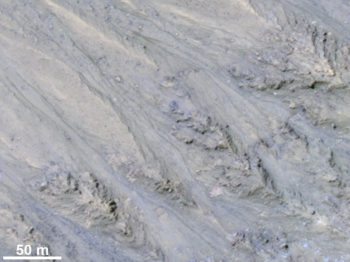
This Mars Reconnaissance Orbiter HiRISE image cutout shows Recurring Slope Lineae in Tivat crater on Mars in enhanced color. The narrow, dark flows descend downhill (towards the upper left). Analysis shows that the flows all end at approximately the same slope, which is similar to the angle of repose for sand.
Dark features previously proposed as evidence for significant liquid water flowing on Mars have now been identified as granular flows, where sand and dust move rather than liquid water, according to a new article published in Nature Geoscience by the U.S. Geological Survey.
Credit: NASA/JPL/University of Arizona/USGS
There appears to be a cascading truism about Recurring Slope Lineae, or RSL on Mars. That is, what causes these features is a recurring controversy.
On one hand, the appearance and growth of RSL resemble seeping liquid water. RSL features grow incrementally, fade when inactive and recur annually during the warmest time of year on Mars.
RSL are mostly found on steep rocky slopes in dark regions of Mars, such as the southern mid-latitudes, Valles Marineris near the equator, and in Acidalia Planitia on the northern plains.
But new research focused on these dark features have now been identified as granular flows, where sand and dust move rather than liquid water, according to a new article published in Nature Geoscience by the U.S. Geological Survey (USGS). This study was done in cooperation with the NASA Mars Reconnaissance Orbiter project.
Dry sand
If RSL are actually dry grain flow phenomena, this suggests that recent Mars has not had significant volumes of liquid water, which could preclude the presence of microbial life thriving at these sites. This finding would alleviate planetary protection concerns about habitable environments.
“We’ve thought of RSL as possible liquid water flows, but the slopes are more like what we expect for dry sand,” said USGS scientist and lead author of the published findings, Colin Dundas. “This new understanding of RSL supports other evidence that shows that Mars today is very dry.”
In a press statement, Dundas said that the terminal end of the RSL slopes are identical to the slopes of sand dunes where movement is caused by dry granular flows. Water almost certainly is not responsible for this behavior, which would require the volume of liquid to correspond to the length of slope available, producing more liquid on longer slopes. Instead, the 151 RSL examined all end on similar slopes despite very different lengths. Additionally, water is unlikely to be produced only near the tops of slopes at these angles and if it were, it should be able to flow onto lower slopes.

Flow physics
Planetary Science Institute (PSI) Senior Scientist Jim McElwaine is a co-author on the paper. PSI is headquartered in Tucson, Arizona.
“The RSL on Mars behave in a similar way to laboratory experiments on Earth,” said McElwaine who contributed expertise on the physics of granular flow and fluid dynamics to the research.
“What is still not understood is where the supply of fresh material comes from, though we do have some speculative ideas,” McElwaine said in a PSI statement.
Triggering mechanism
David Stillman, Senior Research Scientist at the Southwest Research Institute (SwRI) in Boulder, Colorado is an RSL investigator. He notes that McElwaine’s quote is correct.
“There is no known way to resupply/reset the slopes year after year after year. Also no known triggering mechanism that always triggers just below the bedrock-regolith interface and then for some reason slowly triggers further downslope as the RSL lengthen,” says Stillman.

NASA Mars Reconnaissance Orbiter’s HiRISE image of recurring slope lineae in Melas Chasma, Valles Marineris. Arrows point out tops and bottoms of a few lineae.
Credit: NASA/JPL-Caltech/University of Arizona
Furthermore, that is no explanation why dust can so quickly fade RSL away in low-dust areas, Stillman points out, compared to the decades needed to fade away slope streaks in dusty areas.
“Overall, it’s a great observation that will influence future RSL models, but many more things need to be understood before this theory is confirmed,” Stillman concludes.
Total speculation
“It is an important observation that RSL appear near the angle of repose, “but it is not a final, conclusive result,” responds Robert Grimm, a geophysicist in the Department of Space Studies at SwRI.
Everything is about the material volume budget, Grimm adds.
“Water can be replaced by an aquifer even if it is hard to explain the presence of that aquifer. How the sand would get replaced is total speculation at this
point. And this is related to the question of how RSL advance incrementally…easy to explain by flow of water in a porous medium, but sand must repeatedly trigger throughout the season – it’s not like flow down a dune face. “So the controversy continues,” concludes Grimm.
Resources
To access the new research in Nature Geoscience, “Granular flows at recurring slope lineae on Mars indicate a limited role for liquid water,” by Colin M. Dundas, Alfred S. McEwen, Matthew Chojnacki, Moses P. Milazzo, Shane Byrne, Jim N. McElwaine & Anna Urso, go to:

