Archive for the ‘Space News’ Category
 Author:
  November 16th, 2017
Curiosity Mastcam Left image acquired on Sol 1874, November 13, 2017.
Credit: NASA/JPL-Caltech/MSSS
Now in Sol 1877, NASA’s Curiosity Mars rover has reached a new milestone in driving – 11 miles (17.70 kilometers) — since landing in August 2012.

Curiosity Front Hazcam Left B photo taken on Sol 1875, November 14, 2017.
Credit: NASA/JPL-Caltech
Science teams have been identifying and working out a plan to characterize several high-priority science targets, brought about due to the robot sitting right on the boundary between two geologic units observed from orbit.
Upper unit
Reports Christopher Edwards, a planetary geologist from Northern Arizona University in Flagstaff, Curiosity is set to drive over this contact between the lighter-toned, lower unit and the darker-toned, upper unit of the Vera Rubin Ridge.

Curiosity Navcam Left B image acquired on Sol 1875, November 14, 2017.
Credit: NASA/JPL-Caltech
“These brightness differences observed from orbit are quite striking and at Curiosity’s current position, both of these units were visible and reachable by the arm,” Edwards adds.
Very steep slope
In the plan, the robot will conduct contact science on a light-toned block dubbed “Fort Brown” and a dark-toned pebble dubbed “Middleton.”

Curiosity Mars Hand Lens Imager (MAHLI) image acquired on Sol 1875, November 14, 2017.
Credit: NASA/JPL-Caltech/MSSS
“These targets will have Alpha Particle X-Ray Spectrometer (APXS) data acquired of them, illuminating their major element chemistry. Curiosity will carry out these contact science activities all while parked on a very steep slope,” Edwards notes, a slope roughly 19 degrees, “which is about as steep as the steepest road on Earth, Baldwin Street in Dunedin, New Zealand.”

Curiosity ChemCam Remote Micro-Imager photo taken on Sol 1876, November 15, 2017.
Credit: NASA/JPL-Caltech/LANL
Journey continues
Edwards says that, in addition to the two contact science targets, the rover will measure several similarly appearing targets with the remote sensing Chemistry and Camera (ChemCam) instrument.

Credit: NASA/JPL-Caltech/Univ. of Arizona
“In the days to come Curiosity will gain a much better understanding of these darker-toned materials as it continues on its journey up Mt. Sharp,” Edwards concludes.
Traverse map
A recently issued map of Curiosity’s whereabouts through Sol 1873 shows the route driven by the robot through the 1873 Martian day, or sol.
Numbering of the dots along the line indicate the sol number of each drive. North is up.
The scale bar is 1 kilometer (~0.62 mile).
From Sol 1871 to Sol 1873, Curiosity had driven a straight line distance of about 1.80 feet (0.55 meters), bringing the rover’s total odometry for the mission to 11.00 miles (17.70 kilometers).
The base image from the map is from the High Resolution Imaging Science Experiment Camera (HiRISE) in NASA’s Mars Reconnaissance Orbiter.
 Posted in

NASA Kilopower project is viewed as a stepping stone to small fission-powered planetary science missions.
Credit: NASA
NASA is pushing forward on testing a key energy source that literally “empowers” human crews on distant Mars, energizing habitats and running on-the-spot processing equipment to transform Red Planet resources into oxygen, water, and fuel.
The agency’s Space Technology Mission Directorate (STMD) has provided multi-year funding for the Kilopower project. This work is viewed as a stepping stone to small fission-powered planetary science missions. The technology is moving into a methodical and milestone-making trial program.
Go to this informative video at:
For detailed information on the on-going work, go to:
https://www.nasa.gov/directorates/spacetech/feature/Powering_Up_NASA_Human_Reach_for_the_Red_Planet

Credit: NASA
Keep an eye on a trio of CubeSats – tiny satellites that are expected to make a big impact on future space missions.
The Optical Communications and Sensor Demonstration (OCSD) project uses a pair of CubeSats to explore data transmission to the ground via ultra-small lasers, and is also tasked to maneuver the diminutive spacecraft to up-close proximity.

The Optical Communications and Sensor Demonstration (OCSD) project uses a pair of CubeSats to explore data transmission to the ground via ultra-small lasers, and is also tasked to maneuver the diminutive spacecraft to up-close proximity.
Credit: The Aerospace Corporation
Antenna test
Also set for space is the Integrated Solar Array and Reflectarray Antenna (ISARA) mission. It will showcase a pioneering ability to increase downlink data rates for CubeSats thanks to a novel antenna array design that utilizes printed circuit board patches.

The Integrated Solar Array and Reflectarray Antenna (ISARA) mission. It will showcase a pioneering ability to increase downlink data rates for CubeSats thanks to a novel antenna array design that utilizes printed circuit board patches.
Credit: NASA/JPL
Both are onboard the S.S. Gene Cernan supply ship that is now docked to the International Space Station. OCSD and ISARA are to be deployed from the supply vessel after it undocks from the station.
Resources
A detailed update on OCSD/ISARA can be found here:
https://www.nasa.gov/spacetech/feature/CubeSat_Missions_Pushing_Boundaries_of_Technology

Floor time with InSight as technicians ready the Mars lander for launch next year.
Credit: Barbara David
Littleton, Colorado – NASA’s next Mars mission is reaching “ship and shoot” status, a lander geared next year to start probing the Red Planet’s deep interior and even eavesdrop on rumbling Marsquakes.
As spacecraft names go, it’s a mouthful: Interior Exploration using Seismic Investigations, Geodesy and Heat Transport. That has been mercifully shortened to InSight.

Handle with care. InSight technicians give thumbs-up for Mars lander sendoff and landing on the Red Planet next year.
Credit: Barbara David
Here at Lockheed Martin Space Systems Company – builder of the Mars-bound craft – technicians are in busy bee, touchy feely status with InSight while garbed in less than stylish “bunny suits” to help keep human contaminants from getting a free ride to the planet.
For a detailed, inside look at InSight, go to my new Scientific American article –NASA’s Next Mars Lander Zooms toward Launch – at:
https://www.scientificamerican.com/article/nasa-rsquo-s-next-mars-lander-zooms-toward-launch/

Credit: NASA/Bill Ingalls
The Orbital ATK Antares rocket, topped by the Cygnus spacecraft — S.S. Gene Cernan — launched from Pad-0A today, Sunday, Nov. 12, 2017 at NASA’s Wallops Flight Facility in Virginia.
Credit: NASA
This supply ship is headed for the International Space Station, set to deliver approximately 7,400 pounds of science and research, crew supplies and vehicle hardware to the orbital laboratory and its crew. Link-up with the ISS is scheduled for Tuesday.
Laser communications
For example, onboard the cargo ship: two innovative 1.5-unit CubeSats designed and built by The Aerospace Corporation.
The Optical Communications and Sensor Demonstration (OCSD) project uses a pair of CubeSats to explore data transmission to the ground via ultra-small lasers, and is also tasked to maneuver the diminutive spacecraft to up-close proximity.
Credit: The Aerospace Corporation
Both CubeSats were developed for NASA Ames Research Center’s Optical Communications and Sensor Demonstration (OCSD) mission. This effort focuses on two significant capabilities of value for future small spacecraft missions: high-speed optical transmission of data and proximity operations between two small satellites–both capabilities not previously demonstrated in spacecraft of this size.
A pioneering propulsion system on OCSD uses water as a propellant, which is exhausted as steam.
Novel antenna array
Another innovative mission on the Orbital ATK CRS-8 (OA-8) supply ship is the Integrated Solar Array and Reflectarray Antenna (ISARA) spacecraft.
JPL’s ISARA will showcase a unique ability to increase downlink data rates for CubeSats thanks to a novel antenna array design that utilizes printed circuit board patches.
The Integrated Solar Array and Reflectarray Antenna (ISARA) mission. It will showcase a pioneering ability to increase downlink data rates for CubeSats thanks to a novel antenna array design that utilizes printed circuit board patches.
Credit: NASA/JPL
NanoRacks deployer
This supply mission to the ISS also totes a full NanoRacks External Cygnus Deployer (ENRCSD), a virtual reality camera, and educational research.
The NanoRacks ENRCSD is installed on the exterior of the Cygnus service module with the capability to deploy satellites after Cygnus’ completion of its primary ISS resupply mission.
On this ENRCSD mission, NanoRacks has 14 satellites ready to be deployed with customers including the NRO Office of Space Launch, Asgardia, Spire, Tyvak, NASA’s Jet Propulsion Lab (JPL), and the Naval Research Laboratory in Washington, D.C. Included in this External Cygnus manifest are also The Aerospace Corporation’s AeroCube B/C satellites, water-based propulsion CubeSats.
One strange rock
This mission is enabling a unique virtual reality opportunity with National Geographic’s VUZE camera.
Integrated and launched via NanoRacks, VUZE will allow for the recording of the new National Geographic series “One Strange Rock,” in which the astronaut crew will record a series of virtual reality pieces for incorporation into a larger documentary about natural history and the solar system.

NASA’s Gerstenmaier and AIAA’s Sandra Magnus at recent hearing.
Credit: Inside Outer Space/Screen Grab
A House Space Subcommittee hearing was held November 9, dedicated to examining the development of the Space Launch System (SLS), Orion Crew Vehicle and the associated ground systems.
The hearing, titled “An Update on NASA Exploration Systems Development,” heard from William Gerstenmaier, Associate Administrator, Human Exploration and Operations Directorate, NASA and Sandra Magnus, the outgoing Executive Director of the American Institute of Aeronautics and Astronautics (AIAA).
Delay and disappointment
A key upshot of the hearing is that NASA is sliding the first SLS launch to no earlier than December 2019 – a delay of at least one year for Exploration Mission-1 (EM-1), the first flight of SLS with an uncrewed Orion. Delays with the delivery of the European Service Module could push this into 2020.

NASA’s Space Launch System.
Credit: NASA
In his opening statement, Full Committee Chairman Lamar Smith (R-Texas) said, in part:
“After all these years, after billions of dollars spent, we are facing more delays and cost overruns,” Smith said. “Recent hurricanes and tornadoes have damaged some facilities and slowed localized progress but many of the problems are self-inflicted.”
Smith said it is very disappointing to hear about delays caused by poor execution when the U.S. taxpayer has invested so much in these programs.
“Congress needs to have confidence in NASA and the Exploration Systems contractors,” Smith concluded, “which I don’t believe we have now. That confidence is ebbing. If it slips much further, NASA and the contractors will have a hard time regaining their credibility.”
Smith’s full opening statement can be found here at:

Artist rendering of Lockheed Martin-built Orion spacecraft in deep space.
Credit: Lockheed Martin
Not out of woods yet
In an opening statement from Subcommittee Chairman, Brian Babin (R-Texas), he commented: “We aren’t out of the woods yet on this program, but we can see the edge of the forest. Significant progress has been made. We are bending metal, writing software code and integrating hardware. Given a program of this magnitude, this is no small feat — particularly given the challenges the program faced under the last administration.”
Babin’s full statement can be found here at:
Testimony
The written testimony of NASA’s William Gerstenmaier is available at:
AIAA’s Sandra Magnus is available at:
Hearing video
To video view the entire hearing, go to:
Inspector General report
Also, take note of “NASA’s 2017 Top Management and Performance Challenges.”
The NASA Office of Inspector General (OIG) released its annual report identifying what it views as the top management and performance challenges facing the space agency.
OIG report available at:
https://oig.nasa.gov/reports/MC-2017.pdf
An OIG video is can be viewed at:
https://oig.nasa.gov/pages/player.html?guid=0c7f3398-ce93-4b2c-979c-d5bb96c04abe

Curiosity Navcam Right B image acquired on Sol 1869, November 8, 2017.
Credit: NASA/JPL-Caltech
Now in Sol 1870, NASA’s Curiosity rover on Mars has wheeled itself into a new position along the Vera Rubin Ridge.
Reports Rachel Kronyak, a planetary geologist at the University of Tennessee in Knoxville, in looking at recent images from the robot: “I can’t help but think that Curiosity is giving us a ‘high-five’ for another stellar drive!”

High-five! Curiosity Navcam Right B photo showing Curiosity’s location after a successful drive on Sol 1869. The shadows show the Robotic Arm and turret on the left, and the Remote Sensing Mast to the lower right.
Credit: NASA/JPL-Caltech
Jam-packed agenda
Earth control teams have planned a “jam-packed” agenda for two sols of remote and contact science as the journey along the Vera Rubin Ridge (VRR) continues.
That plan calls for, on Sol 1870, use of the Chemistry and Camera (ChemCam) observation on the bedrock target “Waboomberg.”
This will be followed by Mastcam imaging of nearby VRR features, including exposed rock layers and light-colored bedrock, Kronyak explains.

Curiosity Front Hazcam Right B image taken on Sol 1869, November 8, 2017.
Credit: NASA/JPL-Caltech
Brush off
On tap is use of the Dust Removal Tool (DRT) to brush the surface on target “Platberg,” which is to be followed by Mars Hand Lens Imager (MAHLI) imaging and an Alpha Particle X-Ray Spectrometer (APXS) analysis. Additional APXS and MAHLI observations are slated on Waboomberg.
On the Sol 1871 to do list, Kronyak adds that there’s a continuation of Curiosity science observations by using ChemCam and Mastcam multispectral to target Platberg.

Curiosity Navcam: Left B image taken on Sol 1869, November 8, 2017.
Credit: NASA/JPL-Caltech
Bedrock features
“It’s quite common that we use multiple instruments on a single target – this is to corroborate datasets and give us a more complete, thorough analysis. We’ll take an additional Mastcam image of ‘St. Lucia’ to look at some interesting bedrock features by Curiosity’s wheel,” Kronyak reports.
Lastly, the plan calls for a suite of environmental monitoring activities, which will include use of the Dynamic Albedo of Neutrons (DAN) and Rover Environmental Monitoring Station (REMS) instruments, a Mastcam look at dust in the atmosphere, and a Mastcam line-of-sight extinction image.
Weekend science
“To wrap up the plan,” concludes Kronyak, “we’ll drive to our next VRR stop, take some standard post-drive images, and set ourselves up for an exciting weekend of science on Mars!”

Why should we imagine solar flares taking down the International Space Station?
That’s the subject of a Future Tense seminar hosted by New America, Slate, and Arizona State University.
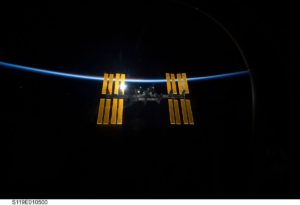
International Space Station.
Credit: NASA
So what happens when a catastrophic solar flare paralyzes global space agencies and throws the world order into chaos? This very scenario drives the plot of Deji Olukotun’s book, After the Flare. The result is an introspective look at timely questions of technology and international ambition.
Future Tense is bringing together Olukotun, an internet rights advocate and author, and Lucianne Walkowicz, astrophysicist and multimedia artist, to discuss the science behind solar flares and what we can learn about global tech policy through science fiction. Walkowicz is also the Baruch S. Blumberg NASA/Library of Congress Chair in Astrobiology at the Library of Congress.
This event is being held today — November 8, 2017 from 6:00-7:15 pm ET – and will be livestreamed.
To view the event, go to:

Source: Space-Track.org
On October 4, 1957, the Soviet Union launched Sputnik 1, the first human-made object to orbit the Earth. Precisely 60 years later, space-faring nations face a much different space environment; one that’s more diverse, disruptive, disordered, and dangerous. Today’s space domain presents a number of asymmetries that differ from other domains, creating a specific deterrence environment with unique policy implications.
Escalation and Deterrence in the Second Space Age is a new report by the Center for Strategic and International Studies (CSIS) Aerospace Security Project.
The report discusses the evolution of space as a contested domain, the changing threats to U.S. space systems, deterrence theory and its applications to the space domain, and findings from a space crisis exercise administered by CSIS last year.
Resources
The report, Escalation and Deterrence in the Second Space Age, written by Todd Harrison, Zack Cooper, Kaitlyn Johnson, and Thomas G. Roberts is available at:
A CSIS video provides a good overview of the report, and can be viewed at:

Curiosity Navcam Left B image taken on Sol 1867, November 6, 2017.
Credit: NASA/JPL-Caltech
“Back in the saddle again,” reports Michelle Minitti, a planetary geologist at Framework in Silver Spring, Maryland.
On Sol 1864, Curiosity successfully got a move on from the robot’s inadvertent layover stop.
The result is that the science team has a new workspace, and a new view of the structures exposed in the “Vera Rubin Ridge.”
New real estate
“The team grabbed as many observations of this new piece of real estate as they could fit in the plan,” Minitti says, not only because they were happy with the change of scenery, but because the plan had the rover drive once again.

Curiosity Navcam Left B image taken on Sol 1867, November 6, 2017.
Credit: NASA/JPL-Caltech
Both the Mars Hand Lens Imager (MAHLI) and the Alpha Particle X-Ray Spectrometer (APXS) were slated to look at the targets “Barberton” and “Campbellrand” using somewhat unusual techniques.
MAHLI will image both Barberton (a patch of bedrock with a rough, nodular texture) and Campbellrand, a smooth patch of Vera Rubin Ridge bedrock at night using her white light LEDs to illuminate the target.
“The choice of night imaging was driven by the poor workspace illumination expected at the more-typical daytime imaging times,” Minitti notes. When Curiosity is parked facing eastern headings, the rover arm and body cast shadows on the workspace in front of the rover.
“Shadows across MAHLI images make it more challenging to see the color and texture of the targets. MAHLI’s white light LEDs are not quite bright enough to use during the day to fill in these shadows, but in the dark of night, they illuminate targets brightly, giving the team an unfettered look at their rocks of interest,” Minitti explains.
Different chemistries
APXS was on tap to analyze Barberton using a raster technique. In a raster, APXS is placed at multiple spots, each slightly offset from one another, over a target that is hypothesized to have at least two different chemical components.

Curiosity Mastcam Left image acquired on Sol 1866, November 5, 2017.
Credit: NASA/JPL-Caltech/MSSS
“In the case of Barberton, these two different components are the background bedrock and the material producing the nodular texture. The slightly different spots measured by APXS yield slightly different chemistries,” Minitti points out. “By using the MAHLI images that accompany each APXS analysis to determine how much of each component is within each spot, the chemistry of the components can be separated from one another.”
Mastcam had many new features and structures to look at even just over 80 feet (25 meters) away from Curiosity’s last stop. “
South and east of Curiosity were two prime mosaic targets: bedrock exposures identified from orbit, which proved even more interesting on the ground. Stereo imaging of both these areas will allow the team to measure the bedding orientations in this part of the Vera Rubin Ridge, perhaps gaining more clues to its origin,” Minitti reports.
The rover’s Mastcam was scheduled to turn its filters on one of these bedrock areas to probe its iron mineralogy. Smaller, closer targets of interest for Mastcam were also available including “Belingwe” (a vertical exposure of nodular bedrock) and “Bergersdorp” (a resistant bedrock layer).

Curiosity Mastcam Right photo taken on Sol 1866, November 5, 2017.
Credit: NASA/JPL-Caltech/MSSS
Dust load
“The environment-minded members of the science team planned a suite of observations – movies looking for clouds and dust devils, and images assessing the dust load in the atmosphere – at three different times of day throughout the weekend,” Minitti says. “Taking measurements at multiple times of day helps the team understand how the Martian atmosphere behaves throughout the course of a sol in Gale.”
Curiosity’s drive of roughly 70 feet (22 meters) is intended to wheel the robot further up the ridge toward another bedrock exposure of interest.
Minitti concludes: “Here’s hoping the new vistas keep coming!”

