Archive for the ‘Space News’ Category
 Author:
  November 29th, 2017
Credit: Rocket Lab
Rocket Lab, a US aerospace company with operations in New Zealand, will open a ten-day launch window from Friday December 8, 2017 NZT to carry out the company’s second test launch of the Electron rocket.
During this time a four-hour launch window will open daily from 2:30 p.m. NZT.
Māhia Peninsula
The test launch, titled “Still Testing,” will take place from Rocket Lab’s Launch Complex 1 on the Māhia Peninsula, New Zealand.
This projected flight follows on from the inaugural Electron test carried out on May 25, 2017. That maiden launch failed to enter orbit, but the group has analyzed more than 25,000 channels of data from flight one to attempt reaching Earth orbit on flight two.
Payloads
The upcoming Still Testing will carry an Earth-imaging Dove satellite for Planet and two Lemur-2 satellites for Spire for weather and ship tracking, enabling Rocket Lab to gather crucial data and test systems for the deployment stage of a mission.
Still Testing is the second of three test launches planned from Launch Complex 1 ahead of commercial operations, however if the vehicle performs nominally throughout the second test the commercial phase may be accelerated.
Video stream
For the first time, a live video stream will be available approximately 15 minutes prior to a launch attempt at:
 Posted in

Curiosity Navcam Right B image taken on Sol 1887, November 27, 2017.
Credit: NASA/JPL-Caltech
Now in Sol 1889, NASA’s Curiosity Mars Rover is “back to the grind,” post-holiday, reports Scott Guzewich, an atmospheric scientist for NASA Goddard Space Flight Center in Greenbelt, Maryland.
“While many of us spent the holiday weekend relaxing with friends and family,” Guzewich notes, “Curiosity took no rest on Mars and continued working hard today.”
The Thanksgiving plan for the robot included some unusual activities, but is now back to more typical operations with a “touch-and-go” sol on the agenda.

Possible impact crater termed “Beit” (the round-looking feature in the middle of this Curiosity Navcam Left B image acquired on Sol 1887, November 27, 2017
Credit: NASA/JPL-Caltech
Possible impact crater
On the first sol of the plan, Mars researchers scheduled contact science with its Alpha Particle X-Ray Spectrometer (APXS) and Mars Hand Lens Imager (MAHLI).

Wheel inspection. Curiosity Mars Hand Lens Imager (MAHLI), located on the turret at the end of the rover’s robotic arm, acquired this image on Sol 1887, November 26, 2017.
Credit: NASA/JPL-Caltech/MSSS
In addition to a Chemistry and Camera (ChemCam) observation of a rock target termed “Lyttelton” and then Mastcam imaging of a possible impact crater nearby termed “Beit.”
Following that, Curiosity will drive approximately 130 feet (40 meters) toward its next stop of the Vera Rubin Ridge science campaign, Guzewich adds.

Curiosity ChemCam Remote Micro-Imager photo taken on Sol 1888, November 28, 2017.
Credit: NASA/JPL-Caltech/LANL
Fan-like deposit
The second sol of the plan will have Curiosity dedicated to remote-sensing science, including a long-distance image with ChemCam of a fan like deposit closer to Mt. Sharp in addition to Navcam movies searching for dust devils and clouds, Guzewich concludes.

NASA’s Space Launch System (SLS) makes use of powerful solid rocket motors.
Credit: NASA
The Earth’s stratosphere is under assault by rocket engine emissions and also polluted by reentering space debris. While space transportation plays a vital and increasing role in Earth’s economic system, rockets uniquely emit gases and particles directly into the middle and upper atmosphere. That exhaust from hundreds of launches accumulates and alters atmospheric radiation patterns.

An Orbital ATK Cygnus cargo ship plunges into the Earth’s atmosphere in a fiery finale. Vaporization of discarded space hardware equals dust production – a process that is not well understood.
Credit: ESA/NASA
This troublesome outlook is exasperated given the predicted pace of rocket launches by increasing numbers of nations in the coming decades.
Here’s my new Space.com story on this topic, posted today at:
Spaceflight Pollution: How Do Rocket Launches and Space Junk Affect Earth’s Atmosphere?
By Leonard David, Space.com’s Space Insider Columnist
November 27, 2017 06:35am ET
https://www.space.com/38884-rocket-exhaust-space-junk-pollution.html

Credit: IBMP RAS
A simulated Moon mission has been wrapped up by the Institute of Biomedical Problems of the Russian Academy of Sciences (IBMP RAS) in cooperation with NASA.
The 17-day experiment focused on long-term space travel, but centered on use of the proposed cis-lunar Deep Space Gateway. Eyed for the 2020s, this facility could be a collaborative partnership between Roscosmos, Russian’s federal space agency, and NASA.

Credit: IBMP RAS
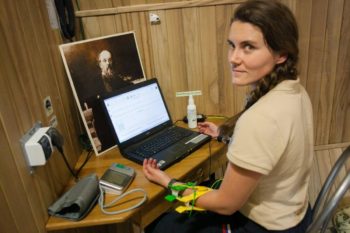
Called the SIRIUS (Scientific International Research in Unique Terrestrial Station) project, the simulated space voyage began on November 7, involving three men and three women. SIRIUS-17 crew members carried out an agenda of scientific experiments during their mission. The crew of the isolation experiment: Kikina Anna Yuryevna; Luchitskaya Elena Sergeevna; Lysova Natalia Yuryevna; Rukavishnikov IlyaVyacheslavovich; Serov Mark Vyacheslavovich and Viktor Fetter.
Personal space
The SIRIUS -17 mission focused on a simulated flight to the Moon. This international isolation experiment mimicked travel to the Moon, surveying the lunar surface by rovers, and trekking back to Earth.
During the 17-day isolation, scientists studied the distribution of roles in teamwork and leadership, interaction between men and women, their personal space, biochemistry. New systems of psychological support were applied, and new principles for the distribution of elbow room in spacecraft were also introduced.

Credit: IBMP RAS
Credit: IBMP RAS
Follow-on missions
NASA is also slated to work with the IBMP to conduct at least three follow-on missions: a four-month mission in 2018, an eight-month mission in 2019, and a 12-month mission in 2020.

Credit: IBMP RAS

MARS 500 Session training in the IMBP module.
Credit: IBMP RAS
The Moscow-based IBMP RAS complex was previously utilized for the “Mars 500” project – a set of “flights” carried out 2007-2011 that included a 520-day simulated voyage to the Red Planet.
IBMP maintains international scientific and technical ties under cooperative agreements with space agencies and research centers in the U.S., France, Germany, Italy, Canada, Japan, Austria, the Republic of Korea, China and other countries.
The SIRIUS missions are the first time NASA’s Human Research Program (HRP) partners with Russia’s IBMP Ground-based Experimental Complex (NEK) to conduct a series of analog missions.
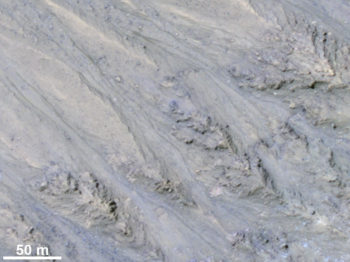
This Mars Reconnaissance Orbiter HiRISE image cutout shows Recurring Slope Lineae in Tivat crater on Mars in enhanced color. The narrow, dark flows descend downhill (towards the upper left). Analysis shows that the flows all end at approximately the same slope, which is similar to the angle of repose for sand.
Dark features previously proposed as evidence for significant liquid water flowing on Mars have now been identified as granular flows, where sand and dust move rather than liquid water, according to a new article published in Nature Geoscience by the U.S. Geological Survey.
Credit: NASA/JPL/University of Arizona/USGS
There appears to be a cascading truism about Recurring Slope Lineae, or RSL on Mars. That is, what causes these features is a recurring controversy.
On one hand, the appearance and growth of RSL resemble seeping liquid water. RSL features grow incrementally, fade when inactive and recur annually during the warmest time of year on Mars.
RSL are mostly found on steep rocky slopes in dark regions of Mars, such as the southern mid-latitudes, Valles Marineris near the equator, and in Acidalia Planitia on the northern plains.
But new research focused on these dark features have now been identified as granular flows, where sand and dust move rather than liquid water, according to a new article published in Nature Geoscience by the U.S. Geological Survey (USGS). This study was done in cooperation with the NASA Mars Reconnaissance Orbiter project.
Dry sand
If RSL are actually dry grain flow phenomena, this suggests that recent Mars has not had significant volumes of liquid water, which could preclude the presence of microbial life thriving at these sites. This finding would alleviate planetary protection concerns about habitable environments.
“We’ve thought of RSL as possible liquid water flows, but the slopes are more like what we expect for dry sand,” said USGS scientist and lead author of the published findings, Colin Dundas. “This new understanding of RSL supports other evidence that shows that Mars today is very dry.”
In a press statement, Dundas said that the terminal end of the RSL slopes are identical to the slopes of sand dunes where movement is caused by dry granular flows. Water almost certainly is not responsible for this behavior, which would require the volume of liquid to correspond to the length of slope available, producing more liquid on longer slopes. Instead, the 151 RSL examined all end on similar slopes despite very different lengths. Additionally, water is unlikely to be produced only near the tops of slopes at these angles and if it were, it should be able to flow onto lower slopes.

Flow physics
Planetary Science Institute (PSI) Senior Scientist Jim McElwaine is a co-author on the paper. PSI is headquartered in Tucson, Arizona.
“The RSL on Mars behave in a similar way to laboratory experiments on Earth,” said McElwaine who contributed expertise on the physics of granular flow and fluid dynamics to the research.
“What is still not understood is where the supply of fresh material comes from, though we do have some speculative ideas,” McElwaine said in a PSI statement.
Triggering mechanism
David Stillman, Senior Research Scientist at the Southwest Research Institute (SwRI) in Boulder, Colorado is an RSL investigator. He notes that McElwaine’s quote is correct.
“There is no known way to resupply/reset the slopes year after year after year. Also no known triggering mechanism that always triggers just below the bedrock-regolith interface and then for some reason slowly triggers further downslope as the RSL lengthen,” says Stillman.

NASA Mars Reconnaissance Orbiter’s HiRISE image of recurring slope lineae in Melas Chasma, Valles Marineris. Arrows point out tops and bottoms of a few lineae.
Credit: NASA/JPL-Caltech/University of Arizona
Furthermore, that is no explanation why dust can so quickly fade RSL away in low-dust areas, Stillman points out, compared to the decades needed to fade away slope streaks in dusty areas.
“Overall, it’s a great observation that will influence future RSL models, but many more things need to be understood before this theory is confirmed,” Stillman concludes.
Total speculation
“It is an important observation that RSL appear near the angle of repose, “but it is not a final, conclusive result,” responds Robert Grimm, a geophysicist in the Department of Space Studies at SwRI.
Everything is about the material volume budget, Grimm adds.
“Water can be replaced by an aquifer even if it is hard to explain the presence of that aquifer. How the sand would get replaced is total speculation at this
point. And this is related to the question of how RSL advance incrementally…easy to explain by flow of water in a porous medium, but sand must repeatedly trigger throughout the season – it’s not like flow down a dune face. “So the controversy continues,” concludes Grimm.
Resources
To access the new research in Nature Geoscience, “Granular flows at recurring slope lineae on Mars indicate a limited role for liquid water,” by Colin M. Dundas, Alfred S. McEwen, Matthew Chojnacki, Moses P. Milazzo, Shane Byrne, Jim N. McElwaine & Anna Urso, go to:
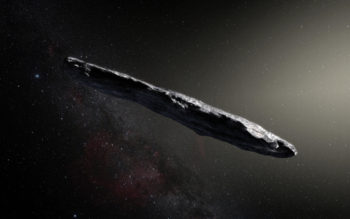
Artist’s impression of the interstellar asteroid `Oumuamua
Credit: ESO/M. Kornmesser
The UK-based Initiative for Interstellar Studies (i4is) has taken a look at how best to get up close and personal with interstellar asteroid A/2017 U1.
This interstellar interloper is tagged as being more than 1,310 feet (400 meters) in diameter and is currently travelling at 44 kilometers per second with respect to the Sun. That’s much faster than any human-made object to date.
Hidden secrets
“What can be more exciting than chasing this object with a spacecraft and making observations from a close distance? What secrets are hidden on this visitor from our galaxy? The velocity of the object makes it challenging to reach but this challenge might lead to new, innovative mission concepts,” explains the i4is study group.

Credit: Initiative for Interstellar Studies (i4is)
Their findings have been published by way of Project Lyra: Sending a Spacecraft to 1I/’Oumuamua (former A/2017 U1), the Interstellar Asteroid
Lyra is the star constellation from which the interstellar asteroid came from.
High-speed interception
The opportunity to directly study material from other star systems is the quest. But can such objects be intercepted? The challenge of reaching the object within a reasonable timeframe is formidable due to its high heliocentric hyperbolic excess velocity.
Project Lyra participants took a look at different mission durations and their velocity requirements, as well as intercept trajectories.
Several technology options are outlined in their work, ranging from a close solar Oberth Maneuver using chemical propulsion, and the more advanced options of solar and laser sails.
Viable options
“To maximize science return decelerating the spacecraft at ’Oumuamua is highly desirable, due to the minimal science return from a hyper-velocity encounter,” the study paper notes. “It is concluded that although reaching the object is challenging, there seem to be viable options based on current and near-term technology.”
The discovery of the first interstellar object entering our solar system is an exciting event and could be the chance of a lifetime or several lifetimes.

Credit: Breakthrough Initiatives
Important result
The i4is study group concludes that a mission to the object will stretch the boundary of what is technologically possible today. “A mission using conventional chemical propulsion system would be feasible using a Jupiter flyby to gravity assist into a close encounter with the Sun. Given the right materials, solar sail technology or laser sails could be used,” they report.
An important result of the i4is analysis is that the value of a laser beaming infrastructure from the Breakthrough Initiatives’ Project Starshot “would be the flexibility to react quickly to future unexpected events, such as sending a swarm of probes to the next object like 1I/‘Oumuamua.” Indeed, if such an infrastructure would be in place today, “intercept missions could have reached 1I/‘Oumuamua within a year.”

Credit: Initiative for Interstellar Studies (i4is)
Long-term ambition
The long-term ambition of the Initiative for Interstellar Studies (i4is) is to enable both robotic and human exploration and colonization of the nearby stars. “However, we have to start with a plan, that builds from incremental steps year on year and takes us in the right direction and with growth as a key,” their website explains.
To that end, future work within Project Lyra will focus on analyzing the different mission concepts and technology options in more detail and to down select two to three promising concepts for further development.
Resources
To read the Project Lyra study paper, go to:
https://arxiv.org/ftp/arxiv/papers/1711/1711.03155.pdf
More information on the Initiative for Interstellar Studies (i4is) can be found at:
Lastly, take a look at this animation of `Oumuamua passing through the Solar System, issued by the European Southern Observatory (ESO), published on November 20, 2017. This animation shows the path of the interstellar asteroid 1I/2017 (‘Oumuamua) through the Solar System. Observations with ESO’s Very Large Telescope and others have shown that this unique object is dark, reddish in color and highly elongated.
Go the video at:
https://www.youtube.com/watch?time_continue=25&v=Yzha7ji3lsM

Credit: RR Auction
Apollo 11 Buzz Aldrin’s solid gold Lunar Module replica has sold for nearly $150,000 at a recent Boston-based auction.
Cartier Solid Gold Lunar Module Replica sold for $149,861 according to Boston-based RR Auction.
Produced by the legendary jewelry company Cartier, three of the solid gold models of the Lunar Module Eagle was commissioned by a French newspaper and presented to the Apollo 11 astronauts during their post-flight visit to Paris in October 1969.
The astronauts’ visit to Paris came as part of their ‘Giant Step’ international goodwill tour, which brought them to 24 countries in 45 days. In the celebratory mania that ensued, one hundred million people turned out to see the crew who had performed humanity’s greatest triumph…a journey to the Moon and back.
Space memorabilia highlights
“With the upcoming Apollo 11 50th Anniversary interest in space memorabilia remains incredibly strong — as evidenced by the Apollo 11 crew signed flag included in our sale that more than doubled the previous world record price for a public auction,” said Bobby Livingston, Executive VP at RR Auction, in a press statement.
Highlights from the sale include:
Apollo 11 crew signed American flag presentation realized $120,693.

Credit: RR Auction
Apollo 11 Lunar Module flown page with Neil Armstrong notations “Go to Descent” sold for $78,346.
A letter penned by astronaut Michael Collins that notes: “The ultimate value of our lunar landing program cannot be outlined in detail at this time,” writes the future Apollo 11 pilot, “just as it was impossible to foresee all the uses to which the Wright brothers’ invention would be put. The letter sold for $18,616.
Another item was a Neil Armstrong letter in which he states, “Exploration in space, as in any other area, provides answers to old questions, but, perhaps more importantly, provides new questions. New questions are the basis for progress, and progress is the key to a better world in which to live. It sold for $11,837.
Resources
The Space Exploration Auction from RR Auction began on November 9 and concluded on November 16.
More details can be found online at:
Also, go to:
https://www.rrauction.com/past_auction_summary.cfm?auction=518

Credit: ESA/NASA
It takes a Moon village – and the International Space University is onboard by creating a new Moon Village Association.
This week, more than 150 experts, engineers, educators and students from around the world gathered in Strasbourg, France to participate in the first International Moon Village Workshop.
Emerging focus
The consensus of the participants is the Moon Village concept?
First of all, there is immense potential to focus and communicate broadly an emerging focus on lunar exploration and development and activities throughout cis-lunar space (i.e., outer space in the vicinity of Earth and the Moon), according to an International Space University (ISU) press statement.
Also, here’s a factoid about the Moon Village: It is not a single location nor a traditional space project, but is rather a broadly defined conceptual framework encompassing a diverse suite of planned and potential future human activities in space.

Concept of view from a deep space habitat
Credit: ESA
“Beginning now, and continuing into future decades the Moon Village represents a community comprising a wide range of future missions and emerging markets, including scientific research, commercial ventures, profound cultural developments and more,” notes the ISU press statement.
New networks
The Moon Village Association (MVA) partners with non-space organizations to promote international discussion and formulation of plans to foster the implementation of a Moon Village, and is creating networks — international/national/regional — to engage civil society around the world.
Moreover, the MVA has been set up to work with other space and non-space organizations (commercial, non-profit, government, and others) to organize dedicated Moon Village and related events, with the MVA making the results available.

Inside look at one idea the European Space Agency is exploring in its formulation of a “Moon Village” that incorporates 3D printing.
Credit: ESA/ Foster + Partners
For information on how to become involved in realizing the Moon Village, visit:

NASA’s InSight Mars lander is moving forward in testing, nearing “ship and shoot” status next year. The spacecraft is shown here fresh out of intense thermal vacuum test period.
Credit: Lockheed Martin
Littleton, Colorado – InSight, NASA’s next Mars mission is rapidly approaching “ship and shoot” status next year. This Interior Exploration using Seismic Investigations, Geodesy and Heat Transport — InSight for short space speak — has just completed “thermal vac” here at Lockheed Martin Space Systems Company – builder of the Mars-bound craft.
Thermal vacuum testing (TVAC) simulates the cruel environment of space to appraise how the Mars-bound craft and its instruments operate under “flight-like” conditions.
For more information on this next NASA Mars mission, go to my new Space.com story at:
NASA’s Next Mars Lander Passes Big Test Ahead of May 2018 Launch
November 22, 2017 12:39pm ET
https://www.space.com/38868-nasa-mars-lander-insight-testing.html

Curiosity Navcam Left B image taken on Sol 1879, November 18, 2017.
Credit: NASA/JPL-Caltech
Now in Sol 1883, NASA’s Curiosity Mars rover is ready to carry out duties over the upcoming holiday.
Mars rover scientists have put together “two extra-large helpings of science” to get through the Thanksgiving holiday, reports Ryan Anderson, a planetary geologist at the USGS in Flagstaff, Arizona.
The first plan covers sols 1882 through 1886 and will mostly involve sitting in one place and not moving. While in this mode, Curiosity will be cooking a sample of “Ogunquit Beach” in the Sample Analysis at Mars (SAM) Instrument Suite via the Evolved Gas Analysis (EGA) oven.
Before that happens, the rover will use its Mars Descent Imager (MARDI) to look at the ground under the rover to see if anything has moved while the Mars machinery has been sitting at this location.

Curiosity Front Hazcam Left B image acquired on Sol 1882, November 21, 2017.
Credit: NASA/JPL-Caltech
Looking for frost
Anderson notes that at pre-dawn on sol 1883 the robot’s Chemistry and Camera (ChemCam) is to analyze the rock target “Lebombo” and the soil “Oaktree” to look for evidence of frost.
Then, on sol 1885, remote sensing tasks includes use of Mastcam to collect multispectral observations of the target “Hexriver” and ChemCam will analyze the targets “Klipfonteinheuwel” and “Klippan.”

Curiosity Rear Hazcam Right B image taken on Sol 1882, November 21, 2017.
Credit: NASA/JPL-Caltech
Mt. Sharp observations
Anderson says he has advocated for ChemCam to use the Remote Micro-Imager (RMI) to take a closer look at an interesting geologic contact on Mt. Sharp.
Curiosity’s Mastcam is slated to document all of the ChemCam observations, as well as the ChemCam auto-targeted observation from sol 1878. Mastcam will repeat its clast (a rock fragment or grain resulting from the breakdown of larger rocks) survey observation from a few days ago to check for any changes, and then utilize the Alpha Particle X-Ray Spectrometer (APXS) to analyze Klippan and Klipfonteinheuwel overnight.
Before dawn on Sol 1886, Anderson adds that ChemCam will once again analyze Lebombo and Oaktree to look for frost and Navcam and Mastcam will take advantage of the early start to make atmospheric observations.
Second plan
“The second plan for the long weekend covers Sols 1886 through 1888. Mastcam will take pictures of the two frost campaign targets, as well as another atmospheric observation,” Anderson explains.
Then ChemCam and Mastcam will take another look at the Autonomous Exploration for Gathering Increased Science (AEGIS) target from sol 1878.
“This target was given the name ‘Reivilo’ by two of our French colleagues who were on operations today…both named Olivier, who really like the name for some reason,” Anderson says. After that, the Mars Hand Lens Imager (MAHLI) will take a closer look at Klipfonteinheuwel and Klippan and APXS will do an overnight calibration measurement.”

Dust Removal Tool at work. Curiosity Mastcam Right image acquired on Sol 1881, November 20, 2017.
Credit: NASA/JPL-Caltech/MSSS
On Sol 1887 Curiosity will finally move on from the locale where the Mars machinery has been camped for a while, collecting some post-drive images to help with targeting next week.
Lastly, on tap is an untargeted science block.
Distant mesa
Curiosity’s ChemCam will use AEGIS software to automatically pick another target via artificial intelligence. There will be another attempt to observe Mt. Sharp with the RMI, Anderson points out, “this time to check for changes on a distant mesa that I have been monitoring.”

Curiosity ChemCam Remote Micro-Imager photo taken on Sol 1879, November 18, 2017.
Credit: NASA/JPL-Caltech/LANL
The long weekend will wrap up with Navcam observations to check for clouds and dust devils, and Mastcam observations to measure the dust in the atmosphere.
“We on the Curiosity team are thankful every day that we get to be a part of the exploration of Mars,” Anderson concludes, “and next week we’ll pick up where we left off as we continue our campaign to explore Vera Rubin Ridge!”

