Archive for the ‘Space News’ Category
 Author:
  January 16th, 2018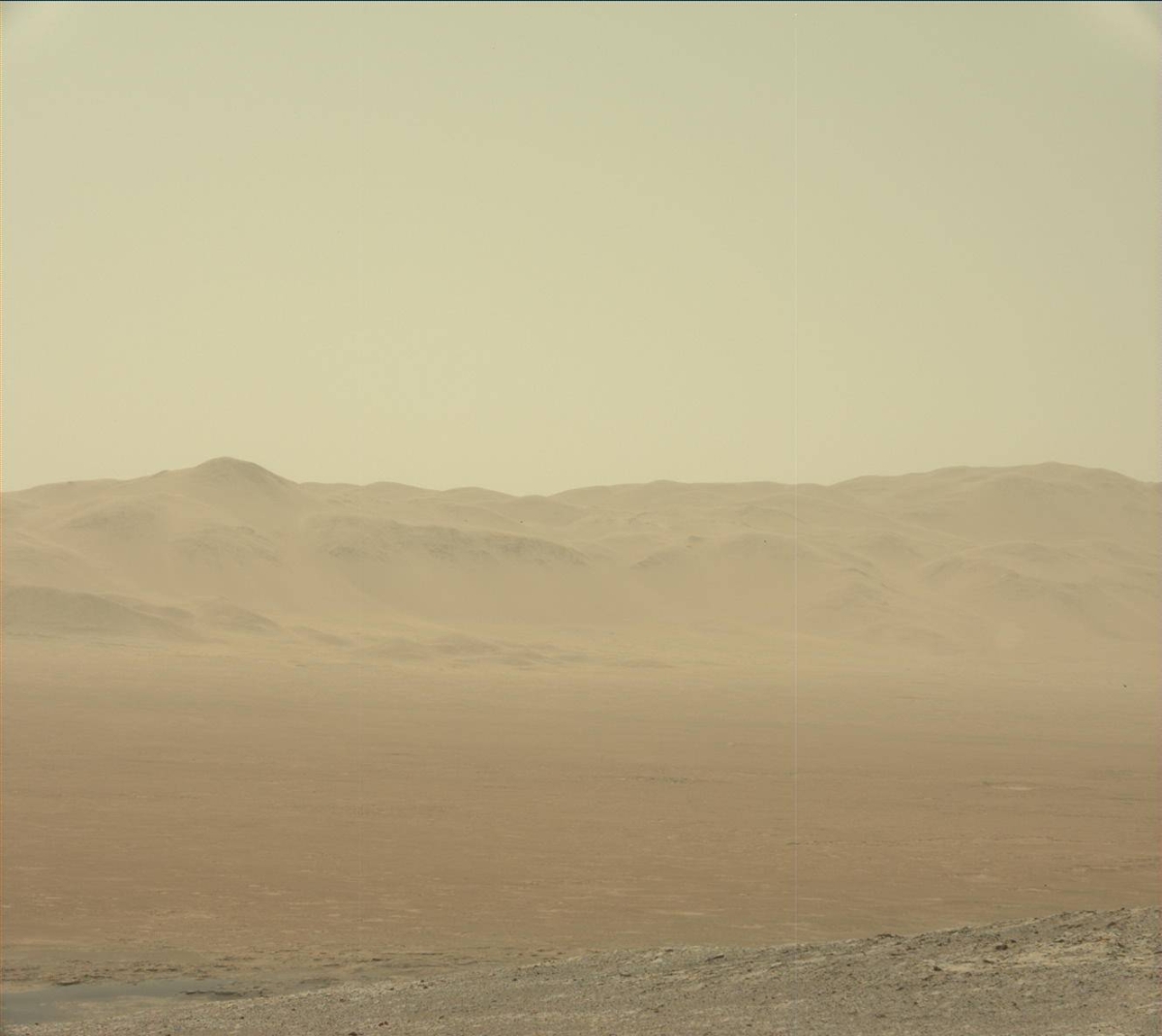
Curiosity Mastcam Left photo acquired on Sol 1933, January 13, 2018.
Credit: NASA/JPL-Caltech/MSSS
NASA’s Curiosity Mars rover is now in Sol 1936 and investigating location “e” – an informal site name but one that is stirring up excitement within the rover’s science team.
That’s the word from Christopher Edwards, a planetary geologist from Northern Arizona University in Flagstaff.

Curiosity Front Hazcam Right B image acquired on Sol 1935. January 15, 2018.
Credit: NASA/JPL-Caltech
Geologic story
“The first thing the science team on shift did was decide to stay at the current location rather than drive away,” Edwards notes. “This was primarily driven by the large suite of excellent science targets available in the workspace. These targets continue to help constrain the geologic story of the Vera Rubin Ridge.”
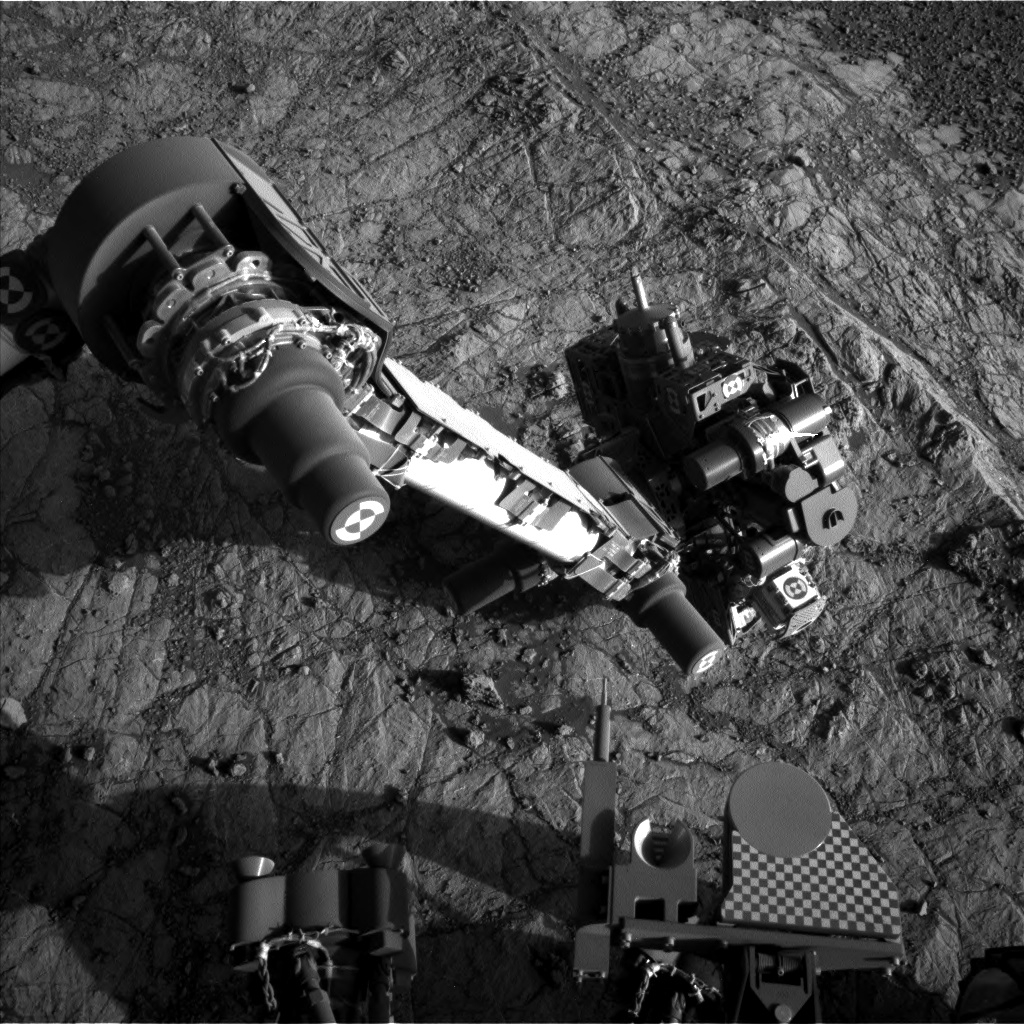
Curiosity Navcam Left B image acquired on Sol 1935, January 15, 2018.
Credit: NASA/JPL-Caltech
Two arm targets for Alpha Particle X-Ray Spectrometer (APXS) integrations were quickly chosen by the science team and handed off to the rover planners for assessment: “Ross of Mull” and “Mcleans Nose.”
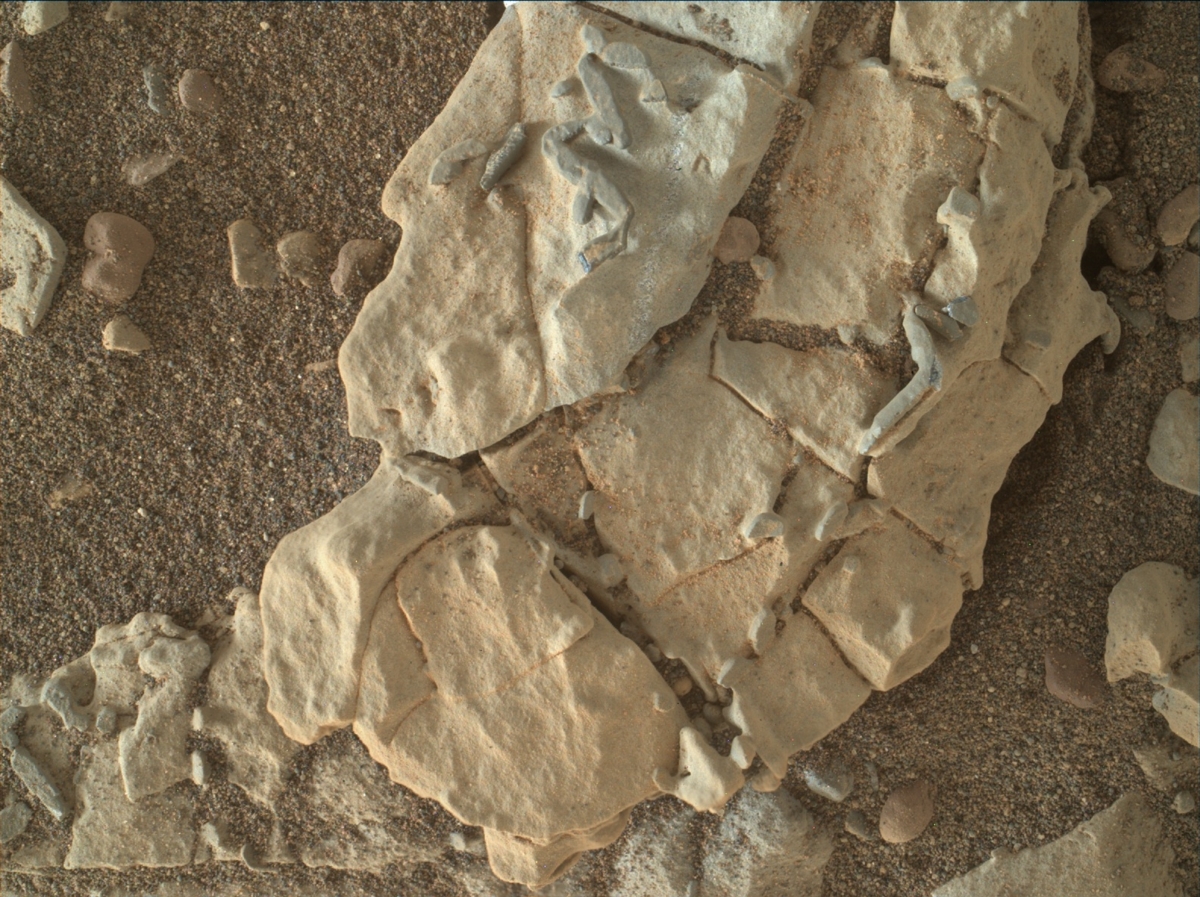
“Sticks” and stones! Using an onboard focusing process, the Mars Hand Lens Imager (MAHLI) aboard NASA’s Mars rover Curiosity created this product by merging two to eight images previously taken by the MAHLI, located on the turret at the end of the rover’s robotic arm.
MAHLI imagery of the unusual features taken back on Sol 1923 January 2, 2018.
Credit: NASA/JPL-Caltech/MSSS
Elongated, raised, linear features
Ross of Mull is a grayer bedrock area with nodular material nearby, while Mcleans Nose is a prominent gray toned resistant feature.
Edwards says that Chemistry and Camera (ChemCam) data was acquired of a suite of targets, “including those that had the elongate[d], raised, linear features known by the team as “sticks”, as well as the two APXS targets.”
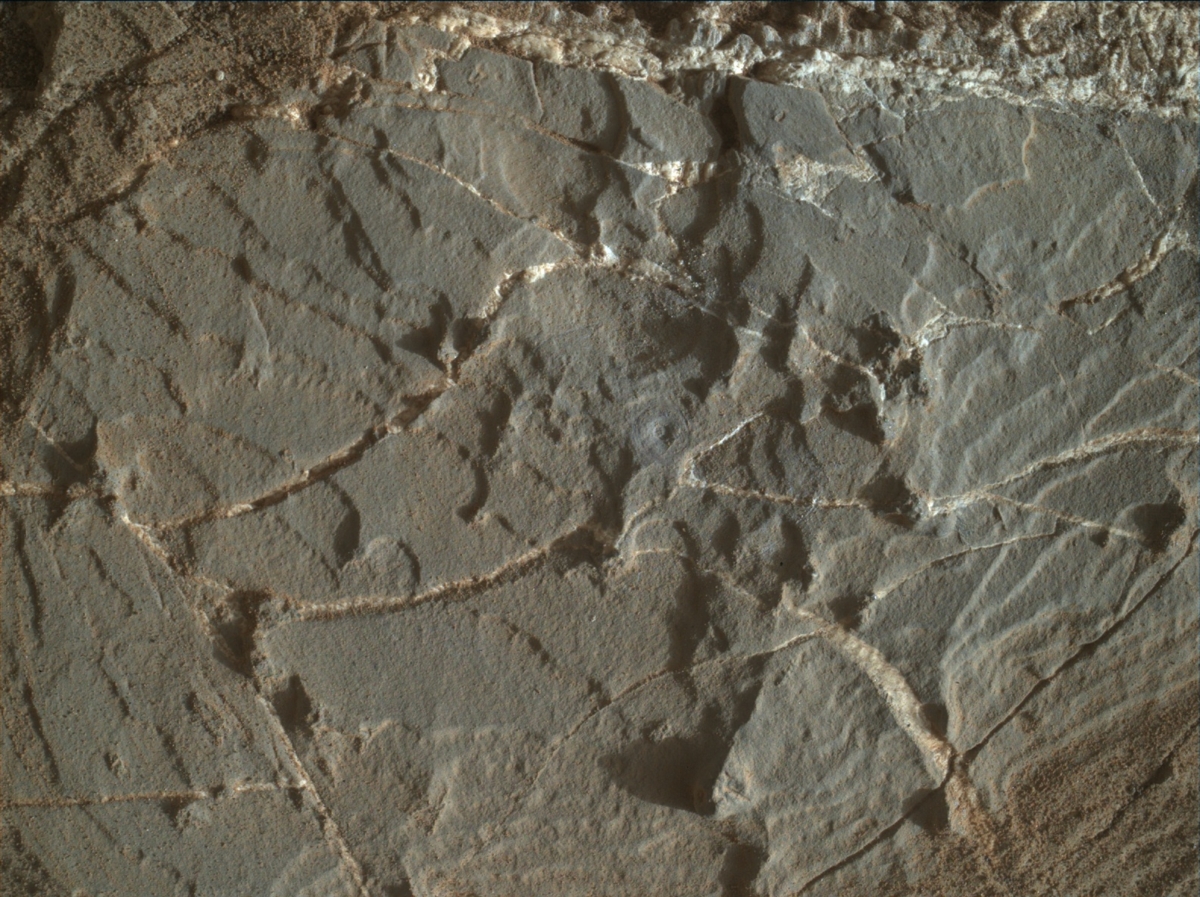
Using an onboard focusing process, the Mars Hand Lens Imager (MAHLI) aboard NASA’s Mars rover Curiosity created this product by merging two to eight images previously taken by the MAHLI, located on the turret at the end of the rover’s robotic arm.
MAHLI imagery from Sol 1935 January 16, 2018.
Credit: NASA/JPL-Caltech/MSSS
Workspace photos
Documentation imaging of these targets, Edwards adds, including multispectral imaging to characterize the visible/near-infrared spectral properties of the site, will happen over the course of the plan.
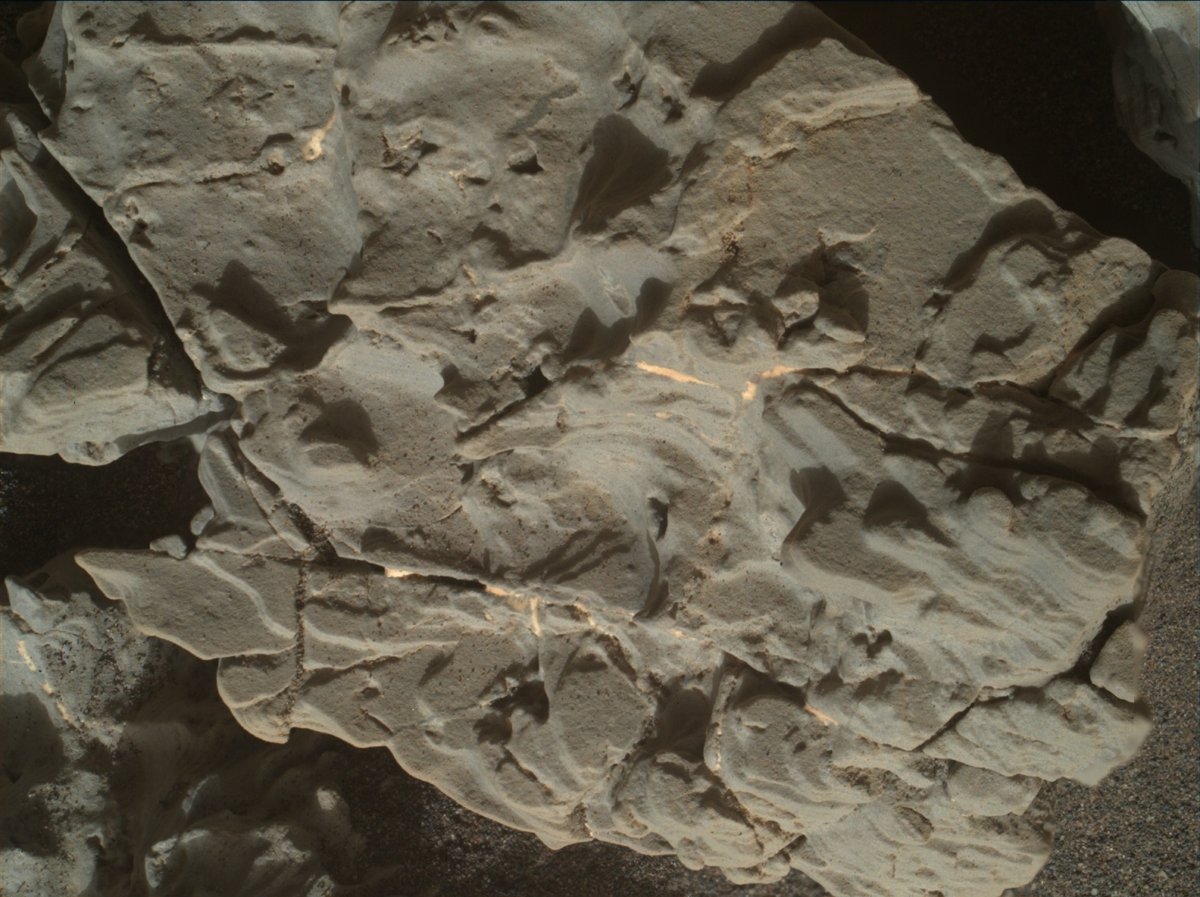
Using an onboard focusing process, the Mars Hand Lens Imager (MAHLI) aboard NASA’s Mars rover Curiosity created this product by merging two to eight images previously taken by the MAHLI, located on the turret at the end of the rover’s robotic arm.
MAHLI imagery from Sol 1935 January 16, 2018.
Credit: NASA/JPL-Caltech/MSSS
Use of the robot’s Mars Hand Lens Imager (MAHLI) imaging of the workspace will continue and is likely to produce stunning images, Edwards concludes. “Mars continues to provide Curiosity with some fabulous rocks for investigation!”
 Posted in
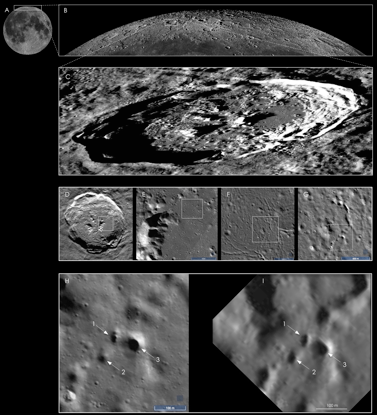
Series of images showing the location of some of the newly discovered lava tube skylight candidates at Philolaus Crater near the North Pole of the Moon (NASA/LunarReconnaissanceOrbiter/SETI Institute/Mars Institute/PascalLee).
Entrance to an underground network of lava tubes on the Moon may have been found – perhaps an underground “watering hole” rife with ice for future explorers.
Using NASA’s Lunar Reconnaissance Orbiter (LRO), the discovery of small pits in a large crater near the Moon’s North Pole could indicate pathways to a subsurface system of lava tubes. The finding was announced by the SETI Institute and the Mars Institute.
Impact crater
Location of the pits is cross-haired on the northeastern floor of Philolaus Crater, a large, 43 mile (70 kilometer)-diameter impact crater.
“The highest resolution images available for Philolaus Crater do not allow the pits to be identified as lava tube skylights with 100 percent certainty, but we are looking at good candidates considering simultaneously their size, shape, lighting conditions and geologic setting” says Pascal Lee, planetary scientist at the SETI Institute and the Mars Institute who made the new finding at NASA’s Ames Research Center in Silicon Valley.
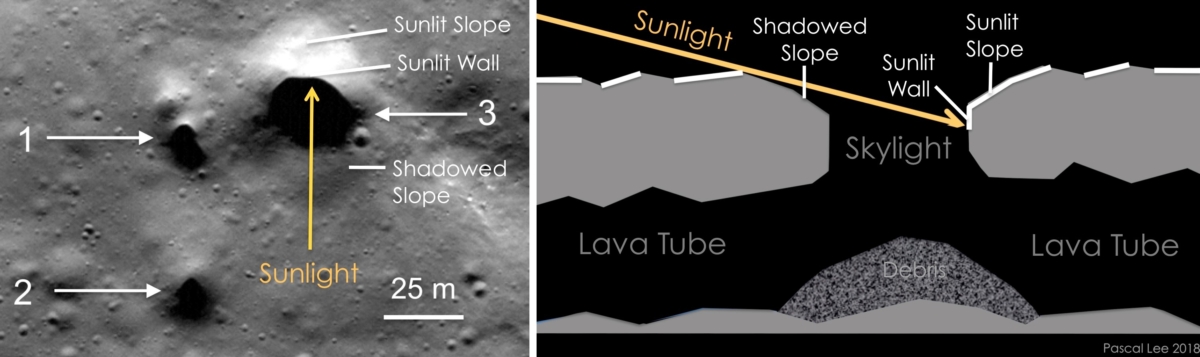
In the polar regions of the Moon, the grazing sunlight would never illuminate the interiors of skylights, making them difficult to identify with 100% certainty. Underlying lava tubes would experience perpetual darkness and extreme cold. Credit: NASA LRO/SETI Institute/Mars Institute/Pascal Lee
Subsurface ice
If water ice is present, these potential lava tube entrances or “skylights” might allow future explorers easier access to subsurface ice, and therefore water, than if they had to excavate the gritty ice-rich “regolith” (surface rubble) at the actual lunar poles, Lee points out.
Lee announced the discovery of the candidate lava tube skylights in Philolaus Crater last week at NASA’s Lunar Science for Landed Missions Workshop convened by the Solar System Exploration Research Virtual Institute (SSERVI) at Ames.
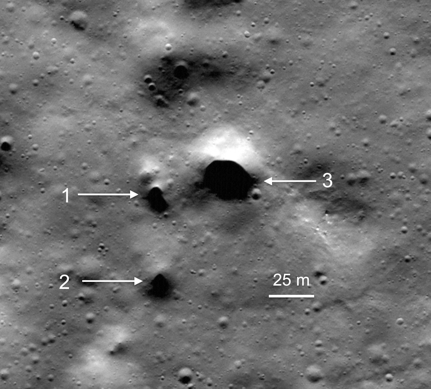
One of the highest resolution NASA Lunar Reconnaissance Orbiter images showing some of the newly discovered lava tube skylight candidates at Philolaus Crater near the North Pole of the Moon (NASA/Lunar Reconnaissance Orbiter/SETI Institute/Mars Institute/Pascal Lee).
Access, extraction, utilizati
The announcement represents the first published report of possible lava tube skylights in the Moon’s polar regions. Over 200 pits had been found elsewhere on the Moon by other researchers, with many identified as likely skylights leading to underground lava tubes along sections of winding channels, known on the Moon as “sinuous rilles.”
Particularly important for future human explorers is the prospect of easier access, extraction and then utilization of lunar polar ice.
First of all, skylights and lava tubes could provide more direct access to the very cold polar underground, alleviating the need to excavate vast amounts of lunar regolith.
Secondly, if ice is present inside the lava tubes – which is not yet known – it could be in the form of massive ice formations as often occur in cold lava tubes on Earth – instead of mixed-in within lunar grit.
Lastly, solar power would be available nearby, just outside each skylight.
BTW: NASA’s Gravity Recovery and Interior Laboratory (GRAIL) mission ended on December 17, 2012 with the two spacecraft GRAIL A (Ebb) and GRAIL B (Flow) impacting the Moon. Both impact sites lie on the southern slope of an unnamed massif (mountain) that lies south of the crater Mouchez and northeast of the Philolaus Crater.
Caving astronauts
Being on the Moon’s near side, Philolaus Crater affords direct communications with the Earth.
“We would also have a beautiful view of Earth. The Apollo landing sites were all near the Moon’s equator, such that the Earth was almost directly overhead for the astronauts. But from the Philolaus skylights, Earth would loom just over the crater’s mountainous rim, near the horizon to the southeast” adds Lee in a press statement.
“This is an exciting possibility that a new generation of caving astronauts or robotic spelunkers could help address” Lee notes. “Exploring lava tubes on the Moon will also prepare us for the exploration of lava tubes on Mars. There, we will face the prospect of expanding our search for life into the deeper underground of Mars where we might find environments that are warmer, wetter, and more sheltered than at the surface.”
Go to these informative videos:
Philolaus Traverse
Polar Caves on the Moon? – Pascal Lee

Credit: ASAP
The newly issued Aerospace Safety Advisory Panel Annual (ASAP) Report for 2017 flags an impressive interactive tool: Significant Incidents and Close Calls in Human Spaceflight.
This tool chronicles some 186 safety incidents going back to the 1960s and includes operations by SR-71 aircraft, the X-15, Russia’s Soyuz, the U.S. Space Shuttle and the International Space Station.
The ASAP was established by Congress in 1968 to provide advice and make recommendations to the NASA Administrator on safety matters.

Credit: NASA Johnson Space Center’s Flight Safety Office
Visible reminder
Spotlighted in the new report is a comprehensive study of past significant incidents and close calls that have occurred in human space flight
As noted in the interactive and informative graphic tool, the Significant Incidents and Close Calls in Human Spaceflight chart is maintained by NASA Johnson Space Center’s Flight Safety Office to raise awareness of lessons learned through the years. It provides a visible reminder of the risks inherent in human spaceflight and is intended to spark an interest in past events, to inspire people to delve into lessons learned, and to encourage continued vigilance.
The chart is a tool “to ensure the lessons of history are incorporated into new designs, so that future accidents may be prevented.”

Credit: NASA Johnson Space Center’s Flight Safety Office
Sharing information
Within the Significant Incidents and Close Calls in Human Spaceflight chart, two fatal events highlight the importance of sharing country to country information.
“On March 23, 1961 Soviet cosmonaut Valentin Bondarenko lost his life after being severely burned in an altitude chamber fire. The incident occurred during a routine training exercise, when Bondarenko attempted to throw an alcohol swab into a waste basket, but hit a hot plate instead. The oxygen-rich environment quickly ignited. Rescue efforts were thwarted because internal pressure prevented rescuers from opening the chamber’s inwardly swinging hatch for several minutes. By the time the pressure was released and the hatch could be opened, Bondarenko had been hopelessly burned. He died hours later,” the interactive chart explains.

Apollo 204 fire.
Credit: NASA
Apollo fire
“Six years later,” the chart description continues, “three U.S. astronaut’s lives were lost during a test in the Apollo crew module, which contained an oxygen-rich atmosphere. An electrical short caused a fire that spread quickly throughout the cabin. Again, rescue efforts were delayed due to the buildup of pressure behind an inwardly opening hatch. Unlike the Soviet altitude chamber oxygen fire, the crew did not die due to burns from the fire, but from cardiac arrest caused by smoke inhalation. However, in both the Bondarenko and Apollo events, high levels of oxygen caused the fires to spread rapidly, and pressure against inward-opening hatches slowed rescue efforts. Neither cabin was equipped with effective fire-suppression equipment.”
Detail about the Bondarenko incident was not known in the U.S. until 1986 – more than 20 years after it occurred, the chart description explains.
“Would access to this information have led to design changes that could have saved the Apollo astronauts’ lives? Although that question can never be answered, these events underscore the importance of sharing information and maintaining awareness of past events in the effort to prevent future tragedies.”
To access this fact-filled and eye-opening chart, go to:
https://sma.nasa.gov/SignificantIncidents/
Also available is the Aerospace Safety Advisory Panel Annual (ASAP) Report for 2017 that can be found at:
https://oiir.hq.nasa.gov/asap/documents/2017_ASAP_Annual_Report.pdf

Curiosity Front Hazcam Left B image taken on Sol 1933, January 13, 2018.
Credit: NASA/JPL-Caltech
Now at the end of Sol 1933 operations, Curiosity has made it to “Region e” of the Vera Rubin Ridge (VRR) campaign, reports Mark Salvatore, a planetary geologist from the University of Michigan in Dearborn.

Curiosity Rear Hazcam Right B photo acquired on Sol 1933, January 13, 2018.
Credit: NASA/JPL-Caltech
“This location is a slight depression with exposed fractured bedrock that appears more ‘blue’ from orbit than the surrounding region,” Salvatore notes. In addition, the orbital evidence and observations from the ground suggest that this location is similar to ‘Region 10’ that was visited recently, “which was shown to have some pretty spectacular small-scale features that were of particular interest to many on the science team.
As a result, the team is very excited to reach “Region e” and begin a focused scientific investigation.

Curiosity Navcam Left B image taken on Sol 1932, January 12, 2018.
Credit: NASA/JPL-Caltech
MAVEN relay
During the first day of the current plan, Curiosity will focus on acquiring a large amount of high-resolution Mast Camera (Mastcam) color images of the area immediately in front of the rover, the “mid-range” region a few meters in front of the rover, and the entirety of Mt. Sharp.

Curiosity Mastcam Right image taken on Sol 1932, January 12, 2018.
Credit: NASA/JPL-Caltech/MSSS
“This is an anomalous amount of data to collect at a given time, but we are able to do so thanks to the help of the Mars Atmosphere and Volatile Evolution Mission (MAVEN) spacecraft, which will be helping us to downlink those images over the course of the next week,” Salvatore adds.
With the exception of the Mt. Sharp images, Salvatore says, the other data are to characterize any small-scale geologic features present within “Region e,” and the plan was to have those images back to Earth at last week’s end.

Curiosity Mars Hand Lens Imager (MAHLI) produced on Sol 1933, January 13, 2018.
Credit: NASA/JPL-Caltech/MSSS
Dust off
In the afternoon of the first day, the plan called for Curiosity’s arm to characterize an unfractured piece of bedrock in front of the rover named “Unst.”
The robot’s Dust Removal Tool (DRT) was slated to remove any surface dust, image the patch of bedrock with the Mars Hand Lens Imager (MAHLI) instrument, and then place the Alpha Particle X-Ray Spectrometer (APXS) instrument on the target for an overnight integration to derive its bulk chemistry.

Curiosity ChemCam Remote Micro-Imager photo acquired on Sol 1933. January 13, 2018.
Credit: NASA/JPL-Caltech/LANL
Knobby bedrock
On the second day of the scripted plan, Curiosity was set to utilize its Chemistry & Camera (ChemCam) to remotely acquire chemistry data on two targets of interest.
The first will be “Canna,” a knobby piece of bedrock, and the second will be “Aberfoyle,” the flattest portion of this blocky region in front of the rover.
Aberfoyle will also be the target of an APXS measurement that evening.
Mastcam will be used to document these targets, in addition to the automated ChemCam observation that was obtained two days earlier.
Layered rock
“The ‘Aberfoyle’ ChemCam observation is beneficial for two reasons. First, we will be acquiring additional chemical measurements of this target that will be analyzed with APXS. Second, the laser blasts of ChemCam will help to remove any surface dust on the target, which will allow APXS to more confidently measure the bedrock composition with minimal input from the fine-grained dust,” Salvatore reports.
After this suite of measurements, the arm was scheduled to be moved into position to image the “Canna” target, the “Aberfoyle” target, and also a nearby layered rock named “Funzie.” After these images are acquired, the APXS instrument will be placed on “Aberfoyle” for an overnight integration.
Unique patterns
On the final day of the plan, Salvatore adds that ChemCam will analyze the chemistry of the “Unst” target (which was analyzed by APXS on the first evening of the plan), the “Funzie” target (to determine if there are any compositional variations associated with the observed layers), and a new target named “Morar,” which is a piece of bedrock that shows some unique patterns that might be due to fracturing, the presence of veins, and/or sculpting by the wind.
After the ChemCam observations, the plan calls for acquisition of Mastcam documentation images, and then make environmental observations with Mastcam and Navcam to hunt for dust devils and to assess the amount of dust in the air.

Credit: NASA/JPL-Caltech/Univ. of Arizona
Traverse map
Meanwhile, a new Curiosity traverse map through Sol 1930 has been issued.
This map shows the route driven by NASA’s Mars rover Curiosity through the 1930 Martian day, or sol, of the rover’s mission on Mars (January 10, 2018).
Numbering of the dots along the line indicate the sol number of each drive. North is up. The scale bar is 1 kilometer (~0.62 mile).
From Sol 1928 to Sol 1930, Curiosity had driven a straight line distance of about 63.65 feet (19.40 meters), bringing the rover’s total odometry for the mission to 11.19 miles (18.01 kilometers).
The base image from the map is from the High Resolution Imaging Science Experiment Camera (HiRISE) in NASA’s Mars Reconnaissance Orbiter.

Curiosity Front Hazcam Left B image taken on Sol 1930, January 10, 2018.
Credit: NASA/JPL-Caltech
NASA’s Curiosity Mars rover is wrapping up Sol 1930 duties.
Scott Guzewich, an atmospheric scientist at NASA’s Goddard Space Flight Center in Greenbelt, Maryland reports:
“For the last several weeks, Curiosity has been hopping between areas of blue-ish toned rocks on the Vera Rubin Ridge and the results from these locations continue to become more compelling,”

Curosity Rear Hazcam Right B image acquires on Sol 1930, January 10, 2018.
Credit: NASA/JPL-Caltech
Next stop
The robot’s next blue-toned destination, Guzewich says, has informally been called “Stop E” and the Curiosity science team “made a unanimous decision to get there as quickly as possible on the second sol of our plan, Sol 1930.”
That’s not to say, Guzewich adds, Curiosity scientists will be ignoring the current location en route!

Curosity Navcam Left B image taken on Sol 1930, January 10, 2018.
Credit: NASA/JPL-Caltech
Contact science
Guzewich says the plan called for contact science for Sol 1929 with the robot’s Alpha Particle X-Ray Spectrometer (APXS) and use of Mars Hand Lens Imager (MAHLI).
Those instruments were slated to study a bedrock target termed “Banff” as well as Curiosity performing associated Chemistry & Camera (ChemCam) work and taking Mastcam images.

Curiosity Mastcam Right image acquired on Sol 1928, January 8, 2018.
Credit: NASA/JPL-Caltech/MSSS
Also on the agenda, use of ChemCam and Mastcam on targets “Bass Rock” and “Barraclough.”
In addition to the drive on Sol 1930, environmental work by the rover is planned via three Mastcam tau observations during the day to help study how the amount of dust and clouds in the sky vary throughout the day, Guzewich concluded.

Luis Elizondo, the former intelligence officer who ran the secretive Advanced Aviation Threat Identification Program speaks out on CNN interview.
Credit: CNN/screen grab
For believers in aliens visiting Earth’s friendly skies via Unidentified Flying Objects you couldn’t ask for more: A secretive government group backed by federal “black money,” a distressed and talkative former U.S. military intelligence official, fighter jet video of odd objects doing out-of-this-world maneuvers, and a space mogul purportedly housing leftovers of unidentified aerial craft.
All this has the feel of sliding open a top drawer in a new X-Files TV episode.
Check out my new SPACE.com story:
UFO Legacy: What Impact Will Revelation of Secret Government Program Have?
Go to:
https://www.space.com/39325-us-government-ufo-program-legacy.html
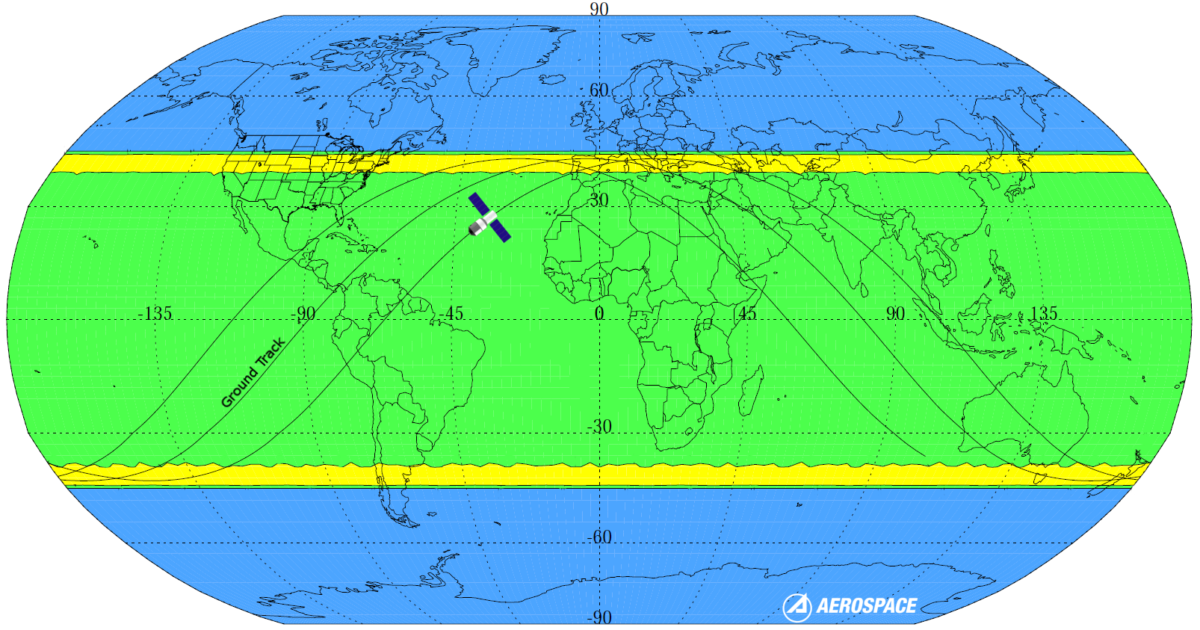
The craft is now at about 300 km altitude in an orbit that wThere is a chance that a small amount of Tiangong-1 debris may survive reentry and impact the ground. Should this happen, any surviving debris would fall within a region that is a few hundred kilometers in size and centered along a point on the Earth that the station passes over. The map below shows the relative probabilities of debris landing within a given region. Yellow indicates locations that have a higher probability while green indicates areas of lower probability. Blue areas have zero probability of debris reentry since Tiangong-1 does not fly over these areas (north of 42.7° N latitude or south of 42.7° S latitude). These zero probability areas constitute about a third of the total Earth’s surface area.
Credit: The Aerospace Corporation’s CORDS
A leading Chinese space engineer has been reported to indicate that the country’s Tiangong-1 space lab is not out of control.
“We have been continuously monitoring Tiangong-1 and expect to allow it to fall within the first half of this year,” explains Zhu Congpeng, an engineer at the China Aerospace Science and Technology Corporation, notifying the state-run Science and Technology Daily newspaper.

China’s Tiangong-1. Follow-on space lab has been modified to provide crews more room and support extended space-stays.
Credit: CMSE
“It will burn up on entering the atmosphere,” Zhu said, “and the remaining wreckage will fall into a designated area of the sea, without endangering the surface,” he said, remarks also relayed via a January 7 story by Reuters.
Plot predictions
Meanwhile, a January 3 plot by The Aerospace Corporation’s Center for Orbital and Reentry Debris Studies (CORDS) notes that Tiangong-1 is predicted to reenter in mid-March 2018, plus or minus two weeks.
CORDS is sponsoring a “live on green event” guessing game. Entrants can compete for Aerospace swag with the closest estimate to the actual reentry date and time of China’s Tiangong-1 space lab.
Enter your information for a chance to win some Aerospace booty with the closest guess to the actual reentry date and time of China’s Tiangong-1.
Submit your guess by going to:
http://www.aerospace.org/cords/live-on-green/
Heavenly palace
Tiangong-1 is the first space station built and launched by China. It was designed to be a crewed lab as well as an experiment/demonstration for the larger, multiple-module space station.

Docking of China’s Shenzhou 10 spacecraft with the Tiangong-1 space station June 13, 2013.
Credit: CCTV
Tiangong-1 (whose name means “Heavenly Palace” in Chinese) was rocketed into Earth orbit in late September 2011.
The first Chinese orbital docking occurred between Tiangong-1 and an unpiloted Shenzhou spacecraft on November 2, 2011. Two piloted missions were completed to visit Tiangong-1: Shenzhou 9 in June 2012 and Shenzhou 10 in June 2013.
International campaign
Experts at the European Space Agency (ESA) are hosting an international campaign to monitor the reentry of the Tiangong-1, conducted by the Inter Agency Space Debris Coordination Committee (IADC).
IADC comprises space debris and other experts from 13 space agencies/organizations, including NASA, ESA, European national space agencies, Japan’s JAXA, India’s ISRO, the Korea Aerospace Research Institute (KARI), Russia’s Roscosmos, as well as the China National Space Administration.
Owing to the Chinese station’s 18,740 pounds (8,500 kilograms) and construction materials, there is a distinct possibility that some portions of the Tiangong-1 will survive and reach the surface, according to a previous ESA statement.
The vessel will inevitably decay sometime between January and March 2018, when it will make an uncontrolled reentry,” the November 6, 2017 press statement explains.

Artist’s concept of the Tiangong-1 in Earth orbit.
Credit: CMSA
Emergency preparedness plans
In a December 8 communiqué from the Permanent Mission of China to the United Nations (Vienna), China has made note of the upcoming re-entry into the atmosphere of Tiangong-1.
“Currently, it [Tiangong-1] has maintained its structural integrity with stabilized attitude control,” notes the communiqué.
“China attaches great importance to the re-entry of Tiangong-1. For this purpose, China has set up a special working group, made relevant emergency preparedness plans and been working closely with its follow-up tracking, monitoring, forecasting and relevant analyzing,” the communiqué explains.
Confusion
“I think the confusion comes from the fact that control is limited to the attitude of the space lab – but not to the orbit,” explains Holger Krag, Head of the Space Debris Office for ESA in Darmstadt, Germany.
Attitude control has (hardly) no impact on the orbit, Krag said, “and a deorbit impact point cannot be achieved. Orbit control requires a meaningful propulsion function, which is not available/defunct,” he told Inside Outer Space.

Astrobotic’s Peregrine Lunar Lander
Credit: Astrobotic
The Pittsburgh-based Astrobotic — spun out of Carnegie Mellon University’s Robotics Institute in 2007 — is headquartered in Pittsburgh, Pennsylvania and has been working on developing a low-cost, lunar delivery service.
According to the group, it has nearly a dozen “deals” for their first mission and dozens of customer negotiations for upcoming missions.
Astrobotic is offering a lander service that is “poised to be central to America’s return to the Moon,” says Astrobotic CEO John Thornton, and is calling for a “surge” of landers to dot the Moon.

Credit: NASA
Commercial cargo
One enabler for peppering the Moon with private-sector landers is NASA’s Advanced Exploration Systems (AES) program and the Lunar Cargo Transportation and Landing by Soft Touchdown (Lunar CATALYST) initiative
NASA competitively selected three partners in 2014 to spur commercial cargo transportation capabilities to the surface of the Moon.
The no-funds-exchanged Space Act Agreement partnerships are with Astrobotic, Masten Space Systems Inc. of Mojave, California, and Moon Express Inc., of Cape Canaveral, Florida, is designed to develop capabilities that could lead to a commercial robotic spacecraft landing on the Moon, but also potentially enable new science and exploration missions of interest to NASA and to broader scientific and academic communities.

Astrobotic’s Peregrine Lunar Lander
Credit: Astrobotic
Robust American presence
Astrobotic has recommended to NASA that the space agency orchestrate a “Lunar Surge” of science, technology and robotic exploration missions. Doing so, the group adds, would rapidly expand a presence on the Moon with robotic landers starting in 2020 to ensure a robust American presence across key areas of the lunar surface, in advance of a human return.
Such a surge, contends the group, could be done within existing budget profile by taking advantage of privately-developed lunar landers, like Astrobotic’s Peregrine, without deviating resources from other critical development programs and exploration capabilities, like NASA’s proposed Deep Space Gateway.

Astrobotic’s Peregrine Lunar Lander
Credit: Astrobotic
Sustained surge
Additionally, such a rush forward “could demonstrate America’s unparalleled access to the Moon’s surface, and explore the Moon’s resource and shelter potential to enable the long-term presence of astronauts,” explains an Astrobotic press statement.
“With a sustained surge campaign of robotic precursor missions, America can prospect for water ice at the lunar poles, evaluate the habitability of lunar lava tubes (caves), test the peaks of persistent light as a power source, and get a firm grasp of how to make use of the Moon to propel exploration,” adds the press statement.

Curiosity Mars Hand Lens Imager (MAHLI) image acquired on Sol 1926, January 6, 2018. This product was created by merging two to eight images previously taken by the MAHLI, located on the turret at the end of the rover’s robotic arm.
Credit: NASA/JPL-Caltech/MSSS
NASA’s Curiosity Mars rover has just concluded Sol 1926 science operations.
The robot is investigating “layers of fun!” That’s the word from Michelle Minitti, a planetary geologist at Framework in Silver Spring, Maryland.
Curiosity color imagery taken during Sols 1925-1926 shows in greater detail the numerous layers and color variations that kept the rover at this spot for another round of science observations within its workspace.

Curiosity MAHLI imagery from Sol 1926, January 5, 2018.
Credit: NASA/JPL-Caltech/MSSS
Staircase-like workspace
“Exploring more of the steps in our staircase-like workspace was the name of the game today,” Minitti reports. The Mars Hand Lens Imager (MAHLI) mosaics acquired on Sol 1925 from the targets “Jura” and “Crinan,” near the bottom of the workspace, were intriguing enough to lead Chemistry and Camera (ChemCam) to analyze both of them with rasters that crossed over multiple layers exposed in these targets.

Curiosity Mastcam Right image taken on Sol 1925, January 5, 2018.
Credit: NASA/JPL-Caltech/MSSS
Also near the bottom of the workspace, the target “Craighead,” a gray rock cut by criss-crossing sulfate veins, was slated to be brushed by the Dust Removal Tool (DRT), and then imaged by MAHLI and analyzed by the rover’s Alpha Particle X-Ray Spectrometer (APXS).

Curiosity ChemCam Remote Micro-Imager photo from Sol 1926, January 6, 2018.
Credit: NASA/JPL-Caltech/LANL
Chemical survey
In between the targets Crinan and “Assynt” (another Sol 1925 target), ChemCam will shoot the target “Brodick” to add to a chemical survey of the outcrop.
MAHLI will follow up on a ChemCam target from Sol 1925, “Barra,” taking advantage of the dust-removing capability of ChemCam’s laser to get a closer, cleaner look at this target near the top of the workspace.
“We took a few brief breaks from the rocks in front of us to image and analyze other objects of interest,” Minitti adds. ChemCam will shoot the sand target “Boreray” to compare its chemistry to those of sands Curiosity has encountered throughout the mission.
Clear viewing
ChemCam and Mastcam will both image the Peace Vallis fan, far north of the rover on the Gale crater rim, “as our vantage point on top of the ‘Vera Rubin Ridge’ gives us a clear view of it,” Minitti points out.
MAHLI is slated to image the Rover Environmental Monitoring Station (REMS) ultraviolet sensor to monitor dust accumulation on the zenith-pointing sensor.
REMS itself along with the Radiation Assessment Detector (RAD) will make regular measurements of the environment, and Dynamic Albedo of Neutrons (DAN) instrument will ping the ground below the rover both before and after a rover drive to seek signs of subsurface hydrogen.
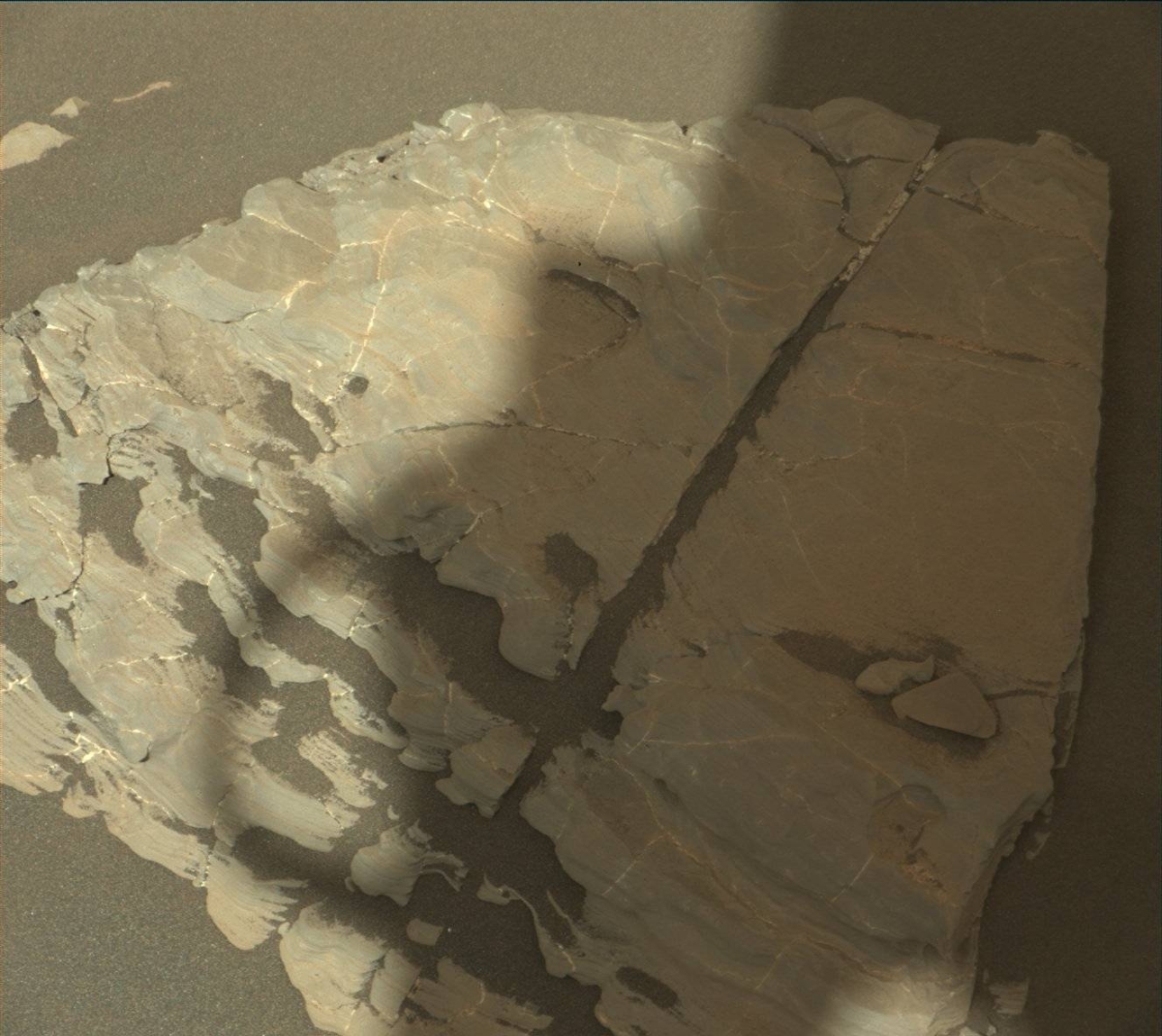
Curiosity Mastcam Right image taken on Sol 1925, January 5, 2018.
Credit: NASA/JPL-Caltech/MSSS
New drive to bedrock
Early morning Navcam and Mastcam observations were to be done of clouds and the amount of dust in the atmosphere to complement a similar suite of observations made mid-day on Sol 1925.

Curiosity Front Hazcam Right B image acquired on Sol 1926, January 6, 2018.
Credit: NASA/JPL-Caltech
On the second sol of the plan, Curiosity was scheduled to drive away “to a new patch of bedrock that, at least from orbit, shares characteristics with the bedrock we have spent the past few sols investigating,” Minitti concludes. “By comparing what we find there to our recent measurements, we can continue to put together a story for how the Vera Rubin Ridge came to be.”

Curiosity Mars Hand Lens Imager (MAHLI) photo acquired on Sol 1923, January 2, 2018. Using an onboard focusing process, the robot created this product by merging two to eight images previously taken by the MAHLI, located on the turret at the end of the rover’s robotic arm.
Credit: NASA/JPL-Caltech/MSSS
Have trace fossils been found on Mars?
In browsing the first new batch of 2018 Curiosity Mars Hand Lens Imager (MAHLI) photos snagged from Sols 1922 and 1923, researcher Barry DiGregorio speculates whether or not the Red Planet prowler has found trace fossils on Mars. DiGregorio is a research fellow for the Buckingham Centre for Astrobiology in the United Kingdom and author of the nonfiction books “Mars: The Living Planet” and “The Microbes of Mars.”
“They look remarkably similar to Ordovician trace fossils I have studied and photographed here on Earth,” DiGregorio told Inside Outer Space. “If not trace fossils, what other geological explanations will NASA come up with?”

Ordovician trace fossils here on Earth.
Copyright Barry E. DiGregorio – used with permission
Tiny features
So I posed that question to Ashwin Vasavada of NASA’s Jet Propulsion Laboratory in Pasadena, California. He’s project scientist for the Curiosity Mars rover.
Vasavada reports that the eye-catching features are very small, probably on the order of a millimeter or two in width, with the longest of the features stretching to roughly 5 millimeters. “So they are tiny,” he advised Inside Outer Space.
Serendipitously, they were first spotted in black and white imagery. The features were compelling enough for the science team to roll back Curiosity to further examine them, Vasavada says, making use of the robot’s MAHLI – a focusable color camera mounted on the rover’s arm.
“These were unique enough, given the fact that we didn’t know they were there…we thought we should go back,” Vasavada explains.

Curiosity Mastcam Right image taken on Sol 1905, December 15, 2017
Credit: NASA/JPL-Caltech/MSSS
Peculiar targets
Christopher Edwards, a planetary geologist at Northern Arizona University in Flagstaff, Arizona, and Curiosity mission team member also made note of the plan to wheel Curiosity back to study the dark toned “stick-like” features.
“This site was so interesting that we backtracked to get to where the rover was parked for this plan,” Edwards explains in a January 3 mission update. “In the workspace in front of the rover, we have some very peculiar targets that warranted some additional interrogation.”

Curiosity ChemCam Remote Micro-Imager photo of novel features, taken on Sol 1921, December 31, 2017
Credit: NASA/JPL-Caltech/LANL

Ashwin Vasavada of NASA’s Jet Propulsion Laboratory in Pasadena, California. He’s project scientist for the Curiosity Mars rover.
Credit: NASA/JPL
Geological or biological processes?
As to the origin of these odd features – geological or biological processes – it’s in TBD limbo.
Regarding trace fossils on Mars, “we don’t rule it out,” Vasavada responds, “but we certainly won’t jump to that as our first interpretation.”
Rather, close-up looks at these features show them to be angular in multiple dimensions. That could mean that they are related to crystals in the rock, perhaps “crystal molds” that are also found here on Earth, Vasavada adds. Crystals in rock that are dissolved away leave crystal molds, he said.
Still, that’s just one of a few possibilities, Vasavada explains. “If we see more of them…then we begin to say that this is an important process that’s going on at Vera Rubin Ridge.”
Mission impossible
Curiosity scientists have been discussing the newly found and novel features, Vasavada says, attempting to discern just what they signify.

Self-portrait of Curiosity located at the foothill of Mount Sharp back on October 6, 2015.
Credit:
NASA/JPL-Caltech/MSSS
In the end, however, can the Mars robot discern a crystallization process versus a biological process?
“That’s pretty challenging on Earth to distinguish those two things without being able to put these things into a lab to look for the presence of organics,” Vasavada points out. “We have a very limited capability overall to understand whether something is biological or not.”
Meanwhile, along with new MAHLI imagery, Curiosity’s Chemistry and Camera (ChemCam) and its Alpha Particle X-Ray Spectrometer (APXS) are also inspecting the features for clues as to their nature.
Bioturbation?
“The Curiosity images really pique our curiosity,” explains Pascal Lee, a planetary scientist at the Mars Institute and SETI Institute in Mountain View, California. Still, given the imagery, “it’s hard to tell what the wiggly sticks are,” he said, “and a strictly mineral origin is, of course, the most plausible.”
But as a field geologist, Lee said that on first view of the feature “the immediate thought that came to my mind is bioturbation.”
Bioturbation is the process through which organisms living in sediments can disturb the very structure of these sediments.
“A common example of bioturbation is the formation of worm burrows. The burrows, once refilled with sediments, fossilized, and then exposed by erosion, can end up looking like wiggly sticks,” Lee tells Inside Outer Space.

Picture of a sedimentary rock from the Ordovician/Silurian period from Devon Island, High Arctic, showing bioturbation.
Credit: HMP/Pascal Lee
Implications
Is any of this relevant to Mars?
“Well, bioturbation at the scale of the features seen in the Curiosity imagery would imply macroscopic multicellular organisms at work, so something that would have evolved far beyond unicellular life,” Lee responds. “To claim that we’re seeing bioturbation on Mars – which I did not say – would be an extraordinary claim.”
Lee adds that he’s reminded of what noted astronomer, Carl Sagan, would say: “Extraordinary claims require extraordinary evidence.”
The upshot of the Curiosity observations is need for a lot more evidence to make any such claim, Lee said, including evidence that allows ruling out less extraordinary claims.
“But I have to say, the imagery is really intriguing, and I hope Curiosity spends more time in the area to get to the bottom of this,” Lee concludes. “This is exciting!”

Scoping out the scene. Curiosity Front Hazcam Right B photo acquired on Sol 1925, January 5, 2018
Credit: NASA/JPL-Caltech
Concretions?
Also finding the Mars rover images interesting is astrobiologist, Dirk Schulze-Makuch, a professor at the Technical University Berlin, Germany, and an adjunct professor at Arizona State University and Washington State University. His latest book, co-authored with MIT researcher, William Bains, is The Cosmic Zoo: Complex Life on Many Worlds.
“Cool, looks like bioturbation and would likely be as such identified if the image would be from Earth,” Schulze-Makuch says. “But concretions can look quite similar and in case of Mars, it´s being more likely concretions.”

