Archive for the ‘Space News’ Category
 Author:
  May 17th, 2018
International Space Station.
Credit: NASA
“America’s Human Presence in Low-Earth Orbit” is the hearing topic today for the House Committee on Science, Space, and Technology.
“The United States is committed to continuing its presence on and support for the International Space Station (ISS) to 2024. However, the Administration has stated its intention that direct Federal support for the ISS should end in 2025. This hearing will explore that choice, how we can determine the best policy outcome, and other essential questions about human spaceflight advanced by this discussion,” notes the Committee.
Go to video of hearing at: https://youtu.be/e_BE1CMTkh4
Chairman Brian Babin (R-TX) made this opening statement, as prepared for delivery:
“The International Space Station (ISS) is the crown jewel of America’ human spaceflight program.
As a representative for Johnson Space Center, I am proud of the leadership role Johnson has with the ISS and American human space exploration in general. I am keenly aware of the importance of the ISS to the hard-working professionals of Johnson Space Center. For them, the ISS is more than just a program of record, it is part of their being. This is why I take, with the utmost seriousness, the questions our committee must address on future of the ISS and America’s human spaceflight program.
The Trump administration is a strong advocate for human space exploration and I support the administration’s renewed focus. I agree, in broad terms, with the human exploration plans the administration has outlined. I appreciate the administration’s invitation to discuss and mature plans for our civil space exploration program, including the ISS. However, we, as a Congress, have a responsibility to think through the issues on our own and reach our own conclusions, which is why we are here today.
Two main objectives
I believe that doing exploration right means that anywhere we establish a human presence in space we must fulfill two main objectives. First, we must make that presence sustainable. Second, we must use that presence as a jumping off point to extend our reach even further.
This discussion, along with maintaining continuity of purpose, are key themes in the 2018 NASA Authorization Act, recently passed out of this committee on a bipartisan vote. Section 202 of the act, on the ISS transition, reflects a balance. It provides authority and guidance to the administration to carry out the initial steps of its ISS transition plan, but does so on a limited basis. It explicitly limits authorization to carry out the initial exploratory steps of the administration’s plan to FY19.
Four criteria
Section 202 of the 2018 NASA Authorization Act is good policy that provides a strong foundation for Congress and the nation as we take our next steps with the ISS and America’s future human presence in low-Earth orbit (LEO).
Four criteria that we may consider for evaluating success of an ISS transition:
First, the United States must preserve its global leadership in space and this means preserving our international partnerships as we continue onwards.
Second, our presence in LEO should support our journey to the moon and beyond.
Third, staying in LEO should not preclude further human exploration for economic or other reasons.
Fourth, as necessary to meet our national interests, we should maintain a regular American human presence—and whether public or private, whether permanent or periodic—in LEO.
Lead and cooperate
I can tell you that “failure is not an option.” I can also tell you that there are not a lot of scenarios in which a few billion dollars per year can magically be added to NASA’s human spaceflight program. Therefore, we have only one option: we must figure out how to lead and cooperate with our private and international partners to make human presence in LEO sustainable. With commitment, we can successfully transition the ISS while maintaining American leadership in human spaceflight.
In closing, I am proud that America has led and will continue to lead the human exploration of the cosmos. I will do everything in my power as chairman of the subcommittee to support NASA and American leadership in human space exploration. I thank the witnesses for their attendance and look forward to their testimony.”
Long-term future
U.S. Rep. Lamar Smith (R-Texas), chairman of the House Science, Space, and Technology Committee, delivered the following opening statement, as prepared for delivery:
“Our nation faces important questions about future space exploration. Will the International Space Station (ISS) stop receiving federal support in 2025? If so, under what conditions? What is the future of America’s human presence in low-Earth orbit? Beyond that, what is the future of human presence on the Moon and Mars?
The ISS has been authorized and funded to operate until 2024. Decisions about the long-term future of the ISS impact the future of America’s human space exploration program.
Unless NASA’s budget is significantly increased, there are not enough funds both to maintain direct federal support for the ISS and return American astronauts to the surface of the moon in the 2020s. And without a sharp increase in funding for NASA, we cannot ensure American leadership in human deep space exploration in the next decade and beyond.
ISS transition plan
NASA announced an ISS transition plan at the end of March. According to the proposal, the United States should not continue direct federal support for ISS operation beyond 2024. The private sector—commercial space—may well pick up where NASA leaves off.
In addition to the transition of the ISS, a related but important question is the future of America’s human presence in low-Earth orbit. After 2025, should Americans maintain some human presence in low-Earth orbit, even on a limited basis? But, having an “American human presence in low-Earth orbit” does not necessarily mean continuing to operate the ISS. Discussing continued human presence and continued operation of the ISS are related, but distinct subjects.
Existing law can help guide this discussion. The 2017 NASA Transition Authorization Act reaffirms the principle of “continuity of purpose.” It also establishes that extending human presence throughout the solar system is a long-term goal for NASA. It directs NASA to follow a “stepping stone” approach to exploration.
This involves expanding human presence from low-Earth orbit to the moon, from the moon to Mars, and then from Mars to other bodies throughout the solar system. The 2018 NASA Authorization Act was approved by the Science Committee on a bipartisan vote and the act supports the administration’s transition plan in FY 2019.
It is my hope that this hearing will help us evaluate the transition of the ISS and continued American presence in low-Earth orbit.”
Credit: Screengrab
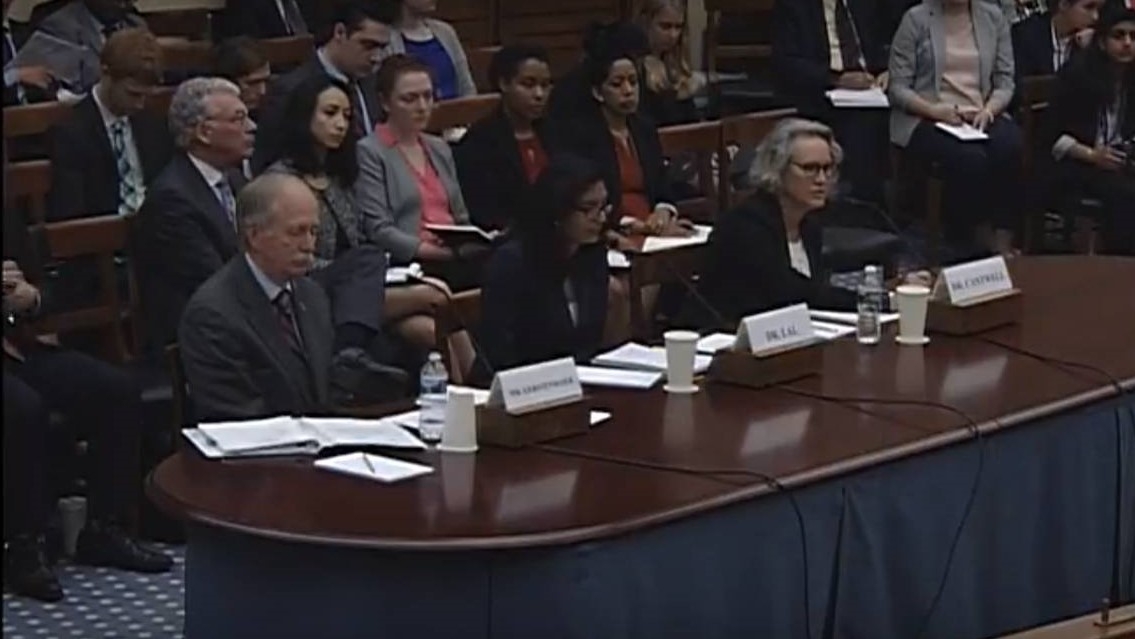
Witness testimony:
Mr. William Gerstenmaier, Associate Administrator, Human Exploration and Operations Directorate, NASA
Dr. Bhavya Lal, Research Staff, Science and Technology Policy Institute for Defense Analysis
Dr. Elizabeth R. Cantwell, CEO, Arizona State University Research Enterprise (ASURE); Professor of Practice, School for Engineering of Matter, Transport & Energy, Arizona State University.
 Posted in

Credt: CCTV/Screengrab
China’s One Space successfully launched on May 17 its first private rocket at a launch base in the country’s northwestern region.
The suborbital rocket, OS-X Chongqing Liangjiang Star, traveled 273 kilometers at a speed five times faster than sound, flying along its preset trajectory for 306 seconds.
Bigger strides
“The success of today’s maiden flight actually marks our very first step, which means, for the first time we have launched a newly built rocket with just one blast,” Shu Chang, CEO and co-founder of One Space told China Central Television (CCTV). “Next time we will make bigger strides to take on the challenges such as how to produce 100 rockets at the same time.”

Credit: CCTV/Screengrab
OneSpace was founded in 2015. Shu told China Daily that the rocket company is striving for 10 missions in 2019. “I hope we can become one of the biggest small-satellite launchers in the world,” Shu said.
Added Zhang Jie, a One Space engineer: “I feel so thrilled and excited. My heart kept beating fast. I’m absolutely happy about it, after we have spent so much time, put so much energy into this.”
To view the launch, go to: https://youtu.be/sd-GBymrtqc

Curiosity Navcam Left B image acquired on Sol 2053, May 16, 2018.
Credit: NASA/JPL-Caltech
NASA’s Curiosity Mars rover is carrying out Sol 2054 science duties.
Reports Abigail Fraeman, a planetary geologist at NASA/JPL in Pasadena, California:

Curiosity Mastcam Left photo taken on Sol 2052, May 15, 2018.
Credit: NASA/JPL-Caltech/MSSS
“Our sol 2054 plan was limited by a small morning downlink. Occasionally, the flight paths of the Mars orbiters over Gale Crater don’t have favorable geometries for relays with Curiosity, and this means our data downlink passes are smaller than average. Today we received only 1.6 MB (Megabytes) of data at the start of our planning day. This was just enough to tell us the drive executed successfully and the rover was healthy, but not enough to include any new images from our current spot.”
Another small downlink several hours into planning, Fraeman adds, gave scientists the first view of a drill target “smack in the middle of our workspace”- a rock that has been dubbed “Duluth.”
Untargeted activities
The plan now calls for most of Sol 2054 completing “untargeted” activities.
Data from Curiosity’s Chemistry and Camera (ChemCam) will be collected from the ChemCam calibration target. Also, the robot’s Mars Hand Lens Imager (MAHLI) is slated to take photos of the sky. Mastcam will snag a photo of the rover deck. Additionally, the Laser Induced Breakdown Spectrometer (LIBS) will be used on a target chosen autonomously by the rover using the Autonomous Exploration for Gathering Increased Science (AEGIS) software.

Curiosity Navcam Left B image acquired on Sol 2053, May 16, 2018.
Credit: NASA/JPL-Caltech
Phobos in focus
“We will also make observations to characterize our environment and the dust in the atmosphere, including a Mastcam tau observation and images of the crater rim, and Navcam images of the sky and horizon,” Fraeman explains. On Sol 2055, Phobos, one of the two moons of the Red Planet, will be imaged as it passed in front of the Sun. “These data help us better constrain the orbit of this small, potato shaped moon, she concludes.
Credit: NASA/JPL-Caltech/Univ. of Arizona
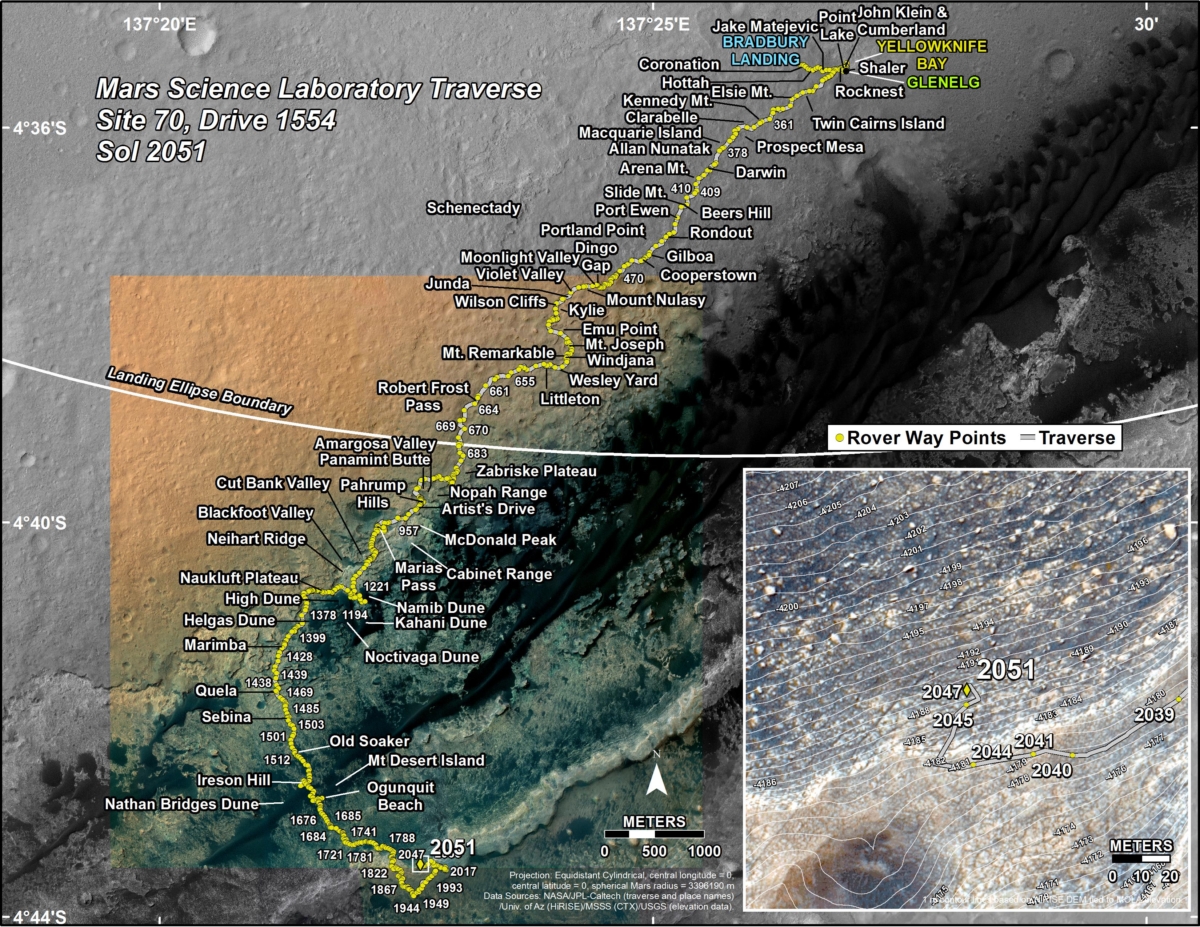
Traverse map
A Curiosity traverse map through Sol 2051 has been issued.
The map shows the route driven by Curiosity through the 2051 Martian day, or sol, of the rover’s mission on Mars (May 16, 2018).
Numbering of the dots along the line indicate the sol number of each drive. North is up. The scale bar is 1 kilometer (~0.62 mile).
From Sol 2047 to Sol 2051, Curiosity had driven a straight line distance of about 1.94 feet (0.59 meters), bringing the rover’s total odometry for the mission to 11.84 miles (19.06 kilometers).
The base image from the map is from the High Resolution Imaging Science Experiment Camera (HiRISE) in NASA’s Mars Reconnaissance Orbiter.
International Space Station.
Credit: NASA
U.S. Sen. Ted Cruz (R-Texas), chairman of the Subcommittee on Space, Science, and Competitiveness, convened a hearing titled “Examining the Future of the International Space Station: Administration Perspectives,” held May 16, 2018.
The first in a series of two hearings to examine the role of the International Space Station (ISS), these hearings will provide an opportunity to discuss the value of the ISS to our national space program and the future of human space exploration.
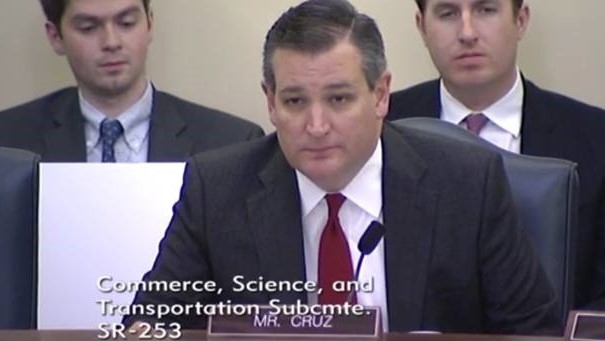
U.S. Sen. Ted Cruz (R-Texas), chairman of the Subcommittee on Space, Science, and Competitiveness.
Credit: Inside Outer Space Screengrab
Witnesses
Today’s witnesses and their written testimony:
William Gerstenmaier, NASA Associate Administrator for Human Exploration and Operations
Paul K. Martin, Inspector General, NASA
Common themes
As noted by Gerstenmaier, decisions about the future of the ISS will be discussed across the ISS international partnership. The partners agree on common themes for considering the future of ISS and exploration, including:
Reducing operational costs;
Offering frequent visible national astronaut opportunities;
Continuation and continuity of research and technology development activities;
Building synergies between LEO and exploration activities; and
Support of commercial opportunities.
For a video look at the entire hearing, go to:
https://www.commerce.senate.gov/public/index.cfm/hearings?ID=9B168E39-CF8D-426E-BE8E-B3950F517BD6

“Duluth” – perhaps the next drill target.
Curiosity Navcam Right B image acquired on Sol 2052, May 15, 2018.
Credit: NASA/JPL-Caltech
Now in Sol 2053, NASA’s Curiosity Mars rover is slated to Bump to “Duluth” – perhaps the next drill target.
Reports Rachel Kronyak, a planetary geologist at the University of Tennessee in Knoxville: “A successful drive on Sol 2052 brought Curiosity within bumping distance of what will likely be our next intended drill target. The science team named this target ‘Duluth.’ Duluth is a beautifully exposed Murray formation block.”

Curiosity Navcam Left B photo taken on Sol 2052, May 15, 2018.
Credit: NASA/JPL-Caltech
Nice vantage point
“From our current location,” Kronyak adds, “we have a really nice vantage point of both the top and sides of the Duluth block. Analyzing blocks that have this kind of 3-D expression gives us a great opportunity to assess the full architecture of the rock.”
A new plan for Sol 2053 includes a science block prior to the Curiosity bump. In the science block, researchers will acquire several Chemistry and Camera (ChemCam) Laser-Induced Breakdown Spectrometer (LIBS) rasters on targets “Pine Mountain” and “Windigo,” both of which are located on the Duluth block.

Curiosity Mastcam Left image acquired on Sol 2051, May 14, 2018.
Credit: NASA/JPL-Caltech/MSSS
The plan also calls for the robot to take Mastcam images of Duluth to document the ChemCam observations and to provide some additional context on the vertically exposed sides of the block, Kronyak notes.
Drilling campaign
Curiosity environmental observations are in the plan as well, including Dynamic Albedo of Neutrons (DAN) measurements and a dust devil survey with Navcam.
“After our bump, Kronyak adds, “we’ll take some post-drive images to set up for an exciting drilling campaign over the next several sols!”

Earth and our moon in the center, was acquired by MarCO-B CubeSat on May 9.
Credit: NASA/JPL-Caltech
En route to the Red Planet are NASA’s Mars Cube One (MarCO) CubeSats. The two MarCO CubeSats were launched on May 5 along with NASA’s InSight lander, a spacecraft that will touch down on Mars November 26 and study the planet’s deep interior for the first time.

Engineer Joel Steinkraus uses sunlight to test the solar arrays on one of the Mars Cube One (MarCO) spacecraft at NASA’s Jet Propulsion Laboratory.
Credit: NASA/JPL-Caltech
“CubeSats have never gone this far into space before, so it’s a big milestone. Both our CubeSats are healthy and functioning properly,” said Andy Klesh, MarCO’s chief engineer at NASA’s Jet Propulsion Laboratory, Pasadena, California.
Coming up: trajectory correction maneuvers
The MarCO CubeSats will follow along behind InSight during its cruise to Mars.
Should the CubeSats make it all the way to Mars, they will radio back data about InSight while it enters the atmosphere and descends to the planet’s surface. The high-gain antennas on the CubeSats are key to that effort; the MarCO team have early confirmation that the antennas have successfully deployed, but will continue to test them in the weeks ahead.

Outward bound for Mars, InSight lander. Photo taken shortly after release from Atlas V upper stage.
Credit: Atlas V InSight Rocket Cam/ULA
The InSight lander won’t rely on the MarCO mission for data relay. That job will fall to NASA’s Mars Reconnaissance Orbiter.

MarCO-A and B.
Credit: NASA/JPL-Caltech
Later this month, the MarCOs will attempt the first trajectory correction maneuvers ever performed by CubeSats, steering them towards Mars.
“The initial checkout after launch was very successful and the spacecraft is healthy,” said Lockheed Martin’s Tim Linn, InSight deputy program manager and entry, descent and landing manager. Lockheed Martin built InSight.
“We are planning our first trajectory correction maneuver, or TCM, on May 22 to make a slight adjustment on our path to Mars. We do not plan a second TCM until the end of July,” Linn told Inside Outer Space.

Cargo carrying Peregrine lander.
Credit: Astrobotic
To preserve and disseminate humanity’s most important knowledge across time and space feels like a Star Trek imperative.
Astrobotic and the Arch Mission Foundation have partnered to land the “Lunar Library” on Astrobotic’s first robotic lander mission to the Moon in 2020.
That Lunar Library will include the Wikipedia, and the Long Now Foundation’s Rosetta Project, a digital library of human languages. Additional content and data for the Lunar Library is to be announced in the coming year.
Analog microfiche
Astrobotic will carry the Lunar Library to the Moon on its Peregrine Lunar Lander and store it on the lunar surface. The Lunar Library consists of a set of tens of millions of pages of text and images stored as analog microfiche on thin sheets of nickel. Each page is etched by laser at 300,000 dpi using patented nanolithography technology provided exclusively to the Arch Mission Foundation by Stamper Technologies.

Commercial interest in returning to the Moon.
Photo Credit: NASA/GSFC
The content of the Library can easily be read via a 1000x magnification optical microscope, without needing a computer. Nickel is impervious to radiation as well as the changing temperatures on the Moon, and can last for millions to billions of years in space.
Cold storage
John Thornton, CEO of Astrobotic said in a press statement: “It’s humbling to think our mission to the Moon will deliver something that could be read millions of years from now. Arch’s Lunar Library will be a monument not only to human knowledge and culture, but also the first commercial mission to the Moon.”
Along with the library, the Peregrine Lunar Lander has a manifest of other payloads from governments, companies, universities, nonprofits, and individuals.
“Through massive replication around the solar system we will be able to guarantee that the Arch Libraries will never be lost even millions to billions of years in the future,” said Nova Spivack, cofounder and Chairman of the Arch Mission Foundation.
“We can definitely preserve our unique cultural heritage and biological record in a way that will survive for millions to billions of years,” Spivack adds, “and that has not been possible before. We see the Lunar Library as the ultimate in cold storage for human civilization.”

Credit: SpaceX
Long-term “arkives”
The Lunar Library follows the Arch Mission’s initial foray into space with the Solar Library, launched aboard SpaceX’s first Falcon Heavy flight earlier this year – yes, the one that hurled the Tesla roadster into space. The first books in the Solar Library are Isaac Asimov’s Foundation Trilogy.
The Arch Mission Foundation designs, builds, delivers and maintains curated longterm archives that are housed in specially designed devices called Arch Libraries (pronounced “Arks”). Arch Libraries are being developed with a variety of form factors to survive for long durations in space, as well as on the surfaces of planets, moons and asteroids.

The Red Planet as seen by Europe’s Mars Express.
Credit: ESA/D. O’Donnell – CC BY-SA IGO
Future plans
The Arch Libraries may last billions of years longer than the Pyramids. They may even last longer than our planet. In a million years the Arch Libraries may be the only remaining trace of our species and our civilization, states the group.
The Mars Library is planned, and will be designed to supply a future human settlement on Mars with a vast collection of important knowledge from Earth. This will form a backup of Earth on Mars, in the event that the connection between Mars and Earth is ever lost in the future. It will also provide colonists on Mars with a massive data set with which to seed a local Internet and Web on Mars.
For more information, visit Astrobotic at:
The Arch Mission Foundation is available at:
Take a look at this video at:

Curiosity Front Hazcam Right B image taken on Sol 2051, May 14, 2018.
Credit: NASA/JPL-Caltech
NASA’s Curiosity Mars rover is working Sol 2052 science duties. However, a recent drive did not wheel the rover into an expected spot.
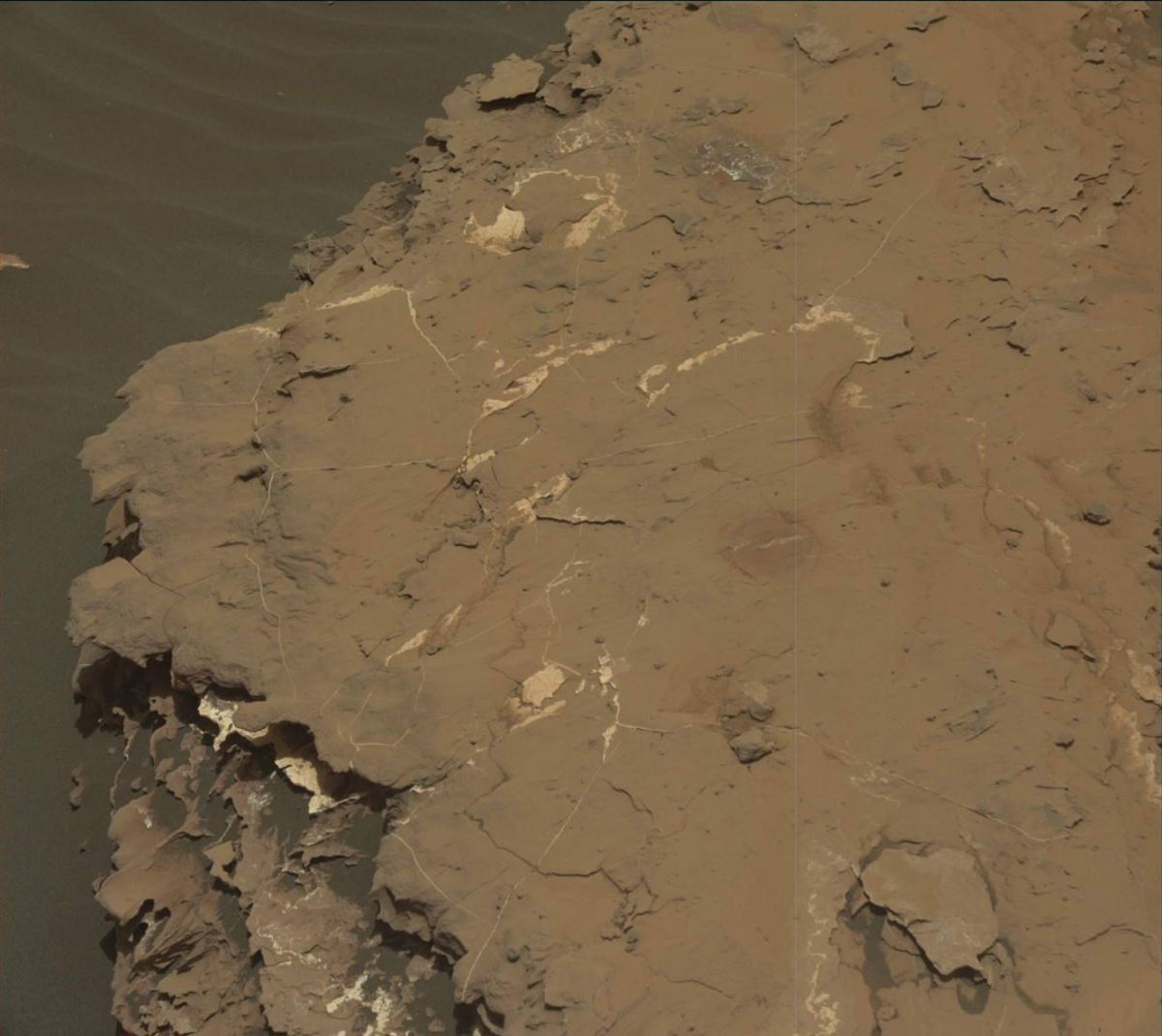
“We’ve been here before,” reports Scott Guzewich, an atmospheric scientist at NASA’s Goddard Space Flight Center in Greenbelt, Maryland: “Rather than driving almost 11 meters, Curiosity only drove about 1/2 meter before stopping. So, we found ourselves looking at images of previous wheel tracks and contact science targets rather than a new location.”
Curiosity Mastcam Left image acquired on Sol 2050, May 13, 2018.
Credit: NASA/JPL-Caltech/MSSS
New drilling attempt
Scientists had expected to start examining a new location within the robot’s arm reach (or a very short drive’s reach) of a possible location for a next drilling attempt.
The priority now is to recover that drive, which left plenty of time for some additional targeted and untargeted science.
This included instrument looks at “Brownell” and “Mahtowa”, additional Mastcam images of “Munger” and “Itasca”, and taking a Navcam dust devil movie.
Dust devils
Following the drive, the plan calls for Curiosity to use Chemistry and Camera (ChemCam) specialized software – Autonomous Exploration for Gathering Increased Science (AEGIS). That software autonomously directs the robot’s cameras to interesting science targets.

Curiosity Mars Hand Lens Imager (MAHLI) photo produced on Sol 2050, May 13, 2018.
Credit: NASA/JPL-Caltech/MSSS
Along with AEGIS activity, the rover will make a longer version of a Navcam dust devil movie.
“We often schedule dust devil movies closer to midday, when dust devils are more common, but it’s important to also observe at other times of day to understand their frequency and patterns,” Guzewich explains.

China’s Lunar Palace 1 – an experimental biosphere here on Earth.
Credit: CMSE
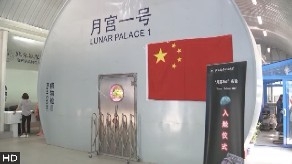
Chinese student volunteers have completed a one-year test living in a simulated space lab in Beijing on May 15, setting a new record for the longest stay in a self-contained cabin: Yuegong-1, or Lunar Palace 1.
The Moonlab program is staged at Beihang University.
As reported by the state-run Xinhua news agency, the total length of the test, which started on May 10 last year, was 370 days, with the third stage accounting for 110 days.
Co-existing in closed environment
Liu Hong, chief designer of Yuegong-1, said the test marked the longest stay in a bioregenerative life support system (BLSS), in which humans, animals, plants and microorganisms co-exist in a closed environment, simulating a lunar base. Oxygen, water and food are recycled within the BLSS, creating an Earth-like environment.
Eight student volunteers took turns living in the cabin, which measures around 150 square meters. The BLSS is a critical piece of technology required for long-term human stays on the Moon or other extraterrestrial bodies, Liu said.

Inside look at one area of China’s Lunar Palace 1.
Credit: CMSE
New starting point
The cabin consists of two plant cabins and a comprehensive cabin. Liu said the BLSS system had proven to function well over a long period of time. Researchers have also explored the mechanism in which light affects human’s biological rhythms and emotions. They also improved technology for vertical planting, the Xhinua story explains. “This is not the end, but a new starting point to continue to explore space,” Liu said.
Researchers will evaluate the physical and mental conditions of volunteers, study test results, and explore smaller BLSS equipment which could be loaded onto space labs, and Moon and Mars probes in the future.
“The test has important implications for human endeavors to achieve long-term stays outside Earth. The experience, technology and findings will be conducive for future space exploration efforts,” said Wang Jun, an academician from the Chinese Academy of Engineering.
Credit: CCTV-Plus
Integrative experimental facility
Lunar Palace 1 is short for the Integrative Experimental Facility for Permanent Astrobase Life-support Artificial Closed Ecosystem (PALACE) Research.
Construction on the Lunar Palace 1 capsule began in March 2013. The facility was unveiled in January 2014, and it was commissioned just prior to the first mission starting in February 2014.

Credit: Jilin Provincial Government
By 2030, there will be an estimated 11,631 launch demands for new constellation installations and replacement missions, which could take the market past the $62 billion mark.
That projection comes from the London-based Frost & Sullivan’s recent analysis, “Small-satellite Launch Services Market, Quarterly Update Q1 2018, Forecast to 2030.”
Launch demand
The evolution of small satellites from technology demonstrators to providers of low-cost operational services across distributed industry segments is attracting launch demand from organizations all over the world.

Credit: OneWeb
As the lifespan of these satellites is between two years and five years, there will be constant launch demand and participants will look to enhance their systems and infrastructure.
Business model
Observes Vivek Suresh Prasad, the group’s Space Industry Principal, Aerospace & Defense:
“While North American and European companies will be the leading developers of flexible, dedicated launch vehicles, players in Asia-Pacific are looking to follow suit,” he said in a press statement. “Many players are also analyzing the feasibility of the small-satellite spaceport business model to provide dedicated launch services to small-satellite operators.”
Rideshare insufficient
According to a Frost & Sullivan statement:
“The high volume of launch demand for small satellites is driving satellite operators to increase their launch capacity. The current rideshare capacity is insufficient to meet the upcoming launch demand. Most small satellites use the rideshare capacity as a secondary payload on existing launches. This makes their project schedule and mission requirements dependent on the primary payload. Many incumbent and emerging commercial operators are preparing for the impending capacity expansion by providing dedicated services and launch flexibility to small-satellite operators.”

Credit: Planet
Production challenges
Once the unit shipment needs are met, the market could grow impressively. Some key numbers are outlined below:
— The total projected launch capacity supply, including the success of multiple dedicated planned launch services, is 11,640 small satellites.
— In this case, a total payload mass of 2,473 tons can be potentially launched.
— Small satellites in the mass segments of 0 to 15 Kilograms and 150 to 500 Kg could account for as much as 65 percent of the small-satellite launch demand. Thirty-two small-satellite commercial operators will generate more than 90% of the launch demand.
“The key to resolving production challenges is to standardize, optimize and deploy low-rate serial production lines for small satellites and the launch hardware for the relevant launch vehicles,” added Vivek.
For further information on this analysis, please contact jacqui.holmes@frost.com

