Archive for the ‘Space News’ Category
 Author:
  May 24th, 2018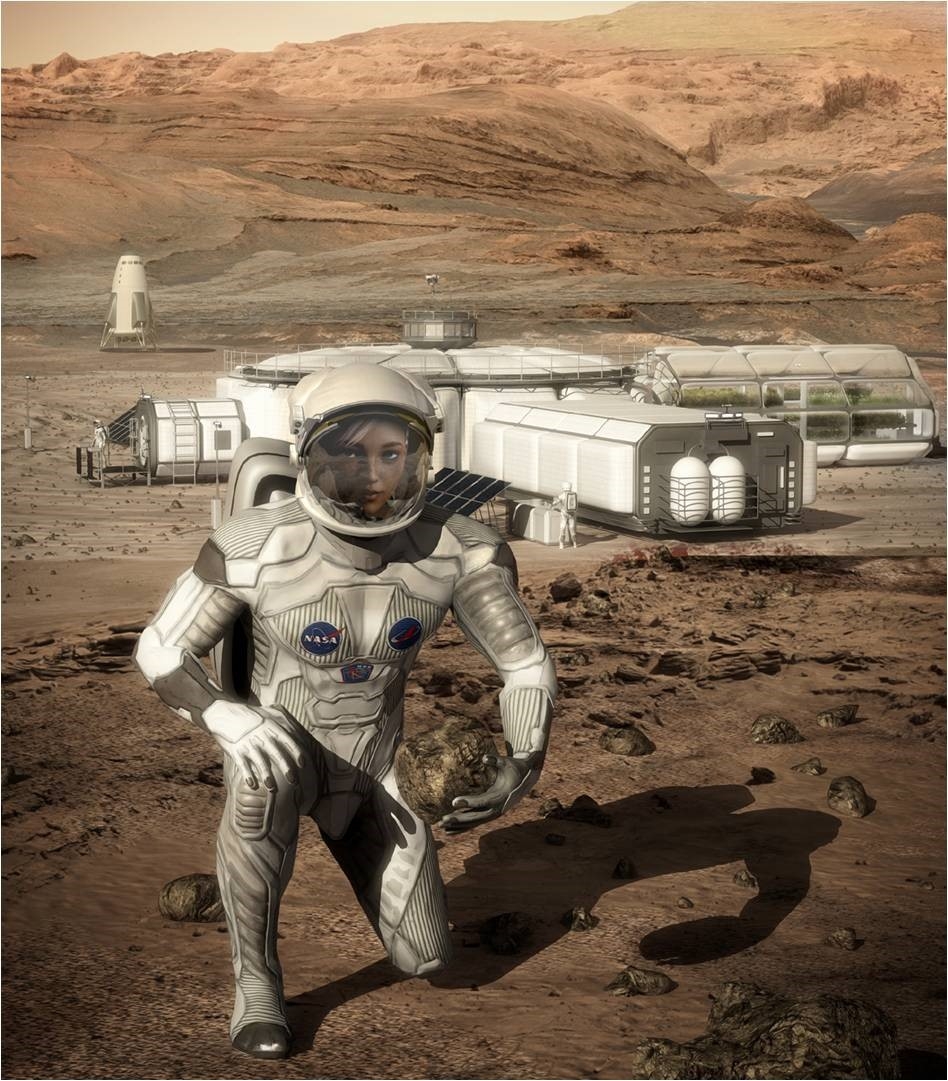
Credit: Bryan Versteeg
A new research paper is flagging the psychological underpinnings of long duration treks to Mars.
Bottom line: If humanity hopes to make it to Mars anytime soon, we need to understand not just technology, but the psychological dynamic of a small group of astronauts trapped in a confined space for months with no escape.
One understudied area of spaceflight teams, the paper explains, involves coordinating communication across a multiteam system (MTS) under conditions of communication delay.
“Relatedly, more scientifically rigorous research and development of training and countermeasures are required to ensure that the remote, highly autonomous spaceflight team is able to maintain teamwork skills throughout a mission lasting 2 to 3 years with reduced support from Mission Control.”
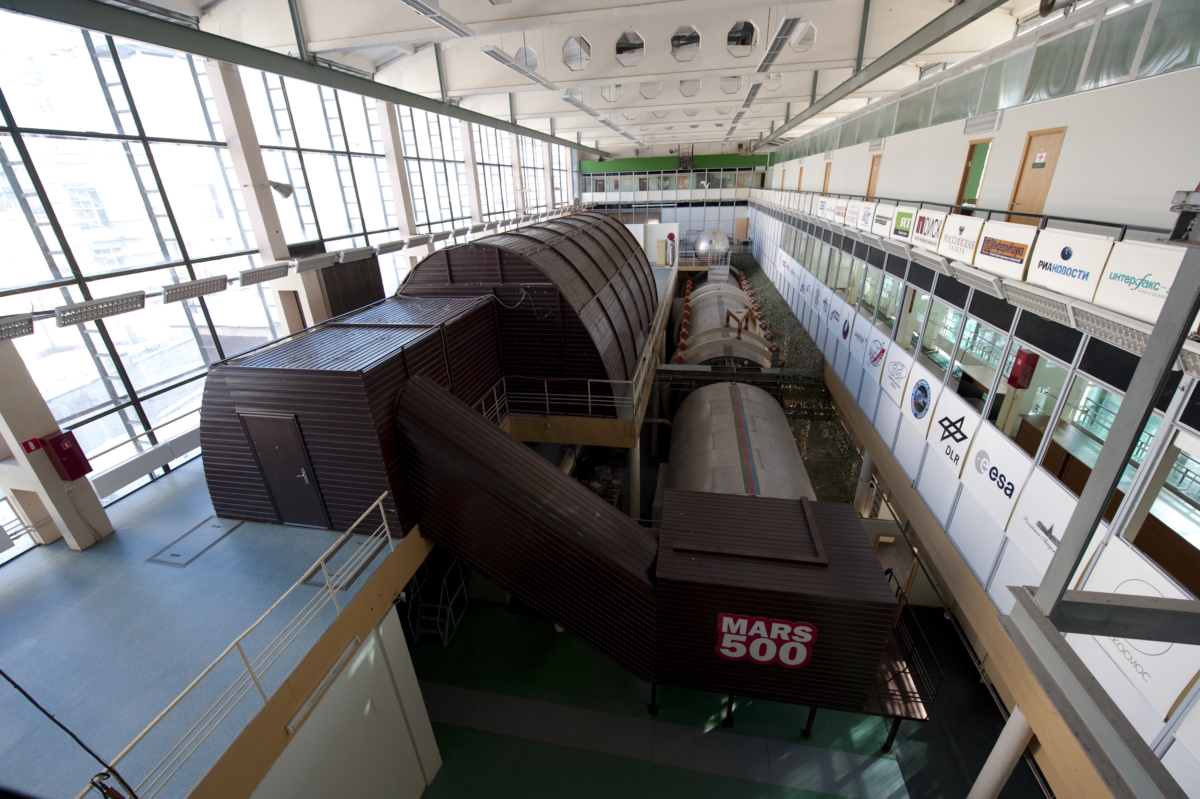
MARS 500 Session training in the IMBP module.
Credit: IBMP RAS
The paper – “Teamwork and Collaboration in Long-Duration Space Missions: Going to Extremes” – has been published in American Psychologist, the flagship journal of the American Psychological Association.
Critical components
“Teamwork and collaboration are critical components of all space flights and will be even more important for astronauts during long-duration missions, such as to Mars. The astronauts will be months away from home, confined to a vehicle no larger than a mid-sized RV for two to three years and there will be an up to 45-minute lag on communications to and from Earth,” said Lauren Blackwell Landon of KBRwyle/NASA in Houston, Texas, lead author of the paper in a press statement.

Credit: NASA
Kelley J. Slack University of Houston/NASA as well as Jamie D. Barrett of the Federal Aviation Administration, Oklahoma City, Oklahoma co-authored the research paper.
Assemble best teams
Currently, psychological research on spaceflight is limited, especially regarding teams, the researchers suggest. Applying best practices in psychology, the authors offered insights into how NASA can assemble the best teams possible to ensure successful long-duration missions.
Other research factoids are highlighted:
Astronauts who are highly emotionally stable, agreeable, open to new experiences, conscientious, resilient, adaptable and not too introverted or extroverted are more likely to work well with others. A sense of humor will also help to defuse tense situations, according to the authors.
The long delay in communication to and from Earth will mean that crews will have to be highly autonomous as they will not be able to rely on immediate help from Mission Control. The authors said this will be an ongoing challenge and having defined goals, building trust, developing communication norms and debriefing will help alleviate potential conflict.
The researchers also advised the use of technology to monitor the physiological health of astronauts to predict points of friction among team members, due to lack of sleep, for example.
To access the paper – “Teamwork and Collaboration in Long-Duration Space Missions: Going to Extremes” – go to:
http://www.apa.org/pubs/journals/releases/amp-amp0000260.pdf
 Posted in
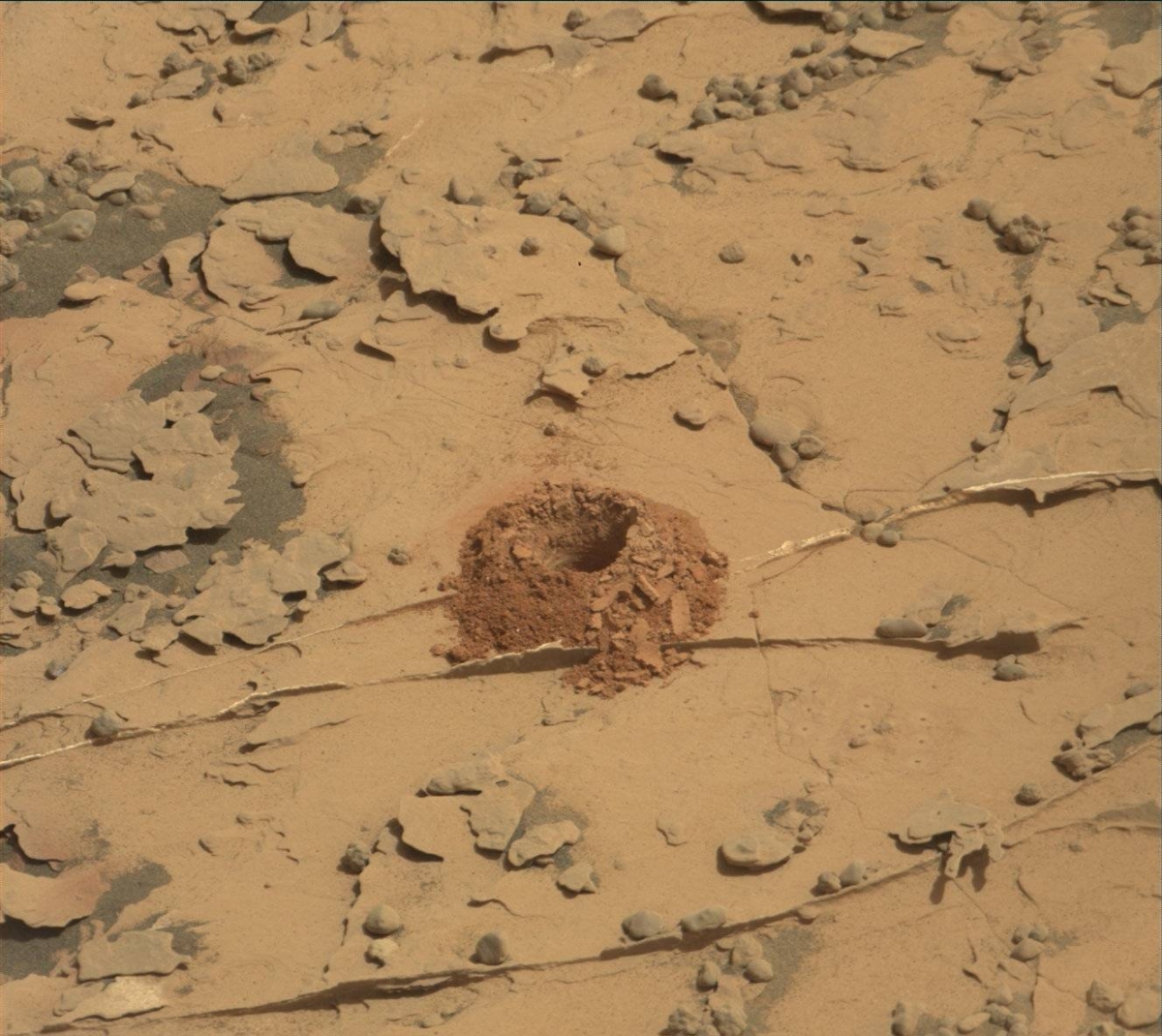
Curiosity Mastcam Right image taken on Sol 2058, May 21, 2018.
Credit: NASA/JPL-Caltech/MSSS
NASA’s Curiosity Mars rover is performing Sol 2061 science duties.
“After successfully drilling the ‘Duluth’ target on Sol 2057, the science team is eager to find out what it’s made of,” reports Lauren Edgar, planetary geologist at the USGS in Flagstaff, Arizona.
Edgar says the plan calls for drop-off of material to the Chemistry & Mineralogy X-Ray Diffraction/X-Ray Fluorescence Instrument (CheMin) for overnight analysis. “Hopefully we’ll get some good data about the mineralogy of this sample!”
Vein targets
In addition to the CheMin activities, the team has planned another Chemistry and Camera (ChemCam) observation of the “Duluth” drill hole, and nearby bedrock and vein targets named “Prosit” and “Grand Marais.”
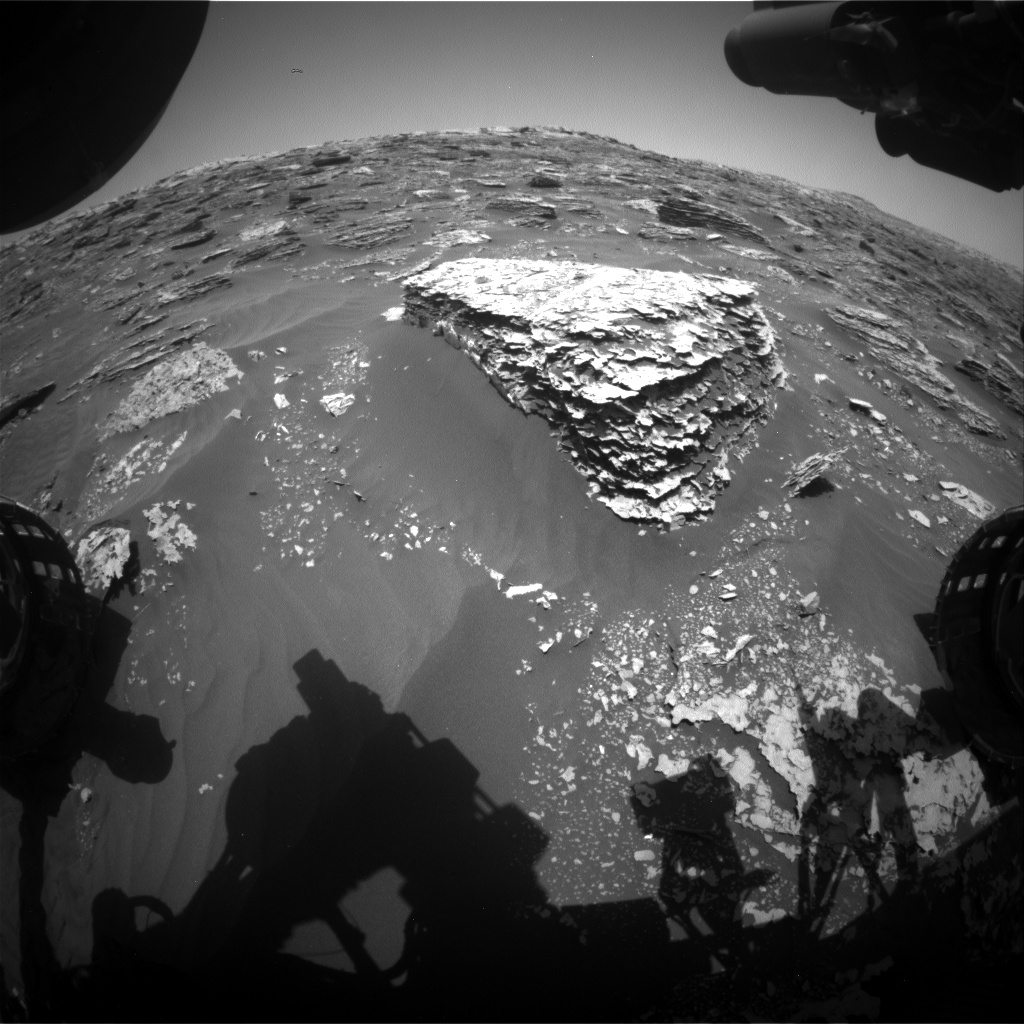
Curiosity Front Hazcam Right B image acquired on Sol 2060, May 23, 2018.
Credit: NASA/JPL-Caltech
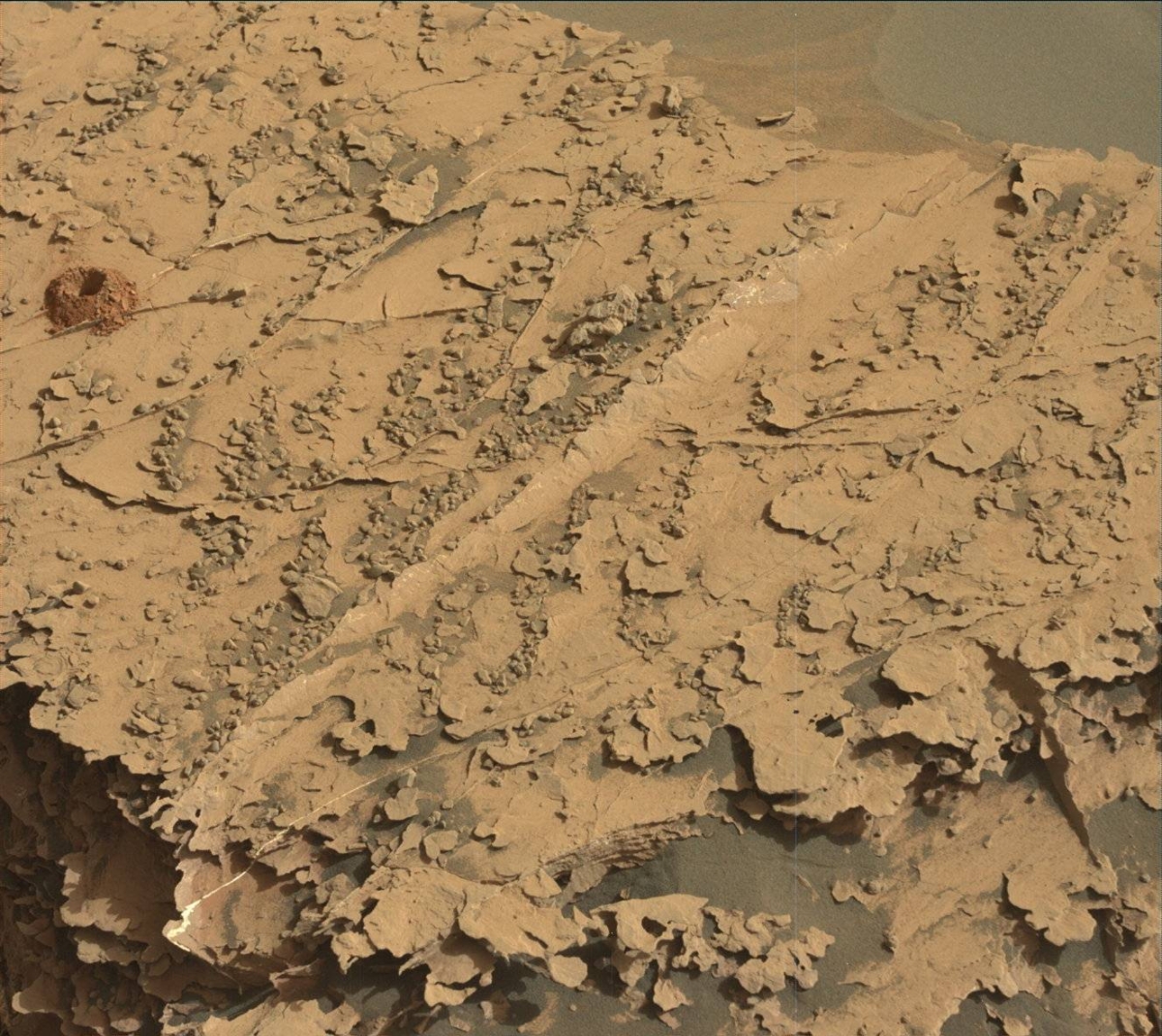
Last Monday, the science team delivered three portions of the drill material to a nearby rock surface, and in a follow-up plan they are monitoring those piles to see if any of the fines are moving in the wind.
Sandy ripple
“We’ll also check for changes in a sandy ripple named “Esko.” Both change detection observations will be repeated on the second sol, along with a Mastcam mosaic to provide more context for this drill location,” Edgar adds.
Curiosity Mastcam Left image taken on Sol 2059, May 22, 2018.
Credit: NASA/JPL-Caltech/MSSS
The environmental theme group also planned a couple of Navcam dust devil observations, a Mastcam tau, and a Mastcam crater rim extinction activity to monitor dust in the atmosphere.
Edgar concludes: “Looking forward to finding out what this rock is made of!”

Curiosity Mastcam Right image of drill hole taken on Sol 2058, May 21, 2018.
Credit: NASA/JPL-Caltech/MSSS
Now in Sol 2060, NASA’s Curiosity Mars rover is back in gear in its drilling functions.
Reports Mark Salvatore, a planetary geologist at the University of Michigan in Dearborn: “This past weekend, Curiosity successfully drilled into the ‘Duluth’ rock target, generating a beautiful pile of drill tailings! This is a very exciting time for us on the rover team,” he notes, “who have been waiting for quite a while to successfully drill into a target and to ingest samples into the rover’s analytical instruments.”
Before Mars researchers are able to use all of the rover’s instruments they must first characterize the nature of the materials that were collected during the drill activities.
Collected sample
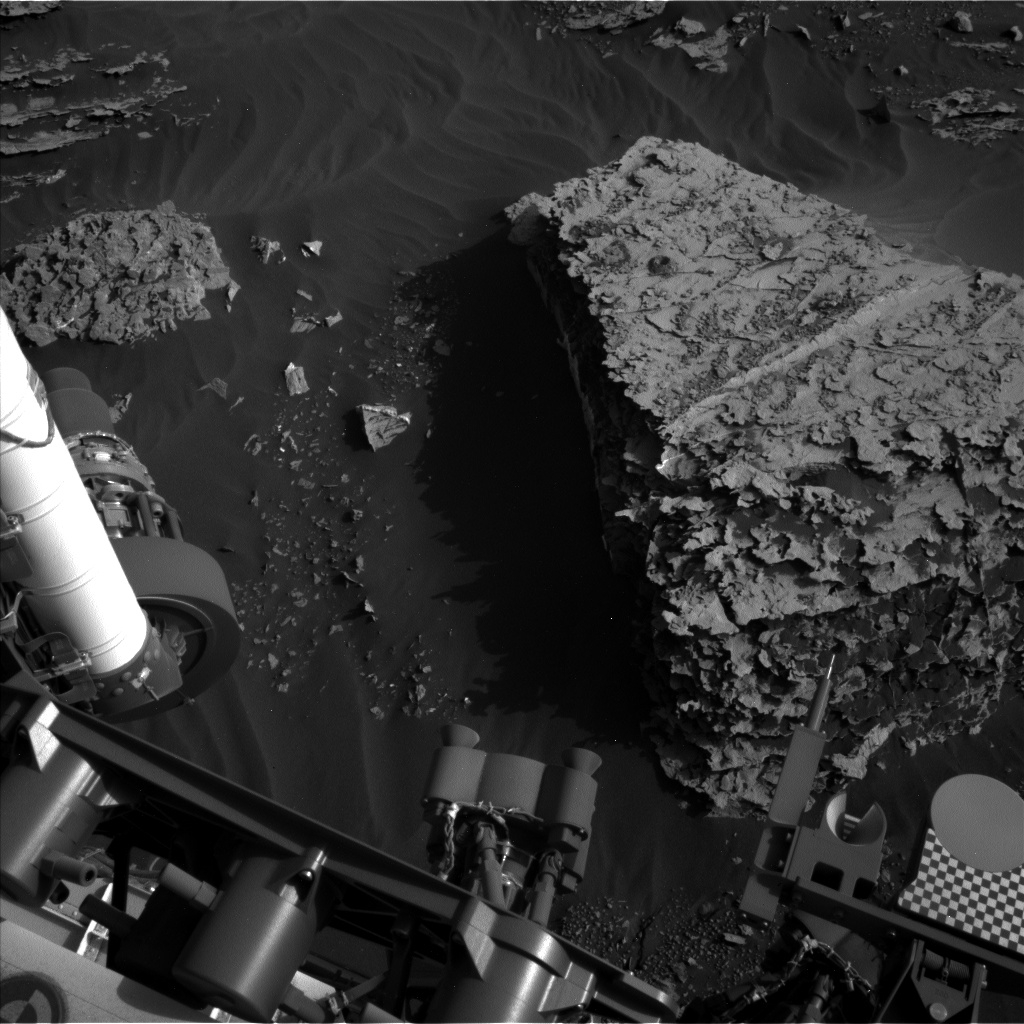
Back on Monday, the science team planned for the characterization of three small portions of the collected sample that were to be dropped onto the surface in front of Curiosity so that images of these materials could be taken at high resolution.
Curiosity Navcam Left B image acquired on Sol 2059, May 22, 2018.
Credit: NASA/JPL-Caltech
While these efforts were not primarily driven by science — the rover engineers were more interested in the nature of the sample and whether there would be any difficulties in delivering the sample to Curiosity’s instruments – the science team, Salvatore adds, “didn’t dare miss an opportunity to make some cool measurements of the new materials in front of us!”
Sand ripples
On the Monday plan was multispectral imaging of the drill target and some regular visible imaging of a small patch of sand ripples named “Esko.” The drill target observation was requested to help determine how the interior of the Duluth target differs from its surface, Salvatore reports, while the imaging of Esko was used to see if there is any motion of the Esko ripples over time.
Curiosity’s Chemistry and Camera (ChemCam) device was then used to passively image the drill hole, and then to actively characterize the chemistry of the drill hole and drill tailings using its laser instrument.
The rover’s Mastcam and ChemCam imaging capabilities were also used to acquire high-resolution images of the small test portions throughout the plan.
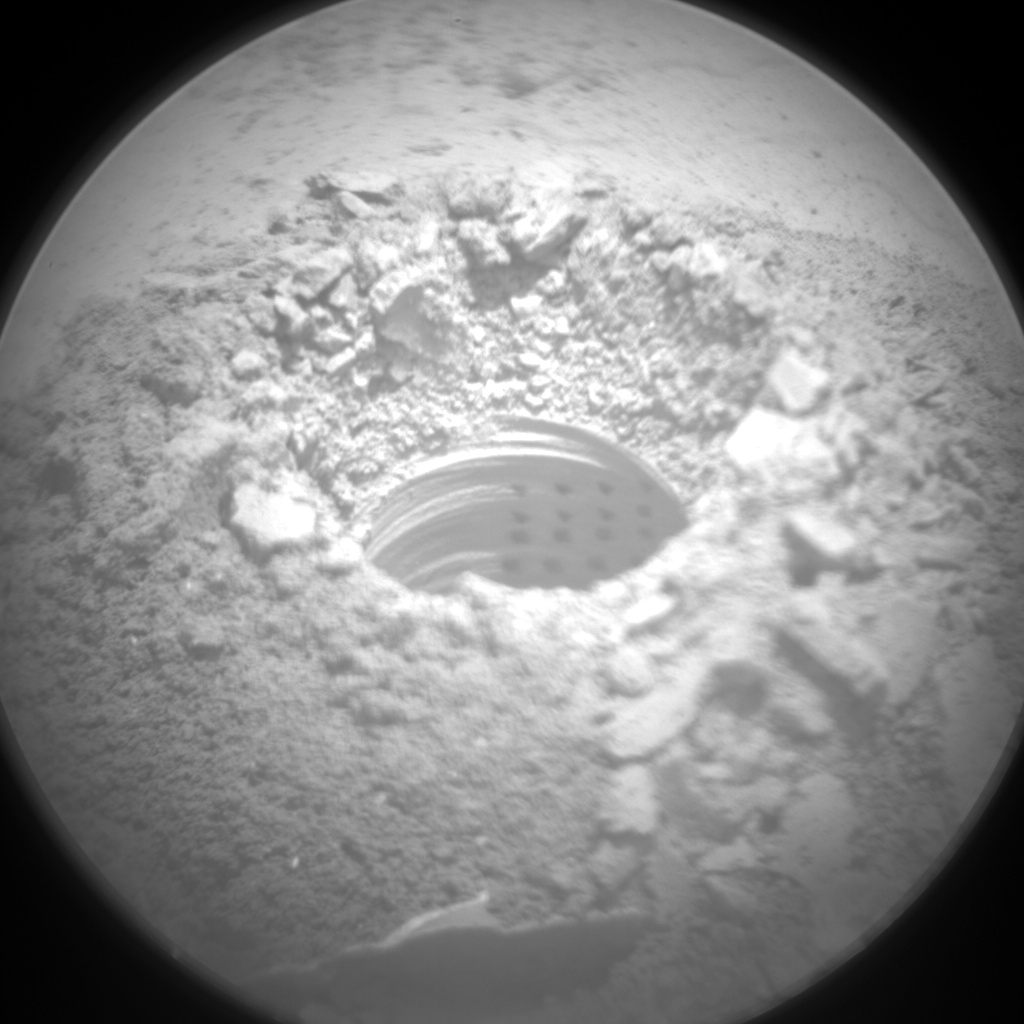
Curiosity ChemCam Remote Micro-Imager photo taken on Sol 2059, May 22, 2018. Note laser shots within the drill hole.
Credit: NASA/JPL-Caltech/LANL
Long awaited measurements
The next day’s science plan had two Mastcam observations – one of the small portions and one of the Esko ripples, “both of which were designed to identify whether the wind had modified these surfaces at all. Environmental measurements were also made on the second day to search for both cloud motion and dust devils,” Salvatore adds.
“We’re all very excited to continue on with drill activities and to make some long awaited measurements,” Salvatore concludes. “Stay tuned for more updates as the week progresses!”
No official word as yet, but new downlink photos indicate that Curiosity did sink its drill into the complexly-layered “Duluth” block.
The robot is now performing Sol 2059 duties.

Curiosity ChemCam Remote Micro-Imager photo taken on Sol 2057, May 20, 2018
Credit: NASA/JPL-Caltech/LANL
Earlier, Michelle Minitti, a planetary geologist at Framework in Silver Spring, Maryland reported the rover was also slated to gather more data from the “Blunts Point” member rocks in front of and around the robot.
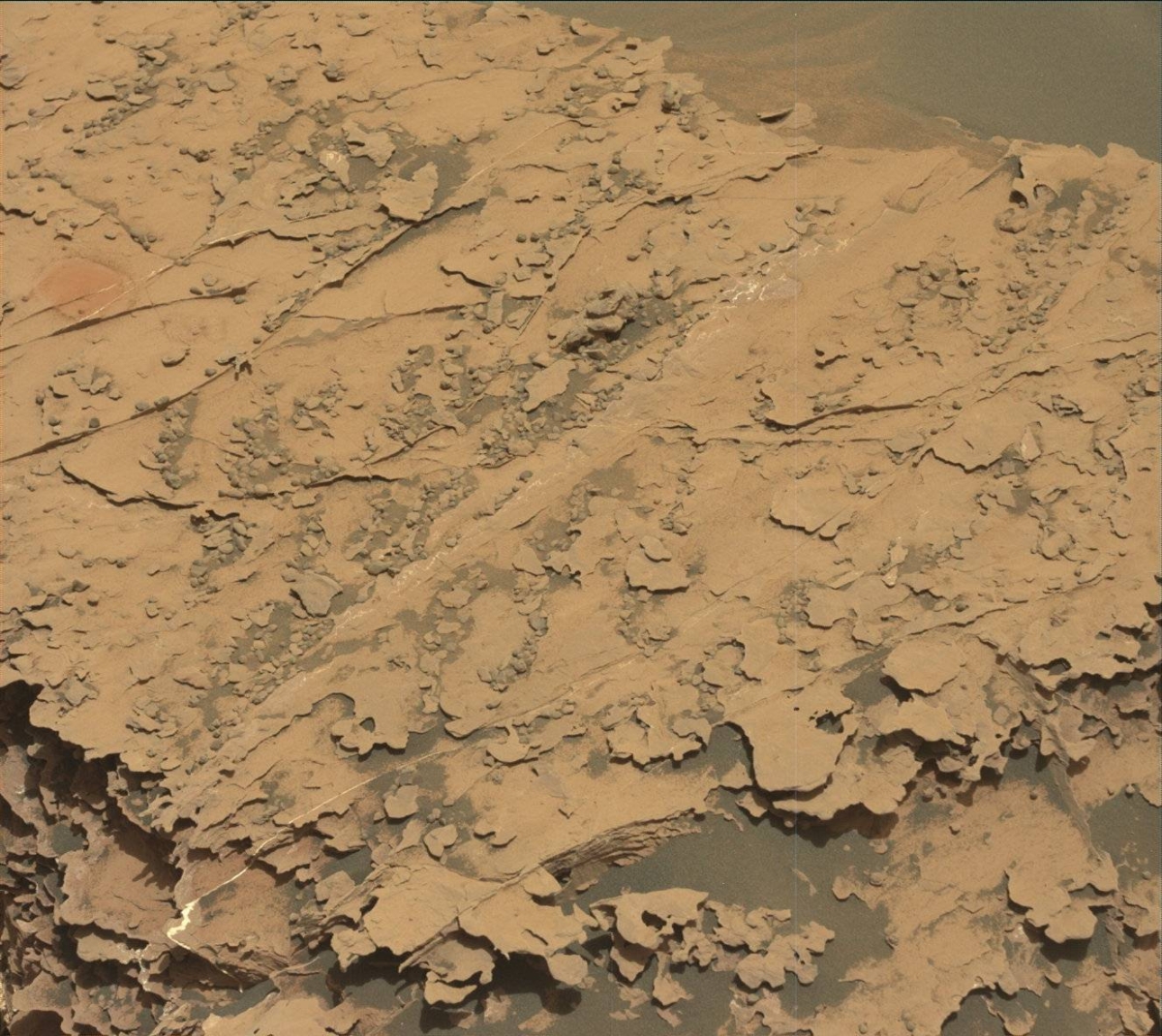
The Duluth target was neatly cleared of dust by the Dust Removal Tool prior to drilling.
The robot’s Chemistry and Camera (ChemCam) in passive mode and Mastcam’s multispectral mode was slated to gauge what iron mineralogy was hiding beneath the target’s thin veneer of dust. ChemCam was to shoot three targets to learn more about the chemistry of the layers within the Duluth block and similar blocks around it.
Delicate layer
“Within the Duluth block, ChemCam will target “Chisholm,” the delicate layer curling up above the top of the Duluth block, and ‘Aitkin,’ another layer jutting out from the side of the block,” Minitti explains. “The ‘Buhl’ target sits off to the rover’s right and represents another example of the Blunts Point member for ChemCam to sample.”
Curiosity Mastcam Left image taken on Sol 2057, May 20, 2018.
Credit: NASA/JPL-Caltech/MSSS
Also on tap was use of Curiosity’s Mastcam to image two large blocks dubbed “Kabetogama” to learn more about the intricate layering of the Blunts Point member. Prior to drilling, Curiosity was to give the sky some attention. Images and movies acquired in the early morning will measure dust and look for clouds, while images and movies at mid-day will measure dust and look for dust devils.
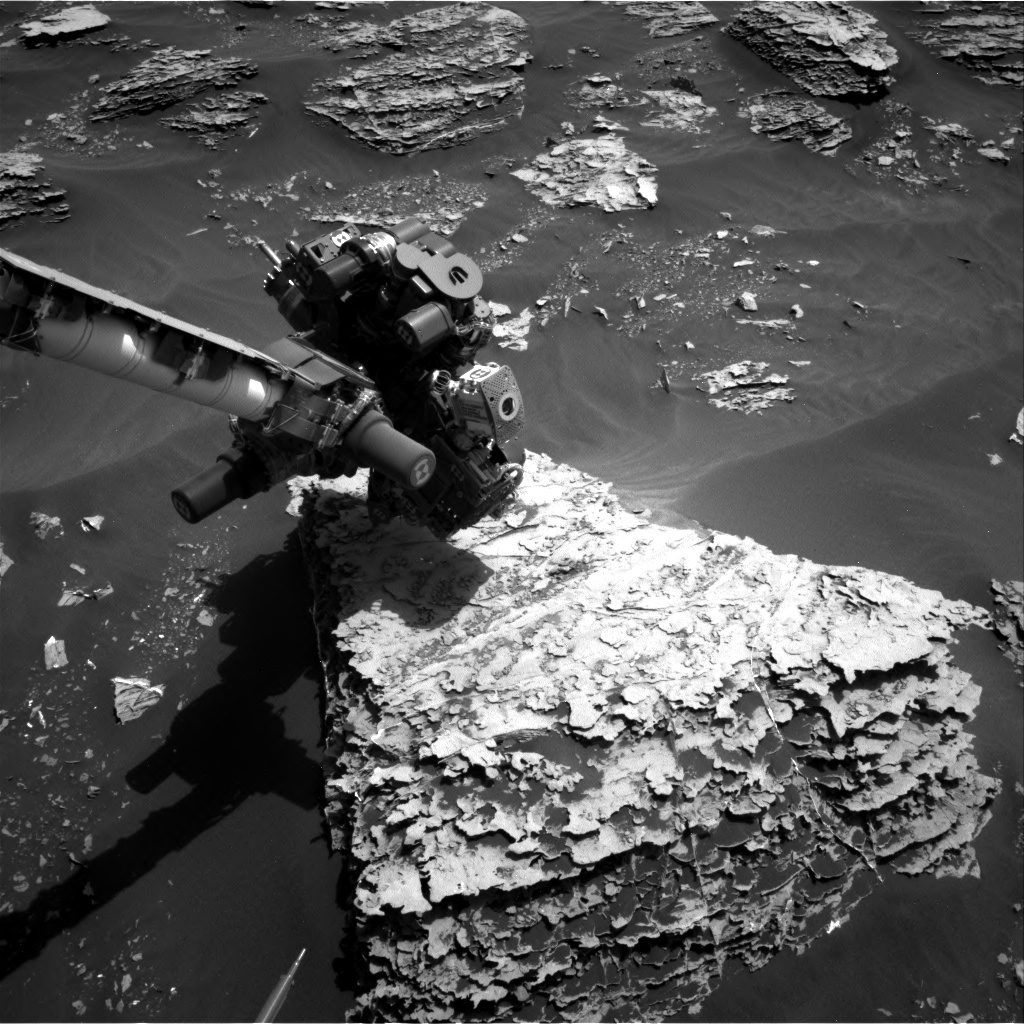
Curiosity Navcam Right B image acquired on Sol 2057, May 20, 2018.
Credit: NASA/JPL-Caltech
Imaging the hole
Before drilling, Curiosity’s Mars Hand Lens Imager (MAHLI) was to capture “before” images of the drill target, and MAHLI and Mastcam will image the areas where different portions of a drill sample could be dumped both before and after sample delivery to the Sample Analysis at Mars (SAM) Instrument Suite and the Chemistry & Mineralogy X-Ray Diffraction/X-Ray Fluorescence Instrument (CheMin).
Once the drill hole was created, ChemCam was to image the hole with its Remote Micro-Imager (RMI) to set up for shooting the laser down the drill hole in subsequent sols, and Mastcam and Navcam will image the post-drill workspace.
Work around the problem
“The engineers have worked incredibly hard to invent a new way to use the drill,” Minitti notes. “Their ability to work around the problem from afar and give us another chance at drilling is very much in the spirit of NASA’s engineers designing fixes to the systems of Apollo 13 as the spacecraft hurtled, crippled, to the Moon.”
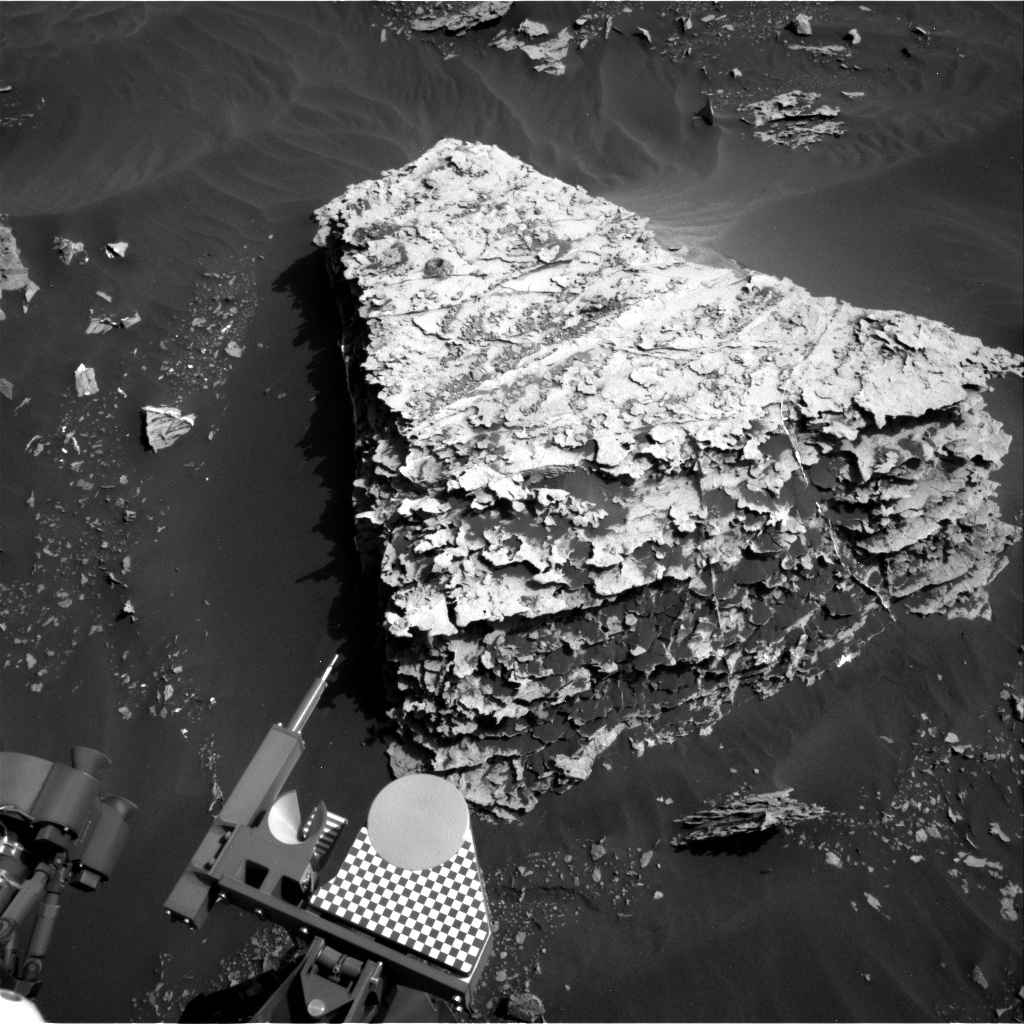
Curiosity Navcam Right B image acquired on Sol 2057, May 20, 2018.
Credit: NASA/JPL-Caltech
While the stakes are different for Curiosity, “the ingenuity is the same,” Minitti suggests. “The science team has been wondering what minerals might be responsible for the layers, veins and nodules in the Blunts Point rocks. A successful drill will mark the first step in answering that mystery.”

Credit: CNSA/CCTV Screengrab
The first phase of China’s bid to make space history by hurling a robotic mission to the far side of the moon is en route to a halo orbit of the Earth-Moon Lagrange Point L2. The Queqiao (Magpie Bridge) relay satellite departed Earth atop a Long March 4C booster on Sunday evening May 20 (May 21 in China). Liftoff took place at the Xichang Satellite Launch Center.
Comsat Launch Bolsters China’s Dreams for Landing on the Moon’s Far Side
The Queqiao orbiter will serve as a vital communications relay between the Earth and future lunar landers—and perform some science, too
By Leonard David on May 22, 2018

Radio antennas of the Netherlands Chinese Low-Frequency Explorer (NCLE), developed by ASTRON, Radboud Radio Lab, ISIS and the National Astronomical Observatories of China (NAOC).
Credit: Radboud Radio Lab/ASTRON/Albert-Jan Boonstra

Moon landing target for Chang’e-4, the southern floor of the Von Kármán crater, within the South Pole-Aitken basin.
Courtesy: Philip Stooke

Credit: ESA/Hubble & NASA
NASA has published a map capturing a cultural perspective of locations in the solar system and points beyond.
The map was produced by Bryce Space and Technology under contract with NASA’s Space Technology Mission Directorate for the Directorate’s Emerging Space Office.
Bold and broad
This map is unique in that it is not science or engineering-focused. The wall chart is bold in vision and broad in scope, designed to elicit discussion at the agency’s highest levels when it comes to thinking about our future in space.
The map’s emphasis is on three parts of human geography: strategic geography (control of, or access to, spatial areas that have an impact on the security and prosperity of nations), economic geography (patterns of trade and finance, infrastructure and facilities that contribute to the economy of a region), and social geography (interaction of social processes, cultural products and norms and their variations).
To take a look, go to:
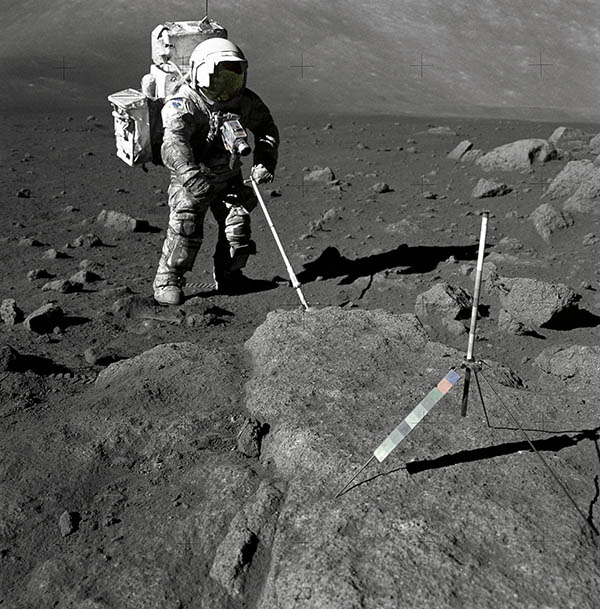
Geologist Harrison Schmitt performs Moon tasks during Apollo 17 mission in December 1972.
Credit: NASA
There are unopened treasures brought back by moonwalkers, lunar collectibles returned to Earth in 1971-72.
A new NASA program has been established – the Apollo Next Generation Sample Analysis (ANGSA).
The goal of the ANGSA program is to maximize the science derived from samples returned by the Apollo Program in preparation for future lunar missions anticipated in the 2020s and beyond.
Specially curated materials
To achieve this, ANGSA is asking the lunar research community what kind of work can be accomplished on specially curated materials from the Apollo 15, 16, and 17 sample collections.

Astronaut John W. Young, commander of the Apollo 16 mission, stands at the ALSEP deployment site during the first extravehicular activity (EVA-1) at the Descartes landing site.
The ANGSA program is considering only proposals that focus on the analysis of unopened vacuum-sealed Apollo samples; frozen Apollo Samples; and Apollo samples stored in Helium.
The Apollo missions collected 382 kg of rock, regolith (i.e., soil), and core samples from six locations on the nearside of the Moon. Today, just over 84% by mass of the Apollo collection remains in “pristine” condition within the curation facility at the NASA Johnson Space Center in Houston, Texa

Astronaut David R. Scott, commander of Apollo 15, standing on the slope of Hadley Delta.
Credit: NASA
Wholly or largely unstudied
Although most Apollo samples have been well characterized over the years, there remain several types of samples that have remained wholly or largely unstudied since their return, and have been curated under special conditions.
Unopened vacuum-sealed Apollo samples: Nine “special samples” were collected in containers that had indium knife-edge seals to maintain a lunar-like vacuum, and three such containers remain sealed from Apollo 15, 16 and 17 missions.
Frozen Apollo samples: Several Apollo 17 samples were initially processed under nominal laboratory conditions in a nitrogen cabinet at room temperature, but placed into cold storage (-20°C) within one month of return: six subsamples of Apollo 17 drill core, nine subsamples of permanently shadowed soils, a subsample of soil, and all of the lunar rock identified as 71036.
Apollo samples stored in Helium: Apollo 15 Special Environmental Sample Container (SESC) specimens were opened in a helium cabinet inside an organic clean room at the University of California, Berkeley. A total of 21 subsamples have been continuously stored in Helium since this initial processing.
Expected program budget for first year of new awards is roughly $3.5 million, with those wanting to take part in the ANGSA program required to send NASA a notice of intent (NOI), due June 22, 2018.
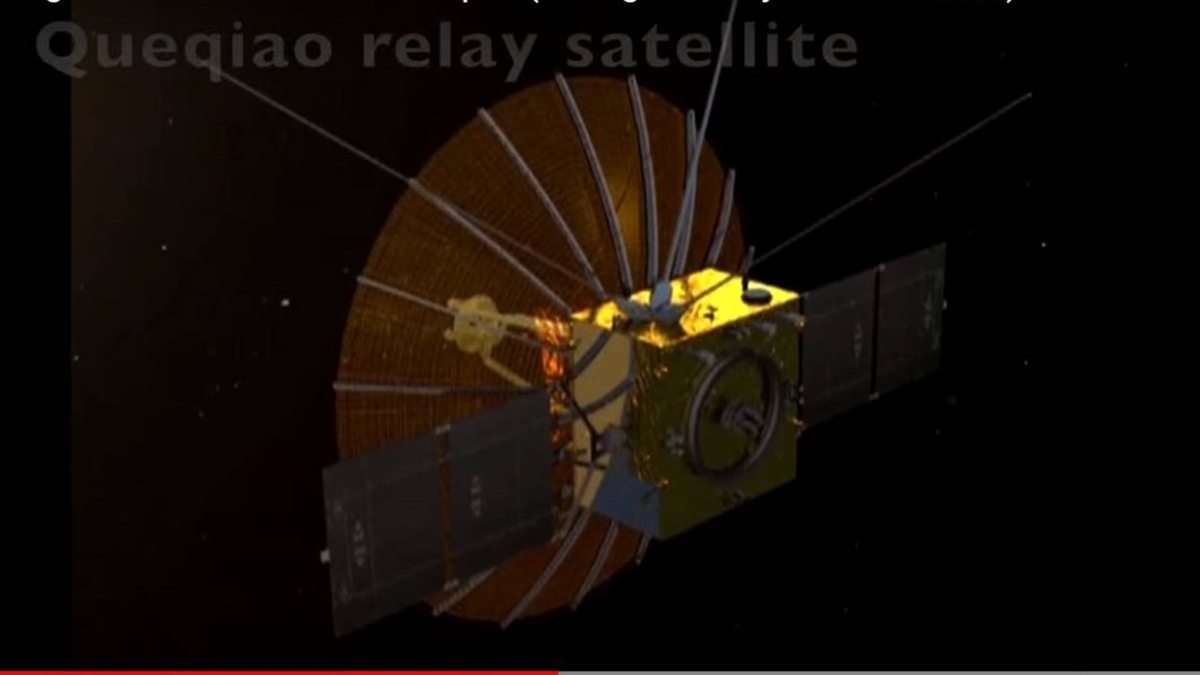
Credit: CNSA
China has successfully launched the Queqiao relay satellite, a first step in the country’s quest to land the Chang’e-4 spacecraft on the far side of the Moon.
Queqiao is to be positioned in an Earth-Moon L2 Lagrange point – a place in space where the spacecraft can relay communications between ground controllers and the far side lander/rover mission.

The Queqiao relay craft is essential to any far side landing attempt by Chang’e-4, to be launched moonward later this year.

Credit: CNSA
Radio astronomy
Queqiao is carrying a Dutch radio antenna, the Netherlands Chinese Low-Frequency Explorer (NCLE).
With the instrument, made by engineers from the Radboud Radio Lab of Radboud University, ASTRON, the Netherlands Institute for Radio Astronomy in Dwingeloo, and the Delft-based company ISIS, astronomers want
to measure radio waves originating from the period directly after the Big Bang, when the first stars and galaxies were formed.
For a look at NCLE deploying one of its three antennas in a lab test, go to this video:
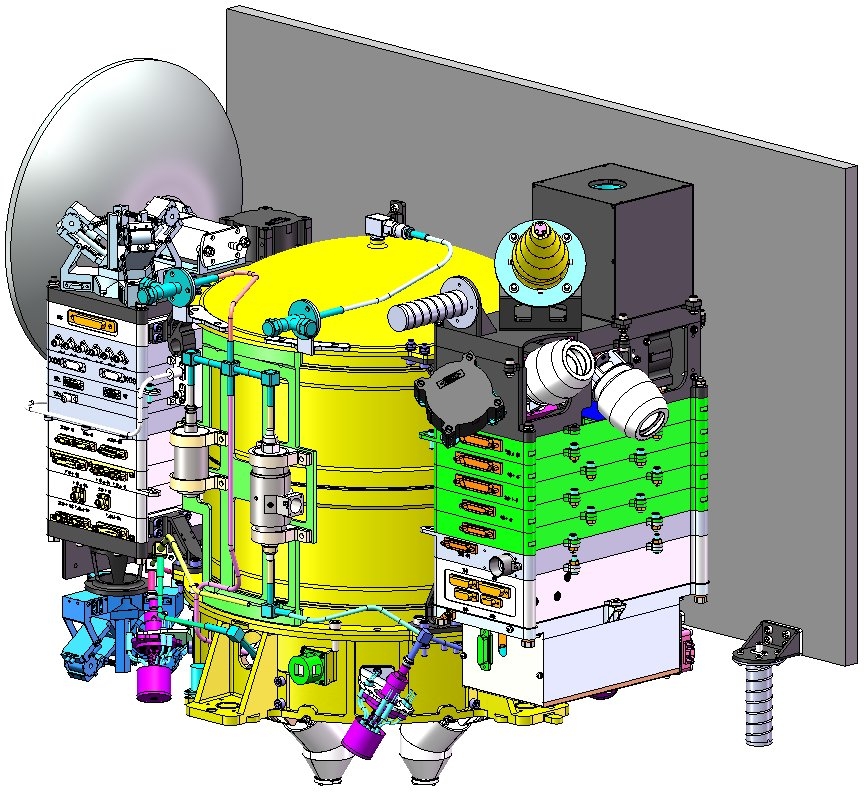
A pair of 104 pound (47 kilograms) microsatellites are also heading for the Moon.
Credit: Harbin Institute of Technology
Hitchhiking microsatellites
Also on board the relay satellite mission, a pair of hitchhiking microsatellites – unofficially called DSLWP-A1 and DSLWP-A2 (DSLWP = Discovering the Sky at Longest Wavelengths Pathfinder).
DSLWP is a lunar formation flying mission led by students at the Harbin Institute of Technology, designed for low frequency radio astronomy, amateur radio and education. They will eventually enter a lunar elliptical orbit. Onboard each satellite, there are two VHF/UHF SDR transceivers to provide beacon, telemetry, telecommand, digital image downlink and a repeater. Onboard transmitting power is about 2 watts.
The satellites will use the Moon to shield them from radio emissions from Earth for a series of long wavelength space-based interferometry experiments.
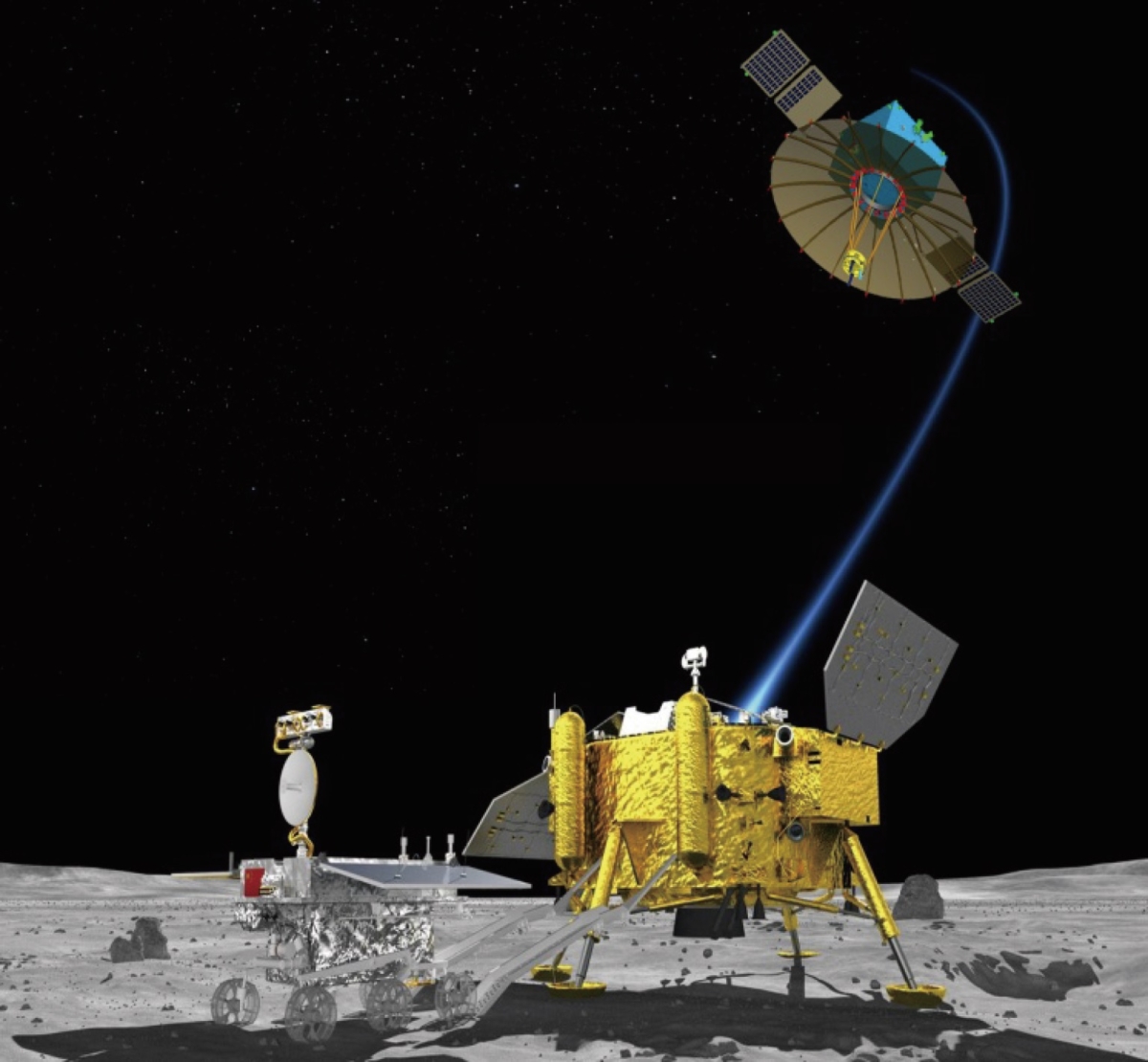
Chang’e-4 Moon lander and rover.
Credit: Chinese Academy of Sciences
Emotional time
NCLE project leader Marc Klein Wolt (managing director Radboud Radio Lab) was present at the launch together with colleagues and representatives from the Dutch embassy in China.
“Everything has been successful and our antenna is now on its way to the so-called second Lagrange point (L2) of the Earth-Moon system. That is about 65,000 kilometers behind the Moon,” Wolt said in a press statement. “The team watched the launch at a distance of 2 km from the platform…I have never heard such an impressive sound. The rocket came over our heads at a height of 100 kilometers and we all got a bit emotional. We have been working hard on this mission for two years and now NCLE has to continue this journey on its own.”
“The launch was spectacular, clear sky with stars and Mars, unfortunately not the moon as backdrop,” Albert-Jan Boonstra, project leader at ASTRON, told Inside Outer Space.
For a view of the launch, go to:
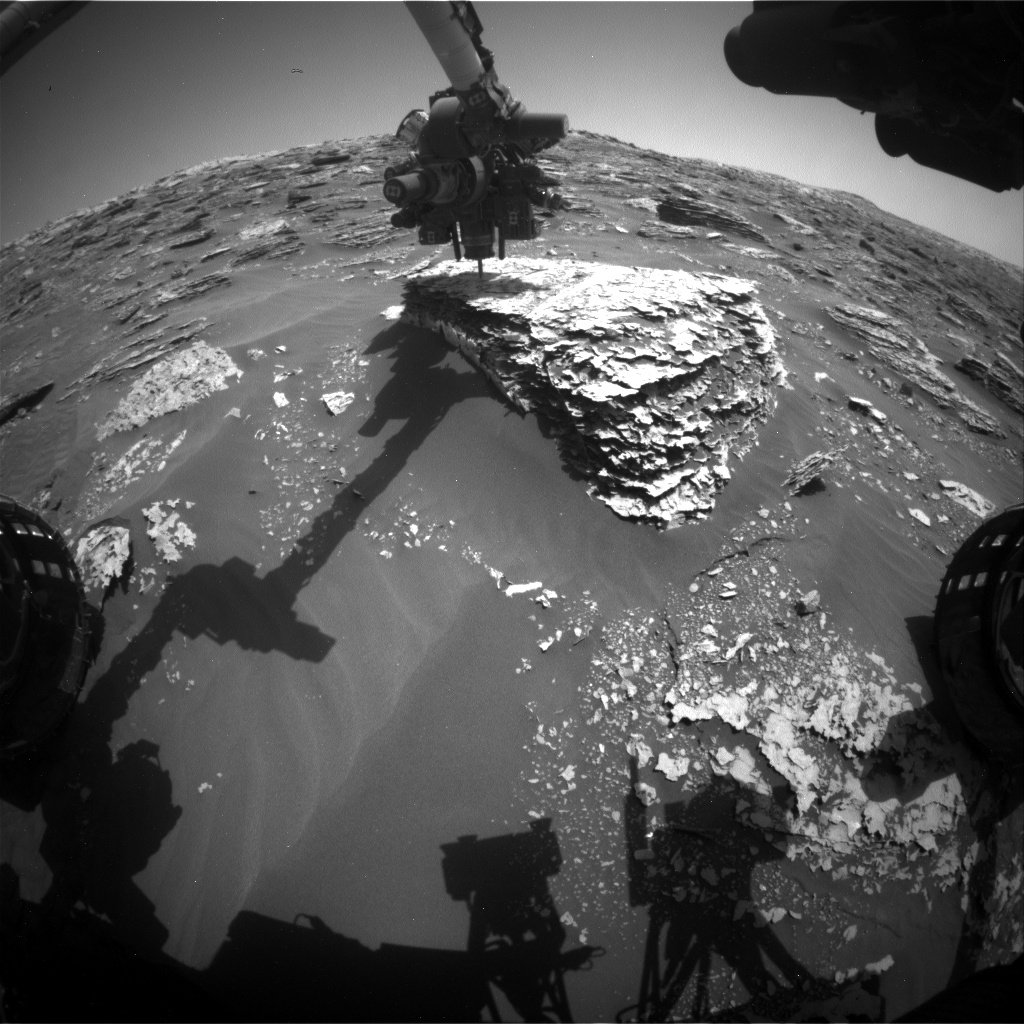
Curiosity Front Hazcam Right B image acquired on Sol 2055, May 18, 2018.
Credit: NASA/JPL-Caltech
Will Mars get the drill?
NASA’s Curiosity Mars rover is now in Sol 2056 implementing a step-wise drilling of the target “Duluth.”
The robot’s Dust Removal Tool (DRT) has brushed a section of the target, prepping it for drilling.
According to JPL, engineers have been working for the past year to restore the rover’s full drilling capabilities, which were hampered in 2016 due to a mechanical problem.

Curiosity Navcam Left B photo taken on Sol 2055, May 18, 2018.
Credit: NASA/JPL-Caltech
Percussion technique
If all goes well, Curiosity controllers will be adding “percussion” to a new technique already in use on Mars.
“This new technique is called Feed Extended Drilling, or FED. It lets Curiosity drill more like the way a person would at home, using the force of its robotic arm to push its drill bit forward as it spins. The new version of FED adds a hammering force to the drill bit,” notes a JPL statement.
Why Duluth?
In the United States, Duluth, Minnesota has one of the coolest climates in the U.S. due to its proximity to the world’s largest and one of the deepest freshwater lakes.
“The drill target ‘Duluth’ on Mars was also once near the shore of a large freshwater lake. Its climate is also relatively cool, so the name is apropos,” explains Roger Wiens, a geochemist at Los Alamos National Laboratory in New Mexico.
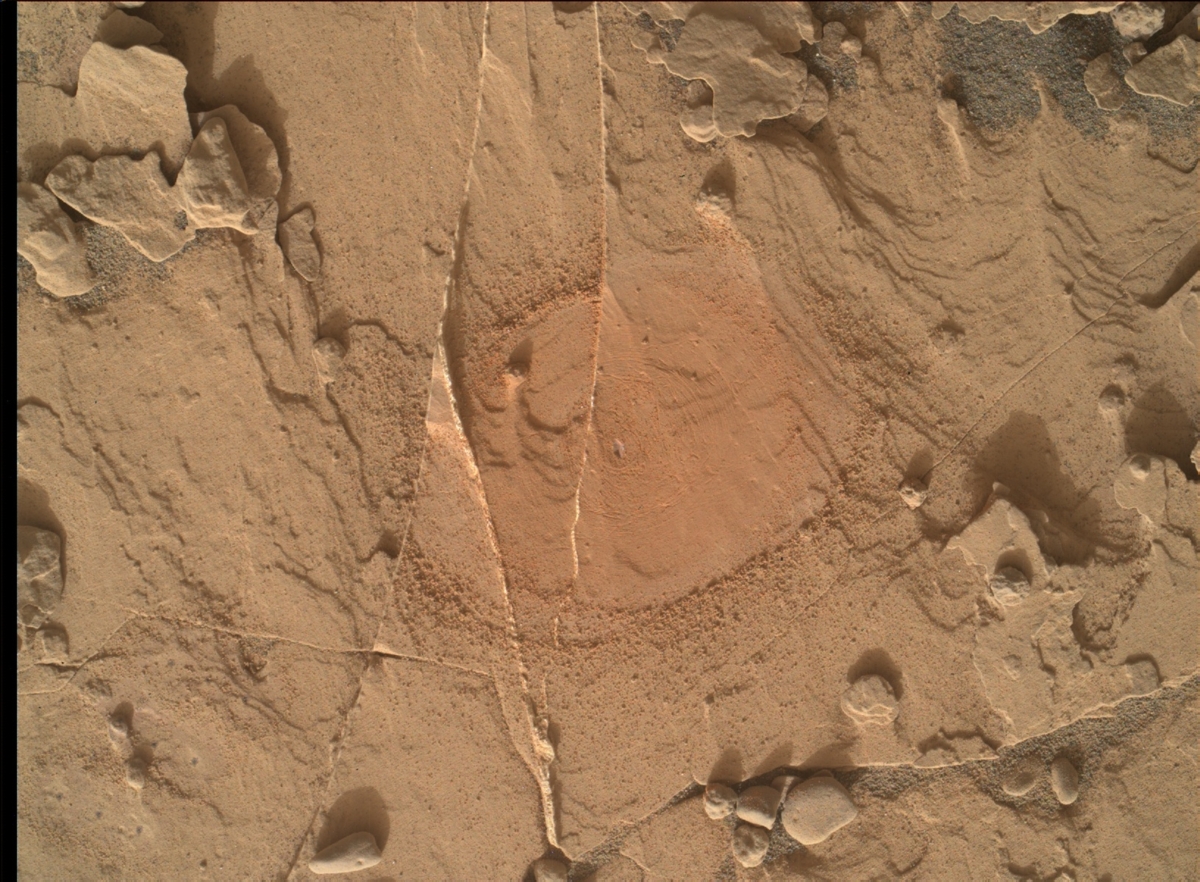
The robot’s Dust Removal Tool (DRT) has brushed a section of the target, prepping it for drilling. Curiosity Mars Hand Lens Imager (MAHLI) produced this image on Sol 2055, May 18, 2018.
Credit: NASA/JPL-Caltech/MSSS
The name of the drill site was almost changed when it was realized that “Duluth” was already used for a Chemistry and Camera (ChemCam) target way back on Sol 292. “Normally we don’t use names more than once, but the team decided an exception was warranted,” Wiens adds.
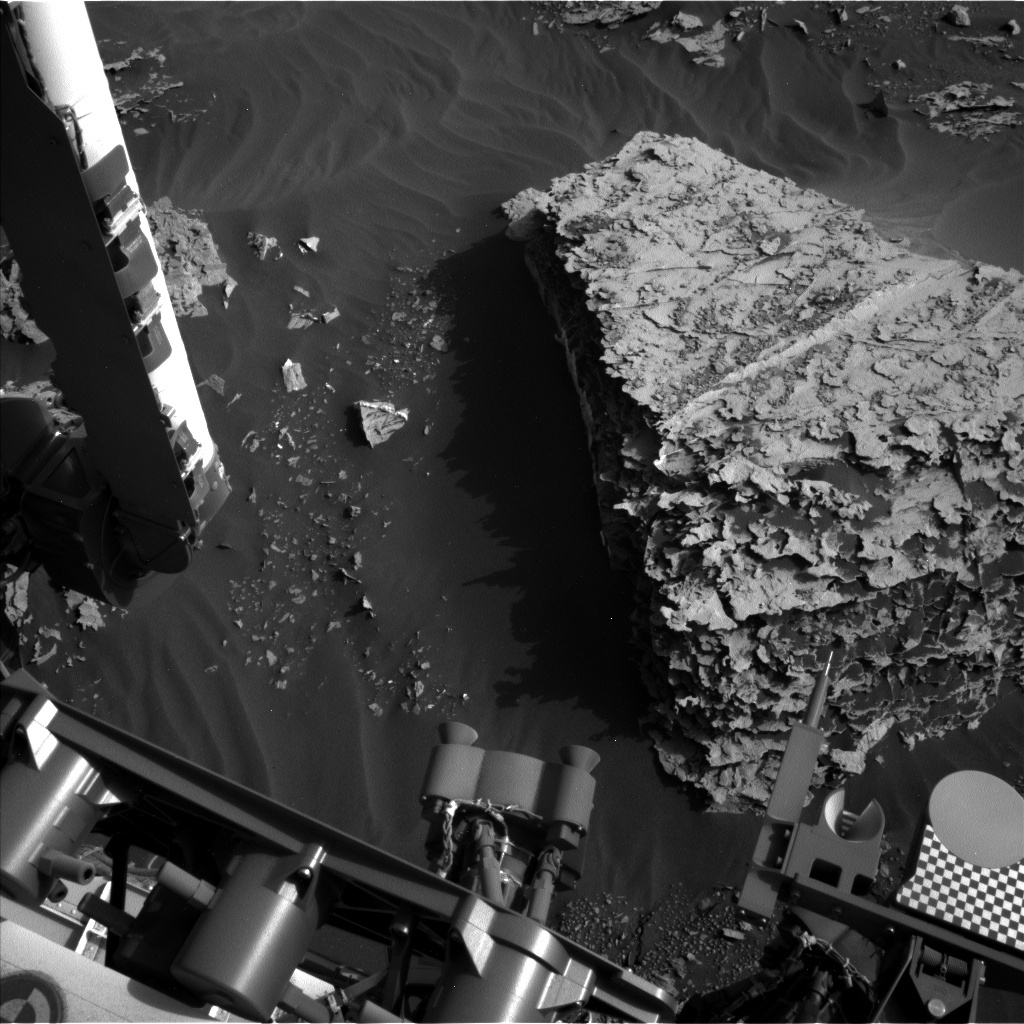
Curiosity Navcam Left B photo taken on Sol 2054, May 17, 2018.
Credit: NASA/JPL-Caltech
NASA’s Curiosity Mars rover is now performing Sol 2055 science duties. Red Planet researchers are getting ready for re-starting drill activities on Mars. The drill target is “Duluth.”
Drill sequence
Reports Roger Wiens, a geochemist at Los Alamos National Laboratory in New Mexico, the Curiosity rover is commencing its drill sequence with a full suite of contact science characterizations. It will start with a touch of the target by the arm just off to the side of the planned drill site, documented earlier by Hazcam and Navcam.

Rover drill ready for action. Curiosity Navcam Left B image acquired on Sol 2053, May 16, 2018.
Credit: NASA/JPL-Caltech
Then an Alpha Particle X-Ray Spectrometer (APXS) observation will be performed, followed by Mars Hand Lens Imager (MAHLI) observations of the Duluth target at 25 centimeters.
Up close on Duluth
“After that there will be a pre-load drill test,” Wiens notes, “which will be documented by the imagers. MAHLI will image the site at 35 centimeters along with imaging the location where the arm did its touch.”
The Dust Removal Tool (DRT) will brush the target, after which Mastcam will inspect the brush and the brushed surface, Wiens adds, and MAHLI will document the brushed target at 25, 5, and 1-2 centimeter distances. The 5 centimeter distance will support a stereo pair of images.
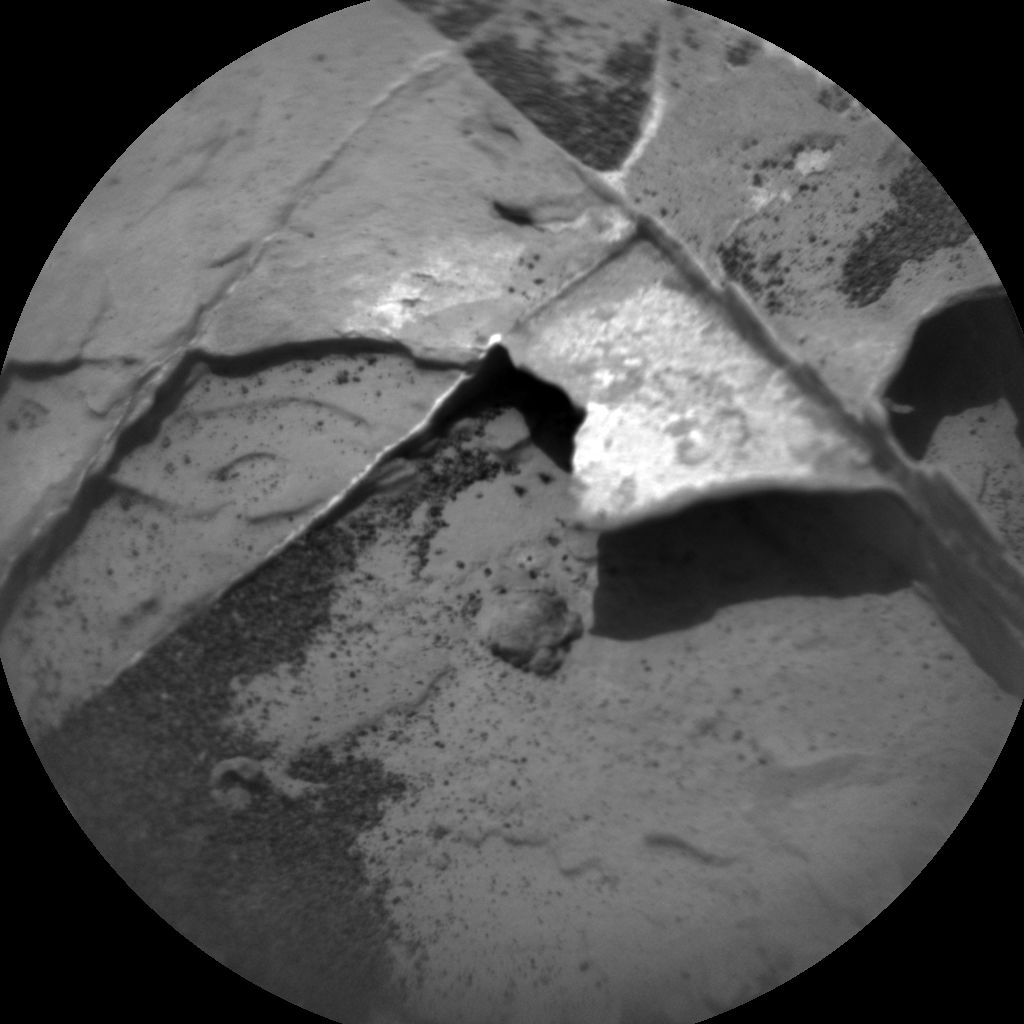
Curiosity ChemCam Remote Micro-Imager photo taken on Sol 2054, May 17, 2018.
Credit: NASA/JPL-Caltech/LANL
Uplink commands
Also on the plan, APXS will be placed for an overnight observation of the target. Navcam and Hazcam will document most of the arm instrument positions over the course of the day.
The robot’s Mastcam is slated to take a Phobos transit video near sunset. The rover is set to use its Radiation Assessment Detector (RAD), Rover Environmental Monitoring Station (REMS), and Dynamic Albedo of Neutrons (DAN) to monitor the background environment. If all goes well, the uplink team will soon begin work on the drilling commands, Wiens reports.
Name is apropos
The name Duluth was selected by geologists on the mission to recognize the Duluth Complex, one of the largest intrusions of gabbro on Earth, along the north shore of Lake Superior. Gabbro is a coarse-grained and usually dark-colored igneous rock.
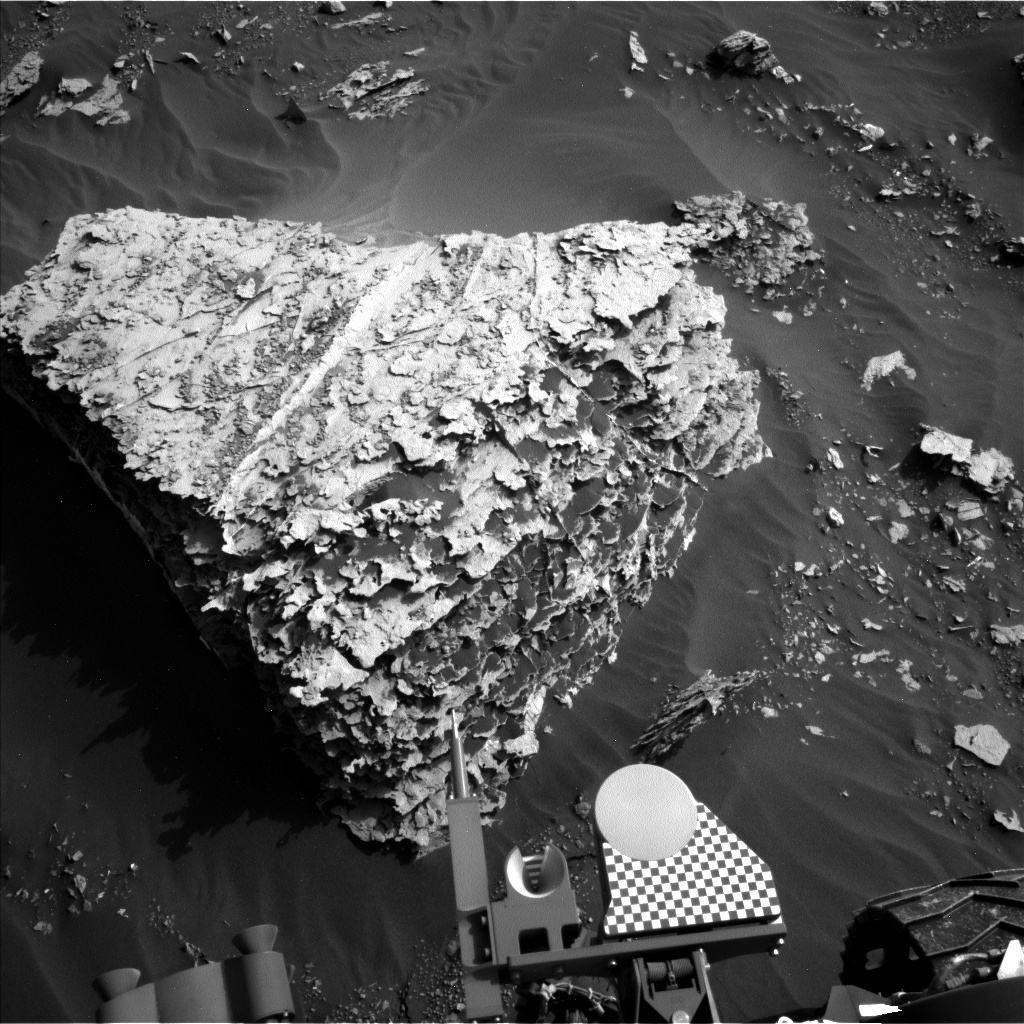
Curiosity Navcam Left B photo taken on Sol 2054, May 17, 2018.
Credit: NASA/JPL-Caltech
“Duluth has one of the coolest climates in the U.S. due to its proximity to the world’s largest and one of the deepest freshwater lakes. The drill target ‘Duluth’ on Mars was also once near the shore of a large freshwater lake. Its climate is also relatively cool, so the name is apropos,” Wiens explains.
Drilling issues
According to JPL, engineers have been working for the past year to restore the rover’s full drilling capabilities, which were hampered in 2016 due to a mechanical problem. If all goes well, this weekend, Curiosity controllers will be adding percussion to a new technique already in use on Mars.
“This new technique is called Feed Extended Drilling, or FED. It lets Curiosity drill more like the way a person would at home, using the force of its robotic arm to push its drill bit forward as it spins. The new version of FED adds a hammering force to the drill bit,” notes a JPL statement.

