Archive for the ‘Space News’ Category
 Author:
  June 22nd, 2018
Today’s hearing on space situational awareness.
Rep. Mike Rogers (R-AL), Chairman of the House Armed Services Subcommittee on Strategic Forces, made the following remarks, as prepared for delivery, on today’s hearing: Space Situational Awareness – Whole of Government Perspectives on Roles and Responsibilities.
“Good morning. I’m excited to host this joint hearing with my sister committee from HSST on space situational awareness [SSA].
“Ever since the first satellite was launched into space in 1957 people here on earth have tried to track man-made space objects. During the Cold War space object tracking became an inherently DoD mission using ballistic missile early warning radars and the infrastructure associated with launch detection.

Clutter in the cosmos.
Credit: Used with permission: Melrae Pictures/Space Junk 3D
From tracking one small sphere in 1957 to over 20,000 objects in today’s space catalog we have come a long way. But for the most part we have still maintained space surveillance as a DoD mission, or at least a mission that is fulfilled using DoD funded-sensors.
On Monday President Trump directed the Chairman of the Joint Chiefs of Staff to begin the process necessary to establish a space force as the sixth branch of the armed forces and he also signed a space policy directive on space traffic management that is beginning to shift that paradigm.
Space force
Let me just briefly say that while this hearing is not on the Space Force, this has been one of my personal priorities for this subcommittee and I’m thrilled to have the continued support of the President in this endeavor.
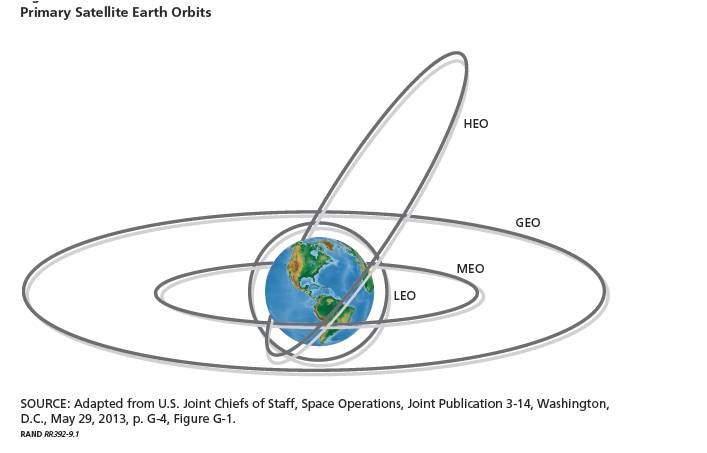
From RAND report: The U.S.-China Military Scorecard: Forces, Geography, and the Evolving Balance of Power 1996–2017.
The document that President Trump signed directs the Department of Commerce to take responsibility for DoD’s existing commercial and foreign entities public SSA services. It advances SSA science and technology, improves SSA data standards and information sharing, and encouraging U.S. commercial leadership in SSA.
I’m encouraged by this effort. Space situational awareness is key to understanding what is in space and how it supports our military, economy, and society down here on earth. In the end, the DoD’s number one mission is to prepare for, fight, and win wars. And so the focus of this hearing will be what are the roles and responsibilities of the DoD, Commerce, and NASA in providing for SSA. In particular I’m focused on making sure that DoD requirements are being met by DoD systems, and civil and commercial requirements are met by other appropriate government agencies. To hear more about the recently signed directive we have excellent panel of witnesses, I thank each of you for taking time today to testify in front of us.”
Wilber Ross, Secretary of Commerce
https://docs.house.gov/meetings/AS/AS29/20180622/108426/HHRG-115-AS29-Wstate-RossW-20180622.pdf
Jim Bridenstine, Administrator, National Aeronautics and Space Administration
General John Hyten, Commander, United States Strategic Command
https://docs.house.gov/meetings/AS/AS29/20180622/108426/HHRG-115-AS29-Wstate-HytenJ-20180622.pdf
To view the hearing, go to:
 Posted in
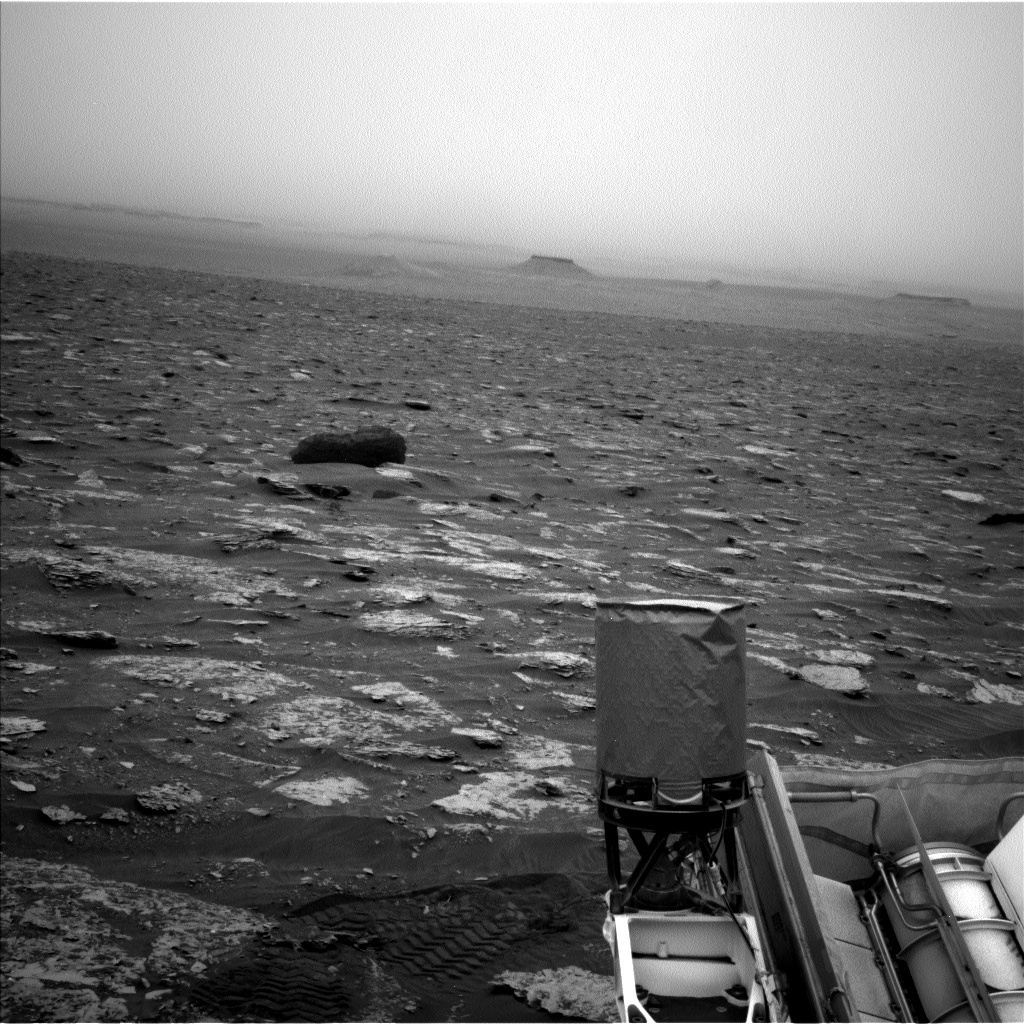
Curiosity Navcam Left B image acquired on Sol 2087, June 20, 2018.
Credit: NASA/JPL-Caltech
NASA’s Curiosity Mars rover is now performing Sol 2088 science duties.
Reports Mark Salvatore, a planetary geologist at the University of Michigan in Dearborn: “Over the past week or so, Curiosity has experienced increasingly dusty conditions in Gale crater. Unlike her older cousin Opportunity on the other side of the planet, Curiosity is not solar powered and, therefore, doesn’t suffer from the same power issues resulting from the darkening skies that Opportunity does. That allows Curiosity to play more of an active role in monitoring this dust storm from the ground and collecting important information to help scientists understand the evolution of such a weather phenomenon.”
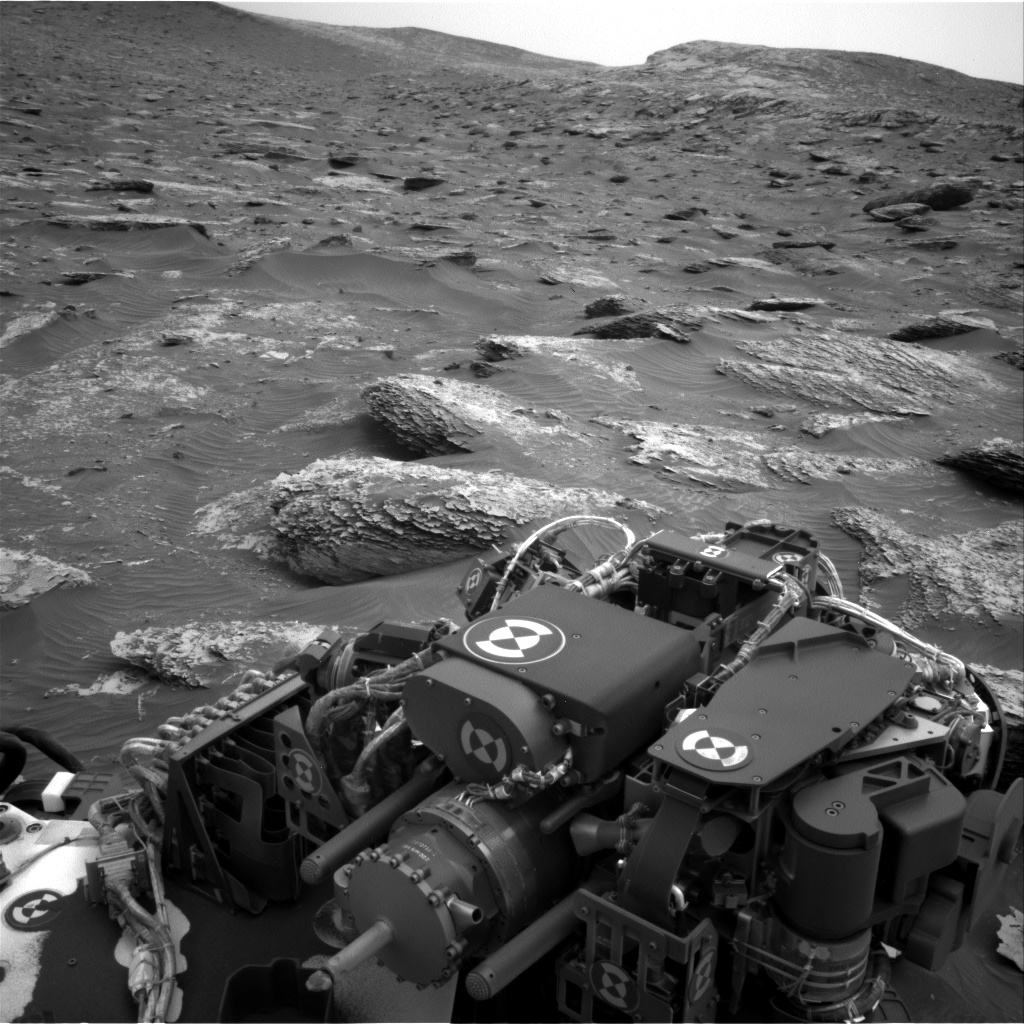
Curiosity Navcam Right B photo taken on Sol 2087, June 20, 2018.
Credit: NASA/JPL-Caltech
Short drive
Salvatore explains that, after an unexpectedly short drive on Sol 2086 due to some “slippery” ground conditions, Curiosity made a very short drive in the Sol 2087 plan due to additional wheel slippage.
“In fact, Curiosity only recorded a drive of 17 millimeters,” Salvatore adds, “or about half an inch!” So the robot’s scenic view is very similar to landscape views in the near past.
Heading south
“The science team did a great job in taking advantage of this familiar landscape by planning several new measurements,” Salvatore points out.
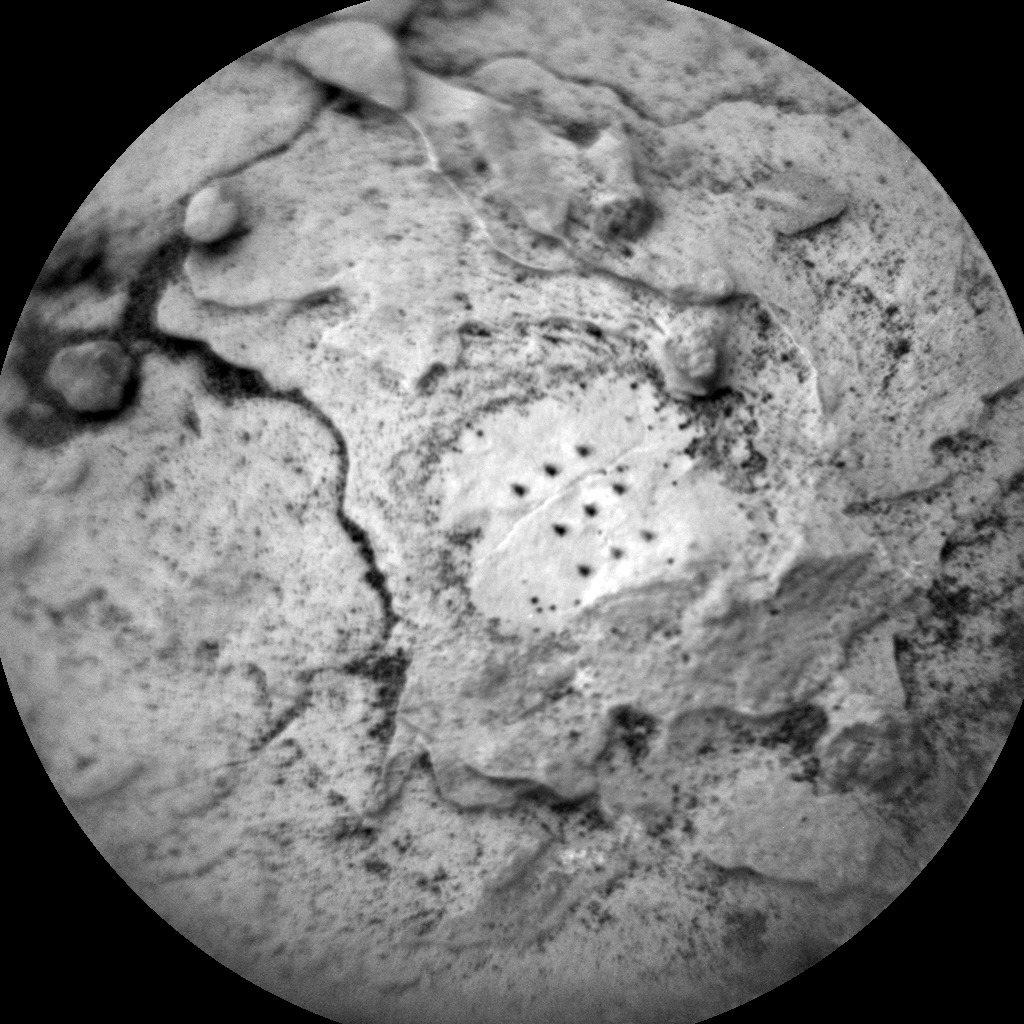
Laser shots. Curiosity ChemCam Remote Micro-Imager photo acquired on Sol 2087, June 20, 2018.
Credit: NASA/JPL-Caltech/LANL
The robot’s Chemistry and Camera (ChemCam) is to use its Laser Induced Breakdown Spectrometer (LIBS) capabilities to analyze targets named “Beaver Bay,” “Moose Mountain,” and “Breakwater,” while Mastcam and Navcam will dedicate their efforts primarily towards documenting these ChemCam targets and making environmental observations.
“The plan is to then drive away from this location heading south back up the Vera Rubin Ridge,” Salvatore explains. “Following the drive, we will make some additional environmental measurements and acquire our standard post-drive observations in preparation for our next day of planning on Friday.”
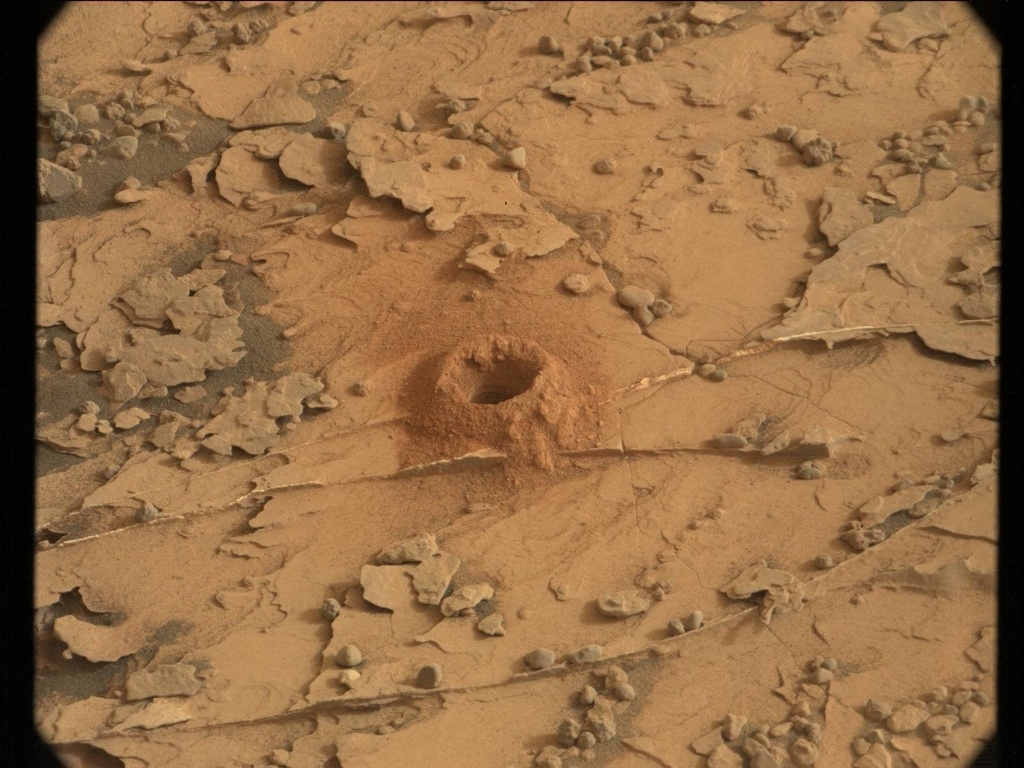
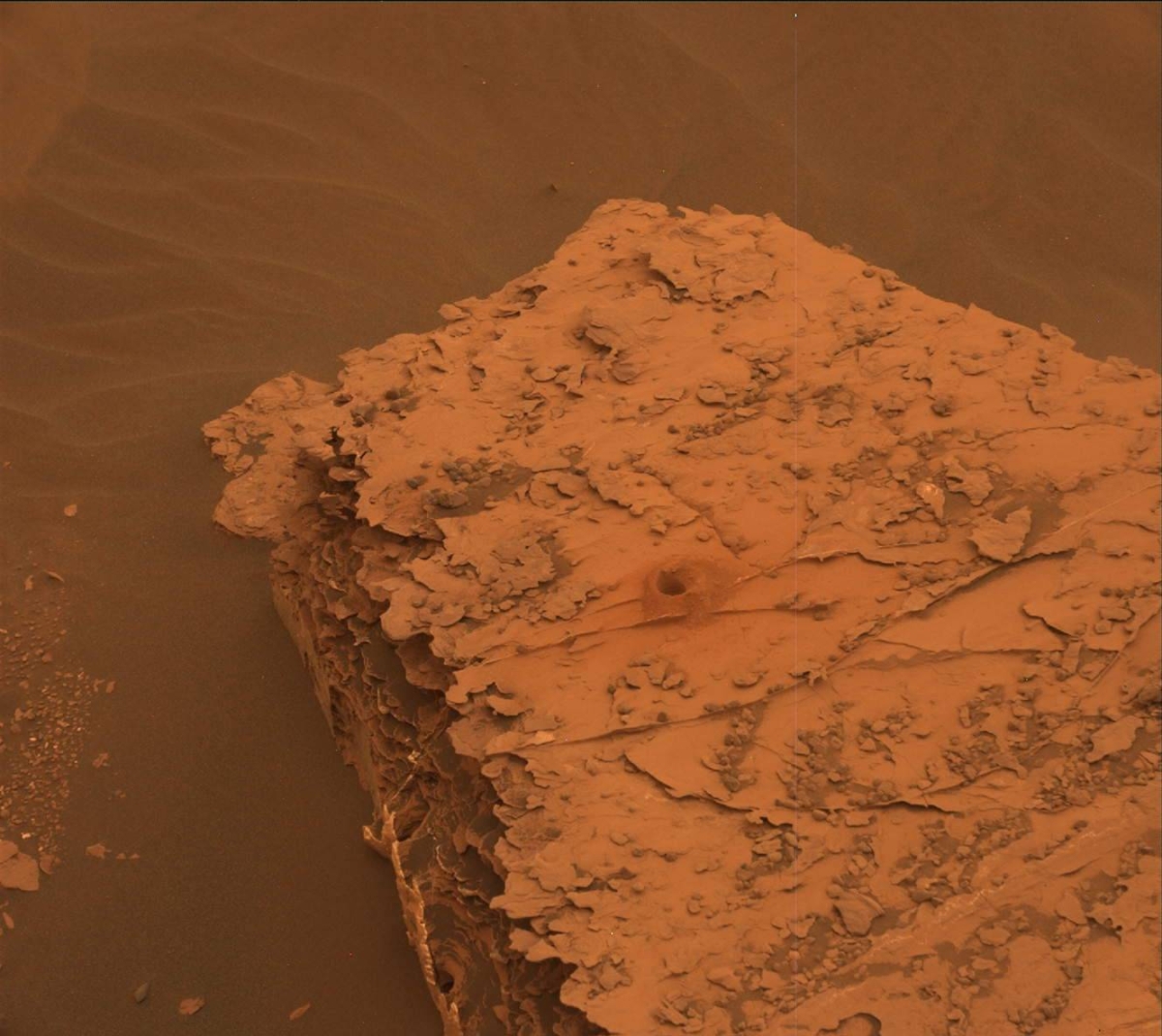
Check out the differences between Mastcam images of Duluth drill hole on Sol 2078 and image below taken on Sol 2084. Color contrast has decreased significantly as the air has become redder and sunlight is scattered more and more as the dust storm continues to evolve. Credit: NASA/JPL-Caltech/MSSS
Looking into thin air
A really “cool observation” is on tap using ChemCam LIBS observation of thin air, Salvatore says. “The idea is to target the ChemCam laser into the dusty martian air. By observing the amount of dispersion of the laser pulse, the team will be able to make some really cool observations and estimations of atmospheric dust abundances. This is equivalent to shining a laser pointer into the sky during a foggy day, or in a dusty classroom. It’s a new tool available to Curiosity thanks to some really ingenious planning by the scientists and engineers, and today is the first day that we will make this observation, so stay tuned!”
Sunlight scattering
Like overcast days here on Earth, Salvatore adds, there are very few shadows currently observed in Gale crater when the sun is overhead. “The red martian dust in the atmosphere is scattering nearly all observed sunlight, creating dim and diffuse conditions.”
It’s clear that the amount of color contrast has decreased significantly as the air has become redder and sunlight is scattered more and more. “We’ll continue to monitor the amount of atmospheric scattering as the dust storm evolves over the next few weeks,” Salvatore concludes.
Credit: NASA/JPL-Caltech/Univ. of Arizona
New road map
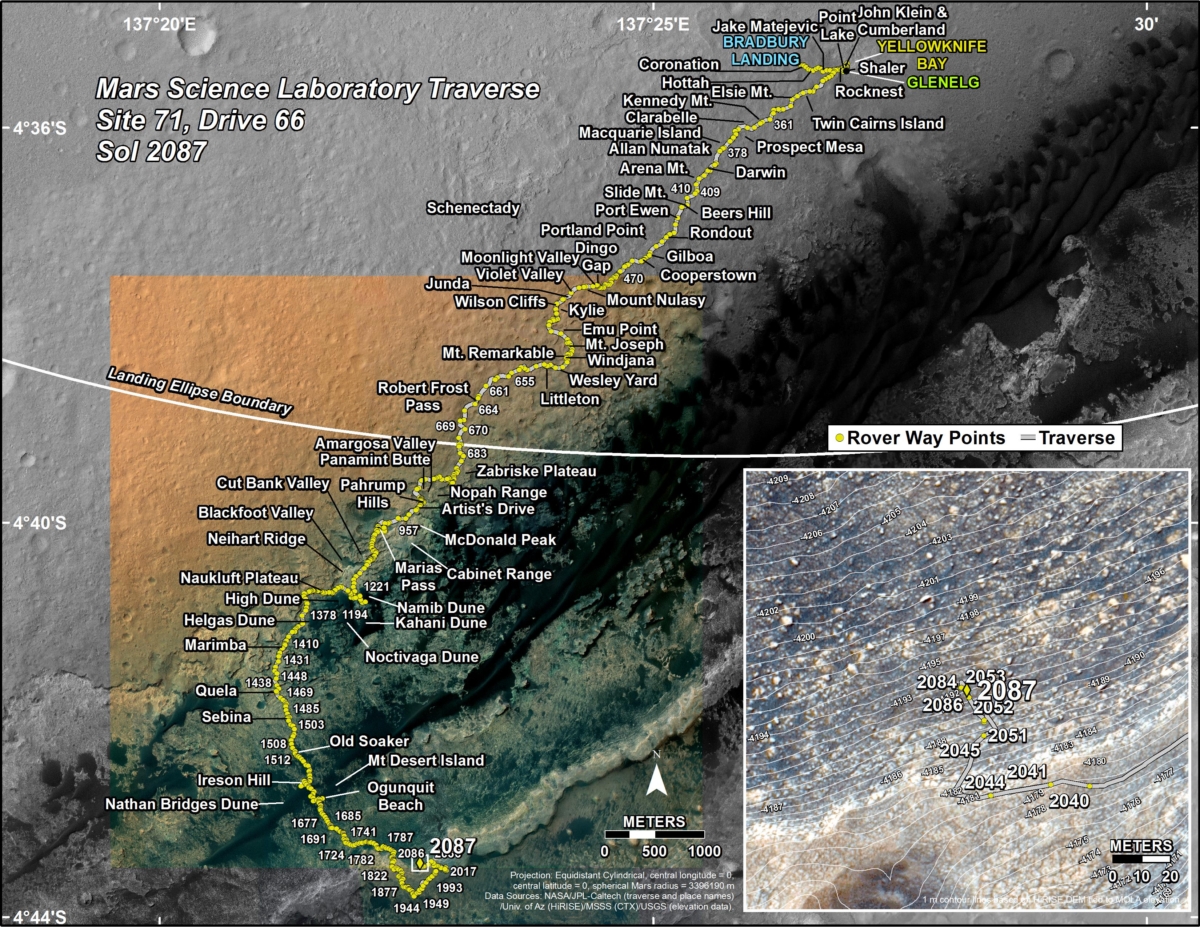
Meanwhile a new Curiosity traverse map through Sol 2087 has been issued.
The map shows the route driven by NASA’s Mars rover Curiosity through the 2087 Martian day, or sol, of the rover’s mission on Mars (June 20, 2018).
Numbering of the dots along the line indicate the sol number of each drive. North is up. The scale bar is 1 kilometer (~0.62 mile).
From Sol 2086 to Sol 2087, Curiosity had driven a straight line distance of about 0.06 feet (0.02 meters), bringing the rover’s total odometry for the mission to 11.85 miles (19.08 kilometers).
The base image from the map is from the High Resolution Imaging Science Experiment Camera (HiRISE) in NASA’s Mars Reconnaissance Orbiter.

Credit: ESAshop
In the wake of yesterday’s release of a study on the threat of Earth getting smacked by a destructive space rock, you can make a fashion statement.
The European Space Agency’s ESAshop is offering planetary defender accessories, “wear and care” items that showcase your protect the Earth status.
Credit: ESAshop
All items are printed on demand and delivered to your door, wherever you are in the world.
Space rock items are part of the “Earthpositive Collection.”
E-commerce platform
The ESAshop is collaboration with the German company, Spreadshirt which, with a focus on sustainability, was founded in 2002. Spreadshirt is an e-commerce platform for on-demand printing of clothing and accessories.
ESA provides the designs for the products in the ESAshop, and Spreadshirt takes care of all the rest.
For a look at all the ESAshop offerings, go to:
https://shop.spreadshirt.net/esashop/
Credit: ESAshop
Report available
So put on a T-shirt, sip a coffee from your planetary defender cup…stay calm, sit back and read:
National Near-Earth Object Preparedness Strategy and Action Plan

Close-calls in the cosmos.
Credit: Naval Research Laboratory (NRL)
That new space traffic management policy just signed by U.S. President Donald Trump may not be enough to prevent space objects from crashing into each other.
That’s the ruling of Purdue aerospace professor Carolin Frueh.
Research hasn’t caught up yet with how to reliably characterize and continuously track everything ranging from satellites and rocket boosters to tiny debris. Even if all objects were characterized, most of them can’t control their movement, so crashes are still unpredictable.
The number of objects in space and the frequency of traffic jams also keep increasing, making research from five years ago irrelevant.

In-orbit explosions can be related to the mixing of residual fuel that remain in tanks or fuel lines once a rocket stage or satellite is discarded in Earth orbit. The resulting explosion can destroy the object and spread its mass across numerous fragments with a wide spectrum of masses and imparted speeds.
Credit: ESA
Congested, unpredictable
In a Purdue press release, Frueh, assistant professor of aeronautics and astronautics, suggests that space traffic is much more congested and unpredictable than air traffic here on Earth.
“For air traffic, there are multiple radars tracking several airplanes per hour, but for space traffic, only a few sensors on earth are tracking about 20,000 known objects,” Frueh explains. “If we include the objects that are smaller in size, then we’re talking about 100,000 or more objects that are of interest – and all of them different dimensions.”
Open-access catalog
Trump’s Space Policy Directive 3 calls for establishing an open-access data repository of all known space objects.
Currently, U.S. Strategic Command via the website space-track.org offers a public catalog of around 16,000 unclassified objects of known origin, explains Frueh, but research hasn’t caught up yet with how to reliably characterize and continuously track everything ranging from satellites and rocket boosters to tiny debris.

Chunk of junk zips by the International Space Station.
Credit: NASA
“Maintaining an open-access catalog with at least basic information is crucial for the sustainable use of space, but currently the quality of the data is not disclosed – severely hindering development of solutions for space traffic management,” Frueh points out.
Paper studies
“The directive enforces national space debris mitigation standards and best practices, which could mean making it finally mandatory for spacecraft to burn up in the Earth’s atmosphere within 25 years of shutting down,” Frueh said.
“This new legislation also commits the U.S. to exploring active space debris removal, actively taking down defunct satellites so that they no longer pose a risk to other objects. Active removal has so far only been explored theoretically in paper studies.”
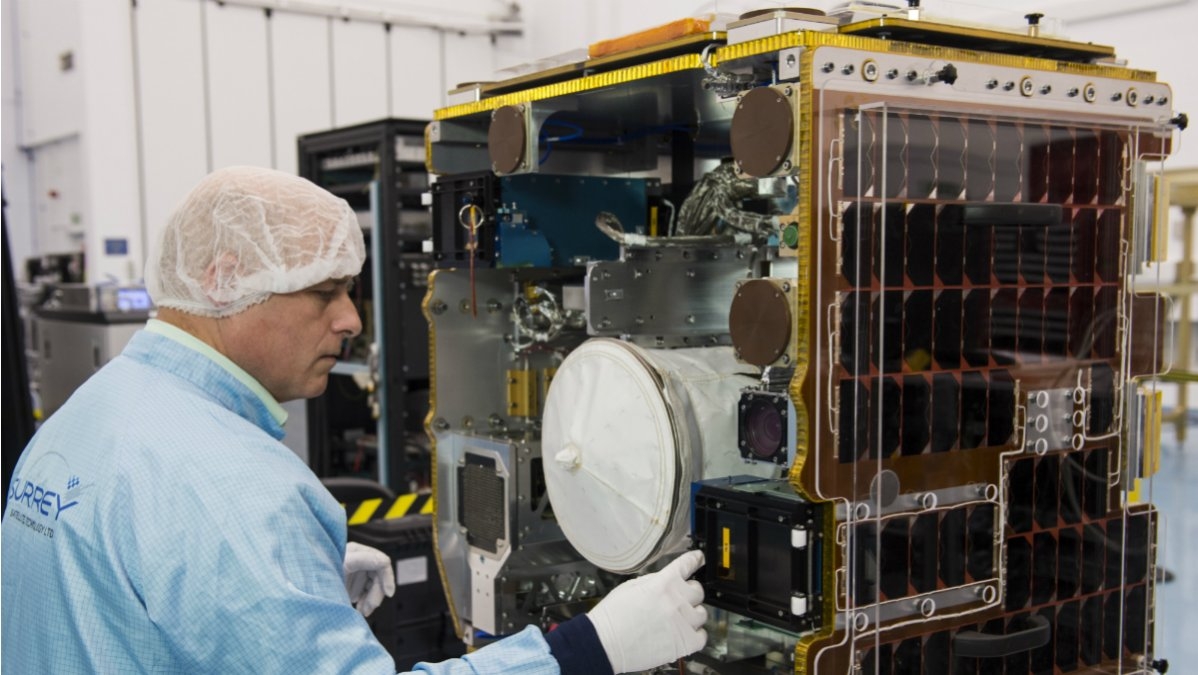
Pre-launch photo of RemoveDEBRIS satellite.
Credit: SSC/Max Alexander
NanoRacks successfully deployed the RemoveDEBRIS satellite today from the International Space Station.
Deployment made use of the company’s commercially developed Kaber Microsatellite Deployer. RemoveDEBRIS is the largest satellite to ever be deployed from the ISS – designed, built and manufactured by a consortium of leading space companies and research institutions, led by the Surrey Space Center at the University of Surrey and funded in part by the European Union Seventh Framework Program.
Credit: Airbus Defence and Space
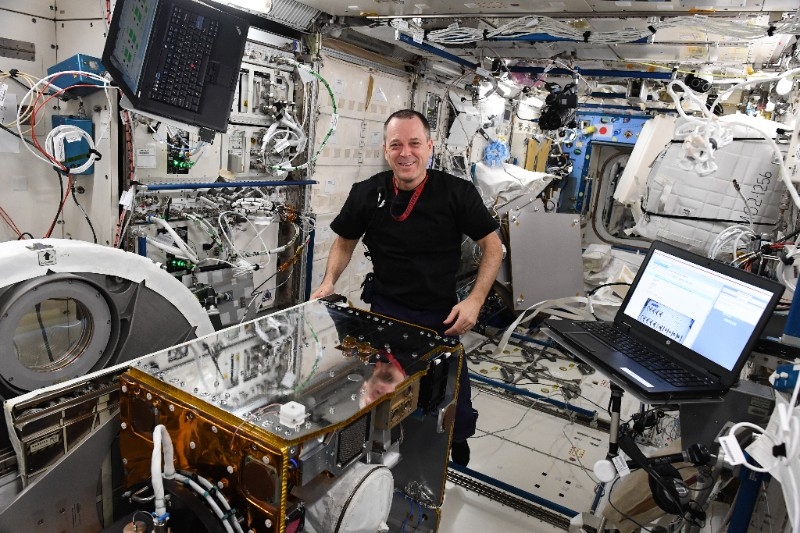
Onboard the ISS, crewmember readies RemoveDEBRIS for launch from the orbiting facility.
Credit: NASA/NanoRacks
Four experiments
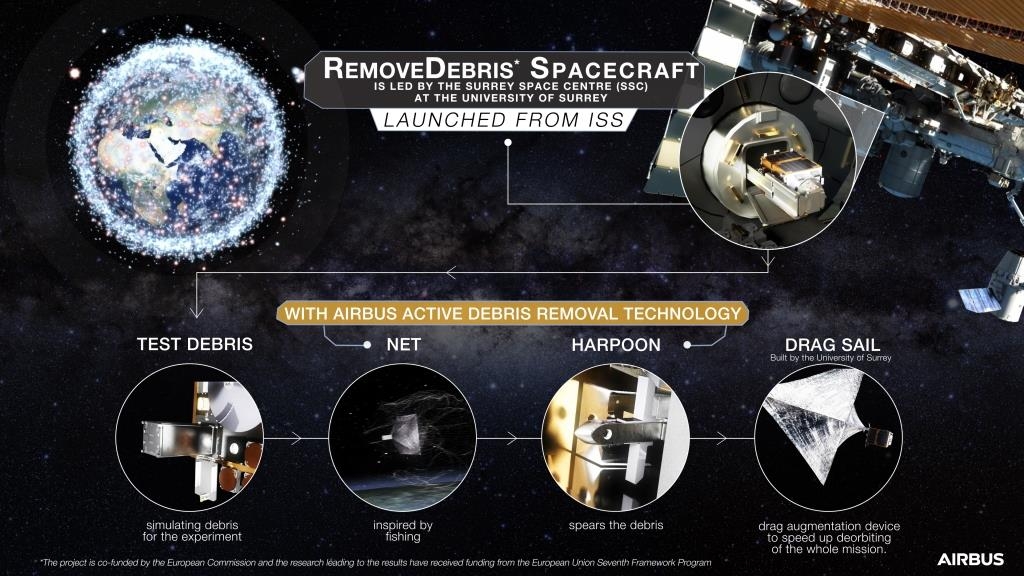
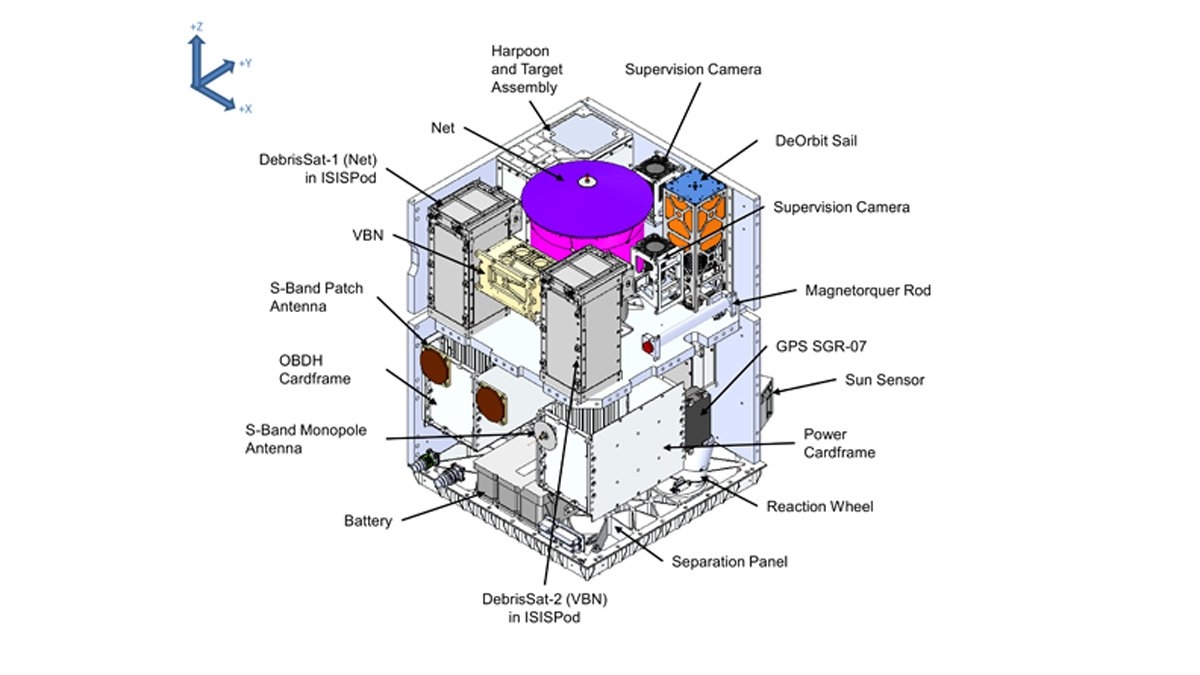
The RemoveDEBRIS mission will perform four experiments, which will be tested on two CubeSats to-be-deployed from the larger satellite, acting as artificial targets.
Credit: Surrey Space Centre (SSC)
These experiments include both the first harpoon capture in orbit and a net that will be used on a deployed target. The team will also test a vision-based navigation system that uses cameras and LiDaR technology to observe CubeSats that will be released from the main spacecraft.

Airlocked and loaded!
Credit: NASA/NanoRacks
Lastly, the RemoveDEBRIS craft will deploy a large drag sail that will cause the orbit of the spacecraft to rapidly decay until making a destructive plunge into the Earth’s atmosphere.
Video
RemoveDEBRIS was launched to the Space Station via NanoRacks on the 14th SpaceX Commercial Resupply Mission in early April.
For a video on this creative mission, go to:
Credit: NASA/JPL-Caltech/MSSS/Kevin M. Gill
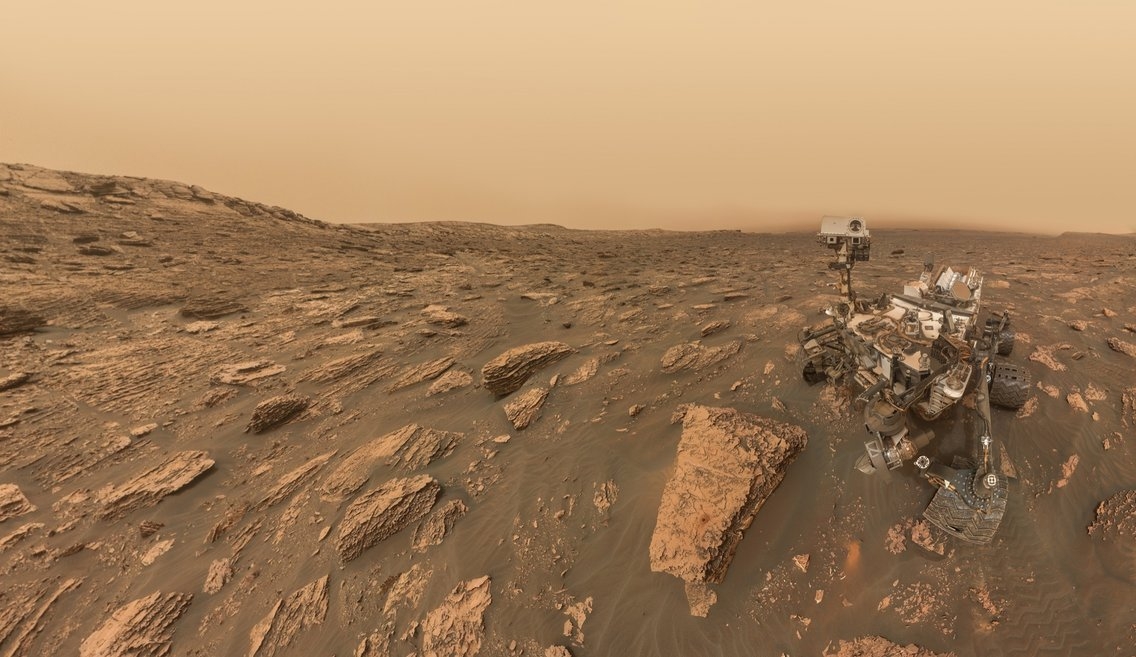
Now in Sol 2086, NASA’s Curiosity Mars rover continues to probe the Vera Rubin Ridge.
Christopher Edwards, a planetary geologist at Northern Arizona University, Flagstaff, Arizona notes that the last time Curiosity drove anywhere was 30 martian days ago.
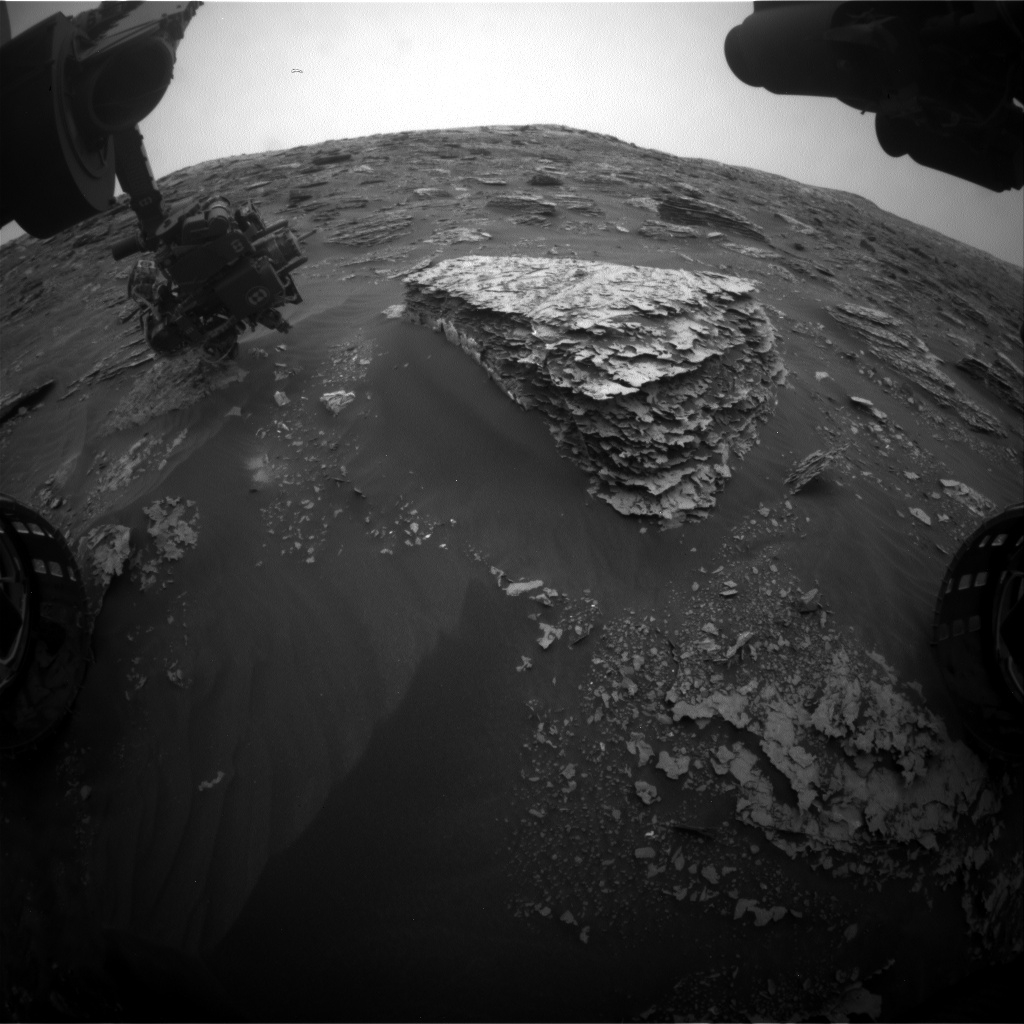
Curiosity Front Hazcam Right B photo acquired on Sol 2085, June 18, 2018.
Credit: NASA/JPL-Caltech
“A lot has happened in these past 30 sols. The rover got its groove back and successfully carried out a feed extended percussion drill activity and delivered drilled rock powder samples to the analytical instruments internal to the rover,” Edwards adds.
Resurrected drilling duties
Two instruments, the robot’s Chemistry & Mineralogy X-Ray Diffraction/X-Ray Fluorescence Instrument (CheMin) and the Sample Analysis at Mars (SAM) mass spectrometer/gas chromatograph/tunable laser spectrometer suite — have been without fresh samples to analyze for months.
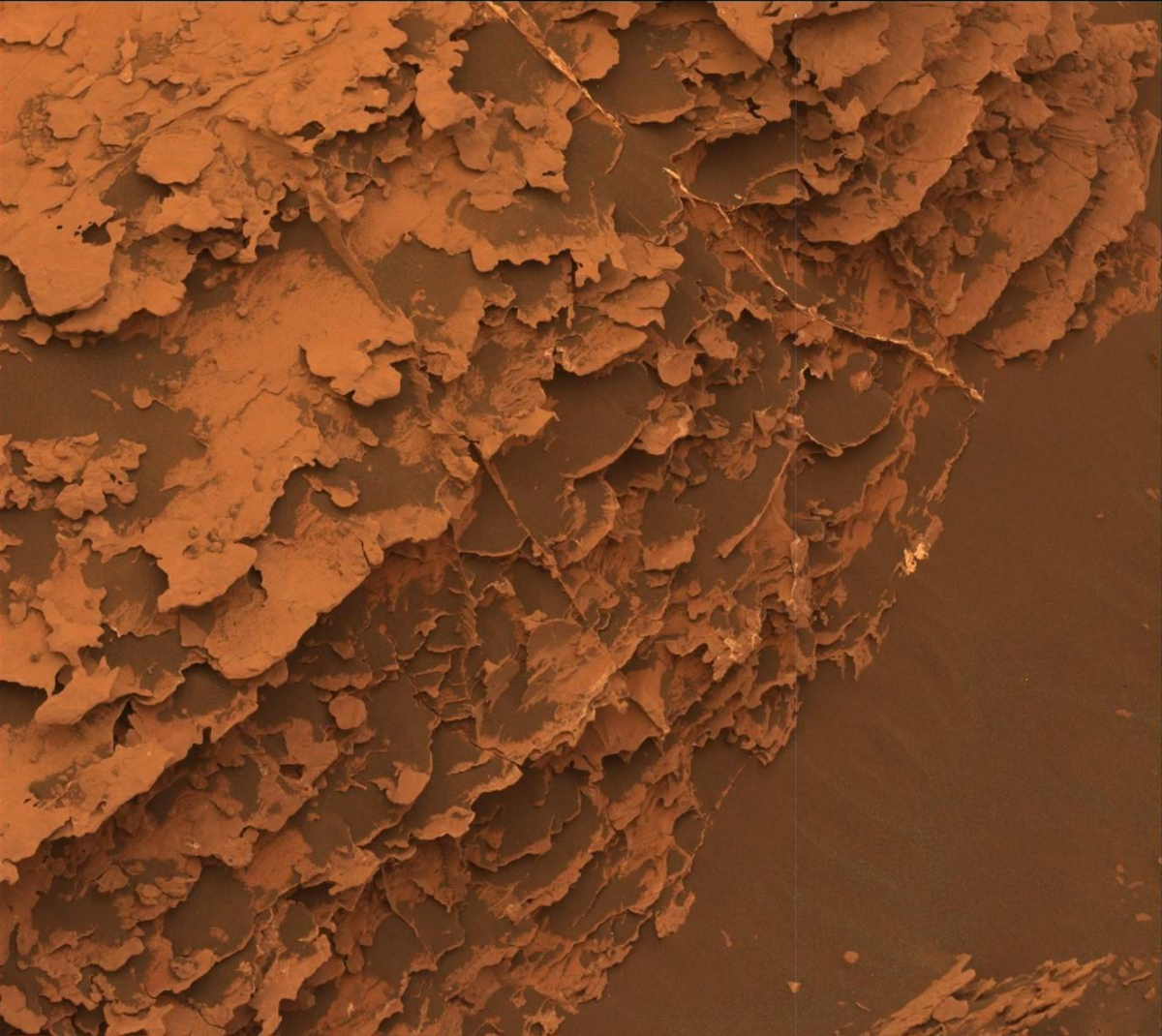
Curiosity Mastcam Left image taken on Sol 2084, June 17, 2018.
Credit: NASA/JPL-Caltech/MSSS
“Of course over the time while the drill was inoperable, Curiosity still carried out some fantastic scientific investigations examining the nature of the Vera Rubin Ridge,” Edwards points out. “With its newly resurrected drilling capabilities, Curiosity will do one last pass over the Vera Rubin Ridge units, now that the rest of the instrument suite onboard can have access to this and future drill samples.”
Hit the road
Edwards reports that after completing the last little bit of drill related activities designed to characterize the sampling site in detail Curiosity will hit the road on the second sol of this three sol plan.
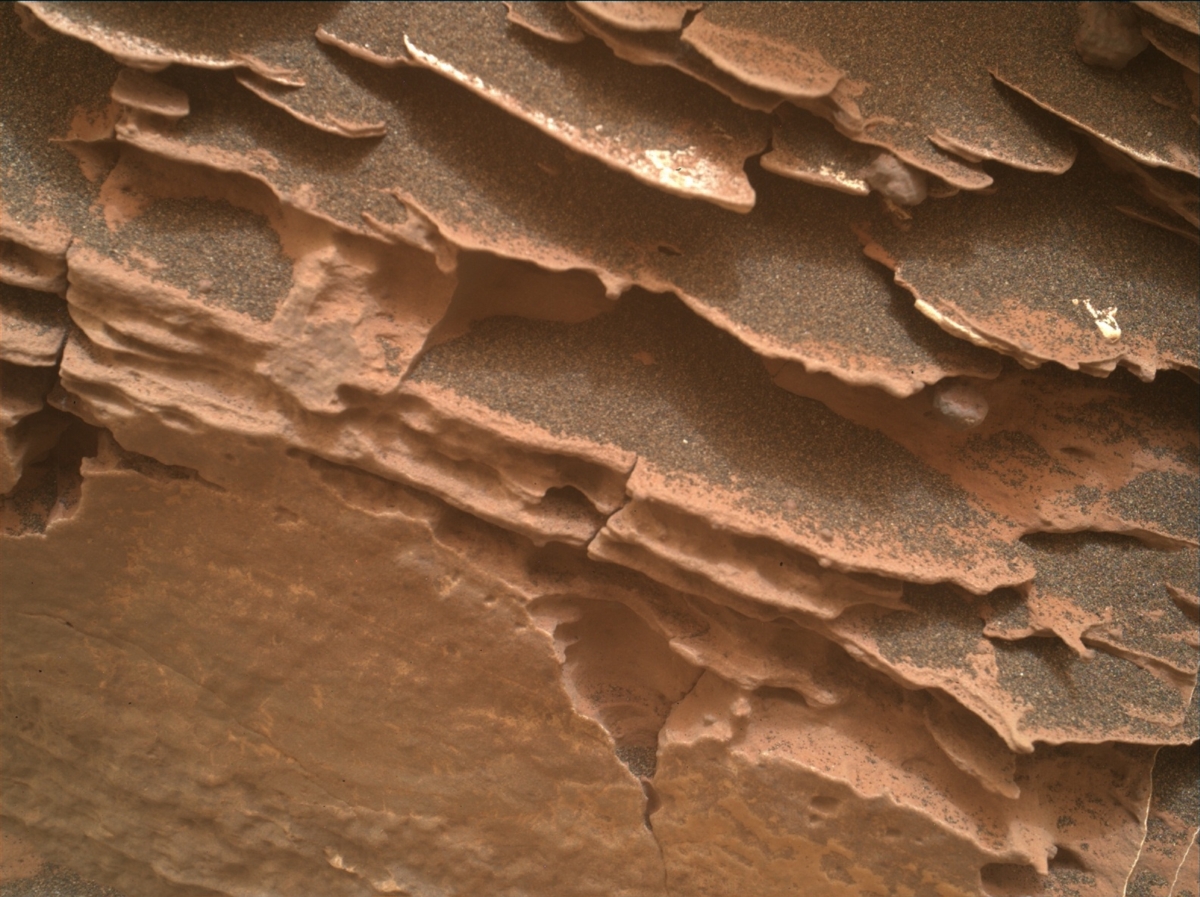
Curiosity Mars Hand Lens Imager (MAHLI) photo produced on Sol 2083, June 16, 2018.
Credit: NASA/JPL-Caltech/MSSS
“However, the rover won’t be driving very far due to the rough terrain, only around 13 meters [43 feet]. We’ll carry out the usual suite of imaging at this site following the drive to make sure we can acquire the needed data to support contact science in the next plan. In the coming months, Curiosity will end its stint on the Vera Rubin Ridge and continue up Mt. Sharp,” Edwards concludes.
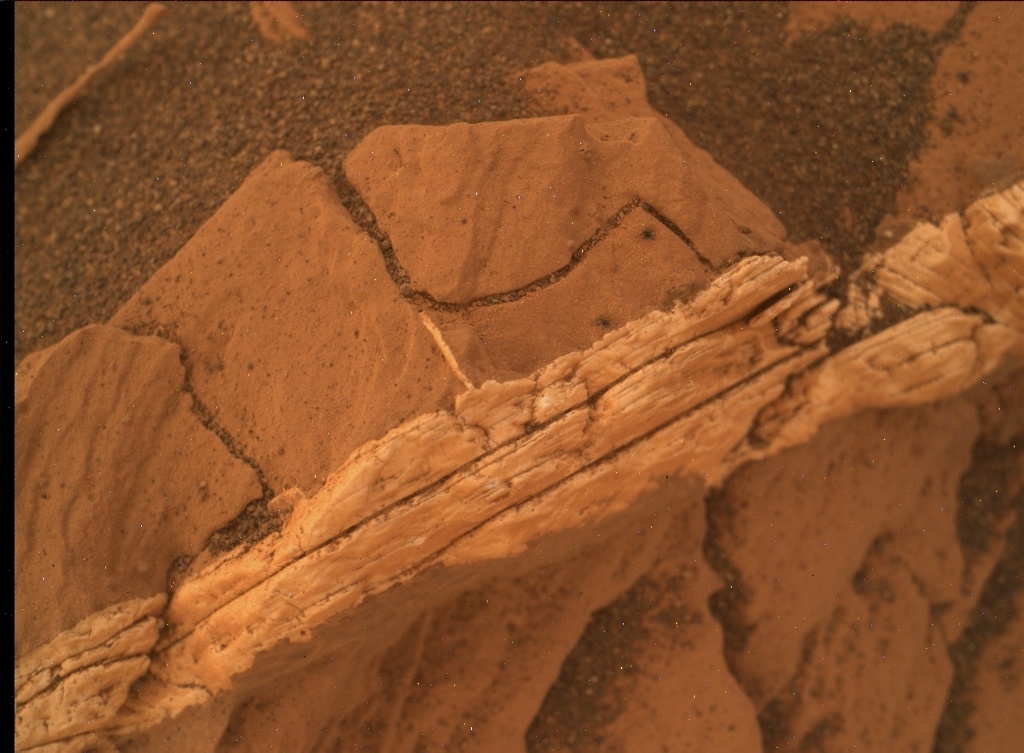
Curiosity Mars Hand Lens Imager (MAHLI) photo produced on Sol 2083, June 16, 2018.
Credit: NASA/JPL-Caltech/MSSS
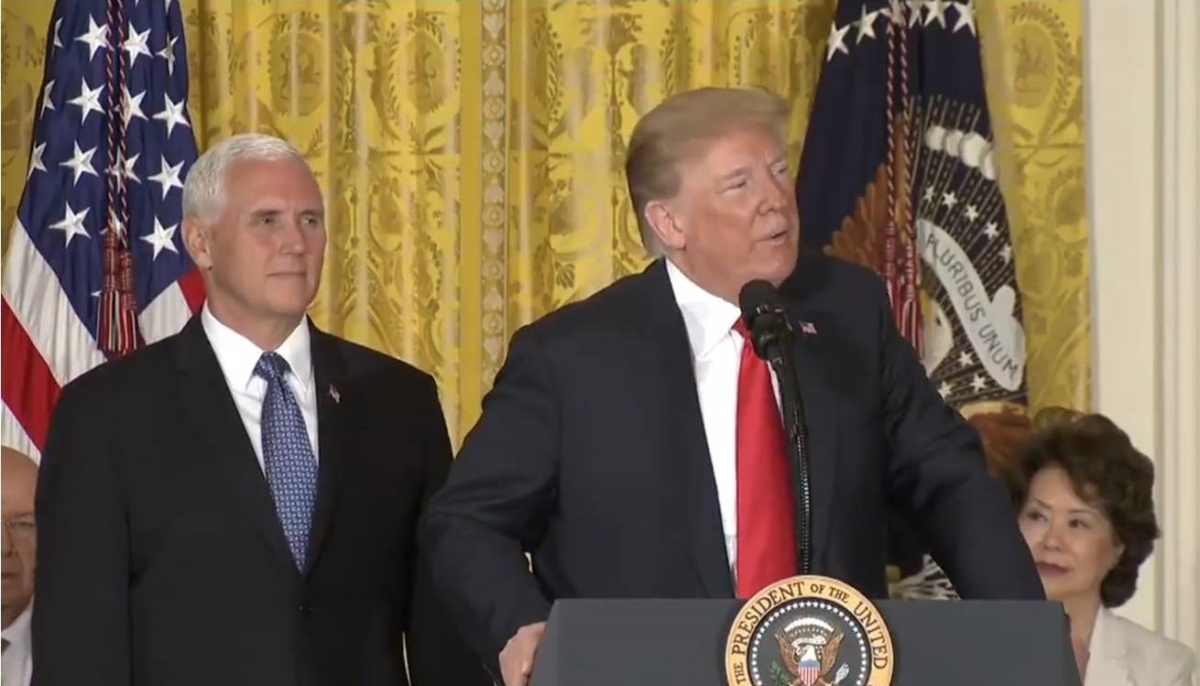
Credit: White House TV/Screengrab
In remarks today before the third meeting of the National Space Council, U.S. President Donald Trump called for “reclaiming America’s heritage as the world’s greatest space-faring nation,” the President said.
“The essence of the American character,” Trump added, “is to explore new horizons and to tame new frontiers. But our destiny, beyond the Earth, is not only a matter of national identity, but a matter of national security.”
In that regard, Trump directed the Department of Defense and Pentagon “to immediately begin the process necessary to establish a space force as the sixth branch of the armed forces. That’s a big statement,” Trump emphasized. “We are going to have the Air Force and we are going to have the Space Force — separate but equal.”
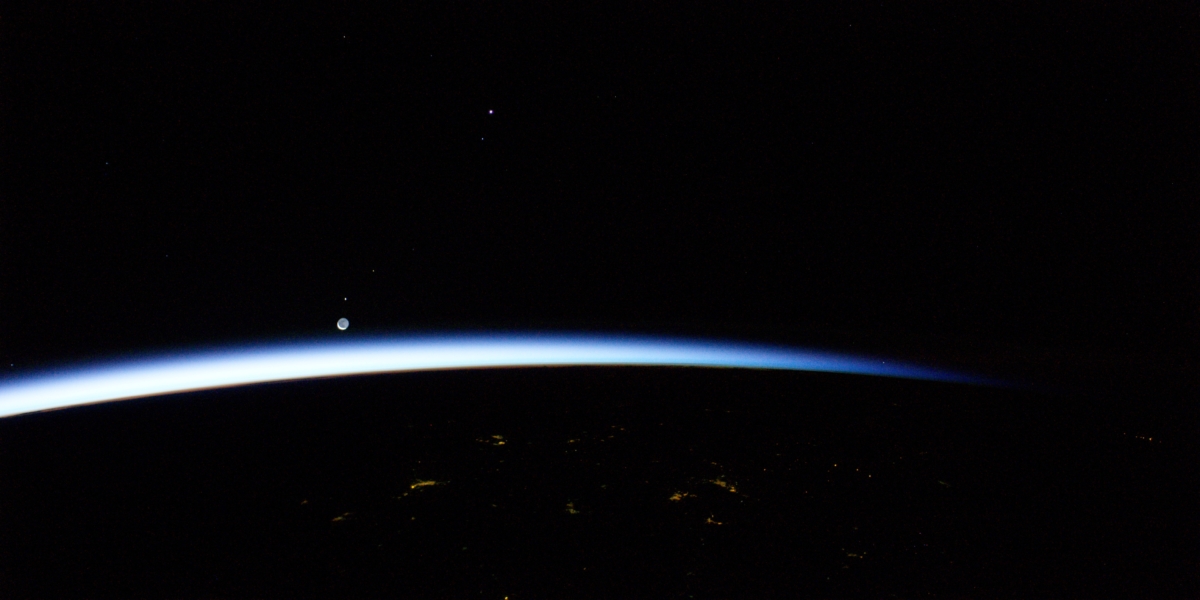
The Moon and Mars. as seen from the International Space Station.
Credit: NASA/ESA
Moon return
Regarding the President’s time table for returning humans to the Moon, Trump advised: “This time, we will do more than plant our flag and leave our footprints. We will establish a long-term presence, expand our economy, and build the foundation for the eventual mission to Mars — which is actually going to happen very quickly.”
Trump also said that when it comes to space, “too often, for too many years, our dreams of exploration and discovery were really squandered by politics and bureaucracy, and we knocked that out.

Earth orbit is a junkyard of human-made space clutter.
Credit: Space Junk 3D, LLC. Melrae Pictures
Dealing with debris
President Donald J. Trump signed Space Policy Directive – 3 today directing the United States to lead the management of traffic and mitigate the effects of debris in space.
Space Policy Directive – 3 provides guidelines and direction to ensure that the United States is a leader in providing a safe and secure environment as commercial and civil space traffic increases.
As space becomes increasingly contested, the demand for the Department of Defense to focus on protecting U.S. space assets and interests also increases.
At the same time, the rapid commercialization of space requires a traffic management framework that protects U.S. interests and considers the private sector’s needs.
The new Directive seeks to reduce the growing threat of orbital debris to the common interest of all nations.
Setting guidelines
The Directive articulates the policy of the United States to pursue and utilize both Government and commercial sector technologies to track and monitor space debris.
The Directive requires updates to the U.S. Orbital Debris Mitigation Standard Practices and new guidelines for satellite design and operation.
The new Directive sets guidelines for the United States to manage space traffic more effectively by spearheading new data sharing initiatives.
The United States should continue to provide basic space situational awareness data and basic space traffic management services free of direct user fees.
The Department of Commerce will make space safety data and services available to the public, while the Department of Defense maintains the authoritative catalogue of space objects.
The United States will maintain and expand its leadership in space by increasing its capabilities and developing standards and best practices.
This effort will:
Improve space situational awareness data standards and information sharing;
Leverage U.S. standards and best practices to shape international norms; and
Streamline processes and reduce regulatory burdens that inhibit commercial growth, enabling the U.S. commercial sector to lead the world in space.

U.S. President Donald Trump holds up the Space Policy Directive – 1 after signing it, directing NASA to return to the Moon, alongside members of the Senate, Congress, NASA, and commercial space companies in the Roosevelt room of the White House in Washington, Monday, Dec. 11, 2017.
Credit: NASA/Aubrey Gemignani
Space directives
The new Space Policy Directive builds on the President’s efforts to reinstate the United States leadership role in space.
On June 30, 2017, President Trump signed an Executive Order reviving the National Space Council for the first time in 24 years.
On December 11, 2017, the President signed Space Policy Directive – 1, instructing NASA to return United States astronauts to the Moon, followed by human missions to Mars.
On March 23, 2018, President Trump unveiled a National Space Strategy that laid out an approach to ensuring that the United States is strong and competitive in the space environment.
On May 24, 2018, the President signed Space Policy Directive – 2 to reform United States commercial space regulatory framework, seeking to ensure our place as a leader in space commerce.
Resources
For more information on today’s White House space happenings, go to:
Remarks by President Trump at a Meeting with the National Space Council and Signing of Space Policy Directive-3
Go to:
Opening Remarks by Vice President Pence at Meeting of the National Space Council
Go to:

Aarhus Wind Tunnel Simulator II at Aarhus University in Denmark.
(Left) The wind turbine positioned in the wind tunnel, which is 2 meters in diameter. (right) Close-up
of the wind turbine, with the wind tunnel fan visible in the background.
Credit: Credit: C. Holstein-Rathlou, P.E. Thomas, J. Merrison, J.J. Iversen
Experimental demonstration of a small, light-weight wind turbine under simulated current Martian atmospheric conditions has shown that wind power on Mars is feasible.
The experiments were conducted in the Aarhus Wind Tunnel Simulator II at Aarhus University in Denmark in the fall of 2010.
Follow-up findings stemming from the work are spotlighted by Christina Holstein-Rathlou at Boston University’s Center for Space Physics at the Mars Workshop on Amazonian and Present Day Climate being held this week in Lakewood, Colorado. The Planetary Science Institute is holding the event.

Credit: Planetary Science Institute
Realistic conditions
The objective of the wind turbine investigations was to see how much power is produced under realistic Martian atmospheric conditions. For future possible missions to the polar regions of Mars standard power sources will be unfit for the task, Holstein-Rathlou and colleagues note. Solar cells will have limited or no sunlight for roughly half the year and the heat expunged by multi-mission radioisotope thermoelectric generators, or similar devices, would be detrimental to any science performed in a polar region.
A different possible power source would be a wind turbine along with a battery for storing produced electricity, potentially in combination with solar cells.
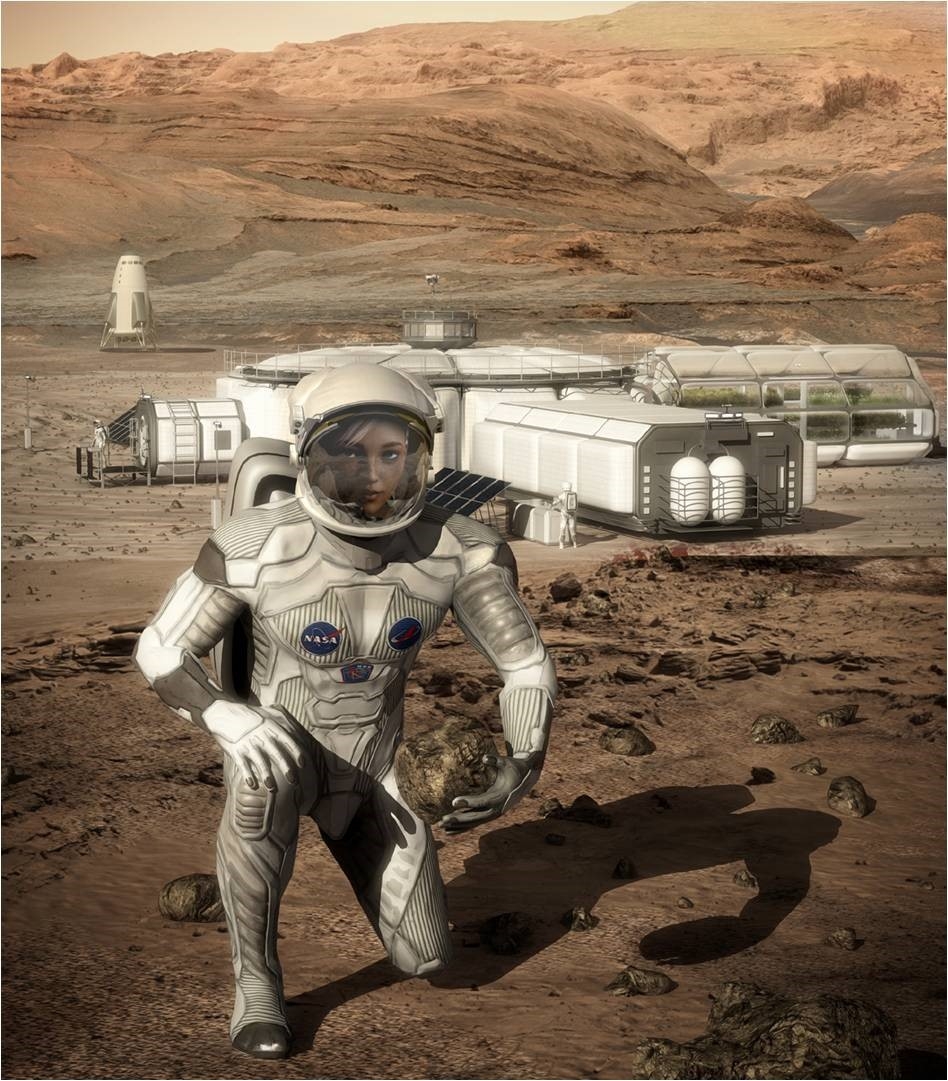
Credit: Bryan Versteeg
Wind speeds
The concept of a Martian wind turbine has been explored theoretically in connection with human missions to the Red Planet. Along the same lines, a 100 kilowatt wind turbine was designed and tested in Antarctica – a general Mars analog site — by researchers from NASA’s Ames Research Center in California.
However, these early concepts were large and heavy and would require substantial wind speeds to be functional. Also, these sizes and masses are unfeasible for the power supply for a science missions to Mars, which are generally much smaller and lightweight, Holstein-Rathlou and her colleagues report.
Typical wind speeds on Mars are in the roughly 2-10 meters per second range.
Output voltage
The wind tunnel experiment was run at 6 different wind speeds, selected based on the most common wind speeds at the May 2008 NASA Phoenix Mars landing site in the northern polar regions of Mars, the minimum wind speed needed to make the wind turbine rotate and the maximum wind speed the wings could withstand.

NASA Phoenix lander.
Credit: NASA/JPL
For each wind speed the output voltage was measured for 30-120 seconds.
“The optimal locations for this type of power production are areas where the Sun doesn’t always shine, but winds will blow, such as latitudes poleward of the polar circles,” the researchers explain.
Small lander
Prior to dispatching wind turbines to Mars, the research team adds there are a suite of studies still to be conducted. However, most designs, singular or part of a system, will be more efficient than this experiment, and thus should lead to power production in a range that is able to support some or all instrumentation on a small lander.
“For now, we can say for the first time and with certainty,” the team concludes, “that, yes, you can use wind power on Mars!”

Notional design of Lunar Orbital Platform-Gateway.
Credit: Lockheed Martin
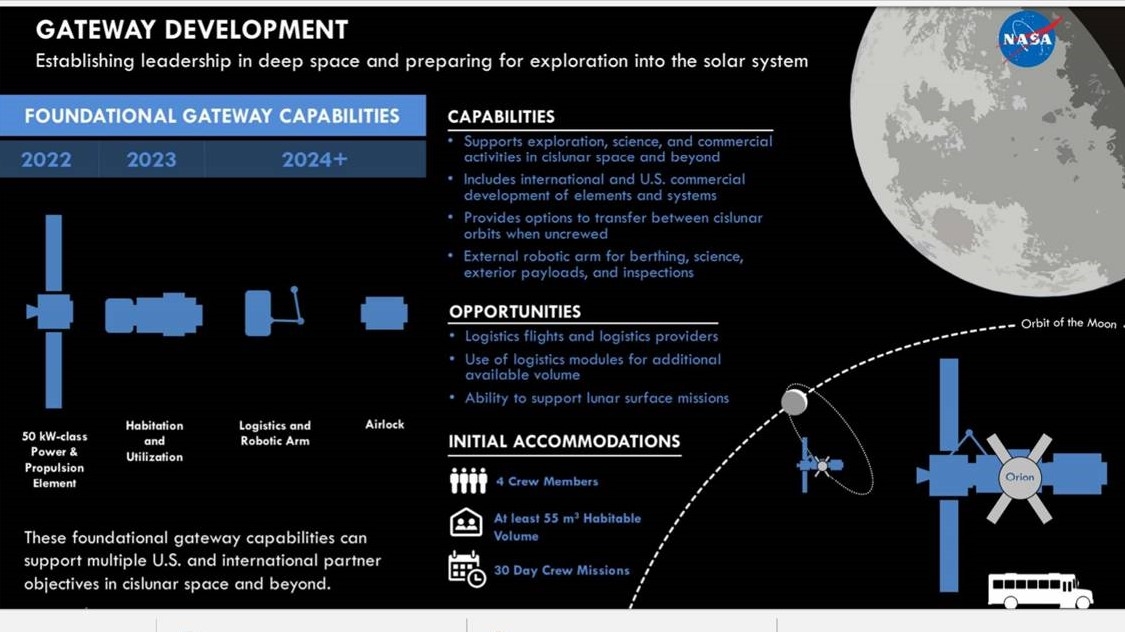
A European Space Agency (ESA) Council meeting held in Paris on June 13, 2018 has approved steps that could see Europe become a major player in the proposed “Lunar gateway” – a concept that extends the presence of humans one thousand times farther into space compared with today.

Concept of view from a deep space habitat.
Credit: ESA
The lunar gateway was one of a number of discussion points within a European Exploration Envelope Program known as E3P.
Balanced investment
The June Council meeting included shaping an exploration mission framework for the future of E3P. The framework foresees a balanced investment between ESA’s three exploration destinations — low Earth orbit, the Moon and Mars — and between human infrastructures, transportation and robotic missions.
According to an ESA statement: “The Council was informed that studies and technology developments are under way including enhancements of the European Service Module for NASA’s Orion spacecraft to support visiting astronauts as well as modules for the gateway itself.”
Credit: NASA
Call for ideas
ESA held a Call for Ideas for use of the gateway in 2017, generating 100 ideas from the European science and technology community in areas as diverse as human physiology, Solar System science and lunar exploration.
These preparations are prelude to possible decisions to be taken at the next ESA Ministerial Council in 2019.
NASA also held a three-day workshop from February 27-March 1, 2018 in Denver, Colorado that solicited ideas on use of the gateway to facilitate science duties and other tasks.
Credit: Kurt Hughes Sailing Designs.
Naval architect Kurt Hughes runs the Seattle-based company, Kurt Hughes Sailing Designs.
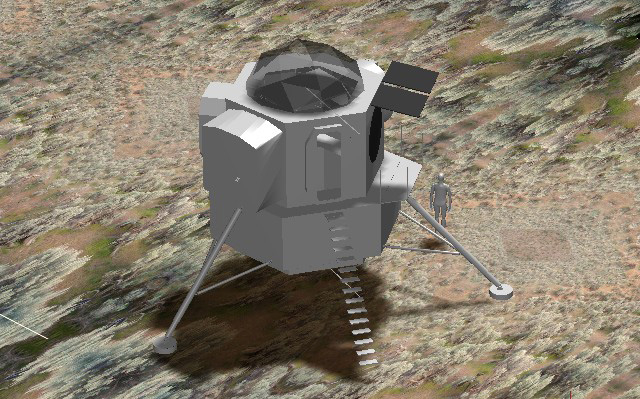
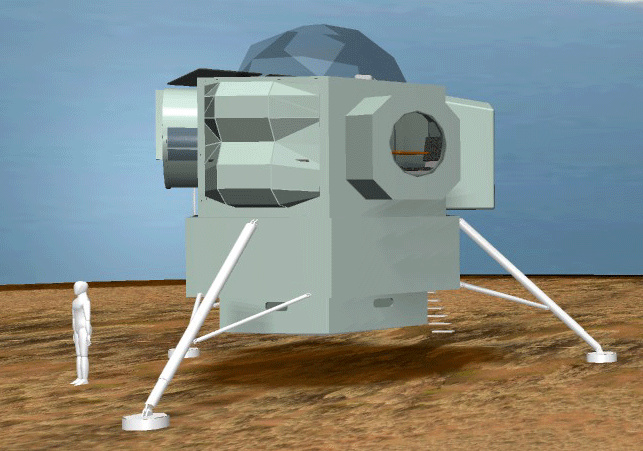
A recent mission Hughes has launched is to build a line of habitable, Apollo-era lunar landers providing creature comforts with low impact on the land and high amazement factor.
External modules
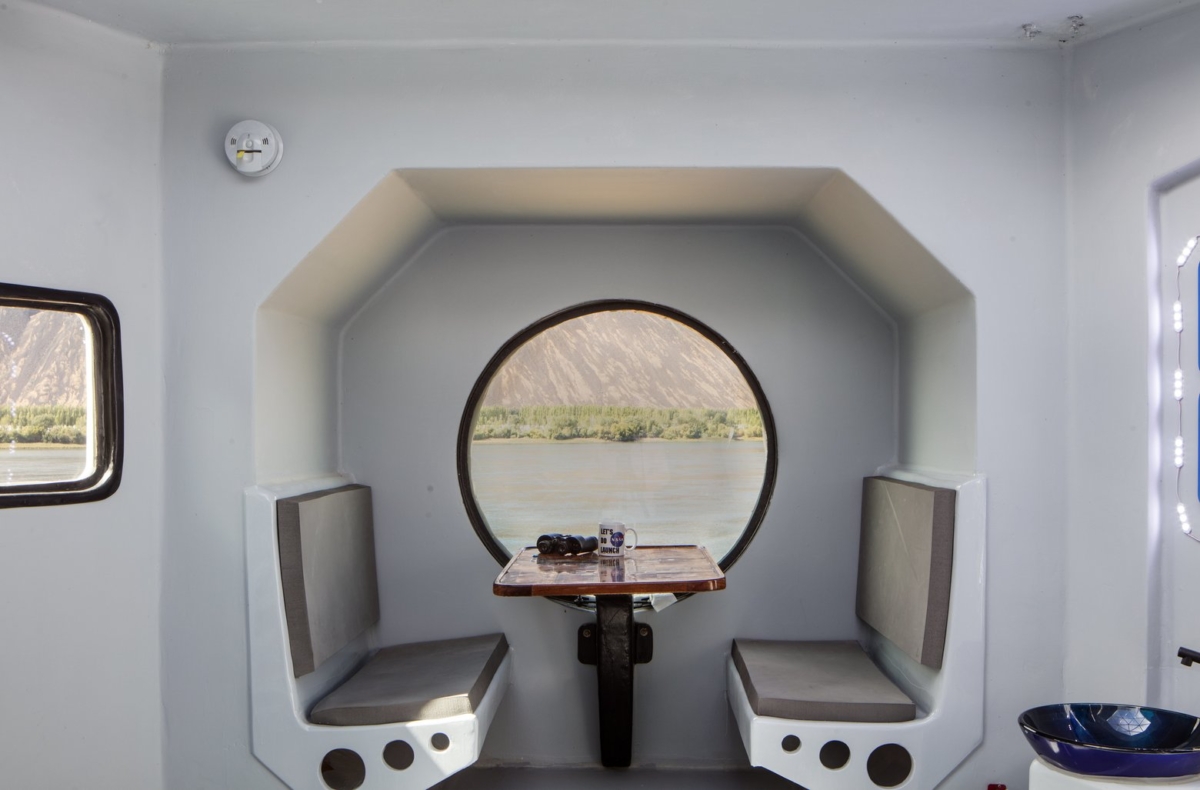
An inside visitor will find an open space, with external modules for bath, galley, breakfast nook and storage.
Credit: Steve Ringman/Seattle Times staff photographer.
On top is a clear geodesic dome with queen size berth under it. It is suspended by carbon fiber tensors so the light can stream in down all around the berth.
A foam/glass cover can be used to keep extreme heat or cold out of the dome.
Down inside is a soft lounging pit. On one side is an outside deck.
The systems are placed in the hexagon ring that the living space rests on.
Off-the-grid outposts
The Lunar Lander can rest comfortably on drastic, uneven terrain.
Credit: Kurt Hughes Sailing Designs
These off-the-grid outposts will use the latest marine technology to afford a strong, light, and easily maintained structure.
For more information, go to this article written by Sandy Deneau Dunham.
Also, check out this Business Insider story on this spacial housing project at:
http://www.businessinsider.com/lunar-lander-tiny-home-2018-6
Lastly, go to the section of the designer’s website at:
http://www.multihulldesigns.com/designs_other/sp_lunarlander.htm

