Archive for the ‘Space News’ Category
 Author:
  July 13th, 2018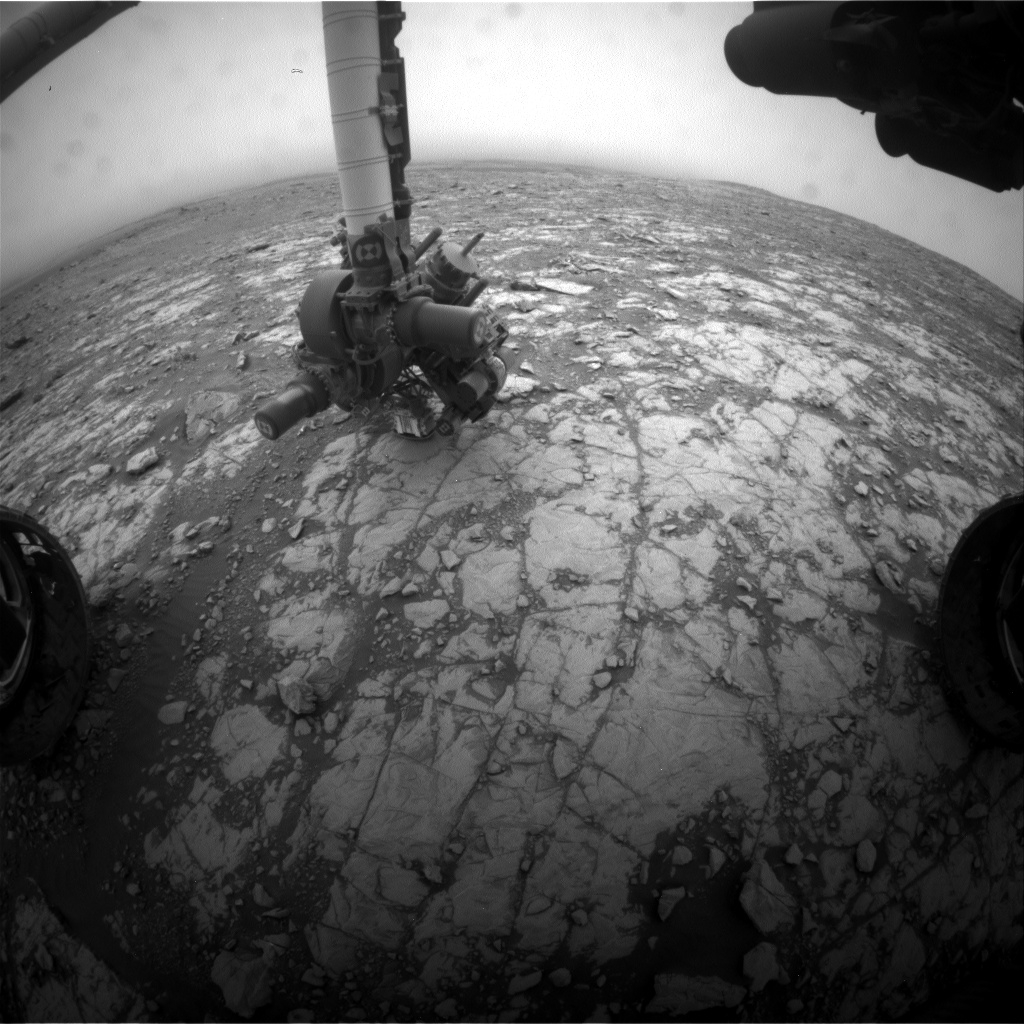
Curiosity Front Hazcam Right B photo acquired on Sol 2109, July 13, 2018.
Credit: NASA/JPL-Caltech
NASA’s Curiosity Mars rover is wrapping up Sol 2109 duties on Vera Rubin Ridge.
Abigail Fraeman, a planetary geologist at NASA/JPL in Pasadena, California, notes one of the most significant aspects of Vera Rubin Ridge is the signature of the mineral hematite (Fe2O3).
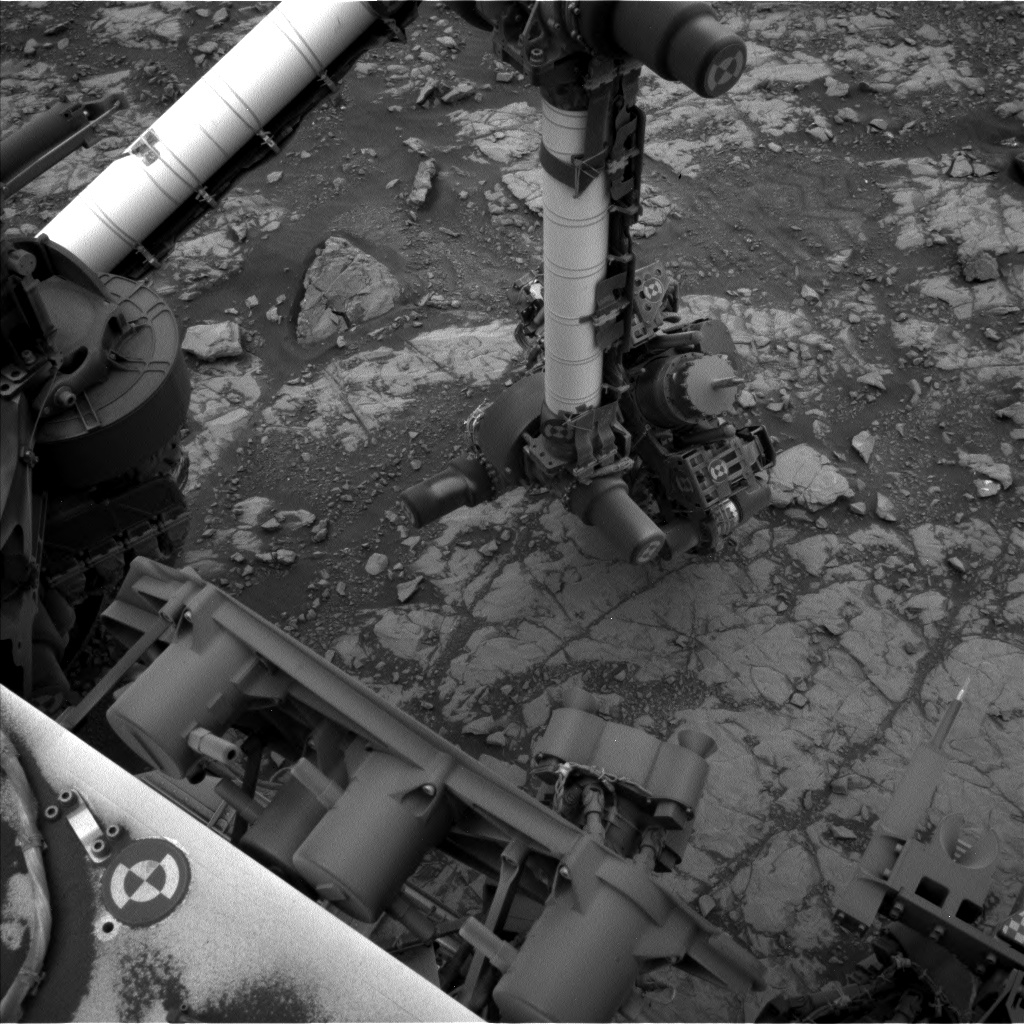
Curiosity Navcam Left B image taken on Sol 2109, July 13, 2018.
Credit: NASA/JPL-Caltech
Fraeman recalls that she and many collaborators spent the winter and spring of 2012 — the time between launch of Curiosity and its landing — working out the geological implications of this discovery as best as possible using orbital data.
Poised to drill
“Almost 2100 sols and countless exciting discoveries later, Curiosity is now poised to drill at the exact spot we first detected the strongest hematite signature over seven years ago,” Fraeman reports. “We’ve named the new drill target ‘Voyageurs’ after a National Park in northern Minnesota. I love this name because it reminds me we truly are a team of voyagers, participating in a mission of exploration and discovery.”
The data collected from this upcoming sample will help Mars researchers better understand the environments that shaped Mt. Sharp over time. On a personal level, it will allow Fraeman to test some of the hypotheses she first started to formulate as a graduate student back in 2012.
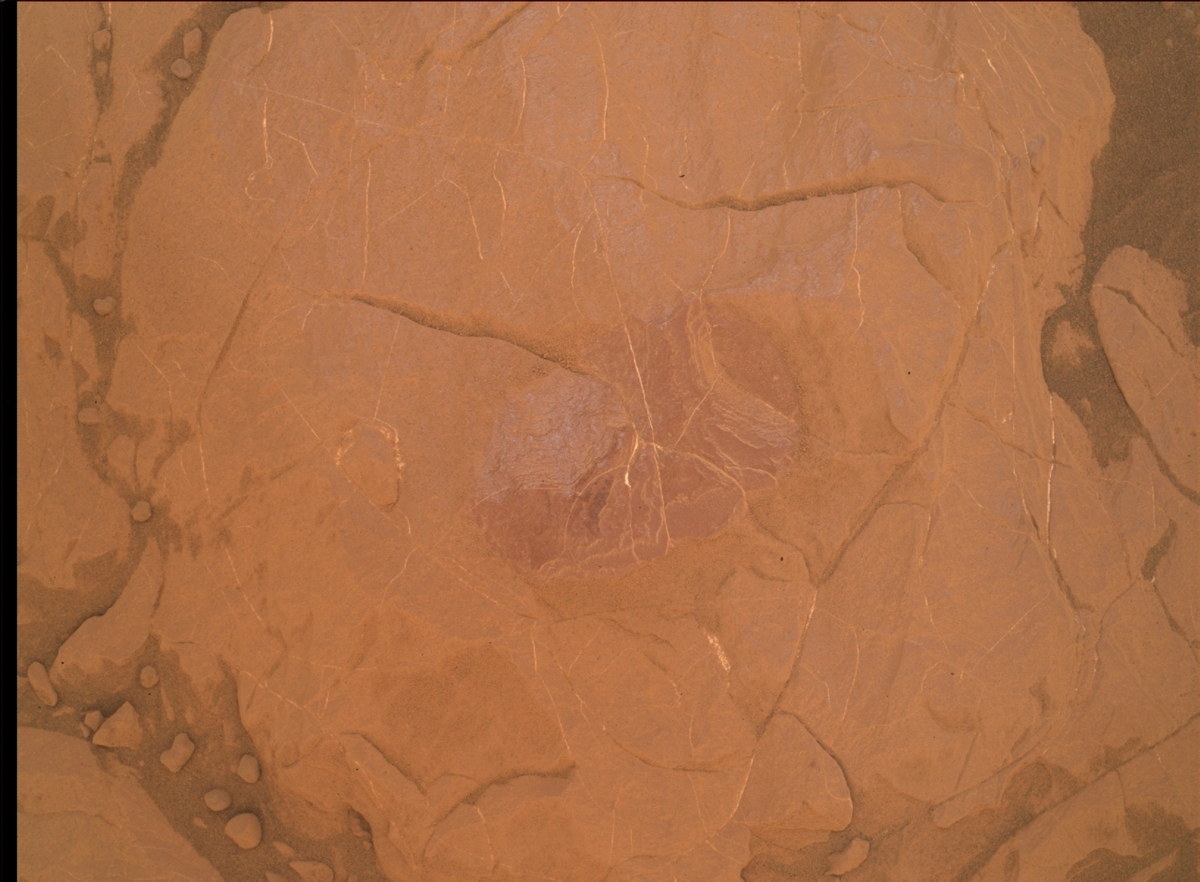
Curiosity Mars Hand Lens Imager (MAHLI) produced on Sol 2109, July 13, 2018.
Credit: NASA/JPL-Caltech/MSSS
Drilling campaign
Sol 2109 will be the first sol of our drilling campaign at Voyageurs – very close to the former target “Stranraer” that the rover examined back around sol 2004.
The main focus of the current plan will be contact science of the site, including use of Curiosity’s Dust Removal Tool, its Mars Hand Lens Imager (MAHLI), and observations by the Alpha Particle X-Ray Spectrometer (APXS).
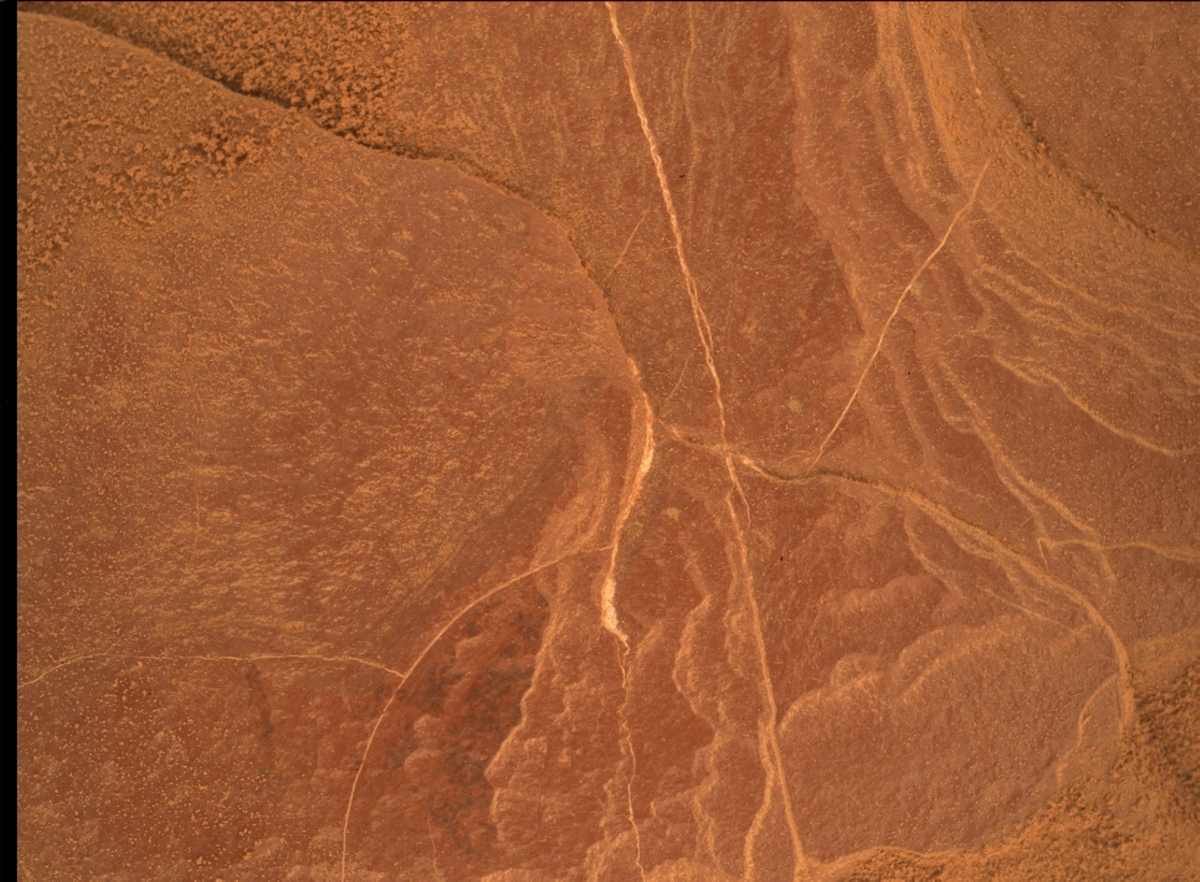
Curiosity Mars Hand Lens Imager (MAHLI) produced on Sol 2109, July 13, 2018.
Credit: NASA/JPL-Caltech/MSSS
Also on tap is taking a Mastcam documentation of a recent Autonomous Exploration for Gathering Increased Science (AEGIS) target and do some Chemistry and Camera (ChemCam) calibration activities.
“As always, we will continue to take environmental science observations to monitor the ongoing dust storm,” Fraeman concludes. “As you can imagine, I am quite anxious and excited to see what we find!”
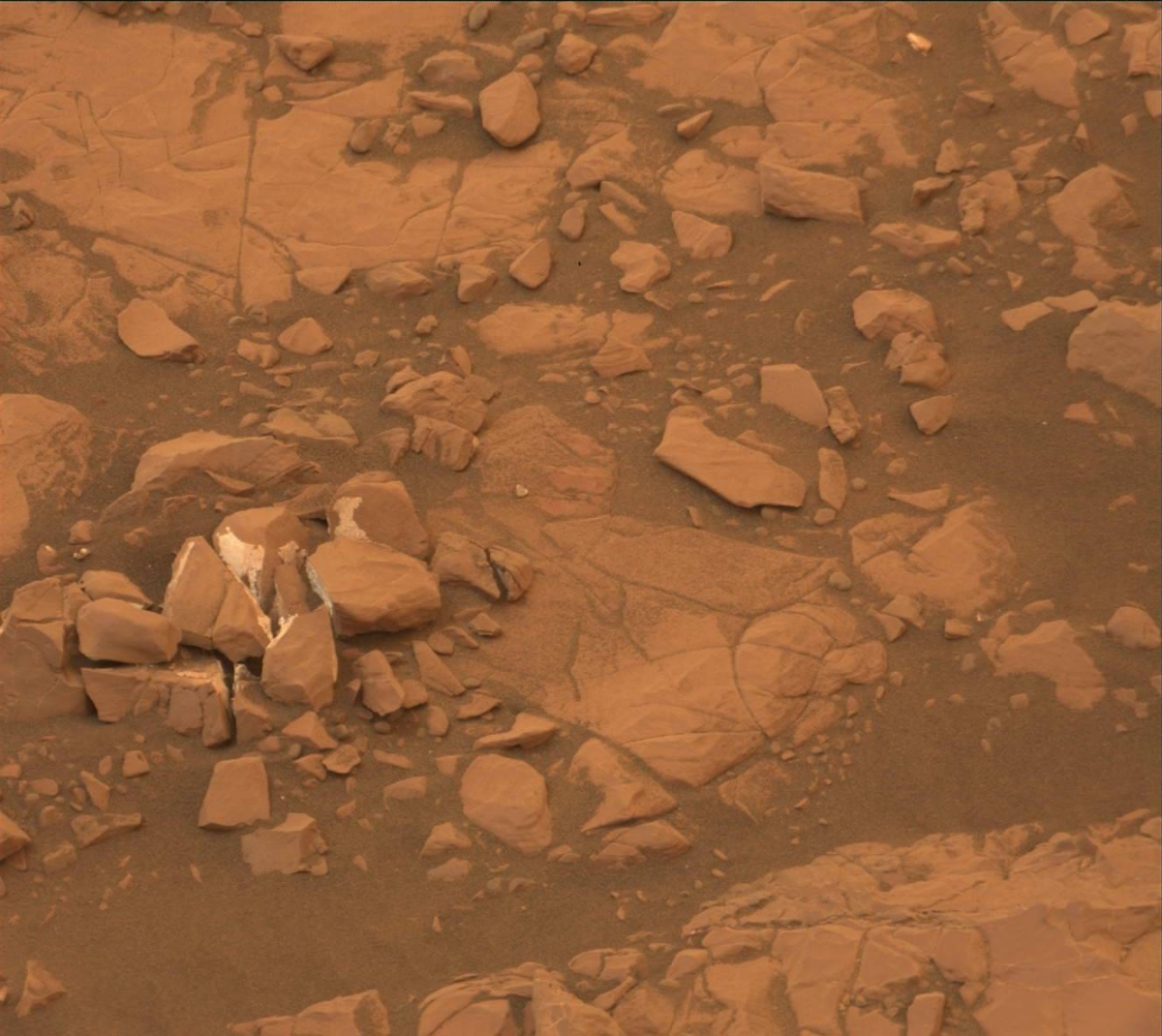
Curiosity Mastcam Right image taken on Sol 2108, July 12, 2018.
Credit: NASA/JPL-Caltech/MSSS
 Posted in
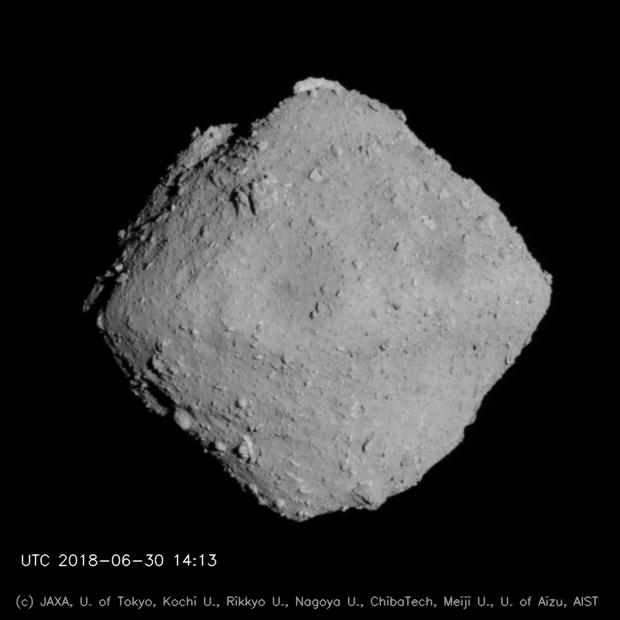
Credit: JAXA, University of Tokyo & collaborators
The Japanese space probe Hayabusa2 is in “home position” at 12 miles (20 kilometers) away from asteroid Ryugu.
Hayabusa2 has been confirming instrument operations in preparation for future observations. New images have shown the results of part of this rehearsal observation, notes the Japan Aerospace and Exploration Agency (JAXA).
As the asteroid has rotated, Hayabusa2 imagery almost reveals back-to-back sides of the object.
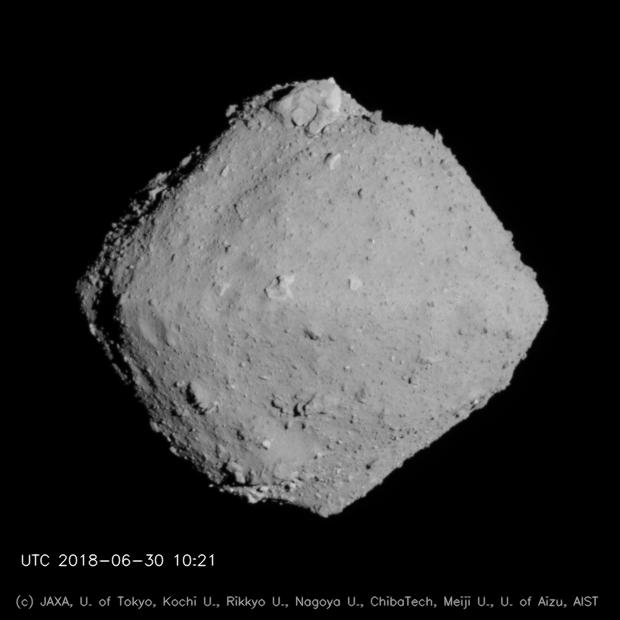
Credit: JAXA, University of Tokyo & collaborators
Surface scout
Meanwhile, first signals have been received from the Mobile Asteroid Surface Scout (MASCOT), an asteroid lander soon to be deployed onto the space rock. The team at the German Aerospace Center (Deutsches Zentrum für Luft- und Raumfahrt; DLR) MASCOT Control Center in Cologne received the first signals from the German-French asteroid lander.
“Now begins the period of intensive landing preparations, because we can only intervene to a limited extent during the landing,” says MASCOT Ground Segment and Operations Manager Christian Krause from the DLR Microgravity User Support Center.
Landing sequences
Since the launch of Hayabusa2 on December 3, 2014, the researchers have, together with JAXA, been working through and refining the landing sequences and instrument calibrations with a ground model. For the most part, they have had to work without much information about the asteroid and make broad assumptions about the surface conditions and reflectivity which they can now adapt and refine, explains a DLR press statement. MASCOT is targeted for an October deployment.
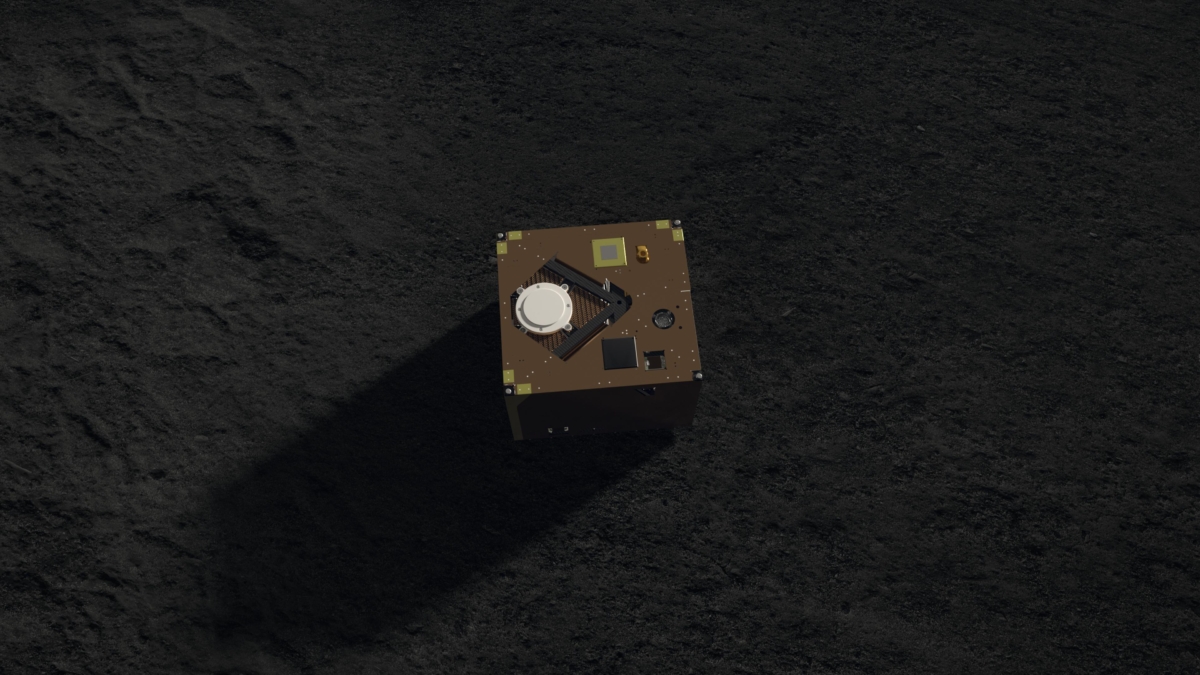
Artwork shows MASCOT jumper on asteroid’s surface.
Credit: German Aerospace Center (Deutsches Zentrum für Luft- und Raumfahrt; DLR)
Four instruments are installed inside the 30 × 30 × 20 centimeter lander. It weighs only 22 pounds (10 kilograms).
Jumping maneuvers
The mineralogical and geological composition of the asteroid surface will be investigated and the surface temperature and magnetic field of the asteroid determined by means of a radiometer and a camera from DLR, a spectrometer from the Institut d’Astrophysique Spatiale and a magnetometer from TU Braunschweig.
MASCOT will receive the necessary kinetic energy for its “jumping” maneuvers on the asteroid’s surface via a built-in swing arm. Programmed “jumps” of up to 230 feet (70 meters) are slated in order to perform measurements at various points on the asteroid’s surface.
The ambitious Hayabussa2 project involves 18 months of asteroid study, including touch-and-go landings to snag samples of the object for return to Earth.
For more information on this impressive and record-setting mission, go to:
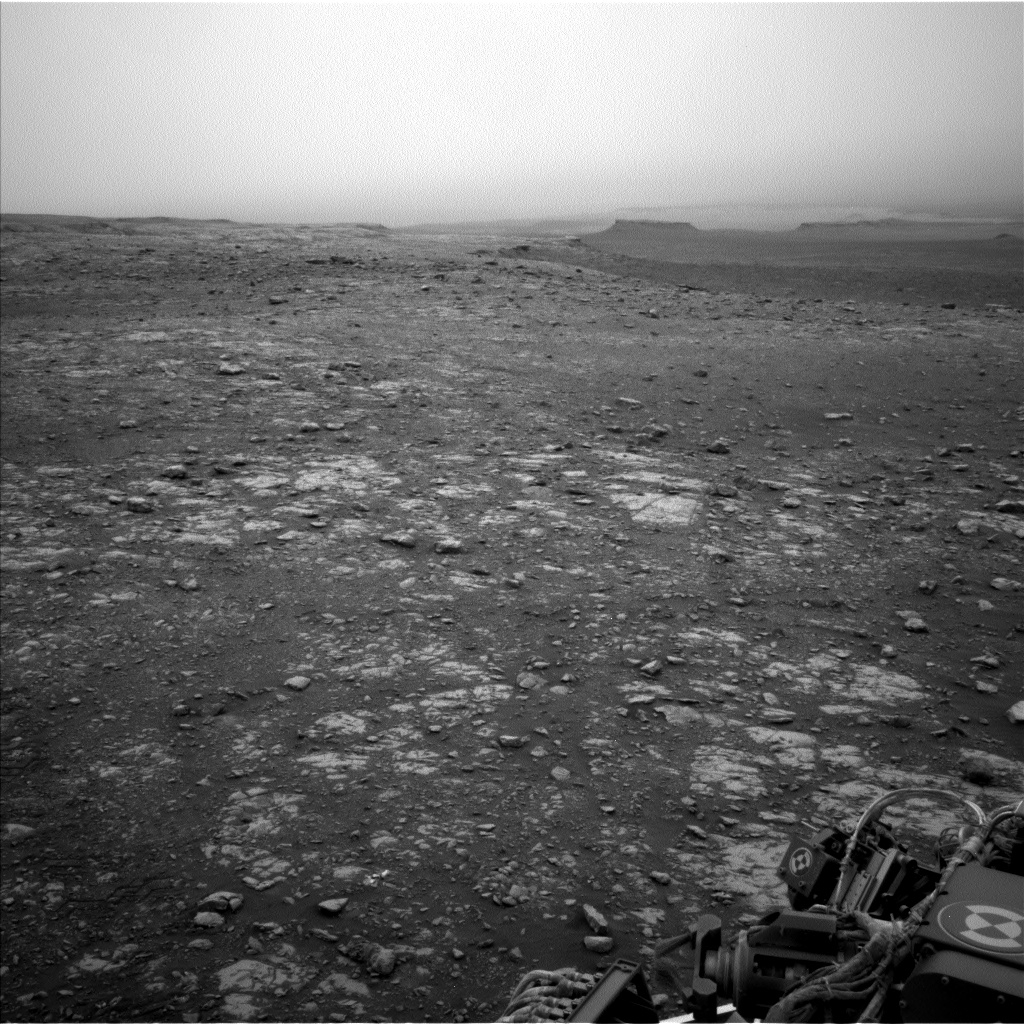
Curiosity Navcam Left B image acquired on Sol 2107, July 11, 2018.
Credit: NASA/JPL-Caltech
Now in Sol 2108, NASA’s Curiosity rover is headed for another drill session on the Red Planet.
“After being out of commission for over a year, Curiosity’s drill is making not just a comeback, but a strong one, with imminent plans for a second drill hole within the span of 60 sols,” reports Roger Wiens, a geochemist at Los Alamos National Laboratory in New Mexico.
Rapid turn-around
The rover is heading back to a place it visited on Sol 2005, looking to drill near target Stranraer.
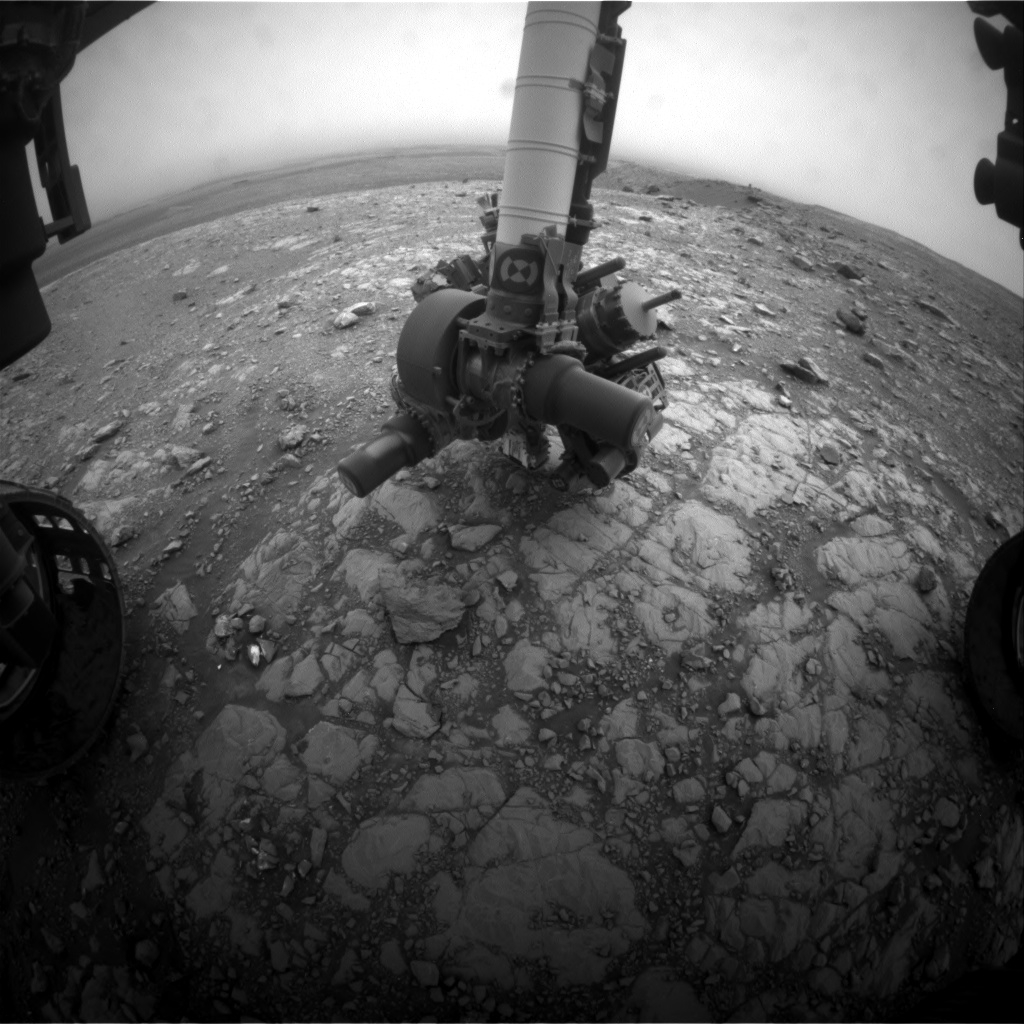
Curiosity Front Hazcam Left B image taken on Sol 2107, July 10, 2018.
Credit: NASA/JPL-Caltech
Wiens explains that Curiosity has been climbing back up Vera Rubin Ridge from drill target Duluth, which was drilled on Sol 2057 at the base of the ridge.
“If the rover succeeds with another drill target within the next few sols, it will be quite a rapid turn-around. Previous instances when drill holes were made within rapid succession include the combination of Mojave and Telegraph Peak (sols 882 and 908) at Pahrump; the trio of Lubango, Okoruso, and Oudam on Naukluft Plateau between sols 1320 and 1361; and Quela and Sebina between sols 1464 and 1495,” Wiens points out.
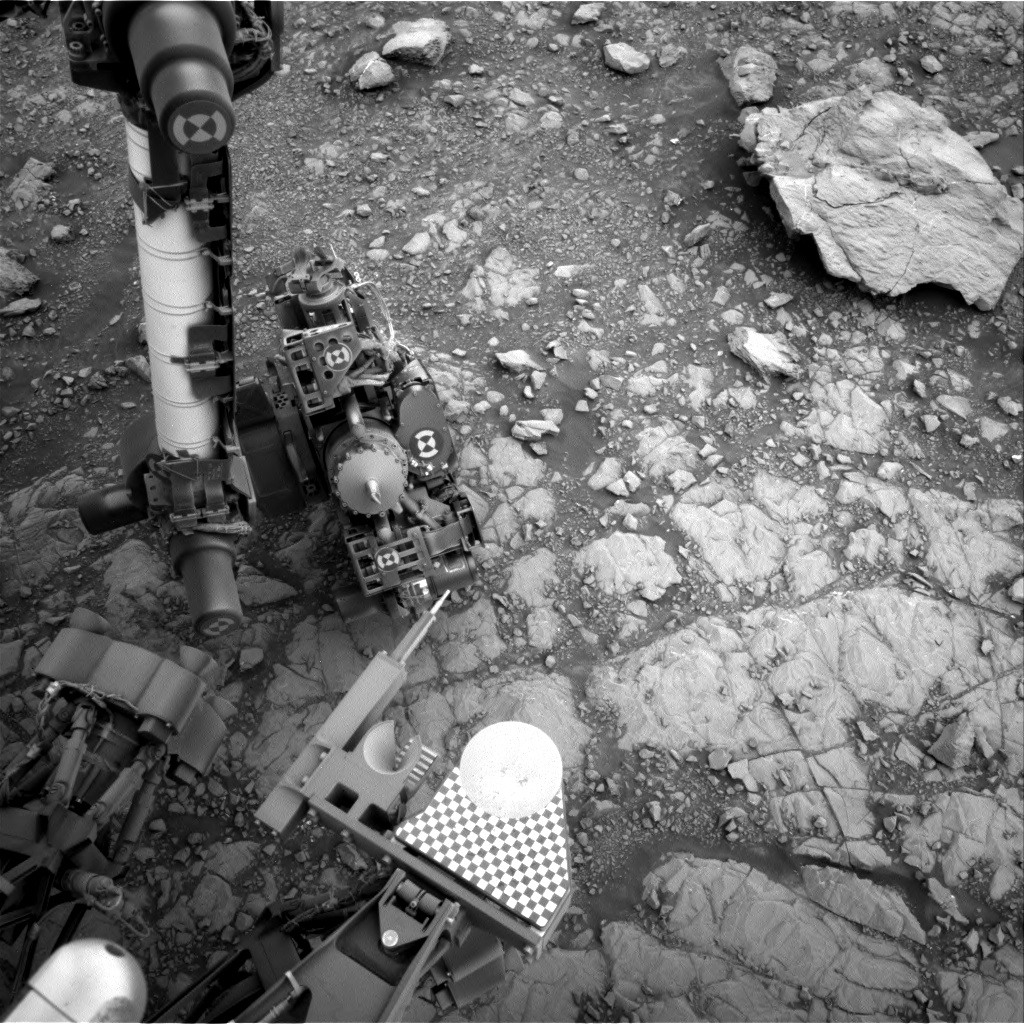
Curiosity Navcam Right B photo taken on Sol 2107, July 10, 2018.
Credit: NASA/JPL-Caltech
Other targets
Curiosity still has about 20 feet (six meters) to go to the area around Stranraer, so a short spurt of a drive is on tap.
The robot’s Chemistry and Camera (ChemCam) are set to analyze targets “Fort Francis and “Icarus Lake.”
The rover’s Alpha Particle X-Ray Spectrometer (APXS) and Mars Hand Lens Imager (MAHLI) are slated to analyze a dark rock named “Orr.”
Crater rim viewing
After the drive, Navcam will take images of the region in front of the rover, and the onboard computer will select a new target for ChemCam to shoot.
Mastcam will take an image for the clast survey, and will check the sky conditions with a tau measurement and a view out to the crater rim (if it shows up through the dusty air).
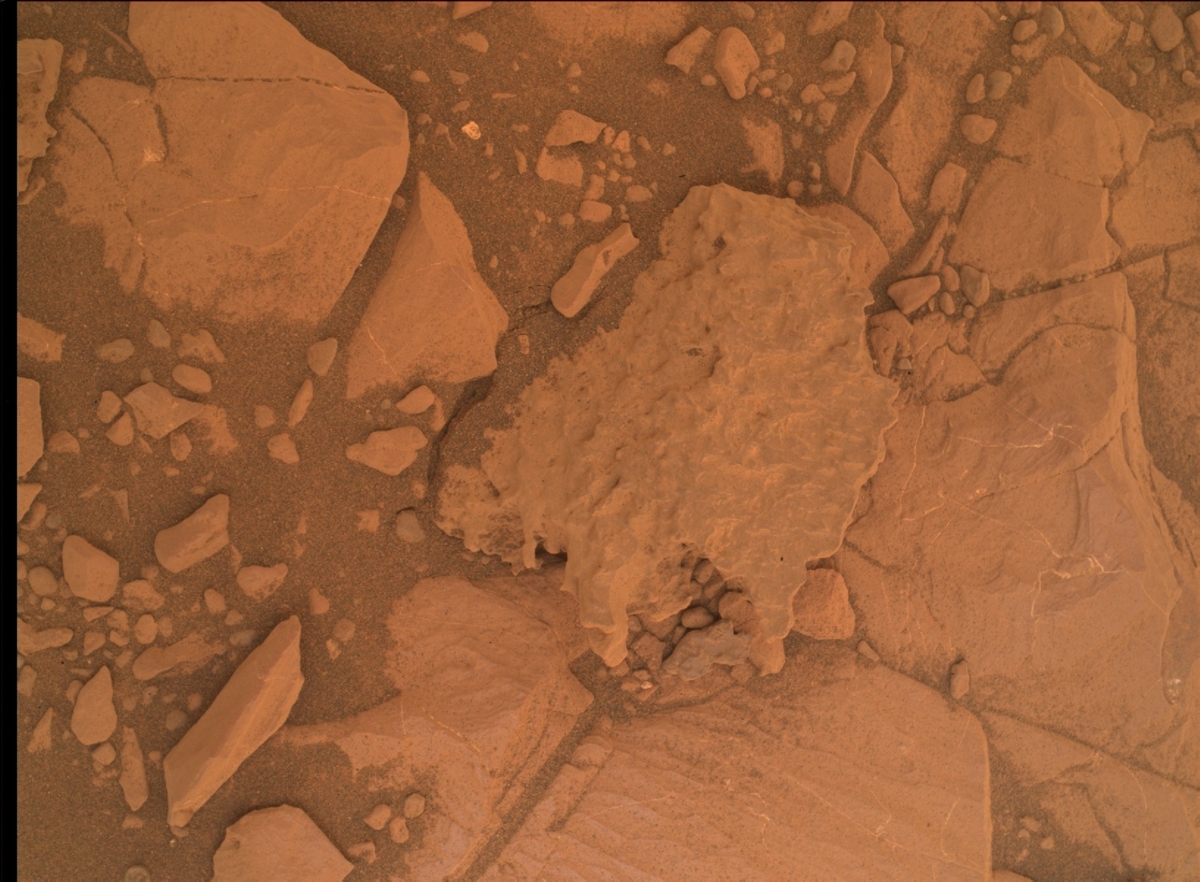
Curiosity Mars Hand Lens Imager (MAHLI) photo produced on Sol 2107, July 10, 2018.
Credit: NASA/JPL-Caltech/MSSS
Curiosity’s Radiation Assessment Detector (RAD), Rover Environmental Monitoring Station (REMS), and the Dynamic Albedo of Neutrons (DAN) are scheduled to get data, including a DAN Active measurement, and the rover’s Mars Descent Imager (MARDI) is set to take an image of the ground beneath the rover, Wiens concludes.

Credit: Blue Origin

Rocketeer Jeff Bezos and his commercial rocket firm, Blue Origin.
Credit: Blue Origin
Thanks to the first commercial tweet from space, New Mexcio-based Solstar is taking a next step in building infrastructure for the Internet of Things (IOT) in space.
On April 29th, Solstar demonstrated the first commercial internet and Wi-Fi service in space, funded entirely by private investment. The Solstar payload flew on Blue Origin’s eighth test flight of the New Shepard rocket from Blue’s West Texas launch site.
“Solstar is choosing to crowdfund this stage of its development to open up this opportunity to as many people as possible, democratizing access to space by allowing everyone to choose to take a stake in their own future,” explains Solstar Founder and CEO, M. Brian Barnett.
According to a company press statement, Solstar will be conducting a second test of its patent-pending technology on board another New Shepard flight in the future.
For more information, go to:
https://wefunder.com/solstar.space.company
On April 29th, 2018, Solstar demonstrated the first ever commercial WiFi service in space. Go to this video at:
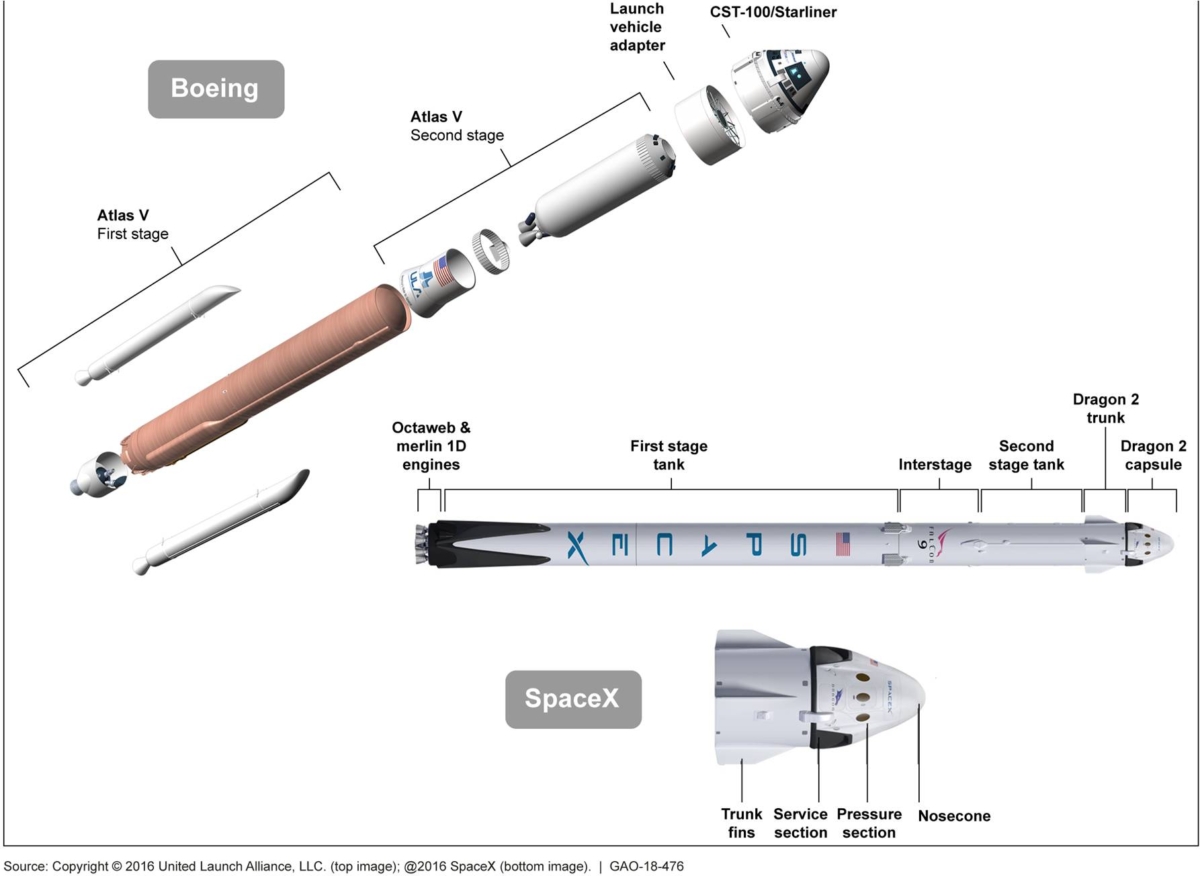
The United States Government Accountability Office (GAO) issued today an assessment of NASA’s Commercial Crew Program.
NASA has contracted with two companies — Boeing and SpaceX — to develop vehicles to transport astronauts to the International Space Station. Neither is expected to be ready until 2019.
Before any missions happen, the GAO reports, NASA will have to certify that both contractors’ vehicles are safe for human spaceflight.
Loss of crew metric
One way that NASA will assess safety is the loss of crew metric, which captures the probability of a crew member’s death or disability.
However, NASA doesn’t have a consistent approach for calculating this metric, so results can vary based on who within NASA is conducting the analysis.
The GAO has recommended that NASA clarify how it will assess loss of crew.
A one-page Highlights Page of this report is available at:
https://www.gao.gov/assets/700/693036.pdf
For the July 2018 full report — NASA COMMERCIAL CREW PROGRAM: Plan Needed to Ensure Uninterrupted Access to the International Space Station – go to:
Credit: Rocket Lab
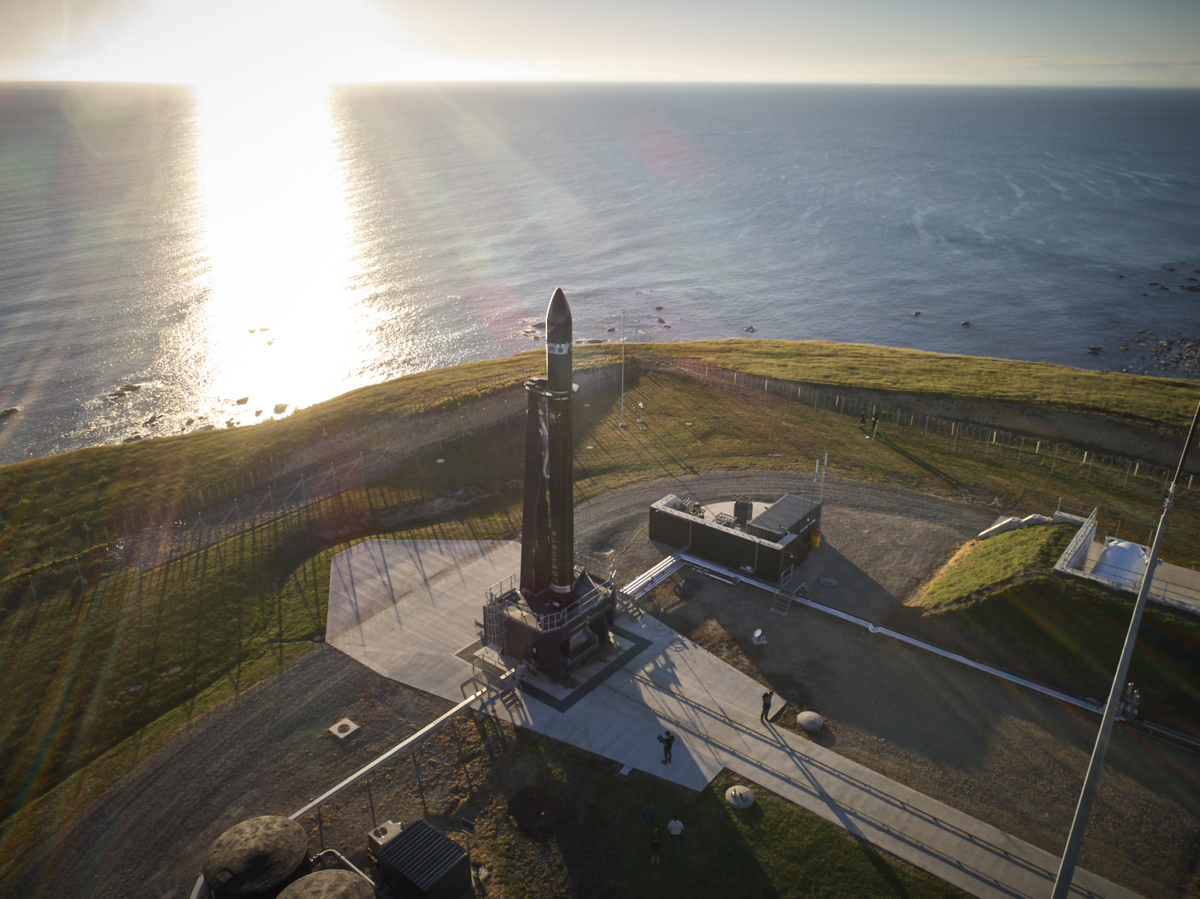
Rocket Lab has confirmed plans to expand its launch capability by developing a U.S. launch site – Launch Complex 2.
Four U.S. space ports are under review to launch the group’s Electron rocket.
— Cape Canaveral
— Wallops Flight Facility
— Pacific Spaceport Complex – Alaska
— Vandenberg Air Force Base
A decision on the confirmed site is expected to be made in August.
Simple, seamless
“We believe the launch process should be simple, seamless and tailored to our customers’ missions – from idea to orbit. Every aspect of the Electron orbital launch program is designed with this in mind and Launch Complex 2 is the next step in this strategy,” said Rocket Lab founder and chief executive Peter Beck in a company press statement.
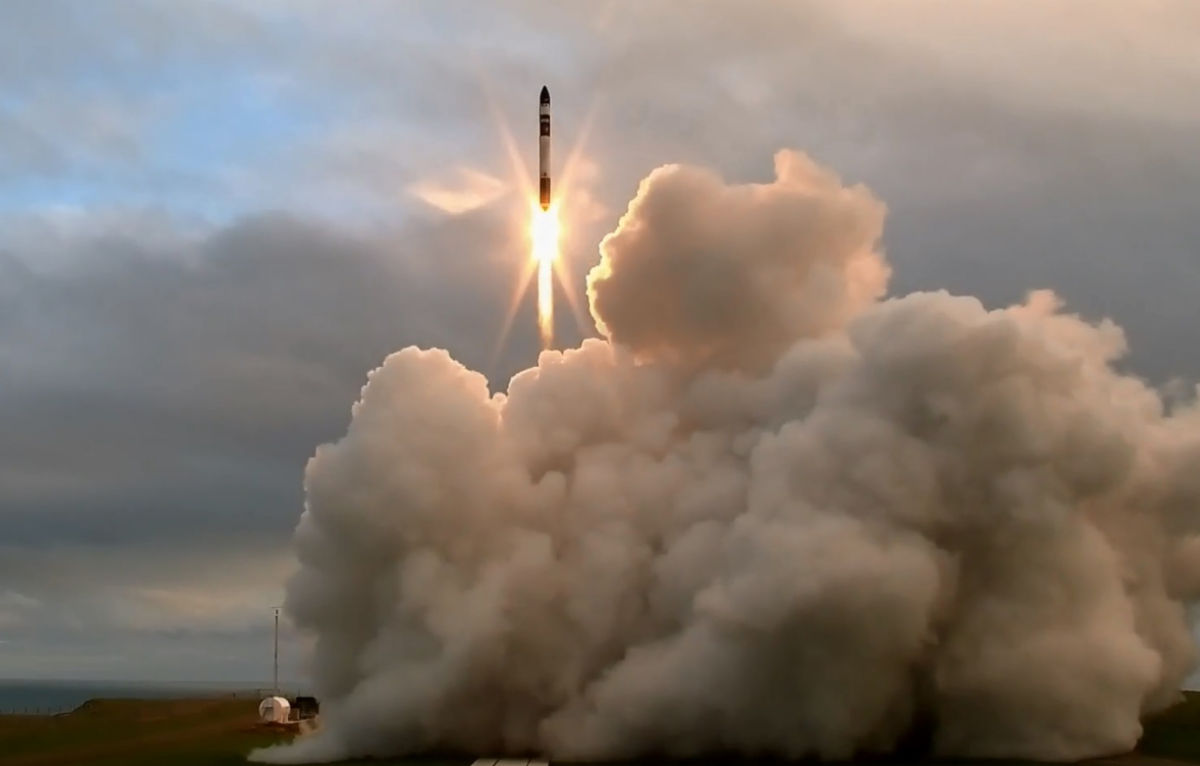
Putting some zeal into New Zealand – Rocket Lab’s Electron booster lifts off on maiden flight.
Credit: Rocket Lab
Rocket Lab is considering East and West coast options to explore a wide range of inclinations matched against current and anticipated manifest demand.
Pad infrastructure
Launch Complex 2 will be designed to support monthly orbital launches. Once the final site is confirmed, construction will begin immediately, with the first mission from Launch Complex 2 slated for second quarter of 2019. Rocket Lab will construct its own pad infrastructure tailored to the Electron launch vehicle.
Credit: Rocket Lab
Rocket Lab’s Launch Complex 1 is situated on the Māhia Peninsula in New Zealand. Launch Complex 1 is licensed to launch up to every 72 hours.
Track record
The first Electron flight took place on May 25, 2017 but failed to reach orbit.
An Electron booster successfully lofted small satellites into orbit on January 21, 2018 local time. An attempt by Rocket Lab to launch its first commercial flight of five small satellites has been repeatedly delayed due to technical issues. No upcoming launch date has been issued by the group.
Rocket Lab is an American aerospace manufacturer with a wholly owned New Zealand subsidiary.

The Israeli lunar spacecraft weighs only 1,322 pounds, or 600 kilograms.
Credit: Eliran Avital
The nonprofit SpaceIL and Israel Aerospace Industries (IAI) announced today that a robotic lunar landing mission is slated to launch from Cape Canaveral, Florida this December.
If all goes as planned, the craft would attempt a touchdown on the Moon on February 13, 2019.
A final launch date will be announced closer to the event, according to a press statement.
Secondary payload
Following eight years of collaboration between SpaceIL and IAI, the lunar landing would make Israel the fourth country after Russia, the United States and China to reach the Moon.

Lunar lander is 1.5 meters, or over 4.9 feet high, 2 meters or 6 and a half feet in diameter, and the fuel it will carry will comprise some 75 percent of its total weight.
Credit: SpaceIL
The spacecraft will be launched as a secondary payload on a SpaceX Falcon 9 rocket from Cape Canaveral, Florida, and its journey to the Moon will take roughly two months.
The Israeli lunar spacecraft will be the smallest to land on the Moon, weighing only 1,322 pounds, or 600 kilograms.
The journey
Following launch, the moonbound craft will begin orbiting Earth in elliptical orbits. Upon receipt of a command from the control room, the spacecraft will enter a higher altitude elliptical orbit around Earth, which will reach a point near the Moon.
At this point, the lander will ignite its engines to enter a phase of orbiting the Moon prior to attempting a lunar landing. This process will be executed autonomously by the spacecraft’s navigation control system.
The entire journey, from launch to landing, will last approximately two months.

The nonprofit SpaceIL and Israel Aerospace Industries (IAI) announced today that a robotic lunar landing mission is slated to launch from Cape Canaveral, Florida this December.
Credit: SpaceIL
Continuing the mission
SpaceIL was the only Israeli contestant in the international Google Lunar XPRIZE competition. That competition ended officially with no winner on March 31, with Google announcing that it would no longer sponsor the competition.
SpaceIL is continuing with its mission to the Moon despite the contest’s expiration without a winner.
Approximately $88 million has been invested in the spacecraft’s development and construction, mostly from private donors.
For more information, visit:
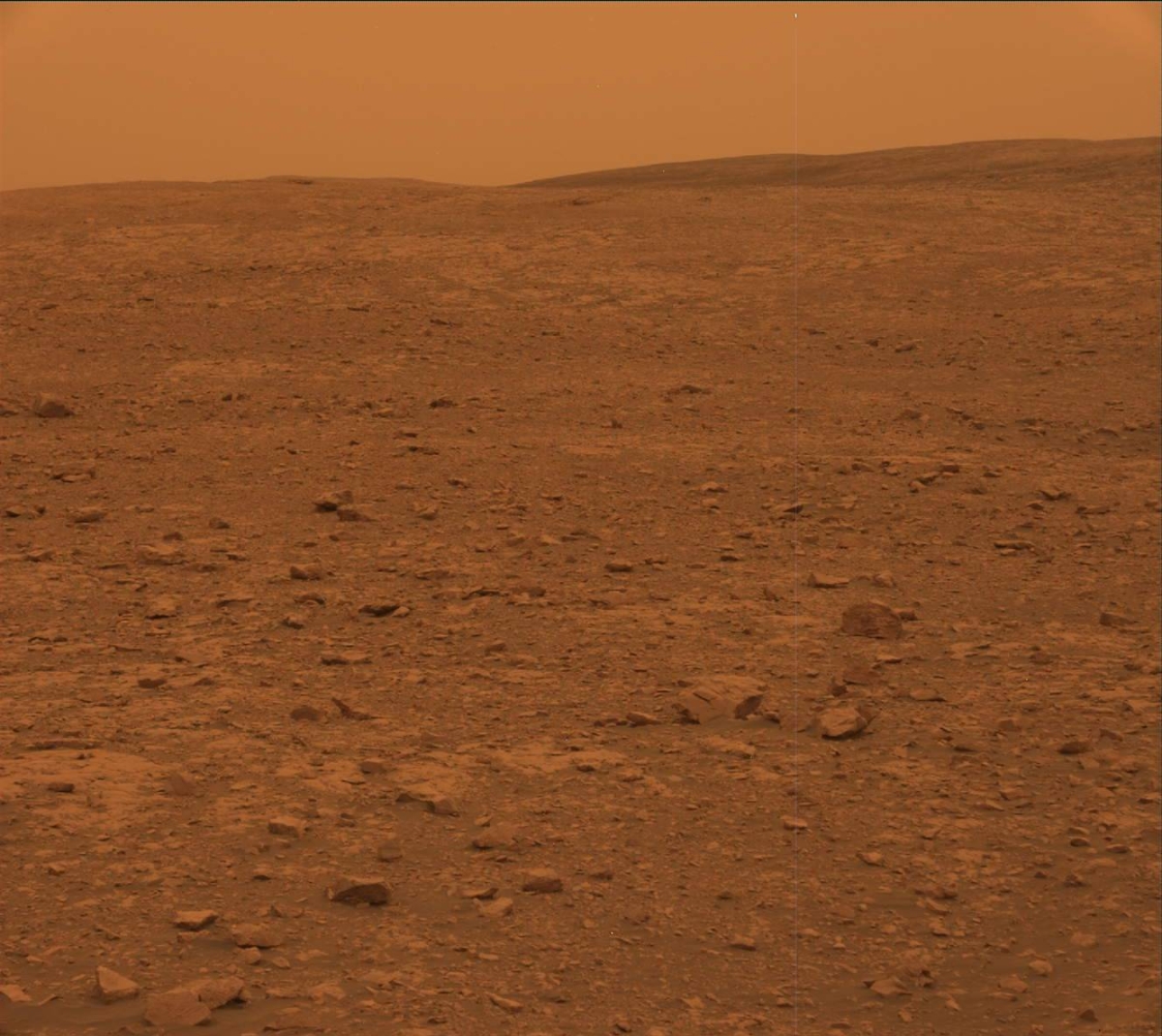
The image shows the Mastcam view as of Sol 2104, in which the nearby terrain is clearly visible, but nothing beyond the foreground and the entire scene looks a murky red-brown color due to the dust storm.
Curiosity Mastcam Left image acquired on Sol 2104, July 8, 2018.
Credit: NASA/JPL-Caltech/MSSS
NASA’s Curiosity Mars rover has just begun Sol 2107 science duties.
The robot is heading back to the “Great Red Spot,” reports Roger Wiens, a geochemist at Los Alamos National Laboratory in New Mexico.
“Unhampered by the storm, Curiosity is heading back toward a site visited on Sol 2005 for what we hope will be the next drill target,” Wiens adds.
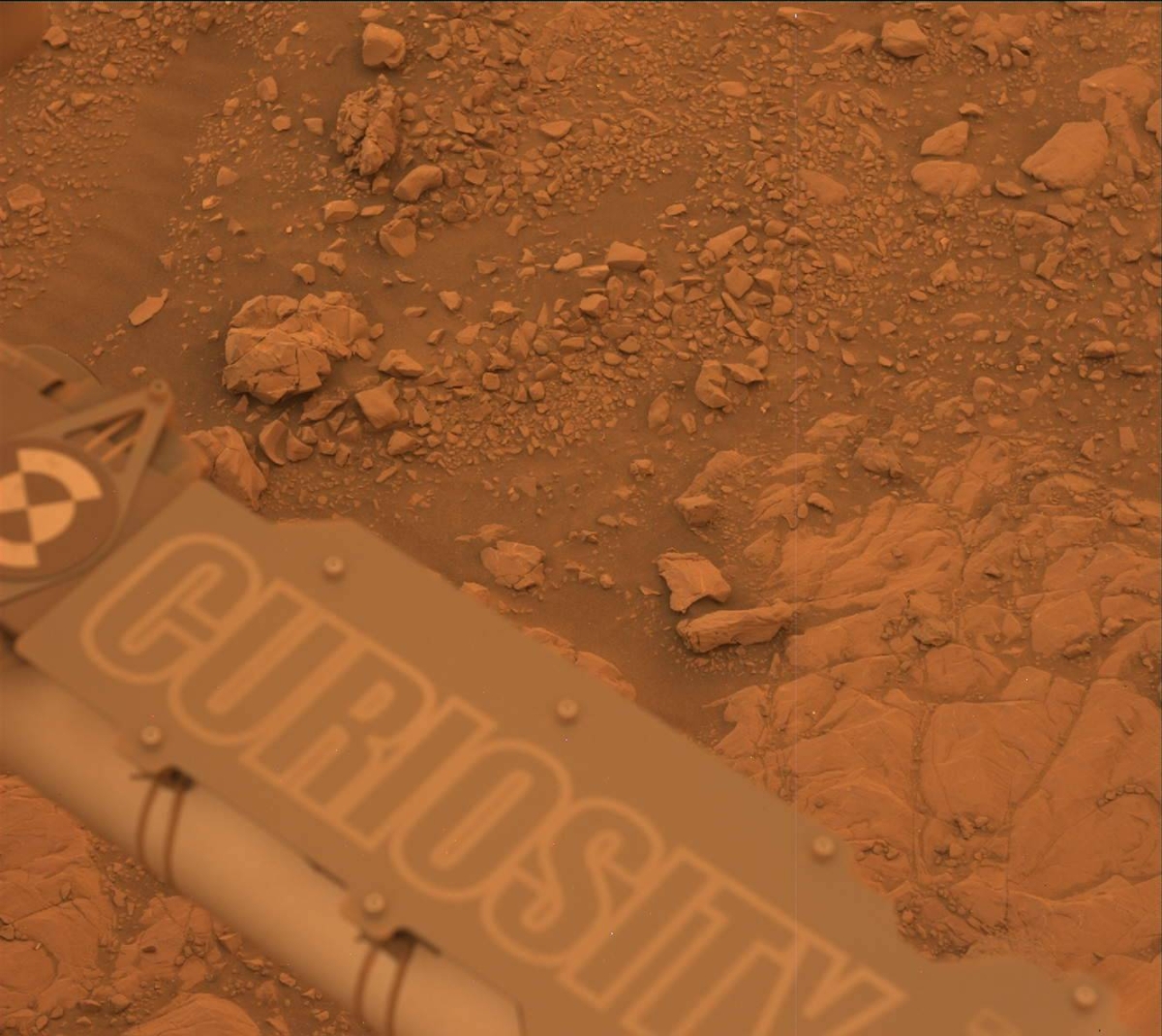
Curiosity Mastcam Left photo taken on Sol 2104, July 8, 2018.
Credit: NASA/JPL-Caltech/MSSS
Hematite-rich site
Jupiter is known for its “Great Red Spot”, which is a swirling storm thousands of kilometers in diameter.
Wiens notes that the rover drive destination could perhaps be called the “Great Red Spot on Mars” as it seems to indicate the presence of a reddish mineral, hematite, as seen from orbit and in rover spectra.
“Of course this spot is not at all as prominent from orbit as Jupiter’s Great Red Spot,” Wiens points out, “but the orbital spectra do predict this location to have one of the highest surface hematite abundances in this part of Gale crater.”
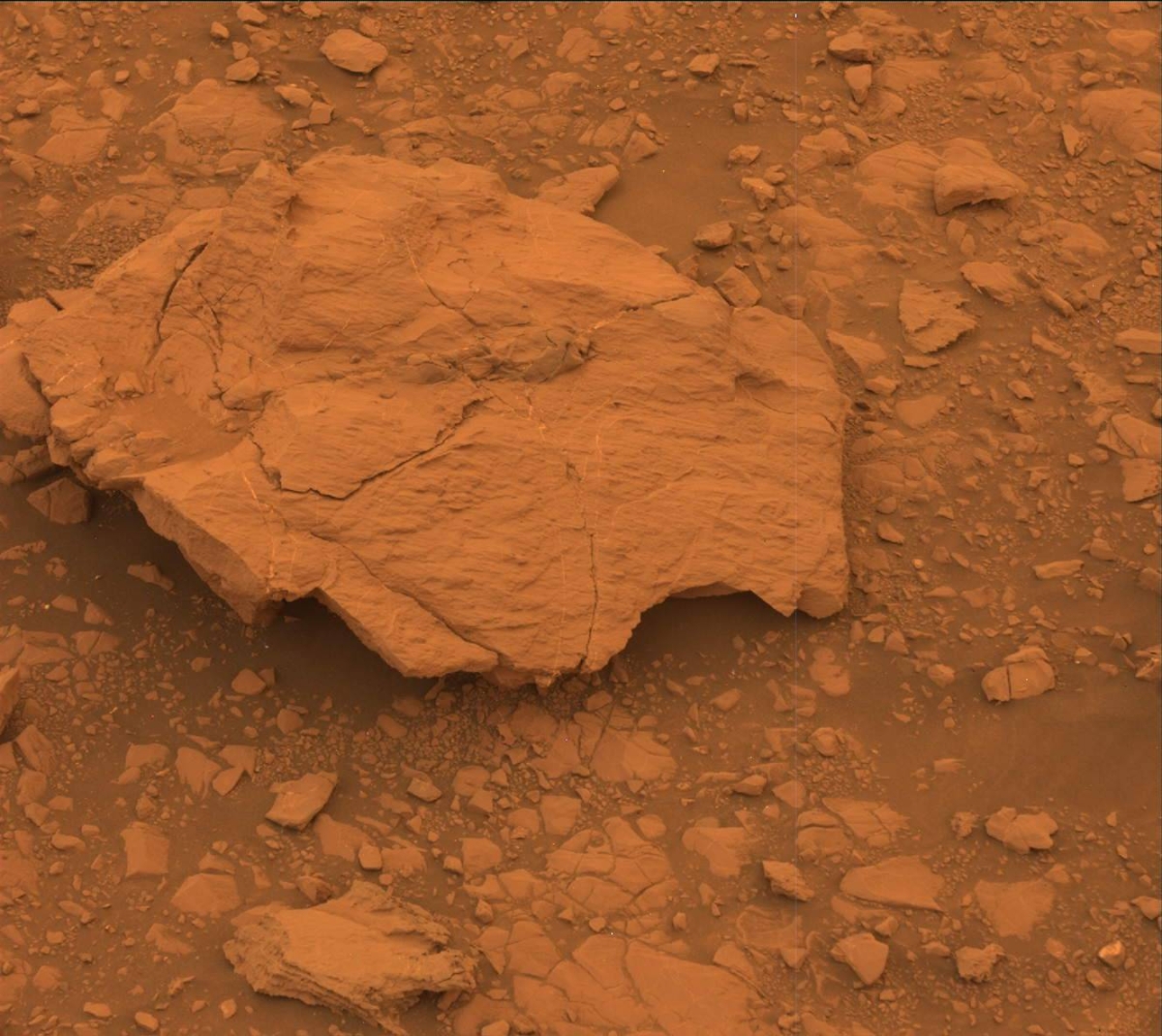
Curiosity Mastcam Left photo acquired on Sol 2104, July 8, 2018.
Credit: NASA/JPL-Caltech/MSSS
Slight anomaly
The robot’s Chemistry and Camera (ChemCam) was marked healthy over the weekend after repetition of a known event last week.
Curiosity’s Rover Environmental Monitoring Station (REMS) lost a small amount of science data over the weekend in a slight anomaly, but the instrument remains healthy, Wiens adds.
A new one-sol plan is being uplinked to the rover.
Drill targets
Activities will include a drive to cover most of the roughly 164 feet (50 meters) remaining to a planned drill target. There are three targets in the pre-drive workspace.
Curiosity’s robotic arm will deploy the Mars Hand Lens Imager (MAHLI) and the Alpha Particle X-Ray Spectrometer (APXS) to target “Chippewa.”
APXS will get two 15-minute integrations; MAHLI will image from 25 and 5 centimeter distances.
ChemCam will target “Animikie” nearby. Mastcam will document that target plus “Barnum”, a piece of bedrock in between the other two.
Mosaic
Navcam will continue checking the atmospheric opacity and Mastcam will collect a four-image mosaic of “Taconite_crater.”
The rover’s Radiation Assessment Detector (RAD), Dynamic Albedo of Neutrons (DAN) and REMS will continue taking environmental data, Wiens explains.
A “soliday” — effectively a leap day in which Earth has an extra day relative to Mars – is occurring. “Our next sol of uplink will be on Wednesday,” Wiens concludes.
Credit: NASA/JPL-Caltech/Univ. of Arizona
Rover reaches 12 miles
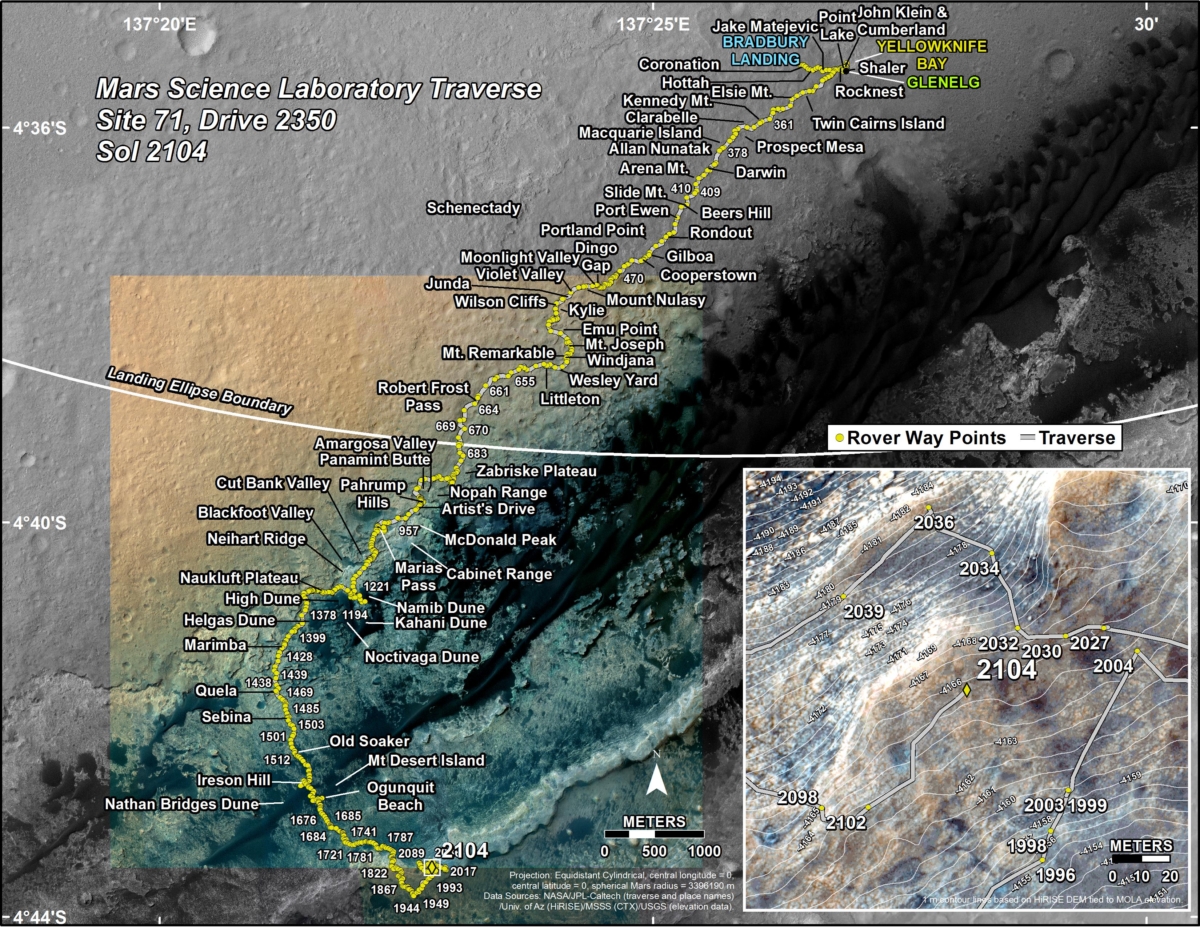
A Curiosity traverse map through Sol 2104 has been issued.
The map shows the route driven by NASA’s Mars rover Curiosity through the 2104 Martian day, or sol, of the rover’s mission on Mars (July 09, 2018).
Numbering of the dots along the line indicate the sol number of each drive. North is up. The scale bar is 1 kilometer (~0.62 mile).
From Sol 2102 to Sol 2104, Curiosity had driven a straight line distance of about 174.46 feet (53.18 meters), bringing the rover’s total odometry for the mission to 12.00 miles (19.32 kilometers).
Curiosity landed on Mars in August 2012.
The base image from the map is from the High Resolution Imaging Science Experiment Camera (HiRISE) in NASA’s Mars Reconnaissance Orbiter.

In-orbit explosions can be related to the mixing of residual fuel that remain in tanks or fuel lines once a rocket stage or satellite is discarded in Earth orbit. The resulting explosion can destroy the object and spread its mass across numerous fragments with a wide spectrum of masses and imparted speeds.
Credit: ESA
The European Space Agency (ESA) has issued an annual report on the status of the space environment.
The report focuses on the time evolution of cataloged and asserted objects in terms of number, mass, and area as well as addressing the global adherence to space debris mitigation measures.
Summary statements
A number of summary statements can be made derived from the presented data in the report, such as:
— The amount of objects, their combined mass, and there combined area has been steadily rising since the beginning of the space age, leading to the appearance of involuntary collisions between operational payloads and space debris.
— The amount of mission related objects released into the space environment is steadily declining, but still significant for rocket bodies.
— Launch traffic into the low Earth orbit protected regions is on the rise, fuelled by the proliferation of small payloads, i.e. below 10.0 kg in mass, during the last few years in terms of number, but not contributing significantly to the mass.
— Between 30 and 60% of all payload mass recently reaching end-of-life in the LEO protected region does so in orbits which adhere to the space debris mitigation measures.
— Around 70% of all rocket body mass recently reaching end-of-life does so in orbits which adhere to the space debris mitigation measures on protecting LEO. A significant amount of this is due to controlled re-entries after launch, a practice which is increasing and was above 20% in 2017.
— Around 90% of all payloads recently reaching end-of-life in the GEO protected region attempt to comply with the space debris mitigation measures. Around 80 % do so successfully.

Earth orbit is a junkyard of human-made space clutter.
Credit: Space Junk 3D, LLC. Melrae Pictures
Transparent overview
The content of the report aims to provide a transparent overview of global space activities, as well as estimate the impact of these activities on the space environment.
Furthermore, the report attempts to quantify the effect of internationally endorsed mitigation measures aimed at sustainability of the environment.
To read the entire document — ESA’s Annual Space Environment Report – go to:
https://www.sdo.esoc.esa.int/environment_report/Space_Environment_Report_latest.pdf

Credit: China Manned Space Agency
China’s state-run Xinhua news agency reports that the country is accelerating its timetable for a space station.
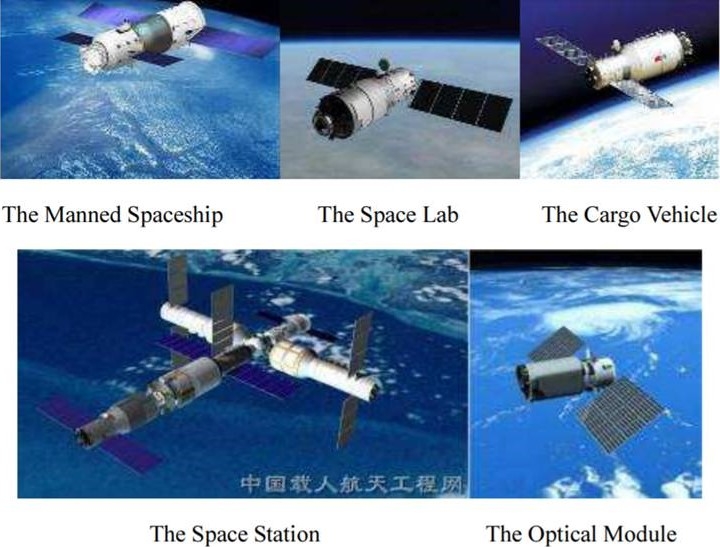
Citing Yang Liwei, director of the China Manned Space Engineering Office and the country’s first astronaut, the station’s core section is expected to be launched in 2020. Two experiment modules of the space station will be sent into space in 2021 and 2022. Three or four manned missions and several cargo spacecraft are planned in 2021 and 2022.
Credit: CMSA
After construction of the main parts of the space station, a capsule holding a large optical telescope will be sent into the same orbit to fly with the station, Yang said.
Flight rate
During construction of the station, the number of manned space missions will rise to about five a year, according to the July 8 Xinhua news story.
That flight rate beats the once every two or three years when China began sending astronauts into space more than a decade ago.
The quickening pace also means astronaut recruitment will be expanded, as reported by Xinhua.

Credit: CMSE
Handbook available
A version 1.0 handbook on the China Space Station (CSS) and its resources for international cooperation was issued May 28 by the UN Office for Outer Space Affairs and China Manned Space Agency.
For more details, go to this earlier Inside Outer Space story:
https://www.leonarddavid.com/china-space-station-handbook-details-operations/
To read the handbook, go to:
http://www.unoosa.org/documents/doc/psa/hsti/CSS_1stAO/CSS_1stAO_Handbook_2018.pdf

